如何選擇合適的 STM32 微控制器:比較各系列、Cortex-M 核心與關鍵功能
9 分鐘
- STM32 Family 比較:如何選擇適合應用的系列?
- 選擇 STM32 Microcontroller 的 6 個關鍵標準
- Cortex-M0 vs. M3 vs. M4 vs. M7 vs. M33:應該選哪一個 Core?
- STM32 Part Number 如何解讀?
- STM32 選型範例:Battery-Powered IoT Sensor
- 如何 Prototype 並驗證 STM32 選型?
- 常見 STM32 選型錯誤
- STM32 Microcontroller 常見問題
- 結論
STMicroelectronics(意法半導體)旗下擁有超過十個系列、數千種 STM32 MCU 型號,而如此龐大的產品陣容,也正是 STM32 Microcontroller Selection(STM32 微控制器選型)最困難的地方。
如果選錯 MCU Family,往往要在專案後期付出代價,例如:
- BOM Cost 過高
- Power Budget 被浪費
- Flash/RAM 不足
- 缺少必要 Peripheral
- 甚至必須重新設計 PCB
本 STM32 Microcontroller Selection Guide 將選型流程拆解為 6 個實用工程標準,不只看 Datasheet 上的行銷規格,而是從 Performance、Power、Memory、Peripheral、Package 與 Development Ecosystem 出發,協助您選出符合 Embedded System Requirement 的 ARM Cortex-M Microcontroller。
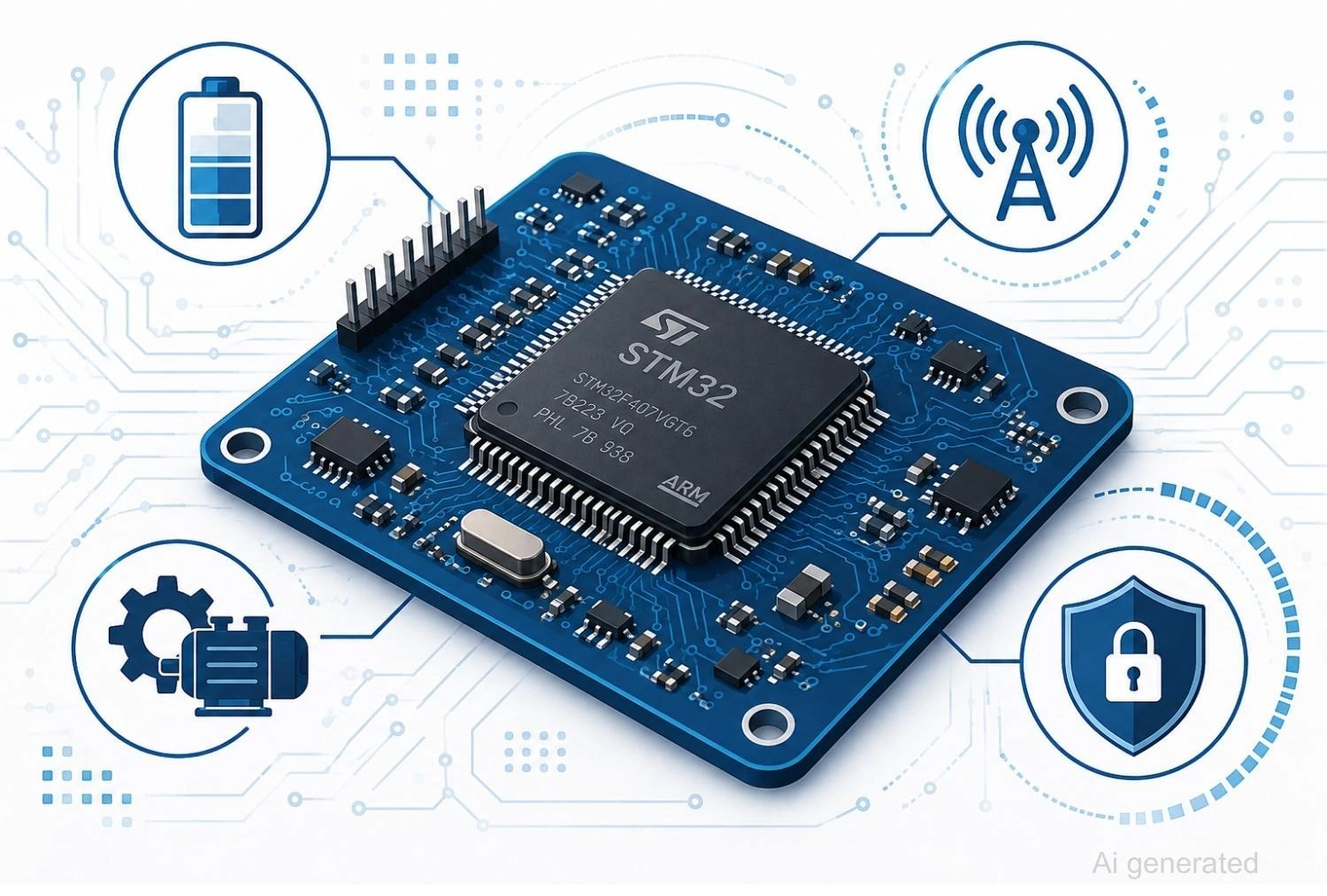
圖:PCB 上的 STM32 Microcontroller,以及 Power、Wireless、Motor Control 與 Security 等應用示意。
STM32 Family 比較:如何選擇適合應用的系列?
每一個 STM32 Series 都針對特定的 Performance、Power Consumption 與 Cost 組合進行定位。
因此,選型時先確認適合的 Series,可以先把數千個 Part Number 縮小到少數幾個範圍,再進一步閱讀 Datasheet。
STM32F4 至今仍是非常廣泛使用的 STM32 Family 之一,也是許多工程師熟悉的 General-Purpose 選擇。
不過對新的 Design,仍應依實際 Application Requirement 評估較新的 G、H、U、C 或 Wireless Family,因為不同世代會在 Power Efficiency、Integration、Performance 或 Security 等方面提供不同優勢。
| Series | Core | 最高 Clock | Flash | RAM | 適合應用 | 典型 Development Board |
|---|---|---|---|---|---|---|
| STM32F4 | Cortex-M4F | 180 MHz | 最高 2 MB | 最高 384 KB | General-Purpose、Audio、Mixed-Signal | NUCLEO-F446RE |
| STM32L4 | Cortex-M4F | 80 MHz | 最高 1 MB | 最高 320 KB | Battery-Powered Device、Wearable | NUCLEO-L476RG |
| STM32G0 / G4 | Cortex-M0+ / M4F | 64 MHz / 170 MHz | 最高 512 KB | 最高 128 KB | Cost-Sensitive Mainstream、Motor Control | NUCLEO-G071RB / NUCLEO-G474RE |
| STM32C0 | Cortex-M0+ | 48 MHz | 最高 32 KB | 最高 6 KB | 8-bit MCU Replacement、Ultra-Low Cost | NUCLEO-C031C6 |
| STM32H7 | Cortex-M7F(部分型號 + M4) | 600 MHz | 最高 2 MB | 最高 1 MB | High-Performance、Graphics、DSP | NUCLEO-H743ZI |
| STM32U5 | Cortex-M33 | 160 MHz | 最高 4 MB | 最高 2.5 MB | Secure、Low-Power Connected Device | NUCLEO-U575ZI-Q |
| STM32WB | Cortex-M4 + M0+ | 64 MHz / 32 MHz | 最高 1 MB | 最高 256 KB | Bluetooth LE、Zigbee、Thread | NUCLEO-WB55RG |
| STM32WL | Cortex-M4 + M0+ | 48 MHz | 最高 256 KB | 最高 64 KB | LoRaWAN、Long-Range IoT | NUCLEO-WL55JC1 |
F Series:General-Purpose 主力系列
STM32F4 搭配 Cortex-M4F Core,提供 Hardware Floating-Point Unit(FPU)與 DSP Instruction,適合:
- Sensor Fusion
- Audio Processing
- Mixed-Signal Application
- 一般 Embedded Control
STM32F4 擁有相當大的使用者基礎與 Community,因此 Reference Code、Library 與 Troubleshooting Resource 都非常豐富。
對新的 Design,也可以同時比較 STM32G4 等較新的 Family,確認 Peripheral、Cost、Power 與 Performance 哪一個更符合實際需求。
L Series:Battery Device 的 Ultra-Low-Power 選擇
STM32L4 專為 Battery-Operated Product 設計,提供多種 Low-Power Mode,Standby Current 可達 µA 等級,同時保留 Cortex-M4F 的基本 Signal Processing 能力。
因此 STM32L4 常見於:
- Wearable Device
- Metering
- Portable Sensor
- Always-On Sensor Node
G Series:兼顧成本與 Mainstream Performance
STM32G0 採用 Cortex-M0+,STM32G4 則採用 Cortex-M4F。
這兩個系列適合 BOM Cost 敏感,但仍需要完整 32-bit MCU Performance 與豐富 Peripheral 的 Mainstream Application。
部分 G Series Device 也提供 CAN FD 等功能。
對許多新的 General-Purpose Design,STM32G0 與 STM32G4 都可以作為較舊 F Series 的候選替代方案;但並不是所有 F Series Application 都能直接遷移至 G Series,因此仍需逐一確認 Peripheral、Pinout 與 Software Requirement。
C Series:取代 8-bit MCU 的 Entry-Level 32-bit 選擇
STM32C0 是 STM32 Family 中定位非常入門、Cost-Oriented 的系列,目標之一就是取代部分傳統 8-bit 與 16-bit MCU。
它以較少 Flash 與 RAM 換取較低 Unit Cost,因此更適合:
- Simple Control
- GPIO Logic
- 簡單 Sensor Application
- 不需要大量 Memory 的 Embedded Product
H Series:High-Performance Computing
STM32H7 採用 Cortex-M7F Core,部分 Device 最高 Clock 可達 600 MHz。
STM32H7 中有些型號採用 Dual-Core Cortex-M7 + Cortex-M4,也有 Single-Core Variant,因此選型前必須確認具體 Device。
適合應用包括:
- Graphics
- High-Speed Data Acquisition
- Advanced DSP
- Compute-Heavy Real-Time Task
U Series:Security + Low Power
STM32U5 採用 Cortex-M33,結合 Low-Power Architecture 與 TrustZone Hardware Security。
適合需要 Battery Operation,同時又需要符合現代 Cybersecurity Requirement 的 Connected Device。
對需要將 Secure Code 與 Non-Secure Code 隔離的 IoT Product,STM32U5 是值得評估的選項之一。
W Series:BLE、Zigbee、Thread 與 LoRa Wireless Connectivity
STM32WB 將 Bluetooth Low Energy、Zigbee 與 Thread 等 Wireless Capability 與 Cortex-M4 Application Core 整合。
實際 Bluetooth Version 與 Protocol Stack 會依具體 Device 而不同,因此不能用單一規格代表整個 STM32WB Family。
STM32WL 則加入 Long-Range LoRa/LoRaWAN Connectivity。
STM32WBA 是較新的 Wireless Family,主要面向較新的 Bluetooth Capability 與更嚴格的 Low-Power Requirement。
仍然常見的 Legacy Series:F0、F1、F3、F7
現有產品與大量既有設計中,仍然很常看到:
- STM32F0:Cortex-M0,Entry-Level
- STM32F1:Cortex-M3,著名的 Blue Pill 開發板常用系列
- STM32F3:Cortex-M4F,提供較強 Analog Peripheral
- STM32F7:Cortex-M7F,可視為 H7 之前的重要 High-Performance Family
這些系列仍可用於既有 Product Line 的維護,而新設計則可依需求進一步比較 G、H 或 U Series。
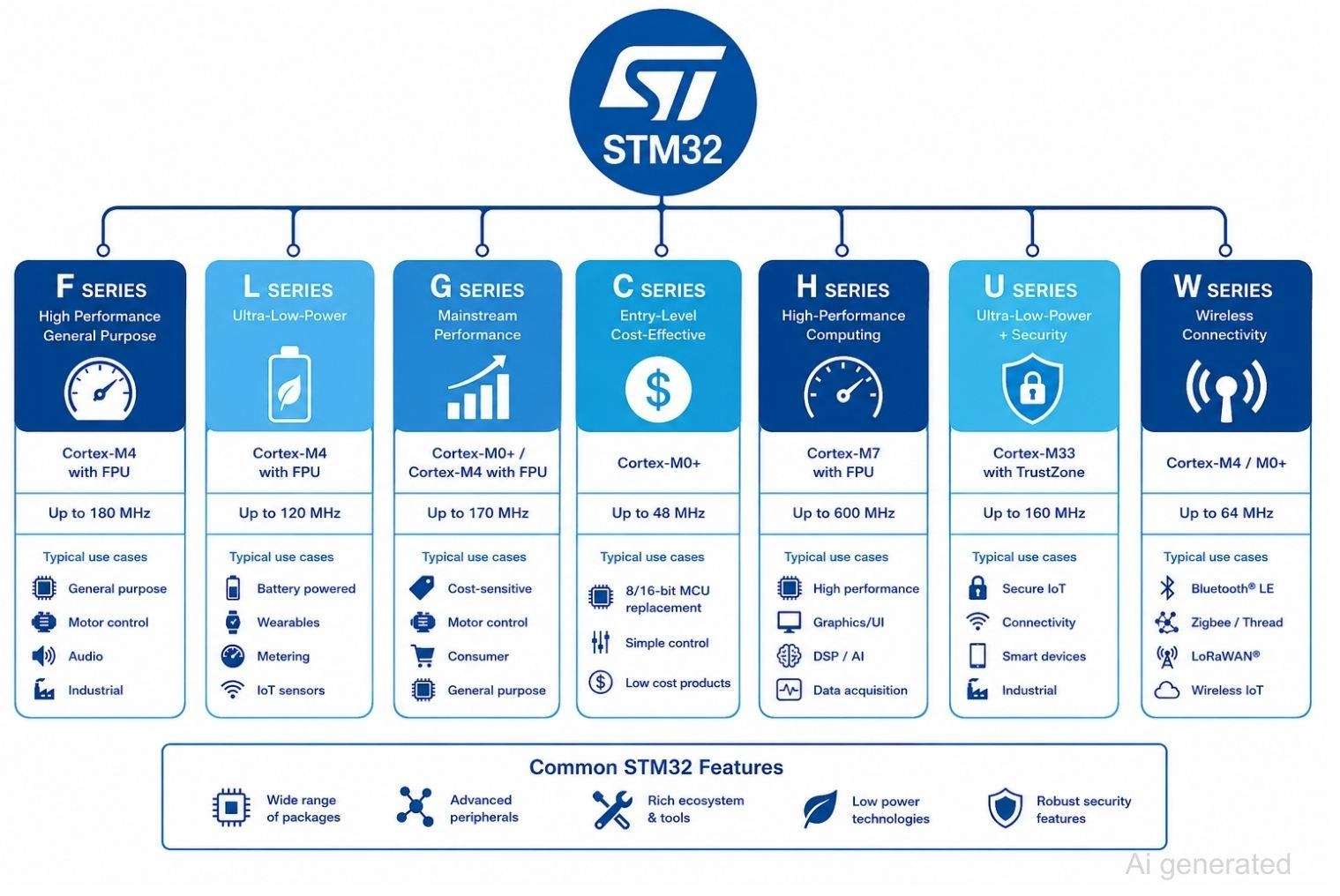
圖:依 Series 與 Cortex-M Core 類型整理的 STM32 Microcontroller Family。
工程師提示
如果兩個 STM32 Series 在 Specification 上看起來差不多,除了價格之外,也應比較 Development Ecosystem。
擁有更多 Reference Design、Example Code 與 Community Discussion 的 Device,往往可以節省更多 Engineering Time。
選擇 STM32 Microcontroller 的 6 個關鍵標準
可以按照以下順序進行 STM32 Selection。
先排除明顯不符合需求的 MCU Family,通常比逐一比較數百個 Part Number 更有效率。
1. Performance Requirement:Clock、Core、FPU 與 DSP
首先確認實際 Workload:
- Simple GPIO Control
- Sensor Data Acquisition
- Motor Control
- Audio/Signal Processing
- TinyML Inference
- Polling/Simple Control Logic
Simple Control 與 Sensor Polling 所需運算能力可能很低。
Motor Control 與 Audio Processing 則可以受益於 Cortex-M4 的 FPU 與 DSP Instruction。
如果需要大量 Real-Time Computation,則可以評估 Cortex-M7。
2. Power Consumption:Active、Sleep、Standby 與 Wake-Up
不要只看單一 Standby Current,至少需要一起確認:
- 實際 Operating Frequency 下的 Active Current
- 保留所需 Peripheral 時的 Sleep Current
- Standby Current
- Wake-Up Latency
L Series 與 U Series 部分 Device 的 Standby Current 可以進入 Single-Digit µA 等級。
對 Battery-Powered Product 而言,真正的 Battery Life 取決於 Active Time、Sleep Time、Wake-Up Frequency 與各種 Power State 的綜合結果,而不是只看最低 Standby Current。
3. Memory:Flash 與 RAM 如何估算?
Flash Requirement 需要考慮:
- 目前 Firmware Image Size
- 未來 Feature Growth
- Bootloader
- OTA Update
- Middleware/Protocol Stack
如果需要 Over-The-Air(OTA)Update,通常還需要為 Active Firmware 與 Staging Image 預留額外 Flash。
RAM Requirement 則常受到以下因素影響:
- Communication Buffer
- Sensor Data Buffer
- FreeRTOS/Zephyr 等 RTOS
- Graphics/Display Frame Buffer
- Machine Learning Model
一個實用的初步估算方式:Flash 可以先預留目前 Firmware Size 的約 1.5–2 倍;如果未來確定需要 OTA、Graphics 或更大型 Middleware,則應進一步增加 Headroom。
工程師提示
Flash 不足通常很早就會被發現,但 RAM Shortage 經常是在專案後期加入 Middleware、RTOS Task 或 Communication Buffer 後才出現。
因此,RAM Headroom 往往比想像中更加重要。
4. Peripheral:UART、SPI、I²C、ADC、CAN、USB、Timer
搜尋 Part Number 前,先完整列出需要的 Interface:
- Serial Bus:UART、SPI、I²C
- Analog:ADC/DAC Channel Count 與 Resolution
- Timer/PWM:Motor、LED 或 Lighting Control
- USB:Host 或 Device
- CAN/CAN FD:Automotive 與 Industrial Communication
專案中途才發現 MCU 缺少必要 Peripheral,是造成 MCU Swap 與 PCB Redesign 的常見原因之一。
5. Package Type 與 Pin Count:LQFP、QFN、BGA
Package Selection 會同時影響 PCB Size、Routing、Assembly 與 Rework。
較小的 QFN 可以節省 Board Space,但 Manual Assembly 與 Rework 會更加困難。
LQFP 則具有外露 Lead,更容易進行 Soldering、Probe 與 Debug。
如果需要进一步了解 QFP/LQFP,可以參考 Quad Flat Package Guide。
選定 Package 前,也要確認 PCB Assembly Partner 是否具有:
- 所需 Placement Accuracy
- Reflow Process Capability
- AOI/X-Ray Inspection
- 對應 Fine-Pitch/BGA Assembly Capability
-
為了支援 High-Density Package,JLCPCB 提供相應的 SMT Assembly Capability。原文列出的能力包括最低 IC Pin Spacing 約 0.35 mm、BGA Center-to-Center Spacing 約 0.35 mm,並搭配 3D AOI 與 X-Ray Inspection。實際能力應以下單時最新規格為準。
-
確定 Footprint 後,也可以透過 JLCPCB Parts Library 查詢可用 STM32 MCU 與其他元件,再上傳製造資料取得報價。
6. Development Ecosystem 與 Software Support
STM32 Development Ecosystem 的核心工具主要包括:
- STM32CubeMX
- STM32CubeIDE
主要功能包括:
- 依 Peripheral 與 Pin Requirement 篩選 MCU
- Pin Conflict Checker
- Clock Tree Configuration
- 自動 Frequency Validation
- HAL(Hardware Abstraction Layer)Driver
- LL(Low-Layer)Driver
- FreeRTOS Integration
這些 Tool 可以降低 MCU Selection 與 Firmware Development 的時間與風險。
再加上龐大的 STM32 Community 與大量 Nucleo Development Board,使工程師能在 PCB Design 之前先完成 Hardware/Firmware Validation。
| 選型因素 | 關鍵問題 | 可優先評估 |
|---|---|---|
| Performance | 需要 DSP/FPU,還是只有基本 Control? | M0+/M3 用於一般 Control;M4/M7 適合較多 DSP Workload |
| Power | 是否為 Battery-Powered? | L、U、WB、WL Series |
| Memory | 是否需要 OTA 或大型 Buffer? | 需要較多 Headroom 時可評估 H、U Series |
| Peripheral | 是否需要 CAN FD、USB 或 Wireless? | G4(部分型號 CAN FD)、WB/WL(Wireless) |
| Package | Board Space 是否非常有限? | 各系列的 QFN/BGA Variant |
Cortex-M0 vs. M3 vs. M4 vs. M7 vs. M33:應該選哪一個 Core?
Cortex-M Core 會直接影響 MCU 的運算能力,部分新 Core 也進一步加入 Security Feature。
什麼時候 Cortex-M0/M0+ 就夠用?
Cortex-M0+ 適合:
- Basic Control Loop
- Simple Sensor Polling
- GPIO-Heavy Logic
- Cost/Power 非常敏感的 Embedded Product
什麼時候需要 Cortex-M4?FPU + DSP
Cortex-M4F 增加 Hardware Floating-Point Unit 與 DSP Instruction,因此適合:
- Motor Control
- Digital Filtering
- Sensor Fusion
- Audio Processing
不需要 Cortex-M7 Performance 時,M4F 可以提供相當實用的 Performance/Cost Balance。
什麼時候需要 Cortex-M7?
Cortex-M7F 提供更高的 Per-Cycle Performance,適合:
- Graphics
- High-Speed Data Acquisition
- Advanced DSP
- TinyML/Edge AI
- Compute-Heavy Real-Time Application
Cortex-M33 + TrustZone:Security-Critical Design
Cortex-M33 加入 TrustZone Hardware Isolation。
在 STM32L5、STM32U5 與 STM32H5 等 Family 中,可以利用 TrustZone 在 Silicon Level 分離 Secure 與 Non-Secure Code Execution。
| Core | 約 DMIPS/MHz | FPU | DSP | TrustZone | 範例 |
|---|---|---|---|---|---|
| Cortex-M0+ | 0.95 | No | No | No | STM32G0 |
| Cortex-M3 | 1.25 | No | No | No | STM32F103 |
| Cortex-M4F | 1.25 | Yes | Yes | No | STM32F407 |
| Cortex-M7F | 2.14 | Yes | Yes | No | STM32H743 |
| Cortex-M33 | 1.5 | Yes | Yes | Yes | STM32U575 |
| 如果應用是…… | 可以優先評估…… |
|---|---|
| Simple Sensor Node | Cortex-M0+ |
| Motor Control | Cortex-M4F |
| Audio/DSP Processing | Cortex-M4F |
| TinyML/Edge AI | Cortex-M7F |
| Secure IoT Device | Cortex-M33 |
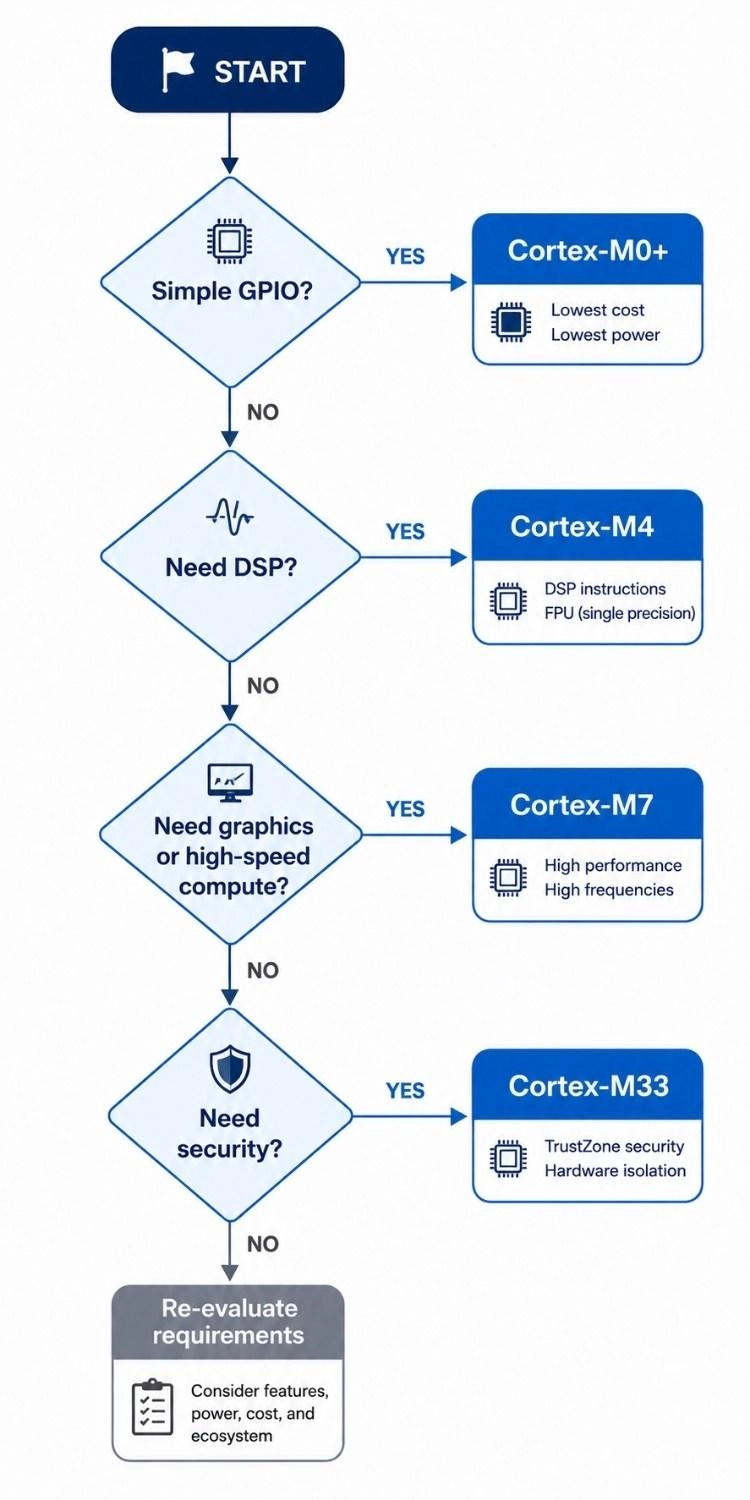
圖:根據 GPIO、DSP、Graphics 與 Security Requirement 選擇 Cortex-M Core 的流程圖。
STM32 Part Number 如何解讀?
以 STM32F407VGT6 為例:
- STM32:Product Family
- F4:Series/Performance Line,Cortex-M4F
- 07:F4 Family 中的 Specific Sub-Line
- V:Pin Count,100 Pins
- G:Flash Size,1024 KB
- T:Package Type,LQFP
- 6:Temperature Range,−40°C 至 85°C
理解 Part Number Structure 後,就能更快比較不同 Variant,並透過 JLCPCB Parts Library 搜尋對應元件。
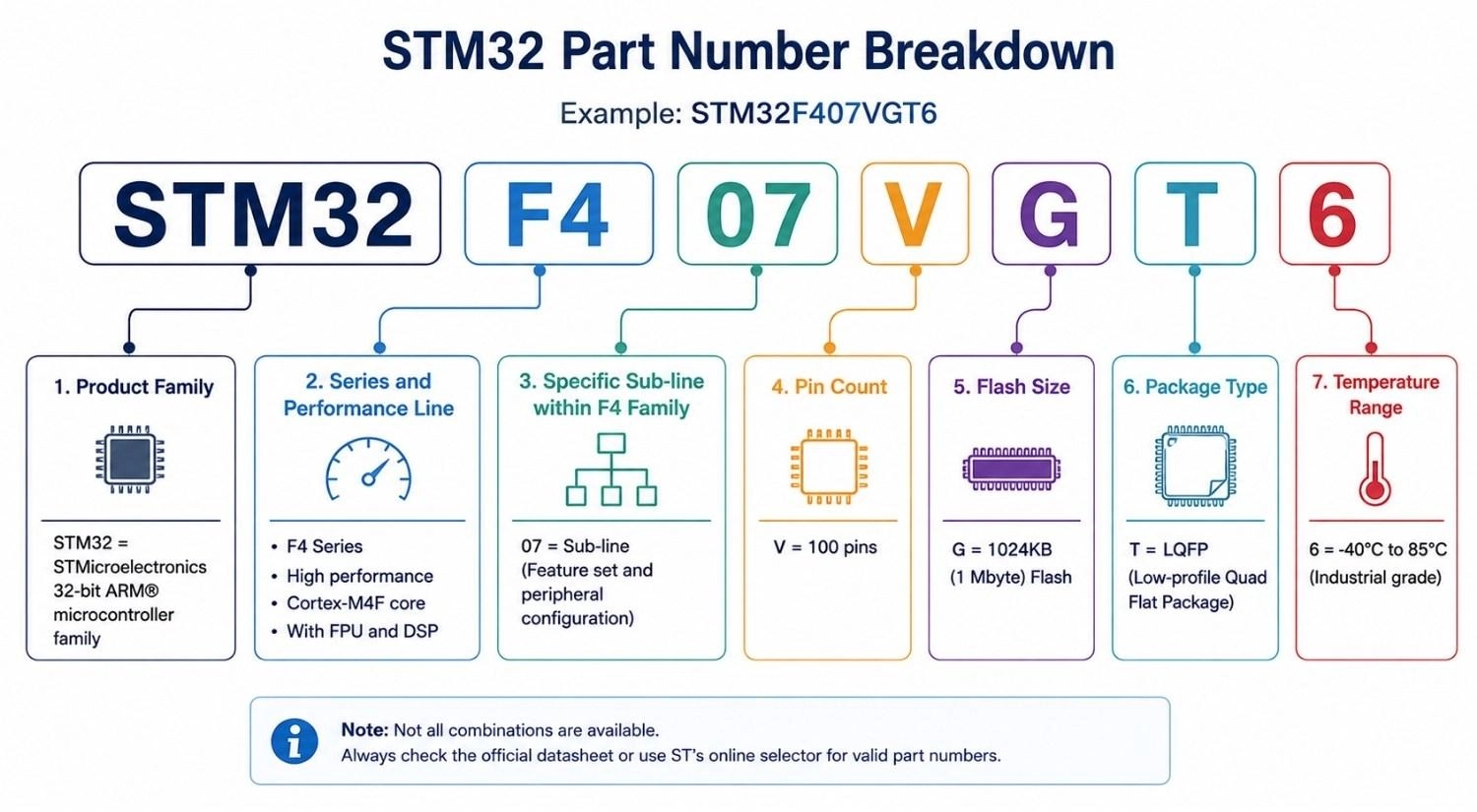
圖:STM32 Part Number 中的 Family、Sub-Line、Pin Count、Flash Size、Package Code 與 Temperature Grade。
常見 Package Code
Package Letter 很容易與 Flash Size 或 Temperature Code 混淆,因為它們都位於同一串 Part Number 中。
原文列出的常見例子包括:
- T:LQFP
- H:BGA
- U:VFQFPN/QFN
- Y:WLCSP
但這些 Package Code 並不保證在每一個 STM32 Series 都使用完全相同的對應方式,因此最終仍應查看具體 Device Datasheet。
STM32 選型範例:Battery-Powered IoT Sensor
Project Requirement
- Coin Cell 至少 1 年 Battery Life
- Bluetooth Low Energy Connectivity
- 非常有限的 Power Budget
- 較小 Firmware Footprint
- Protocol Stack 需要適量 Flash
- 沒有 DSP Workload
排除不適合的 STM32 Family
按照原文的此案例設定,Power Budget 會先排除較高 Performance 的 F 與 H Series。
由於需要 Integrated Wireless Connectivity,因此可以優先考慮 W Series,而不是使用 L/G Series 再增加 External BLE Module。
比較候選 STM32 MCU
為什麼不是 STM32L4?
STM32L4 具有良好的 Standby Current,但沒有 Integrated Radio,因此需要額外 BLE Module,增加:
- Board Area
- 額外元件
- Power Supply Requirement
- Firmware Integration Complexity
為什麼不是 STM32G0?
STM32G0 成本低且功耗較低,但沒有 Integrated Wireless,在這個需要 BLE 的 Application 中,不如專門整合 Radio 的 Device 直接。
為什麼不使用 ESP32?
ESP32 整合 Wi-Fi 與 Bluetooth,是非常熱門的 Wireless MCU。
不過在原文設定的 Coin-Cell、BLE-Only Application 中,作者認為 STM32WB 的 Power Profile 更適合一整年 Battery-Life Target。
如果想进一步了解 Platform Ecosystem,也可以參考 ESP32 vs. Arduino 比較。
STM32WB55 使用 Cortex-M4 Application Core 搭配 Cortex-M0+ Radio Core,讓 Bluetooth Stack 可以與 Application Logic 分工。
建議 STM32 MCU:STM32WB55
依此案例,STM32WB55 是更合適的選擇:具備 Integrated Radio、足夠的 Flash/RAM 支援 Protocol Stack 與 Application Code,而且能在不增加 External Wireless Hardware 的前提下满足 Battery-Powered Requirement。
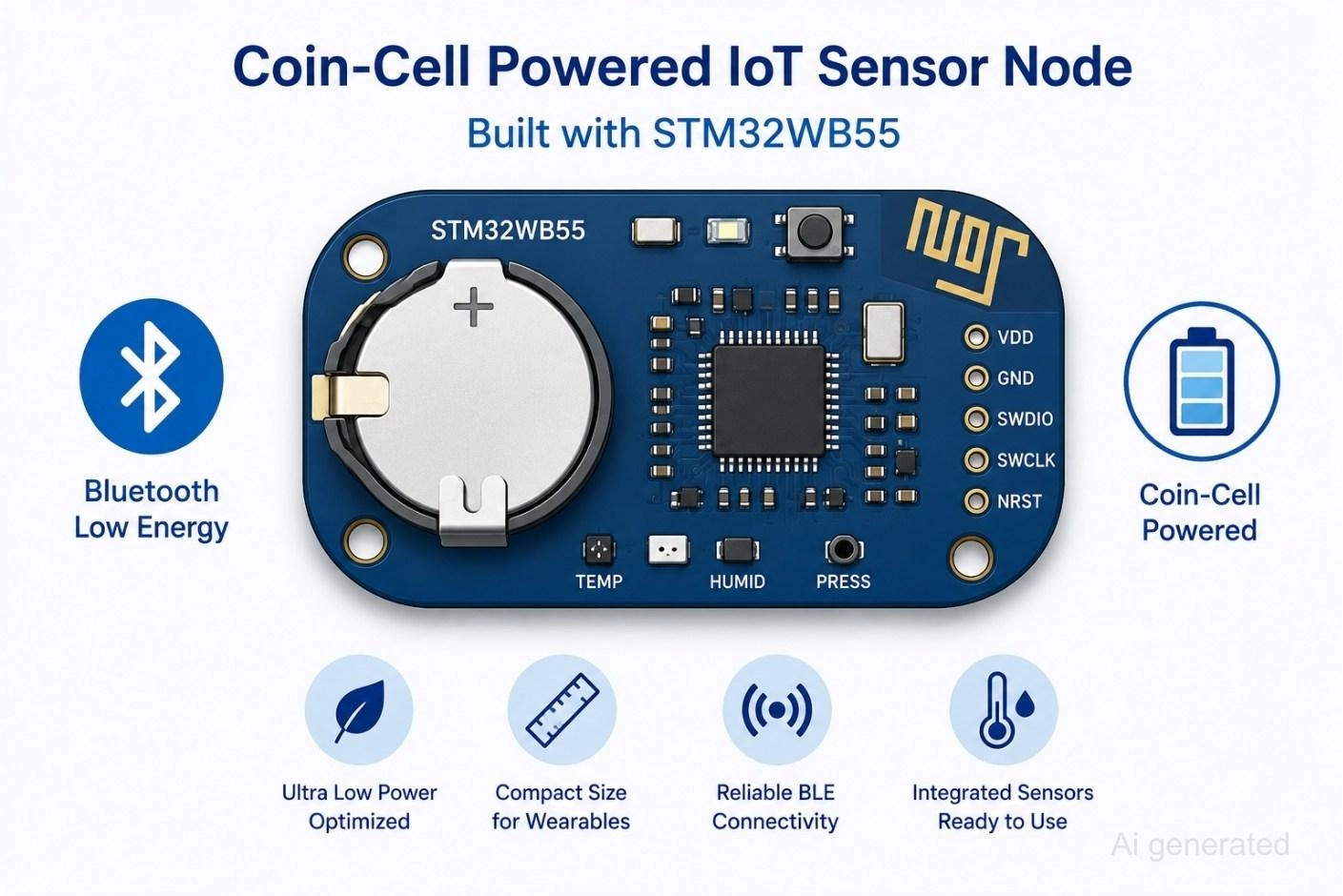
圖:以 STM32WB55 為核心、搭配 Bluetooth 與 Coin Cell 的 IoT Sensor Board。
如何 Prototype 並驗證 STM32 選型?
STM32 Nucleo vs. Discovery vs. Evaluation Board
STM32 Nucleo Board 通常成本較低,是大多數 Project 的良好起點。
STM32 Discovery Board 會加入更多 On-Board Sensor、Display 或特定 Peripheral,方便評估特定功能。
Evaluation Board(Eval Board)則提供更加完整的 Hardware Feature,適合更深入的 Design Verification。
使用 STM32CubeMX
CubeMX 可以協助完成四項常見工作:
- 透過 MCU Selector 按 Peripheral、Package 與 Power Requirement 篩選 Device
- Pin Conflict Checker,在 PCB Layout 前發現 Alternate-Function Conflict
- Clock Tree Configuration 與 Frequency Validation
- 產生 HAL/LL Initialization Code
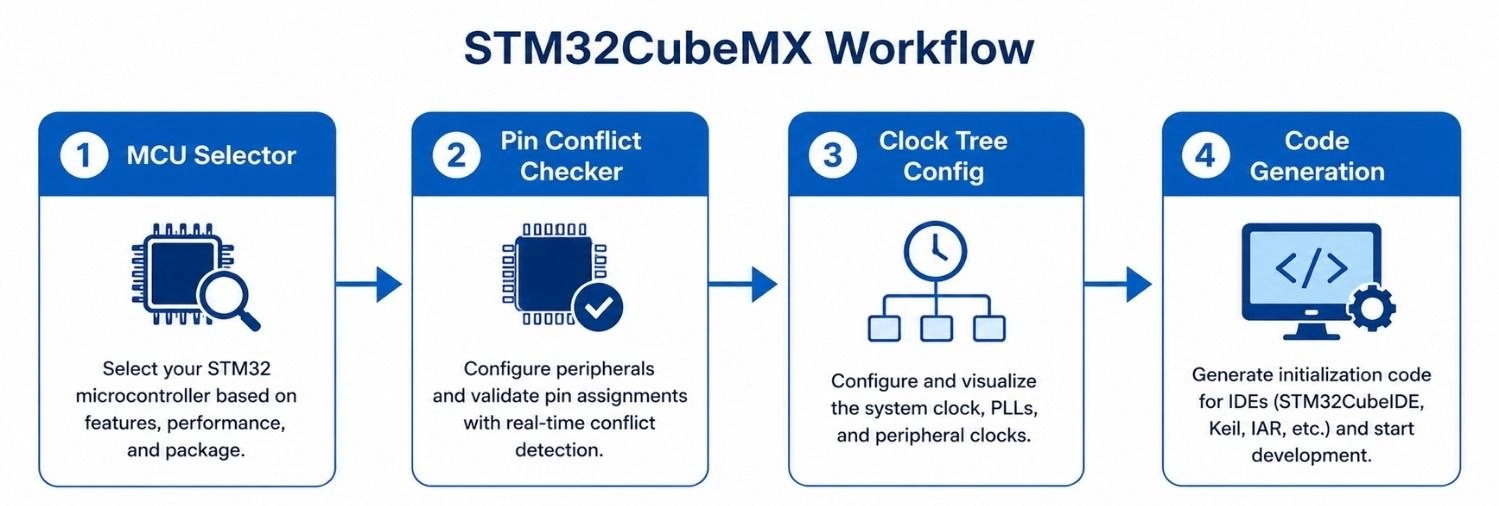
圖:STM32CubeMX 從 MCU Selector、Pin Conflict Checker、Clock Tree Configuration 到 Code Generation 的 Workflow。
預留 STM32 Pin-Compatible Upgrade 路徑
如果產品未來可能需要升級,可以在選型階段優先評估具有 Pin-Compatible Variant 的 Device。
例如使用標準 LQFP64 Package,可以在符合實際 Pinout Compatibility 的前提下,保留從較低階 MCU 升級至更高 Performance Device 的可能性,降低重新設計 PCB 的需求。
最終選型前再次閱讀 STM32 Datasheet
鎖定 Part Number 之前,應確認 Datasheet 中容易被 Marketing Summary 忽略的細節:
- 具體 Device Variant 的 Flash/RAM
- ADC Accuracy
- ADC Channel Count
- Operating Voltage Range
- Temperature Grade
- 每個 Peripheral 的實際 Pin Mapping
真正保證特定 Device Specification 的來源,是該 Part Number 的 Datasheet 與 Reference Manual,而不是整個 Family 的概括介紹。
STM32 PCB Design 進入製造前的檢查
取得 PCB 報價並正式下單之前,建議確認:
- Pin Multiplexing 能涵蓋所有已分配 Peripheral
- Clock Source 符合 Timing Accuracy Requirement
- 所有外部 Component 的 Voltage Domain 相容
- 依需要配置適當 Decoupling/Bypass Network,可參考 Bypass Capacitor PCB Layout Guide
- Package Footprint 符合 PCB Fabrication/Assembly Capability
- Memory Headroom 能支援 Future Firmware Roadmap
工程師提示
最後確認 Part Number 前,務必把 Operating Voltage 與 Temperature Grade 與實際 Power Rail、Enclosure 與 Operating Environment 交叉核對。
這兩個 Datasheet 欄位非常容易被忽略,但如果在 PCB 製作完成後才發現選錯,修改成本會非常高。
常見 STM32 選型錯誤
- 為了「以防萬一」直接使用 STM32H7,但實際上 G 或 L Series 已能滿足 Workload,造成 Cost 與 Power Waste。
- 只依目前 Firmware 大小估算 RAM,沒有預留 RTOS、Buffer 與 Future Feature Growth。
- Pinout 確認前沒有檢查 Alternate-Function Conflict。
- 選擇 Contract Manufacturer 無法穩定 Placement/Reflow 的 Package。
- 假設同一 Part 的每個 Package Variant 都提供完全相同 Peripheral Pin;部分小 Package 可能沒有引出所有功能。
- 忽略 STM32 Product Longevity/Supply Planning,增加量產期間被迫 Redesign 的風險。
STM32 Microcontroller 常見問題
問:初學者最容易上手的 STM32 Development Board 是哪一種?
STM32F1 與 STM32F4 Series 擁有龐大的 Community、相當多 Open-Source Library 與 Example Project,因此很適合初學者。
搭配 STM32 Nucleo Hardware,可以快速進行 Prototype 與 Firmware Learning。
問:哪一個 STM32 Family 適合 Low-Power IoT Device?
原文推薦 STM32L4 與 STM32U5 作為 Low-Power 選項。它們提供多種 Sleep Mode、低 Standby Current 與不同 Power Domain,可用於提高 Battery-Powered Device 的使用時間。
如果同時需要 Integrated Wireless,也可以依 Protocol Requirement 評估 STM32WB、WL 或其他 Wireless Family。
問:Embedded System 應該如何選擇 STM32 或 ESP32?
STM32 Family 涵蓋非常廣泛的 Real-Time Control、Industrial Peripheral、Motor Control、Low-Power 與 High-Performance Application。
ESP32 則以 Integrated Wi-Fi/Bluetooth 與 Wireless IoT Ecosystem 著稱。
實際選擇應依 Wireless Requirement、Real-Time Performance、Peripheral、Power Consumption、Software Ecosystem 與 Cost 綜合判斷。
問:哪裡可以找到 STM32 官方 Part Number 解碼規則?
STM32 Datasheet 的 Ordering Information 區段通常會提供完整 Part Number Coding,說明 Package、Flash Capacity、Temperature Grade 與其他 Variant Information。
問:哪些 STM32 Microcontroller 原生支援 CAN FD?
部分 STM32 Family/Device 原生整合 CAN FD,例如 STM32G4、STM32H7 中的特定型號。
由於同一 Family 並不是所有 Part Number 都一定具有相同 Interface,因此應確認特定 Device Datasheet。
問:為什麼 Motor Control 常使用 Cortex-M4,而不是 Cortex-M0+?
Cortex-M4F 提供 Hardware Floating-Point Unit(FPU)與 Digital Signal Processing(DSP)Instruction。
這些 Hardware Feature 可以加速 Filtering、Transformation 與部分 Field-Oriented Control(FOC)運算,因此更適合較複雜的 Motor Control Algorithm。
問:高可靠度專案的 Flash Memory 建議預留多少?
原文提供的經驗法則是,初期可考慮選擇約為目前 Compiled Firmware Size 1.5–2 倍的 Flash Capacity。
如果 Product Roadmap 包含 OTA Update,還需要額外考慮 Staging Firmware Image、Bootloader、Rollback Mechanism 與 Future Feature Growth。
問:STM32 MCU 可以在不重新設計整塊 PCB 的情況下升級嗎?
可以,但前提是候選 Device 之間確實具有 Pin-Compatible Package 與對應 Peripheral Mapping。
在選型初期主動規劃 Pin-Compatible Upgrade Path,可以讓未來從 Entry-Level MCU 升級到更高 Performance Variant 時,降低 PCB Redesign 的可能性。
結論
STM32 選型最有效率的方式,不是直接打開數百份 Datasheet 逐一比較,而是先從 Application Requirement 開始。
一個實用的流程是:
Application → STM32 Family → Cortex-M Core → Power/Memory → Peripheral → Package → STM32CubeMX Validation → PCB Design
無論您正在設計 Coin-Cell IoT Sensor、Motor Controller,還是 High-Performance Embedded System,這套流程都可以協助縮小選型範圍。
Prototype 階段可以先利用 STM32 Nucleo、Discovery 或 Evaluation Board 驗證 MCU、Firmware、Peripheral 與 Power Requirement,再進一步轉換成 Custom PCB。
持續學習
什麼是 100 nF 電容?如何選擇合適的型號?
重點摘要 電容值:100 nF 電容的標稱電容量為 0.1 µF,也就是 100,000 pF,這三種寫法代表相同的電容值。 標記:許多直插式陶瓷電容與薄膜電容使用三位數代碼 104,而大多數表面黏著型多層陶瓷電容(SMD MLCC)沒有標記。 主要用途:最常用於 IC 電源接腳附近的局部去耦,提供快速瞬態電流,並將高頻雜訊旁路至接地。 常用選擇:一般去耦用途通常可從 X7R 或 X5R 多層陶瓷電容著手選型,0402 與 0603 是廣泛使用的封裝尺寸。 選型原則:應同時考量介電材料、額定電壓與封裝,因為第 2 類陶瓷電容在施加直流電壓後,電容量可能大幅下降。 100 nF 電容就是 0.1 µF 電容,有引腳的型號通常標記為 104。它是最常放置於積體電路電源接腳旁的電容,也用於訊號耦合、雜訊濾波與 RC 定時電路。 即使標稱電容值相同,不同的介電材料、額定電壓與封裝,也會讓元件呈現不同的電氣特性。因此,若只依電容量選型,實際有效電容量可能低於原理圖所標示的數值。 本指南將帶您了解: 什麼是 100 nF 電容,以及如何在 nF、µF 與 pF 之間換算。 如何讀取 100 nF 陶瓷電容與薄......
電阻功率額定值:如何計算 SMD 與通孔電阻的瓦特數
每個電子電路都會產生熱量。電阻器正如其名稱所示,會透過將電能轉換為熱能來限制電流。但多少熱量才算過多? 了解電阻功率額定值對任何硬件設計師都至關重要。它定義元件在不劣化的情況下,可以安全耗散的最大連續功率(以瓦特計)。 如果你不知道如何準確計算電阻瓦數,便可能面臨熱失控、元件損壞,甚至整塊 PCB 燒毀的風險。無論你是在麵包板上製作簡單 LED 電路,還是使用密集 SMT 及可靠 THT 元件進行專業 PCB 組裝,選擇正確瓦數都是基礎。 本指南將介紹: 如何計算電阻瓦數 SMD 電阻功率額定值表 通孔電阻瓦數指南 降額曲線說明 PCB 散熱設計技巧 甚麼是電阻功率額定值? 電阻功率額定值是指電阻器在不受永久損壞的情況下,可以安全地將電能轉換為熱能的最大功率。它以瓦特為單位,取決於電阻尺寸、材料、環境溫度及 PCB 散熱條件。 選擇正確的瓦數,可確保元件不會過熱,從而保護電阻器及周圍電路,避免性能下降或災難性故障。 如何計算電阻功率額定值(公式及範例) 選擇元件前,必須計算它將耗散的準確功率。功率耗散由焦耳定律及歐姆定律決定。根據電路中已知的電壓(V)、電流(I)或電阻(R)數值,可以使用以下三個......
TQFP 與 QFN:PCB 設計師的全面比較指南
選擇 TQFP 還是 QFN,並不只是外觀問題,更涉及電路板空間、散熱管理及可製造性之間的重要取捨。TQFP 的外露引腳便於製作原型及檢查,而 QFN 的緊湊無引腳設計,則廣泛用於高性能且空間受限的應用。 哪一種封裝更適合你的項目?這份全面的 TQFP 與 QFN 比較指南將分析技術規格、優點及限制,協助你設計兼具效率與量產擴展能力的 PCB。 TQFP 與 QFN:直接比較 特性 TQFP(薄型四方扁平封裝) QFN(四方扁平無引腳封裝) 引腳 鷗翼形引腳,向外延伸 接點位於底部,封裝接近晶片尺寸 佔板面積 較大,佔用更多 PCB 空間 緊湊,佔用空間小 散熱焊盤 通常沒有 有,採用外露散熱焊盤 焊接 較容易,適合手工焊接 較具挑戰,通常採用回流焊 高速/射頻性能 中等,引腳電感較高 出色,寄生電感較低 檢查方式 目視/光學檢查 通常需要 X 光檢查 實體尺寸及 PCB 佔板面積 最明顯的分別在於PCB 佔板面積及封裝幾何形狀。 TQFP 封裝的鷗翼形引腳向封裝本體外延伸,因此需要較大的電路板空間及佈線區域。 相比之下,QFN 屬於接近晶片尺寸的封裝(CSP)。由於所有接點均位於封裝底部,在引腳......
LED 尺寸解析:完整 LED 尺寸表、類型、尺寸規格與應用指南
LED 擁有多種封裝類型,選擇錯誤的 LED 尺寸會直接影響亮度、PCB 佈局、散熱性能以及組裝方式。無論您是在麵包板上放置指示燈、設計 LED 燈條 PCB,還是為聚光燈指定 COB 模組,尺寸都是第一個需要正確決定的因素。 本文將介紹所有主要 LED 尺寸分類,包括直插式 LED 尺寸、SMD LED 封裝代碼、COB 模組尺寸,以及晶片尺寸與封裝尺寸之間的差異,並提供快速查詢表。 圖: 展示 LED 封裝尺寸演變,包括 0402 SMD LED 晶片、5050 RGB LED、5mm 直插式 LED,以及 30mm COB 模組。 LED 尺寸概覽 快速答案: LED 尺寸主要依照封裝類型分為四大類。 直插式 LED: 3mm、5mm、8mm、10mm,通常以燈體直徑識別。 SMD 指示燈 LED: 0402、0603、0805、1206,封裝尺寸代碼代表公制尺寸。 SMD 照明 LED: 2835、3528、5050、5630(例如 2835 代表 2.8 × 3.5 mm)。 COB LED: 10 至 50mm 以上模組,通常依發光區域(LES)直徑定義。 LED 類型 常見尺寸 主要......
SMD 電阻封裝尺寸:完整尺寸圖表、焊盤圖與選型指南
表面貼裝元件(SMD)電阻是現代電子產品的基礎,選擇正確的封裝尺寸是影響 PCB 電氣性能、熱可靠性與製造成本的關鍵工程決策。 本文提供實用且具權威性的指引,內容涵蓋: ● 完整的 SMD 電阻尺寸對照表(01005 至 2512),含精確尺寸與額定功率。 ● 建議的 PCB 焊盤與迴焊可靠度設計規範。 ● 功率耗散、組裝難易度、成本與機械穩定性之間的關鍵取捨。 ● 消費性、IoT 與電源電路的實際應用案例。 SMD 電阻封裝尺寸 SMD 電阻尺寸速查表(英制與公制對照) 封裝代碼(英制) 封裝代碼(公制) 長度 (L) ± 公差 寬度 (W) ± 公差 高度 (H) 典型值 額定功率 (W) 應用 01005 0402 0.016″/0.40 mm 0.008″/0.20 mm 0.005″/0.13 mm 31/1000 W (0.031 W) 超小型 RF 模組、行動與穿戴裝置 0201 0603 0.024″/0.60 mm 0.012″/0.30 mm 0.010″/0.25 mm 1/20 W (0.05 W) 智慧型手機、IoT 感測器、精簡邏輯電路 0402 1005 0.04″/......
電容器類型詳解:應用、差異與選型指南
電容器(Capacitor)是電子設計中使用最廣泛的元件之一,從 Input/Output Coupling、Bypass 到 Decoupling Network,幾乎無處不在。 但如果選錯 Capacitor Type 或 Capacitance Value,後果可能包括 Power Rail 出現可聽見的噪音、Bootloader 無法正常啟動,甚至在嚴重的 Overstress 情況下造成電容器損壞。 實際進行 Capacitor Selection 時,最重要的問題通常不是「哪一個品牌最好」,而是: 「這個位置應該使用哪一種電容器?又應該選多大的電容值?」 本文不會花大量篇幅介紹 Dielectric 的教科書理論,而是直接從 PCB Design 與實際 Circuit Application 出發,說明不同 Capacitor Type 適合哪些用途。 Capacitor Types 快速總覽 圖:比較 Ceramic、Electrolytic、Tantalum、Film、Polymer、Supercapacitor 與 Mica Capacitor 的常見 Capacitance ......