Why UL94 V0 Matters for Safe and Reliable PCB Manufacturing
10 min
- Understanding UL94 V0 and Its Role in PCB Materials
- The Safety and Performance Benefits of UL94 V0
- Choosing UL94 V0 Materials for Your PCB Project
- Manufacturing Processes That Ensure UL94 V0 Compliance
- JLCPCB's Expertise in UL94 V0 PCB Production
- FAQ about UL94 V0 Material
Key Takeaways
UL94 V0 is the highest flame rating for PCB materials, requiring self-extinguishing within 10 seconds with no flaming drips. It greatly reduces fire risk and has become the de facto standard for safe, reliable PCBs in consumer, industrial, automotive, and medical applications. JLCPCB offers UL94 V0 compliant FR4 and high-Tg materials by default, ensuring regulatory compliance (UL, CE, CCC) and long-term reliability without compromising performance or budget. Never sacrifice V0 rating for marginal cost savings.
Have you ever observed the tiny print on the face of nearly any circuit board within your laptop, cell phone charger, or LED driver? That small mark is one of the most important safety ratings in electronics production. UL94 V0 is a flammability standard published by Underwriters Laboratories, and it informs you that the PCB substrate material will extinguish itself within 10 seconds after being deprived of a flame source. Why suffer you to care? Due to the fact that regulatory agencies all over the world, such as UL, CE, CCC, and BIS, are starting to use UL94 as a minimum requirement. Products that do not pass this criterion may be banned at the import stage, may experience liability problems, and may pose actual safety hazards to the final consumer. Today, we will deconstruct the meaning of UL94 V0 and how it is compared to other flame ratings, and how a manufacturer such as JLCPCB can guarantee compliance at all levels.
Understanding UL94 V0 and Its Role in PCB Materials
What UL94 V0 Rating Means and How It Is Tested
The UL94 standard, officially known as Tests of Flammability of Plastic Materials in Parts of Devices and Appliances, outlines a number of classifications depending on both vertical and horizontal burn tests. The top vertical burn classification is the V0 rating.
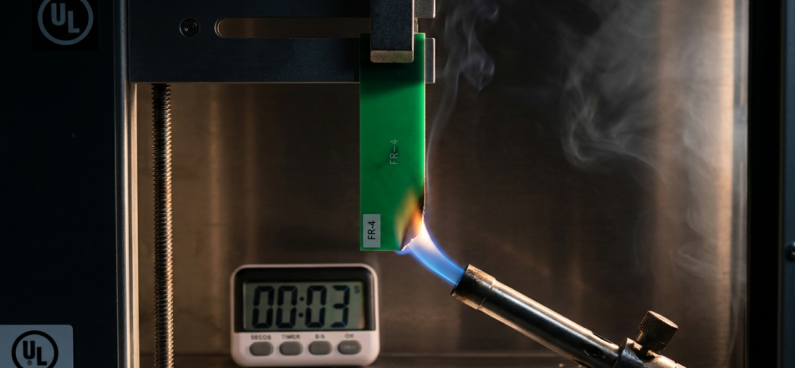
Here is how the vertical burn test works:
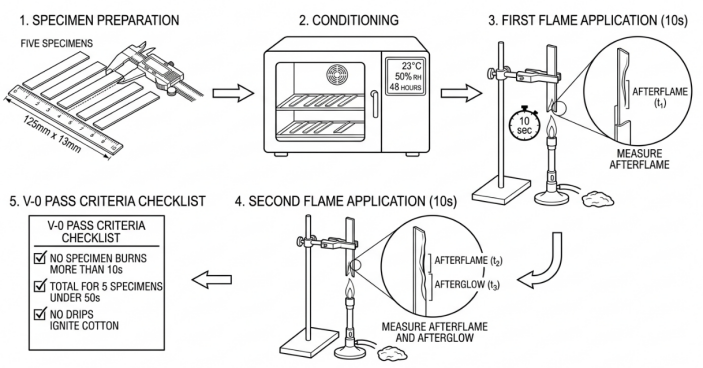
1.The test sample is 125 mm x 13 mm and is fixed in a vertical clamped position in a controlled environment.
2.The lower edge is subjected to a 20 mm calibrated Bunsen burner flame for 10 seconds.
3.The flame is extinguished, and the time of the afterflame is noted.
4.The flame is again subjected to one more 10-second period, and after flame time and afterglow time are noted.
5.Any drips that light a cotton indicator 300 mm below are recorded.
For V0 classification, the material must satisfy:
- No individual afterflame time exceeds 10 seconds.
- The total after flame for 5 specimens does not exceed 50 seconds.
- No afterflame or afterglow beyond 30 seconds after the second application.
- No specimen burns up to the holding clamp.
- No flaming drips ignite the cotton indicator.
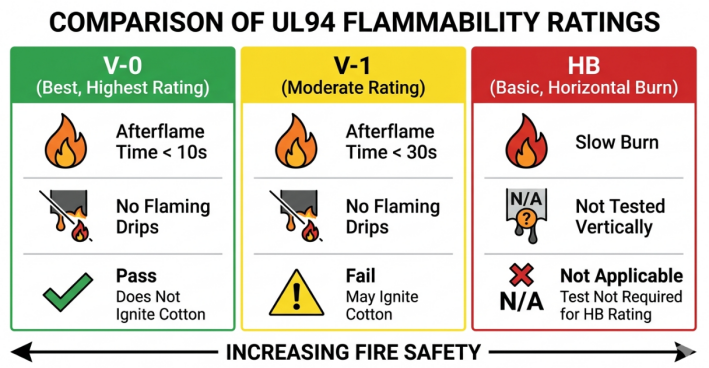
Comparison with Other UL94 Ratings (V-1, HB)
Understanding where V0 sits in the UL94 hierarchy helps you make informed material choices. Here is a direct comparison.
| Parameter | UL94 HB | UL94 V-2 | UL94 V-1 | UL94 V-0 |
|---|---|---|---|---|
| Test Orientation | Horizontal | Vertical | Vertical | Vertical |
| Max Afterflame Time (per specimen) | N/A (burn rate measured) | 30 seconds | 30 seconds | 10 seconds |
| Total Afterflame (5 specimens) | N/A | 250 seconds | 250 seconds | 50 seconds |
| Afterflame + Afterglow (2nd application) | N/A | 60 seconds | 60 seconds | 30 seconds |
| Flaming Drips Igniting Cotton | N/A | Yes (allowed) | No | No |
| Fire Safety Level | Lowest | Moderate | High | Highest (vertical) |
The lowest level of classification is HB and does not test the vertical flame resistance. V-2 permits drips of flame, a major safety issue. V-1 removes flaming drips, but prolongs afterflame periods. V-0 is the only one that has a high self-extinguishing rate and no drips of flames; therefore, it is highly preferred in commercial and industrial electronics.
The Safety and Performance Benefits of UL94 V0
Enhanced Flame Retardancy and Reduced Fire Risk
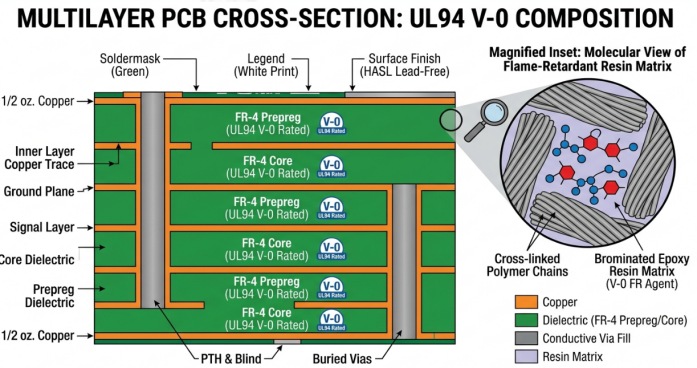
A PCB substrate of V0 grade will extinguish itself within less than 10 seconds without flaming drips. In a real-life failure, such as a short circuit or overheating of a component, this helps to ensure that a small thermal event does not grow into a full-scale enclosure fire. V-2 material may drip burning particles onto wiring underneath the PCB and cause secondary fires. V0 completely removes this cascading failure mode. In the case of unattended products such as IoT sensors or industrial controllers, this behavior is crucial. The brominated epoxy resin systems or halogen-free flame retardant additives that are available in FR4 laminates today are UL94 V0-compliant and are RoHS and REACH-compliant.
Improved Long-Term Reliability in Harsh Environments
The resin systems that facilitate V0 compliance also play a role in extending material stability, such as increased glass transition temperatures (Tg), increased resistance to thermal decomposition, and increased dimensional stability in thermal cycling. To achieve a built-in safety margin, a V0-rated substrate is used with less delamination potential and less conductive anodic filament (CAF) formation, especially in automotive under-hood electronics or industrial power supplies. This is the reason why UL94 flammability ratings are mentioned in IPC-6012 (Qualification and Performance Specification of Rigid Printed Boards) when qualifying boards. V0-rated substrates are nearly universal in Class 2 and Class 3 boards.
Choosing UL94 V0 Materials for Your PCB Project
Matching V0 to Application Demands (Consumer, Industrial, Automotive)
V0 has become the de facto standard across nearly all sectors. Here is how the demand breaks down.
- Consumer Electronics: UL and TUV require V0 as a minimum of products sold in North America and Europe. This is met by standard FR4 with Tg 130-140 °C at a reasonable cost.
- Industrial and Telecom: V0-compliant and higher Tg (150-180 °C) are more common because of the higher ambient temperature and increased reliability requirements.
- Automotive Electronics: ECU, ADAS, and infotainment board standards, such as AEC-Q100, are increasingly requiring V0-rated substrates, with operating temperatures between -40C and +125C.
- Medical and Aerospace: The most stressful industries, which may need to undergo biocompatibility testing or other requirements such as FAR 25.853, as well as V0.
Balancing Flame Rating with Cost and Mechanical Properties
FR4, which is standard and meets UL94 V0, is extremely common and economical. Manufacturers such as Shengyi, Kingboard, and ITEQ design their standard FR4 with a V0 default. The price discussion gets more fine-tuned when you require more properties:
- V0 materials are halogen-free, which comes with a 10-20% premium but comply with EU and Japanese environmental standards.
- Lead-free assembly and high-temperature applications require high-Tg V0 (Tg 170 °C+) materials.
- RF designs require higher frequency V0 materials, such as Rogers laminates, which are more costly.
- Dielectric layers of V0-rated can be obtained on metal-core LED and power substrates.
The cost should not be compromised at the expense of V0 compliance. The exposure and safety risks of the liability are way beyond the marginal savings.
Manufacturing Processes That Ensure UL94 V0 Compliance
Material Qualification and Process Controls
All V0 manufacturing processes start with the qualification of incoming material. Manufacturers have approved vendor lists (AVLs) and ensure that every batch is certified with a valid UL certification. Key process controls:
- Inward inspection is done to confirm lot numbers, UL file numbers, and certificates of compliance (CoC).
- The conditions of storage eliminate moisture uptake that compromises resin properties.
- The laminate parameters are strictly adhered to by the manufacturer of the laminate.
- Controlled feed rates are used in drilling and routing to avoid excessive heat build-up.
- Monitoring of chemical processing is to avoid an attack on the base laminate.
Any bending may affect flame-retardant features despite the proper certification of the raw laminate.
Testing and Certification in Professional Production
The UL certification of PCB manufacturers is based on UL QMTS2 (Qualified Manufacturers Testing Standard). Manufacturers should be able to show a steady adherence to the flammability ratings of their base materials. Periodic auditing includes:
- UL representatives do follow-up inspections, which are usually quarterly.
- Sample testing in which completed boards are subjected to a vertical burn test.
- Documentation audits to provide traceability of incoming laminate to finished product.
- Re-qualification of process change control in case of parameter changes.
JLCPCB's Expertise in UL94 V0 PCB Production
Certified High-Performance Materials and Strict Compliance
JLCPCB sources laminates from tier-one suppliers with valid UL certifications. Every laminate option carries UL94 V0 certification.
| Material Type | Typical Tg (C) | UL94 Rating | Common Applications |
|---|---|---|---|
| Standard FR4 | 130-140 | V-0 | Consumer electronics, IoT, general-purpose |
| Mid-Tg FR4 | 150 | V-0 | LED drivers, power supplies, telecom |
| High-Tg FR4 | 170-180 | V-0 | Automotive, industrial, lead-free assembly |
| Halogen-Free FR4 | 150-170 | V-0 | EU-compliant products, green electronics |
| Aluminum MCPCB | N/A (dielectric rated) | V-0 | LED lighting, power modules |
You do not have to second-guess whether your order will meet V0 requirements. It is built into the material specification by default.
Advanced Manufacturing and Quality Assurance
JLCPCB's production lines maintain the tight tolerances necessary for V0 compliance through automated process controls. Quality assurance measures include:
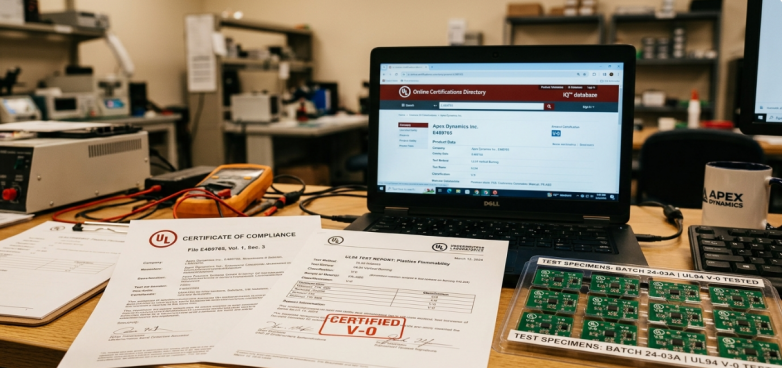
- AOI (Automated Optical Inspection) at multiple stages to catch defects early.
- Electrical testing via flying probe or fixture to verify board integrity.
- Cross-section analysis for multilayer boards to confirm proper lamination.
- Material traceability systems linking every finished board to its source laminate batch.
These controls ensure V0-rated material retains its full flame-retardant properties through every fabrication stage.
Reliable Solutions from Prototype to Volume Production
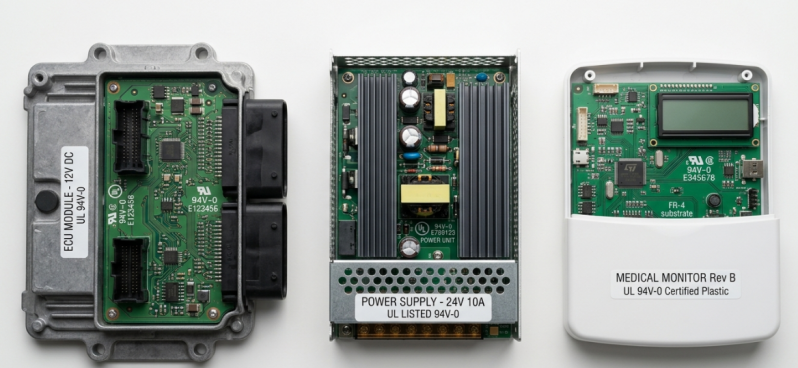
JLCPCB maintains consistent V0 compliance from prototype through volume production. With PCBs starting from $2 and turnaround as fast as 1-2 days, you can iterate quickly without compromising safety ratings. JLCPCB's SMT assembly services use controlled reflow profiles that respect the thermal limits of both components and laminate. If you are looking to put these principles into practice, the instant quoting system lets you specify material requirements upfront. Combined with EasyEDA integration, it is a straightforward path from schematic to certified, V0-compliant boards.
FAQ about UL94 V0 Material
Q: What does the 94V-0 marking on a circuit board mean?
The "94V-0" marking indicates that the PCB substrate has been tested under UL94 and achieved the V-0 rating. It self-extinguishes within 10 seconds of flame removal and does not produce flaming drips.
Q: Is UL94 V0 mandatory for all PCBs?
Not universally mandatory by law, but effectively required for any product seeking UL, TUV, CE, or similar safety certifications. Most end-product standards reference V0 as the minimum for PCB substrates.
Q:What is the difference between UL94 V0 and UL94 5VA?
V-0 uses a 50W Bunsen burner flame, while 5VA uses a 500W flame across 5 cycles. 5VA is more stringent and typically required for enclosures rather than PCB substrates.
Q: Does standard FR4 meet UL94 V0?
Yes. Virtually all commercial-grade FR4 laminates meet UL94 V0. Always verify via the supplier's documentation or the UL Product iQ database.
Q: Can high-frequency materials like Rogers meet UL94 V0?
Many Rogers laminates, including RO4003C and RO4350B, carry V0 ratings. Some ultra-low-loss PTFE materials may differ, so check the specific datasheet.
Keep Learning
Optimizing High-Voltage Circuit Safety with PCB Dielectric Strength
Key Takeaways Non-linear Scaling: Dielectric strength drops as thickness increases. Safety vs Signals: Dielectric strength ensures safety, while Dk controls signal speed. Material Selection: High-voltage safety depends on Tg, CTI, and moisture resistance. Spacing Rules: Clearance prevents air arcs, while creepage prevents surface tracking. Assembly Testing: Hi-pot testing requires finished assemblies, not bare boards. Dielectric strength is the number engineers quote to prove a board is safe at mains ......
How Copper Foil Shapes PCB Performance and Manufacturing Quality
Key Takeaways Weight: 1 oz copper ≈ 35 µm thickness; higher weight increases current capacity. Types: ED for standard rigid boards, RA for dynamic flex circuits. DFM & Loss: Smoother foil lowers RF loss; thicker foil requires wider trace spacing. The part of a PCB that actually carries the electrical signal is the copper foil. The strength comes from the glass weave, the resin is used to keep the layers together, and the solder mask is used to provide protection and separation of exposed copper. But w......
A Complete Guide to Copper Clad Laminate (CCL) in PCB Manufacturing
Key Takeaways CCL is the base material: a cured resin-reinforcement sheet with copper foil bonded to one or both sides. Three parts control performance: Resin affects heat and loss, reinforcement controls stability, and copper foil affects conductor behavior. Choose by the main design stress: Heat, frequency, and cost usually determine the best laminate family. Slash sheets define the material: IPC-4101 uses numbered slash sheets to specify rigid PCB base materials. Tg alone is not enough: Td and time......
Buried Vias in Advanced PCBs: Enabling Higher Density, Better Signal Integrity, and Compact Designs
Key Takeaways Hidden Routing: Buried vias connect only inner layers, keeping outer surfaces clear for dense components and traces. Better Signal Integrity: They eliminate via stubs, reducing parasitics and signal loss in high-speed designs. Higher Density: Essential for HDI boards, dense BGAs, and small form factors like wearables. Higher Cost: Sequential lamination and extra drilling steps make them ~3×-4× more expensive than standard through-holes. Ever wondered how a modern smartphone mainboard can......
Unlocking Higher Density and Better Performance with Blind Vias in HDI PCBs
Key Takeaway Higher Density: Connects surface to inner layers without penetrating the whole board, freeing routing channels under fine-pitch BGAs. Improved Signal Integrity: Reduces via stub length to minimize impedance discontinuities in high-speed designs. Aspect Ratio Rule: Keep the depth-to-diameter ratio near 0.75:1 (max 1:1) for reliable laser drilling and void-free plating. Thermal Efficiency: Supports via-in-pad setups for better heat dissipation and compact component placement. Ever wonder ho......
How to Select Tg of PCB ?
What is the Tg of PCB? In PCB manufacturing, "Tg" stands for Glass Transition Temperature. It is the temperature at which the PCB substrate material transitions from a rigid, glassy state to a soft, rubbery state. PCBs are flame-retardant (UL94 V-0) and do not burn easily; instead, they soften above Tg. The Critical Correlation Between Tg and Z-Axis CTE (Coefficient of Thermal Expansion) When the temperature exceeds the Tg point, the PCB substrate material (such as standard FR-4) undergoes a physical ......