PCB Adhesive : Types, Applications, and Best Alternatives for Circuit Board Assembly
12 min
- The Role of Adhesives in PCB Reliability and Performance
- Main Types of PCB Adhesives Available Today
- Key Applications of PCB Adhesives in Real Projects
- Top Alternatives to Traditional PCB Adhesives
- How to Choose and Apply the Right Circuit Board Adhesive
- Application Tips and Common Mistakes to Avoid
- Frequently Asked Questions (FAQ)
A printed circuit board uses more than just solder to secure its components. PCB adhesives, or circuit board glue, bond layers and components together under extreme conditions. Good adhesives help hold parts in place during assembly, electrically insulate, moisture seal, and thermally spread from hot chips. In fact, adhesives are critical to performance by preventing micro components from loosening and shifting. In other words, the right adhesive keeps the puzzle of a device's electronic pieces reliably glued together during tough usage.
The Role of Adhesives in PCB Reliability and Performance
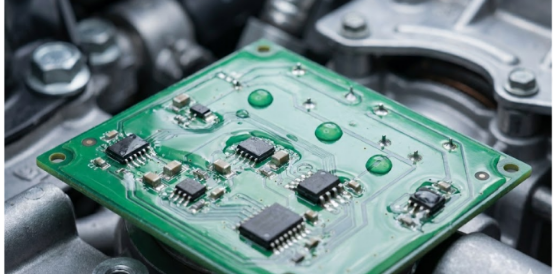
Durability is mostly appreciated in silence, and so are most PCB adhesives. They help the gadgets we use everyday worth drive and humidity from the environment. In car and airplane electronics, they help the parts survive extreme conditions. They also help survive drops and extend reliability. PCB adhesives help in shrinking the size of electronics. By strongly holding even the smallest chips, adhesives allow tiny boards to have even more features. High-density boards wouldn’t survive without cracks and shorts. In silence, a good PCB adhesive keeps the components where they need to be so the circuits operate at their best.
Common Scenarios Where PCB Glue Is Essential
Big caps, transformers, and connectors: Large caps, transformers, and connectors may shake or vibrate their solder joints. These parts are held together by a dash of adhesive so that they do not fall off.
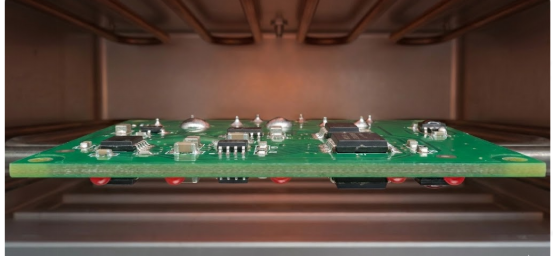
Double-sided assembly: In assemblies with parts on both sides, the bottom parts are clamped in place by glue as the top parts melt down. Without it the parts would only fall off half-way through the soldering process!
Prototyping and hand assembly: Hobbyists normally hand assemble parts with quick-setting glues. This prevents the drift of components during soldering.
Damage prevention: When making a repair or when the product is used over an extended period, the adhesives are used to seal the gaps and prevent defects such as solder wicking or cracking of the joints.
Main Types of PCB Adhesives Available Today
Epoxy-Based PCB Adhesives
Among the many bonding agents, epoxy adhesives stand out as the adhesive of choice. Standing out is the fact that they come in two parts; epoxy resin and epoxy hardener. When cured, the mixture turns into a strong plastic-like substance that, in addition to the strength, is also resistant to heat and chemicals. These features make it ideal for bonding and sealing. Permanent bonding of heavy components is done during the assembly of the printed circuit boards (PCBs) as is the bonding of heat sinks to the boards. Cured epoxy is a structural, "additional component" of the PCB itself. It is capable of withstanding waves of soldering heat and mechanical pounding without failing. One of the drawbacks of epoxy adhesives is that they need a few hours to completely set. Epoxy adhesives can, however, be used to create bonds that need to last and withstand very high temperatures.
Silicone Adhesives for Flexible and High-Temperature Applications
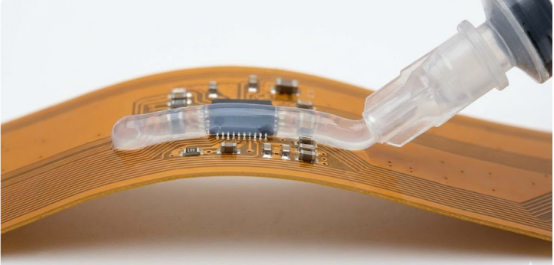
Silicone adhesives are rubbery they can cure faster than epoxies and remain somewhat soft and stretchy. This will help in absorbing shock and vibration. Silicones handle extreme temperature swings ( –40°C up to 200°C) without breaking down. This makes them perfect for applications like flexible PCBs and LED modules. They also excel at electrical insulation and moisture sealing. One popular choice is neutral-cure silicone as it doesn’t release corrosive byproducts during cure. Engineers often hot-glue parts in place during assembly but rely on silicone for the long-term anti-vibration bonding.
Acrylic and UV-Curable Options
The acrylic adhesives are so widespread in many industries as they install quickly and bond to a wide variety of materials. The newer acrylics actually can withstand some heat on assembly lines and they are more impervious to moisture than regular glues. UV-curable adhesives refer to a type of acrylic which remains liquid until you subject it to UV light. The glue will be able to cure within a few seconds with a UV lamp, which is a massive victory.
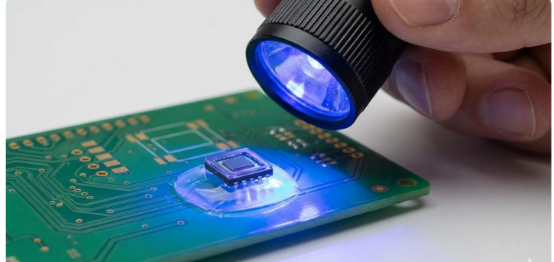
The immediate curing is also very convenient in factories since they can cure the parts in hot without the problem of breaking delicate items. UV adhesives that are acrylic are particularly useful when assembling miniature components such as sensors or screens. They are quick and hard hence fit perfectly into that niche. With these adhesives however you must keep in mind that they must have direct access to the UV source in order to cure. When the bond is deep or has much shadowing, then they will not work as well, and that is one of the main limitations to be considered.
Specialized SMT Red Glue and Conductive Adhesives
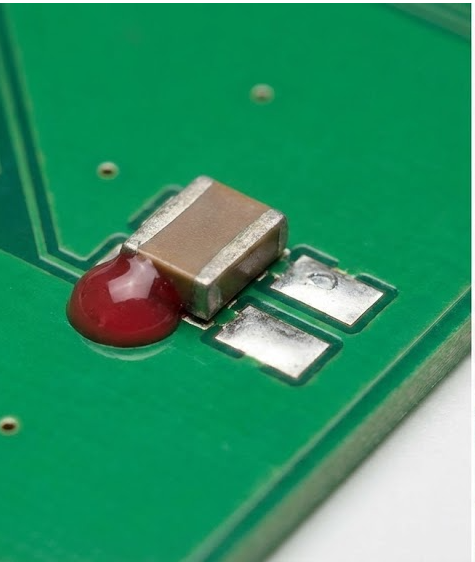
SMT Red Glue: In surface-mount assembly, a common special adhesive is the famous SMT red glue. This is a thermoset epoxy tack-applied to hold parts in place before reflow. It’s unique because it cures when heated around 100–150°C, it turns from a paste into a solid mass, so that when your solder paste melts, the part is already glued down. Electronics manufacturers use it on double-sided boards to lock the bottom components during the top-side soldering cycle. Once cured, red glue becomes permanent and rigid.
Conductive Adhesives: These adhesives do more than stick; they conduct electricity. Often filled with silver or carbon, they can replace solder in specialized cases. For example, conductive epoxies attach chips to boards that can’t be exposed to high soldering heat, or they repair broken PCB traces. They bond components electrically and mechanically. The downside is cost and lower conductivity than metal solder, so they’re used only when soldering isn’t an option.
Key Applications of PCB Adhesives in Real Projects
Component Securement Before Soldering
One of the most fundamental uses of PCB glue is simply to tack down parts before soldering. In manufacturing, every SMD is placed by machine; a small dot of adhesive can keep it from jumping out of position. This is especially critical on double-sided boards. An adhesive dot under each bottom-side prevents it from falling off. Heavier parts like big electrolytic capacitors and tall connectors, always need a extra adhestive to get fixed.
Multilayer Board Lamination and Bonding
Building multilayer PCBs requires laminating many thin sheets together. Sticky prepreg films resin-soaked adhesive sheets are sandwiched between copper-clad cores. Under heat and pressure, the adhesive cures and chemically bonds all layers into one solid board. In flexible PCBs, thin adhesive films bond coverlay films to the copper/polyimide base. As JLCPCB explains, this adhesive material is a sticky film that provides interlayer adhesion and insulation in multilayer boards. Without the adhesive, the board’s layers wouldn’t stay laminated or would short out.
Modern multilayer PCBs stack copper and substrate layers bonded by thin adhesive films. These bonding films ensure each layer stays laminated under heat and stress. On a flexible board, a special adhesive layer ties the copper to the coverlay, isolating and protecting the circuitry.
Repair, Rework, and Conformal Coating Support
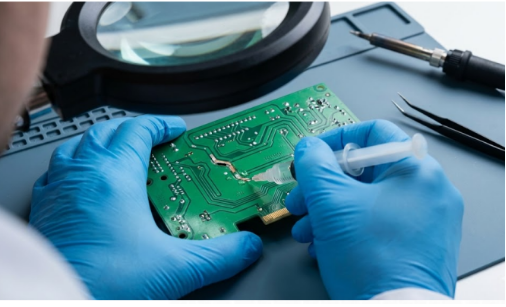
Adhesives are the heroes during repair and rework. As an example, a loose wire or jumper can be held in place during a re-sold trace using wire-tacking adhesives. And the special epoxy adhesives? The best thing about them is that they can be used to replace broken copper runs or clipped parts into broken sockets. There are also adhesives that are used as temporary solder masks. Liquid tape is smeared over the part you wish to protect when wave soldering and then you remove it when you are finished. Pretty convenient, right Conversely, the resultant product is commonly covered with a conformal coating - basically polymeric glue that is sprayed or brushed onto cover the entire board. That is the textbook method of insuring durability.
Flexible and Rigid-Flex PCB Construction
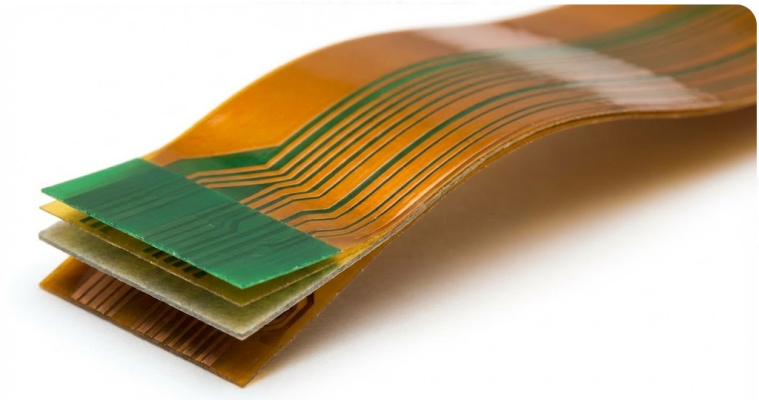
Flexible and rigid-flex PCBs use adhesives to construct the various layers. On flex boards, coverlays and stiffeners are bonded to the flexible polyimide and glued. This gives flexibility to board, while reinforcing the mountings and connectors. However, keep in mind that JLCPCB’s flex service uses supplier flex boards that are mostly adhesive-free These modern flex boards use heat and pressure bonding instead of glue in the core. Rigid-flex boards that have both solid and flexible sections, use specific types of adhesives to bond the rigid FR-4 sections to the flex sections. These adhesives are designed to hold the rigid and flexible layers together when the flex is bent, which is important for creating long lasting rigid-flex assemblies.
Top Alternatives to Traditional PCB Adhesives
Mechanical Fastening Methods
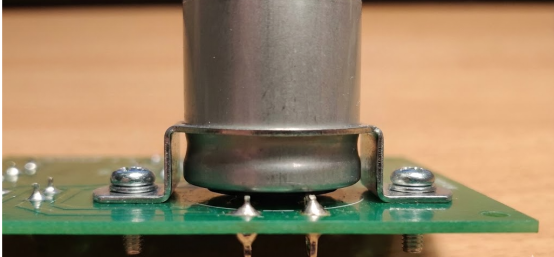
Sometimes, a mechanical solution can replace glue. Heavy or high-stress components might instead be screwed or clamped to the board or chassis. Brackets, mounting clamps, threaded studs or rivets can bear loads without any adhesive. For example, a large transformer on a power supply board is often bolted down rather than glued, since it will be subjected to strong forces. Threaded inserts in the PCB or chassis provide anchoring that outperforms any epoxy. In essence, if a part needs more strength than solder provides, opt for a physical fastener.
Adhesiveless Flex PCB Technologies
A recent innovation is to eliminate glue entirely in flexible circuits. Adhesiveless FPCs bond polyimide to copper without an intervening adhesive layer. This can be done via special laminating films or liquid polyimide processes. The result is a flex PCB with fewer materials that performs better at high heat and flex cycles. In fact, JLCPCB notes that 90% of flex products today are adhesive-free due to superior reliability. Thus, one alternative to gluing is to skip the glue stage altogether when manufacturing flexible or rigid-flex boards.
Advanced Soldering and Dispensing Techniques
Creative soldering or dispensing, instead of glue, may also be an option. Selective soldering or wave soldering with solder masks can retain components without adhesives. Instead of temporarily securing a component with glue, a vacuum gripper can hold it in place during reflow. Automated dispensing machines and paste dispensers can minimize the need for operator intervention and apply materials precisely. Protective glue may be eliminated with some designs of solderable metal pads. More generally, any method which rigidly holds components can serve as an alternative to conventional glue applications.
How to Choose and Apply the Right Circuit Board Adhesive
Key Selection Factors (Thermal, Electrical, Environmental)
The selection of the correct PCB glue is a match. It has to possess the features that match your project. Take into account the temperature that the adhesive will be subjected to. In the case of high-power boards, a glue that can resist more heat and has good thermal conductivity should be selected. Decide whether the adhesive should be insulating or should be conductive. The majority of adhesives are insulating although electrically conductive ones are needed in certain applications. Check the dielectric strength and resistivity of each alternative.
Ensure that the adhesive sticks effectively to your PCB material without damaging the material. Plastics are susceptible to some epoxies and silicones might need primers in bonding to metal. Consider the curing procedure. Is the adhesive heat-curing, UV-curing or can the adhesive cure at room temperature? It depends on the capacity of production you have. UV or fast-curing glues are used to speed up mass production, and slower-curing epoxies can be used in the laboratory.
Application Tips and Common Mistakes to Avoid
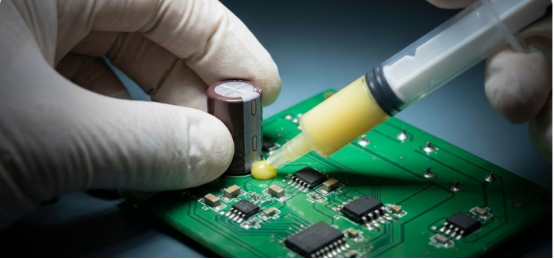
All you need to do is wipe the PCB pads and component leads with isopropyl alcohol and get the oils or flux off. Adhesion is killed by dust and grease. Take a syringe or a fine applicator. A drop under each part is sufficient, usually. Excessive glue may be deposited on the solder pads, which may be wicked or shorted joints. Ensure that you do not exceed the given cure time, temperature or UV exposure. Hurrying or undercuring will provide poor bonds that will break in future. When using epoxies which are heat-cured, again, ensure that your reflow oven profile will not overcook the glue.
Certain glues may produce fumes or cause skin irritation so it is best to glue in a well-ventilated room or extract the fumes and wear gloves (this is my preference). Safety first, right? In doubt, simply put a scrap of PCB on there first -test the strength of the adhesive and ensure that it will not ruin the finish on the board.

Frequently Asked Questions (FAQ)
Q. What is PCB adhesive used for?
PCB adhesive is used to secure components and layers on a circuit board. It provides mechanical support, protects against vibration and environmental stress, electrically insulates parts, and in some cases helps with thermal management.
Q. Can I use superglue (cyanoacrylate) on a PCB?
Superglue bonds quickly and can be useful for temporary tacking or non-critical parts. However, it becomes brittle over time and performs poorly under heat and vibration. For long-term reliability, electronics-grade epoxies or silicones are a better choice.
Q. Is hot glue safe for PCBs?
Hot-melt glue is often used in consumer electronics for temporary or low-stress support, but it softens at relatively low temperatures and degrades with thermal cycling. It is not recommended for high-reliability or high-temperature designs.
Q. What does adhesive-free flex PCB mean?
Adhesive-free flex PCBs eliminate the glue layer between the copper and polyimide layers. Instead, the layers are directly bonded using specialized lamination processes. This improves flex life, heat resistance, and overall reliability, especially in dynamic flex applications.
Q. What is SMT red glue?
SMT red glue is a thermosetting epoxy adhesive used in surface-mount assembly. It is applied under components and cured during reflow (typically 105–150 °C) to hold parts in place during soldering and permanently secure them afterward.
Keep Learning
Optimizing High-Voltage Circuit Safety with PCB Dielectric Strength
Key Takeaways Non-linear Scaling: Dielectric strength drops as thickness increases. Safety vs Signals: Dielectric strength ensures safety, while Dk controls signal speed. Material Selection: High-voltage safety depends on Tg, CTI, and moisture resistance. Spacing Rules: Clearance prevents air arcs, while creepage prevents surface tracking. Assembly Testing: Hi-pot testing requires finished assemblies, not bare boards. Dielectric strength is the number engineers quote to prove a board is safe at mains ......
How Copper Foil Shapes PCB Performance and Manufacturing Quality
Key Takeaways Weight: 1 oz copper ≈ 35 µm thickness; higher weight increases current capacity. Types: ED for standard rigid boards, RA for dynamic flex circuits. DFM & Loss: Smoother foil lowers RF loss; thicker foil requires wider trace spacing. The part of a PCB that actually carries the electrical signal is the copper foil. The strength comes from the glass weave, the resin is used to keep the layers together, and the solder mask is used to provide protection and separation of exposed copper. But w......
A Complete Guide to Copper Clad Laminate (CCL) in PCB Manufacturing
Key Takeaways CCL is the base material: a cured resin-reinforcement sheet with copper foil bonded to one or both sides. Three parts control performance: Resin affects heat and loss, reinforcement controls stability, and copper foil affects conductor behavior. Choose by the main design stress: Heat, frequency, and cost usually determine the best laminate family. Slash sheets define the material: IPC-4101 uses numbered slash sheets to specify rigid PCB base materials. Tg alone is not enough: Td and time......
Buried Vias in Advanced PCBs: Enabling Higher Density, Better Signal Integrity, and Compact Designs
Key Takeaways Hidden Routing: Buried vias connect only inner layers, keeping outer surfaces clear for dense components and traces. Better Signal Integrity: They eliminate via stubs, reducing parasitics and signal loss in high-speed designs. Higher Density: Essential for HDI boards, dense BGAs, and small form factors like wearables. Higher Cost: Sequential lamination and extra drilling steps make them ~3×-4× more expensive than standard through-holes. Ever wondered how a modern smartphone mainboard can......
Unlocking Higher Density and Better Performance with Blind Vias in HDI PCBs
Key Takeaway Higher Density: Connects surface to inner layers without penetrating the whole board, freeing routing channels under fine-pitch BGAs. Improved Signal Integrity: Reduces via stub length to minimize impedance discontinuities in high-speed designs. Aspect Ratio Rule: Keep the depth-to-diameter ratio near 0.75:1 (max 1:1) for reliable laser drilling and void-free plating. Thermal Efficiency: Supports via-in-pad setups for better heat dissipation and compact component placement. Ever wonder ho......
How to Select Tg of PCB ?
What is the Tg of PCB? In PCB manufacturing, "Tg" stands for Glass Transition Temperature. It is the temperature at which the PCB substrate material transitions from a rigid, glassy state to a soft, rubbery state. PCBs are flame-retardant (UL94 V-0) and do not burn easily; instead, they soften above Tg. The Critical Correlation Between Tg and Z-Axis CTE (Coefficient of Thermal Expansion) When the temperature exceeds the Tg point, the PCB substrate material (such as standard FR-4) undergoes a physical ......