Why Td Value Matters for Lead-Free and High-Reliability PCBs
15 min
- Understanding Td Value in PCB Materials
- Td Value vs Tg Value – Key Differences and Complementary Roles
- The Impact of Td Value on PCB Reliability
- Selecting the Right TD Value for Your Application
- Manufacturing Considerations for High Td Materials
- JLCPCB's Expertise in High Td Value PCB Production
- FAQ about Td Value
- Conclusion
Key Takeaways
- Td Definition: Td is the irreversible temperature where PCB laminate chemically breaks down (5% mass loss).
- Td vs. Tg: Tg is reversible softening; Td is permanent chemical destruction.
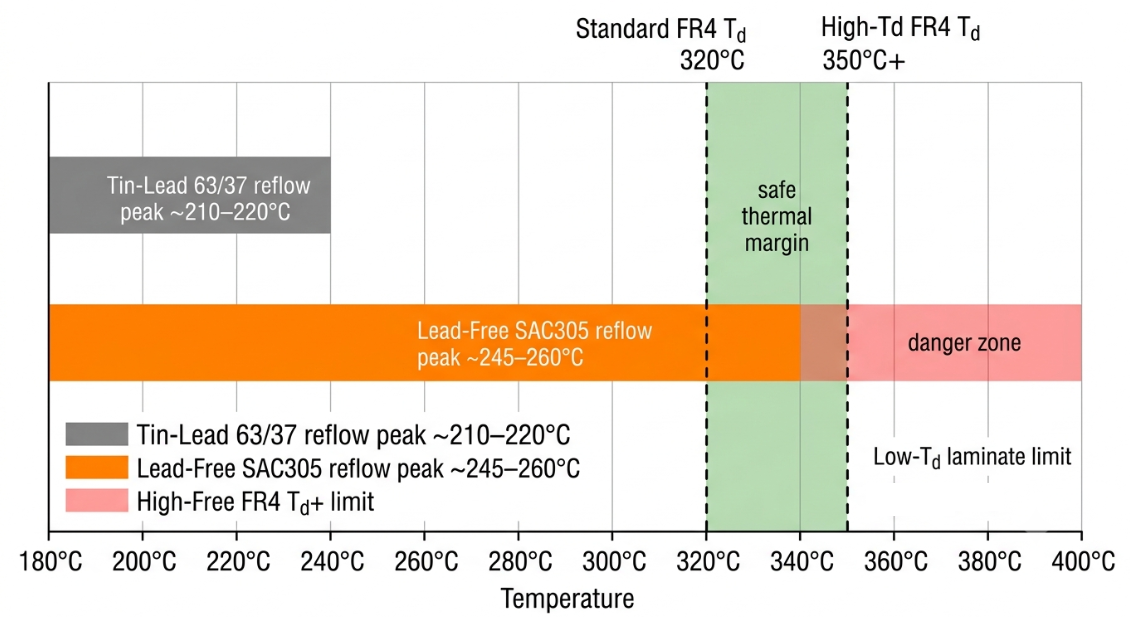
- Lead-Free Need: High lead-free reflow heat (245–260°C) requires high Td (≥340°C) to stop delamination.
- Reliability Metric: IPC Class 3 designs need high-Td materials and long T260/T288 delamination times.
- JLCPCB Solution: JLCPCB supplies high-Tg/Td laminates (Tg170/S1000-2) with optimized thermal DFM.
Ever remove a newly reflowed board from the line and notice some small bubbles or a slightly hazy delamination in the laminate? That isn't always due to your footprint or your paste. In most cases, it has to do with one material specification that many engineers don't consider: Td Value (Thermal Decomposition Temperature) of the base laminate. As the industry switched from tin-lead to lead-free solder, the reflow peak temperatures increased 30-40°C, and suddenly the laminates that had been around for decades began to break down in the reflow oven.
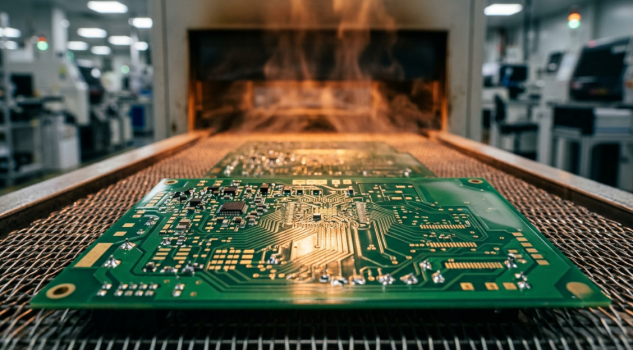
Hence, the Td Value for PCB material selection has become one of the most significant reliability parameters that you can specify, particularly if your boards are subject to multiple thermal cycles and/or rough field conditions. In this guide, we'll dissect what Td Value is, how it is measured, how it differs from Tg, and why it is the number that can make or break a lead-free soldering and/or High Reliability Board. Let's dig in.
Understanding Td Value in PCB Materials
In order to select the proper laminate, you should know what this number is and how it was generated. There is a lot of confusion around the Td, so let's first construct a picture.
What Td Value Is and How It Is Measured
Thermal decomposition temperature (Td) is the temperature at which the PCB laminate starts to break down chemically and loses a certain percentage of mass in a permanent way. This is not a phase change; once the resin decomposes, it won't return.
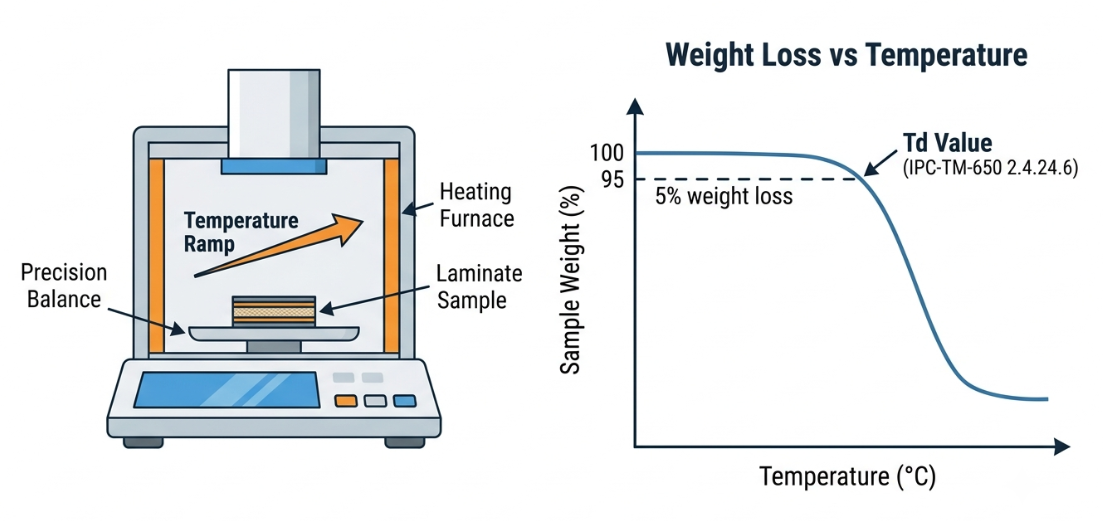
Thermogravimetric Analysis (TGA) is used to measure Td. During this test, a small amount of laminate is placed in a furnace and heated at a controlled rate, and a precision balance continuously monitors the laminate's weight. As the temperature climbs, the resin system starts to volatilize and off-gas, and the sample loses mass. According to industry standard, Td is defined as the temperature at which the sample loses 5% of its weight, according to IPC-TM-650 method 2.4.24.6. Some datasheets give a 2% weight loss point, which is a more conservative and stringent figure. Before comparing two materials, always check which criterion a supplier quotes.
Things to keep in mind about Td measurement:
- Not measured by DSC or TMA, but rather by TGA.
- The default reference is the 5% weight loss temp.
- The test method is IPC-TM-650 2.4.24.6.
- Td is an irreversible, destructive material property that has no restoration.
The Physical Meaning of Thermal Decomposition Temperature
What do you mean on the molecular level? Below Td, the epoxy resin, curing agents, and any flame-retardant additives are not destroyed, but remain in their original chemical form. The polymer backbone begins to break up above it, where volatile byproducts are released as gas. It's those trapped gases that are the issue. They push the layers apart as they grow between the copper and glass-reinforced resin.
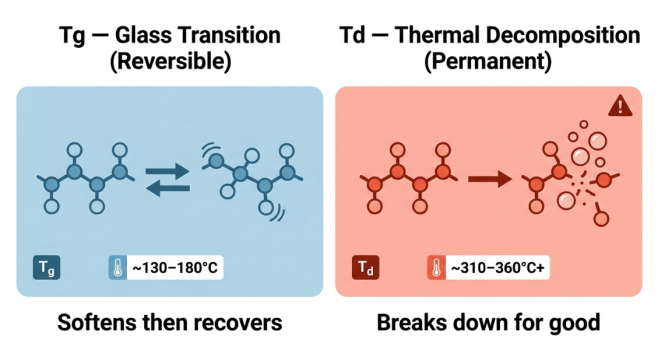
This causes the board to bubble, blister, and delaminate, destroying the mechanical integrity and electrical performance of the board. Imagine Td to be like a point of no return. A board may go through the glass transition multiple times without suffering any injury or damage, but when it passes Td, it is permanently damaged. This is why a high Td Value provides thermal headroom – a thermal buffer between the assembly process temperature and the temperature at which the laminate chemically fails.
Td Value vs Tg Value – Key Differences and Complementary Roles
Td and Tg can be easily confused by the engineer, which causes a poor selection of materials. What is really the case is that both are important, but they tell of very different behaviors. The Td Value and Tg Value are not independent but are both necessary to specify a reliable laminate.
How Td and Tg Together Determine Material Performance
Glass Transition Temperature (Tg) is the temperature at which the resin changes from a hard and glassy condition to a soft and rubbery condition. This transformation is completely reversible (cool the board down, and the resin goes back to being rigid). Tg is an indicator of the behavior of the board when it is subjected to normal thermal cycling and the Z-axis expansion acceleration when the Tg is exceeded.
TD, however, informs you of the time when the material is lost forever. One can laminate with a very good Tg and a very low Td – this is a very bad trap for lead-free work. Let's put it into perspective:
| Property | Td Value | Tg Value |
|---|---|---|
| Full name | Thermal decomposition temperature | Glass transition temperature |
| What it describes | Chemical breakdown of resin | Reversible physical softening |
| Measurement method | TGA (5% weight loss) | DSC, TMA, or DMA |
| IPC test method | IPC-TM-650 2.4.24.6 | IPC-TM-650 2.4.25 / 2.4.24 |
| Reversible? | No — permanent | Yes — recoverable |
| Typical standard FR4 | ~310–330°C | ~130–140°C |
| Typical high-Tg FR4 | ~340–360°C+ | ~170–180°C |
| Failure mode when exceeded | Delamination, outgassing, blistering | Rapid Z-axis expansion, via cracking |
Why Td Value Becomes Critical in Lead-Free Soldering
It's the one thing about lead-free soldering: it gets hot! The melt temperature of SAC305 (Sn96.5/Ag3.0/Cu0.5) is approximately 217-220°C, and to achieve good wetting, reflow peaks are pushed up to 245-260°C, as opposed to the older eutectic tin-lead 63/37, which peaked at the much more comfortable 210-220°C.
It is exactly this 30 to 40°C that is the downfall of low-Td laminates. In assembly, a board can experience several reflow passes (top side, bottom side, rework), each time approaching the limit of decomposition of the laminate. There are two complementary metrics that are useful here, T260 and T288. These measure the time-to-delamination at constant 260°C and 288°C, respectively, as per IPC-TM-650 2.4.24.1. A material that has been rated T288 > 15 minutes will easily withstand lead-free profiles, whereas a poor laminate may separate in less than 5 minutes at 260°C. To prevent problems with leaded soldering, it's desirable to have a high Td with good T260/T288 values.
The Impact of Td Value on PCB Reliability
When you specify Td, it's not only about reflow oven survival once. It directly influences the service life of your product in the field and its ability to withstand repeated thermal stress. This is where Td Value in PCB reliability comes to make a difference.
Resistance to Delamination and Long-Term Thermal Stability
The delamination is the most frequent and worst form of failure associated with low Td. When inner layers separate, the bond between copper and resin is lost, and all the trace and via crossings in that area are vulnerable. The greater the Td Value, the further away the decomposition threshold is from your assembly and operating temperatures. This extends the stable range of the resin system, and the risk is seriously decreased.
- Delamination in the inner layers after several reflows.
- Through barrel cracking, due to Z-axis expansion.
- Swelling and blistering due to the gases of decomposition.
- Lifting of soldered pads in rework or hand soldering.
This stability is a must for multilayer boards that have buried and blind vias. The higher the number of layers and the more interconnected they are, the more thermal stress will focus on the plated barrels, and a strong Td will hold the structure intact.
Performance in High-Temperature and Harsh Environments
Some applications don't have a cooling-down period. Automotive under-hood modules, industrial power supplies, LED drivers, and aerospace electronics are examples of products that are constantly running at elevated temperatures and/or experience repeated thermal cycling, often rapidly.
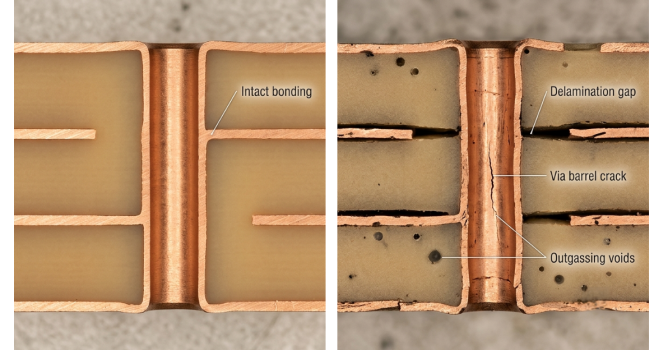
In such situations, the laminate is constantly operating close to its high end of thermal comfort. A high Td Value is a guarantee that the resin will not degrade, outgas, or embrittle during thousands of hours of service. That is why High Reliability Boards (designed to IPC Class 3 requirements) almost invariably require high Td laminate. A high decomposition temperature is cheap insurance when a failure in the field could be costly and/or hazardous.
Selecting the Right TD Value for Your Application
Not all boards require an exotic laminate. Too much is a waste, too little is dangerous. The idea is to make the Td Value match the real process and reliability requirements.
Matching Td to Lead-Free Processes and Industry Requirements
First, draw a map of your process. Record the number of reflow passes, maximum reflow temperature, and rework. Then correlate that thermal budget to a laminate class. Use this as a practical starting point:
- Consumer, single/double-sided, tin-lead legacy: Generally, a standard FR4 with Td 310-330°C is sufficient.
- General lead-free assembly (1–2 reflow passes): Use a laminate with Td ≥ 335°C and T260 > 30 minutes.
- High reliability boards (automotive, industrial, aerospace): Specify high-Tg, high-Td materials, rating to IPC Class 3, often Td 350°C+.
Industry specifications such as IPC-4101 include laminate slash sheets that combine Tg, Td, and CTE requirements, making it easier to reference the appropriate specification and ensuring your fabricator is on the same page as you.
Balancing Td, Cost, and Other Material Properties
A TD can always be found with someone else. Typically, a higher Td laminate will offer a higher Tg, and lower Z-axis CTE, which is a good thing, but also a higher price and potentially longer lead times.
Here is a basic rundown of material classes:
| Material Class | Typical Tg (°C) | Typical Td (°C) | Best Fit |
|---|---|---|---|
| Standard FR4 (e.g. KB-6160 class) | 130–140 | 310–330 | Consumer, prototyping |
| Mid-Tg FR4 | 150–160 | 330–340 | General lead-free |
| High-Tg FR4 (e.g. Tg170 / S1000-2 class) | 170–180 | 340–360+ | Lead-free multilayer, High Reliability Boards |
| Polyimide | 250–260 | 380–400+ | Aerospace, extreme heat |
Avoid getting the top-of-the-line Td on the market for a plain two-layer sensor board, but don't cut corners on the choice for a dense automotive controller either. Determine the corresponding mission for each number.
Manufacturing Considerations for High Td Materials
Selecting a high-Td laminate isn't enough. These materials respond differently on the shop floor, and a fabricator must adapt the process to make the best value of these materials.
Process Adjustments for Lamination, Drilling, and Assembly
Harder and thermally more stable, high-Td, high-Tg resin systems machine and bond differently. A competent manufacturer optimizes a number of steps in the process:
- Lamination: Higher press temperatures and longer cure cycles are needed to cross-link the tougher resin fully.
- Drilling: Feed rates, spindle speeds, and bit changes are varied to prevent rough hole walls. Harder laminates wear out drill bits more quickly.
- Desmear: Many times, the more resistant resin requires a modified desmear chemistry to clean and prepare the hole walls for plating effectively.
Even though Td is very high, assembly can still be optimized for the board to be within a safe thermal window, using the reflow profiles. Without these changes, you risk the reliability that you purchased. It's only as good as the process that converts it into a finished board.
Quality Control and Verification of Td Performance
There is no way to check Td visually, only by data and testing, and that is best performed by a reputable fabricator. Incoming laminate is qualified to supplier data sheets and IPC-4101 slash sheets, and the boards produced are thermally qualified. Some verification measures include:
- Certificate of conformance for laminate Td, Tg, and T260/T288 ratings.
- Thermal Stress Coupons for Solder Float or Reflow simulation to investigate delamination.
- Inspection by cross-section microsectioning – via barrel and inner-layer bonding after thermal stress.
- TGA sampling on incoming material for full traceability is required with the design.
This is what distinguishes a board that feels good from one that will pass lead-free assembly and years of field service.
JLCPCB's Expertise in High Td Value PCB Production
Knowing the theory is easy; having good boards built is another. A fabricator's material range and process control come into play here.
Wide Selection of High Td and Lead-Free Compatible Materials
JLCPCB has a wide range of laminate offerings, from everyday to demanding applications. In general-purpose applications, a standard FR4 in class KB-6160 will offer acceptable performance at a reasonable cost and normally will have a Td in the 310-330°C range.

JLCPCB provides high-Tg options for lead-free multilayer builds and High Reliability Boards, such as Tg170 and S1000-2 class laminates, with high Tg of 170 to 180℃ and high Td to withstand the multiple lead-free reflow processes. This range allows you to specify the Td Value exactly what you need for your project, rather than over- or underspecifying.
Advanced Process Control and DFM Support for Thermal Reliability
Good materials are still not good as long as they are not well processed. JLCPCB optimizes lamination, drilling, and desmear process for high-Td resins to ensure clean hole walls, strong inner-layer bonding, even on dense stackups. Their free DFM analysis and instant quoting system help to identify potential thermal and manufacturability issues prior to production. Combined with lead-free compatible SMT assembly, this translates to your selected laminate being processed within its safe thermal window from bare board to finished assembly.
Consistent High-Quality Manufacturing for Demanding Applications
Consistency is the key that makes a good design a reliable product. JLCPCB's rapid production of PCBs in 1-2 days, affordable prices of $2.00 and above for PCBs, and high-quality standards make it easy to prototype and scale high-reliability designs. In the event that you are choosing high-Td laminates for your automotive, industrial, or some other extreme surroundings applications, JLCPCB product materials and process management provide you with a strong basis to start.
FAQ about Td Value
Q: What is the Td Value in a PCB?
Td Value is the thermal decomposition temperature, the point at which a laminate chemically breaks down and permanently loses mass. It is measured by TGA as the temperature at 5% weight loss, following IPC-TM-650 method 2.4.24.6.
Q: How is Td Value different from Tg Value?
Tg is the reversible glass transition, where resin softens, while Td is the irreversible temperature where the resin decomposes. Tg governs thermal cycling behavior, and Td governs survivability during high-temperature processes like lead-free reflow.
Q: Why does Td Value matter for lead-free soldering?
Lead-free reflow peaks at 245–260°C, far higher than tin-lead processes, and boards may see multiple passes. A high Td keeps the laminate well below its decomposition point, preventing delamination and outgassing during assembly.
Q: What Td Value should I choose for High Reliability Boards?
For High Reliability Boards built to IPC Class 3, choose high-Tg, high-Td laminates with Td of roughly 340–360°C or higher, backed by strong T260/T288 time-to-delamination ratings. This provides the thermal margin needed for harsh, long-life applications.
Q:What are T260 and T288, and how do they relate to Td?
T260 and T288 measure the time a laminate resists delamination when held at 260°C or 288°C, respectively, per IPC-TM-650 2.4.24.1. They complement Td by showing how the material behaves under sustained heat, not just a single decomposition point.
Conclusion
The switch to lead-free soldering permanently put the thermal bar up on every PCB, and the Td Value is the spec that indicates whether or not your laminate can pass it. However, it is the thermal decomposition temperature, which is determined using TGA at 5% weight loss. The true determining factor is whether your board survives assembly without damage, or if it delaminates in the oven.
As electronics move into increasingly hot, terrific automotive, industrial, and power-dense applications, the importance of high-Td materials will only increase. Take Td, Tg, and T260/T288 as one unit, customize them for your true process and field conditions, and you are assured reliability from the ground up. If you're prepared to implement these guidelines, then JLCPCB offers a variety of high-Td and lead-free compatible laminates for easy board specification that can withstand the thermal stresses of the real world.

Keep Learning
Is FR4 the Best Board Material for Your Design
Key Takeaways Best All-Rounder: Ideal balance of strength, insulation, and low cost for standard PCBs. Clear Limits: Poor heat dissipation (~0.3 W/m·K) and high loss for RF (>3 GHz). Alternatives: Use Rogers for RF, Aluminum for high heat, and FPC for flexibility. Selection Essentials: Pick High-Tg (170°C+) for lead-free reflow and custom stackups for impedance. JLCPCB Advantage: 1–32 layer FR4 boards with ±10% impedance control and 24h fast dispatch. In the world of electronics and printed circuit bo......
Optimizing High-Voltage Circuit Safety with PCB Dielectric Strength
Key Takeaways Non-linear Scaling: Dielectric strength drops as thickness increases. Safety vs Signals: Dielectric strength ensures safety, while Dk controls signal speed. Material Selection: High-voltage safety depends on Tg, CTI, and moisture resistance. Spacing Rules: Clearance prevents air arcs, while creepage prevents surface tracking. Assembly Testing: Hi-pot testing requires finished assemblies, not bare boards. Dielectric strength is the number engineers quote to prove a board is safe at mains ......
How Copper Foil Shapes PCB Performance and Manufacturing Quality
Key Takeaways Weight: 1 oz copper ≈ 35 µm thickness; higher weight increases current capacity. Types: ED for standard rigid boards, RA for dynamic flex circuits. DFM & Loss: Smoother foil lowers RF loss; thicker foil requires wider trace spacing. The part of a PCB that actually carries the electrical signal is the copper foil. The strength comes from the glass weave, the resin is used to keep the layers together, and the solder mask is used to provide protection and separation of exposed copper. But w......
A Complete Guide to Copper Clad Laminate (CCL) in PCB Manufacturing
Key Takeaways CCL is the base material: a cured resin-reinforcement sheet with copper foil bonded to one or both sides. Three parts control performance: Resin affects heat and loss, reinforcement controls stability, and copper foil affects conductor behavior. Choose by the main design stress: Heat, frequency, and cost usually determine the best laminate family. Slash sheets define the material: IPC-4101 uses numbered slash sheets to specify rigid PCB base materials. Tg alone is not enough: Td and time......
Buried Vias in Advanced PCBs: Enabling Higher Density, Better Signal Integrity, and Compact Designs
Key Takeaways Hidden Routing: Buried vias connect only inner layers, keeping outer surfaces clear for dense components and traces. Better Signal Integrity: They eliminate via stubs, reducing parasitics and signal loss in high-speed designs. Higher Density: Essential for HDI boards, dense BGAs, and small form factors like wearables. Higher Cost: Sequential lamination and extra drilling steps make them ~3×-4× more expensive than standard through-holes. Ever wondered how a modern smartphone mainboard can......
Unlocking Higher Density and Better Performance with Blind Vias in HDI PCBs
Key Takeaway Higher Density: Connects surface to inner layers without penetrating the whole board, freeing routing channels under fine-pitch BGAs. Improved Signal Integrity: Reduces via stub length to minimize impedance discontinuities in high-speed designs. Aspect Ratio Rule: Keep the depth-to-diameter ratio near 0.75:1 (max 1:1) for reliable laser drilling and void-free plating. Thermal Efficiency: Supports via-in-pad setups for better heat dissipation and compact component placement. Ever wonder ho......