How to Choose the Right PCB Laminate: A Practical Guide for Performance, Cost & Reliability
7 min
- Introduction: Why Laminate Selection Matters More Than Ever
- Understanding PCB Laminates and Their Core Components
- Key Factors to Consider When Choosing a Laminate
- Popular Laminate Types and How to Compare Them
- Design, Manufacturing, and JLCPCB’s Professional Expertise
- Conclusion: Select the Right Laminate with Confidence
- FAQ
Selecting the correct PCB laminate is one of the most important decisions in any board design. The laminate determines electrical performance, thermal behavior, mechanical strength, cost, and long-term reliability. A poor choice can lead to signal integrity problems, delamination during reflow, or excessive warpage in production. Engineers who understand laminate properties can avoid these issues and achieve better results at lower cost.
Introduction: Why Laminate Selection Matters More Than Ever
The Direct Impact on Signal Integrity and Cost
Modern designs push data rates higher every year. At 5 Gbps and above, even small differences in dielectric constant (Dk) or dissipation factor (Df) can cause impedance mismatches and signal loss. Choosing the wrong laminate can force designers to add extra layers or use more expensive materials later, increasing both cost and lead time. Conversely, selecting the right laminate from the start can reduce layer count by 1–2 layers and cut material cost by 15–25%.
New Challenges in High-Speed and High-Reliability Projects
Automotive, 5G, and medical applications now demand higher Tg, lower CTE, and better thermal conductivity. At the same time, environmental regulations push for halogen-free and RoHS-compliant materials. Balancing all these requirements makes laminate selection more complex than ever.
Understanding PCB Laminates and Their Core Components
What Makes Up a Laminate
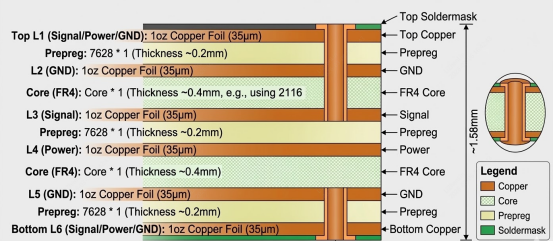
A PCB laminate consists of three main elements: woven glass fabric for mechanical strength, epoxy resin system for insulation and bonding, and copper foil for conductivity. The glass style (106, 2116, 7628, etc.) and resin formulation determine the final electrical and thermal properties. Thicker glass styles give better rigidity but higher Dk; finer styles reduce Dk but increase cost.
Standard FR-4 vs Specialty Laminates
Standard FR-4 remains the workhorse for most designs because of its low cost and wide availability. However, specialty laminates — high-Tg, low-loss, halogen-free, or metal-core — are increasingly used when standard FR-4 cannot meet thermal, speed, or environmental requirements. Understanding the differences early prevents costly redesigns later.
Key Factors to Consider When Choosing a Laminate
Electrical Properties (Dk, Df, Impedance Control)
Dielectric constant (Dk) and dissipation factor (Df) directly affect signal propagation speed and loss. For high-speed designs, lower Dk and Df materials reduce insertion loss. JLCPCB’s standard FR-4 has Dk around 4.5 at 1 GHz; low-loss options drop to 3.8–4.0. Tight impedance control (±10% or better) requires stable Dk across frequency and temperature.
Thermal Performance (Tg, Td, CTE)
Glass transition temperature (Tg) indicates when the resin softens. Higher Tg (170°C+) materials withstand multiple lead-free reflow cycles without delamination. Decomposition temperature (Td) shows when the material starts breaking down — aim for Td >340°C for reliability. Z-axis CTE should be below 50 ppm/°C to minimize via stress.
Mechanical Strength, Cost, and Compliance Needs
Mechanical strength affects drilling and assembly yield. Cost increases with Tg, low-loss properties, or halogen-free certification. Environmental requirements (RoHS, halogen-free) have become standard in many markets. Always balance these factors against the actual operating environment and expected product lifetime.
Table 1: Laminate Selection Factors Overview
| Factor | Standard FR-4 | High-Tg FR-4 | Low-Loss Halogen-Free | Key Consideration |
| Dk (@1GHz) | 4.4–4.7 | 4.3–4.6 | 3.8–4.1 | Signal speed & impedance control |
| Df (@1GHz) | 0.018–0.022 | 0.016–0.019 | 0.008–0.012 | Insertion loss at high frequency |
| Tg (°C) | 130–140 | 170–180 | 150–170 | Reflow cycles & thermal cycling |
| Td (°C) | 310–330 | 350–380 | 340–370 | Long-term thermal reliability |
| Cost Index | 1.0 | 1.3–1.6 | 1.8–2.5 | Budget vs performance trade-off |
Popular Laminate Types and How to Compare Them
High-Tg, Low-Loss, Halogen-Free and Metal-Core Options
High-Tg laminates (170°C+) are ideal for automotive and industrial boards that experience wide temperature swings. Low-loss materials (Df <0.012) suit 5G, PCIe, and RF applications. Halogen-free versions meet strict environmental standards while maintaining good thermal performance. Metal-core (aluminum or copper) laminates are used when heat dissipation is the primary concern.
Material Comparison Table
| Laminate Type | Tg (°C) | Dk (1 GHz) | Df (1 GHz) | CTE-Z (ppm/°C) | Typical Applications |
| Standard FR-4 | 135 | 4.5 | 0.020 | 55 | General consumer & industrial |
| High-Tg FR-4 | 175 | 4.4 | 0.017 | 45 | Automotive, multiple reflow |
| Low-Loss Halogen-Free | 160 | 3.9 | 0.010 | 50 | 5G, high-speed digital |
| Metal-Core (Aluminum) | N/A | 4.2 | 0.018 | 20–25 | LED lighting, power electronics |
Quick Selection Guide by Application
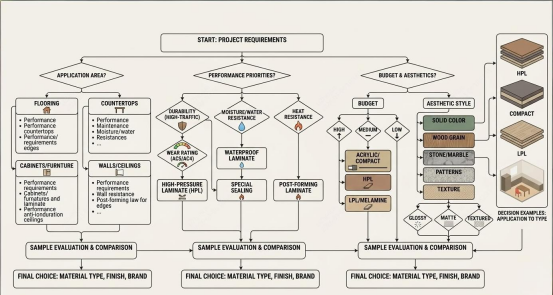
For cost-sensitive consumer products, standard FR-4 is usually sufficient. Automotive and server designs benefit from high-Tg materials. High-frequency RF and 5G boards require low-loss laminates. LED or high-power applications often use metal-core laminates for superior heat dissipation.
Design, Manufacturing, and JLCPCB’s Professional Expertise
Essential DFM Rules for Different Laminates
Different laminates require different design rules. High-Tg materials need slightly larger annular rings to compensate for higher Z-axis expansion. Low-loss laminates are more sensitive to trace geometry, so maintain consistent width and spacing. Always verify minimum drill-to-copper clearance with the chosen material.
Advanced Process Controls for Consistent Quality
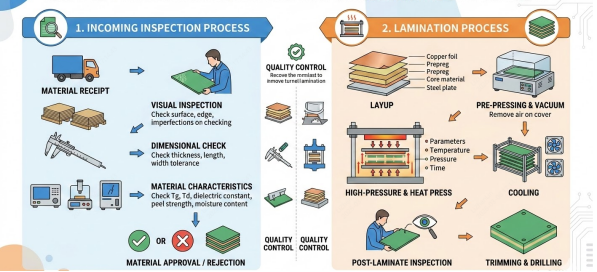
JLCPCB controls laminate quality through incoming material inspection, precise lamination pressure/temperature profiles, and post-lamination testing. Every panel includes test coupons for Tg, impedance, and thermal stress verification.
Why JLCPCB Makes Laminate Selection Easier and More Reliable
JLCPCB maintains a large inventory of verified laminates, including standard FR-4, high-Tg, halogen-free, and low-loss grades. Our online quoting system shows material availability instantly. The free DFM check automatically flags issues related to the selected laminate, and our engineering team provides optimization suggestions within hours. Quick-turn service (as fast as 24 hours for prototypes) lets you validate your laminate choice early.
Conclusion: Select the Right Laminate with Confidence
Choosing the right PCB laminate directly affects signal integrity, thermal reliability, cost, and time-to-market. By understanding Dk, Df, Tg, Td, and CTE, and matching them to your specific application, you can avoid costly redesigns and field failures.
At JLCPCB, laminate selection is made simple. With a wide range of in-stock materials, professional DFM support, precise impedance control, and fast turnaround, we help engineers turn designs into reliable products quickly and economically. Upload your design today at jlcpcb.com and let our team help you choose — and manufacture — the perfect laminate for your project.

FAQ
Q1: What is the most important factor when choosing a PCB laminate?
A: Electrical requirements (Dk/Df) and thermal demands (Tg/Td) are usually the top priorities, followed by cost and environmental compliance.
Q2: How much more expensive are high-Tg or low-loss laminates?
A: Typically 30–60% higher than standard FR-4, but they often reduce layer count and improve long-term reliability.
Q3: Can I mix different laminates in one board?
A: Yes, but CTE matching and symmetric stackup are critical to prevent warpage and ensure reliable lamination.
Q4: Does JLCPCB provide support for laminate selection?
A: Yes. We offer free DFM checks, real-time material availability, and engineering recommendations to help you select the best laminate for your project.
Keep Learning
Is FR4 the Best Board Material for Your Design
Key Takeaways Best All-Rounder: Ideal balance of strength, insulation, and low cost for standard PCBs. Clear Limits: Poor heat dissipation (~0.3 W/m·K) and high loss for RF (>3 GHz). Alternatives: Use Rogers for RF, Aluminum for high heat, and FPC for flexibility. Selection Essentials: Pick High-Tg (170°C+) for lead-free reflow and custom stackups for impedance. JLCPCB Advantage: 1–32 layer FR4 boards with ±10% impedance control and 24h fast dispatch. In the world of electronics and printed circuit bo......
Optimizing High-Voltage Circuit Safety with PCB Dielectric Strength
Key Takeaways Non-linear Scaling: Dielectric strength drops as thickness increases. Safety vs Signals: Dielectric strength ensures safety, while Dk controls signal speed. Material Selection: High-voltage safety depends on Tg, CTI, and moisture resistance. Spacing Rules: Clearance prevents air arcs, while creepage prevents surface tracking. Assembly Testing: Hi-pot testing requires finished assemblies, not bare boards. Dielectric strength is the number engineers quote to prove a board is safe at mains ......
How Copper Foil Shapes PCB Performance and Manufacturing Quality
Key Takeaways Weight: 1 oz copper ≈ 35 µm thickness; higher weight increases current capacity. Types: ED for standard rigid boards, RA for dynamic flex circuits. DFM & Loss: Smoother foil lowers RF loss; thicker foil requires wider trace spacing. The part of a PCB that actually carries the electrical signal is the copper foil. The strength comes from the glass weave, the resin is used to keep the layers together, and the solder mask is used to provide protection and separation of exposed copper. But w......
A Complete Guide to Copper Clad Laminate (CCL) in PCB Manufacturing
Key Takeaways CCL is the base material: a cured resin-reinforcement sheet with copper foil bonded to one or both sides. Three parts control performance: Resin affects heat and loss, reinforcement controls stability, and copper foil affects conductor behavior. Choose by the main design stress: Heat, frequency, and cost usually determine the best laminate family. Slash sheets define the material: IPC-4101 uses numbered slash sheets to specify rigid PCB base materials. Tg alone is not enough: Td and time......
Buried Vias in Advanced PCBs: Enabling Higher Density, Better Signal Integrity, and Compact Designs
Key Takeaways Hidden Routing: Buried vias connect only inner layers, keeping outer surfaces clear for dense components and traces. Better Signal Integrity: They eliminate via stubs, reducing parasitics and signal loss in high-speed designs. Higher Density: Essential for HDI boards, dense BGAs, and small form factors like wearables. Higher Cost: Sequential lamination and extra drilling steps make them ~3×-4× more expensive than standard through-holes. Ever wondered how a modern smartphone mainboard can......
Unlocking Higher Density and Better Performance with Blind Vias in HDI PCBs
Key Takeaway Higher Density: Connects surface to inner layers without penetrating the whole board, freeing routing channels under fine-pitch BGAs. Improved Signal Integrity: Reduces via stub length to minimize impedance discontinuities in high-speed designs. Aspect Ratio Rule: Keep the depth-to-diameter ratio near 0.75:1 (max 1:1) for reliable laser drilling and void-free plating. Thermal Efficiency: Supports via-in-pad setups for better heat dissipation and compact component placement. Ever wonder ho......