Understanding Moisture Absorption: Choosing PCB Materials for Long-Term Reliability
15 min
- What Moisture Absorption Means for PCB Materials
- Why Moisture Absorption Significantly Impacts PCB Performance
- Key Factors That Influence Moisture Absorption
- Comparing Moisture Absorption Across Popular PCB Materials
- Design and Manufacturing Strategies to Minimize Moisture Issues
- JLCPCB's Expertise in Low-Moisture Absorption PCB Production
- FAQ about Moisture Absorption
- Conclusion
Key Takeaways
- High Failure Risk: Absorbed moisture shifts trace impedance, causes signal loss, and leads to board delamination or CAF shorts during reflow.
- Material Differences: PTFE (<0.02%) offers top resistance, FR4 is moderate (~0.10–0.15%), while Polyimide absorbs the most (0.40–0.90%).
- Standardized Testing: Susceptibility is measured by weight gain using IPC-TM-650 (Method 2.6.2.1)—lower percentages are better.
- Effective Prevention: Prevent issues by using low-absorption substrates, pre-reflow baking (105–125℃), conformal coating, and sealed vacuum packaging.
Ever made a board that passed all your bench tests, then bombed out weeks later, in the field? But don't fault the design, ask yourself a quieter question: how much water did that laminate absorb? Moisture Absorption is one of the most underestimated killers of electronics' reliability. A printed circuit board is not a solid piece of plastic. Over time, the resin systems, glass weaves, and interfaces within the resin will absorb water vapor from the ambient air, as they are all a bit hygroscopic.
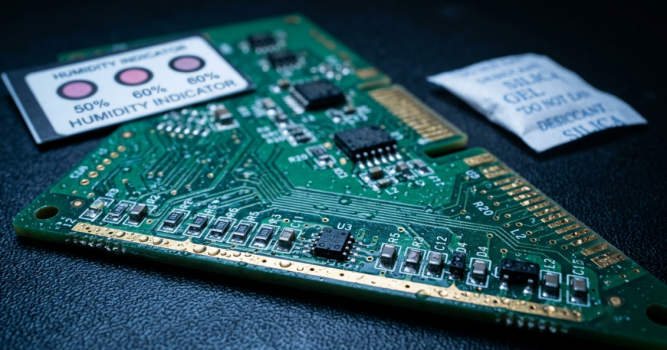
This trapped moisture alters the electrical, mechanical, and thermal characteristics of the board. In this article, we'll dig into the implications of moisture absorption in PCBs, how it can be measured, and how different laminates compare. Here you will discover the real-world design and manufacturing techniques to prevent water from getting in and ruining your board for weeks or years.
What Moisture Absorption Means for PCB Materials
All PCB substrates experience a balance with the environment. If a laminate is left in a moist room, it will gradually increase in weight due to the diffusion of water molecules into the resin and along the interfaces between the glass and resin. This is simply moisture absorption.
The issue is that water is a polar molecule and has a very high dielectric constant, ~78 at room temperature. A very small quantity of water, absorbed by a material, can significantly alter the electrical and mechanical characteristics of that material, which is otherwise stable. That is why you need to know how your PCB material will act when exposed to moisture before you have even started building your board.
Definition and How It Is Measured
So what are the measurable levels of moisture absorption? It is the percentage increase in weight of a material after exposure to water and/or humidity in a controlled condition. The industry standard approach is to immerse a conditioned laminate sample in distilled water and measure the weight gain according to IPC-TM-650 Test Method 2.6.2.1. The most frequently used protocol is D24/23, which involves drying the sample, weighing it, placing it in water at 23°C for 24 hours, and reweighing it. The weight gain is expressed as a percentage:
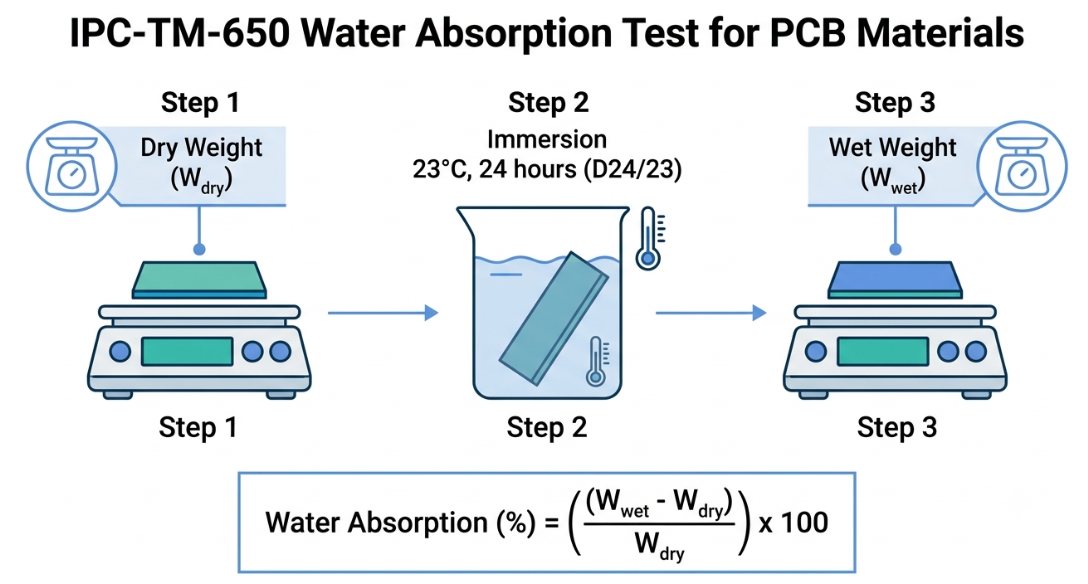
Water Absorption (%) = (Wet weight - Dry weight / Dry weight) × 100
It's important to point out a few things about this measure:
- Lower is better: A material with 0.05% will be more effective at resisting environmental humidity than a material with 0.5%.
- Test conditions matter: Some datasheets refer to pressure cooker or elevated temp soaks, that will yield higher numbers, so always compare apples to apples.
- It is a relative measure: The actual amount of absorption that occurs depends on the humidity, temperature, and length of exposure, but the IPC-TM-650 value allows for relative comparison of materials.
Absorption Rates of Common PCB Substrates
There are a lot of differences between the absorption rates of families of substrates, and the differences are greater than most engineers think. Standard FR4 is some sort of middle ground compromise, while polyimide is very thirsty and fluoropolymers are nearly hydrophobic. Understanding the position of the laminate you have selected on this continuum will give you an idea of how forcefully you should be dealing with storage and baking.
A simple rule of thumb: fluoropolymers absorb the least, FR4-type glass-reinforced epoxies absorb a medium amount, and polyimide absorbs the most. Let's give actual numbers to this in the comparison section below.
Why Moisture Absorption Significantly Impacts PCB Performance
Water absorbed in a laminate isn't lying there idly. It actively alters the property on which your design relies, and it does so in ways that range from a nuisance to catastrophic failure. There are two large buckets of impact: electrical and mechanical. Moisture changes the electrical properties of the air. Mechanically, it changes to steam in soldering and pulls the board apart from the inside.
Effects on Electrical Properties and Signal Integrity
Water has a high dielectric constant, so absorbed moisture increases the effective dielectric constant (Dk) of the laminate. A few percent change in Dk goes a long way in terms of changes in trace impedance, which is critical for controlled-impedance and high-speed designs. The dissipation factor (Df), which governs signal loss, is also increased by moisture. A wetter board is a lossier board, and your meticulously budgeted insertion loss on a 10Gbps link can “leak” out of spec. That can make the difference between a successful and a failed product for RF and microwave designs.
Let's see how moisture affects your electrical performance:
- Impedance shift, due to an increase in Dk, and deterioration of return loss and eye margin.
- Increased insertion loss due to more Df (primarily > 1 GHz).
- Reduction of insulation resistance, which increases leakage currents between conductors.
- Low dielectric breakdown voltage is a safety and reliability issue for high-voltage design.
Risks of Delamination, Warpage, and Reduced Lifespan
The mechanical risks are even more spectacular. Trapped water flashes to steam when the moisture-laden board reaches reflow temperatures of 245-260°C when applying lead-free assembly. This steam can expand suddenly and force the layers apart, causing delamination or, if blistered, "measling" and "popcorning.
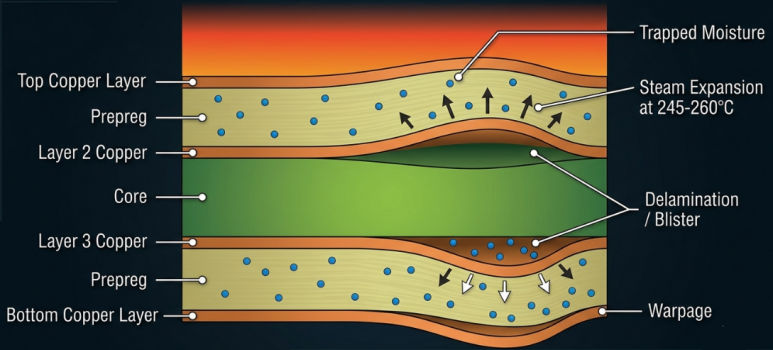
The absorbed moisture also reduces the glass transition temperature (Tg) slightly, and causes differential expansion that results in warpage that can destroy flatness and stress solder joints. Moisture over time can allow Conductive Anodic Filament (CAF) to develop and grow between plated holes and short the board using the glass fibers as a means of transport for the copper. These failures typically only manifest themselves after months in service, and moisture is one of the most insidious reliability hazards you will encounter.
Key Factors That Influence Moisture Absorption
Different laminates absorb water in different ways, and even the same type of laminate can have different properties depending on its manufacturing and storage. Knowing the details of these factors enables you to foresee and manage the moisture intake of your PCB materials.
Material Composition, Resin Content, and Surface Treatment
The resin system is the largest single driver. Epoxy resins are moderately hygroscopic, polyimide is more hygroscopic, and fluoropolymers such as PTFE absorb almost nothing. The chemistry determines literally how many water molecules the resin can hold. In addition to the foundation chemistry, a number of construction factors affect the needle:
- The percentage of resin and glass weave: In general, the higher the resin-to-glass ratio, the more that will be absorbed, and the glass-resin interface is a good conduit for water to enter.
- Filler loading: Laminates filled with ceramic absorb less than the same laminates without ceramic fillers because the inorganic fillers replace the resin that would absorb.
- Cure quality: A fully cured, well-laminated board has fewer voids and micro-cracks for water to reside.
- Surface preparation and surface finishing: The quality of via walls, solder mask coverage, and exposed copper all influence the ease with which moisture permeates the edges of the board and drilled holes.
Environmental Conditions and Storage Practices
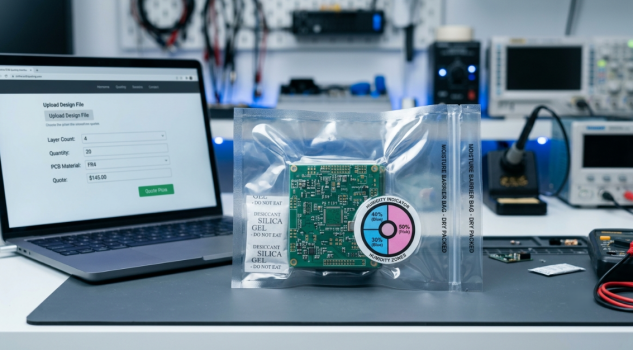
The rest is done by the environment. Moisture absorption depends on relative humidity, temperature, and time of exposure, and is governed by classical diffusion physics – the higher the humidity and the higher the temperature, the more quickly the moisture is absorbed. A bare laminate left on an open shelf in a humid facility can almost reach its saturation level within days to weeks. To ensure this, moisture-sensitive materials are often packaged in vacuum-sealed bags containing desiccant and humidity indicator cards, and low-humidity controlled storage is a standard practice. The way a board is stored prior to assembly can be as important as the material you selected.
Comparing Moisture Absorption Across Popular PCB Materials
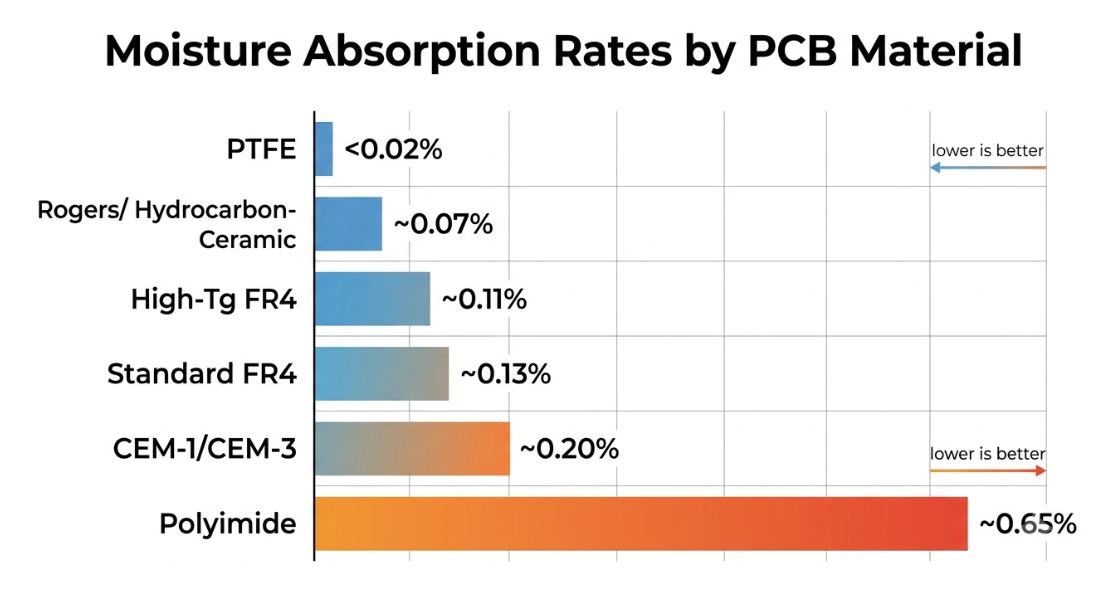
Let's now give numbers to all these. The water absorption rates shown below are typical as measured under IPC-TM-650 style conditions, and the practical consequence of each class of materials is summarized. Use these as indicative ranges, as actual values may differ from manufacturer to manufacturer and test to test.
| PCB Material | Typical Water Absorption (%) | Notes / Impact |
|---|---|---|
| Standard FR4 | 0.10 – 0.15 | Good general-purpose balance; manageable with normal baking and storage |
| High-Tg FR4 | 0.08 – 0.15 | Similar to standard FR4 but tolerates reflow better due to higher Tg |
| Polyimide | 0.40 – 0.90 | Highest absorption; requires strict baking before assembly |
| PTFE (Teflon) | < 0.02 | Near-hydrophobic; excellent for mmWave, but hard to process |
| Rogers / Hydrocarbon-Ceramic | 0.04 – 0.10 | Low and stable; ideal for RF where Dk/Df must not drift |
| CEM-1 / CEM-3 | 0.15 – 0.25 | Paper/glass composites; higher uptake, used in low-cost consumer boards |
Standard FR4 vs High-Tg, Low-Dk, and High-Frequency Laminates
For most digital and low-frequency designs, standard FR4 is fine. The absorption rates are well known and are in the range of 0.10-0.15%, and a routine bake-out prior to assembly will prevent delamination. Things are different at high speed and RF. Low Dk and high frequency laminates like Rogers RO4350B or hydrocarbon-ceramic systems are used as not only low and stable Dk but also low absorption, which is usually in the range of 0.04-0.10%. It's that stability that maintains the desired impedance and loss, both in humid and dry environments. In between is the High-Tg FR4, which provides a compromise of high thermal survival during lead-free reflow with FR4-like absorption.
Moisture Behavior in Lead-Free and High-Reliability Applications
The risk of moisture increased with the advent of lead-free assembly. Old tin-lead profiles would never come near the steam pressure created by the higher peak reflow temps of the SAC305 solder, ~245 - 260 °C. A board that has been successfully assembled at 220°C with lead could pop if it is not dried properly using a lead-free assembly temperature. Moisture control is a must in high-reliability industries like automotive, aerospace, and medical. For these applications, IPC-6012 boards, formally tested for their ability to resist CAF and to survive delamination, are often required. You meet those requirements consistently by selecting a low-absorption laminate and by ensuring proper moisture handling.
Design and Manufacturing Strategies to Minimize Moisture Issues
The good news is that moisture problems can be almost completely avoided. With the use of a combination of intelligent selection of materials, disciplined processing, and proper design rules, the vast majority of moisture-related failures can be eliminated.
Material Selection, Bake-Out Processes, and Protective Coatings
Begin at the level of the material! Don't just end up fighting this problem later; specify a low-absorbing laminate from the beginning if your product will be used in a humid or thermally challenged place.
Then incorporate these steps in your process:
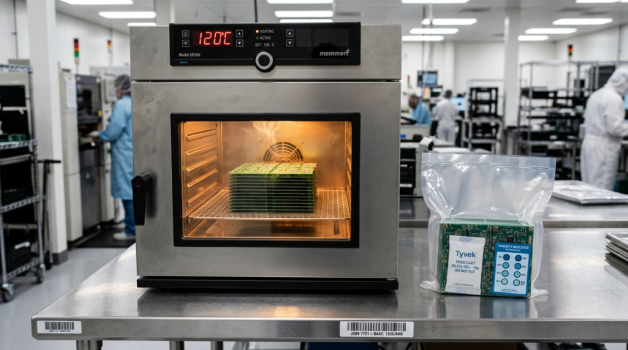
- Pre-assembly bake-out: Exhaust moisture by baking boards at 105-125°C for 4-8 hours (depending on the thickness of the board or polyimide board) before reflow.
- Apply protective coatings: Field moisture ingress is reduced by conformal coatings and a solid solder mask.
- Seal open edges and openings: The fewer the ways that water can enter the laminate, the more water is kept out by using Via filling and good edge coverage.
- Handle immediately after baking: When it comes to assembling a dried board, it will reabsorb moisture, so make sure that it is within the moisture sensitivity level (MSL) window.
DFM Guidelines and Process Controls for Moisture Management
Moisture resilience is also a function of design. Observe DFM rules that minimize the physical conditions conducive to water entry and CAF growth:
- Add more space between holes to improve CAF margin (IPC-2221 clearance guidance).
- Prevent resin-starved areas by the appropriate selection of prepreg and balancing of copper.
- Indicate sufficient solder mask over traces and around annular rings.
- Effectively control lamination quality to avoid voids that hold moisture.
Process side, receipt of laminate lots, storage in a humidity-controlled environment, and handling of laminate according to IPC/JEDEC J-STD-033 take moisture management from guesswork to repeatable and auditable processes.
JLCPCB's Expertise in Low-Moisture Absorption PCB Production
Learning theory is very different from putting it into practice at a production scale. Here is where a manufacturer's material discipline and process controls will directly impact whether your boards make it through the realities of humidity. It is based on these controls that JLCPCB has developed its workflow.
Strict Material Qualification and Moisture-Controlled Storage
The first step to reliable low-absorption boards is using qualified raw materials. JLCPCB is a trusted source for laminates and ensures that every lot complies with its published water absorption and thermal requirements before entering production. No less vital, those laminates and completed boards are kept in dampness-managed stockrooms. Moisture-sensitive materials are carefully handled to reduce humidity exposure, and boards intended for assembly are prevented from moisture absorption to ensure they are dry and stable when they reach the reflow line.
Advanced Manufacturing Processes with Moisture Mitigation
Moisture is directly addressed in several steps on the production floor. For lead-free reflow and reliability critical builds, Boards may be baked before assembly to remove any water absorbed. From the factory to your workbench, finished boards are vacuum sealed with desiccant and a humidity indicator card. When used in conjunction with controlled lamination and quality inspection, these prevent the delamination and CAF issues that moisture can cause.
Reliable High-Performance Boards for Demanding Environments
The payoff is boards that hold their electrical and mechanical properties in the field. Whether for a 5 GHz RF front-end with a low-Dk laminate or a high-Tg FR4 for an automotive module, the same degree of moisture discipline applies. JLCPCB's quick turnaround, instant online quoting, and in-house SMT assembly ensure that transitioning from moisture-driven design to a reliable product is easy.
FAQ about Moisture Absorption
Q: What is moisture absorption in PCBs, and why does it matter?
Moisture absorption is the amount of water a PCB laminate takes up from its environment, reported as a percentage of weight gain. It matters because absorbed water raises the dielectric constant and loss, and it can flash to steam during soldering to cause delamination and long-term CAF failures.
Q: How is the moisture absorption of PCB material measured?
It is measured per IPC-TM-650 Test Method 2.6.2.1, typically by drying a sample, immersing it in water at 23°C for 24 hours, and recording the percentage weight gain. Lower percentages indicate a more moisture-resistant material.
Q: Which PCB material has the lowest absorption rates?
PTFE (Teflon) laminates have the lowest absorption, often below 0.02%, followed by Rogers hydrocarbon-ceramic materials at roughly 0.04–0.10%. Standard FR4 is moderate at 0.10–0.15%, while polyimide is the highest common material at 0.40–0.90%.
Q: Do I need to bake my boards before assembly?
For most moisture-sensitive materials and all lead-free reflow, yes. Baking at 105–125°C for several hours drives out absorbed moisture and prevents delamination or popcorning during soldering; boards should then be assembled promptly before they reabsorb water.
Q: How does JLCPCB control moisture in its PCBs?
JLCPCB qualifies laminate lots against their absorption specifications, keeps materials and boards in moisture-controlled storage, bakes boards before assembly when needed, and ships finished boards in vacuum-sealed bags with desiccant and a humidity indicator card.
Conclusion
Moisture is invisible until it isn't, and then you might be looking at a delaminated board or a signal that is out of spec. The good news is that it's one of the most controllable reliability factors in all of PCB engineering. Having the absorption rate of a material will allow you to design storage, baking margins, and plan accordingly.
Along with the trend toward higher frequencies, lead-free assembly, and more demanding operating conditions for electronics, the amount of moisture the products can tolerate continues to diminish. The key to a laminate that lasts the duration of the warranty, as opposed to a decade, is how it's combined with good moisture management. To implement these principles, JLCPCB's expertise in materials, moisture management, and vacuum packaging provides your design with a solid, stable foundation, ensuring it achieves long-lasting reliability.
Keep Learning
How Copper Foil Shapes PCB Performance and Manufacturing Quality
Key Takeaways Weight: 1 oz copper ≈ 35 µm thickness; higher weight increases current capacity. Types: ED for standard rigid boards, RA for dynamic flex circuits. DFM & Loss: Smoother foil lowers RF loss; thicker foil requires wider trace spacing. The part of a PCB that actually carries the electrical signal is the copper foil. The strength comes from the glass weave, the resin is used to keep the layers together, and the solder mask is used to provide protection and separation of exposed copper. But w......
A Complete Guide to Copper Clad Laminate (CCL) in PCB Manufacturing
Key Takeaways CCL is the base material: a cured resin-reinforcement sheet with copper foil bonded to one or both sides. Three parts control performance: Resin affects heat and loss, reinforcement controls stability, and copper foil affects conductor behavior. Choose by the main design stress: Heat, frequency, and cost usually determine the best laminate family. Slash sheets define the material: IPC-4101 uses numbered slash sheets to specify rigid PCB base materials. Tg alone is not enough: Td and time......
Buried Vias in Advanced PCBs: Enabling Higher Density, Better Signal Integrity, and Compact Designs
Key Takeaways Hidden Routing: Buried vias connect only inner layers, keeping outer surfaces clear for dense components and traces. Better Signal Integrity: They eliminate via stubs, reducing parasitics and signal loss in high-speed designs. Higher Density: Essential for HDI boards, dense BGAs, and small form factors like wearables. Higher Cost: Sequential lamination and extra drilling steps make them ~3×-4× more expensive than standard through-holes. Ever wondered how a modern smartphone mainboard can......
Unlocking Higher Density and Better Performance with Blind Vias in HDI PCBs
Key Takeaway Higher Density: Connects surface to inner layers without penetrating the whole board, freeing routing channels under fine-pitch BGAs. Improved Signal Integrity: Reduces via stub length to minimize impedance discontinuities in high-speed designs. Aspect Ratio Rule: Keep the depth-to-diameter ratio near 0.75:1 (max 1:1) for reliable laser drilling and void-free plating. Thermal Efficiency: Supports via-in-pad setups for better heat dissipation and compact component placement. Ever wonder ho......
How to Select Tg of PCB ?
What is the Tg of PCB? In PCB manufacturing, "Tg" stands for Glass Transition Temperature. It is the temperature at which the PCB substrate material transitions from a rigid, glassy state to a soft, rubbery state. PCBs are flame-retardant (UL94 V-0) and do not burn easily; instead, they soften above Tg. The Critical Correlation Between Tg and Z-Axis CTE (Coefficient of Thermal Expansion) When the temperature exceeds the Tg point, the PCB substrate material (such as standard FR-4) undergoes a physical ......
Beyond the Basics: The Role of PTFE PCBs
Polytetrafluoroethylene (PTFE) PCBs are integral to advanced electronic applications. Among various PCB materials, Teflon, the brand name for Polytetrafluoroethylene (PTFE). Teflon PCBs, known for their high frequency and heat resistance properties. All of this is achievable due to its exceptional dielectric properties. RF PCB designs often make use of low-loss PTFE-based materials thanks to their very low dielectric losses and huge range of possible Dk values. Low Dielectric Constant: Enables high-sp......