What is the Standard Thickness of a PCB?
10 min
- What Is the Standard PCB Thickness?
- Factors That Determine PCB Thickness
- Standard PCB Thickness Options and Applications
- How to Select the Right PCB Thickness
- PCB Thickness vs. Layer Count
- FAQ about Standard Thickness of a PCB
- Conclusion

Key Takeaways
- 1.6 mm Standard: 1.6 mm (0.062") is the universal industry standard, balancing rigidity, assembly ease, and component fit.
- 0.4mm–3.0mm Options: JLCPCB provides versatile FR-4 thicknesses from 0.4 mm for ultra-thin devices to 3.0 mm for high-power systems.
- Stackup Flexibility: Multilayer PCBs up to 12–16 layers can still maintain a 1.6 mm profile using thinner cores and prepregs.
- Impedance & Heat Balance: Dielectric thickness directly sets trace impedance (Z0), while thicker boards increase thermal resistance.
- 10:1 Aspect Ratio Limit: Thicker boards require larger minimum drill sizes (e.g., ≥ 0.2 drill for a 2.0 mm board) for reliable via plating.
A Printed Circuit Board (PCB) is the foundation of electronic devices, which serves as a substrate to support electrical components. In PCB design, thickness is a crucial parameter as it influences several key processes. It influences not only the mechanical performance of the board but also its electrical properties, manufacturability, and overall cost. The prevailing PCB thickness is 1.6 mm, but there will be many further options suitable for various purposes. Knowing the rule and when it’s acceptable to break it regarding your PCB thickness can help designers make a decision that will keep your circuit board functioning as intended.
If you want to explore different PCB thickness options for your next project, you can easily customize them when placing an order at JLCPCB. Their instant online quote lets you compare prices and lead times across multiple thicknesses.
What Is the Standard PCB Thickness?
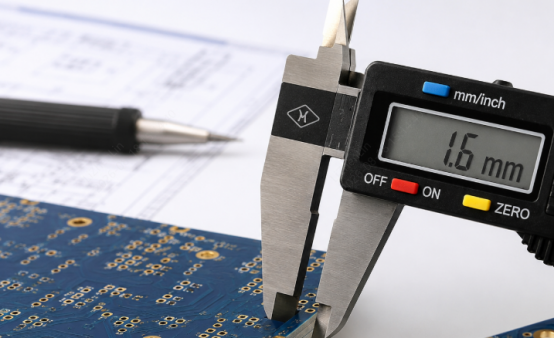
1.6 mm (0.062 inch) is the most common standard PCB thickness. This dimension is the industry standard because it strikes a balance among mechanical strength, manufacturability, and compatibility with most electronic assemblies. A 1.6 mm board is rigid enough for structural handling, yet thin enough to fit into compact devices.
However, 1.6 mm is not the only option. JLCPCB provides a wide range of standard FR-4 board thicknesses to meet different mechanical and space constraints:
·0.4 mm – ultra-thin option popular in wearable devices, SIM card modules, and compact sensors.
·0.6 mm – lightweight design suitable for highly space-constrained enclosures and smart cards.
·0.8 mm – popular in compact consumer electronics and portable IoT equipment.
·1.0 mm – often used in handheld devices, small form factor boards, and mobile accessories.
·1.2 mm – a balanced alternative for mid-sized devices requiring reduced weight without losing stability.
·1.6 mm – the universal standard for general-purpose electronics, mainboards, and industrial controls.
·2.0 mm – chosen when extra rigidity is needed for boards with heavy components or high-vibration environments.
·2.5 mm to 3.0 mm – applied in high-power electronics, automotive PCBs, and heavy-duty industrial systems where high mechanical strength is critical.
These thickness options are readily available to satisfy varying engineering requirements, but 1.6 mm remains the primary go-to choice for universal PCB manufacturing.
Factors That Determine PCB Thickness
Number of Layers & Stackup Architecture
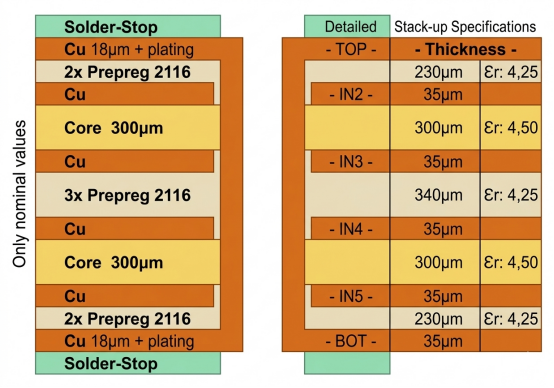
The number of layers directly influences the choice of core substrates and prepreg (PP) materials. A standard 2-layer board easily defaults to 1.6 mm using a single thick core substrate.
For multilayer PCBs (e.g., 4, 6, 8, or 12 layers), maintaining a total thickness of 1.6 mm requires precise stackup adjustments. Fabricators like JLCPCB use thinner dielectric cores (e.g., 0.1 mm–0.2 mm) and thin prepreg sheets (such as 7628, 2116, or 1080 PP) between copper foils. While 8 to 12-layer boards can still be manufactured at 1.6 mm total thickness, designs exceeding 12–16 layers often require an increased overall thickness (e.g., 2.0 mm or 2.5 mm) to preserve mechanical stability, microvia reliability, and fabrication yields.
Mechanical Rigidity & Thermal Management
Thicker substrates increase structural stiffness, preventing sagging or warping during thermal processing (reflow soldering) and physical handling. This is ideal for heavy industrial power supplies or automotive electronics subjected to high vibration. Conversely, thinner boards (0.4 mm–0.8 mm) are essential for weight-sensitive applications like wearables and IoT devices.
Board thickness also plays a crucial role in thermal dissipation. Standard FR-4 has a relatively low thermal conductivity (~0.3 (W/m·K)). A thicker FR-4 dielectric increases vertical thermal resistance (Rth = d/k·A), making heat transfer from top-layer components to bottom heat sinks slower. To mitigate heat buildup on thicker boards, designers must utilize thermal vias, thicker inner copper layers (e.g., 2 oz copper at JLCPCB), or alternative substrates like Aluminum-core PCBs.
Electrical Performance
PCB thickness also affects the electrical characteristics of the board. For example, the use of controlled impedance is critical for high-speed and/or high-frequency designs. In which the thicknesses of dielectric layers between copper planes directly affect signal quality and exchange, thus overall signal integrity. In which the designers also often speak with PCB fabricators to determine which stack-up and how much thickness is best for a specific application to achieve stable and reliable electrical performance.
Manufacturing Standards and Cost
A better alternative is to settle on a standard thickness such as 1.6 mm. It conforms to the PCB thickness of the IPC-2221 standard and is regularly used by most PCB fabrication houses. Moreover, these options are easier to acquire and make and cost less. Although it is possible to have thicker or thinner PCBs, these will increase lead times and overall PCB production costs.
Standard PCB Thickness Options and Applications
The following thickness ranges are commonly used in the industry, each serving different applications and manufacturing requirements:
| PCB Thickness | Supported Layers @JLCPCB | Typical Applications | JLCPCB Process Notes |
|---|---|---|---|
| 0.4 mm – 0.6 mm | 1, 2, 4 layers | Wearable devices, SIM modules, ultra-thin sensors, FPC stiffeners | Ultra-thin and flexible; V-cut panelization may have restrictions. |
| 0.8 mm – 1.0 mm | 1, 2, 4, 6, 8 layers | Handheld devices, consumer electronics, compact IoT modules | Reduces overall weight and volume; ideal for card-edge designs. |
| 1.6 mm (Standard) | 1 – 32 layers | General-purpose electronics, mainboards, communication gear | Default standard; offers the best cost-to-performance ratio and fastest turnaround. |
| 2.0 mm – 2.5 mm | 2 – 32 layers | Automotive electronics, backplanes with heavy connectors, high-power supplies | High mechanical strength; watch out for drill aspect ratio constraints. |
| 3.0 mm – 3.2 mm | 2 – 16 layers | Industrial control systems, power electronics, heavy-copper boards | Extra-thick board; larger via diameters recommended for reliable hole plating. |
It reflects that 1.6 mm is the universal standard, yet designers maintain a free choice of thickness according to performance and mechanical requirements.
How to Select the Right PCB Thickness
Consider Electrical Requirements & Impedance Control
In high-speed and RF PCB designs, substrate dielectric thickness between signal traces and reference planes directly determines the characteristic impedance (Z0) . For a standard microstrip line, characteristic impedance is governed by: Z0 ≈ (87 / √(εr + 1.41)) * ln(5.98 * h / (0.8 * w + t))(where h is dielectric thickness, w is trace width, t is copper thickness, and εr is dielectric constant)
A thinner dielectric layer (h) allows for narrower trace widths (w) to achieve target 50 Ω single-ended or 90/100 Ω differential impedance, which is crucial for dense BGA routing. Fabricators like JLCPCB provide pre-calculated impedance stackup templates (JLC-Impedance tool) to simplify high-speed layout design.
Consider Mechanical Requirements
If your board is likely to experience physical stress, vibration, or connector mating, then you may benefit from increasing the thickness up to 2.0mm or above. Thinner boards are preferred, on the other hand, for portable or wearable devices and handheld equipment.
Consider Manufacturing & Cost
Some common thicknesses are also more readily available and cheap, such as 1.6mm/1.2mm. Custom configurations are sometimes required for unique projects, but they can typically come with higher fabrication costs and a larger lead count. We adhere to the industrial standard and acceptance, making it easier to trace the production.
PCB Thickness vs. Layer Count
It is a common misconception that more layers automatically result in a thicker PCB. A 1.6 mm PCB can easily accommodate anywhere from 2 up to 12 (or even 16) layers by using thinner cores and prepregs.
However, when selecting thickness for high-layer-count boards (12+ layers), designers must consider the Drill Aspect Ratio (Board Thickness : Drill Diameter). Fabricators like JLCPCB typically maintain a maximum aspect ratio of 10:1 for standard PTH (Plated Through Hole) processing. For instance, on a 2.0 mm thick board, the minimum reliable mechanical drill size is:
Min Drill Diameter =Board Thickness/10 = 2.0 mm/10 = 0.2 mm
Choosing an overly thick board with tiny vias can lead to plating solution flow issues inside the hole, resulting in unplated via walls and board failure. Non-standard thickness custom configurations may also lead to higher fabrication costs and longer lead times.
FAQ about Standard Thickness of a PCB
Q: What is the most common standard PCB thickness?
The standard PCB thickness is 1.6 mm (0.062 inches), which provides the optimal balance of mechanical strength, ease of handling during assembly, and compatibility with standard electronic components.
Q:What board thickness options does JLCPCB offer for FR-4 PCBs?
JLCPCB offers standard FR-4 board thicknesses ranging from 0.4 mm to 3.0 mm, including 0.4 mm, 0.6 mm, 0.8 mm, 1.0 mm, 1.2 mm, 1.6 mm, 2.0 mm, 2.5 mm, and 3.0 mm.
Q: Does adding more layers make a PCB thicker?
Not necessarily, as manufacturers can adjust the thickness of internal core substrates and prepreg layers to maintain a standard 1.6 mm total thickness for boards with up to 12 or 16 layers.
Q: How does dielectric thickness affect impedance control in high-speed designs?
Dielectric thickness directly dictates the characteristic impedance between signal traces and reference planes, where thinner dielectrics allow narrower trace widths to achieve target impedances like 50 Ω single-ended or 100 Ω differential signals.
Q: What limits the thickness choice for PCBs with small via holes?
Thick boards with tiny vias are limited by the manufacturing drill aspect ratio (typically 10:1 at JLCPCB), meaning a 2.0 mm thick board requires a minimum mechanical drill size of 0.2 mm to ensure reliable hole plating.
Conclusion
It’s easy to dismiss the thickness of the PCB as trivial when first designing it; however, there are implications for mechanical strength, signal quality, layer stack-up sequencing, and even price. PCBs come in different thicknesses, the most popular being the 1.6 mm industry standard, but they can range from 0.2 mm up to 3.2 mm or above! The trade-off between performance and manufacturability, this thickness is the sweet spot for most applications.
Keep Learning
Is FR4 the Best Board Material for Your Design
Key Takeaways Best All-Rounder: Ideal balance of strength, insulation, and low cost for standard PCBs. Clear Limits: Poor heat dissipation (~0.3 W/m·K) and high loss for RF (>3 GHz). Alternatives: Use Rogers for RF, Aluminum for high heat, and FPC for flexibility. Selection Essentials: Pick High-Tg (170°C+) for lead-free reflow and custom stackups for impedance. JLCPCB Advantage: 1–32 layer FR4 boards with ±10% impedance control and 24h fast dispatch. In the world of electronics and printed circuit bo......
Optimizing High-Voltage Circuit Safety with PCB Dielectric Strength
Key Takeaways Non-linear Scaling: Dielectric strength drops as thickness increases. Safety vs Signals: Dielectric strength ensures safety, while Dk controls signal speed. Material Selection: High-voltage safety depends on Tg, CTI, and moisture resistance. Spacing Rules: Clearance prevents air arcs, while creepage prevents surface tracking. Assembly Testing: Hi-pot testing requires finished assemblies, not bare boards. Dielectric strength is the number engineers quote to prove a board is safe at mains ......
How Copper Foil Shapes PCB Performance and Manufacturing Quality
Key Takeaways Weight: 1 oz copper ≈ 35 µm thickness; higher weight increases current capacity. Types: ED for standard rigid boards, RA for dynamic flex circuits. DFM & Loss: Smoother foil lowers RF loss; thicker foil requires wider trace spacing. The part of a PCB that actually carries the electrical signal is the copper foil. The strength comes from the glass weave, the resin is used to keep the layers together, and the solder mask is used to provide protection and separation of exposed copper. But w......
A Complete Guide to Copper Clad Laminate (CCL) in PCB Manufacturing
Key Takeaways CCL is the base material: a cured resin-reinforcement sheet with copper foil bonded to one or both sides. Three parts control performance: Resin affects heat and loss, reinforcement controls stability, and copper foil affects conductor behavior. Choose by the main design stress: Heat, frequency, and cost usually determine the best laminate family. Slash sheets define the material: IPC-4101 uses numbered slash sheets to specify rigid PCB base materials. Tg alone is not enough: Td and time......
Buried Vias in Advanced PCBs: Enabling Higher Density, Better Signal Integrity, and Compact Designs
Key Takeaways Hidden Routing: Buried vias connect only inner layers, keeping outer surfaces clear for dense components and traces. Better Signal Integrity: They eliminate via stubs, reducing parasitics and signal loss in high-speed designs. Higher Density: Essential for HDI boards, dense BGAs, and small form factors like wearables. Higher Cost: Sequential lamination and extra drilling steps make them ~3×-4× more expensive than standard through-holes. Ever wondered how a modern smartphone mainboard can......
Unlocking Higher Density and Better Performance with Blind Vias in HDI PCBs
Key Takeaway Higher Density: Connects surface to inner layers without penetrating the whole board, freeing routing channels under fine-pitch BGAs. Improved Signal Integrity: Reduces via stub length to minimize impedance discontinuities in high-speed designs. Aspect Ratio Rule: Keep the depth-to-diameter ratio near 0.75:1 (max 1:1) for reliable laser drilling and void-free plating. Thermal Efficiency: Supports via-in-pad setups for better heat dissipation and compact component placement. Ever wonder ho......