Solder Paste Types, Viscosity & Mesh Size: A Printing-Performance Guide
11 min
- Quick Answer: Solder Paste Types, Mesh, and Viscosity in One Minute
- Solder Paste Types Explained: Powder Particle Size (IPC Type 3/4/5)
- Solder Paste Mesh Size: What the Numbers Mean
- Solder Paste Viscosity: What It Is and Why It Matters
- Matching Solder Paste Types to Your Stencil and Pitch
- Trade-offs: Why Finer Solder Paste Types Aren’t Always Better
- Common Solder Paste Type and Mesh Mistakes
- FAQ about Solder Paste Types, Mesh, and Viscosity
- Conclusion: Choosing the Right Solder Paste Types, Mesh, and Viscosity
Key Takeaways
Type and mesh describe powder size, viscosity describes flow: Higher IPC Type numbers mean progressively finer powder for smaller stencil apertures, while viscosity governs how the paste rolls, fills, and releases, so both must be matched to the aperture, foil thickness, and printing method.
Screen with the five-ball rule and area ratio: The smallest aperture width should be about five times the largest powder diameter, and a release target around 0.66 area ratio or higher helps, so choose the coarsest powder that reliably prints your smallest aperture.
Finer is not automatically better: Smaller particles add surface area, oxidation sensitivity, cost, and process demands, and viscosity values are comparable only under the same test conditions, so confirm every choice against the paste datasheet.
Solder paste may look like a single gray material, but its printing behavior changes significantly with powder size and viscosity. Terms such as solder paste type, mesh size, and viscosity are often mixed together, even though they answer different questions. The right combination determines whether paste fills a stencil aperture, releases cleanly, and stays where it is printed.
This guide focuses on solder paste types in the IPC particle-size sense, along with solder paste mesh size and solder paste viscosity. It does not attempt to choose an alloy or flux chemistry for you. Those are separate decisions that affect melting behavior, reliability, cleaning, and residues.
For broader material background, see what solder paste is and how it is used. For alloy selection, use the separate lead-free vs. lead solder guide rather than treating powder Type as an alloy label.
Quick Answer: Solder Paste Types, Mesh, and Viscosity in One Minute
Solder paste Type and mesh describe the solder powder’s particle-size range: higher Type numbers use finer powder for smaller stencil apertures. Viscosity describes how the paste flows during printing. Good print quality comes from matching the powder size and flow behavior to the stencil opening, foil thickness, and printing method.
Solder Paste Types Explained: Powder Particle Size (IPC Type 3/4/5)
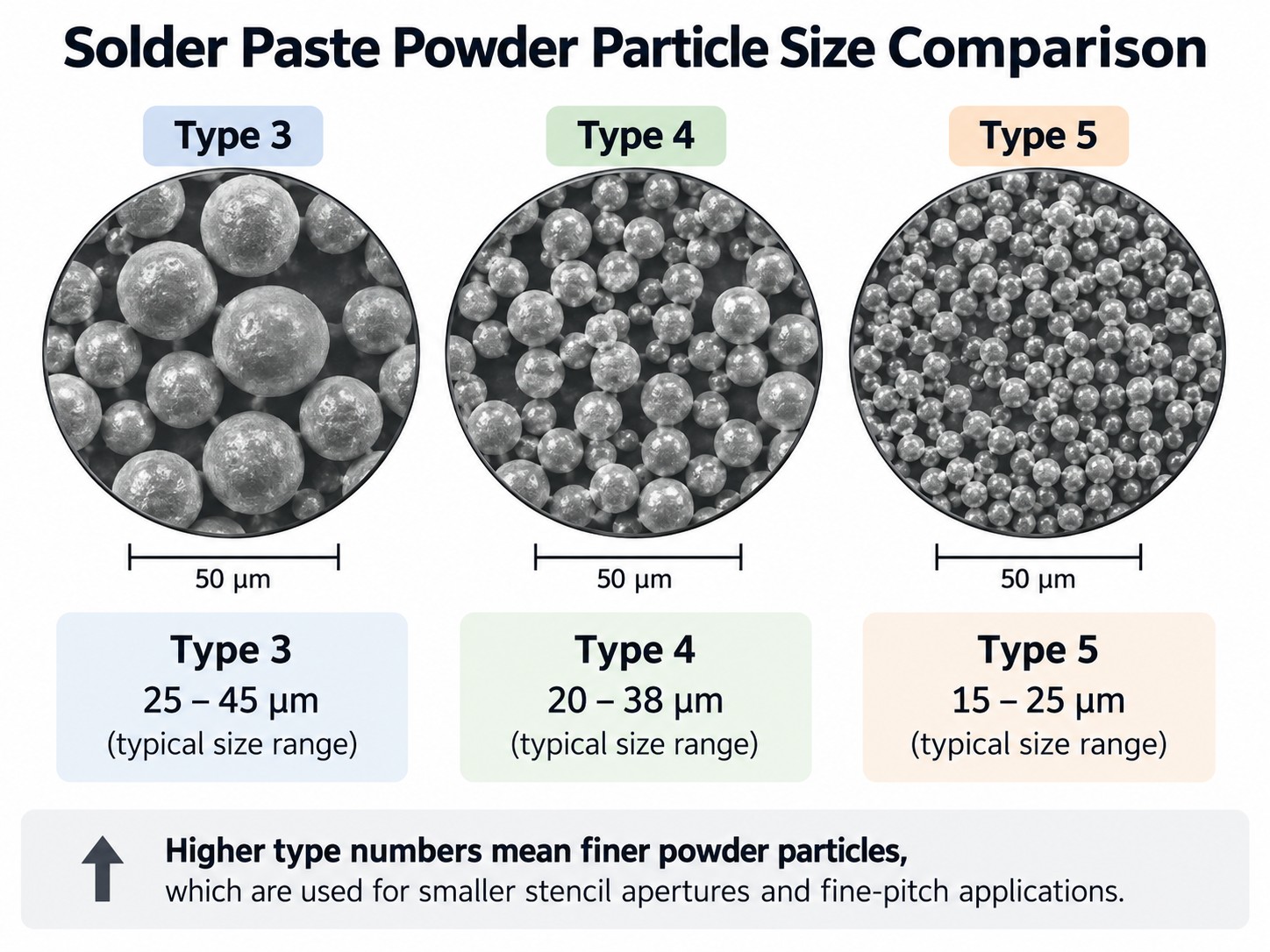
IPC J-STD-005B Requirements for Solder Pastes classifies solder powder by particle-size distribution and shape. In everyday production language, Type 3, Type 4, Type 5, and Type 6 refer to progressively finer solder powder. A higher Type number does not mean a better alloy; it simply means a smaller powder distribution.
That distinction matters because alloy and powder size are independent. SAC305, Sn63/Pb37, and other alloys can be supplied in more than one powder Type. Specify the alloy, flux system, and powder Type separately when ordering paste.
Solder Paste Powder Types
| Powder Type | Typical Particle Size | Common Mesh Shorthand* | Typical Use |
|---|---|---|---|
| Type 3 | 25–45 µm | −325/+500 | General SMT and standard-pitch printing |
| Type 4 | 20–38 µm | Commonly −400 class; supplier notation varies | Fine pitch and smaller stencil apertures |
| Type 5 | 15–25 µm | Commonly −500/+635 | Ultra-fine deposits, 0201/01005 where process allows |
| Type 6 | 5–15 µm | Finer than typical Type 5 mesh shorthand | Microelectronics and extremely small deposits |
AI-generated
Solder Paste Mesh Size: What the Numbers Mean
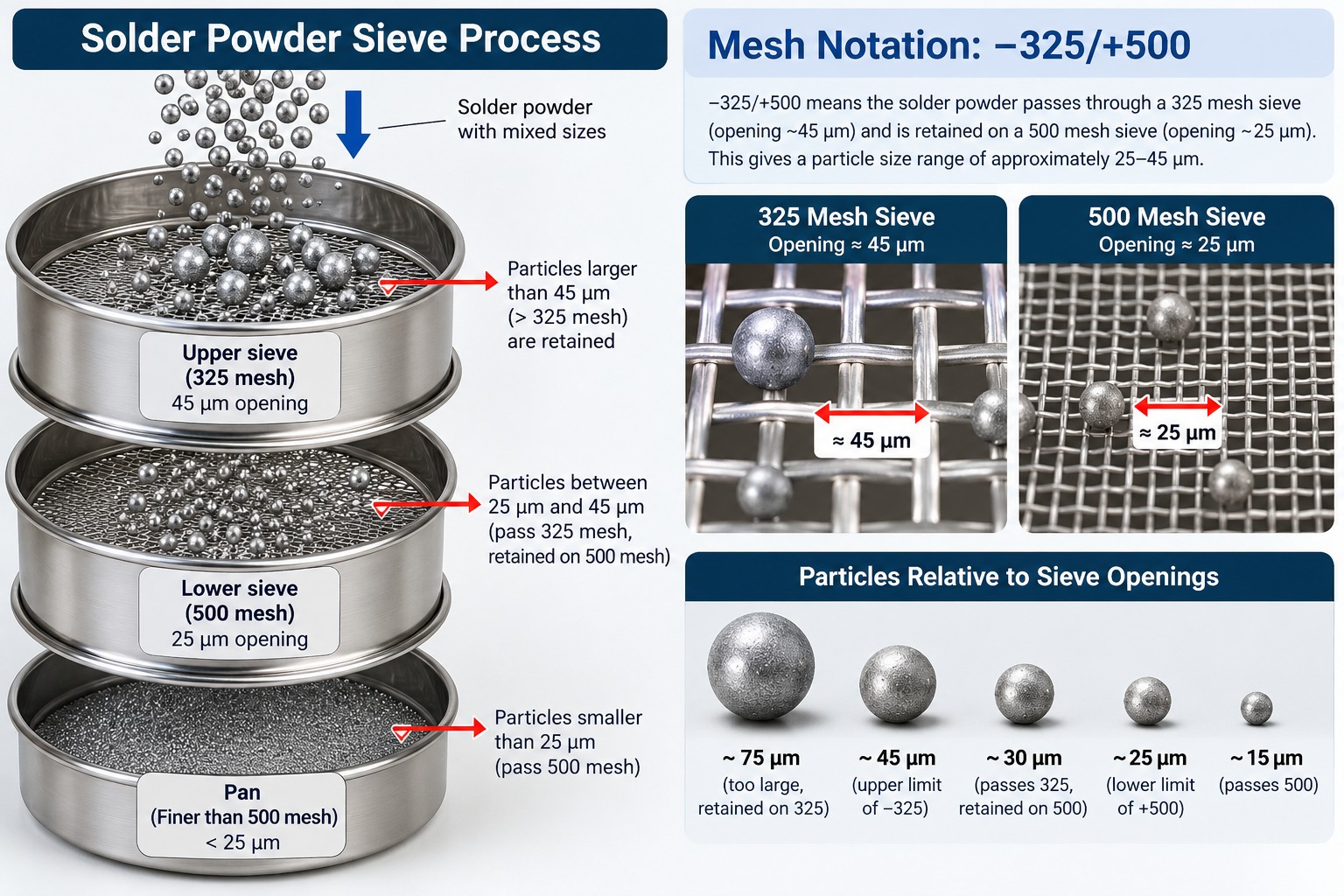
Mesh notation comes from the sieves used to separate solder powder. A minus sign means particles pass through that sieve; a plus sign means they are retained by the next sieve. For example, −325/+500 describes powder that passes a 325-mesh screen but is retained above the finer 500-mesh screen.
Mesh and IPC Type are therefore two ways of describing the same basic property: powder size. In modern process documents, the micron range and IPC Type are usually clearer because mesh terminology is not always written consistently across suppliers.
The practical effect is straightforward. Finer powder can move through smaller apertures and release from fine-pitch stencil features more reliably. However, finer powder also creates more metal surface area, which increases sensitivity to oxidation and process conditions.
AI-generated
Solder Paste Viscosity: What It Is and Why It Matters
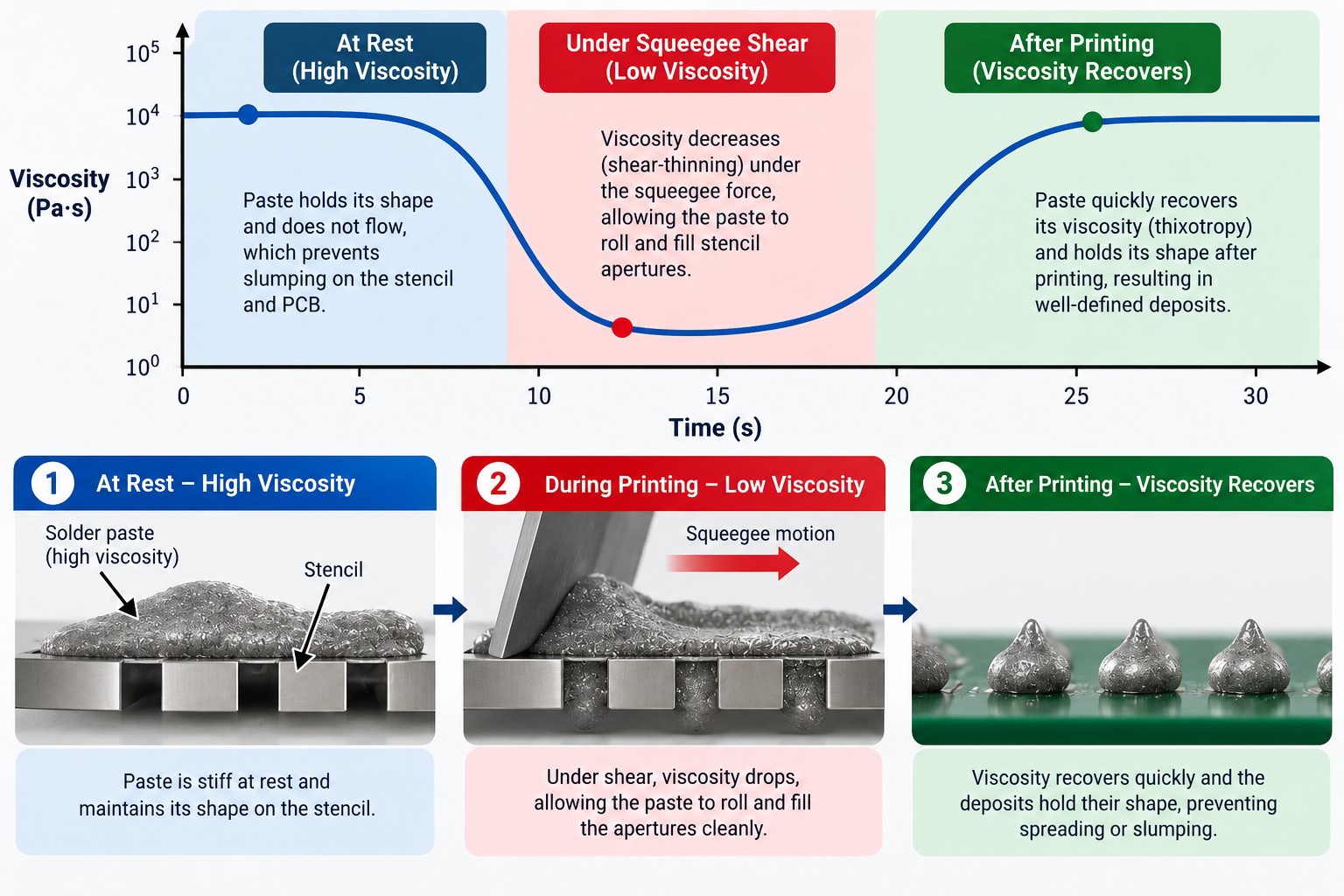
Solder paste viscosity describes resistance to flow, but a single viscosity number does not tell the whole story. Stencil-printing paste is designed to be thixotropic, or shear-thinning. It becomes easier to move while the squeegee applies shear, then recovers after printing so the deposit keeps its shape.
If the paste is too fluid for the process, deposits can spread after stencil release and increase the risk of bridging. If it is too stiff, the paste may roll poorly, skip apertures, or fail to fill and transfer completely.
Do not compare viscosity values without the test conditions. Supplier data may use Pa·s or poise, and the reading depends on temperature, spindle or viscometer type, and test speed. For example, one printable T4 paste may be listed near 1,700 poise under a specified Malcom-viscometer condition, while another process uses a different range. The paste datasheet is the controlling reference.
If you are troubleshooting slump, skips, or bridging, use the solder paste printing defects guide alongside the paste datasheet rather than changing viscosity by guesswork.
AI-generated
Matching Solder Paste Types to Your Stencil and Pitch
Powder size matters most when stencil openings become small. The paste particles must be comfortably smaller than the narrowest aperture dimension; otherwise, particles can crowd the opening and reduce transfer efficiency.
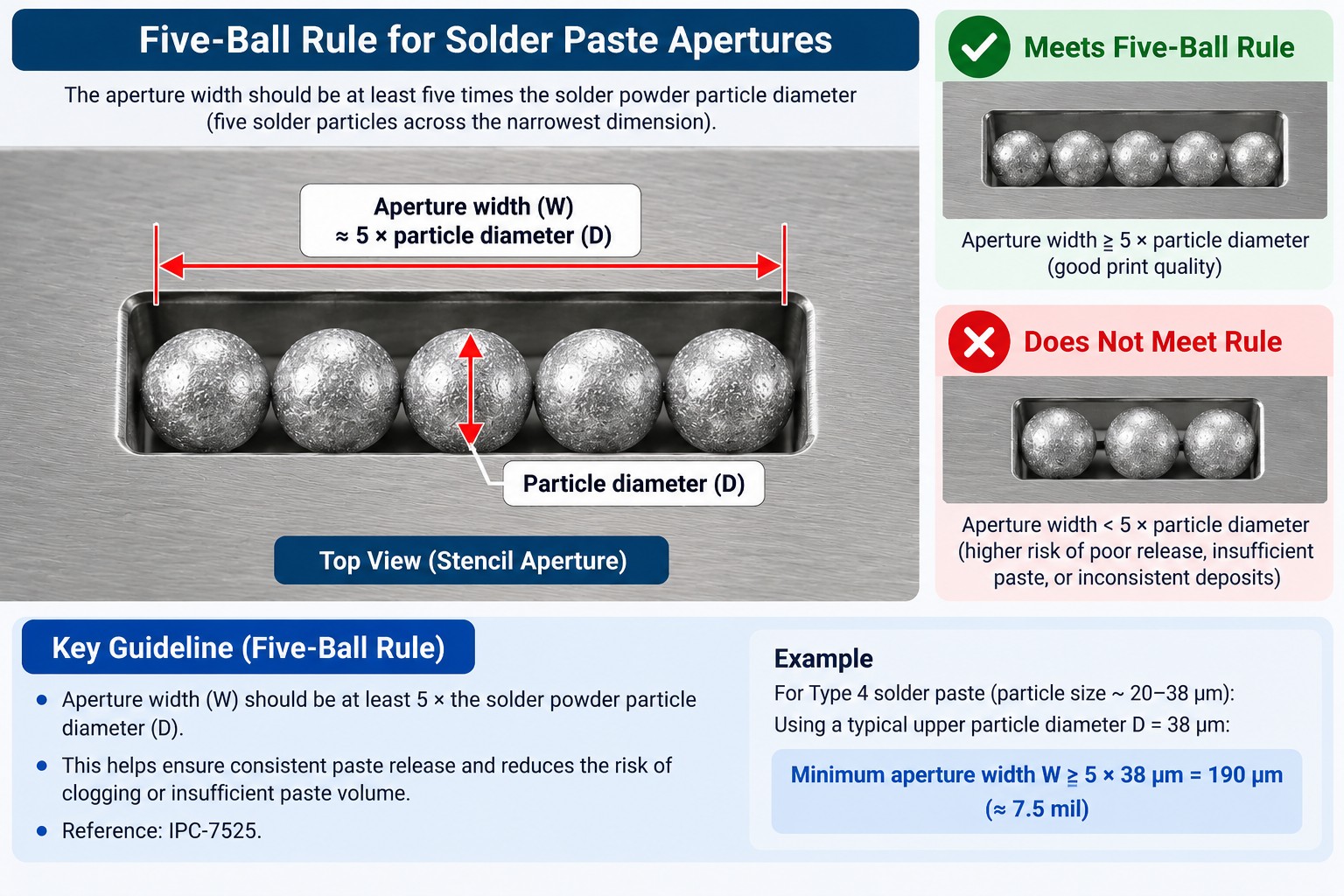
A useful screening rule is the five-ball rule. The smallest aperture width should be about five times the largest powder diameter. Using the typical upper particle sizes above, that suggests roughly 225 µm for Type 3, 190 µm for Type 4, 125 µm for Type 5, and 75 µm for Type 6. Treat this as a process check, not a substitute for paste and stencil supplier guidance.
Area ratio matters at the same time. IPC-7525C Stencil Design Guidelines defines area ratio as the aperture opening area divided by the aperture-wall area. A commonly used release target is around 0.66 or higher. As the area ratio becomes more challenging, finer powder can help, but aperture geometry, wall finish, stencil thickness, paste chemistry, and printing setup still matter.
For the geometry side of this decision, see stencil aperture design and area-ratio guidance. For practical release improvements, the SMT stencil design tips explain aperture and deposition choices in more detail.
As a starting point, Type 3 is suitable for many standard SMT assemblies. Type 4 is a common step for smaller apertures and fine pitch. Type 5 is useful when the design reaches very small deposits such as 0201 or 01005-class features, provided the stencil and paste chemistry support them. Always check the smallest aperture, area ratio, and paste TDS together.
AI-generated
Trade-offs: Why Finer Solder Paste Types Aren’t Always Better
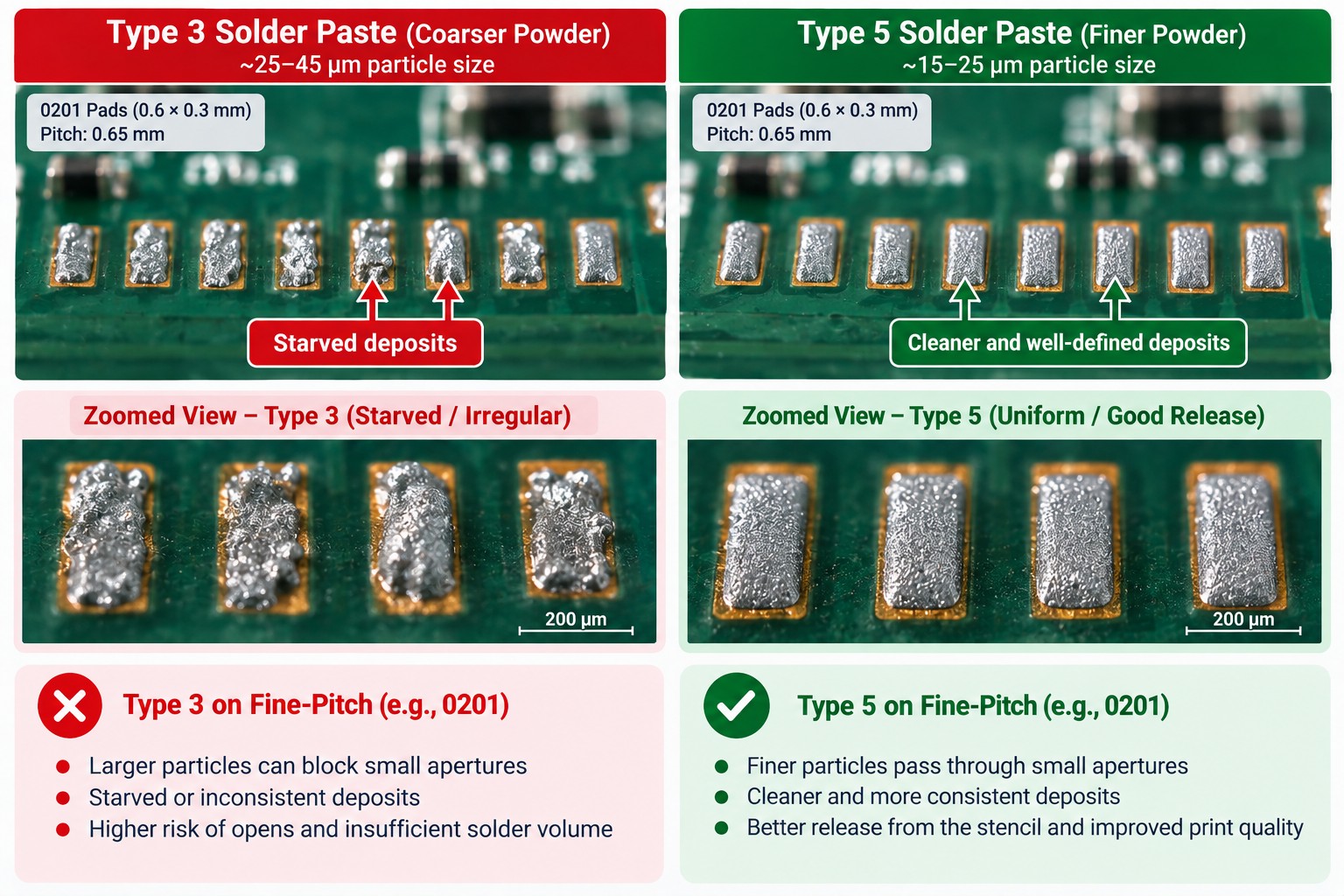
Moving to a finer powder can improve printability on tiny features, but it is not a free upgrade. Smaller particles create more total surface area for the same solder mass. That increases oxide exposure and makes coalescence, storage, handling, and reflow chemistry more demanding.
Finer pastes can also cost more and may have a narrower practical process window. Research and supplier guidance show that powder size can influence voiding and coalescence, so using Type 5 or Type 6 on a standard-pitch board does not automatically improve quality.
The practical rule is to use the coarsest powder that prints your smallest aperture reliably. If Type 3 gives stable transfer and acceptable deposits, moving to Type 5 adds complexity without solving a real problem.
Stencil thickness is part of the same system because it sets paste volume and changes area ratio. Use the SMT stencil thickness guide when aperture release and deposited volume pull in different directions.
AI-generated
Common Solder Paste Type and Mesh Mistakes
- Using Type 3 on ultra-fine apertures — If particle size is too large for the opening, transfer can become inconsistent or starved. Move to Type 4 or Type 5 only after checking aperture size and the five-ball rule.
- Confusing powder Type with alloy — Type 3, 4, or 5 describes particle size. SAC305, Sn63/Pb37, and other alloy names describe metal composition. Specify both.
- Choosing paste by viscosity number alone — A viscosity value is meaningful only with its test method and temperature. Select a paste formulated for stencil printing and follow its TDS.
- Selecting Type 5 "to be safe" on standard pitch — Finer powder increases surface area, oxidation sensitivity, and cost. Use the coarsest powder that meets the print requirement.
- Ignoring area ratio — Powder size cannot rescue an aperture with poor geometry by itself. Check area ratio, foil thickness, aperture wall quality, and paste release together.
FAQ about Solder Paste Types, Mesh, and Viscosity
Q: Is Type 4 solder paste better than Type 3?
Type 4 is not universally better; it is finer. Type 4 typically uses 20–38 µm powder, compared with 25–45 µm for Type 3. That can improve printing through smaller apertures, but standard-pitch boards may gain little. Choose Type 4 when the stencil geometry needs it, not simply because the Type number is higher.
Q: What solder paste Type should I use for 0402 components?
Many 0402 assemblies can print successfully with Type 3 or Type 4, depending on pad size, stencil thickness, and aperture design. Type 4 gives more margin as apertures become smaller. Check the narrowest opening against the five-ball rule and confirm the paste manufacturer’s recommended printing range before changing powder Type.
Q: What solder paste Type is used for 0201 and 01005?
Type 4 or Type 5 is commonly considered for 0201-class features, while Type 5 is often used for 01005 and other very small deposits. The package name alone is not enough to choose the paste. Stencil thickness, aperture width, area ratio, paste chemistry, and printer capability must also support the selected powder size.
Q: Does finer solder paste reduce solder bridging?
Not by itself. Finer powder can improve transfer through a small aperture, but bridging is also driven by excess paste volume, aperture design, stencil-to-board gasketing, paste slump, alignment, and printing parameters. If bridges appear, first identify whether the defect comes from too much paste, poor release, or rheology before changing powder Type.
Q: How is solder paste viscosity measured?
Solder paste viscosity is measured with a defined viscometer method under controlled conditions. Suppliers may report Pa·s or poise and specify temperature, spindle geometry, and rotational speed. Because solder paste is shear-thinning, two values taken with different methods are not directly comparable. Use the test condition printed in the paste TDS when evaluating alternatives.
Q: What happens if solder paste viscosity is too high?
Paste that is too viscous for the printing setup may roll poorly in front of the squeegee, leave skips, or incompletely fill small apertures. It can also reduce transfer efficiency after stencil separation. Before raising pressure or speed, confirm paste temperature, mixing or conditioning instructions, stencil cleanliness, and the manufacturer’s recommended printing window.
Q: What is the difference between solder paste mesh size and particle size?
Particle size is the actual diameter range of the solder powder, usually stated in micrometers. Mesh size is sieve-based shorthand describing which screen sizes the powder passes and is retained by. Both describe powder size, but the IPC Type and micron range are generally clearer for engineering decisions because mesh notation can vary across supplier literature.
Q: Can I use dispensing solder paste for stencil printing?
Only if the product is explicitly designed for both methods. Dispensing and stencil printing impose different rheology requirements, so a paste optimized for a needle or jet may not roll, fill, or release correctly through a stencil. Check the product TDS for the intended application and viscosity test conditions instead of assuming all pastes with the same alloy and powder Type behave alike.
Conclusion: Choosing the Right Solder Paste Types, Mesh, and Viscosity
The most useful way to choose solder paste types is to treat the paste and stencil as one printing system. Type and mesh describe powder size; viscosity and thixotropy describe how the paste moves and recovers during printing.
Start with the coarsest powder that can pass and release from your smallest aperture. Then verify area ratio, foil thickness, paste rheology, and the manufacturer’s process window. This approach avoids paying for finer powder when the design does not need it and reduces the risk of solving the wrong printing problem.
For general paste selection beyond powder size, use JLCPCB’s solder paste selection guide. When the stencil is matched to the paste and pitch, repeatable deposits become much easier to achieve on the next fine-pitch PCB build.
Keep Learning
Solder Paste Types, Viscosity & Mesh Size: A Printing-Performance Guide
Key Takeaways Type and mesh describe powder size, viscosity describes flow: Higher IPC Type numbers mean progressively finer powder for smaller stencil apertures, while viscosity governs how the paste rolls, fills, and releases, so both must be matched to the aperture, foil thickness, and printing method. Screen with the five-ball rule and area ratio: The smallest aperture width should be about five times the largest powder diameter, and a release target around 0.66 area ratio or higher helps, so choo......
Solder Paste Storage & Shelf Life: How to Store It and Make It Last
Key Takeaways Treat paste as perishable: Keep it sealed in a dedicated refrigerator at roughly 2-10 °C (36-50 °F), never freeze it, store jars upright and cartridges tip-down, and run FIFO with dated labels so the oldest stock is used first. Watch all three clocks: Sealed shelf life is commonly around 6 months from manufacture, opened life is only days, and on-stencil working life is measured in hours, so warm the sealed container to room temperature for several hours before opening to avoid condensat......
Solder Paste vs. Solder Wire: What's the Difference and When to Use Each
Key Takeaways Solder wire is a solid, flux-cored wire fed to a heated joint with a soldering iron — ideal for through-hole work, repairs, rework, and one-off projects. Solder paste combines alloy powder and flux, is printed or dispensed onto PCB pads, then reflowed — better for SMT, fine-pitch parts, and surface-mount assembly. Cost & setup: Solder wire is cheaper and easier for beginners; solder paste requires more equipment (stencil, reflow) but saves time for boards with many joints. Both solder pa......
Solder Paste Flux Types: No-Clean, Water-Soluble & Rosin
Key Takeaways No-clean solder paste leaves a low-activity residue designed to stay on the board — no wash step needed for most assemblies. Water-soluble solder paste wets more aggressively but leaves a corrosive, hygroscopic residue that must be washed off with DI water soon after reflow. Rosin-based paste (R, RMA, RA) provides a traditional middle ground, still used in defense, aerospace, and rework applications. IPC J-STD-004 flux code on a datasheet is the most reliable way to identify flux type — ......