Solder Paste vs. Solder Wire: What's the Difference and When to Use Each
14 min
- Quick Answer: Solder Paste vs. Solder Wire
- What Is Solder Wire?
- What Is Solder Paste?
- Solder Paste vs Solder Wire: Side-by-Side
- When to Use Solder Wire
- When to Use Solder Paste and Why a Stencil Comes In
- Can You Use Solder Paste Instead of Solder Wire?
- Cost and Setup: Which Is Cheaper to Start With?
- Common Mistakes in Solder Paste vs Solder Wire Choices
- FAQs about Solder Paste vs Solder Wire
- Conclusion: Choosing Between Solder Paste vs Solder Wire
Key Takeaways
Solder wire is a solid, flux-cored wire fed to a heated joint with a soldering iron — ideal for through-hole work, repairs, rework, and one-off projects.
Solder paste combines alloy powder and flux, is printed or dispensed onto PCB pads, then reflowed — better for SMT, fine-pitch parts, and surface-mount assembly.
Cost & setup: Solder wire is cheaper and easier for beginners; solder paste requires more equipment (stencil, reflow) but saves time for boards with many joints.
Both solder paste and solder wire create the electrical and mechanical joints that connect components to a PCB, but they are not simply interchangeable forms of solder. In the solder paste vs solder wire decision, the key difference is how each is applied and heated.
Solder wire is typically fed by hand to a heated joint using a soldering iron, making it well suited to through-hole assembly, repairs, rework, and one-off projects. Solder paste is deposited onto PCB pads before components are placed, then heated in a reflow process. This makes it especially useful for SMT assembly, fine-pitch components, and repeated production runs.
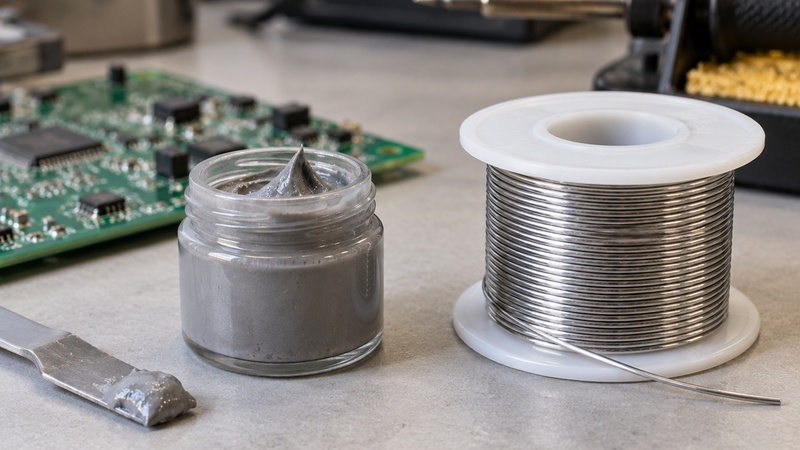
This guide compares solder paste and solder wire side by side, explains how each works, and helps you choose the right option for your application.
Quick Answer: Solder Paste vs. Solder Wire
Solder wire is a solid, usually flux-cored solder fed to a heated joint with an iron, making it ideal for through-hole work, repairs, and hand soldering. Solder paste combines alloy powder and flux, is printed or dispensed, then reflowed, making it better for SMT, fine-pitch parts, and surface-mount assembly.
What Is Solder Wire?
Solder wire is solder alloy manufactured in wire form. Electronics-grade products are commonly flux-cored, so flux is delivered to the joint as the solder melts. The wire is typically sold on a spool in different diameters, flux formulations, and alloys.
For using it, you must heat the component lead and PCB pad with a soldering iron, then feed an appropriate amount of wire into the heated joint. This gives the operator direct control over individual connections. That simplicity is solder wire's biggest strength. With an iron, a suitable tip, and basic soldering technique, you can handle through-hole components, connectors, wires, repairs, rework, and many larger SMD parts without setting up a reflow process.
Solder wire is also convenient to store. For example, the Kester 268 flux-cored wire technical data sheet specifies storage in a dry, non-corrosive environment and lists a three-year warranty period for alloys other than high-lead (over 70% Pb) types. Exact shelf-life and storage requirements depend on the chosen wire.
For a deeper look at wire types, alloys, and flux cores, see Everything You Need to Know About Solder Wire. If you are selecting a diameter or alloy for a project, use Choose the Right Solder Wire.
What Is Solder Paste?
Solder paste is a mixture of fine solder-alloy particles and a flux system. IPC J-STD-005B describes solder paste as solder powder blended with solder-paste flux and establishes requirements for properties such as powder characteristics and testing.
Instead of feeding solder to one joint at a time, you place paste on PCB pads before fitting the components. For a whole board, the usual method is stencil printing in which openings in the stencil align with the pads, a squeegee moves paste across the surface, and paste remains where solder joints are required. After the components are placed, the board is heated with an appropriate reflow process. The solder particles melt, wet the joint surfaces, and form solder connections as the assembly cools.
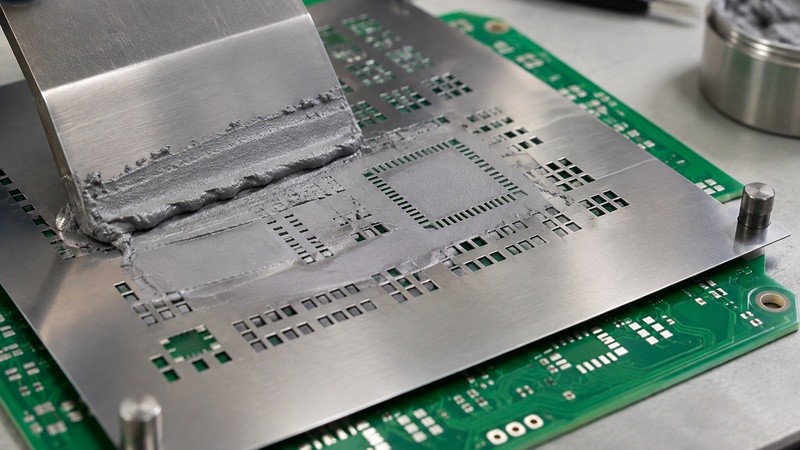
This workflow is especially useful for SMT because many deposits can be created in a single printing pass. Fine-pitch components that would demand careful individual hand soldering can be much more practical when the correct paste volume is printed consistently. Unlike wire, solder paste is comparatively perishable. Storage depends on the specific formula, so its technical data sheet should always take priority.
As one example, Kester's NP510-LT HRL1 data sheet recommends refrigeration at 0–10°C (32–50°F), gives a six-month refrigerated shelf life, and instructs users to let the paste stabilize to room temperature before printing.
For more details about the material, see What Is Solder Paste?. For step-by-step applications, stencil printing, syringe use, and reflow, see How to Use Solder Paste.
Solder Paste vs Solder Wire: Side-by-Side
The main difference is how each type of solder is applied. Solder wire is added to individual joints with a soldering iron, while solder paste is placed on PCB pads before the components are heated during reflow.
In practice, solder wire is usually the better choice for hand soldering, repairs, and jobs with only a few connections. Solder paste is better for surface-mount assembly, especially when a board has many joints or fine-pitch components. Many electronics workbenches keep both because each is useful for a different type of job.
| Attribute | Solder Wire | Solder Paste |
|---|---|---|
| Form | Solid wire, usually flux-cored | Fine solder powder mixed with flux |
| Applied with | Soldering iron, by hand | Stencil or syringe, then reflow |
| Best suited for | Through-hole parts, repairs, rework, one-off jobs | SMT, fine-pitch parts, and boards with many joints |
| Storage | Usually easier to store at room temperature | More perishable and often needs refrigeration |
| Tools/skill | Soldering iron and basic hand-soldering technique | Stencil or syringe plus controlled reflow heating |
| Fine-pitch SMD | Difficult and slow to solder by hand | Well suited to small, closely spaced pads |
In practice, solder wire is usually the better choice for hand soldering, repairs, and jobs with only a few connections. Solder paste is better for surface-mount assembly, especially when a board has many joints or fine-pitch components. Many electronics workbenches keep both because each is useful for a different type of job.
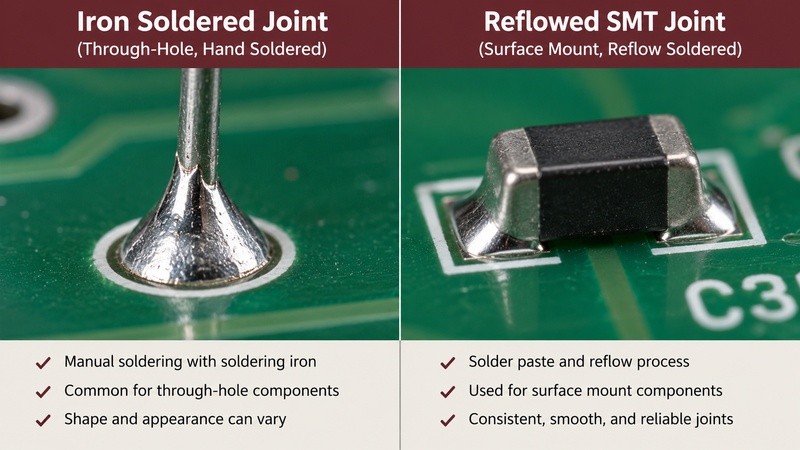
When to Use Solder Wire
Use solder wire when you are working on a small number of joints and a soldering iron is the easiest tool for the job.
- Through-hole components: Solder wire works well for resistors, headers, connectors, switches, and other parts with leads that pass through PCB holes.
- Repairs and rework: For replacing a part or fixing a damaged joint, wire is usually faster than setting up solder paste and reflow.
- Point-to-point wiring: Wires, terminals, and connector contacts are easy to solder by hand with wire.
- One-off prototypes: If you only have a few accessible joints, solder wire keeps the setup simple.
- Larger SMD parts: Many larger surface-mount parts can also be soldered by hand with a fine-tip iron.
Solder wire becomes less practical when a board has many closely spaced SMT joints. In those cases, solder paste and reflow are usually faster and more consistent.
When to Use Solder Paste and Why a Stencil Comes In
Solder paste is a good choice when a PCB has many surface-mount components, especially fine-pitch parts. Instead of soldering every joint one at a time with wire, you can apply paste to all the required pads, place the components, and reflow the whole board. This is usually faster and gives more consistent results.
For a full SMT board, a stencil makes solder-paste application much easier. The stencil has openings that line up with the PCB pads. Paste is spread across the stencil, leaving a controlled amount on each pad. You then remove the stencil, place the components, and heat the board using the recommended reflow profile.
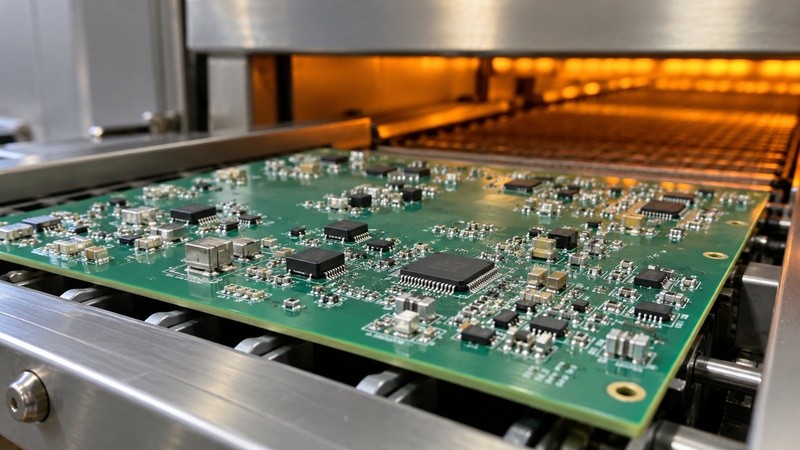
A typical workflow is:
- Align the stencil with the PCB.
- Spread solder paste across the stencil.
- Lift the stencil away carefully.
- Place the surface-mount components.
- Reflow the board.
- Inspect the finished solder joints.
A stencil is not required for every solder-paste job. For repair, prototype, or a board with only a few SMD pads, you can apply paste with a syringe. But as the number of pads increases, dispensing them one by one becomes slower and makes it harder to keep the amount of paste consistent. For a whole board, a stencil is usually the cleaner and more repeatable option.
For detailed application methods, see How to Use Solder Paste Step by Step. If you are still deciding between SMT and through-hole assembly, see Surface Mount vs Through-Hole.
Can You Use Solder Paste Instead of Solder Wire?
Yes, solder paste can sometimes replace wire for hand work, but it is usually most useful on SMD pads. You can dispense a small amount with a syringe and heat it carefully, which can be convenient for a handful of surface-mount components. For through-hole assembly, solder wire is usually easier, cleaner, and gives better control.
Solder wire can also be used for some SMD work. Larger surface-mount parts are often easy to solder by hand with a fine-tip iron. But as the parts get smaller, the pin spacing gets tighter, or the number of joints increases, wire becomes slower and harder to control. That is where solder paste and reflow are usually the better choice.
The two methods overlap, but each has a clear strength. Choose based on the number of joints, component size, accessibility, and whether you can use a reflow process.
Cost and Setup: Which Is Cheaper to Start With?
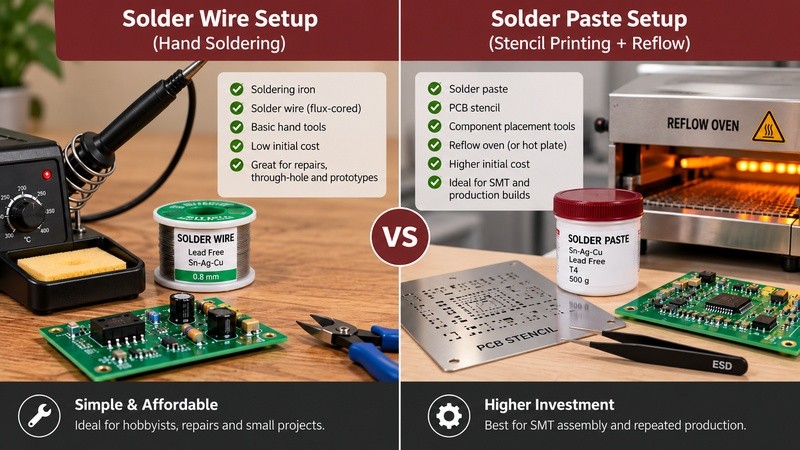
Solder wire is usually the cheaper and easier option for beginners. A soldering iron and a spool of wire are enough for most through-hole work, repairs, hand wiring, and simple prototypes. You also do not need cold storage or reflow equipment.
Solder paste needs more equipment for efficient SMT assembly. A typical setup includes the paste, a stencil, tools for placing components, and a heat source such as a hot plate or reflow oven. That makes the starting cost higher, but the extra setup can save a lot of time when you are soldering many surface-mount joints.
A simple rule of thumb is to use solder wire for occasional repairs, through-hole work, and one-off projects. Choose solder paste with a stencil and reflow equipment when you regularly assemble SMT boards.
Common Mistakes in Solder Paste vs Solder Wire Choices
Mistakes to Avoid
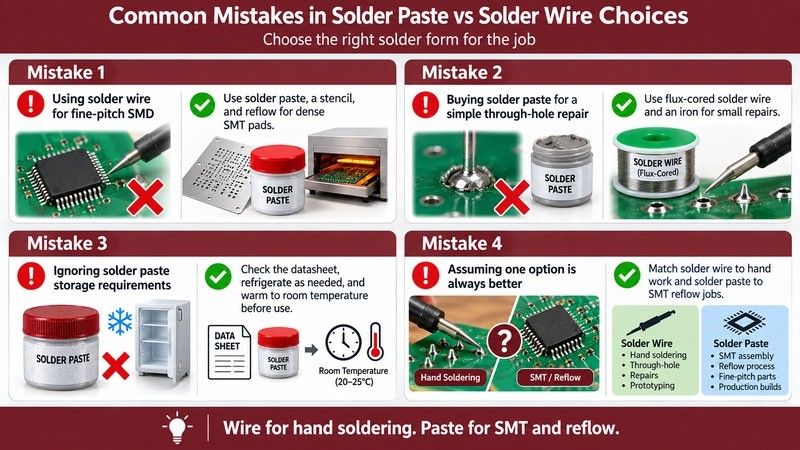
- Trying to hand-solder fine-pitch SMD parts with solder wire. Use solder paste, a stencil, and reflow for very small or closely spaced parts. This is usually faster and helps reduce solder bridges. Save solder wire for through-hole parts and larger components that are easier to reach with an iron.
- Buying solder paste for a simple through-hole repair. Use flux-cored solder wire and a soldering iron. Paste adds extra storage, handling, and heating steps that are usually not needed for one small repair.
- Forgetting about solder paste storage. Check the product's technical data sheet before use. Many solder pastes need refrigeration and time to reach room temperature before printing. Shelf life and handling rules vary by product.
- Thinking solder paste and flux are the same thing. Solder paste contains both solder-alloy particles and flux. Flux alone helps solder flow, but it does not contain the metal needed to make the joint. See Solder Paste vs Flux.
- Assuming one option is always better. Choose based on the job. Solder wire is usually better for hand soldering, repairs, and through-hole work, while solder paste is better for SMT boards with many fine-pitch joints.
For more information about soldering flux requirements and classifications, see IPC J-STD-004D, Requirements for Soldering Fluxes.
FAQs about Solder Paste vs Solder Wire
Q: When to Use Solder Paste for a Small Prototype?
Use solder paste when the prototype contains enough SMD pads that placing paste first is easier than hand-soldering every joint. A stencil is especially useful if you expect to build the board more than once. For only a few large SMD components, syringe-dispensed paste or ordinary solder wire may be faster because neither requires a full-board stencil setup.
Q: Can I Use Solder Paste with a Soldering Iron?
Yes, a soldering iron can melt small amounts of solder paste during localized hand work. This can be useful for a few SMD pads or rework, but it does not reproduce a controlled reflow process across an entire board. Paste can also spread or leave more residue than expected when too much is dispensed, so small, deliberate deposits work best.
Q: Can Solder Paste Expire?
Yes. Solder paste has a defined shelf life because its flux chemistry, viscosity, and printing behavior can change over time. Storage temperature also matters. Always check the manufacturer's technical data sheet and expiration information rather than assuming every formulation lasts the same period. Conventional refrigerated paste may have a shelf life measured in months, while solder wire generally remains usable much longer.
Q: Does Solder Paste Conduct Electricity Before Reflow?
Do not treat unreflowed solder paste as a finished electrical connection. The deposited material consists of separate solder particles suspended in flux, and its purpose is to form a metallurgical joint after heating. Electrical testing should be performed on the completed, reflowed assembly rather than relying on freshly printed paste to behave like a solid solder joint.
Q: Do I Need Extra Flux When Using Flux-Cored Solder Wire?
Not necessarily. Flux-cored solder wire already contains flux that activates as the wire is heated, so properly prepared and solderable joints often do not need extra liquid flux. Additional compatible flux can still help during difficult rework, oxidation, drag soldering, or other specific situations. Follow the wire manufacturer's process guidance because flux chemistry and residue-cleaning requirements vary between products.
Q: Can I Use Solder Wire and Solder Paste on the Same PCB?
Yes. A board can be reflowed with solder paste for its main SMT population and later hand-soldered with wire for through-hole connectors, modifications, or rework. This hybrid workflow is common because each solder form is being used where it is most convenient. Make sure the materials and cleaning processes are compatible with the assembly's requirements.
Q: Is Solder Wire Better for Beginners?
Solder wire is usually easier for a beginner who is learning basic through-hole soldering because the setup is simple and each joint can be worked on individually. Paste becomes attractive once the project moves toward boards with many SMD components. Beginners working primarily with SMT should learn stencil alignment, paste handling, placement, and reflow rather than assuming hand soldering is always easier.
Q: Why Do Fine-Pitch Parts Favor Solder Paste?
Fine-pitch parts favor solder paste because a stencil can place small, repeatable deposits across many closely spaced pads before the component is positioned. Hand-feeding wire to every lead requires more dexterity and creates more opportunities to add excess solder or bridge adjacent connections. Paste does not guarantee defect-free assembly, but it provides a process designed around dense surface-mount pad patterns.
Conclusion: Choosing Between Solder Paste vs Solder Wire
The solder paste vs solder wire choice mainly depends on how you plan to assemble the board. Use solder wire for hand soldering, through-hole parts, repairs, and small jobs where you want direct control over each joint.
Choose solder paste for SMT boards, fine-pitch parts, and projects with many joints that can be soldered together during reflow. A syringe can work for a few pads, but a stencil is usually the cleaner and more consistent choice for a full surface-mount board.
In the end, consider the part size, number of joints, and whether you have a practical way to reflow the board. When your project moves toward regular SMT assembly, ordering a stencil can make solder-paste application faster, easier, and more repeatable.
Keep Learning
Solder Paste vs. Solder Wire: What's the Difference and When to Use Each
Key Takeaways Solder wire is a solid, flux-cored wire fed to a heated joint with a soldering iron — ideal for through-hole work, repairs, rework, and one-off projects. Solder paste combines alloy powder and flux, is printed or dispensed onto PCB pads, then reflowed — better for SMT, fine-pitch parts, and surface-mount assembly. Cost & setup: Solder wire is cheaper and easier for beginners; solder paste requires more equipment (stencil, reflow) but saves time for boards with many joints. Both solder pa......
Solder Paste Flux Types: No-Clean, Water-Soluble & Rosin
Key Takeaways No-clean solder paste leaves a low-activity residue designed to stay on the board — no wash step needed for most assemblies. Water-soluble solder paste wets more aggressively but leaves a corrosive, hygroscopic residue that must be washed off with DI water soon after reflow. Rosin-based paste (R, RMA, RA) provides a traditional middle ground, still used in defense, aerospace, and rework applications. IPC J-STD-004 flux code on a datasheet is the most reliable way to identify flux type — ......