Solder Paste Flux Types: No-Clean, Water-Soluble & Rosin
15 min
- Quick Answer: No-Clean vs. Water-Soluble Solder Paste
- What "Flux Type" Means Inside Solder Paste
- No-Clean Solder Paste
- Water-Soluble Solder Paste
- No-Clean vs. Water-Soluble Solder Paste: Side-by-Side
- The Third Family: Rosin and RMA Solder Pastes
- How to Read a J-STD-004 Flux Code on a Paste Datasheet
- How to Choose a Solder Paste Flux Type
- Cleaning Solder Paste Flux Residue: ICT, Cosmetics, High-Rel
- How Solder Paste Flux Type Affects Stencil Printing
- Common Solder Paste Flux Mistakes and How to Fix Them
- FAQ about Solder Paste Flux Types
- Conclusion: Choosing Between Solder Paste Flux Types
Key Takeaways
No-clean solder paste leaves a low-activity residue designed to stay on the board — no wash step needed for most assemblies.
Water-soluble solder paste wets more aggressively but leaves a corrosive, hygroscopic residue that must be washed off with DI water soon after reflow.
Rosin-based paste (R, RMA, RA) provides a traditional middle ground, still used in defense, aerospace, and rework applications.
IPC J-STD-004 flux code on a datasheet is the most reliable way to identify flux type — not the product's marketing name.
Solder paste isn't just alloy and powder. The flux system inside the paste determines how oxides are controlled during reflow, how the paste wets the surfaces, and what residue remains after the joint forms. That makes solder paste flux types a process decision, not just a chemistry label.
This article covers the flux inside solder paste for reflow assembly — what residue each type leaves and whether you have to wash the board. For flux chemistry in general, outside the paste-and-reflow context, start there.
Quick Answer: No-Clean vs. Water-Soluble Solder Paste
No-clean solder paste leaves a low-activity residue designed to stay on the board — no wash step needed for most assemblies. Water-soluble solder paste wets more aggressively but leaves a corrosive, hygroscopic residue that must be washed off with DI water soon after reflow. Choose based on whether you can clean the board and what reliability level you need.
What "Flux Type" Means Inside Solder Paste
The flux vehicle inside solder paste is a formulated mixture that typically includes activators, resin or rosin components, solvents, and rheology additives. During reflow, the vehicle strips oxide from the pads, leads, and powder particles, then controls how the molten alloy wets the joint. Whatever the vehicle doesn't burn off or volatilize becomes the residue left on the board.
Paste flux chemistry falls into three broad families: no-clean, water-soluble (organic-acid, often labeled OA), and rosin-based (R, RMA, or RA). IPC J-STD-004 classifies flux by base material, activity, and halide content — the full code table appears further down.
No-Clean Solder Paste
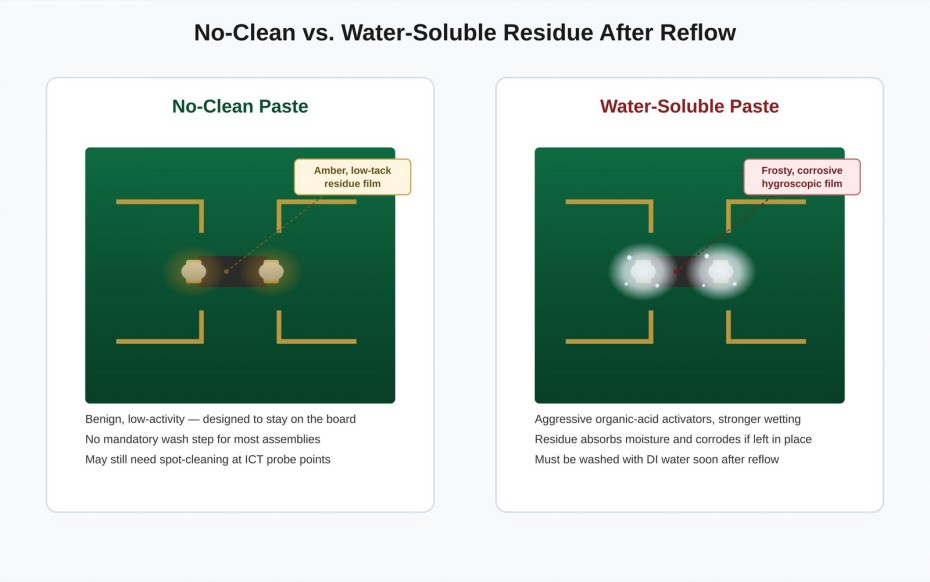
What it is: No-clean solder paste is formulated to leave a relatively low-residue material after reflow. When the residue meets the application's cleanliness and reliability requirements, it can remain on the assembly without a routine wash step. That removes a process stage and can reduce water, equipment, labor, and handling requirements.
Caveat: "No-clean" does not mean "never clean." Residue can interfere with ICT probe contact, create an unwanted appearance, or conflict with high-reliability requirements. Some products also require cleanliness verification under a customer or internal specification. The decision should therefore be tied to the actual assembly and its qualification requirements.
Best fit: Standard commercial SMT assembly, low-cost electronics, rapid prototyping, hand assembly, and manufacturing facilities operating without aqueous washing systems.
Water-Soluble Solder Paste
What it is: Water-soluble solder paste incorporates aggressive organic-acid (OA) activators that deliver superior oxide reduction and high surface wetting activity. This high activation level yields excellent soldering performance on oxidized pads, difficult component lead finishes, and dense fine-pitch surface mount components.
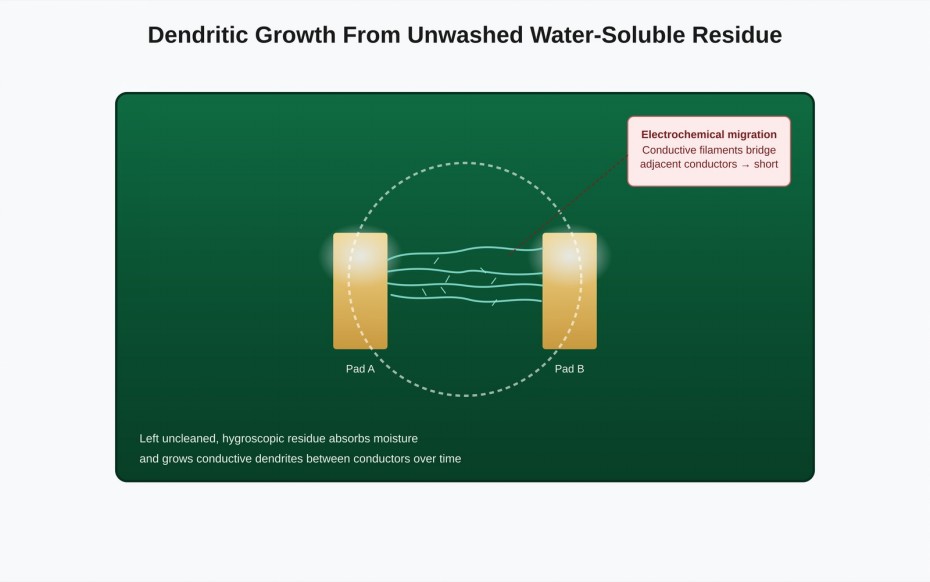
The catch: The post-reflow water-soluble residue is highly corrosive and hygroscopic. If unwashed, it attracts atmospheric moisture, initiating ionic contamination, severe surface corrosion, and dendritic growth leading to electrical shorts. Therefore, water-soluble residue MUST be thoroughly washed off using DI water shortly after reflow.
Best fit: High-density PCBAs, complex board layouts requiring maximum wetting yield, and production environments fully equipped with inline aqueous washing systems.
No-Clean vs. Water-Soluble Solder Paste: Side-by-Side
| Attribute | No-Clean | Water-Soluble |
|---|---|---|
| Residue after reflow | Low-activity, benign residue | Corrosive, hygroscopic residue |
| Cleaning required? | No, for most assemblies | Yes — mandatory and time-sensitive |
| Activator strength | Mild | Aggressive (organic-acid) |
| Best for | General SMT, hand/hobbyist assembly, no-wash shops | High-yield lines with aqueous cleaning in place |
| Risk if not cleaned | Minimal for typical use; can affect ICT or cosmetics | Corrosion, dendritic growth, field failures |
| Throughput/cost | Faster, lower cost — no wash stage | Slower, higher cost — wash + verification stage |
No-clean trades some wetting margin for a simpler process. Water-soluble paste trades a mandatory cleaning stage for stronger activation and potentially higher yield on challenging surfaces.
Rosin and RMA solder pastes provide a traditional middle ground in the wider paste landscape, but the same rule applies: exact residue behavior and cleaning recommendations come from the material specification — more on that in the next section. For how solder paste and flux differ as materials, see the comparison.
The Third Family: Rosin and RMA Solder Pastes
Rosin-based solder paste describes a paste's flux composition rather than a cleaning outcome. Where "no-clean" and "water-soluble" describe residue handling — what happens to the board after reflow — "rosin" describes what the flux is made from: natural or synthetic rosin (colophony) dissolved in a solvent system, sometimes combined with mild-to-moderate activators.
Rosin pastes are traditionally split into three grades. R (rosin, non-activated) relies only on the mild natural acidity of the rosin itself and suits very clean, easily solderable surfaces. RMA (rosin mildly activated) adds a small amount of activator for better oxide removal while keeping the residue non-corrosive and safe to leave in place. RA (rosin activated) uses a stronger activator package for difficult surfaces, but its residue is more aggressive and should generally be cleaned.
In practice, rosin paste sits between no-clean and water-soluble on the activity spectrum — milder than a water-soluble OA system, but with a residue character distinct from most modern no-clean formulations. Because of that predictable, well-documented behavior, rosin pastes still see use in defense and aerospace programs built on legacy qualifications, and in rework and touch-up work where a technician wants a known, controllable flux.
The "no-clean" and "rosin" categories overlap rather than compete: many commercial no-clean pastes are themselves rosin-based (typically ROL0-class), just formulated with a lower-residue rosin system. That overlap is exactly why the IPC J-STD-004 designator on a datasheet is a more reliable guide than a product's marketing name — a paste sold as "no-clean" can still carry a rosin-family base code, and only the full flux code tells you which.
Older documentation may still reference the U.S. military specification QQ-S-571, a now-superseded flux spec that predates IPC J-STD-004 and still turns up on legacy defense drawings; treat it as historical context rather than a current qualification path.
Rosin flux isn't confined to paste, either — it's just as common in standalone form for iron-and-wire work. See our Hand Soldering with Solder Flux: Step-by-Step Guide for how rosin flux behaves outside the paste-and-reflow process.
How to Read a J-STD-004 Flux Code on a Paste Datasheet
IPC J-STD-004 flux code packs three pieces of information into a short string: a two-letter base-material designator, a one-letter activity level, and a one-digit halide indicator.
The base material is RO (rosin), RE (resin — a synthetic material grouped with rosin-style residues), OR (organic, i.e., water-soluble/OA), or IN (inorganic). Inorganic flux exists in the standard but is not used in solder paste — it's reserved for applications, such as some wave-solder fluxes, where post-solder cleaning is guaranteed. The activity letter — L, M, or H — describes how aggressively the flux removes oxide: low, moderate, or high. The trailing digit indicates halide content: 0 means halide-free, 1 means halides are present, within the percentage the standard allows.
| Code | Base | Activity | Halide | Typical Paste Use |
|---|---|---|---|---|
| ROL0 | Rosin | Low | None | Classic rosin / no-clean paste |
| ROL1 | Rosin | Low | Present | Rosin paste, mild halide content |
| REL0 | Resin | Low | None | Low-residue no-clean paste |
| ORL0 | Organic | Low | None | Mild OA no-clean paste |
| ORM1 | Organic | Moderate | Present | Higher-activity, cleaning generally needed |
| ORH1 | Organic | High | Present | Aggressive water-soluble paste |
Datasheets also cite a revision letter for the standard — the current revision is D — and it matters because the classification isn't static. The allowable halide threshold for a "0" (halide-free) designation tightened starting with Revision B, so a code pulled from an old datasheet or a legacy qualification isn't automatically equivalent to the same code under the current revision. When comparing pastes, confirm which revision of IPC J-STD-004 the datasheet is citing before assuming two "ROL0" products are interchangeable.
How to Choose a Solder Paste Flux Type
Three questions settle most flux-type decisions: Can you wash the board after reflow? What reliability or cleanliness level does the product need to meet? And will the board go through an in-circuit test or need a specific cosmetic finish?
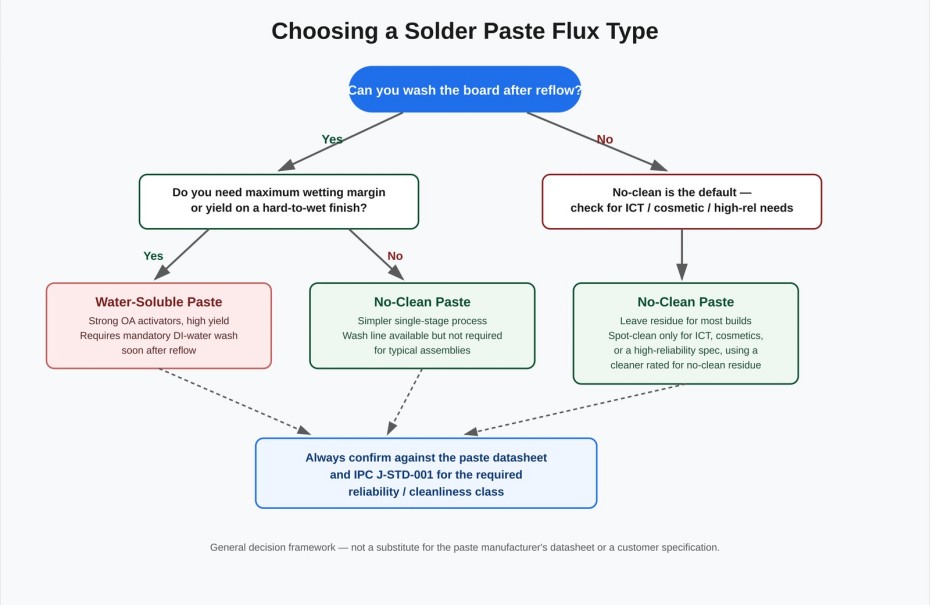
As a default, no-clean paste covers most prototyping, hand assembly, and any shop without a wash line. Water-soluble paste makes sense once you have an aqueous cleaner in place and need the extra wetting margin or yield it provides.
Some standards/customers require cleaning and cleanliness verification — such as surface insulation resistance (SIR) testing — regardless of which paste you use. When that applies, defer to IPC J-STD-001 and the specific customer or program spec rather than the paste type alone.
Cleaning Solder Paste Flux Residue: ICT, Cosmetics, High-Rel
No-clean residue is usually left in place. If cleaning is required for ICT contact, appearance, or high-reliability reasons, use a cleaner that is qualified for the specific no-clean residue. Do not assume that a general solvent will produce the desired result.
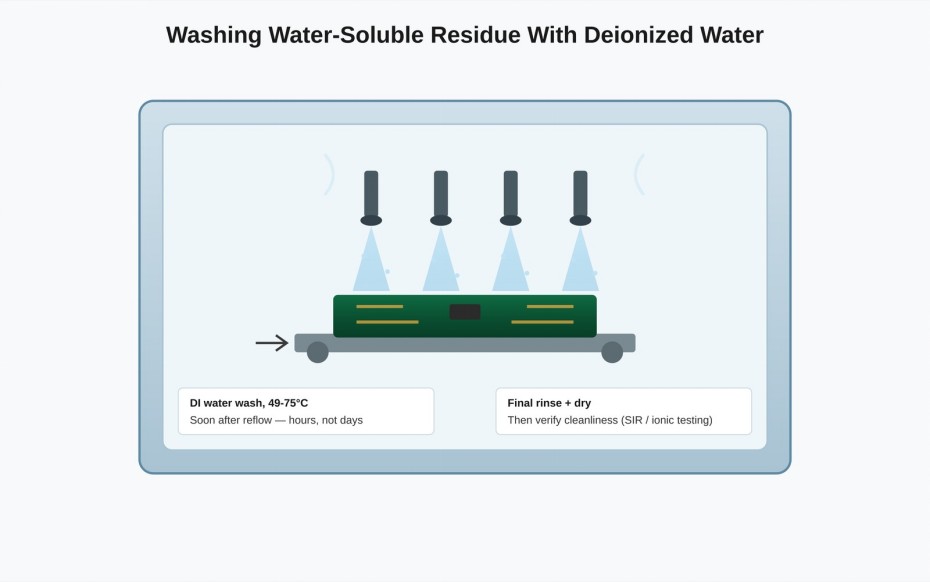
For water-soluble paste, cleaning isn't optional, and it's time-sensitive. Wash with deionized (DI) water per the paste's datasheet, then verify cleanliness through ionic contamination or SIR testing, depending on your reliability class.
Don't mix chemistries casually: running the wrong cleaning agent on no-clean residue can bake it onto the board rather than lifting it, making a later cleaning pass harder, not easier. For cleaning-agent selection and reliability context, see our guides on choosing the right circuit board cleaner and PCB cleanliness in professional manufacturing.
How Solder Paste Flux Type Affects Stencil Printing
Flux chemistry doesn't stay contained to the reflow oven — it shows up at the printer too. Flux type affects paste tack and open time on the stencil, and more aggressive water-soluble or high-activity formulas tend to build up residue on the stencil underside faster, which usually means more frequent wiping to keep apertures clean.
That said, the flux-type decision is fundamentally about residue and reliability, not stencil wear — a clean-releasing, precisely cut stencil keeps prints consistent whichever paste you're running. For wiping frequency and process guidance, see our SMT stencil cleaning guide.
Common Solder Paste Flux Mistakes and How to Fix Them
Common Mistakes
- Using water-soluble paste without a wash process: Corrosive residue stays on the board and eventually fails in the field. Only use water-soluble paste if you can wash and verify cleanliness afterward.
- Assuming "no-clean" always means "leave it": Clean no-clean residue when you're doing ICT, need a cosmetic finish, or building to a high-reliability spec — with a cleaner rated for no-clean chemistry.
- Delaying the wash after reflow on water-soluble paste: The residue is time-sensitive and hygroscopic. Wash promptly, following the timing in the paste's datasheet.
- Mixing incompatible cleaning chemistries: The wrong solvent can bake residue onto the board instead of removing it. Match the cleaner to the flux type. See the Cleaner-selection guide.
- Choosing flux type without checking the spec: Customer or reliability requirements can mandate cleaning regardless of paste type. Confirm against IPC J-STD-001 and the paste datasheet before committing to a process.
FAQ about Solder Paste Flux Types
Q: What Are the Flux Types in Solder Paste?
Solder paste flux falls into three families: no-clean (low-residue, typically left on the board), water-soluble/organic-acid (aggressive activation, residue that must be washed with DI water), and rosin-based (R, RMA, or RA — a traditional middle ground still used in defense, aerospace, and rework). Each family is qualified under IPC J-STD-004, and the code on a paste's datasheet, not the product name, is the definitive way to identify which one you're using. For flux chemistry outside the solder-paste-and-reflow context, see our general flux guide.
Q: Do you have to clean no-clean flux residue?
Not for most assemblies — no-clean residue is formulated to be left on the board safely. You should clean it, though, if the board undergoes in-circuit test (residue can block probe contact), needs a specific cosmetic appearance, or is built to a high-reliability class that requires verified cleanliness. Use a cleaning agent rated for no-clean chemistry rather than whatever solvent is on hand.
Q: Can you leave water-soluble flux residue on a board?
No. Water-soluble residue is corrosive and hygroscopic, meaning it draws in moisture and can promote electrochemical migration between conductors. Manufacturer datasheets typically call for washing with heated deionized water within hours of reflow, not days. Skipping the wash risks dendritic growth and long-term field failures, even if the board passes inspection immediately after assembly.
Q: Is a no-clean paste the same as a ROL0 paste?
No. ROL0 is a J-STD-004 material code — rosin-based, low-activity, halide-free — while "no-clean" describes how a paste's residue is meant to be handled after reflow. Many no-clean pastes do carry a ROL0-family code, but plenty of modern no-clean pastes use a different base chemistry (an REL0 or ORL0 code, for example) and still leave a benign, no-clean residue. Check the datasheet's actual J-STD-004 code rather than assuming "no-clean" implies ROL0.
Q: Does water-soluble paste improve soldering yield?
Water-soluble solder paste can improve yield when its stronger activation and wetting help overcome difficult-to-wet surfaces or process conditions. The benefit comes with a process cost: the active residue must be removed promptly, and the cleaning process must be controlled. This makes water-soluble paste most useful where aqueous cleaning is already engineered into production. Don't select it simply because a higher-activity flux sounds better.
Q: Can no-clean and water-soluble solder paste be used on the same board?
It's uncommon and generally not recommended without a clear process reason, since the two residues need different handling. If a rework or secondary process introduces water-soluble paste onto a board built with no-clean paste, the entire assembly should go through the aqueous wash cycle — you can't selectively clean one paste's residue and leave the other.
Q: Does no-clean solder paste residue affect in-circuit testing?
It can. Even though no-clean residue is electrically benign for the rest of the board, it can sit directly under a test point and interfere with reliable probe contact. Boards that go through ICT often specify a no-clean paste with pin-probable residue, or add a targeted cleaning step at the test points rather than a full board wash.
Conclusion: Choosing Between Solder Paste Flux Types
No-clean paste gives you a simpler, single-stage process with a residue that's designed to stay put. Water-soluble paste gives you stronger wetting and higher yield in exchange for a mandatory, time-sensitive wash. Neither is universally "better" — the right call depends on whether your line can clean boards and what reliability class the product needs to meet. Match the paste to your process and your spec, not to habit, and confirm against the paste's datasheet and IPC J-STD-001 before locking in a production flow.
A precise stencil also supports consistent paste transfer regardless of the chosen flux system. JLCPCB’s stencil service can be used when controlled aperture release and repeatable printing are part of the process.
Keep Learning
Solder Paste vs. Solder Wire: What's the Difference and When to Use Each
Key Takeaways Solder wire is a solid, flux-cored wire fed to a heated joint with a soldering iron — ideal for through-hole work, repairs, rework, and one-off projects. Solder paste combines alloy powder and flux, is printed or dispensed onto PCB pads, then reflowed — better for SMT, fine-pitch parts, and surface-mount assembly. Cost & setup: Solder wire is cheaper and easier for beginners; solder paste requires more equipment (stencil, reflow) but saves time for boards with many joints. Both solder pa......
Solder Paste Flux Types: No-Clean, Water-Soluble & Rosin
Key Takeaways No-clean solder paste leaves a low-activity residue designed to stay on the board — no wash step needed for most assemblies. Water-soluble solder paste wets more aggressively but leaves a corrosive, hygroscopic residue that must be washed off with DI water soon after reflow. Rosin-based paste (R, RMA, RA) provides a traditional middle ground, still used in defense, aerospace, and rework applications. IPC J-STD-004 flux code on a datasheet is the most reliable way to identify flux type — ......