Solder Paste Storage & Shelf Life: How to Store It and Make It Last
13 min
- Quick Answer: How Should You Store Solder Paste?
- Why Solder Paste Has a Shelf Life
- How to Store Solder Paste
- Solder Paste Shelf Life: How Long Does It Last?
- Warming Up Paste Before Use
- How to Tell If Solder Paste Has Gone Bad
- Bad Storage Shows Up as Print & Reflow Defects
- Common Solder Paste Storage Mistakes and How to Fix Them
- FAQ about Solder Paste Storage & Shelf Life
- Conclusion: Solder Paste Storage Is the First Step to Clean Prints
Key Takeaways
Treat paste as perishable: Keep it sealed in a dedicated refrigerator at roughly 2-10 °C (36-50 °F), never freeze it, store jars upright and cartridges tip-down, and run FIFO with dated labels so the oldest stock is used first.
Watch all three clocks: Sealed shelf life is commonly around 6 months from manufacture, opened life is only days, and on-stencil working life is measured in hours, so warm the sealed container to room temperature for several hours before opening to avoid condensation.
Inspect before every print: Separation, crusting, thickening, or a change in smell or color means the paste should not go on a production board, because bad storage shows up later as solder balls, voids, bridging, and poor wetting.
Solder paste is a perishable material, not a shelf-stable supply. Poor solder paste storage slowly degrades both the flux and the metal powder. The damage shows up later as solder balls, voids, poor stencil release, and weak joints, even when the stencil is perfect.
This guide explains why paste ages, how to store it, and how long it lasts in each state. It also covers the warm-up step many people skip and how to tell when a jar should be discarded. Brands differ, so treat every number here as a typical range and confirm it on your paste's technical data sheet (TDS).
Quick Answer: How Should You Store Solder Paste?
Store solder paste sealed in a dedicated refrigerator, typically at about 2–10 °C (36–50 °F), and never freeze it. Keep jars upright, keep cartridges tip-down, and use the oldest stock first. Before use, let the sealed container reach room temperature for several hours, then open it. Always follow the paste datasheet.
Why Solder Paste Has a Shelf Life
Solder paste is fine solder powder suspended in a flux vehicle. For a full breakdown of the ingredients, see our guide to what solder paste is and how it works. What matters here is that both parts keep changing after the paste leaves the factory.
Flux activators slowly react with the oxide on the powder surface, even inside a sealed jar. That reaction uses up activity the paste needs during reflow, and it can gradually raise viscosity. Once the seal is broken, solvents also start to evaporate and the paste begins to dry.
Heat speeds all of this up and can make the flux separate from the metal. Cold slows the chemistry down, which is why refrigeration is the default storage condition on most datasheets.
The practical result is drift. As paste ages, its viscosity, tack, slump resistance, and wetting move away from the values the maker qualified. IPC J-STD-005B defines how these properties are tested. The datasheet shelf life is the window in which the maker expects them to stay in spec.
How to Store Solder Paste
Good storage is simple and cheap. These practices keep paste close to its as-manufactured condition for its full rated life.
- Refrigerate at the datasheet range. Most datasheets specify a band between about 0 and 12 °C. Aiming for 2–10 °C (36–50 °F) keeps you inside most of them; the Kester R562 technical data sheet, for example, specifies 0–10 °C.
- Never freeze it. Standard SMT paste is not designed for sub-zero storage. Freezing can disturb the flux system and cause separation that gentle stirring will not fix.
- Store jars upright and cartridges tip-down. Keep jar lids tight. Kester and Indium both recommend storing cartridges and syringes tip-down so the paste stays packed toward the dispensing end.
- Avoid heat and temperature swings. Keep paste away from ovens, windows, and direct sunlight. Do not move containers in and out of the fridge, since each cycle risks condensation.
- Label everything and run FIFO. Mark each jar or cartridge with its lot, received date, and opened date. Place the oldest stock at the front and use it first.
- Use a clean, dedicated fridge. Do not share a fridge with food or drinks. A small, dedicated unit with a min/max thermometer is enough for most makers and small shops.
- Keep used paste separate. Reseal opened containers tightly and log the open date. Never scrape leftover stencil paste back into a fresh jar, because it carries contamination and dried flux.
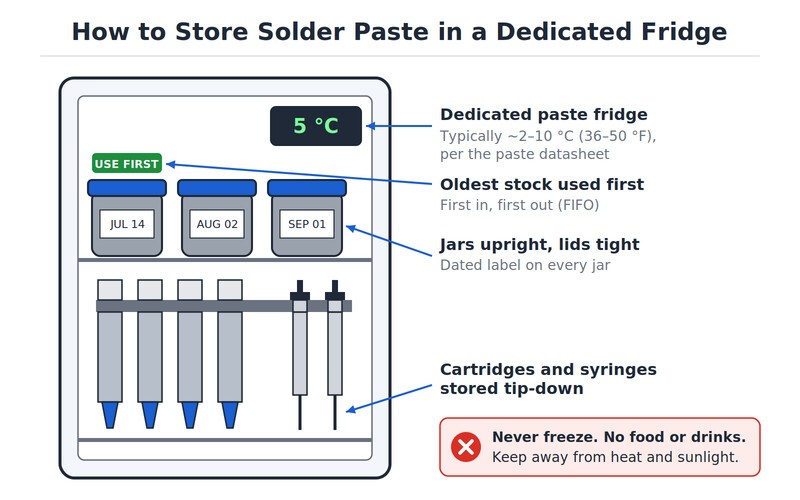
Dated jars sit upright with the oldest in front, while cartridges and syringes hang tip-down.
Solder Paste Shelf Life: How Long Does It Last?
Solder paste does expire, but it runs on three separate clocks. Mixing them up is the most common reason people print with paste that is technically "in date" but past its best.
Sealed and refrigerated is the rated shelf life on the label. It is commonly around 6 months from the date of manufacture, though some products are rated for 4 months and others for 12. The clock starts at the factory, not when the jar reaches you.
Opened life is much shorter. Once the seal is broken, the paste starts to lose solvent and pick up moisture. Many makers suggest using opened paste within a few days, and some recommend fresh paste every production day.
On-stencil working life, often called stencil life or open time, is measured in hours. Many datasheets rate it at 8 hours or more in a controlled room. High humidity and warm air shorten it, sometimes to around 4 hours. For more on print conditions, see the complete stencil guide for lead-free solder paste printing.
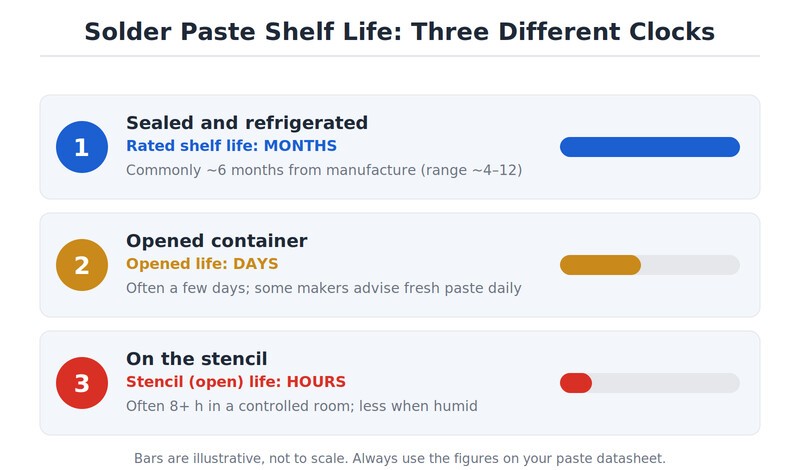
Three separate clocks govern paste life. Each one is much shorter than the one before it.
Solder Paste Life by State
| State | Typical Life | Notes |
|---|---|---|
| Sealed, refrigerated | Commonly ~6 months (range ~4–12) | Stored within the datasheet range, often 0–10 °C. The clock starts at manufacture. |
| Sealed at room temp | Weeks to a few months, product-dependent | Only if the datasheet allows it. Keep below about 25 °C and avoid exposure above 30 °C. |
| Opened container | Typically a few days | Reseal tightly and log the open date. Never mix with used stencil paste. |
| On the stencil (open time) | Hours, often 8+ h in a controlled room | Shortened by heat and humidity. Refresh the paste and clean the stencil each shift. |
Note
All figures are typical values drawn from published paste datasheets. Always use the numbers on your own product's TDS.
Warming Up Paste Before Use
A refrigerated jar is colder than the room around it. Open it too soon and water from the air condenses on the cold paste, just as it does on a cold drink can.
That moisture causes trouble in reflow. As the board heats, trapped water flashes to steam and can cause spattering, solder balls, and voids. The AIM Solder paste storage and handling guidelines warn against breaking the seal until the paste has reached ambient temperature.
The fix is patience. Take the sealed container out and let it stand at room temperature before opening it. Indium recommends at least 2 hours, while AIM notes it typically takes 4–6 hours. The Indium solder paste storage and handling application note even suggests removing jars and cartridges the day before use.
Note
Never force-heat paste in a microwave, oven, heat gun, or hot plate. Indium advises against exposing paste to more than 25 °C during warm-up. If you are unsure, measure the container temperature before you open it.
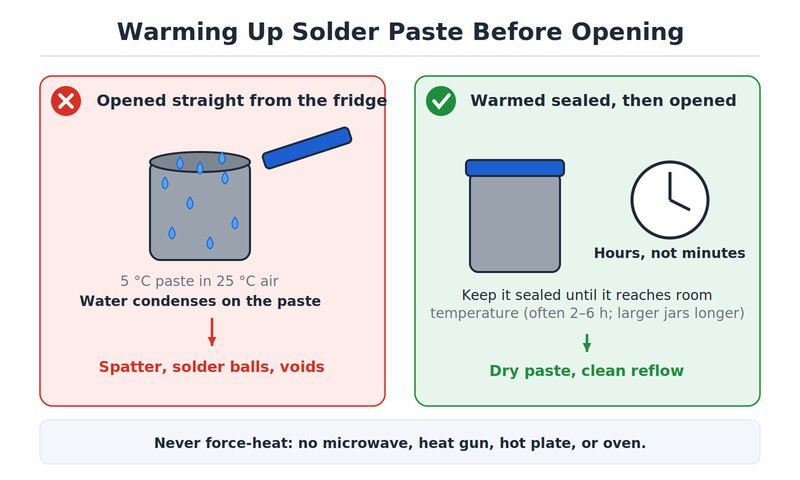
Opening cold paste invites condensation; letting the sealed container warm first keeps the paste dry.
Stir only if the datasheet calls for it, and do it gently. Jar paste is usually hand-stirred with a plastic spatula for about a minute. Cartridges and syringes normally need no mixing. Over-mixing shears the paste and lowers its viscosity, which can lead to slump.
Once the paste is ready, our guide on how to use solder paste with a stencil, syringe, or iron covers application.
How to Tell If Solder Paste Has Gone Bad
Inspect the paste before every print session. These warning signs mean the paste should not go on a production board:
- Separation: a dark, oily flux layer on top that does not blend back in with gentle stirring.
- Dry or crusty texture: a hard skin, lumps, or paste that crumbles instead of flowing.
- Hardening or thickening: noticeably stiffer paste that will not roll smoothly ahead of the squeegee.
- A strong change in smell or color compared with a fresh jar of the same product.
- Poor print behavior: paste that will not release from apertures, slumps after printing, or leaves more solder balls than usual.
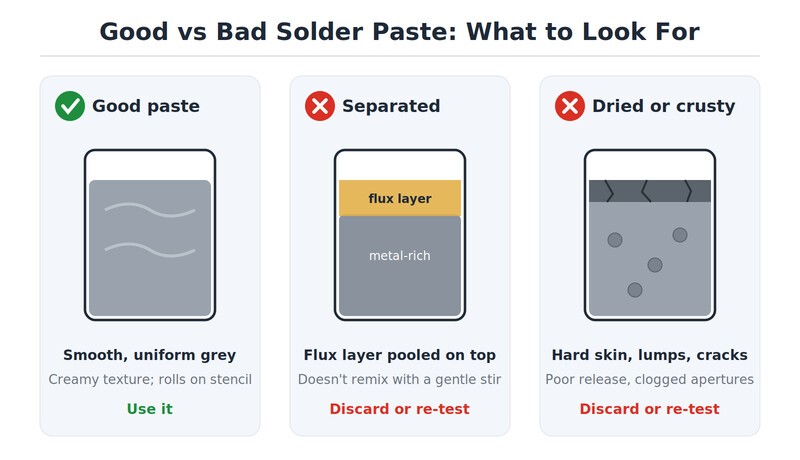
Healthy paste looks smooth and uniform. Persistent separation or a crusty skin are warning signs.
If the paste is past its datasheet expiry, or has been open longer than the maker allows, discard it. A new jar costs far less than reworking a board full of bad joints. Some production lines re-qualify expired paste with test prints, but makers and small-batch builders are better off replacing it.
Dispose of old paste according to local regulations. It contains metals and flux chemicals, so it should never go down a drain. Paste makers such as Kester also direct users to follow local environmental rules, and the product's safety data sheet (SDS) lists specific hazards.
Bad Storage Shows Up as Print & Reflow Defects
Storage problems rarely announce themselves. They surface on the board and get blamed on something else.
- Cold-opened paste brings moisture into reflow, leading to solder balls, spatter, and voids.
- Dried or aged paste releases poorly, so fine-pitch pads end up with insufficient deposits.
- Heat-damaged paste often loses viscosity and slumps, which can bridge adjacent pads.
- Paste with depleted flux activity wets poorly and can leave grainy or incompletely melted joints.
These defects are easy to pin on the stencil or the reflow profile. Before you change aperture sizes or oven settings, rule out the paste first. Our guide to solder paste printing defects and how to prevent them walks through each defect in detail.
The honest point is that clean prints need both fresh paste and a precise stencil. A well-made stencil cannot restore flux activity, and fresh paste cannot fix poor apertures. If the paste checks out, review the most common stencil mistakes and how to fix them.
Common Solder Paste Storage Mistakes and How to Fix Them
- Mistake: Freezing solder paste to make it last longer. → Fix: Freezing can damage the flux system. Store paste within the datasheet's refrigerated range and never below it.
- Mistake: Opening the jar straight from the fridge. → Fix: Cold paste condenses moisture, which causes solder balls and voids. Let the sealed container reach room temperature first.
- Mistake: No dates on jars, so old paste gets used last. → Fix: Label received and opened dates on every container and run FIFO, oldest first.
- Mistake: Returning leftover stencil paste to the jar. → Fix: Used paste contaminates fresh stock. Keep it in a separate container and follow the maker's guidance on reuse.
- Mistake: Leaving paste on the stencil all shift. → Fix: Stencil life is rated in hours. Keep a modest bead, add fresh paste in small amounts, and clean the stencil each shift.
- Mistake: Leaving a delivery on a warm dock or porch. → Fix: Heat exposure shortens paste life. Move new stock into the fridge as soon as it arrives.
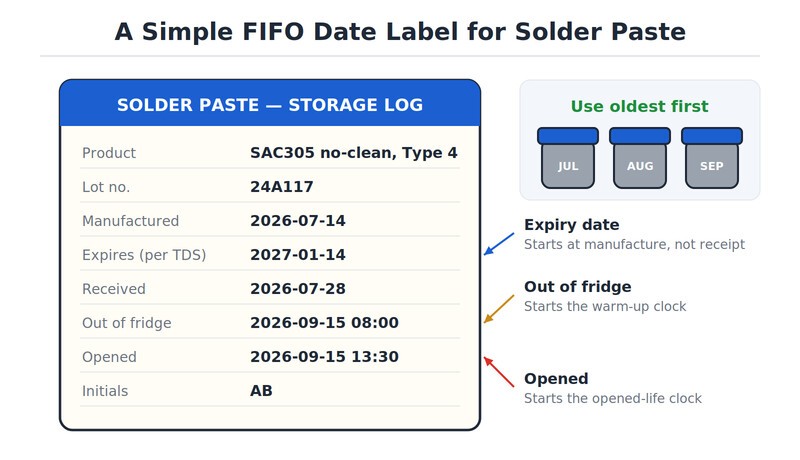
A simple date label tracks all three clocks: expiry, warm-up start, and opened life.
FAQ about Solder Paste Storage & Shelf Life
Q: Does Solder Paste Expire If It's Never Opened?
Yes, sealed solder paste still expires, because flux and powder keep reacting slowly even in the fridge. The expiry date is the maker's guarantee that the paste will meet its specifications, not a point where it instantly fails. Paste just past its date may still print well, but performance is no longer assured. For hobby work, a test print can tell you a lot. For customer or production boards, replace it.
Q: What Is the Best Solder Paste Storage Setup for a Home Lab?
The best home-lab solder paste storage setup is a small dedicated mini-fridge with a cheap min/max thermometer. Buy paste in small syringes or jars that you can finish within a few weeks of opening. Keep a simple log sheet on the fridge door and note each container's opened date. Store the fridge away from heat sources such as a reflow oven. This costs little and prevents wasting a half-used jar that has quietly expired.
Q: Should Opened Solder Paste Go Back in the Fridge?
It depends on the product, so check the datasheet. AIM advises against re-refrigerating opened paste and recommends resealing it at room temperature. Indium's guidance says it is unnecessary unless the work area is uncontrolled or above 30 °C. The concern is repeated condensation each time a cold container is reopened. Whichever rule applies, reseal the container tightly, log the opened date, and keep it away from heat and sunlight.
Q: Does Solder Paste Shelf Life Depend on Alloy or Powder Type?
Solder paste shelf life depends more on the flux chemistry than on the alloy itself. Water-soluble, no-clean, and low-temperature pastes can each carry different ratings, even from the same maker. Finer powders, such as Type 5 and above, have more surface area to oxidize. Check the datasheet for each specific product, and see our guide to selecting the right solder paste for type differences.
Q: What Is the Difference Between Solder Paste Working Life and Tack Time?
Solder paste working life is how long paste stays printable on the stencil. Tack time is how long printed deposits can hold components before placement. Both are measured in hours, and many datasheets list them separately. A long working life does not guarantee long tack time. If boards wait between printing and placement, check that tack time covers the delay.
Q: What Should You Check When a Solder Paste Delivery Arrives?</3>
Check the manufacturing date, expiry date, and container temperature as soon as the delivery arrives. Paste usually ships in insulated packaging with cold packs. AIM notes that melted cold packs are normal and do not mean the paste was damaged. Paste that feels hot, or containers with broken seals, should be reported to the supplier. Then move everything into the fridge immediately.
Conclusion: Solder Paste Storage Is the First Step to Clean Prints
Good solder paste storage comes down to a few habits. Keep paste sealed and refrigerated, never frozen, and run FIFO with dated labels. Warm sealed containers to room temperature before opening, and inspect the paste before every print.
None of these steps is complicated, but together they protect every board you build. Fresh, well-stored paste plus a precise stencil is what produces clean, repeatable prints. When you are ready for your next reflow build, we can cut a stencil to match your design. That way, your well-kept paste lands exactly where it should.
Keep Learning
Solder Paste Types, Viscosity & Mesh Size: A Printing-Performance Guide
Key Takeaways Type and mesh describe powder size, viscosity describes flow: Higher IPC Type numbers mean progressively finer powder for smaller stencil apertures, while viscosity governs how the paste rolls, fills, and releases, so both must be matched to the aperture, foil thickness, and printing method. Screen with the five-ball rule and area ratio: The smallest aperture width should be about five times the largest powder diameter, and a release target around 0.66 area ratio or higher helps, so choo......
Solder Paste Storage & Shelf Life: How to Store It and Make It Last
Key Takeaways Treat paste as perishable: Keep it sealed in a dedicated refrigerator at roughly 2-10 °C (36-50 °F), never freeze it, store jars upright and cartridges tip-down, and run FIFO with dated labels so the oldest stock is used first. Watch all three clocks: Sealed shelf life is commonly around 6 months from manufacture, opened life is only days, and on-stencil working life is measured in hours, so warm the sealed container to room temperature for several hours before opening to avoid condensat......
Solder Paste vs. Solder Wire: What's the Difference and When to Use Each
Key Takeaways Solder wire is a solid, flux-cored wire fed to a heated joint with a soldering iron — ideal for through-hole work, repairs, rework, and one-off projects. Solder paste combines alloy powder and flux, is printed or dispensed onto PCB pads, then reflowed — better for SMT, fine-pitch parts, and surface-mount assembly. Cost & setup: Solder wire is cheaper and easier for beginners; solder paste requires more equipment (stencil, reflow) but saves time for boards with many joints. Both solder pa......
Solder Paste Flux Types: No-Clean, Water-Soluble & Rosin
Key Takeaways No-clean solder paste leaves a low-activity residue designed to stay on the board — no wash step needed for most assemblies. Water-soluble solder paste wets more aggressively but leaves a corrosive, hygroscopic residue that must be washed off with DI water soon after reflow. Rosin-based paste (R, RMA, RA) provides a traditional middle ground, still used in defense, aerospace, and rework applications. IPC J-STD-004 flux code on a datasheet is the most reliable way to identify flux type — ......