SMD Soldering Tools You Need: Complete Guide from Beginner to Pro
8 min
- Essential SMD Soldering Tools for PCB Assembly
- Optional Pro-Level Surface Mount Soldering Tools
- Choosing the Right SMD Soldering Tools
- Conclusion
- FAQs

Surface Mount Devices (SMDs) are essential components in modern electronic devices, including smartphones, tablets, and IoT systems. Unlike older through-hole methods, where components were inserted through drilled PCB holes, soldering SMD components manually can be challenging, especially for beginners.
The extremely small sizes and tight spacing on modern PCBs require high precision, and achieving reliable solder joints often depends on using the best SMD soldering tools. Common issues arising from insufficient or improper tools include cold solder joints, component bridging, heat damage, and even component loss, which can frustrate novice assemblers.
Whether you are building your first electronic device or assembling a single SMD component, having the right SMD soldering tools is crucial for accuracy, reliability, and safety. In this guide, we will cover the essential tools required for successful SMD soldering.
Essential SMD Soldering Tools for PCB Assembly
Working with Surface Mount Devices requires precision, especially when handling fine-pitch components on modern PCBs. The following SMD soldering tools are essential for both beginners and experienced makers to ensure accurate placement, reliable solder joints, and efficient workflow.
1. Temperature-Controlled Soldering Station
A temperature-controlled, ESD-safe soldering station is the foundation for PCB SMD assembly. Unlike basic pencil irons, it provides stable, adjustable heat for precise soldering of tiny pads and components.
Key Features:
- Adjustable temperature range: 200–450°C
- Interchangeable tips for different SMD packages
- ESD-safe design to protect sensitive ICs
A Temperature-Controlled Soldering Station
2. Hot Air Rework Station
A hot air rework station allows selective reflow or removal of SMD components without direct contact. It is indispensable for ICs, fine-pitch devices, and repair tasks. While a PCB preheater can reflow an entire board, a hot air station provides localized control, minimizing risk to surrounding components.
A basic hot air rework station with temperature control and air flow control features
3. Precision Tweezers
Miniature SMD components cannot be placed accurately by hand. Non-magnetic, ESD-safe fine-point tweezers are required for safe and precise placement of resistors, capacitors, and ICs.
Tips for selecting tweezers:
- Choose straight, curved, or angled tips based on your workflow
- Ensure firm grip without excessive bending
- ESD-safe tools protect components from electrostatic damage
ESD-safe tweezers for SMD components placement
4. Solder Flux and Solder Flux Pen
Solder flux lowers the surface tension of molten solder and prevents oxidation, allowing solder to flow smoothly across pads and leads. Flux pens provide a convenient, targeted application for SMD components, improving joint quality and reducing rework.
5. Solder Wire
Solder wire is the core material for forming secure electrical and mechanical connections. For SMD assembly, the recommended diameter is 0.3–0.5 mm, suitable for fine-pitch pads.
Considerations:
- Lead-based solder: lower melting point, easier to handle
- Lead-free solder: environmentally friendly, requires higher temperatures
- Store in dry, clean conditions to preserve quality
A basic 63/37 solder wire
6. Magnification Tools
Due to the small size of SMD components, magnification is critical for detecting cold solder joints, solder bridges, and under-pad defects.
Essential magnification tools include:
- Head-mounted magnifiers – hands-free operation for precise placement and inspection.
- Desk-mounted magnifying glass – ideal for detailed work on small sections.
- Digital microscope – best for inspecting fine-pitch components, documenting defects, and capturing high-resolution images of solder joints.
Digital microscope for SMD soldering
7. PCB Holder
Accurate soldering requires the PCB to remain stable. Any movement can result in misaligned or poor-quality solder joints. Recommended solutions include:
- Silicone work mats – prevent slippage and provide heat resistance.
- Clamp-style PCB holders, vises, or adjustable “third-hand” tools – stabilize the board and free both hands for precise soldering or rework.
PCB holder with adjustable hinge for SMD soldering
8. Cleaning Tools
Post-soldering cleaning ensures reliable electrical performance and long-term board reliability.
Key cleaning tools include:
- Isopropyl alcohol (IPA) with lint-free wipes – remove flux residues without damaging components.
- Solder wick / desoldering braid – remove excess solder and correct solder bridges.
- Solder sucker (manual vacuum tool) – remove solder from pads for rework.
- Small brushes (ESD-safe) – gently clean residual flux and debris from delicate surfaces.
Isopropyl alcohol flux remover for SMD soldering
9. Solder Paste and Stencil
For fine-pitch SMD assembly, uniform solder paste application is critical.
- Solder paste ensures consistent solder volume on all pads.
- Stencils provide precise, repeatable deposition across dense boards, improving reflow consistency and reducing the risk of solder bridges or tombstoning.
Solder paste dispenser with interchangeable nozzles for SMD assembly
Optional Pro-Level Surface Mount Soldering Tools
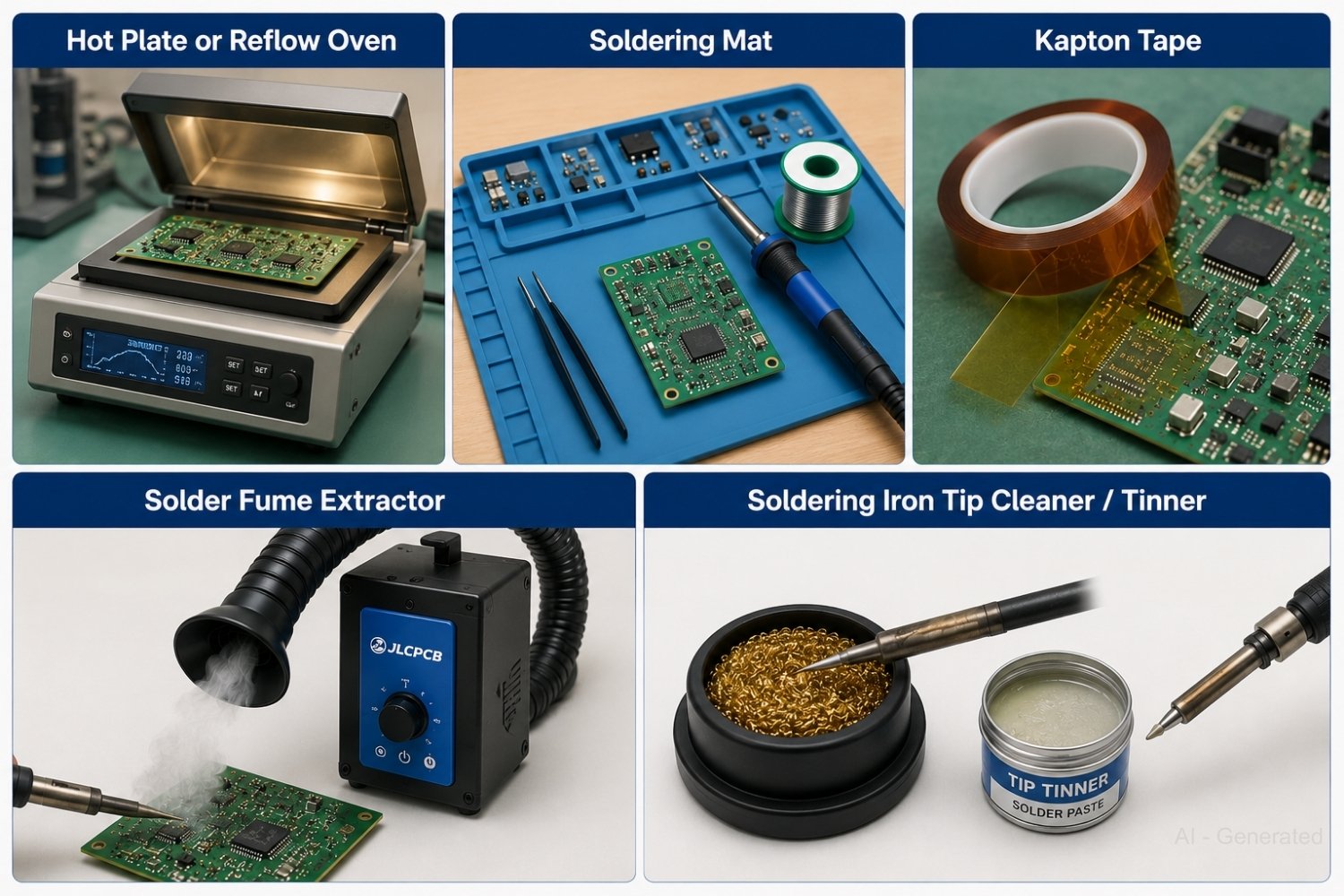
10. Hot Plate or Reflow Oven
A hot plate or reflow oven allows uniform heating of PCBs during soldering or rework. They are essential for:
- Reflowing multiple SMD components simultaneously
- Ensuring consistent solder joints across densely populated boards
- Reducing thermal stress by controlled, even heating
11. Soldering Mat
A heat-resistant, anti-static silicone mat protects both the workspace and sensitive electronic components. It also helps organize small parts during assembly or repair, improving workflow efficiency.
12. Kapton Tape
Kapton tape is a high-temperature, heat-resistant tape used to:
- Shield neighboring components during reflow or hot-air soldering
- Temporarily hold components in place
- Prevent thermal damage during rework or selective soldering After rework, it can be removed without leaving residue.
13. Solder Fume Extractor
A solder fume extractor removes harmful fumes generated during soldering, improving air quality and operator safety. It is essential for long-term health in workshops or labs.
14. Soldering Iron Tip Cleaner/Tinner
Maintaining a clean soldering iron tip is critical for reliable solder joints. Tools include:
- Brass wire sponge – removes oxidation and debris without damaging the tip
- Tip tinner / solder paste – re-tins the tip, improves solder flow, and extends the life of frequently used tips
Choosing the Right SMD Soldering Tools
Beginner-Level: Focus on mastering the basics. Essential tools include a temperature-controlled soldering station, ESD-safe flux pen, solder wire (0.3–0.5 mm), precision fine-point tweezers, and basic magnification tools. These allow beginners to practice soldering small SMD components safely and efficiently, improving their learning experience and building confidence in electronics assembly.
Intermediate-Level: Targeted at hobbyists, electronics students, and DIY enthusiasts. In addition to beginner tools, users should invest in a hot air rework station, cleaning kit (solder wick, isopropyl alcohol, brushes), and improved task lighting. These enable safe rework, selective soldering, and maintenance of high-quality solder joints on moderately complex PCBs.
Advanced-Level: Designed for industrial, university research, and high-precision applications where defects are unacceptable. Along with all beginner and intermediate tools, additional requirements include a reflow oven or hot plate, microscope or digital inspection tools, ESD-safe workbench, and solder fume extraction/PPE. These tools ensure precise handling of fine-pitch components, high-volume production, and compliance with professional safety standards.
For ultra-fine SMT soldering or PCB assembly, using professional SMT assembly service ensures reliable results.
Conclusion
Effective SMD soldering depends on precise thermal control, accurate solder deposition, and careful handling of miniature components. Essential SMD soldering tools—including temperature-controlled soldering stations, ESD-safe tweezers, solder wire, and flux pens—help prevent common soldering defects such as bridging, tombstoning, and cold joints, ensuring reliable, high-quality solder connections.
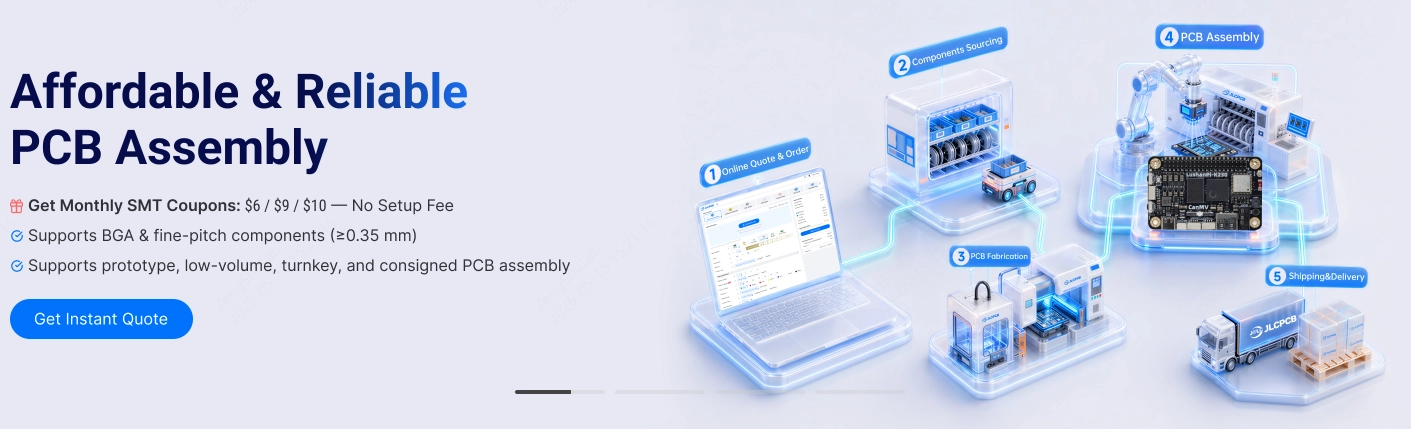
Services like JLCPCB SMT Assembly further simplify this process by providing professional stencil, pick-and-place, and reflow soldering solutions, making high-quality SMD assembly accessible for both prototypes and small-to-medium production runs.
FAQs
Q: What tools do I need for surface mount soldering as a beginner?
You will need a temperature-controlled soldering station, ESD-safe tweezers, flux pen, fine solder wire, and magnification tools. As you gain experience, you may add a hot air rework station and stencils for more precise and complex assemblies.
Q: How can I secure SMD components during the soldering process?
After positioning the component with fine tweezers and applying a small amount of flux, tack-solder one pin or pad first to fix the part in place. Then solder the remaining pins to ensure stable and accurate placement.
Q: Is a hot air rework station necessary for soldering SMD components?
For simple boards and larger SMD components, a fine-tip soldering iron is sufficient. For fine-pitch ICs, dense layouts, or complex PCBs, a hot air rework station is highly recommended for safe and reliable soldering.
Q: In SMD soldering, what distinguishes solder wire from solder paste?
Solder paste, applied using a stencil, is designed for reflow soldering with hot plates or ovens, while solder wire is intended for manual soldering with a soldering iron. Each serves a different purpose depending on the assembly method.
Popular Articles
• SMT Assembly Process Explained and Equipment Used: A Step-by-Step Guide to PCBA Manufacturing
• Common PCB Assembly Methods and Soldering Techniques Explained
• SMD Soldering Tools You Need: Complete Guide from Beginner to Pro
• What Is BGA Void? Causes, IPC Limits, and Solutions
• Reflow Soldering: Everything You Need to Know
Keep Learning
SMT vs Through Hole: Which PCB Assembly is Most Cost-Effective?
Performance and cost in the realm of electronics production depend on choosing the correct assembly method. Of the several approaches accessible, Surface Mount Technology (SMT) and Through-Hole Technology (THT) are the two most often used ones for PCB assembly. These two assemblies can be combined to create some products or used as individual technologies. Though seemingly little, this variance affects several aspects including board design, materials and techniques employed, heat dissipation, and rel......
PCB Soldering Basic Techniques and Overview
Soldering means joining metal components with a melted metal called solder, which has a low melting point compared to other metals. Soldering is crucial in the electronics industry and is the primary method of joining electrical components. There are different types of soldering materials based on quality and their melting points. The most common combination is a tin or lead metal alloy mixed with silver or brass. The soldering iron melts the metal so it can be used like glue to connect two pieces. On......
Lead-Free Solder vs Lead Solder : What is the Difference?
Solder is used by the majority of electrical devices to connect components to PCBs. The procedure of soldering is, when a solder melts down it will make a connection. This connection can be between pads or wires. Soldering is not like welding, we can attach the two joints by heating them again a lil bit. Although after performing the soldering step the curing and cooling is required. If during the cooling step there is any disturbance occur in the system it will lead to dry joints. Two main varieties ......
How to Repair a Burnt Circuit Board (and When to Replace It)
Key Takeaways Find out why the board burnt before you repair anything. The part that charred is often a victim of a fault somewhere else. Charred FR-4 conducts. A repair only lasts if every trace of carbon is cut out and the area measures as an insulator again. Heat that went through the board, blistering, or a burn among vias or under a BGA usually means replacing the board. Rebuild a burnt trace heavier than the original, and keep conductive epoxy off power paths. Power the repaired board from a cur......
How to Set the Temperature for Wave Soldering and What Are the Soldering Temperature Standards?
Wave soldering is a process used for soldering electronic components by inserting them into the holes on a Printed Circuit Board (PCB) and securing the components to the board using a molten solder wave generated by a wave soldering machine. Temperature is a crucial parameter during the wave soldering process, as it directly affects the quality and efficiency of soldering. Therefore, setting the temperature correctly for wave soldering is essential. Temperature for Wave Soldering Wave soldering machin......
SMD - Revolutionizing PCB Technology with Surface Mount Devices
Surface mount devices (SMDs) refer to electronic components that can be mounted directly onto a PCB without the need for through-holes, which is the traditional method of mounting components on a PCB. This technology has revolutionized the way electronic devices are manufactured, and has led to smaller and more compact devices that are both more reliable and less expensive to produce. The purpose of this article is to provide an overview of SMD technology and its importance in PCB manufacturing. We wi......