The Ultimate Guide to Solder Flux: Everything You Should Know Before Soldering PCB
14 min
- What is Solder Flux & How Does It Work in Soldering?
- Why Solder Flux Matters: Functions and Benefits in Soldering
- Is Solder Flux Really Necessary for Soldering?
- Types of Solder Flux Used in Electronics Assembly
- Solder Flux Forms and Packaging Options
- Common Applications of Solder Flux in PCB Assembly
- How to Choose the Best Solder Flux for Your PCB Project
- How to Use Solder Flux Properly: Step-by-Step Guide
- How to Clean and Remove Solder Flux Residue from PCBs
- Solder Flux Alternatives and Substitutes Explained
- Conclusion
- FAQ about Solder Flux
Soldering is needed to make almost all electronic devices. Adding solder alone won't make a joint that is strong, clean, and sound from a metallurgical point of view. Solder flux is a very important part of the process that comes in here.
If you want to do your job better and make it more reliable, you need to know a lot about soldering flux, whether you're an engineer, a professional technician, or just a hobbyist.
This article goes into a lot of detail about solder flux, including what it is, how it works, how to use it, and how to clean it up according to industry standards.
What is Solder Flux & How Does It Work in Soldering?
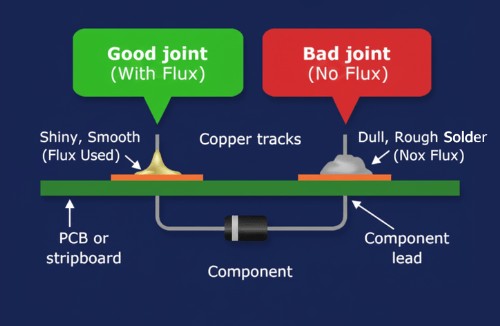
Solder flux is a chemical that is used before and during the thermal soldering process on electronic parts to lower the temperature. There is a layer of metal oxide (for example, copper oxides (CuO, Cu₂O) and tin oxide (SnO₂) on the metal surfaces of a printed circuit board (PCB) and component terminals.
This layer forms naturally when the metal is exposed to air. The oxide layer doesn't melt at the same temperature as the base metal, which means that the molten solder can't form a proper metallurgical bond with the metal surface.
When things heat up, the solder flux comes to life and does three principal works:
- Protect against Oxidation: Molten flux seals off your freshly cleaned metal from the air, so that oxygen can't contaminate things while you work. This will prevent the surface.
- Forming a Protective Barrier: The liquefied flux creates a shield over the clean metal, preventing oxygen from interacting while you're working. This will prevent the surface from reoxidizing.
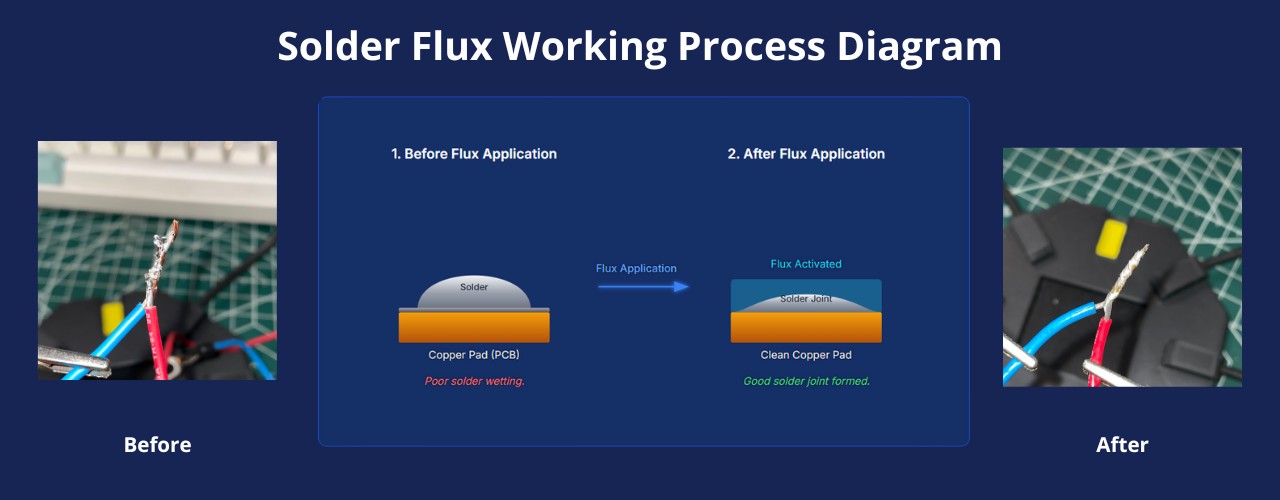
- Better Wetting: Flux allows molten solder to spread out uniformly on the metal surface by removing oxidation and decreasing the surface tension. It is this "wetting" that is critical to generating a solid, blemish-free Intermetallic Compound (IMC) layer, which serves as the foundation of a reliable solder joint.
Why Solder Flux Matters: Functions and Benefits in Soldering
For electronics that you can count on, using solder flux isn't optional. Here's why it makes such a huge difference:
- It Builds Rock-Solid Connections: Because solder flux ensures the surface is perfectly prepped, you get a consistent IMC layer. This results in connections that are mechanically sound and conduct electricity flawlessly.
- It Prevents Common Soldering Headaches: Solder flux dramatically cuts down the chances of issues like solder bridges (shorts between pins), cold joints (dull, cracked connections), or the solder refusing to stick where you want it.
- Efficient: Solder flux also helps transfer heat from the iron to the parts, so everything heats more quickly and to a more even temperature.
- The Results Look Professional and Are Easy to Inspect: Fluxed joints just look more pro — they have a nice, shiny appearance with a smooth concave fillet. This is not just a superficial benefit, either: It denotes a good connection and makes it very easy to eyeball your work.
JLCPCB delivers high-quality, reliably assembled circuit boards. JLCPCB's PCB assembly service employ highly controlled processes to ensure consistent, reliable solder joints. Automated SPI is implemented at multiple stages, and reflow profiles are optimized to minimize common soldering defects. All production adheres strictly to ISO quality standards, and X-ray inspection is performed on complex assemblies to verify hidden joints.
Is Solder Flux Really Necessary for Soldering?
People often ask, "Can I solder without flux?" The truth is that solder flux is absolutely indispensable in any soldering process. It removes oxides from metal surfaces, promotes proper wetting, and ensures strong, durable, and electrically reliable solder joints.
Without flux, soldering becomes unstable, leading to weak bonds, oxidation buildup, and poor conductivity — making it nearly impossible to achieve professional results.
Look, most solder wire already has a solder flux core that activates when you heat it up. That tiny bit of flux, usually just 1-3% of the total weight, might be just enough to get you by if you're soldering some simple through-hole parts onto a brand-new, perfectly clean board.
But the moment you run into stubborn oxidation or you're tackling any kind of precision job like SMT (Surface Mount Technology), that's when adding your own flux is a game-changer. This is especially true for fine-pitch components like QFPs and SOICs.
Applying solder flux separately gives you way more control and guarantees that the heat and solder go exactly where you want them to. And for any kind of rework, desoldering, or BGA jobs? It's not just a good idea—it's pretty much non-negotiable.
Types of Solder Flux Used in Electronics Assembly
The chemical makeup and activity level of solder flux determine its type. These are the three main groups:
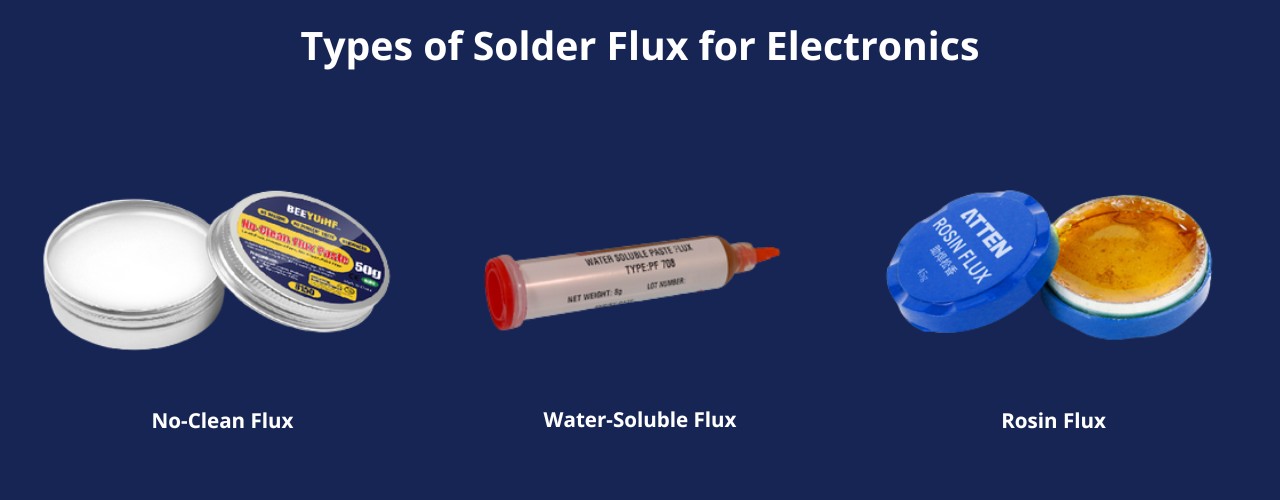
Rosin Flux
Made from resin from pine sap (abietic acid).
R (Rosin): The least active (not activated), it only works because rosin is naturally acidic. Good for surfaces that are very clean. Classification: ROL0.
RMA (Rosin Mildly Activated): This type of rosin has been activated with a small amount of an activator, like amine hydrochlorides, to make it better at cleaning. The most common way is to put things together and fix them by hand. J-STD-004 Classification: ROL0, ROL1.
RA (Rosin Activated): The most active in its class and can clean up a lot of oxidation. If you don't clean it up, its residue is corrosive. J-STD-004 Classification: ROM0, ROM1, ROH0, ROH1.
No-Clean Flux
Made with synthetic resins or polymers that have a low solids content. The residue left behind after soldering is not corrosive, does not conduct electricity, and has a high Surface Insulation Resistance (SIR), so it should not need to be cleaned. But it is still a good idea to clean high-frequency (RF) circuits for aesthetic and inspection reasons.
Water-Soluble Flux (Organic Acid - OA)
This is the strongest solder flux and is made from organic acids like citric acid and glutamic acid. Made to clean surfaces that have a lot of oxidation.
The downside is that its residue is very corrosive and conductive because it contains ions. To keep it from rusting and moving through electrochemistry, it must be cleaned very well with deionized water.
This table compares different types of solder flux used in electronics soldering.
| Feature | Rosin Flux (R/RMA/RA) | No-Clean Flux | Water-Soluble (Organic Acid) Flux |
|---|---|---|---|
| Base Chemistry | Natural Pine Resin (Abietic Acid) | Synthetic Resins, Polymers | Organic Acids (Citric, Glutamic, etc.) |
| Activity Level | Low to High (R < RMA < RA) | Low to Medium | Very High |
| Residue Properties | Hard, non-corrosive (R/RMA) to corrosive (RA) | Soft, non-corrosive, non-conductive, transparent | Highly corrosive and conductive (ionic) |
| Cleaning Requirement | Recommended (IPA/solvent) for RA, optional for RMA | Optional, but recommended for high-reliability apps | Mandatory (Deionized Water) |
| Primary Advantage | Good activity, well-understood, reliable | Eliminates the cleaning step in many applications | Excellent cleaning power for oxidized surfaces |
| Primary Disadvantage | Residue can be difficult to clean | Lower activity, not suitable for heavy oxidation | Aggressive residue requires rigorous cleaning |
| Common Application | Manual soldering, rework, hobbyist use | SMT reflow, automated assembly, fine-pitch rework | Automated wave soldering, metal fabrication |
Solder Flux Forms and Packaging Options
Solder flux comes in various formulations and packaging formats to suit different soldering processes:
- Paste or Gel Flux (Tacky Flux): Supplied in syringes or small jars, tacky flux offers precise application control, making it ideal for SMT rework, BGA reballing, and stencil printing.
- Liquid Flux: Packaged in bottles or spray pens, liquid flux is designed for wave soldering, dip soldering, and drag soldering, where broader surface coverage is needed.
- Flux Pen: The pen-style applicator delivers controlled flux placement for fine-pitch SMD components, minimizing residue and waste.
- Flux-Core Solder Wire: A solder alloy wire preloaded with flux in its core, commonly used in manual soldering and rework. It ensures consistent flux delivery during hand soldering operations.
Further read: How to Apply Solder Flux When Hand Soldering Components
Common Applications of Solder Flux in PCB Assembly
The selection of flux type depends on the soldering process and component packaging:
- Through-Hole Soldering: RMA-type rosin flux is commonly used for wave and hand soldering. It provides reliable wetting while minimizing post-cleaning requirements.
Further read: How to Use Solder Flux When Soldering Through-Hole Components
- SMT and Rework: No-clean tacky flux or flux pens are preferred for surface-mount soldering and small-scale rework, allowing localized application with minimal residue.
- Drag Soldering ICs: Applying a small amount of flux significantly improves solder flow and helps prevent solder bridges between fine-pitch pins.
- BGA Work: Specialized tacky or gel flux is used to secure solder balls and promote even reflow under the package. X-ray inspection is often required for quality assurance.
How to Choose the Best Solder Flux for Your PCB Project
When selecting the appropriate solder flux, you'll want to consider several things in relation to your project:
How You're Soldering: If you're hand-soldering as a hobbyist or doing a repair, RMA or No-Clean in paste or pen form are going to be most convenient.
Type of Component: Tell us if you are soldering through-hole or fine-pitch SMD components. Small, densely packed parts need a precise delivery method, specifically a pen or syringe.
Your cleaning situation: Do you have a way to clean the game afterward? If you're on the fence: No-Clean is probably your best choice. If you can clean it with IPA, then rosin flux is a good choice. For the very best cleaning, particularly with Deionized water wash systems, Water-Soluble flux is your best bet.
Industry Standards (IPC, J-STD): For any commercial products or critical applications (eg: medical/aerospace), it is always important to adhere to the corresponding industry standards. These standards will usually specify exactly which flux to use and how to clean it.
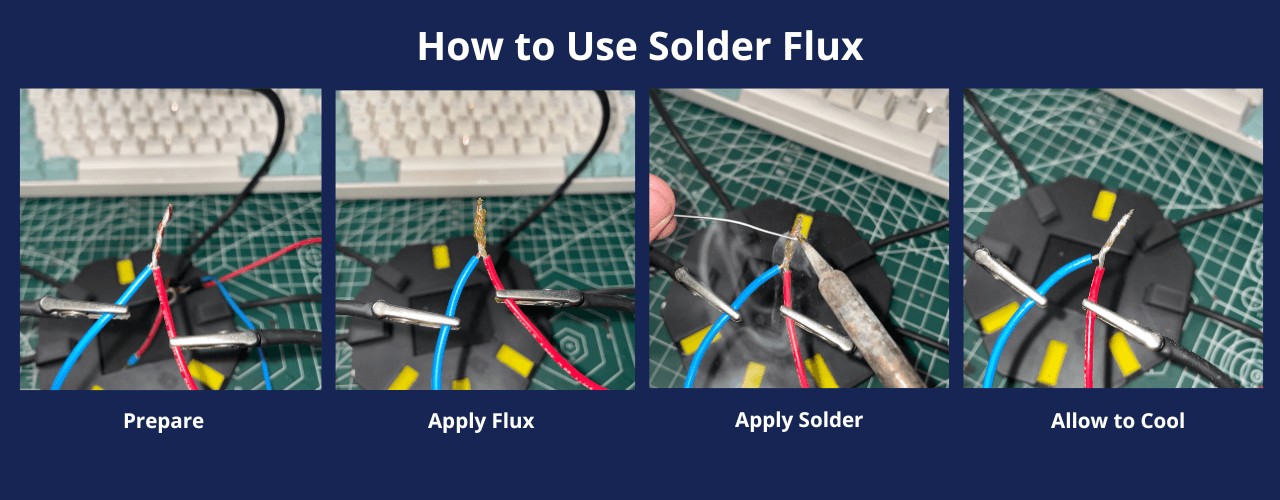
How to Use Solder Flux Properly: Step-by-Step Guide
The technique for producing a good result is this:
Cleaning the Surfaces
To begin, make sure your PCB pads and component leads are clean without any grease or oil.
Use Solder flux
You need only a thin, consistent coating. Too much just means a bigger cleaning-up job.
Carefully Reheat the Joint
Position your warmed-up iron tip so that it's contacting both the component lead and the flat surface of the PCB pad. This will heat them uniformly and ignite the flux.
Feed the Solder
Touch either the joint or the place where you want some of the solder to go—not directly onto the iron's tip—on the wire and allow it to be fed into your joint. The joint will be heated, causing the solder to liquify, and it's the flux that assists in filling and flowing through capillary action.
Lift Off Heat/Solder
When solder flows into a good fillet, quickly remove the solder wire and then the iron.
Cool It Down
Wait a few seconds for the joint to cool. This permits a strong inner structure to develop in the metal.
How to Clean and Remove Solder Flux Residue from PCBs
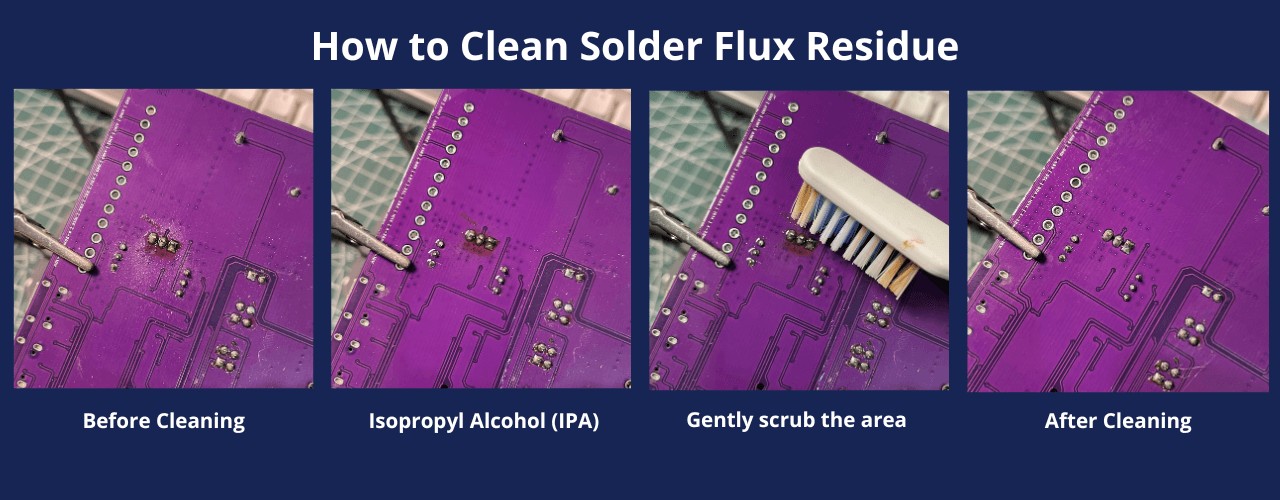
- For Rosin and No-Clean: Dip a stiff-bristled brush (an ESD-safe one is best) in high-purity (99%+) Isopropyl Alcohol (IPA). Gently scrub the area until the gunk dissolves, then dry it with a lint-free cloth or a puff of compressed air. You can also find specialized flux remover solvents that are even more effective.
- For Water-Soluble Residues: This type must be cleaned with distilled or deionized water. Regular tap water is a no-go because its minerals can leave behind conductive salts. After washing, make sure the board is bone dry (often done in a special oven) before you ever power it up.
Solder Flux Alternatives and Substitutes Explained
What can I use instead of flux for soldering?
There aren't any really good alternatives to standard electronics soldering flux. Some sources might say to use pine resin or other materials you can make yourself, but this is not a good idea because the composition is not controlled, and it can hurt sensitive areas.
In very advanced industrial settings, there are a few other choices, like:
- Controlled Atmosphere Soldering: This method uses an inert gas, like nitrogen, in a reflow oven to stop oxidation. This can reduce or even eliminate the need for flux.
- Advanced Solder Paste Technology: Some new solder pastes have very little flux in them or are made to completely evaporate during reflow, leaving no residue.
But for 99% of electronics professionals, using high-quality solder flux is the best, most cost-effective, and most reliable way to get better results.
Conclusion
Solder flux might not seem as important as the solder or the iron, but it's a critical part of the process. It's the cleaning agent that makes strong, reliable, and long-lasting solder joints possible. Understanding the different types and how to use them will let you pick the right tool for any job and seriously level up your electronics projects.
Now that you understand how solder flux improves soldering quality, you can ensure stronger, more reliable PCB assemblies. Whether you're building prototypes or running small to medium production batches, JLCPCB delivers professional PCB assembly services — from component sourcing to precise soldering — to help engineers, makers, and growing businesses bring their projects to life quickly and cost-effectively.
FAQ about Solder Flux
Q: Can I use vaseline as flux for soldering?
No — it's actually harmful. Vaseline is a petroleum jelly product made from hydrocarbons, and it doesn't have the chemical properties to break down oxide layers. Using it will only make the solder joint dirty, break down into carbon at soldering temperatures, and leave behind a weak bond.
Q: Can solder flux damage a PCB?
Yes, if you use the wrong kind or don't clean up the residue well. If you leave behind residue, highly active and acidic fluxes (like Water-Soluble) will eat away at things. Over time, this can cause copper traces on PCBs, leads on components, and trigger electrochemical migration, which can lead to short circuits.
Q: Does solder flux have an expiration date?
Yes. Solder flux doesn't last very long, usually between one and three years. Over time, its solvents can evaporate, changing its viscosity and solids percentage, and its chemical activators can break down, making it less effective. An expired solder flux just won't clean oxides effectively.
Q: Is it possible to use too much solder flux?
More is not always better. While it's better than using none, too much solder flux leaves a sticky mess that's hard to clean and can attract dust. A thin layer that covers the joint is all you need.
Q: Is rosin flux safe for PCBs?
Yes, it's very common. RMA (Rosin Mildly Activated) flux is a popular choice for all sorts of PCB work. The residue it leaves is mostly harmless, but cleaning it off is still good practice for long-term reliability.
Q: What happens if I solder without flux?
Without solder flux, the solder can't properly bond to the metal because of the oxide layer in the way. This usually results in a 'cold joint' that looks dull and rounded. These joints are mechanically weak and make for a poor electrical connection.
Popular Articles
• SMT Assembly Process Explained and Equipment Used: A Step-by-Step Guide to PCBA Manufacturing
• Common PCB Assembly Methods and Soldering Techniques Explained
• SMD Soldering Tools You Need: Complete Guide from Beginner to Pro
• What Is BGA Void? Causes, IPC Limits, and Solutions
• Reflow Soldering: Everything You Need to Know
Keep Learning
How to Solder Wires to a Circuit Board Properly: Step-by-Step Guide
Learning how to solder wires to a circuit board is a fundamental skill for electronics repair, prototyping, and PCB assembly. Whether you are attaching power leads, signal wires, or test connections, a weak solder joint can cause intermittent failures, lifted pads, or long-term reliability issues. In this step-by-step guide, you'll learn the correct tools, preparation methods, and soldering techniques needed to create strong, clean, and reliable wire-to-PCB connections. From preparing the wire and PCB......
PCB Soldering Basic Techniques and Overview
Soldering means joining metal components with a melted metal called solder, which has a low melting point compared to other metals. Soldering is crucial in the electronics industry and is the primary method of joining electrical components. There are different types of soldering materials based on quality and their melting points. The most common combination is a tin or lead metal alloy mixed with silver or brass. The soldering iron melts the metal so it can be used like glue to connect two pieces. On......
SMT Assembly Process Explained and Equipment Used: A Step-by-Step Guide to PCBA Manufacturing
Today's high-performance electronics, from pocket-sized smartphones and IoT sensors to sophisticated industrial control systems, are made possible by a manufacturing miracle: Surface Mount Technology (SMT). SMT is the backbone of electronics manufacturing, allowing us to have the incredible component density and miniaturization. A bare circuit board is simply a substrate. The process of transforming it into a functional electronic circuit is known as Printed Circuit Board Assembly. This article outlin......
Common PCB Assembly Methods and Soldering Techniques Explained
Whether you're designing your first prototype or scaling up to production, understanding PCB assembly methods and soldering techniques is crucial to achieving reliable, high-performance circuit boards. Modern PCBA primarily relies on Surface Mount Technology (SMT) and Through-Hole Technology (THT)—each offering unique advantages for component density, durability, and manufacturability. In this guide, we'll break down the major PCB assembly methods, key soldering techniques such as reflow and wave sold......
What Is Tombstoning? A Practical Guide to Causes, Reflow Risks, Prevention, and Rework
Key Takeaways Definition: Tombstoning occurs when a small two-terminal component lifts off one pad during reflow and stands upright, leaving one end without a proper solder connection. Root Cause: Unequal solder wetting forces act on the two terminals, often due to differences in pad temperature, solder-paste volume, pad geometry, or thermal mass. Highest Risk: Small passive components, such as 0201 and 0402 resistors and capacitors, are especially susceptible because their low mass and small terminat......
Rigid-Flex PCB Assembly: Design, Process, Quality & Cost
Miniaturization, higher functionality, and mechanical adaptability are three main trends in modern electronics. Circuit boards that can tolerate bending, vibration, and compact or small installation spaces are becoming more and more necessary for modern devices like smartphones, medical implants, and aerospace systems. Combining flexibility and stability, rigid-flex PCBs provide both mechanical strength and design freedom, while flexible PCBs allow for bending and folding in confined spaces. This hybr......