Common PCB Assembly Methods and Soldering Techniques Explained
7 min
- Main PCB Assembly Methods
- Main PCB Soldering Techniques
- FAQs about PCB Assembly and Soldering
- Conclusion

Whether you're designing your first prototype or scaling up to production, understanding PCB assembly methods and soldering techniques is crucial to achieving reliable, high-performance circuit boards. Modern PCBA primarily relies on Surface Mount Technology (SMT) and Through-Hole Technology (THT)—each offering unique advantages for component density, durability, and manufacturability.
In this guide, we'll break down the major PCB assembly methods, key soldering techniques such as reflow and wave soldering, and the step-by-step PCB assembly process. You'll also learn how to identify and fix common defects like tombstoning, voids, and cold joints, helping you build cleaner, more consistent boards.
Main PCB Assembly Methods
PCB assembly is not a single technique but a collection of manufacturing strategies optimized for different component types, reliability requirements, and cost targets. The main PCB assembly approaches include Surface Mount Technology (SMT), Through-Hole Technology (THT), and mixed assembly, each with unique implications for signal integrity, thermal management, and manufacturability.
1Surface Mount Technology (SMT)
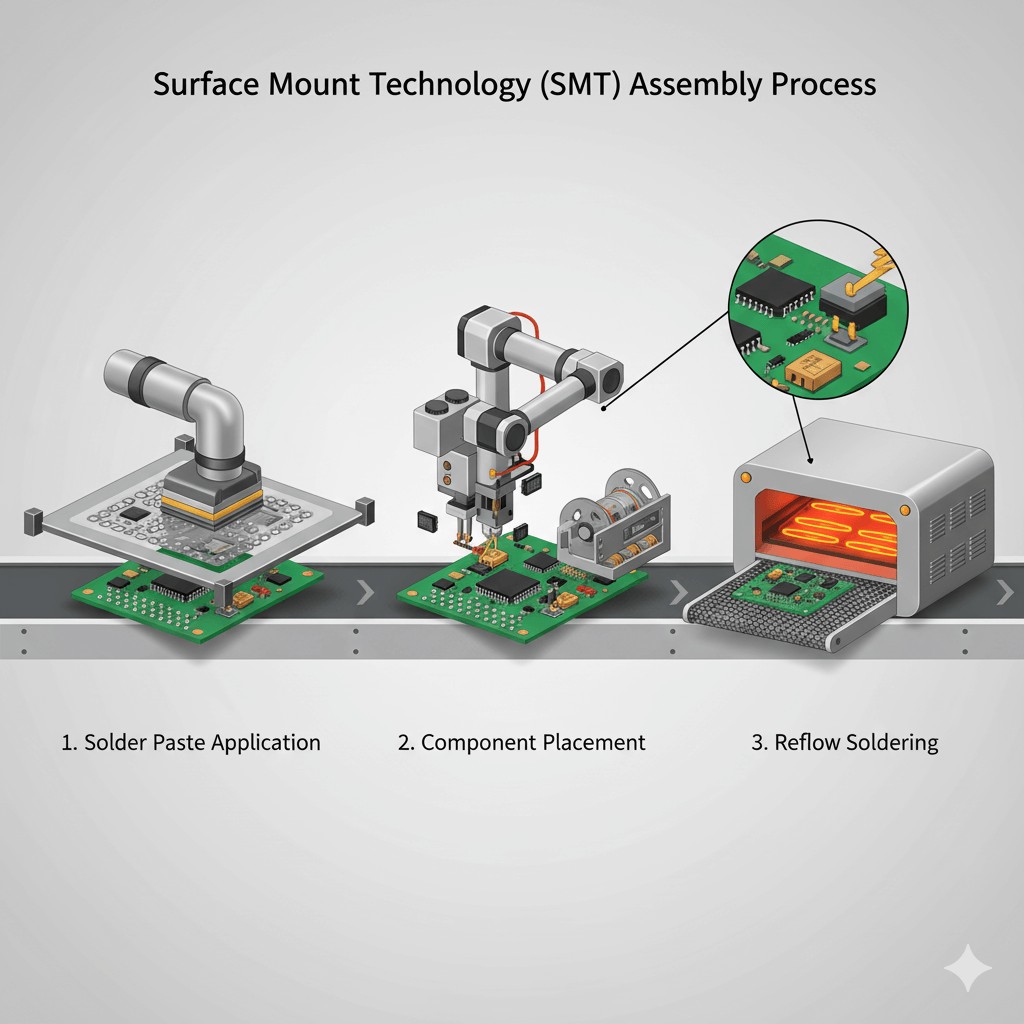
Surface Mount Technology (SMT) dominates modern PCBA because it enables miniaturization and high-density layouts. Instead of long leads, Surface Mount Device (SMD) has flat terminations or solder balls that sit directly on copper pads.
Stencil Printing
A stainless steel stencil deposits solder paste with precise volume control.
Pick-and-Place
High-speed machines place SMDs at ±25 μm accuracy.
Reflow Soldering
Thermal profile (preheat, soak, peak ~245 °C, controlled cool-down) forms intermetallic solder joints.
- From prototype builds to production runs, JLCPCB provides turnkey PCB assembly backed by automated manufacturing and a fully traceable supply chain. Upload your Gerber files and BOM, and we'll handle PCB fabrication, genuine component sourcing, precision SMT assembly, and comprehensive quality inspection—all in one streamlined workflow.
- Get an instant PCBA quote and bring your design into production today.
2Through-Hole Technology (THT)
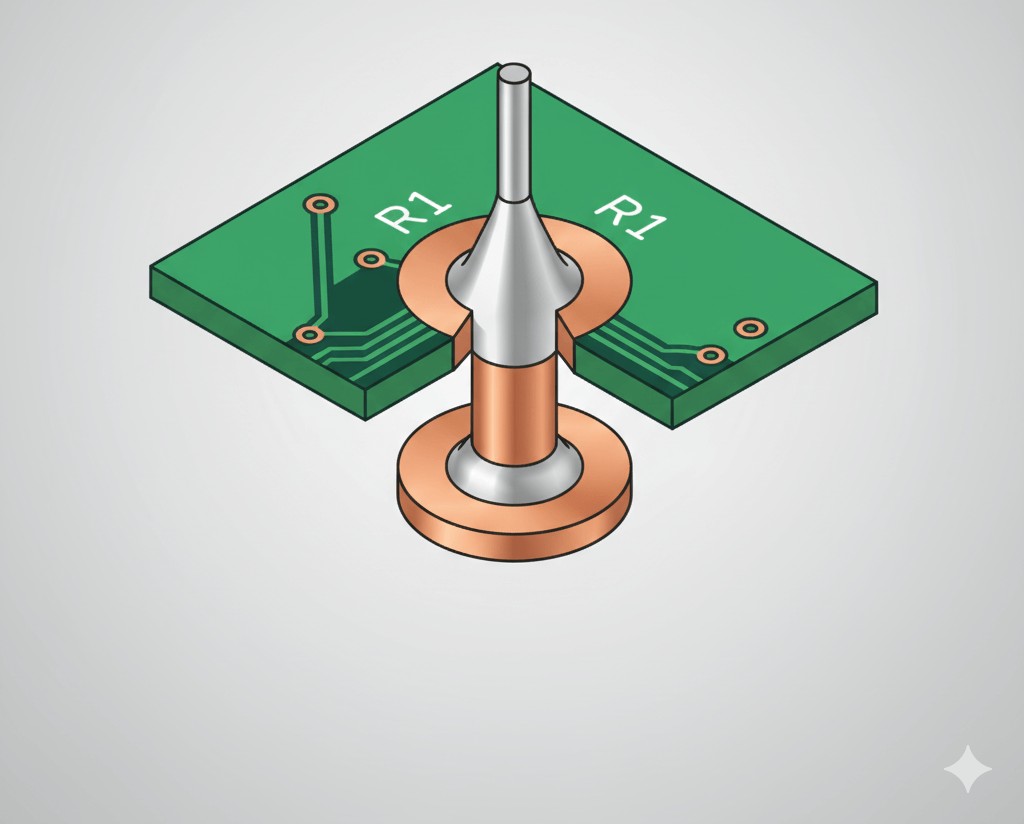
Through-Hole Technology (THT) refers to the process of inserting component leads into drilled holes that are plated with copper, and then it is soldered either by wave soldering or selective soldering.
Hole Drilling
CNC drilling, plating to create conductive barrels.
Component Insertion
Manual or robotic insertion (axial or radial insertion machine).
Wave/Selective Soldering
Molten solder bonds leads to barrels.
3Mixed Assembly (SMT + THT)
Most real-world boards will use a combination of SMT and THT:
- SMT for ICs, passives, and RF circuits.
- THT for connectors, power semiconductors, and relays.
Challenges of Mixed Assembly
- Need to manage two different soldering processes (reflow + wave/selective)
- Thermal management has to address two different solder types.
- Board warpage may introduce alignment issues during the second soldering step.
To simplify this, JLCPCB offers hybrid assembly services, integrating SMT reflow and THT selective soldering.
4PCB Assembly Options: Single vs Double-Sided, Manual, and Turnkey Approaches
Single-Sided vs Double-Sided SMT: Double-sided requires more than one reflow cycle, and must be thermally balanced.
Manual Assembly: Still used for prototypes or specialized low-volume boards.
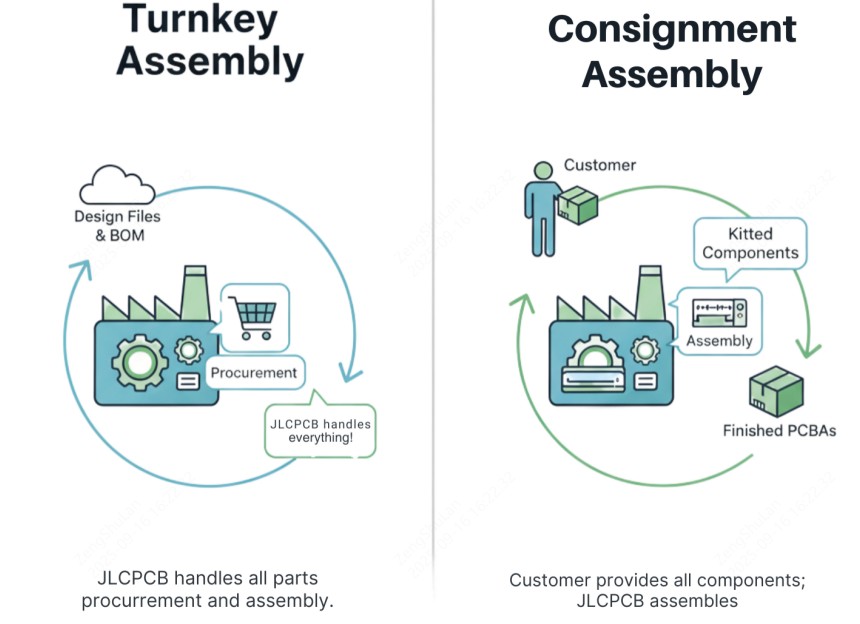
Turnkey vs Consignment PCB Assembly:
- Turnkey PCB Assembly → Manufacturer sources all parts.
- Consignment PCB Assembly → Customer supplies parts; manufacturer only assembles.
Also Read: How to Consign Parts to JLCPCB
Main PCB Soldering Techniques
1Reflow Soldering
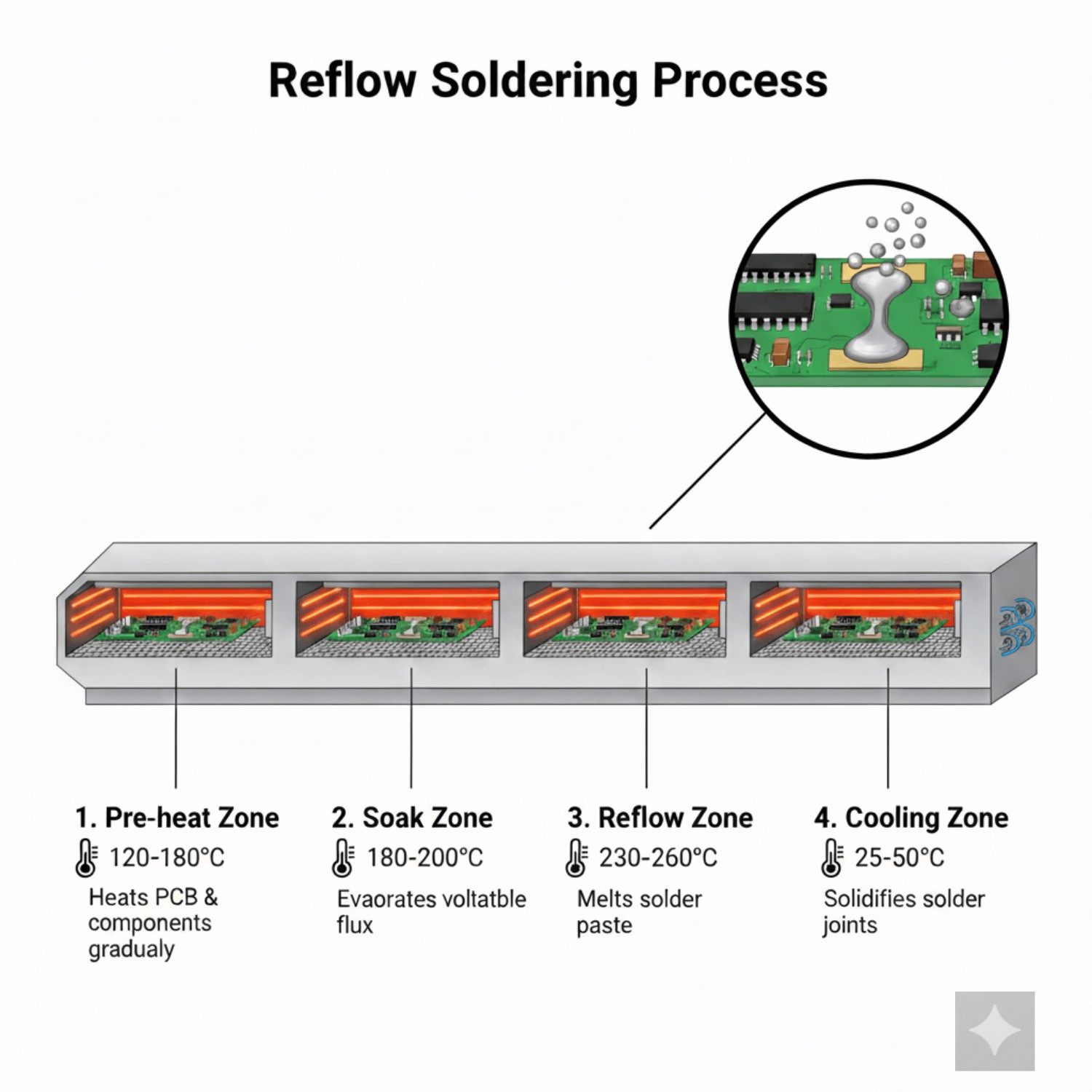
Reflow soldering is the primary method for soldering SMT components. The reflow soldering process includes applying solder paste via a stencil, accurately picking and placing components, and passing the assembled PCB through a reflow oven with multiple thermal zones.
A lead-free solder reflow profile, such as for SAC305 alloy, typically consists of four stages: preheat (120–150 °C), soak (150–180 °C), peak (230–250 °C), and controlled cooling. Mechanical integrity depends on proper intermetallic compound (IMC) formation, while poor thermal management can cause common reflow defects such as tombstoning, voids, or popcorning.
2Wave Soldering
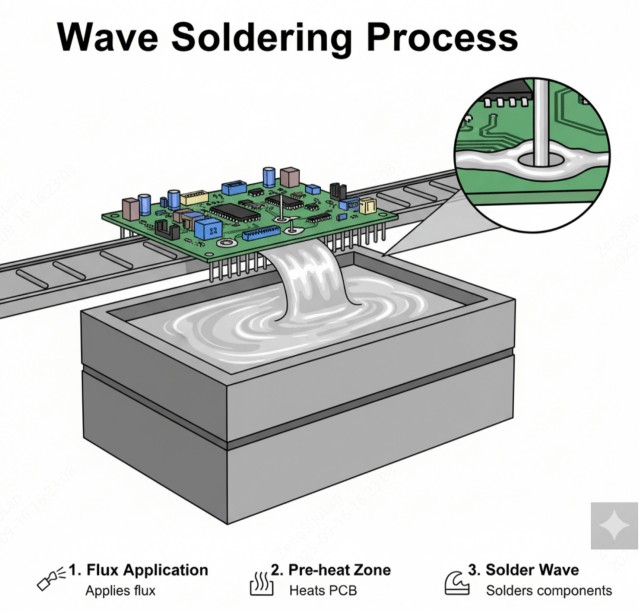
Wave soldering is used for through-hole (THT) components and larger surface-mount (SMT) components; a PCB board is pre-fluxed and passed across molten solder (approximately 250 degrees Celsius).
Wave soldering creates strong solder joints; it is ideal for high pin-count connectors or dual-in-line package integrated circuits (DIP ICs).
Note
Wave soldering is not recommended for small/pitch SMT components or SMT components due to potential risks of bridging and thermal stresses.
3Selective Soldering
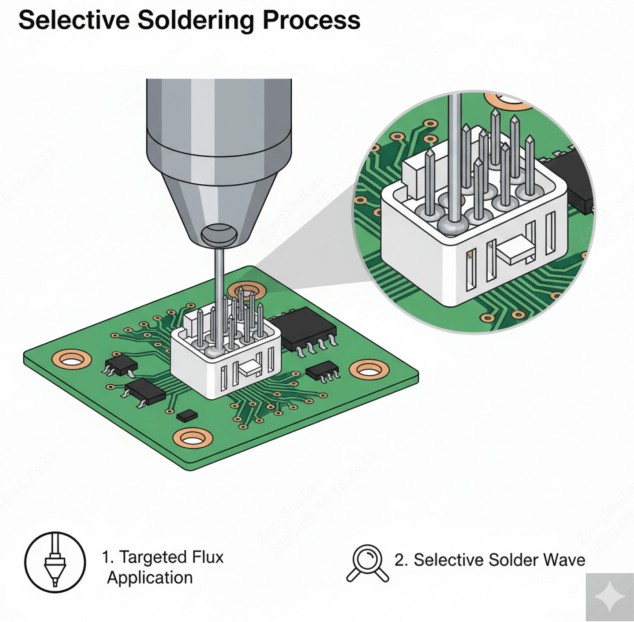
Selective soldering applies solder in a localized area (pin) using a computer numeric controlled (CNC) soldering nozzle, which can be ideal for hybrid assemblies, i.e., an SMT component that has already been reflowed. By using selective soldering, you do not risk damaging the existing connections and minimize thermal stress on the adjacent components. Selective soldering is slower than wave soldering, but a stronger joint can be achieved.
4Hand Soldering
Manual soldering is mostly used for prototyping, rework, and low-volume boards. Hand soldering is flexible and labor-intensive, but errors can and will occur. For example, cold joints and inconsistent wetting. Hence, for high-volume productions, hand soldering should not be recommended.
FAQs about PCB Assembly and Soldering
Q: What is the difference between SMT and THT assembly?
SMT places components directly on the PCB surface using solder paste and reflow soldering, enabling miniaturization and high-density layouts. THT inserts component leads through drilled and plated holes, then solders them via wave or selective soldering for stronger mechanical bonds—ideal for connectors, power components, and high-reliability applications.
Q: What is the most common soldering method for SMT components?
Reflow soldering is the primary method for SMT components. It involves applying solder paste via a stencil, placing components, and passing the PCB through a reflow oven with controlled thermal zones (preheat, soak, peak ~245 °C, cooling) to form reliable intermetallic solder joints.
Q: Can SMT and THT be used on the same PCB?
Yes, this is called mixed assembly. SMT components are placed and reflowed first, then THT components are inserted and soldered via wave or selective soldering. Challenges include managing two different soldering processes and potential board warpage during the second soldering step.
Q: What is the difference between turnkey and consignment PCB assembly?
In turnkey assembly, the manufacturer sources all components and handles the entire process. In consignment assembly, the customer supplies the parts and the manufacturer only performs the assembly. Turnkey reduces procurement burden, while consignment gives the customer more control over component sourcing.
Q: What are common PCB assembly defects and how can they be prevented?
Common defects include tombstoning (uneven solder wetting causing components to stand up), voids (trapped gas in solder joints), cold joints (insufficient heat/dull appearance), and bridging (unintended solder connections between pins). Prevention requires proper stencil design, optimized thermal profiles, controlled cooling rates, and thorough inspection using AOI or X-ray.
Conclusion
Mastering PCB assembly is about precision, consistency, and quality control—from selecting the right assembly method (SMT, THT, or mixed) to applying the proper soldering technique for each component type. Understanding how to prevent and fix assembly defects not only improves circuit board reliability but also reduces production waste and rework.
Popular Articles
• SMT Assembly Process Explained and Equipment Used: A Step-by-Step Guide to PCBA Manufacturing
• Common PCB Assembly Methods and Soldering Techniques Explained
• SMD Soldering Tools You Need: Complete Guide from Beginner to Pro
• What Is BGA Void? Causes, IPC Limits, and Solutions
• Reflow Soldering: Everything You Need to Know
Keep Learning
How to Solder Wires to a Circuit Board Properly: Step-by-Step Guide
Learning how to solder wires to a circuit board is a fundamental skill for electronics repair, prototyping, and PCB assembly. Whether you are attaching power leads, signal wires, or test connections, a weak solder joint can cause intermittent failures, lifted pads, or long-term reliability issues. In this step-by-step guide, you'll learn the correct tools, preparation methods, and soldering techniques needed to create strong, clean, and reliable wire-to-PCB connections. From preparing the wire and PCB......
PCB Soldering Basic Techniques and Overview
Soldering means joining metal components with a melted metal called solder, which has a low melting point compared to other metals. Soldering is crucial in the electronics industry and is the primary method of joining electrical components. There are different types of soldering materials based on quality and their melting points. The most common combination is a tin or lead metal alloy mixed with silver or brass. The soldering iron melts the metal so it can be used like glue to connect two pieces. On......
SMT Assembly Process Explained and Equipment Used: A Step-by-Step Guide to PCBA Manufacturing
Today's high-performance electronics, from pocket-sized smartphones and IoT sensors to sophisticated industrial control systems, are made possible by a manufacturing miracle: Surface Mount Technology (SMT). SMT is the backbone of electronics manufacturing, allowing us to have the incredible component density and miniaturization. A bare circuit board is simply a substrate. The process of transforming it into a functional electronic circuit is known as Printed Circuit Board Assembly. This article outlin......
Common PCB Assembly Methods and Soldering Techniques Explained
Whether you're designing your first prototype or scaling up to production, understanding PCB assembly methods and soldering techniques is crucial to achieving reliable, high-performance circuit boards. Modern PCBA primarily relies on Surface Mount Technology (SMT) and Through-Hole Technology (THT)—each offering unique advantages for component density, durability, and manufacturability. In this guide, we'll break down the major PCB assembly methods, key soldering techniques such as reflow and wave sold......
What Is Tombstoning? A Practical Guide to Causes, Reflow Risks, Prevention, and Rework
Key Takeaways Definition: Tombstoning occurs when a small two-terminal component lifts off one pad during reflow and stands upright, leaving one end without a proper solder connection. Root Cause: Unequal solder wetting forces act on the two terminals, often due to differences in pad temperature, solder-paste volume, pad geometry, or thermal mass. Highest Risk: Small passive components, such as 0201 and 0402 resistors and capacitors, are especially susceptible because their low mass and small terminat......
Rigid-Flex PCB Assembly: Design, Process, Quality & Cost
Miniaturization, higher functionality, and mechanical adaptability are three main trends in modern electronics. Circuit boards that can tolerate bending, vibration, and compact or small installation spaces are becoming more and more necessary for modern devices like smartphones, medical implants, and aerospace systems. Combining flexibility and stability, rigid-flex PCBs provide both mechanical strength and design freedom, while flexible PCBs allow for bending and folding in confined spaces. This hybr......