A Beginner’s Guide to STM32 vs ESP32: Key Differences and Best Uses
12 min
- STM32 vs ESP32: Key Differences Explained
- STM32 vs ESP32: Which Is Better?
- STM32 vs ESP32 in Practice: Real Project Examples
- STM32 vs ESP32 vs Arduino
- Should You Learn STM32 or ESP32 First?
- STM32 vs ESP32 Cost Comparison
- Designing a PCB With STM32 vs ESP32
- STM32 and ESP32: Choosing the Right Variant for Modern Projects
- FAQs
- Conclusion
STM32 vs ESP32 is the most-asked microcontroller comparison on r/embedded for a reason: they look interchangeable on paper, but solve completely different engineering problems.
STM32 is an industrial-grade MCU family built on ARM Cortex-M cores and precision peripherals. ESP32 is a connectivity-first SoC built around Wi-Fi, Bluetooth, and out-of-the-box IoT.
This guide breaks down where each platform wins in real engineering projects, using datasheet numbers, production design trade-offs, and practical embedded use cases.
In simple terms: pick ESP32 for wireless; pick STM32 for control.
STM32 vs ESP32: Key Differences Explained
The ESP32 is a low-cost Wi-Fi + Bluetooth SoC from Espressif optimized for connected products. The STM32 is a family of 32-bit ARM Cortex-M microcontrollers from STMicroelectronics optimized for precision control, ultra-low-power operation, and industrial reliability.
If you are deciding between a dedicated microcontroller and a microprocessor architecture, both platforms serve the microcontroller role exceptionally well, but with completely different architectural priorities. Pick ESP32 for wireless; pick STM32 for control.
| Feature | STM32 | ESP32 |
|---|---|---|
| Main focus | Industrial / control MCU | IoT SoC |
| CPU core | ARM Cortex-M0 to M85 | Xtensa LX6/LX7 or RISC-V |
| Wi-Fi / Bluetooth | External | Built-in |
| Low-power floor | ~0.3 uA (Standby) | ~5-10 uA (Deep Sleep) |
| Motor control | Excellent (advanced timers) | Adequate (LEDC PWM) |
| Cost (chip only) | $1.50 - $12 | $1.30 - $4 (module) |
| Best for | Motor, sensor, industrial | Wi-Fi / BLE products |
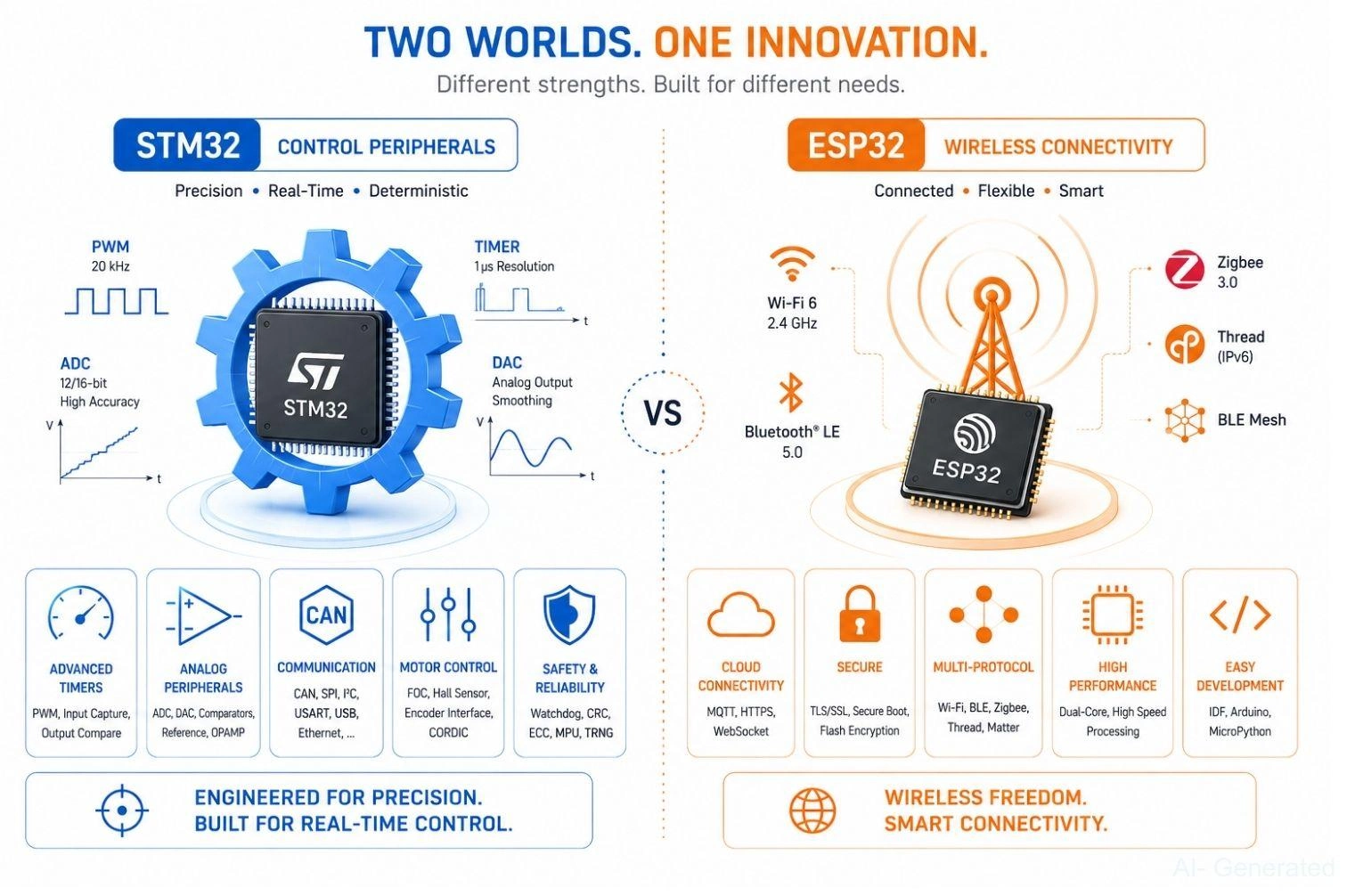
Figure: Comparing the precision hardware control of STM32 with the wireless connectivity features of ESP32.
STM32 vs ESP32: Which Is Better?
The honest answer to "which is better" is neither, they target different problems.
Use ESP32 when wireless and time-to-market matter. Use STM32 when timing, power budget, analog precision, or certification matter. Use both when the product is serious.
To help map your engineering priorities to the perfect platform, refer to the selection key below:
| Requirement / Use Case | Recommended Platform | Primary Engineering Reason |
|---|---|---|
| Lowest BOM Cost (Wireless) | ESP32 | On-chip RF eliminates external transceivers and shielding costs. |
| Best Control Loop Performance | STM32 | Bounded interrupt latency and highly deterministic hardware timers. |
| Lowest Current in Standby Sleep | STM32 | Sub-microamp sleep floor is up to ten times lower than ESP32. |
| Industrial Safety Certification | STM32 | Meets IEC 60730 Class B and AEC-Q100 standards out-of-the-box. |
| Rapid 24-Hour Prototyping | ESP32 | Massive Arduino library ecosystem and instant Wi-Fi server setups. |
| Smart Home Node (Matter/Thread) | ESP32-C6 | Native IEEE 802.15.4 radio supporting Zigbee and Thread. |
| Battery Sensor (3+ Year Life) | STM32L4 / STM32U5 | Autonomous peripherals (LPBAM) allow sampling without waking CPU. |
| BLDC Motor Controller | STM32G4 | High-resolution timers (184 ps resolution) and triple ADCs. |
| Drone Flight Controller | STM32H7 | High CoreMark performance with dual-precision FPU and DMA. |
| Wired Industrial RS485/CAN | STM32 | Native multi-channel CAN-FD and robust UART direction control. |
| Connected Industrial Gateway | STM32 + ESP32 | Combined approach isolates safety-critical control from network stack. |
| Beginner's First IoT Project | ESP32 | Minimal entry barrier using Arduino IDE over a USB connection. |
STM32 vs ESP32 in Practice: Real Project Examples
Smart Home Sensor Node
- Requirements: Wi-Fi, MQTT, OTA updates, ~$2 BOM
- Best Choice: ESP32-C3
- Why: Pre-certified Wi-Fi module, Arduino IDE, ESPHome support. Adding wireless to an STM32 design significantly increases BOM cost and design complexity.
Wi-Fi Energy Meter (Mains-Powered)
- Requirements: Current sensing, cloud reporting, no battery
- Best Choice: ESP32
- Why: Mains power makes radio current draw irrelevant. HLW8032 energy IC speaks UART; ESP32 handles MQTT upload.
Industrial RS485 Controller
- Requirements: Modbus RTU, 4-20 mA input, IEC 60730 certifiable
- Best Choice: STM32G0 / F0
- Why: Bounded UART timing, linear 12-bit ADC, certifiable hardware. ESP32 is adequate but adds qualification risk.
BLDC Motor Controller (Drone ESC)
- Requirements: 6-PWM with dead-time, 30 kHz FOC, deterministic interrupt response
- Best Choice: STM32G431
- Why: HRTIM + advanced timers + synchronous ADC. ArduPilot and PX4 firmware explicitly target STM32F4/H7 for this reason.
Battery-Powered LoRa Soil Sensor (3-Year Target)
- Requirements: Sub-uA sleep, LoRa radio, 2x AA
- Best Choice: STM32WL
- Why: Integrated LoRa + MCU in one die. Sub-1 uA standby. ESP32 + external LoRa drains the same battery in weeks.
AI Doorbell with Camera and Cloud Upload
- Requirements: Camera, person detection (TFLite Micro), Wi-Fi, BLE provisioning
- Best Choice: ESP32-S3
- Why: Dual LX7 cores + PSRAM + USB-OTG + Wi-Fi is a single-chip solution. STM32H7 equivalent needs external Wi-Fi.
Industrial CAN Bus Gateway
- Requirements: CAN-FD field side + cloud Wi-Fi uplink
- Best Choice: STM32 + ESP32 together
- Why: STM32H7 handles CAN-FD; ESP32 handles MQTT over Wi-Fi. UART link between them. Neither chip alone does both well.
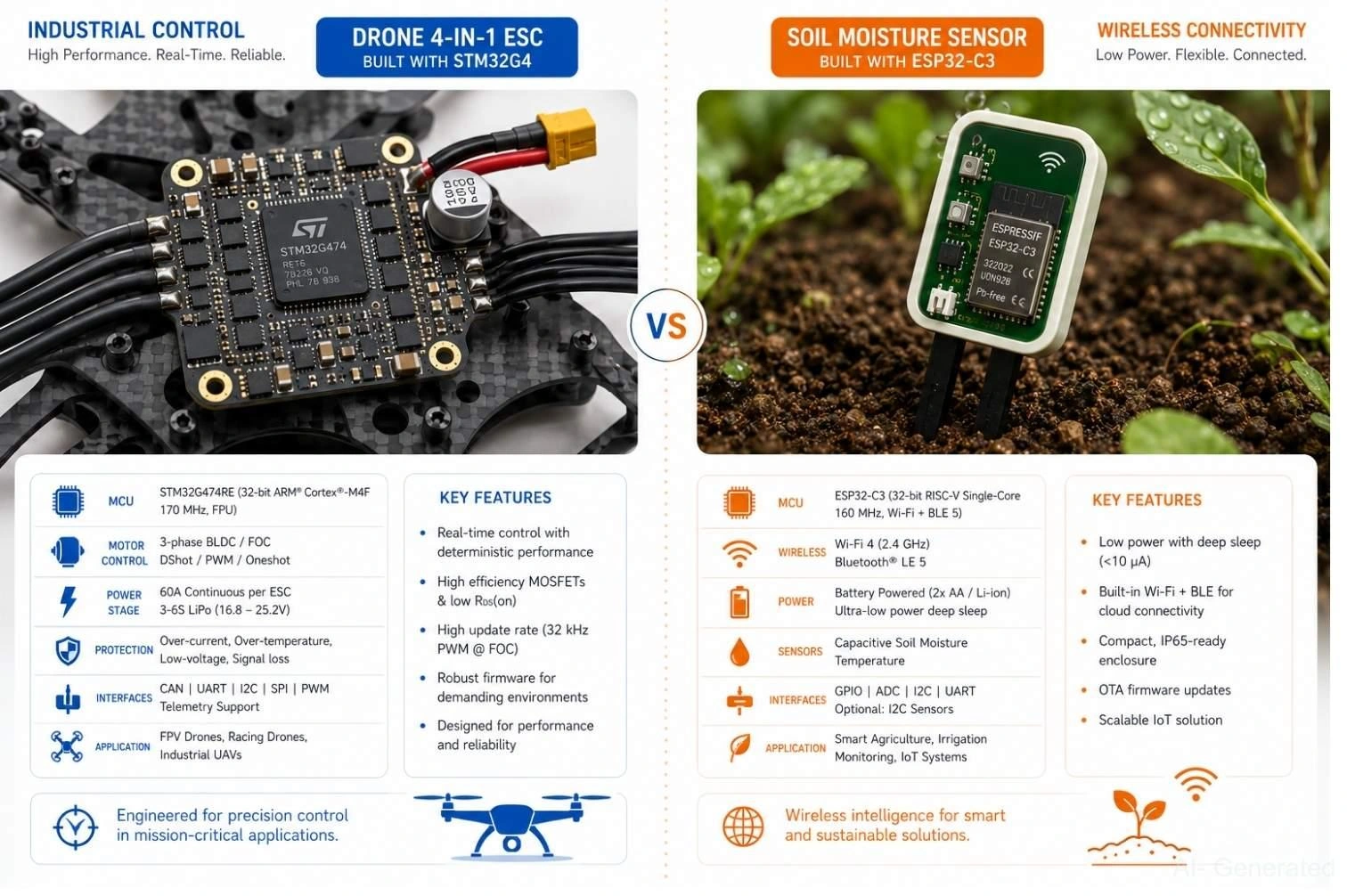
Figure: Comparing an industrial STM32-based drone ESC with an outdoor ESP32-based battery sensor.
STM32 vs ESP32 vs Arduino
| Feature | Arduino Uno | ESP32 | STM32 |
|---|---|---|---|
| CPU | 8-bit AVR @ 16 MHz | 32-bit Xtensa @ 240 MHz | 32-bit Cortex-M @ up to 550 MHz |
| RAM | 2 KB | 520 KB | up to 2.5 MB |
| Wireless | None | Wi-Fi + BT | None (except WB/WL) |
| Best for | Learning | IoT prototypes | Real products |
Arduino is an ecosystem, not a chip, the Uno uses an 8-bit ATmega328P that both ESP32 and STM32 outperform by 50-100x. For a focused breakdown, see our ESP32 vs Arduino guide.
Arduino vs Raspberry Pi vs ESP32: Raspberry Pi runs Linux, different category, pick it only when you need an OS, screen, or heavy Python. For sensors and control, ESP32 or STM32 beats Pi on power and cost.
Should You Learn STM32 or ESP32 First?
For those entering the embedded space, choosing which ecosystem to learn first is a common crossroads. Here is a clear way to evaluate your starting point:
Choose ESP32 First if
- Your primary goal is to build connected smart-home projects, IoT nodes, or cloud-integrated devices quickly.
- You want a gentle learning curve through the beginner-friendly Arduino IDE.
- You want to get a functional web server up and running in under an hour using ultra-affordable boards like the ESP32-DevKitC or ESP32-C3 SuperMini.
Choose STM32 First if:
- Your focus is understanding industry-standard register-level programming, bare-metal firmware development, custom clock tree configurations, and peripheral initialization.
- You want to work with hardware design patterns used in medical, automotive, and industrial instrumentation sectors.
- You want a solid platform to learn how silicon architecture behaves natively at a foundational level using a professional suite like STM32CubeIDE.
The Career Advantage
- Mastering the STM32 and the ARM Cortex ecosystem forces you to learn microcontrollers at a deeper physical and register-level. This solid foundation makes transitioning to any other ARM Cortex-M or RISC-V microcontroller straightforward, making STM32 the highly recommended starting path for aspiring professional firmware engineers.
STM32 vs ESP32 Cost Comparison
Development Boards
When selecting an evaluation board to kick off prototyping, the physical costs scale from pocket-change modules to integrated debug platforms:
- ESP32-C3 SuperMini: Roughly $2, a micro-sized single-core RISC-V platform.
- ESP32-DevKitC: Roughly $5, the standard starting point for classic dual-core developments.
- ESP32-S3-DevKitC: Roughly $9, which adds useful external PSRAM and dual USB-C ports.
- STM32 Blue Pill (F103): Roughly $3, a popular entry-level legacy board.
- STM32 Nucleo-F446: Roughly $15, incorporating an integrated ST-Link V2 programmer on-board.
- STM32H7 Nucleo: Roughly $25, for evaluating dual-core high-performance designs.
For picking a starter ESP32 board, our Beginner's Guide to Choosing an ESP32 Development Board walks through the trade-offs.
Production Cost and BOM
ESP32 modules bundle the chip, crystal, flash, RF matching, antenna, and shielding into one pre-certified part. STM32 designs needing wireless add a radio module, antenna, RF routing, and certification, often $2-4 extra plus engineering time.
Summary: For wireless products, ESP32 lands cheaper end-to-end. For non-wireless, STM32 is competitive or cheaper.
Designing a PCB With STM32 vs ESP32
ESP32 PCB Considerations
- RF antenna keep-out: ~15 x 6 mm copper-free area around the PCB antenna.
- 50 Ohm trace impedance for any RF routing off-module (rare with WROOM).
- Star grounding around the module; tie antenna ground at one point.
- Decoupling: 10 uF + 0.1 uF close to 3V3 to handle the 240 mA Wi-Fi spike.
Module-based designs are covered in our deep dive on How to Design an ESP32-S2 Module PCB.
STM32 PCB Considerations
- Analog/digital split: Separate VDDA, AGND under analog traces, ferrite bead VDD/VDDA.
- Crystal placement: HSE within 5 mm of OSC pins, ground guard ring beneath.
- Decoupling: 100 nF per VDD pin + 4.7 uF bulk near the regulator.
Which Is Easier to Manufacture?
Both ESP32 modules and STM32 devices are widely available through modern PCB assembly services, making either platform straightforward to prototype and manufacture. Most ESP32 modules and common STM32 IC chips are well-stocked in the JLCPCB parts library, and can be auto-assembled directly without sourcing.
RF Certification - The Hidden Cost Advantage of ESP32 Modules
One reason ESP32 modules appear cheap is that Espressif has already absorbed the FCC, CE, and IC certification cost.
A WROOM-32E module ships with test reports you can reference in your own Declaration of Conformity.
Designing an STM32 board with a discrete RF section, custom PCB antenna, RF matching network, external Wi-Fi chip, requires full regulatory testing, which typically runs $5,000-$20,000 and 4-8 weeks per region. For most IoT products, using a pre-certified ESP32 module is not a technical choice; it's a business decision.
STM32 and ESP32: Choosing the Right Variant for Modern Projects
Most "STM32 vs ESP32" comparisons treat each as one chip. Both are families with very different members, and picking the right variant matters more than the brand.
STM32 Family Overview
| Family | CPU | Flash | RAM | Wireless | Typical Use |
|---|---|---|---|---|---|
| STM32F1 | M3 @ 72 MHz | up to 1 MB | up to 96 KB | No | Legacy embedded |
| STM32F4 | M4F @ 180 MHz | up to 2 MB | up to 512 KB | No | Robotics, audio |
| STM32G4 | M4F @ 170 MHz | up to 512 KB | up to 128 KB | No | Motor control, SMPS |
| STM32H7 | M7F @ 480 MHz | up to 2 MB | up to 1.4 MB | No | DSP, HMI, edge AI |
| STM32L4 | M4F @ 80 MHz | up to 1 MB | up to 320 KB | No | Battery sensors |
| STM32U5 | M33 @ 160 MHz | up to 4 MB | up to 2.5 MB | No | Smart metering, wearables |
| STM32WB | Dual (M4 + M0+) | up to 1 MB | up to 256 KB | BLE 5.2 | Wireless sensors |
| STM32WL | M4 + M0+ | up to 256 KB | up to 64 KB | LoRa | LPWAN nodes |
ESP32 Family Overview
| Family | CPU | Flash* | RAM | Wireless | Typical Use |
|---|---|---|---|---|---|
| ESP32 (classic) | Dual Xtensa LX6 @ 240 MHz | 4-16 MB | 520 KB | Wi-Fi 4 + BT 4.2 | General IoT |
| ESP32-C3 | Single RISC-V @ 160 MHz | 4 MB | 400 KB | Wi-Fi 4 + BLE 5 | Cost-sensitive IoT |
| ESP32-S3 | Dual Xtensa LX7 @ 240 MHz | up to 16 MB | 512 KB + 8 MB PSRAM | Wi-Fi 4 + BLE 5 | AI, camera, HMI |
| ESP32-C6 | RISC-V @ 160 MHz | 4 MB | 512 KB | Wi-Fi 6 + BLE 5 + Zigbee + Thread | Smart home, Matter |
| ESP32-H2 | RISC-V @ 96 MHz | 2-4 MB | 320 KB | BLE 5 + Thread + Zigbee | Matter-only devices |
Which STM32 and ESP32 Variants Matter for Modern Projects?
The mainstream STM32 picks for new designs are STM32F4 (general purpose), STM32G4 (motor/power), STM32H7 (performance), and STM32L4 (low-power). On the ESP32 side, the classic ESP32, ESP32-C3 (cheap RISC-V), and ESP32-S3 (AI + USB) cover most projects. The rest of this guide uses these as reference points.
Most Common Chips Side-by-Side:
- Budget / Entry: STM32F103C8 versus ESP32-C3-MINI-1
- General Purpose: STM32F411 versus ESP32 (classic)
- High Performance: STM32H743 versus ESP32-S3
- Ultra-Low Power: STM32U575 versus ESP32-C3 (light sleep)
- Wireless MCU: STM32WB55 versus ESP32-C6
FAQs
Q: Is STM32 better than ESP32 for industrial applications?
Yes. Industrial systems require strict real-time determinism, extended longevity guarantees, and hardware safety certifications. STM32 is backed by ST's 10-year longevity commitment, whereas ESP32 is primarily designed for high-volume consumer IoT.
Q: Can ESP32 replace STM32 in precision projects?
No. ESP32 lacks the linear analog-to-digital converters (ADCs), advanced motor control timers, and deterministic hardware interrupts found in STM32. ESP32's ADCs are notably non-linear above 2.5 V, making it unsuitable for precision measurement.
Q: Is STM32 harder to learn than ESP32 for beginners?
Yes, initially. STM32 requires configuring clock trees, hardware registers, and hardware abstraction layers (HAL). ESP32 has an easier entry point because of its extensive Arduino library ecosystem, though mastering its native ESP-IDF toolchain requires a similar effort.
Q: STM32 vs ESP32 vs Arduino, which should a beginner pick?
Beginners focused on IoT or home automation should choose ESP32 with the Arduino IDE. It provides the same beginner-friendly coding ecosystem but with far more processing power, RAM, and built-in Wi-Fi compared to 8-bit Arduino boards.
Conclusion
STM32 vs ESP32 isn't really a contest, it's a decision. ESP32 wins anywhere wireless, cost, and speed-to-prototype matter. STM32 wins anywhere timing, power budget, analog precision, or certification matter. The best engineering teams often use both in the same product.
Popular Articles
• SMD Resistor Package Sizes: Complete Size Chart, Footprints & How to Choose
• How to Solder SMD Components Like a Pro [2026 Updated]
• SMD Resistor Codes: How to Read 3-Digit, 4-Digit, and EIA-96 Markings
• SMD Capacitor Codes: Identification, Markings, and Polarity
• SMD Capacitor Sizes: Complete Size Chart and Selection Tips for PCB Design and Assembly
Keep Learning
What Are the Main Relay Types and Which One Should You Use?
Key Takeaways Two Main Types: Relays fall into two main categories: electromechanical relays, which use moving metal contacts to switch a circuit, and solid-state relays, which use electronic components with no moving parts. Choose Based on the Load: The load type determines which relay you need. Consider whether the load uses AC or DC, how much current it draws during normal operation and startup, and how frequently it needs to switch. Coil Behavior: A monostable relay returns to rest when its coil i......
SMD MOSFET Code Guide: How to Identify, Test and Replace a MOSFET
Figure: AO3400A (C20917) in the JLCPCB parts library. The listing gives RDS(on) at 2.5 V gate drive, the number that matters in the replacement example later in this guide. An SMD MOSFET code is the two or three characters printed on top of the package, and on its own it rarely tells you which part you're holding. SMD resistors follow standard marking schemes, such as three- and four-digit codes and EIA-96. MOSFETs don't. The same short code can appear on unrelated parts from different manufacturers, ......
ESP8266 vs ESP32: Which One Should You Use?
Key Takeaways ESP32: Dual-core 240 MHz CPU, Bluetooth Classic and BLE, 520 KB SRAM, and up to 34 GPIOs. ESP8266: Single-core CPU, no Bluetooth, and around 50 KB of free RAM for applications. Lifecycle status: Espressif marks the ESP8266 Not Recommended for New Designs (NRND) and names the ESP32-C2 (ESP8684) as its upgrade, although the ESP8266 remains in production with a longevity commitment. Which ESP32 to use: Choose the ESP32-C2 for simple Wi-Fi or Bluetooth LE firmware, the ESP32-C3 for more memo......
What Is a Thermistor? A Practical Guide to NTC, PTC, Applications, and Circuit Design
Key Takeaways Definition: A thermistor is a thermally sensitive resistor whose resistance changes markedly and predictably with temperature, typically by about 4.4% per °C for a standard 10 kΩ NTC (B25/50 = 3950 K) near 25 °C. NTC vs. PTC: An NTC thermistor's resistance falls as temperature rises, which suits temperature sensing and inrush current limiting; a switching PTC's resistance rises steeply above its switch temperature, which suits circuit protection. Key Specifications: An NTC thermistor is ......
What Is the ESP32-CAM, and How to Wire, Power, and Program It?
Key Takeaways Board, not chip: The ESP32-CAM is an AI-Thinker development board, not an Espressif product. It carries AI-Thinker's ESP32-S module, an OV2640 camera, PSRAM, a microSD slot, and a flash LED. No USB port: The board has no USB connector or USB-to-UART bridge, so you program it via its serial pins using a 3.3 V USB-to-serial adapter, with GPIO0 held low at reset. Few free pins: The camera, PSRAM, and microSD card occupy most GPIOs. With the microSD card unused, GPIO2, GPIO4, GPIO12, GPIO13,......
ESP32 Versions: Which One Should You Use for Your Project?
Key Takeaways Radios decide first: ESP32 versions differ mainly in their radios, CPU cores, and peripherals. Common defaults: The ESP32-C3 suits low-cost Wi-Fi and Bluetooth LE, the ESP32-S3 suits camera, display, voice, and on-device AI. Original ESP32: The chip is still in production and remains the choice for Bluetooth Classic. Versions without Wi-Fi: The ESP32-H2 targets battery-powered Thread and Zigbee devices. Chip, module, or board: Prototype on a development board, then design a module onto y......