SMD Capacitor Codes: Identification, Markings, and Polarity
11 min
- What is an SMD Capacitor Code and Why Is It Important?
- Step 1: Visually Identify the Three Main SMD Capacitor Types
- Step 2: The "Unmarked" Rule – How to Identify Multilayer Ceramic Capacitors (MLCCs)
- Step 3: How to Read SMD Capacitor Codes on Tantalum and Electrolytic Capacitors (Marked)
- Step 4: Polarity - The Most Critical Marking on SMD Capacitors
- Troubleshooting Guide: Solving Common SMD Capacitor Identification Problems
- Conclusion
- FAQs about SMD Capacitor Codes

Identifying SMD capacitor codes is a unique and often confusing challenge. Unlike components with clear, standardized labels, capacitor markings depend entirely on capacitor type, and in most cases, the marking is a complete absence of one.
As fundamental components for storing charge, capacitors are essential for every part of an embedded system, from filtering power supply noise (decoupling) and setting oscillator timing to coupling signals between ICs. Correctly identifying them is a critical skill for debugging and repair.
This guide provides a step-by-step methodology to identify any SMD capacitors on your board.
What is an SMD Capacitor Code and Why Is It Important?
Unlike a single, simple standard, an "SMD capacitor code" is a set of different marking systems that depend on the capacitor's type and size. It can be a 3-digit number, a letter, a polarity bar, or - in the most common case - no marking at all.
Understanding these different codes is critical for every phase of engineering:
- Safety & Reliability: For polarized capacitors (like Tantalums), reading the polarity mark is the most important step. A reversed capacitor can fail, short-circuit, and cause catastrophic board-level damage.
- Circuit Function & Debugging: The value code (e.g., 106 for 10µF) allows an engineer to verify the correct part is in the correct place. Mistaking a 1µF timing capacitor for a 10µF bulk capacitor will cause a circuit to fail.
- Design Integrity: The absence of a code on an MLCC is itself a "code" - it tells you that critical parameters like voltage rating and dielectric (C0G vs. X7R) are only found in the Bill of Materials (BOM). This knowledge prevents you from making assumptions and reinforces documentation-driven design.
Step 1: Visually Identify the Three Main SMD Capacitor Types
The marking system you use depends entirely on the physical type of capacitor. Before trying to read a code, you must first identify what you're looking at.
1. Multilayer Ceramic Capacitors (MLCCs)
The most common non-polarized SMD chip capacitors, typically unmarked.
- Appearance: These are tiny, rectangular "chips" that are usually in shades of beige, gray, or light brown. They do not have a physical polarity.
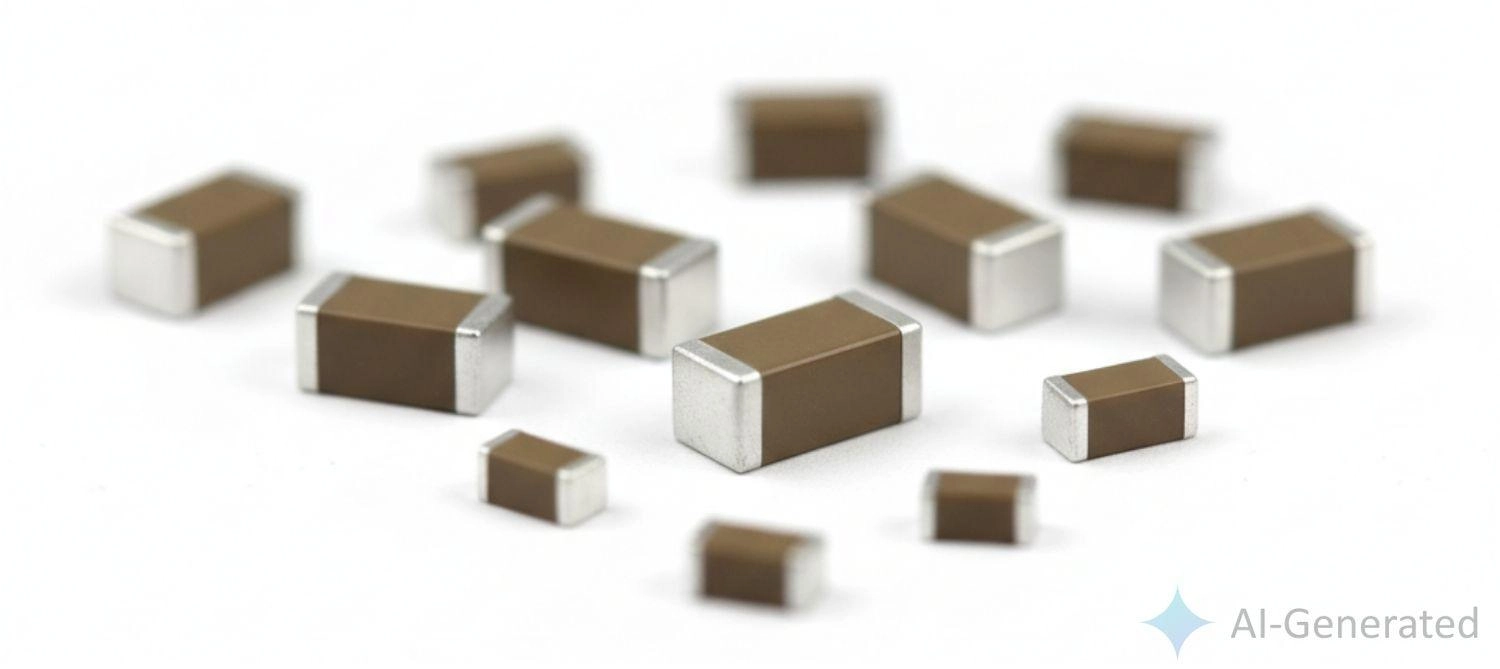
Figure: Unmarked MLCC ceramic capacitors.
- Key Use: The workhorse of modern electronics. Used for high-frequency decoupling (bypass), filtering, and in timing/RF circuits.
- Marking: Almost always unmarked. This is the key challenge, covered in Step 2.
2. Tantalum Capacitors (SMD Chip Tantalum)
Molded, polarized capacitors with printed value and polarity markings.
- Appearance: Overall, well-molded packages formed but colored in black, tan, or yellow, etc. The characteristic of these is either a rectangular or oval shape.
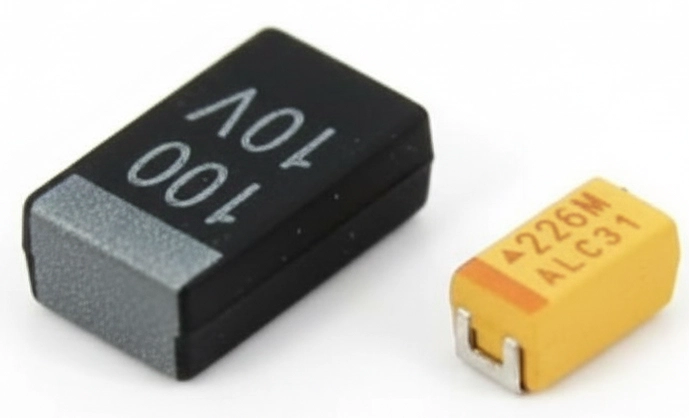
Figure: Molded, SMD tantalum capacitors showing their package shape.
- Key Use: High capacitance in a limited space (high volumetric efficiency). Used for bulk capacitance and power supply filtering where space is tight.
- Marking: Always marked with capacitance, voltage, and a clear polarity indicator.
3. Aluminum Electrolytic Capacitors (SMD V-Chips)
Cylindrical, polarized capacitors mounted on a surface-mount base.
- Appearance: A cylindrical metal "can" sitting on a square, black plastic base.
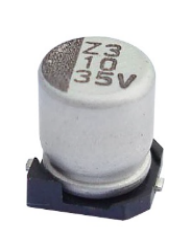
Figure: SMD Aluminum Electrolytic capacitors, also known as V-Chips, showing their metal can and plastic base.
- Key Use: Very high capacitance for bulk energy storage. Typically used on the input or output of power supplies.
- Marking: Always marked with capacitance, voltage, and a clear polarity indicator.
Step 2: The "Unmarked" Rule – How to Identify Multilayer Ceramic Capacitors (MLCCs)
Note
This is the most important lesson: Over 90% of the capacitors you see are MLCCs, and they are unmarked for a specific manufacturing reason.
MLCCs are made by layering ceramic dielectric and metal electrodes, which are then fired at over 1000°C to sinter the ceramic. This intense heat would destroy any marking. Applying one after firing is an expensive, slow step that is impractical for a component produced by the billion.
So, how do you identify an unmarked capacitor? You don't. Not visually. The Bill of Materials (BOM) is the only source of truth.
This is why your design documentation is critical. A 104 (0.1µF) capacitor specified as a 50V C0G dielectric is physically indistinguishable from a 104 (0.1µF) specified as a 10V X7R. One is a stable, high-performance part for a filter; the other is a general-purpose decoupling cap. Only your BOM and your assembly partner know the difference.
The Unmarked Specification: Dielectric Codes Explained: C0G vs X7R vs Y5V
The most important specification for an MLCC, found only in the BOM, is its dielectric.
| Dielectric | Class | Key Characteristic |
|---|---|---|
| C0G (NP0) | Class 1 | Ultra-Stable. Capacitance does not change with temperature, voltage, or time. Used for filters, oscillators, and RF circuits. |
| X7R | Class 2 | Stable. Good for decoupling and general-purpose use. Capacitance can change (±15%) with temperature and voltage. |
| Y5V | Class 2 | General Purpose. High capacitance in a small size, but its value can drop 80% over its temperature range (poor stability). Use only for non-critical bulk decoupling. |
Step 3: How to Read SMD Capacitor Codes on Tantalum and Electrolytic Capacitors (Marked)
The codes are constant for Tantalums and Aluminum Electrolytic(V-Chips), which are the reasons for their polarization and unusually high values. Proper identification is also the case here. The following explains their decoding.
A. Capacitance Value: 3-Digit Code & Spelled-Out Units
1. Spelled-Out Units: On larger V-Chips, the value is often printed directly (e.g., 100µF 16V). Be aware of two common quirks from older conventions:
- MFD: This is often used on parts and schematics to mean µF (microFarad).
- MF: This is also commonly used to mean µF (microFarad). While mF technically means "milliFarad," this unit is rarely used.
2. The 3-Digit Code: This is the most common system. The base unit is always Picofarads (pF).
Format: XXY = XX * 10Y in pF.
- 104 = 10 x 104 pF = 100,000 pF = 100 nF = 0.1µF
- 106 = 10 x 106 pF = 10,000,000 pF = 10,000 nF = 10µF
- 227 = 22 x 107 pF = 220,000,000 pF = 220,000 nF = 220µF
B. Voltage Rating: The EIA Letter Code
A single letter specifies the maximum DC voltage rating.
| Letter | Voltage (V) | Letter | Voltage (V) |
|---|---|---|---|
| f | 4V | C | 16V |
| j | 6.3V | D | 20V |
| A | 10V | E | 25V |
| B | 12V | V | 35V |
Table: Common Tantalum Capacitor Voltage Codes
Example: 107A
- Value: 107 -> 10 x 107 pF = 100µF
- Voltage: A -> 10V
- Result: 100µF, 10V Capacitor
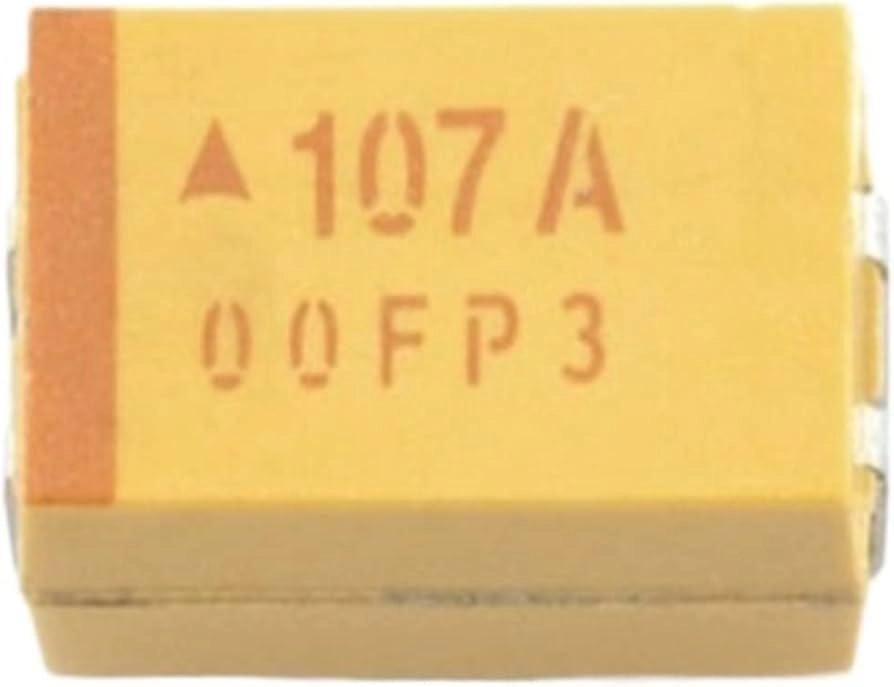
Figure: A tantalum capacitor marked 107A (Manufacturer's Code: 00FP3)
C. Tolerance: The Letter Code
You may also see a letter code for tolerance.
| Code | Tolerance |
|---|---|
| J | ±5% |
| K | ±10% |
| M | ±20% |
| Z | +80%, -20% (Common for Y5V) |
Table: Common Capacitor Tolerance Codes
Step 4: Polarity - The Most Critical Marking on SMD Capacitors
You should never violate this rule. Installing a polarized capacitor the wrong way can lead to failure, short-circuits, and even burning your circuit board.
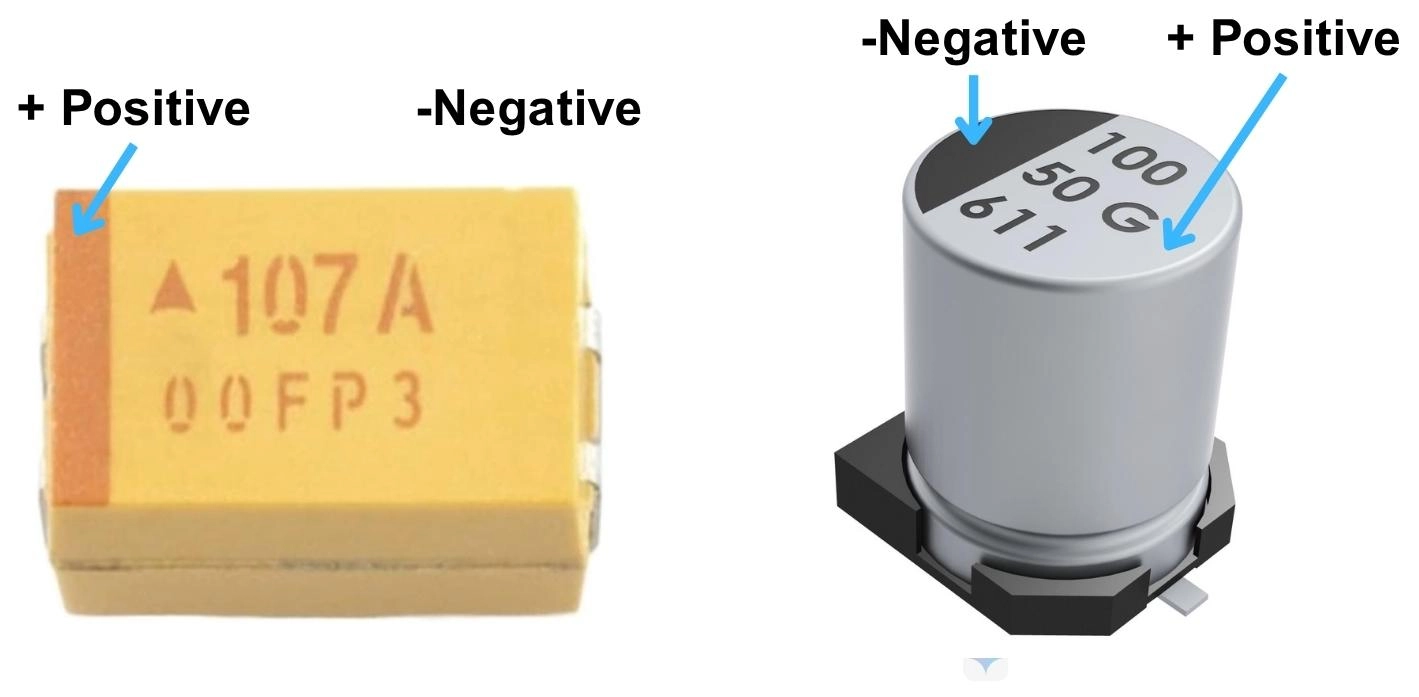
Figure: Comparing SMD capacitor polarity: a Tantalum capacitor with a positive bar, and a V-Chip with a negative stripe.
Tantalum Capacitor Polarity Markings
- The bar, stripe, or bevel on the package indicates the POSITIVE (Anode) side.
Warning
This is the reverse of through-hole electrolytic capacitors, a common "gotcha" for those new to SMT.
Aluminum Electrolytic (V-Chip) Polarity Markings
- The black, shaded area on the plastic base, and often a matching stripe on the can, indicates the NEGATIVE (Cathode) side.
Troubleshooting Guide: Solving Common SMD Capacitor Identification Problems
Even with these rules, you will run into difficult situations. Here are solutions to common problems.
Challenge 1: Measuring an Unmarked MLCC In-Circuit
- Problem: You try to measure an unmarked 0.1uF (104) decoupling capacitor with a multimeter, but the in-circuit reading is 2.5uF.
- Solution: You are measuring the entire power rail. The LCR meter sees your target cap in parallel with all other decoupling caps, and even the IC's internal capacitance. The only reliable way to measure it is to desolder at least one side of the component to isolate it from the rest of the circuit.
Challenge 2: Polarity Confusion in Tantalum vs. Electrolytic Capacitors
- Problem: A junior engineer replaces a failed Tantalum capacitor, matching the value and voltage, but orients the new part with the stripe to the "negative" side. The board powers on, and the new cap explodes.
- Solution: The rule must be memorized: The stripe on a Tantalum capacitor is POSITIVE. The stripe on an Aluminum Electrolytic (through-hole or V-Chip) is NEGATIVE. Always double-check the part type.
Challenge 3: Assuming Color is a Code
- Problem: You see two 0603 MLCCs, one beige and one gray, and assume they have different values or dielectrics.
- Solution: They might not. The color of an MLCC is a result of the manufacturer's specific ceramic and electrode materials. It is not a standardized indicator of value, voltage, or dielectric. Trust only your BOM.
Challenge 4: Cryptic Old Schematics
- Problem: A repair schematic calls for a "10MF" capacitor.
- Solution: This almost certainly means 10µF (microFarad). The legacy "MFD" or "MF" markings for microFarad are very common on older documents and parts. The unit milliFarad (mF) is seldom used in standard circuit design.
Conclusion
For 90% of unmarked capacitors (MLCCs), the only solution is documentation. Trust your BOM, your assembly data, and your PCBA provider. For the 10% that are marked (Tantalums and V-Chips), the SMD Capacitor Code is your key to its value, and the polarity stripe is your critical guide to its orientation.
Don't Let an Unmarked Cap Kill Your Design.
That tiny, beige MLCC is more than just a 104. Is it a 50V C0G for your precision filter or a 10V X7R for simple decoupling? The package won't tell you, but your BOM will.
At JLCPCB, our PCBA service is built on BOM integrity. We verify your parts against our huge Parts Library, ensuring the exact dielectric (C0G, X7R), voltage, and tolerance you specified are placed with machine precision.

FAQs about SMD Capacitor Codes
Q: What's the difference between C0G and NP0?
They are the same. C0G is the EIA code, and NP0 (Negative-Positive-Zero) is the industry name. Both refer to the same ultra-stable, Class 1 dielectric.
Q: Is the capacitor's ESR (Equivalent Series Resistance) marked?
No. ESR is a critical, unmarked parameter you can only find on the datasheet. It's a vital spec for power supplies, where low-ESR capacitors are required to handle ripple current and ensure stability. A general-purpose capacitor with high ESR would overheat and fail in that application.
Q: I see a 2-character code like A4 on a small cap. What is this?
This is an alternative, less common standard (EIA-198) for precision capacitors. The letter represents a significant figure, and the number is the multiplier. For example, A = 1.0, B = 1.1, C = 1.2, etc. The number 4 = 10,000. So, A4 would be 1.0 * 10,000 = 10,000 pF, or 10nF.
Q: What do Tantalum capacitor "Case Codes" like "A" or "B" mean?
This is a standardized code (e.g., EIA-535-BAAC) that defines the physical dimensions (Length x Width x Height) of the molded Tantalum package. For example, an "A" case is 3.2 x 1.6 x 1.6 mm, while a "B" case is 3.5 x 2.8 x 1.9 mm. This is critical for ensuring the part physically fits on your PCB footprint.
Q: What about DC leakage? Is that part of the code?
No, DC leakage is another critical datasheet-only parameter. It's the small amount of current that flows through the capacitor when a DC voltage is applied. For low-power, battery-operated embedded systems, you would choose a part with extremely low leakage (like an MLCC) over a Tantalum, which has higher (but still small) leakage. This is a design-level decision, not an identification code.
Popular Articles
• SMD Resistor Package Sizes: Complete Size Chart, Footprints & How to Choose
• How to Solder SMD Components Like a Pro [2026 Updated]
• SMD Resistor Codes: How to Read 3-Digit, 4-Digit, and EIA-96 Markings
• SMD Capacitor Codes: Identification, Markings, and Polarity
• SMD Capacitor Sizes: Complete Size Chart and Selection Tips for PCB Design and Assembly
Keep Learning
SOIC Package: A Complete Guide to Specifications, Types, Uses, and SMT Assembly
As designs transition from legacy through-hole components to high-density Surface Mount Technology (SMT), the Small Outline Integrated Circuit (SOIC) remains the industry standard for operational amplifiers, flash memory, sensors, and microcontrollers. It reflects a well-balanced engineering design, offering a practical compromise between the miniaturisation demanded by modern consumer electronics and the ruggedness required for industrial applications. In this guide, you will learn: SOIC package dime......
What Is a 100nF Capacitor and How Do You Choose the Right One
Key Takeaways Value: A 100nF capacitor has a nominal capacitance of 0.1 µF, or 100,000 pF, and all three names describe the same part value. Marking: Many through-hole ceramic and film capacitors use the three-digit code 104, while most SMD MLCCs are unmarked. Main use: Its most common function is local decoupling at an IC power pin, where it supplies fast transient current and shunts high-frequency noise to ground. Default choice: For general decoupling, an X7R or X5R MLCC is a common starting point;......
SMD Resistor Package Sizes: Complete Size Chart, Footprints & How to Choose
Surface Mount Device (SMD) resistors are fundamental to modern electronics, and selecting the correct package size is a crucial engineering decision that impacts a PCB’s electrical performance, thermal reliability, and manufacturing cost. In this article, you will find practical, authoritative guidance on: The complete SMD resistor size chart (01005 to 2512) with exact dimensions and power ratings. Recommended PCB footprints and guidelines for reflow reliability. Critical trade-offs concerning power d......
PCB Connector Types Explained: Categories, Comparison, Applications and How to Choose the Right One
PCB connectors are essential components for connecting circuit boards with external devices, cables, or other PCBs. Choosing the right connector type affects signal reliability, mechanical stability, and overall product performance. Factors such as current rating, frequency requirements, pitch size, and mounting method should be considered during selection. In this guide, you will learn: The major types of PCB connectors and their applications. How different connector types compare. How to select the ......
What Is a System on a Chip (SoC)? A Complete Guide for PCB Designers
Nearly every electronic device you interact with today, from smartphones and IoT sensors to industrial controllers and AI edge systems, is powered by a System on a Chip (SoC). By integrating processors, memory controllers, communication interfaces, and specialized accelerators onto a single piece of silicon, SoCs deliver the performance, power efficiency, and compact form factors modern electronics demand. Whether you're selecting a processor for an embedded Linux design, evaluating an AI-capable plat......
Capacitors in PCB Design_ A Complete Guide to All Types
Capacitors are indispensable components in PCB (Printed Circuit Board) design, providing functionality from energy storage and noise filtering to voltage regulation. Whether you're designing a simple circuit or a complex multi-layer board, understanding the different types of capacitors and their applications is crucial. The basic structure of a capacitor consists of two metal plates separated by a layer of dielectric. Capacitors can be of fixed or variable type. The ability of the capacitor to hold e......