What Is Flux for Soldering? A Complete Guide to Types, Uses, and Applications
15 min
- What Is Flux for Soldering?
- What Does Flux Do in Soldering?
- How Flux Works in the Soldering Process
- What Is Flux Made Of?
- Can You Solder Without Flux?
- Types of Flux Used in Soldering
- Forms of Soldering Flux
- How to Use Flux for Soldering
- Is It Necessary to Clean Flux Residue?
- Flux vs Solder Paste: What’s the Difference?
- Common Soldering Problems Without Flux
- Flux in Modern PCB Assembly
- PCB Assembly and Soldering Solutions at JLCPCB
- How to Choose the Right Flux for Your Project
- FAQs About Soldering Flux
- Conclusion
Flux for soldering is a chemical cleaning agent that removes oxidation from metal surfaces, improves solder flow (wetting), and prevents further oxidation during heating. It ensures strong, reliable electrical connections in electronics and PCB assembly.
Whether you are repairing a broken wire or assembling a printed circuit board (PCB), achieving a flawless solder joint is critical. Soldering flux plays a critical role by cleaning metal surfaces, improving solder flow, and preventing oxidation during heating.
In this guide, you will learn what soldering flux is, why it is necessary, how it works chemically, the different types available, and how to use it correctly for electronics repair and PCB assembly.
What Is Flux for Soldering?
To answer what is flux in soldering, it is a chemical compound - often derived from pine sap (rosin) or synthetic materials - used before and during the soldering process. It acts as a purifying agent that prepares the metal surfaces of components and PCB pads to bond with molten solder.
Why Flux Is Essential in Electronics Soldering
When metals are exposed to air, they naturally form a layer of invisible oxidation. Solder cannot adhere to oxidized metal. Is flux necessary for soldering? Absolutely. Without it, the molten solder will ball up and refuse to bond to the joint, leading to a weak or failing electrical connection.
The Role of Flux in PCB Assembly
In professional PCB manufacturing, flux for PCB soldering is indispensable. It ensures that components in high-density surface-mount technology (SMT) and through-hole assemblies attach perfectly, preventing electrical shorts and ensuring long-term reliability.
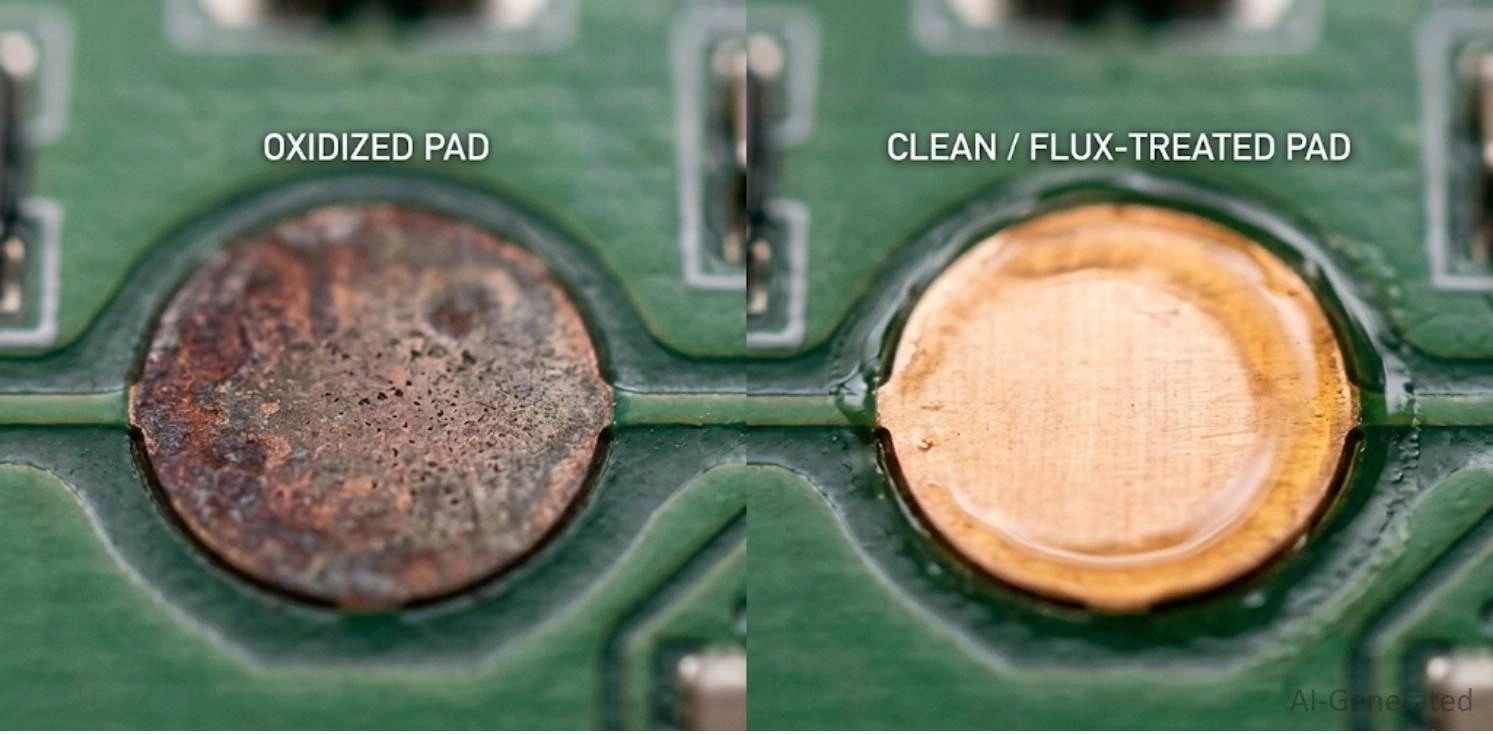
Figure: Comparison showing a shiny, flux-treated PCB pad next to a dull, oxidized pad.
What Does Flux Do in Soldering?
If you are asking why is flux used in soldering, its primary role is to overcome the chemical and physical barriers that prevent metals from bonding under heat. Flux performs three critical functions during soldering:
- Removes oxide layers from metal surfaces
- Reduces surface tension to improve solder wetting
- Protects the joint from re-oxidation during heating
- Helps form strong electrical and mechanical bonds
Removing Oxidation from Metal Surfaces
The primary solder flux purpose is to strip away the oxidized layer on both the component leads and the copper pads. This creates a bare, highly receptive metal surface.
Improving Solder Wetting
Wetting refers to how well the molten solder spreads across a surface. Flux reduces the surface tension of molten solder, allowing it to spread evenly across the metal surface instead of forming isolated blobs. Proper wetting occurs when the contact angle between molten solder and the metal surface is reduced, allowing the solder to spread and form an intermetallic bond. This guarantees a strong metallurgical bond.
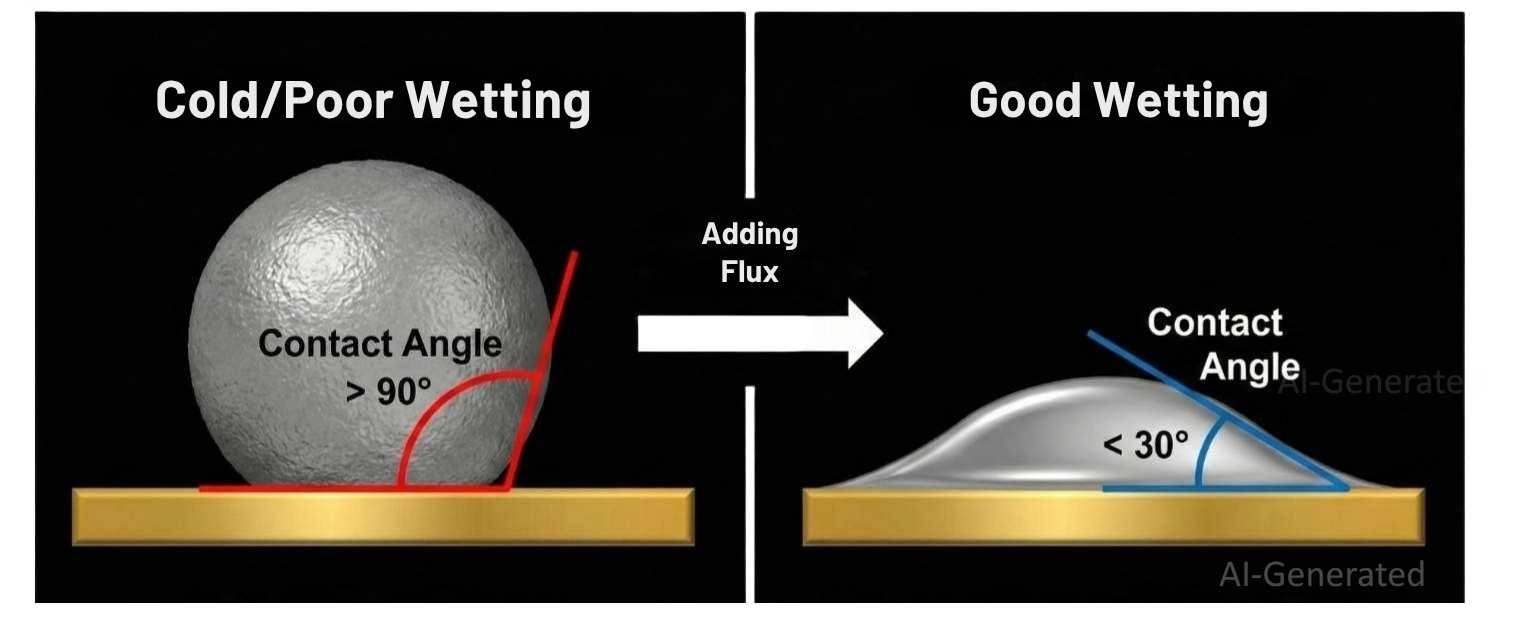
Figure: Showing how flux reduces the contact angle to achieve excellent solder wetting on a copper pad.
Preventing Oxidation During Heating
Heat aggressively accelerates oxidation. As the soldering iron or reflow oven heats the joint, the flux forms a protective liquid barrier over the metal, shielding it from the oxygen in the air until the solder solidifies.
How Flux Works in the Soldering Process
Chemical Reaction with Oxides
At room temperature, most fluxes are inert. However, once heat is applied, the acidic elements within the flux activate and chemically dissolve the metal oxides. Flux contains activators such as organic acids or halide compounds that break down metal oxides at elevated temperatures. These activators become effective within a specific temperature window - typically just below the solder’s melting point - ensuring the surface is chemically clean at the exact moment solder transitions to liquid.
Surface Cleaning Mechanism
As the oxides break down, the flux pushes the impurities and contaminants away from the soldering area, leaving a pristine surface behind.
Heat Activation During Soldering
Different fluxes activate at different temperatures. The flux must activate just before the solder melts, ensuring the pad is perfectly clean at the exact moment the solder flows.
Protective Barrier Formation During Soldering
While the solder is liquid, the flux sits on top of the joint, preventing the surrounding air from reacting with the freshly cleaned metal.
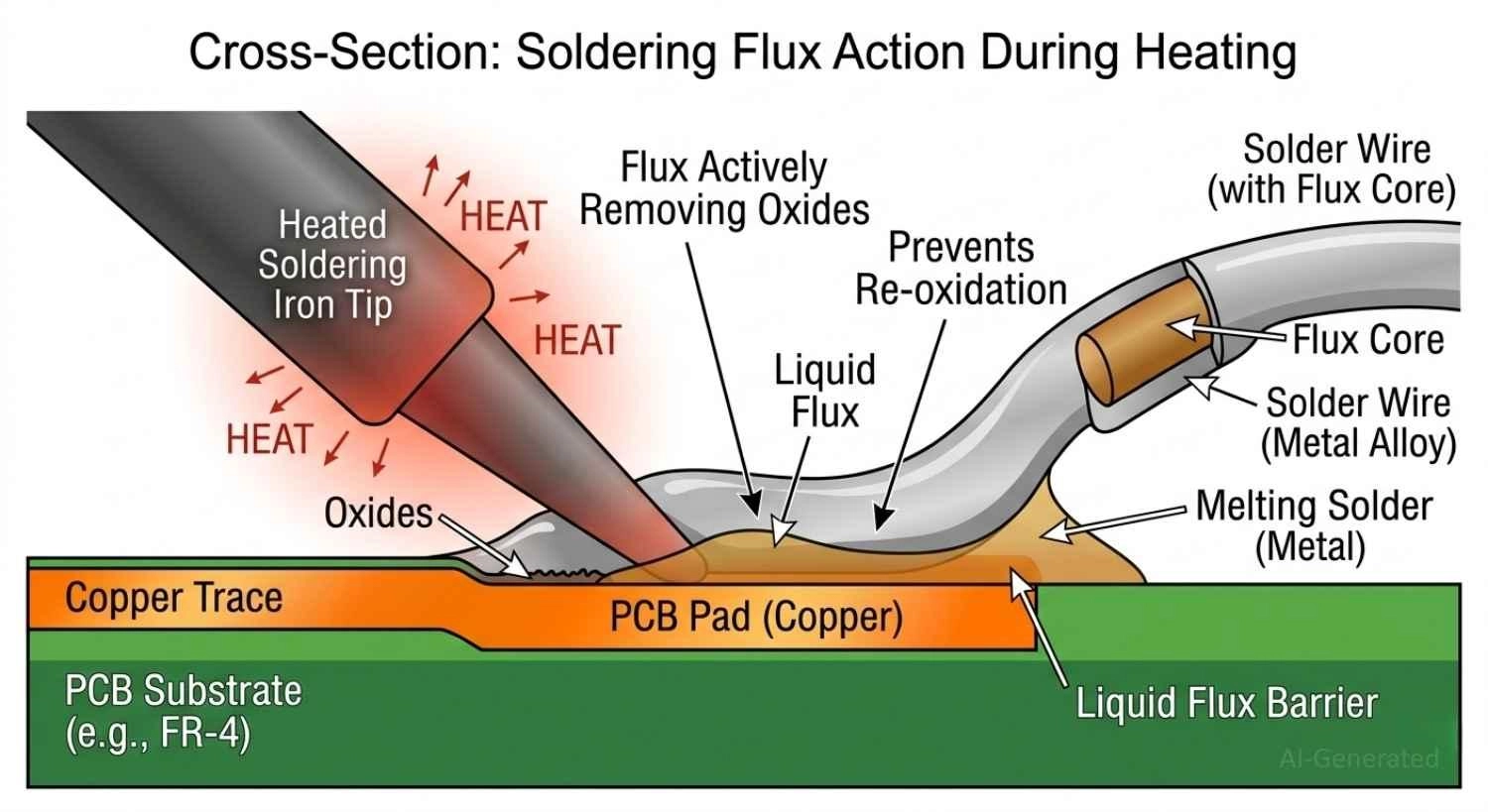
Figure: Illustrating how soldering flux forms a protective barrier over a PCB pad during heating.
What Is Flux Made Of?
Can You Solder Without Flux?
Situations Where Flux May Not Be Required
People often ask if we can solder without flux?" The truth is, if you are working with brand new, highly polished gold-plated contacts in a vacuum, you might get away with it. Additionally, most modern solder wire is "flux-core," meaning the flux is already built into the center of the wire, making external flux strictly optional for simple jobs.
Risks of Soldering Without Flux
Attempting to solder dirty or oxidized pads without any flux will result in "cold joints." These joints are brittle, highly resistant, and prone to mechanical failure. Soldering without flux may cause:
- Cold solder joints
- Poor electrical conductivity
- Weak mechanical bonding
- Excessive oxidation
- Difficult rework and repair
Why Modern Electronics Always Use Flux
Given the microscopic scale of modern electronics, even the slightest impurity can ruin a connection. Therefore, electric flux for soldering is universally adopted across the industry to guarantee high-yield, reliable connections.
Types of Flux Used in Soldering
Understanding the types of soldering flux is essential for choosing the right material for your project. Choose flux based on:
- Level of oxidation on components
- Cleaning capability after soldering
- Required joint reliability
- Assembly method (manual vs SMT)
- Production environment
Low-activity fluxes (no-clean) are suitable for clean environments, while high-activity fluxes (water-soluble) are required for heavily oxidized or industrial-grade assemblies. Flux activity level directly affects cleaning requirements, joint reliability, and compatibility with automated assembly processes.
Comparison Table of Flux Types
Flux Type | Activity Level | Cleaning Requirement | Typical Applications |
|---|---|---|---|
Rosin (R, RMA, RA) | Mild to High | Optional (but recommended for RA) | General electronics, vintage audio, and wire splicing. |
No-Clean (NC) | Mild | None (leaves safe, inert residue) | SMT assembly, quick repairs, prototyping. |
Water-Soluble (WS) | Very High | Mandatory (highly corrosive if left) | Heavily oxidized parts, structural soldering, dense PCB assembly. |
Rosin Flux
One of the oldest types, rosin flux, is made from pine sap. It comes in varying strengths, such as Rosin Mildly Activated (RMA) and Rosin Activated (RA). It leaves a sticky, amber residue that is generally non-corrosive but usually cleaned for cosmetic reasons.
No-Clean Flux
Designed to leave minimal, non-conductive residue behind. It is highly favored in rapid PCB manufacturing because it eliminates the need for an expensive cleaning step.
Water-Soluble Flux
Highly aggressive and excellent at cleaning tough oxidation. However, its residue is conductive and corrosive, meaning it must be washed away with water immediately after the soldering process.
Forms of Soldering Flux
Depending on your application, you will encounter different physical forms of flux. Common flux forms include:
- Liquid flux → best for wave soldering and large through-hole joints
- Flux pen → precise application for SMT touch-up
- Flux paste/gel → ideal for rework and fine-pitch components
- Flux-core wire → convenient for manual soldering
Liquid Flux
Often used in wave soldering machines or applied with a brush for through-hole components.
Flux Pen
A convenient, marker-like tool that allows for precise application on specific SMT pads without making a mess. Flux pens are preferred for SMT touch-up because they deliver a controlled amount of flux without contaminating surrounding areas.
Flux Paste / Gel
A thick, tacky substance applied via a syringe. It is highly favored for SMD rework and hot-air soldering because it holds tiny components in place before the solder melts. Due to its high viscosity, flux gel remains localized during hot-air rework, preventing it from spreading to adjacent components. This makes it ideal for fine-pitch ICs and BGA rework where precision is critical.
Flux-Core Solder Wire
For manual hand-soldering, this is the most common form. The flux is housed inside the hollow core of the solder wire and releases automatically as the wire melts.
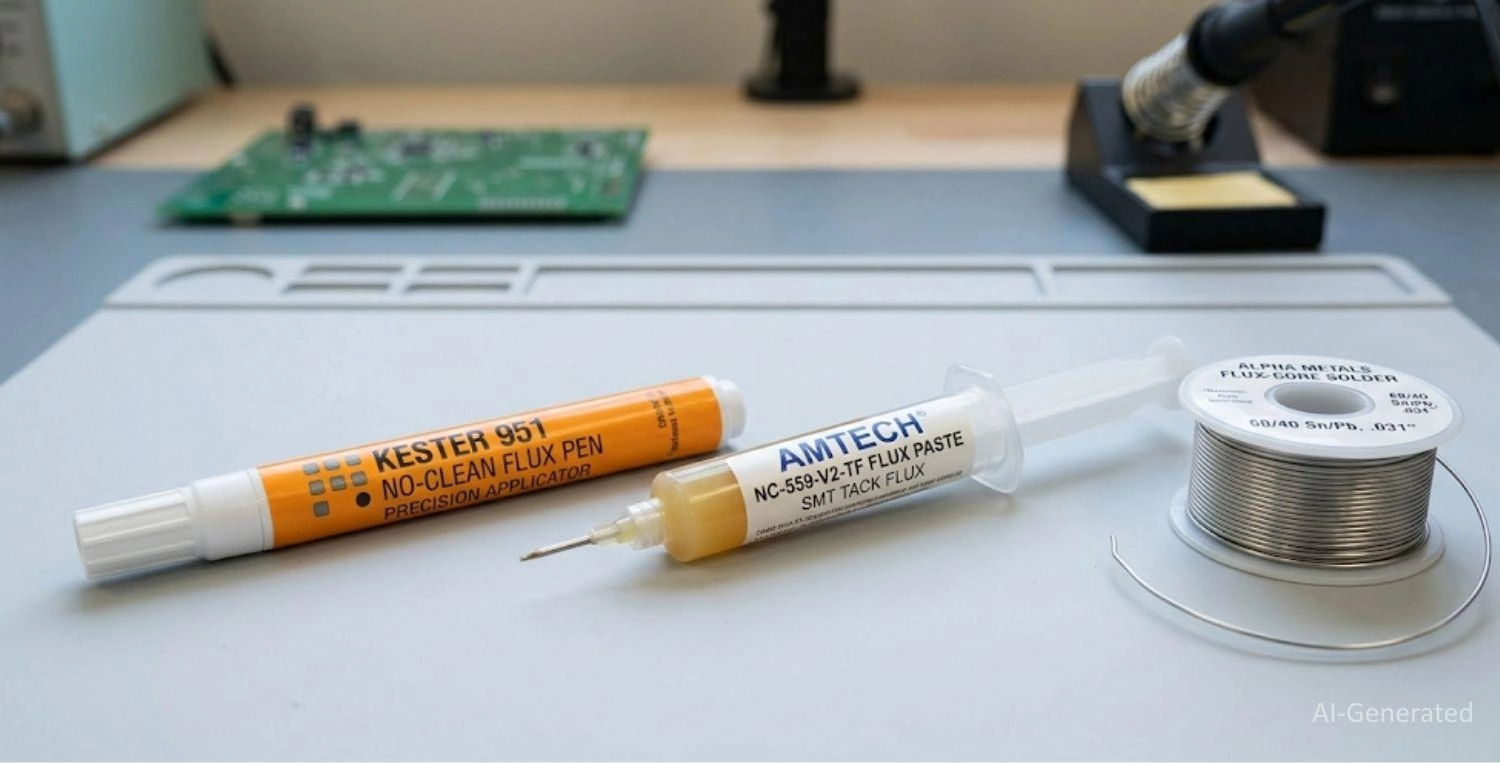
Figure: Different forms of soldering flux, including a flux pen, flux paste syringe, and flux-core solder wire.
How to Use Flux for Soldering
Mastering the application process guarantees professional results. A basic workflow for using soldering flux includes:
- Clean PCB pads and component leads
- Apply a thin layer of flux
- Heat the joint with a soldering iron or hot air
- Apply solder and allow proper wetting
- Clean residue if required
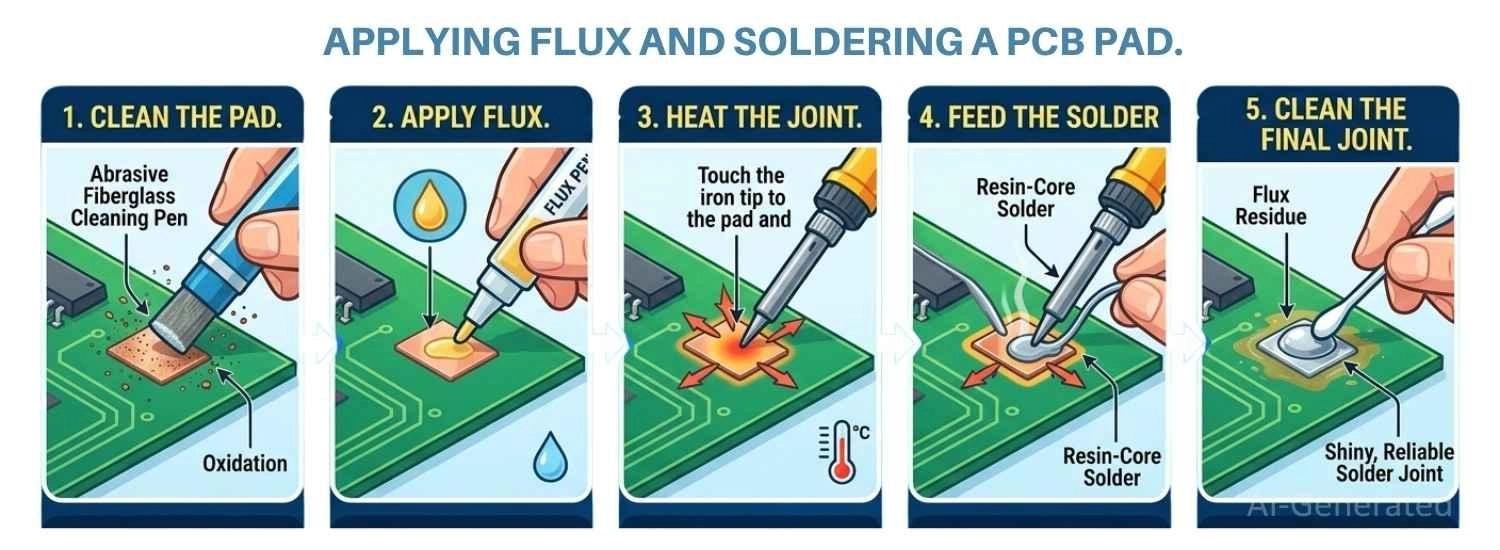
Figure: The proper workflow for applying flux and soldering a PCB pad.
Step 1: Applying Flux Before Soldering
To know how to use flux for soldering, start by applying a thin layer directly to the pads and the component leads. If using a syringe, a tiny drop on the pad is sufficient. In professional soldering workflows, flux is applied immediately before heating to ensure it remains chemically active. Applying flux too early may allow it to dry out or lose effectiveness before soldering begins. A common beginner mistake is overheating the flux before solder contact, which burns off activators and reduces effectiveness.
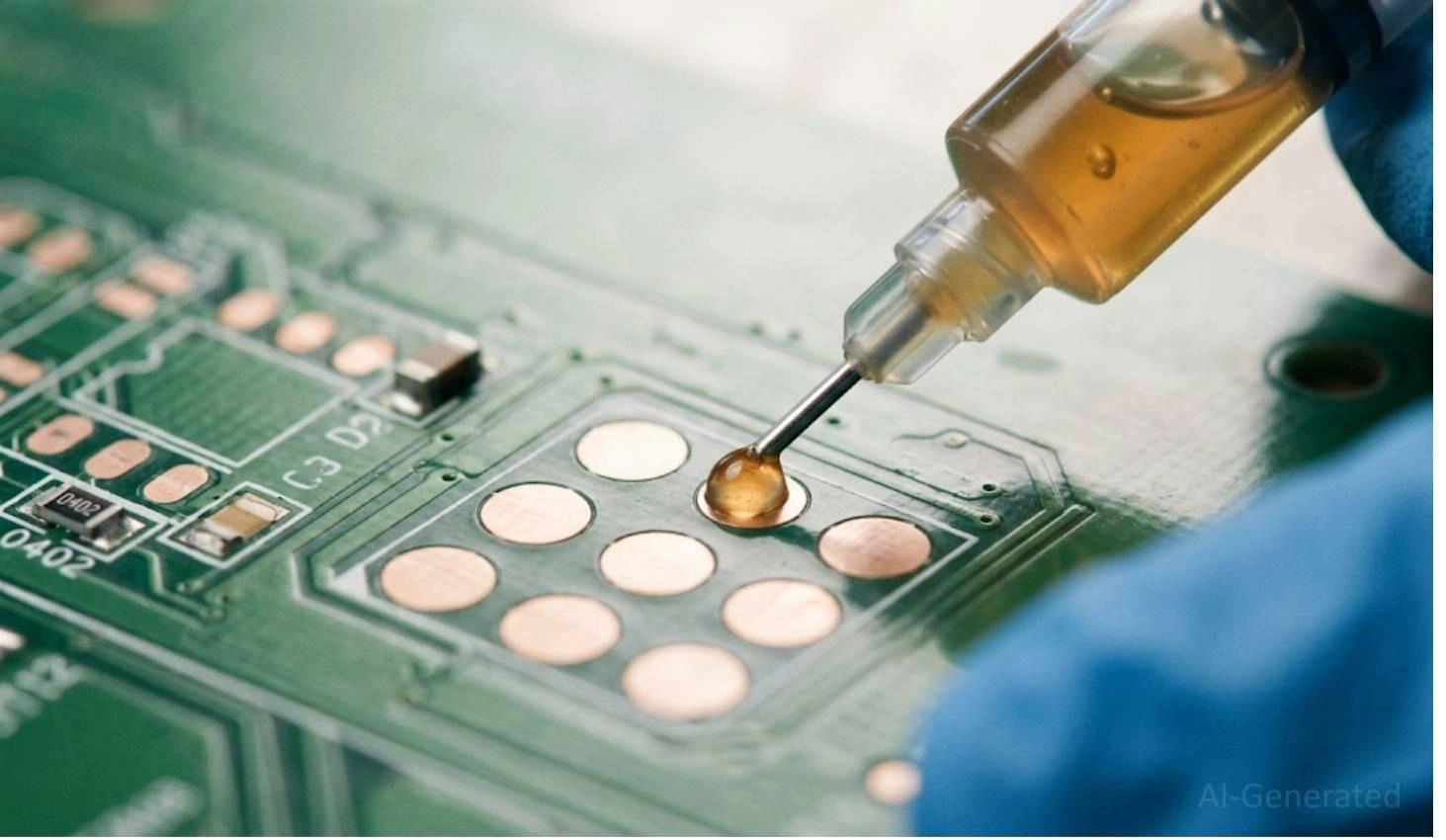
Figure: Applying tacky flux gel to a surface mount PCB pad using a precision dispensing syringe.
Step 2: Using Flux in Rework and Repair
When desoldering or repairing a joint, the old flux has completely burned away. You must apply fresh flux to the old solder to make it flow again, allowing you to easily remove the component or add new solder.
Pro Tip: Always apply fresh flux during rework - old solder joints no longer contain active flux.
Step 3: Correct Amount of Flux to Use
More is not always better. Apply just enough to coat the joint. Excessive flux will boil, spit, and leave a massive sticky mess on your board.
Step 4: Cleaning Flux Residue After Soldering
Use a stiff ESD-safe brush and isopropyl alcohol (at least 90%) to scrub away the leftover burnt flux, wiping it clean with a lint-free wipe.
Note: Always use a fume extractor or work in a well-ventilated area to avoid inhaling flux vapors.
Is It Necessary to Clean Flux Residue?
When No-Clean Flux Can Be Left
As the name implies, no-clean flux leaves a benign residue that does not interact with the circuit. For standard hobbyist electronics, it can be left alone safely.
When Cleaning Is Mandatory (RF, High Voltage, Coating)
If you are designing high-frequency RF boards, high-voltage circuits, or plan to apply conformal coating, all flux residue must be removed to prevent parasitic capacitance, electrical arcing, or coating delamination.
Methods for Cleaning Flux Residue
Manual cleaning involves isopropyl alcohol and a brush. Industrial settings use ultrasonic cleaners or automated aqueous wash systems for water-soluble fluxes.
For water-soluble flux, cleaning should be performed with deionized (DI) water or distilled water, not ordinary tap water. Tap water may leave ionic mineral residues on the PCB surface, which can increase the risk of electromigration, leakage current, and long-term reliability problems.
Flux vs Solder Paste: What’s the Difference?
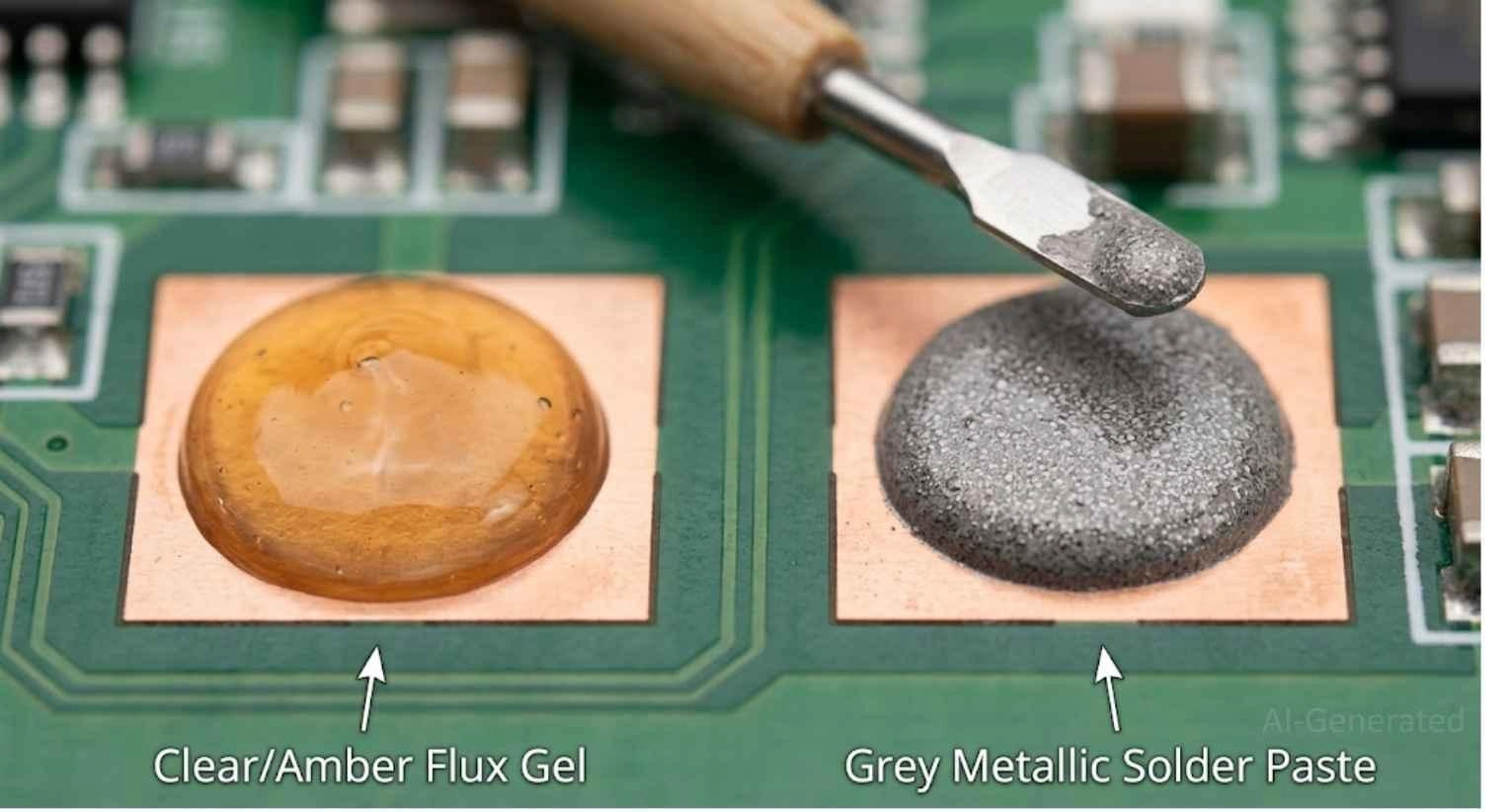
Figure: Visual comparison of translucent flux gel and grey, metal-infused solder paste.
Composition Differences
Flux is strictly a cleaning and wetting agent (no metal). Solder paste is a mixture of sticky flux gel and microscopic solder alloy spheres. Typically, solder paste contains about 8–12% flux by weight, which activates during the reflow process.
Usage in SMT Assembly
Solder paste is applied through a stencil onto bare PCB pads, after which components are placed, and the board is sent through a reflow oven.
When to Use Flux Instead of Solder Paste
Use plain flux when hand-soldering with a traditional iron and wire, or when reworking an existing joint that already has enough metal on it.
Common Soldering Problems Without Flux
Skipping flux almost guarantees defective connections. Signs of poor soldering without flux include:
- Dull or grainy joint appearance
- Solder beading instead of spreading
- Intermittent electrical connection
- Joint cracking under vibration
Poor Solder Wetting
Without flux, the solder will bead up like water on a freshly waxed car, refusing to stick to the copper pad.
Weak Solder Joints
Even if the solder manages to stick, the presence of microscopic oxides will create a fragile mechanical bond that can easily snap under vibration.
Oxidation and Contamination
Heat introduces severe oxidation. Without the protective barrier of flux, your solder joint will look dull, frosty, and grey - a hallmark sign of a bad connection.
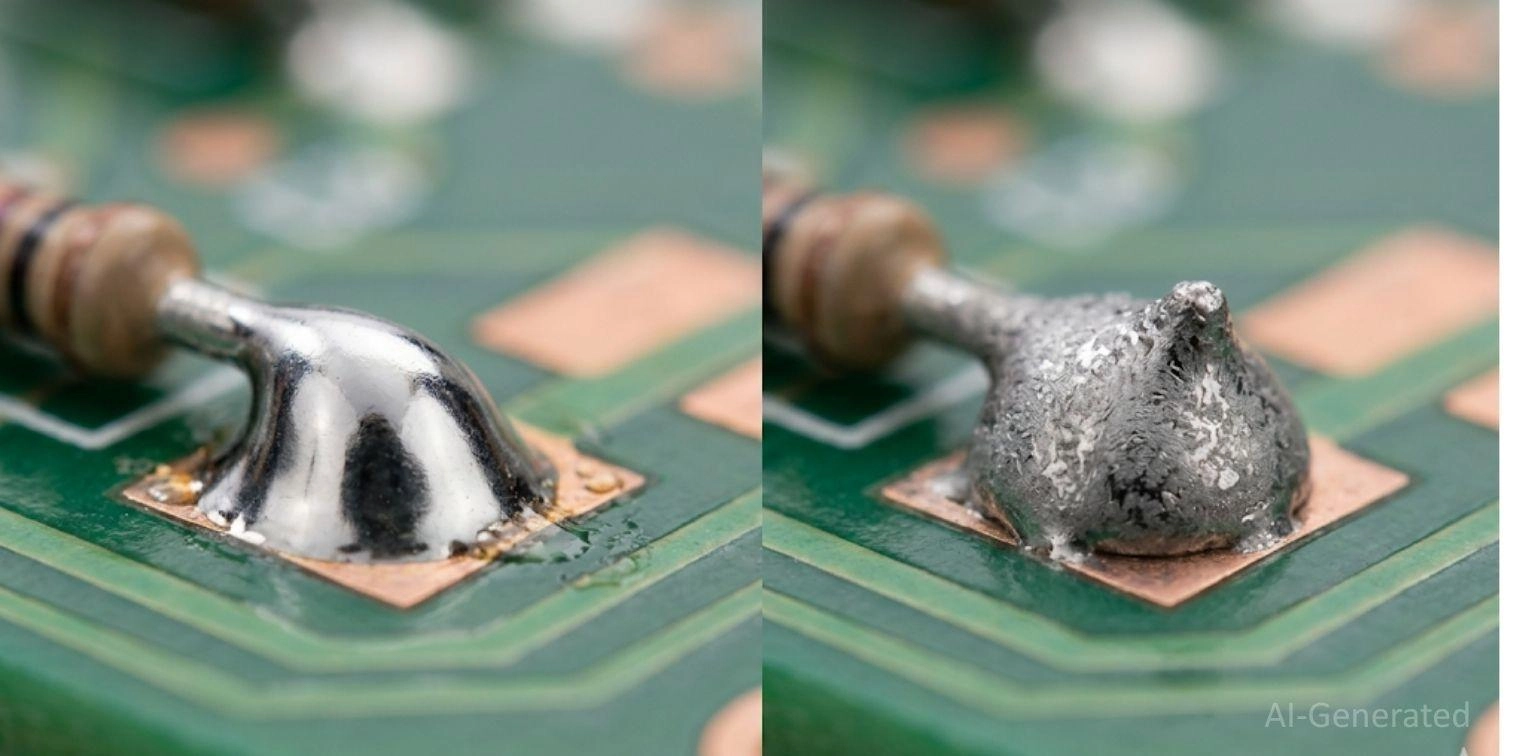
Figure: Comparing a shiny, well-wetted solder joint to a dull, defective cold solder joint.
Flux in Modern PCB Assembly
Role of Flux in SMT Soldering
In SMT assembly, the tackiness of the flux in solder paste acts as a temporary glue, holding the tiny resistors and microcontrollers in place as the board moves down the conveyor belt. Controlled flux chemistry is critical for IPC Class 2 and Class 3 assemblies, where long-term electrical reliability is mandatory.
Flux in Reflow Soldering Processes
During reflow, the oven carefully steps through temperature profiles. The flux activates first to clean the pads, boils off its solvents, and then protects the joint as the oven hits peak reflow temperatures. In controlled SMT processes, flux behavior is tightly matched with the reflow thermal profile. Improper flux activation timing can lead to defects such as head-in-pillow, solder balling, or insufficient wetting.
Importance in High-Density PCB Manufacturing
As electronics shrink, pad pitches (the distance between pins) become microscopic. High-quality flux prevents solder bridges (shorts between pins) by ensuring the solder pulls tightly to the heated metal pads rather than spilling over the solder mask.
In high-density PCB manufacturing, automated inspection systems such as AOI (Automated Optical Inspection) are also essential for verifying solder joint quality and detecting residue-related defects after assembly. This helps ensure that improper flux behavior or leftover contamination does not compromise final product reliability.
PCB Assembly and Soldering Solutions at JLCPCB
Achieving flawless solder joints requires not only the right flux but also precision manufacturing. Services like JLCPCB utilize industry-leading automated SMT assembly lines, utilizing precise solder paste stenciling, top-tier flux compounds, and highly controlled reflow ovens.
JLCPCB also uses automated optical inspection (AOI) to verify solder quality and help ensure that residue-related defects do not affect finished PCB performance.
Whether you are prototyping a new IoT device or scaling up to mass production, relying on professional turnkey assembly ensures your boards are manufactured with zero oxidation issues and perfect solder wetting.
For complex PCB assemblies, using professional SMT services ensures consistent flux control and defect-free soldering results.

How to Choose the Right Flux for Your Project
Flux for Electronics Soldering
For standard through-hole soldering and hobbyist electronics, a No-Clean flux pen or RMA paste is your best bet for a balance of performance and low maintenance.
Flux for PCB Assembly
For dense SMT boards with tiny ICs, a high-quality tacky flux gel applied via syringe will keep your components secure and ensure clean reflows under hot air.
Flux for Repair and Rework
If you are trying to desolder old, crusty joints from a vintage device, reach for an aggressive liquid Rosin or Water-Soluble flux to cut through decades of oxidation.
FAQs About Soldering Flux
Q: Can flux damage a PCB?
Excessive or uncleaned flux - especially water-soluble types - can become conductive or corrosive over time, potentially damaging PCB traces or causing leakage currents.
Q: Do I need flux if I use flux-core solder wire?
For basic through-hole components, flux-core wire is usually sufficient, but additional flux is highly recommended for SMD components, rework, or heavily oxidized surfaces.
Q: What is the best flux for electronics soldering?
No-clean flux is ideal for most electronics due to minimal residue, while rosin or water-soluble flux is better for heavily oxidized or high-reliability applications.
Q: At what temperature does flux activate?
Most soldering fluxes activate between 100°C and 200°C, becoming chemically active just before the solder melts to ensure optimal surface cleaning. Always ensure your flux is rated for your specific solder alloy, as lead-free solders require higher activation temperatures.
Q: What happens if you use too much flux?
Using too much flux can leave excessive residue, attract contaminants, and make cleaning difficult, potentially affecting circuit reliability. It can also interfere with automated testing probes or create sticky surfaces that trap conductive dust over time.
Conclusion
Understanding what is flux for soldering is the first step toward mastering electronics assembly. It is the unsung hero of the workbench - the chemical catalyst that turns an impossible, messy job into a smooth, reliable connection.
By selecting the right type of flux for your specific application and ensuring proper application and cleaning techniques, you can guarantee professional-grade solder joints on every project you build. Mastering flux selection and application is one of the fastest ways to improve soldering quality, reduce defects, and achieve professional PCB assembly results.
Ready to scale your next project? Trust JLCPCB for high-quality, professional PCB manufacturing and assembly.
Popular Articles
• How to Design and Assemble a Reliable ESP32 Module PCB on a 2-Layer Board
• How to Identify SMD LED Polarity: Markings, Testing, and PCB Tips
• The Ultimate Guide to Relay Symbol: Coil, Contacts, Diagrams, and Circuit Applications
• Power Supply Symbols Chart: A Complete Guide to AC, DC, Ground, Battery, and Source Symbols
• How to Create a Bluetooth-Controlled Car With Arduino: A Step-by-Step Guide
Keep Learning
Solder Paste vs Flux: What's the Difference and When Should You Use Each?
Solder paste and flux are not interchangeable. Solder paste contains solder alloy powder and flux, while flux contains no solder alloy. This difference matters when choosing materials for SMT, reflow soldering, or manual soldering. Flux removes metal oxides and prevents re-oxidation, allowing molten solder to wet copper pads and component leads properly. Solder paste combines flux with fine solder alloy powder. During reflow, the flux activates to improve wetting while the solder alloy melts to form t......
Fiducial Marks in PCB and SMT Assembly: A Complete Guide to Accuracy and Design Rules
Modern Printed Circuit Boards (PCBs) are complex, integrating high-density components like 0.4mm pitch Ball Grid Arrays (BGAs), 0201 passives, and fine-pitch Quad Flat No-Lead (QFN) packages. In this advanced manufacturing environment, achieving placement accuracy measured in micrometers is crucial. A significant challenge in automated manufacturing is how pick-and-place machines, which handle thousands of components per hour, precisely locate the PCB. A board on a conveyor system is never in the perf......
Ground Symbols Explained: Earth, Chassis, Signal, Analog, Digital Ground & More
Key Takeaways ⬇ Download the Ground Symbol Cheat Sheet (PDF) Keep all six ground symbols and their standard numbers on one page for quick reference. Four IEC 60417 symbols: IEC 60417 defines symbol 5017 for earth, 5018 for functional earth, 5019 for protective earth, and 5020 for frame/chassis. Protective earth is safety-related: IEC 60417-5019 identifies the protective earth connection and is used for safety-related protective bonding. Signal ground uses a different convention: IEEE Std 315 defines t......
How to Choose an ESP32 Development Board: A Beginner-Friendly Guide
The leap from blinking a simple LED to building a cloud-connected smart home device is a thrilling milestone for any electronics beginner. At the heart of this transition is often one undisputed champion: the ESP32. However, when you first search for an ESP32 development board, you are instantly met with a dizzying array of models, shapes, and specifications. How do you know which one is right for your first IoT (Internet of Things) project? In this beginner's guide, we will break down what makes thes......
How to Design an ESP32-S3 Development Board from Scratch: A 4-Layer PCB Design Tutorial
Designing your own ESP32-S3 development board gives you complete control over your hardware architecture while preparing your IoT projects for commercial production. Instead of relying on bulkier, off-the-shelf boards, building a custom design allows you to optimize the board space, expose only the required GPIO pins, and integrate peripherals directly onto a single substrate. In this tutorial, we will design a 4-layer ESP32-S3 development board from scratch. We will walk through the entire hardware d......
The Ultimate Guide to IC Symbol: Meaning, Types & Circuit Diagram Examples
Think of an integrated circuit (IC) as a microscopic city of electronics. Instead of drawing hundreds of individual components, engineers use an integrated circuit symbol to represent the entire system as one clean block. While the physical chip might look like a tiny black bug with metal legs, the IC schematic symbol explained on paper is a functional map. Understanding these electronic IC symbols makes designing and troubleshooting infinitely easier. What you will learn in this guide: 1. Understand ......