How Graphene and MXene Inks Enable Stretchable Circuits
12 min
- Why Do Traditional Conductors Struggle in Stretchable Circuits?
- How Do Graphene and MXene Enable Stretchable Conductive Networks?
- How Are Graphene and MXene Inks Used to Build Stretchable Circuits?
- What Happens When a Graphene or MXene Circuit Is Stretched?
- Graphene vs. MXene for Stretchable Circuits
- Where Are Graphene and MXene Stretchable Circuits Used?
- What Are the Main Challenges of Stretchable Graphene and MXene Circuits?
- From Laboratory Demonstrations to Practical Circuits
- FAQ About Graphene and MXene Stretchable Circuits
- Conclusion
Stretchable circuits must maintain electrical performance while bending, stretching, or twisting. Graphene and MXene inks offer a promising approach by combining electrical conductivity, mechanical flexibility, and printability. But how do these materials actually enable circuits to stretch without losing their electrical function?
Graphene and MXene inks enable stretchable circuits by forming interconnected conductive networks that can rearrange as the substrate deforms. Their overlapping 2D platelets create multiple conductive pathways, allowing the network to remain electrically connected even as individual contacts shift during stretching, bending, or twisting.
This article explains how these conductive networks form, how graphene and MXene inks are deposited onto flexible substrates, and how their electrical performance changes under mechanical strain.
Why Do Traditional Conductors Struggle in Stretchable Circuits?
Copper traces work well when their geometry remains stable. A rigid printed circuit board supports copper on an epoxy glass-fibre laminate, while a conventional flexible PCB uses thin metal on a polymer film to tolerate controlled bending. Stretching creates a different mechanical problem because it changes distances in-plane rather than simply curving the circuit around a bend radius.
When a compliant substrate stretches beneath a much stiffer conductive feature, the stiffness mismatch concentrates strain at cracks, interfaces, sharp pattern transitions, and component connections. A track may conduct normally while relaxed but become unreliable during movement. It may also delaminate locally before the metal itself breaks.
Copper can still be used in stretchable systems when serpentine traces or other strain-relief geometries accommodate extension by changing shape. For conventional flexible circuits, mechanical design considerations such as bend radius and trace routing determine how well copper conductors tolerate deformation. However, placing a straight metal track on an elastomer, textile, or foam does not make it stretchable. The conductor architecture must either redirect strain or remain electrically connected while its internal contacts evolve.
How Do Graphene and MXene Enable Stretchable Conductive Networks?
Graphene-family materials and MXenes form extremely thin platelets with large lateral dimensions relative to their thickness. This high aspect ratio helps neighboring flakes overlap and create connected paths through a coating. A 2022 comparative review of graphene and MXene coatings (Orts Mercadillo et al., Advanced Functional Materials) describes how these platelet coatings combine electrical conductivity with compatibility across sheets, textiles, and foams used in flexible and stretchable electronics.
After deposition, many platelet-to-platelet contacts form a percolating conductive network. Current does not depend on one uninterrupted strip; it can travel through multiple overlapping routes. If stretching weakens some contacts, other paths may remain available, so a local change does not necessarily open the whole circuit.
When stretched, graphene and MXene platelets can slide, rotate, separate, and reconnect, allowing the conductive network to accommodate deformation without relying on a single continuous conductor. The result is not perfectly constant resistance, but continued conduction through a network whose geometry changes with the substrate.
Network design is therefore critical. A sparse coating may fall below its percolation threshold when stretched, while weak adhesion can allow the film to crack, detach, or rub off. Flake dimensions, loading, coating thickness, substrate roughness, binder content, and interface chemistry all affect whether enough conductive pathways survive. The platelet shape enables the mechanism, but the complete coating-substrate system determines performance.
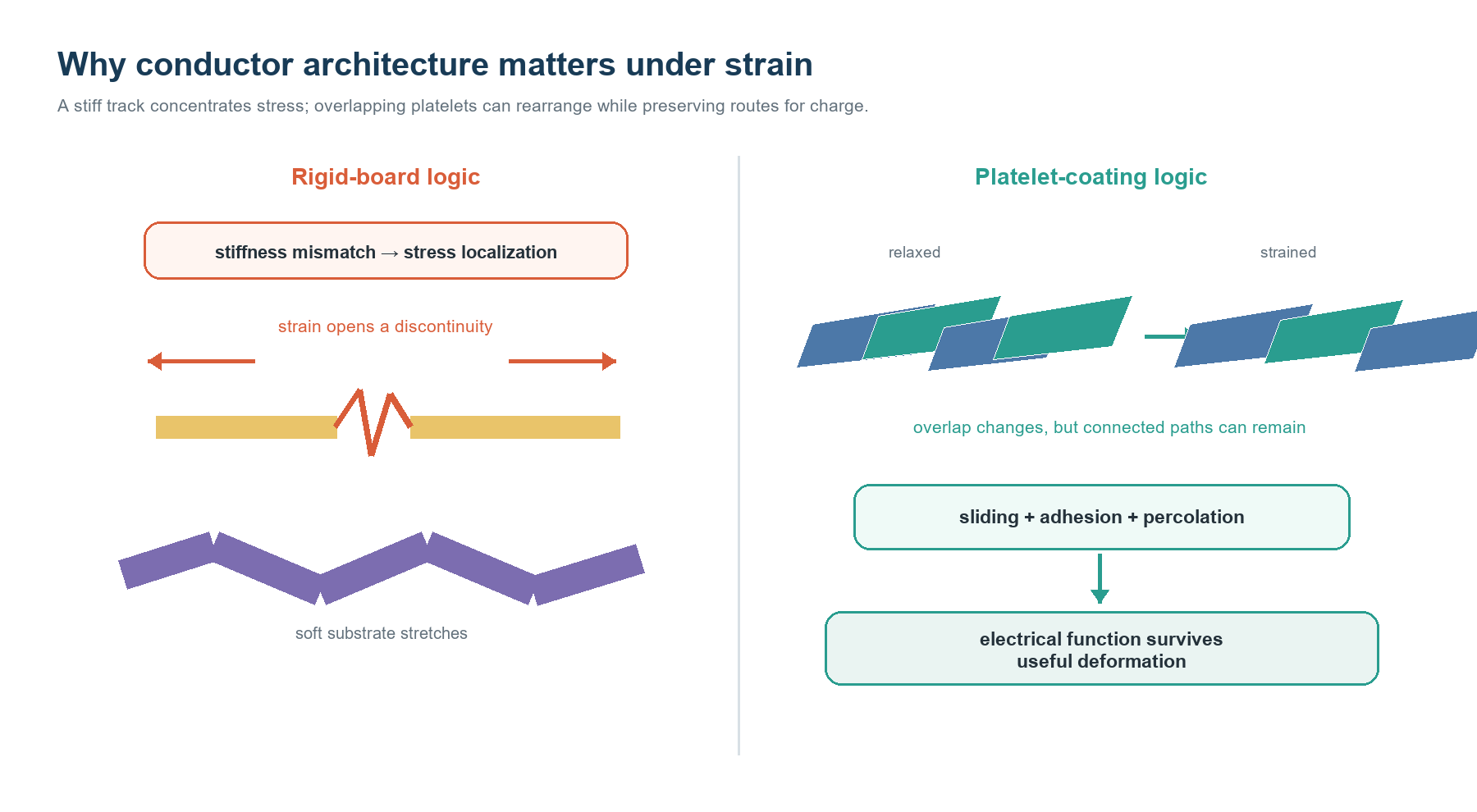
A stiff continuous track can concentrate strain into a crack, whereas an overlapping platelet network can redistribute movement through sliding and changing contacts. Schematic illustration of the mechanism; not experimental data.
How Are Graphene and MXene Inks Used to Build Stretchable Circuits?
A conductive filler is not yet a usable ink. Graphene or MXene platelets must be dispersed in a liquid carrier that can be deposited onto the selected substrate. Binders or stabilizers may be added when they are needed for dispersion, adhesion, viscosity, and film formation, but they cannot be optimized independently: a nonconductive additive that improves mechanical integrity may also increase the resistance between platelets.
The circuit is created by depositing the ink as traces, electrodes, or broader functional coatings, then removing the carrier through drying or another appropriate treatment. Screen printing can produce repeatable patterns, spray or blade coating suits many sheet-based structures, and dip coating can cover fibres and porous foams. The practical choice depends on substrate geometry, required pattern definition, coating thickness, and process compatibility; a more detailed guide explains how to match 2D conductive inks to coating processes.
The circuit is created by depositing the ink as traces, electrodes, or broader functional coatings, then removing the carrier through drying or another appropriate treatment. Screen printing can produce repeatable patterns, spray or blade coating suits many sheet-based structures, and dip coating can cover fibres and porous foams. The practical choice depends on substrate geometry, required pattern definition, coating thickness, and process compatibility; a more detailed guide explains how to match 2D conductive inks to coating processes.
The deposited layer must adhere while leaving the substrate compliant. Graphene nanoplatelets may require suitable solvents or additives for stable dispersion. Graphene oxide is easier to disperse in water but is poorly conductive until reduced when it is used as a precursor to rGO. MXene surface terminations support aqueous processing, although oxidation must be controlled during formulation, drying, storage, and service.
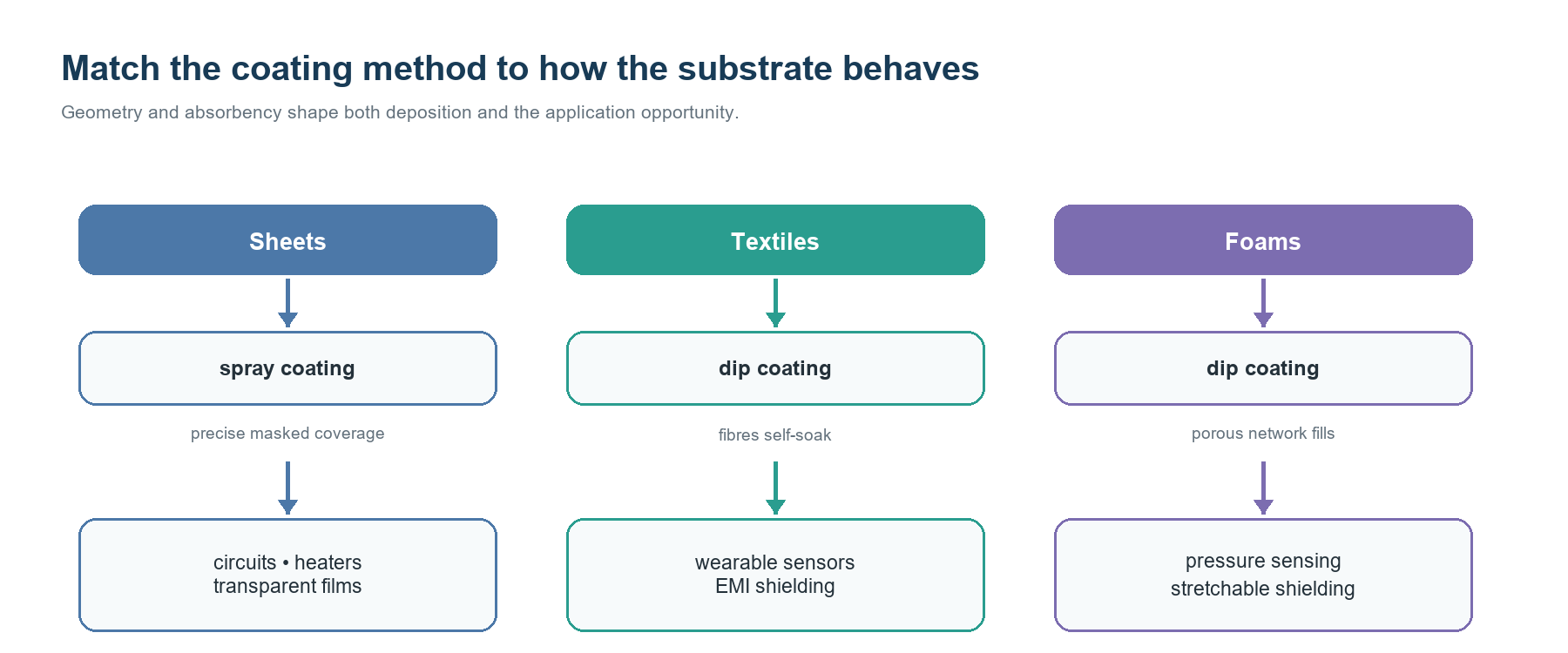
Sheets, textiles, and foams favor different deposition routes because their geometry, absorbency, and deformation mechanisms differ. Schematic overview of substrate geometry, coating methods, and applications.
What Happens When a Graphene or MXene Circuit Is Stretched?
Stretching changes platelet overlap, the distance between neighboring flakes, and the number of available current paths. Some junctions weaken, microcracks may form, and resistance usually changes. When the load is removed, sliding platelets and the substrate may recover toward their earlier arrangement, but the electrical baseline does not always return completely.
The meaning of that resistance change depends on circuit function. An interconnect should keep variation within the allowable electrical margin across its working strain range. A resistive strain or pressure sensor deliberately uses the change as its signal, but the response must still be repeatable and interpretable. Sensitivity alone is not enough if the device has excessive hysteresis, poor recovery, saturation, or progressive drift.
A focused explanation of graphene and MXene piezoresistive flake sensors shows how changing contacts translate mechanical deformation into resistance. For both sensors and interconnects, performance should be measured during deformation and after repeated cycles—not inferred from a relaxed resistance value and a photograph of a stretched sample.
A focused explanation of graphene and MXene piezoresistive flake sensors shows how changing contacts translate mechanical deformation into resistance. For both sensors and interconnects, performance should be measured during deformation and after repeated cycles—not inferred from a relaxed resistance value and a photograph of a stretched sample.
| Electrical behavior | Interconnect requirement | Strain-sensor requirement |
|---|---|---|
| Resistance change | Small enough for reliable power or signal transfer | Large enough to resolve deformation and remain calibratable |
| Recovery | Return close to the original electrical state | Return to a stable, repeatable baseline |
| Hysteresis | Usually minimized | Measured and controlled so loading and unloading remain interpretable |
| Cyclic stability | No progressive open circuit or unacceptable drift | Consistent response over the required cycle life |
Graphene vs. MXene for Stretchable Circuits
Neither material is universally better. The choice depends on the conductivity, processing route, environmental exposure, and mechanical response required by the circuit. It is also important not to treat every graphene-derived material or every MXene composition as identical: graphene nanoplatelets, GO-derived rGO, and hybrid inks differ, while most published MXene examples in this field use Ti₃C₂Tₓ.
| Design factor | Graphene-family inks | MXene inks |
|---|---|---|
| Behavior under deformation | Overlapping flakes can slide and rearrange; binders or hybrid fillers may improve cohesion | Overlapping flakes can also rearrange; interface design and oxidation influence retained performance |
| Environmental stability | Depends on graphene type, formulation, and exposure | Oxidation is a central storage and service-life concern |
For a full comparison of conductivity, dispersibility, and production scale, see our graphene vs MXene inks guide.
Where Are Graphene and MXene Stretchable Circuits Used?
The most direct applications use the network's ability to remain conductive or change resistance under motion. Strain and pressure sensors measure changes in platelet contacts, making them suitable for wearable motion monitoring, soft interfaces, and pressure-sensitive textiles or foams. In these devices, mechanical response and electrical response are deliberately coupled.
The same material platform can support conformal Joule heating when the coating has sufficiently low and uniform resistance, or electromagnetic-interference shielding when the conductive layer remains connected across the relevant frequency range. These are application examples rather than interchangeable recipes. Commercial flexible heaters commonly use etched metal foil or wire laminated in insulating materials; that established architecture is related to flexible heating but is not the same manufacturing route as an experimental graphene- or MXene-coated heater. For more on that gap, see why graphene heaters struggle outside the lab.
Other reported uses include energy-storage electrodes and thermoelectric structures, but those devices introduce different electrochemical or thermal requirements.
What Are the Main Challenges of Stretchable Graphene and MXene Circuits?
A reliable device must balance conductivity with deformability and stability. Increasing platelet loading or coating thickness can lower resistance but may stiffen the layer or make it more prone to cracking. Adding binder may improve adhesion and cyclic integrity while separating conductive platelets. A network near the percolation threshold may provide strong sensor sensitivity but be too unstable for an interconnect.
| Challenge | Why it matters | Design implication |
|---|---|---|
| Resistance stability | Stretch changes platelet contacts and current paths | Set an acceptable resistance window for the actual circuit function |
| Working strain and recovery | Excess strain can create irreversible gaps or cracks | Validate during loading and after release across the intended range |
| Hysteresis and cyclic drift | Loading and unloading may not follow the same electrical path | Evaluate repeated cycles, baseline recovery, and calibration stability |
| Adhesion and abrasion | The coating may delaminate or shed even if the network remains conductive | Match surface chemistry, binder, and protection to the substrate and use environment |
| Environmental stability | Humidity, heat, washing, and oxidation can change the network | Define service conditions and protect the material without over-stiffening the device |
| Contacts and encapsulation | Terminals or protective layers may become the mechanical weak point | Design and test the complete current path rather than the coating alone |
From Laboratory Demonstrations to Practical Circuits
A small coated coupon can hide problems that appear at device scale. Larger patterns introduce variation in coat weight, drying, edge definition, porosity, and platelet-junction resistance. Contacts and component attachment may fail before the printed coating, while encapsulation can protect against oxidation, moisture, abrasion, or shedding at the cost of stretchability, heat transfer, or sensor response.
Practical development therefore requires repeatable deposition, pattern uniformity, reliable conductor-to-terminal interfaces, and testing of the assembled circuit under realistic deformation. Electrical measurements should be linked to strain level, direction, loading rate, cycle count, temperature, humidity, abrasion, and washing where relevant. Manufacturing repeatability matters more than the best result from a single relaxed specimen.
IEC 62899-202-4:2021, for example, defines measurement methods for stretchable printed conductive and insulating layers. IEC 63203-401-1:2023 specifies evaluation methods for stretchable resistive strain sensors, including gauge factor, linearity, response characteristics, and hysteresis. Such frameworks support the transition from demonstrations to comparable engineering data. Future progress will depend on connecting material advances to controlled manufacturing and complete-device reliability rather than reporting conductivity or sensitivity without operating conditions.
FAQ About Graphene and MXene Stretchable Circuits
Does a graphene or MXene coating stretch as far as its substrate?
Not necessarily. A soft substrate may continue stretching after the coating has lost conductive pathways or detached. The usable strain range must be established by measuring the complete circuit during deformation and repeated cycling, including its contacts and protective layers.
Should resistance stay constant in a stretchable circuit?
It depends on the function. Interconnects need resistance variation to stay within the circuit’s electrical limits, while resistive strain sensors use a controlled change as the signal. Both require repeatable behavior within their intended strain range.
Can a graphene or MXene heater replace an etched-foil flexible heater?
A coated heater is not a direct replacement without application testing. Its resistance uniformity, temperature distribution, electrical contacts, protection, and durability must meet the same operating requirements. Etched-foil heaters use a different conductor architecture, so performance should be compared at the complete-device level.
How should graphene and MXene stretchable circuits be tested?
Measure electrical performance while the circuit is loaded, after release, and through repeated cycles. Report strain level, direction, loading rate, cycle count, and relevant environmental conditions. For sensors, also evaluate sensitivity, hysteresis, recovery, and baseline drift.
Conclusion
Graphene and MXene inks enable stretchable circuits because their platelets form overlapping conductive networks that can rearrange under deformation. Multiple current paths allow the coating to remain functional when individual contacts weaken, while controlled resistance changes can also provide the signal in strain and pressure sensors.
The material alone is not enough. Ink preparation, substrate selection, deposition, drying, adhesion, contacts, and encapsulation determine whether the network survives its intended working strain and service environment. The practical question is therefore not whether graphene or MXene is simply conductive, but whether the complete printed circuit delivers the required electrical behavior throughout deformation and repeated use.
Keep Learning
How Graphene and MXene Inks Enable Stretchable Circuits
Stretchable circuits must maintain electrical performance while bending, stretching, or twisting. Graphene and MXene inks offer a promising approach by combining electrical conductivity, mechanical flexibility, and printability. But how do these materials actually enable circuits to stretch without losing their electrical function? Graphene and MXene inks enable stretchable circuits by forming interconnected conductive networks that can rearrange as the substrate deforms. Their overlapping 2D platelet......
Graphene vs MXene Inks for Flexible Electronics: Which Is Better?
GNP, GO, rGO, and Ti3C2Tx MXene all share a platelet shape, but they differ dramatically in conductivity, water compatibility, production scale, and shelf life. If you're designing flexible electronics, choosing the right 2D material ink means understanding which trade-offs your device can tolerate. In this guide, we compare the four most common 2D material inks side by side—graphene nanoplatelets (GNP), graphene oxide (GO), reduced graphene oxide (rGO), and Ti3C2Tx MXene—and explain when each one mak......
What Is a Thermoelectric Generator and How Does It Work?
Can heat from an engine, industrial process, or other heat source be turned into useful electricity without moving parts? A thermoelectric generator (TEG) does this by converting a temperature difference directly into electrical power through the Seebeck effect. Its power output depends on the temperature difference across the device, the thermoelectric materials, and the overall system design. What Is a Thermoelectric Generator? A thermoelectric generator (TEG) is a solid-state device that converts h......
What Are Flexible Electronics? How They Work & Where They're Used
Flexible electronics are electronic circuits, devices, and systems designed to maintain their intended functions while bending or conforming to a surface. They enable electronic functions to fit curved, moving, lightweight, or space-constrained products. Common examples include flex circuits in cameras and phones, wearable sensors, flexible heaters, flexible displays, RFID and NFC labels, conformal industrial sensors, and medical patches. Flexible electronics is a broad field that encompasses differen......
What Is a Strip Heater? How It Works: A Complete Guide [2026]
Strip heaters are electric resistance heaters commonly used to heat metal surfaces, machinery, and industrial equipment. Their flat, narrow design allows them to be mounted against surfaces or in spaces where other heater shapes may be less suitable. Understanding how strip heaters are constructed and installed helps determine whether they’re the right choice for a particular heating application. What Is a Strip Heater? A strip heater converts electrical energy into heat through a resistance element h......
Cartridge Heater Applications: Where and How They Are Used
Sometimes the difficult part of heating a machine is finding room for the heater. External hardware can obstruct moving parts or leave heat too far from the working zone. Industrial cartridge heater applications address that issue by placing the heat source inside the metal itself. Examples include molds, dies, hot runner manifolds, sealing bars, platens, heating blocks, semiconductor tools, laboratory instruments, and 3D-printer hot ends. But an industry label doesn't specify a heater. Here's how the......