Conductive 2D Coatings Are a Matching Problem, Not a Miracle Ink
13 min
- The Conductive Material Is Only One Part of the Ink
- Three Carbon Routes, Three Manufacturing Personalities
- MXenes Move the Bottleneck
- Choose the Surface Before Choosing the Coater
- Record Conductivity Is a Recipe, Not a Material Trophy
- Sustainability Cannot Stop at "Water-Based"
- Scale-Up Means Reproducing the Whole Window
- A Better Selection Order
- FAQ about 2D Conductive Inks and Coating Processes
Key Takeaways
Ink is a system, not a material: Conductivity depends on the combined effect of flake chemistry, solvent, additives, substrate, coating method, and post-processing—not on the 2D filler alone.
Three carbon routes carry different trade-offs: GNPs demand dispersion engineering, GO shifts effort to a reduction step, and MXenes move the bottleneck to synthesis, storage, and oxidation control.
Substrate geometry drives method selection: Spray and blade coating suit flat sheets; dip coating naturally reaches textile fibres and foam pores. Choose the surface and coater before choosing the material.
Headline conductivity numbers mislead without context: A record value reflects a specific material-process-substrate recipe. Always ask whether the coating was pure or hybrid, how it was measured, and whether it survived real-world conditions.
"Water-based" is not a sustainability verdict: A full environmental comparison must include upstream chemistry, drying energy, additive complexity, device lifetime, and end-of-life separation.
The Conductive Material Is Only One Part of the Ink
A conductive ink sounds simple: put conductive particles into a liquid and coat a surface. Yet the liquid has several jobs that can conflict. It must keep billions of thin platelets separated long enough for storage and deposition. It must flow in a way that suits the coating tool. It must wet the target without running, staining, or beading. After deposition, it must leave the platelets close enough to create continuous electrical pathways.
Binders and surfactants can help. A binder improves adhesion between flakes and substrate; a surfactant can prevent suspended flakes from clumping. But these helpers are usually less conductive than the platelets. Too much assistance can place electrically resistive material between neighbouring flakes, cover useful surface area, and weaken the very network the formulation is meant to create.
This is why a conductivity value attached to "graphene ink" or "MXene ink" tells only part of the story. The same filler can behave very differently when its flake size, concentration, solvent, additive package, coating thickness, or substrate changes. The formulation is not a delivery vehicle for the material. It is part of the material system.
Three Carbon Routes, Three Manufacturing Personalities
"Graphene" can conceal several practically different starting materials. Nearly ideal single-layer graphene has extraordinary intrinsic properties, but mass-produced material is more commonly supplied as graphene nanoplatelets, or GNPs: thicker stacks with varying lateral size, thickness, surface area, and surface chemistry. These variables determine how readily the particles disperse and how many flake-to-flake junctions a current must cross.
GNPs are attractive because production has reached industrially significant scale and the platelets can form highly conductive coatings. Their difficulty is wet processing. Graphitic surfaces do not naturally enjoy water, so a stable aqueous GNP ink often needs chemical help. In the review's dataset, 86% of surveyed GNP studies used organic solvents, binders, or surfactants to assist water dispersibility.
Graphene oxide, or GO, reverses that inconvenience. Oxygen-containing groups make it hydrophilic, so it disperses homogeneously in water and can interact favourably with many substrate surfaces. That makes GO a cooperative coating precursor—but a poor conductor. Oxidation disrupts the carbon bonding network that carries current.
The common solution is a two-stage route: coat the easily dispersed GO first, then reduce it to reduced graphene oxide, or rGO, to restore more conductive carbon bonding. This "coat first, activate later" strategy is clever, but reduction becomes an additional manufacturing operation. Chemical reduction may introduce hazardous reagents; thermal treatment can conflict with heat-sensitive polymers; greener reducing agents may operate at lower temperatures but often act more slowly or achieve less complete reduction.
So the carbon-family choice is already a process choice. GNPs ask the formulator to solve dispersion while preserving conductivity. GO simplifies deposition but transfers the burden downstream to reduction. rGO carries the history and imperfections of that conversion.
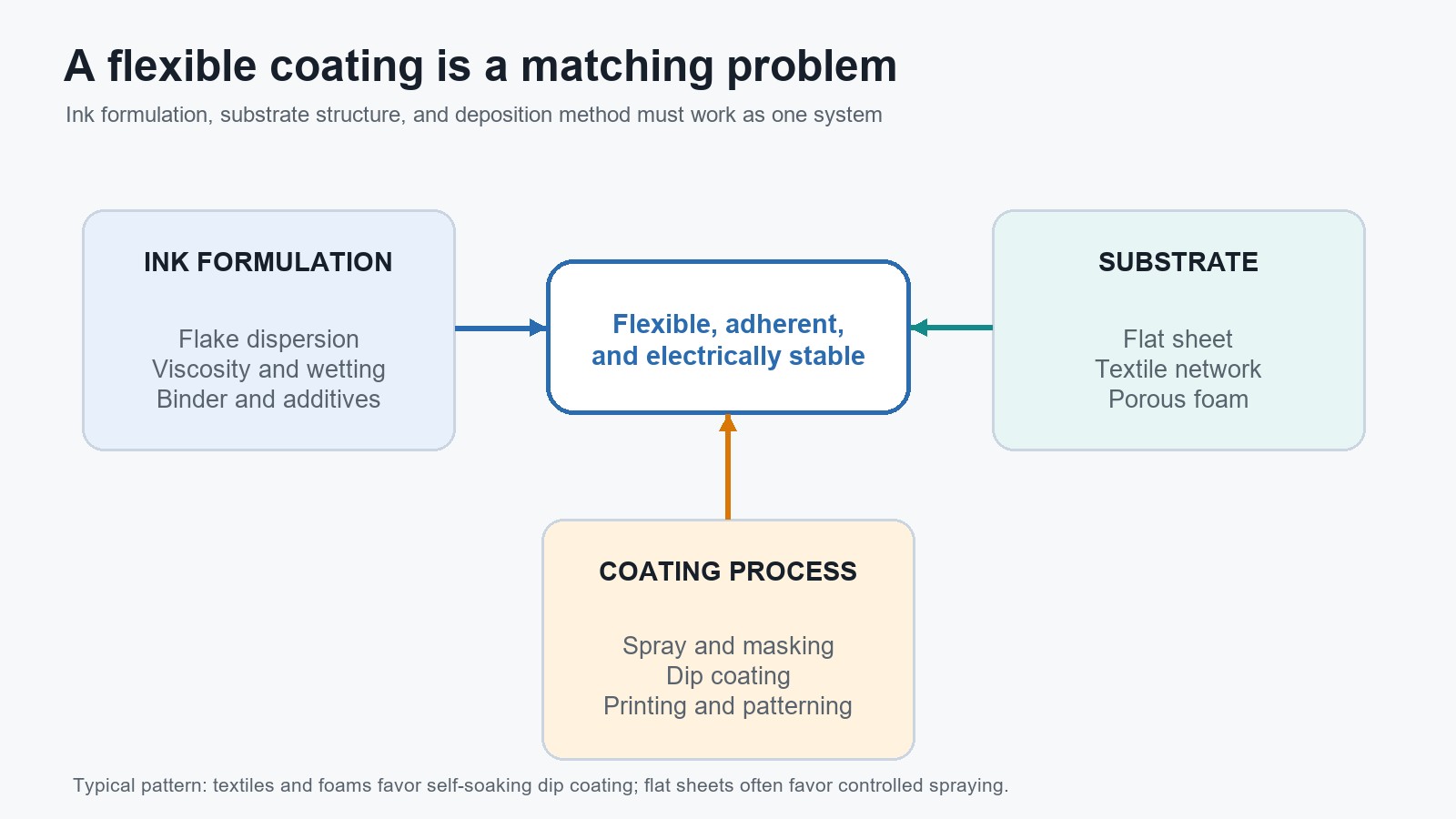
The formulation, substrate, and coating process must be designed as one system. Explanatory diagram based on the source discussion. Created for this article; not an experimental image.
MXenes Move the Bottleneck
MXenes offer a striking alternative. These two-dimensional metal carbides or nitrides combine metallic electrical behaviour with surface terminations that make them hydrophilic. In the reviewed literature, the titanium carbide MXene Ti3C2Tx dominated completely: it was used in every surveyed MXene paper, although other MXene compositions had been synthesised.
For ink making, Ti3C2Tx has an immediate advantage. Sixty percent of the surveyed MXene papers dispersed the material in water alone. Unlike GNPs, it often does not need a stabilising additive; unlike GO, it does not need a later reduction step to become conductive. That removes two common ways of compromising a flexible substrate or diluting a conductive network.
But MXenes do not eliminate manufacturing risk. They relocate it to production and storage. Ti3C2Tx is generally made by selectively etching a layered precursor and then delaminating the remaining sheets. Fluoride-containing acidic chemistry, especially hydrofluoric acid, has commonly been used, creating a serious sustainability and handling challenge. At the time covered by the review, MXene manufacture had reached approximately 50-gram batch reactors, far from the tonne-scale position of graphene nanoplatelets.
The water-friendly surface also has a destructive side. Ti3C2Tx dispersions exposed to air can oxidise into titanium dioxide within days. Refrigeration can extend useful stability beyond a month, while low-temperature storage under argon has achieved more than six months. Those precautions, however, add cold-chain, inert-gas, packaging, and quality-control requirements.
MXenes therefore make coating easier at the point of use while making shelf life and upstream synthesis harder. A factory evaluating them must count both sides of that ledger.
Choose the Surface Before Choosing the Coater
The substrate changes how an ink must arrive and where the conductive network must form. A smooth PET sheet presents a relatively simple two-dimensional surface. A textile is a permeable assembly of fibres and gaps. A foam is a three-dimensional porous skeleton. Calling all three "flexible substrates" hides the manufacturing distinction that matters most.
For sheets, spray coating was the most popular technique in the survey, accounting for roughly 40% of reported sheet-coating choices. Spraying supports controlled deposition and masking. Because droplets partially dry in flight, the method can reduce smearing, yet that same evaporation requirement affects solvent selection and nozzle behaviour. Blade coating is another natural fit for a flat surface because a moving blade can meter a wet film to a controlled thickness.
Textiles and foams reward immersion. Dip coating lets the structure soak up an ink, covering fibres or pore walls that a surface-only pass might miss. The survey found dip coating used for about two-thirds of textiles and about three-quarters of foams. Water-based inks are especially compatible with this approach because a large, absorbent object may carry a substantial liquid inventory.
These geometries also change the electrical challenge. On a flat sheet, platelets can assemble into a comparatively direct film. On a textile, the network must travel around fibres and bridge contacts. In a foam, current follows a tortuous three-dimensional path. The paper found the highest conductivities on sheet substrates, with the closest textile result roughly two orders of magnitude below the leading sheet coating.
That does not make textiles or foams inferior. It means their value lies in deformation, breathability, absorption, or pressure response rather than in winning a flat-film conductivity contest.
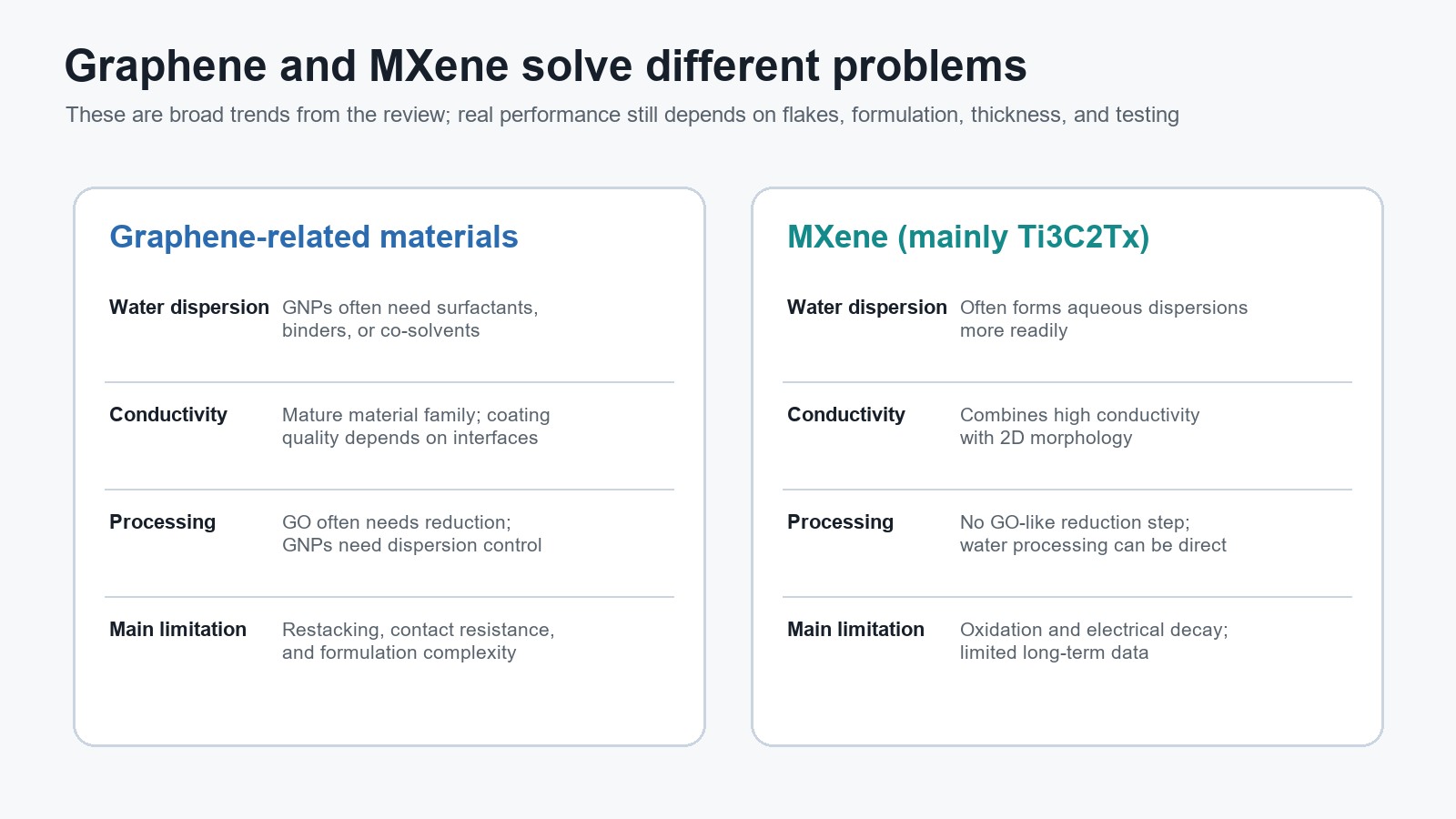
Broad processing strengths and limitations of graphene-related materials and MXenes. Explanatory comparison based on the source discussion. Created for this article; not an experimental image.
Record Conductivity Is a Recipe, Not a Material Trophy
The review's highest reported conductivity makes the systems view concrete. A 4.3-micrometre Ti3C2Tx film spray-coated on PET reached 1.2 × 10⁶ S/m. It is tempting to read that number as proof that MXene is simply the better conductor. More accurately, it demonstrates what a particular MXene, thickness, sheet substrate, and spray process achieved together.
The strongest graphene-based result reached 8.7 × 10⁵ S/m. It was not a graphene-only film: the formulation included copper nanoparticles and silver nitrate, was blade-coated on PET, and was sintered. The additives were copper nanoparticles and silver nitrate—not silver nanowires. That distinction matters because the performance belongs to a hybrid material and its thermal post-process, not to graphene in isolation.
Approximately 40% of all surveyed coatings used hybrid inks, combining a 2D material with conductive polymers, metal particles, carbon black, or carbon nanotubes. Hybrids can bridge gaps between platelets or introduce complementary conduction routes. They can also add cost, formulation complexity, processing steps, and end-of-life uncertainty.
A headline conductivity number should therefore trigger five follow-up questions:
- Was it measured as sheet resistance or converted to bulk conductivity using a reliable thickness?
- Was the coating a pure 2D material or a hybrid?
- Did it require sintering, chemical reduction, or protective storage?
- Was it deposited on a flat sheet, a textile, or a foam?
- Was stability measured after bending, humidity, light exposure, and time?
Without those answers, a league table can reward a laboratory recipe that is poorly matched to manufacturing.
Sustainability Cannot Stop at "Water-Based"
Water was the preferred solvent in 70% of the reviewed studies, and for good reasons: it is accessible, non-hazardous, and compatible with hydrophilic GO and Ti3C2Tx. Yet "water-based" is not a complete environmental assessment.
A GNP formulation may need surfactants or binders. GO production can involve strong acids, followed by a reduction step. MXene synthesis may use hazardous fluoride chemistry and discard large quantities of incompletely processed precursor. A hybrid may introduce precious metals or make material separation more difficult. Drying water also consumes energy, particularly when a porous textile holds much more liquid than a thin sheet.
The useful unit of comparison is the full coating route: raw material production, formulation, deposition efficiency, drying or activation, rejected batches, lifetime, and end of life. The source highlights promising directions—including bio-based dispersants and binders, greener GO reducing agents, safer MXene etching, and reuse of residues—but also makes clear that compromises remain. A slower or incomplete green reduction is not automatically superior if it creates a coating that fails early and must be replaced.
Toxicity and biodegradation evidence also remains uneven. Some graphene oxide structures can be degraded by enzymes or microorganisms under particular conditions, while aggregated material may be harder to break down. For MXenes, environmental and human toxicity mechanisms were still insufficiently understood in the surveyed literature. Responsible scale-up needs this uncertainty stated, not hidden behind a solvent label.
Scale-Up Means Reproducing the Whole Window
Spray, dip, blade, and screen coating are already familiar large-area methods. That is encouraging: 2D inks do not necessarily require an entirely new factory architecture. The harder task is controlling the process window from batch to batch.
Flake size distributions alter settling and junction density. Viscosity affects spray atomisation, screen transfer, and film levelling. Substrate wetting changes with textile finish or polymer surface treatment. Ambient oxygen threatens MXene dispersions. Drying rate can move platelets and additives before the network locks into place. A formulation that works on a small coupon may behave differently across a roll of fabric or a wide sheet.
The review also identifies a gap between scalable coating methods and industrially complete devices. Laboratory demonstrators often lack encapsulation and packaging, while performance tests are not standardised. A device may be tested electrically while relaxed and shown bending in a separate demonstration, even though its real job is to operate while bent, stretched, humid, washed, or repeatedly cycled.
That changes what "best ink" should mean. It is not the formulation with the single highest initial conductivity. It is the formulation that stays within specification through coating, conversion, integration, storage, use, and disposal at an acceptable cost and risk.
A Better Selection Order
Teams can avoid material-first tunnel vision by choosing in the opposite direction.
Recommended Selection Process
Begin with the operating geometry and lifetime: flat sheet, textile, or foam; repeated strain or mostly static use; protected interior or exposed environment. Then choose the coating technique that can reach the relevant surfaces at production scale. Define the allowable solvents, temperatures, and post-processing steps. Only then select the 2D material and additives that can satisfy that window.
This order may lead to GNPs when mature supply and maximum carbon-based conductivity justify dispersion engineering. It may favour GO-to-rGO when aqueous coating and surface compatibility outweigh the cost of reduction. It may point to Ti3C2Tx when additive-free water processing and high conductivity are decisive, provided oxidation and supply-scale constraints can be controlled.
There is no universal champion because every advantage sends a bill somewhere else in the process.
FAQ about 2D Conductive Inks and Coating Processes
Q: Why are graphene nanoplatelets difficult to formulate in water?
Their largely graphitic surfaces are not naturally water-loving, so the flakes tend to aggregate unless their size or surface chemistry helps dispersion or the ink includes suitable solvents, surfactants, or binders. Those additives can improve stability and coating behaviour, but excessive amounts may interrupt electrical contact between platelets.
Q: Are MXene inks automatically more sustainable because they can use water?
No. Water-based deposition is valuable, but a full assessment must include upstream etching chemistry, material yield, cold or inert storage, oxidation-related waste, drying energy, additives, device lifetime, and end of life. The reviewed MXene literature also left important environmental and toxicity questions unresolved.
Q: Which coating method is best for flexible electronics?
It depends on substrate geometry and the ink's drying behaviour. Spray or blade coating suits relatively flat sheets and controlled films; dip coating naturally reaches fibres and pores in textiles and foams. The best method is the one that produces a uniform, durable conductive network within the substrate's thermal and chemical limits.
Conclusion: Matching 2D Conductive Inks to Coating Processes
Conductive 2D coatings are fundamentally a matching problem. No single material—graphene nanoplatelets, graphene oxide, or MXene—wins in every scenario. The right choice emerges only when flake chemistry, formulation, substrate geometry, deposition method, post-processing, and end-use requirements are designed as one integrated system. By selecting the operating environment and coating process before the material, engineers can avoid the trap of optimising a single parameter while creating larger problems elsewhere in the manufacturing chain.
Keep Learning
How to Upgrade a 3D Printer Heated Bed with a Silicone Heater
If your 3D printer heated bed takes too long to reach temperature, develops uneven heating, or struggles to maintain a stable surface temperature, a silicone heater can be a practical upgrade. Faster warm-up and more uniform heat can improve first-layer consistency and reduce temperature-related printing issues. This guide explains how to identify when a heated-bed upgrade is needed, choose a suitable silicone heater, install it safely, and verify the results. Quick Answer A silicone heater can be a s......
How Graphene and MXene Flake Sensors Detect Force
Key Takeaways Flake networks sense force through microstructural change: Graphene and MXene coatings distribute conduction across overlapping platelets whose contacts shift under stretch or pressure, producing measurable resistance changes. Three mechanisms compete: Crack propagation, flake slippage, and quantum tunnelling each dominate at different deformation levels, giving many sensors multiple sensitivity regions rather than one uniform response. The substrate is an active partner: Elastomers, tex......
Conductive 2D Coatings Are a Matching Problem, Not a Miracle Ink
Key Takeaways Ink is a system, not a material: Conductivity depends on the combined effect of flake chemistry, solvent, additives, substrate, coating method, and post-processing—not on the 2D filler alone. Three carbon routes carry different trade-offs: GNPs demand dispersion engineering, GO shifts effort to a reduction step, and MXenes move the bottleneck to synthesis, storage, and oxidation control. Substrate geometry drives method selection: Spray and blade coating suit flat sheets; dip coating nat......
Graphene Heat Spreader Design: Layers and Interfaces
Key Takeaways Conductivity alone is not enough: A record thermal-conductivity value does not guarantee a cooler chip. Effective thickness, interface resistance, hot-spot geometry, and heat-sink connections all belong to the same thermal path. Few-layer graphene can outperform a single layer in practice: A few-layer sheet provides a larger heat-flow cross section and better tolerates transfer, embedding, and defects, even though its intrinsic conductivity is lower. Interface resistance is the bottlenec......
How Graphene Heat Spreaders Cool SOI Chip Hot Spots
Key Takeaways Buried oxide is a thermal bottleneck: SOI's insulating layer improves electrical isolation but traps heat near transistor channels, creating dangerous hot spots that package-level cooling alone cannot fix. Graphene enables lateral heat routing: Placing graphene or few-layer graphene beneath the buried oxide adds a high-conductivity sideways path, redistributing hot-spot energy toward dedicated sinks without removing any heat itself. Multi-source chips benefit most: Finite-element modelin......
Graphene Heaters Look Brilliant in the Lab. Can They Survive the Real World?
Key Takeaways Undoped graphene simplifies reliability: By avoiding chemical dopants that can migrate or degrade, undoped CVD graphene removes one failure route — though it starts with higher sheet resistance than doped alternatives. Layer stacking is a design trade-off: Each added graphene layer lowers resistance and voltage requirements but also reduces optical transmission and introduces potential transfer defects such as wrinkles and polymer residue. Durability is the real barrier: After one year i......