What Are Flexible Electronics? How They Work & Where They're Used
12 min
- What Are Flexible Electronics?
- How Do Flexible Electronics Work?
- Flexible, Printed, Stretchable, Organic, and Hybrid Electronics: What’s the Difference?
- How Are Flexible Electronics Built?
- Where Are Flexible Electronics Used?
- Flexibility Trade-offs and Reliability
- Does Your Product Actually Need Flexible Electronics?
- Frequently Asked Questions About Flexible Electronics
- Conclusion: What to Know About Flexible Electronics
Flexible electronics are electronic circuits, devices, and systems designed to maintain their intended functions while bending or conforming to a surface. They enable electronic functions to fit curved, moving, lightweight, or space-constrained products. Common examples include flex circuits in cameras and phones, wearable sensors, flexible heaters, flexible displays, RFID and NFC labels, conformal industrial sensors, and medical patches. Flexible electronics is a broad field that encompasses different technologies and approaches, including flexible printed circuit boards and printed electronics.
What Are Flexible Electronics?
Unlike electronics built on rigid boards, flexible electronics are designed to accommodate specific forms of mechanical deformation. Their construction may combine flexible substrates, conductive paths, electronic components, and protective layers, depending on the application and its performance requirements.
Bending changes a device’s curvature, while stretching increases its length and places different demands on materials and electrical connections. Not every flexible electronic system is stretchable, and the deformation it can tolerate depends on its construction and intended use.
How Do Flexible Electronics Work?
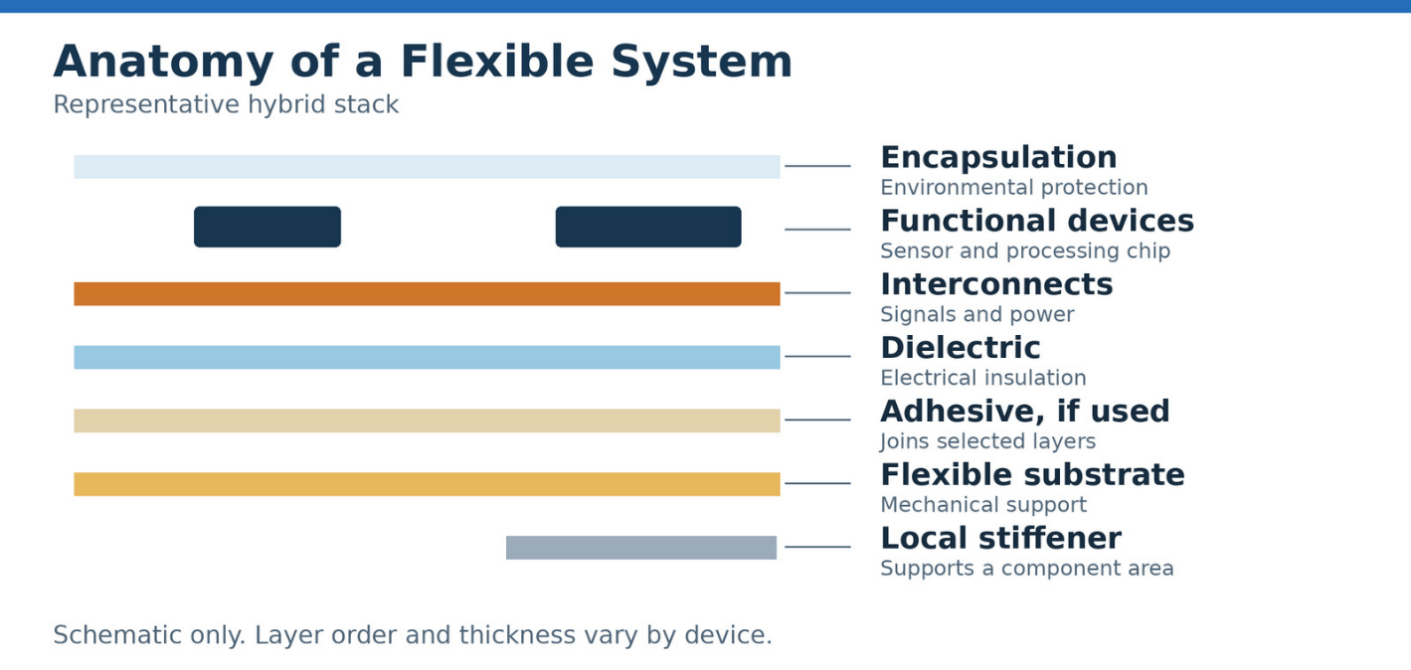
A flexible substrate gives support. Conductors distribute power and signals. And components sense, calculate, connect, emit light, or generate heat. Dielectrics provide electrical insulation. Adhesives join layers. Some constructions are compliant throughout. Others carry rigid chips on certain areas.
Consider a temperature patch. Its sensor changes an electrical signal. Traces connect it to a processing chip. And an antenna sends the reading. A battery or harvested energy supplies power.
Movement creates strain (local deformation relative to original dimensions). Thinner stacks reduce bending strain. Placing vulnerable layers near the neutral plane with bending strain being zero can also protect them. Research on multilayer mechanics shows that layer geometry is critical. Serpentine conductors and island-bridge layouts redirect deformation away from parts.
Coverlay, which is an insulating protective film, shields circuitry from abrasion. Barrier films restrict moisture ingress. And localized stiffeners support connectors. Their transitions need strain relief. Just a bendable base proves little. However, flexible electronics must live as an assembled system under specified motion and environmental conditions.
Flexible, Printed, Stretchable, Organic, and Hybrid Electronics: What’s the Difference?
SEMI’s terminology guide separates characteristics that might get bundled together.
| Term | Describes | Example | Boundary |
|---|---|---|---|
| Flexible electronics | Mechanical compliance | Conformal sensor | Umbrella category |
| Printed electronics | Deposited printing patterns | Printed antenna | Can use rigid substrates |
| Stretchable electronics | Tolerance of tensile deformation | Electronic skin | Requires strain accommodation |
| Organic electronics | Organic electronic materials | Organic transistor | Material class, not shape |
| Flexible hybrid electronics (FHE) | Flexible structures plus conventional components | Printed sensor with silicon chip | Includes locally rigid regions |
| Flex PCB / flexible printed circuit (FPC) | Copper circuitry on flexible dielectric | Camera interconnect | One established platform |
These descriptions overlap. An FHE sensor can contain printed conductors, flexible regions, and rigid silicon simultaneously. A polymer substrate alone does not make its circuitry 'organic'.
Main Types by Function
- Interconnects: Carry electrical connections between separated assemblies.
- Sensors: Detect physical or chemical changes at a surface.
- Displays and lighting: Control light through distributed active layers.
- Energy devices: Harvest or store power within compliant structures.
- Heating elements: Turn electrical power into evenly distributed surface heat, as in polyimide and silicone rubber flexible heaters.
- Integrated systems: Combine several functions with control and communication.
How Are Flexible Electronics Built?
What Are Flexible Electronics Technology Made From?
Fundamentally, a representative sequence is substrate, interconnects, functional devices, insulation or bonding layers, and encapsulation. Actual processes may interleave these stages. Choosing flexible electronics materials means matching processing conditions to service demands. It is explained in the review written by Corzo, Tostado-Blázquez, and Baran. Conductive ink carries conductive particles or polymers in a printable fluid.
| Material Role | Strengths | Constraints and Common Uses |
|---|---|---|
| Polyimide (PI) support | Heat-tolerant processing | Grade-dependent optical properties. Flex circuitry and flexible heaters. |
| Polyethylene terephthalate (PET) or polyethylene naphthalate (PEN) support | Transparency and film handling | Temperature and dimensional stability constrain processing. Labels and displays. |
| Elastomer support | Elastic deformation | Barrier performance and adhesion need attention. Soft sensors and silicone rubber heaters. |
| Copper interconnects | High conductivity | Fatigue-sensitive geometry. Power and signal routing. |
| Conductive ink or thin films | Patternable functional layers | Curing, sheet resistance, adhesion. Antennas and electrodes. |
| Silicon or thin-film devices | Processing or sensing | Attachment and strain limits. Active functions. |
| Dielectrics, adhesives, coverlays, barriers, encapsulants | Insulation, bonding, environmental protection | Interfaces can separate. Packaging. |
No set of flexible electronics materials is good for every comparison. Check solvent compatibility, permeability, cost, and dimensional stability together.
E.g., a transparent film may be good for an optical device but distort during curing. A printable conductor may simplify patterning but need wider tracks to get the resistance your circuit needs.
Four Manufacturing Routes
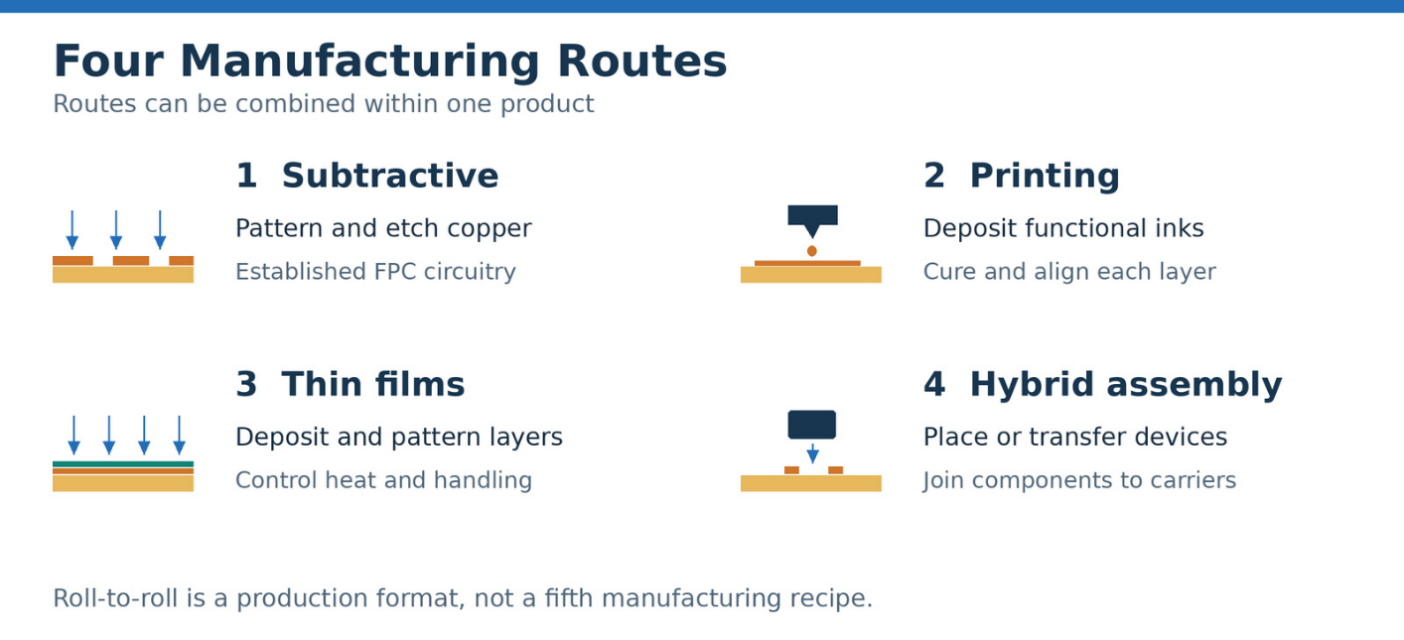
- Subtractive fabrication: Pattern and etch copper-clad film, add insulation, and assemble components. This is a mature route for flexible printed circuits. Flexible heaters use the same etch-and-laminate approach, but with resistive foils such as stainless steel or FeCrAl in place of copper.
- Printing: Inks that are conductive or functional may be deposited using equipment such as screen, inkjet, gravure, or flexographic printing. Resolution, curing, registration between layers, conductivity, and yield help to determine appropriateness.
- Thin-film processing: Deposit and pattern electrodes, semiconductors, or dielectrics. Temperature-sensitive films may need controlled processing and temporary carriers.
- Transfer or hybrid assembly: Move fabricated devices or mount conventional components onto compliant carriers. And then connect and protect them.
The term "roll-to-roll" refers to the process of managing a continuous web inside production. It’s no automatic cost saving. The evaluation conducted by the National Academies indicates challenges when it comes to substrate and device integration.
Where Are Flexible Electronics Used?
The European Commission’s application overview covers packaging, transport, healthcare, and energy. Here’s what makes different flexible electronics applications worthwhile.
| Application | Example | Mechanical Benefit | Main Constraint |
|---|---|---|---|
| Consumer products | Camera and phone flex circuits | Routes through cramped housings | Packaging and fatigue |
| Wearables and healthcare | Body-worn patches | Close surface contact | Moisture, biocompatibility, validation |
| Automotive and aerospace | Contoured sensors, controls | Integrates with shaped structures | Vibration, temperature, qualification |
| Industry and infrastructure | Bonded strain gauges | Follows equipment surfaces | Calibration and durability |
| Packaging and logistics | RFID/NFC labels | Thin attachment to packages | Unit cost and recyclability |
| Energy and lighting | Flexible photovoltaics, batteries, lighting | Lightweight curved integration | Barrier integrity and lifetime |
| Thermal management | Flexible heaters on batteries, displays, and sensors | Heats curved or confined surfaces directly | Temperature control and adhesive limits |
| Robotics and textiles | Soft sensors, conductive yarns | Accommodates motion | Strain range, washing, connectors |
Consumer assemblies differentiate between static flexing (occurs after installation) and dynamic flexing (occurs repeatedly while the assembly is in operation). When it comes to qualification, a fixed internal ribbon and a moving hinge need different things.
Display and lighting stacks depend on thin functional layers, substrate choice, and encapsulation. Remember, flexible doesn’t promise foldable or stretchable. Healthcare examples describe device formats and not diagnostic approval. Textile designs must address skin contact as well as laundry. On the other hand, elastomeric robotic sensors may use serpentine connections. Many flexible battery architectures remain developmental. Commercial maturity differs by technology.
Thermal Management and Localized Heating
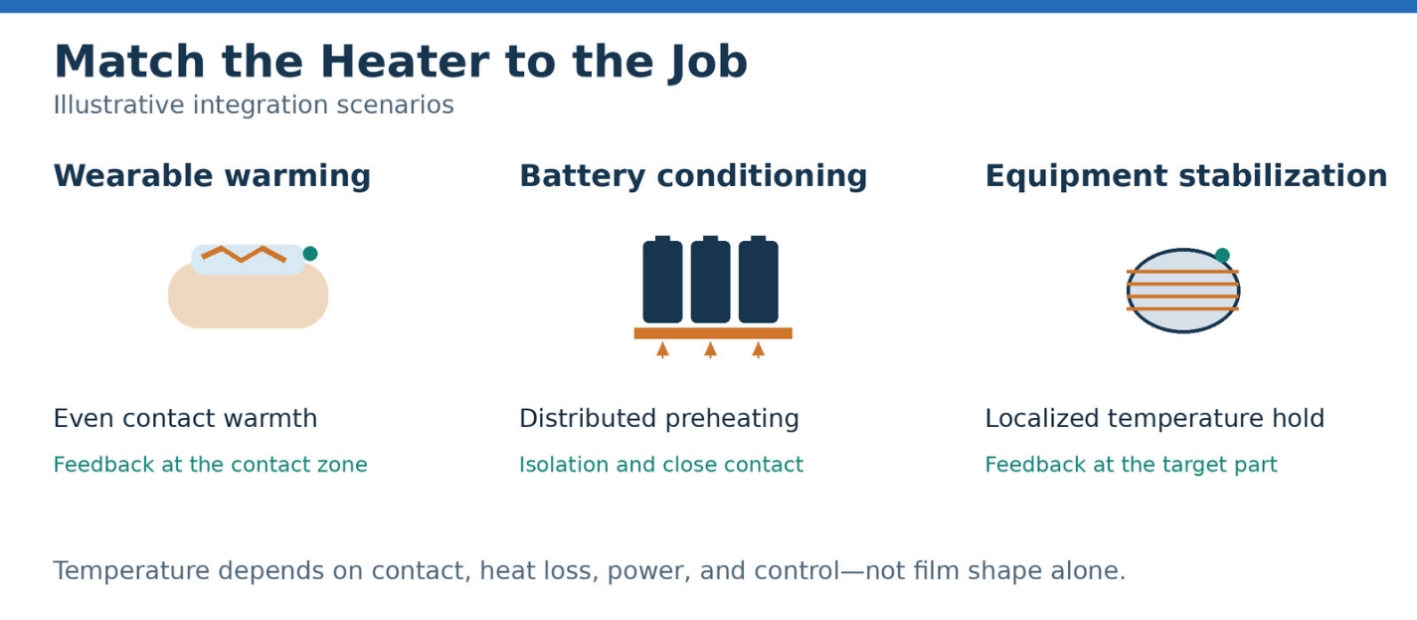
A flexible heater is itself a flexible electronic circuit: a patterned resistive trace sealed between polyimide or silicone rubber layers. It is often added to other flexible systems that must work in the cold, stay free of condensation, or hold a sensor at a stable temperature. Select by the thermal task.
| Thermal Job | Heated Part and Heat Profile | Installation and Technology Choice |
|---|---|---|
| Wearable warming | Contact pad. Even and controlled warmth. | Moving surface. Compliant heater with temperature feedback. |
| Battery conditioning | Cell assembly. Distributed preheating. | Electrical isolation and limited clearance. Insulated foil heater. |
| Compact equipment stabilization | Sensor housing. Localized temperature hold. | Curved mounting area. Thin-film or etched heater. |
These are design scenarios, and these should not be considered as fixed temperature prescriptions. Mounting contact, heat losses, and sensor location govern the result.
An air pocket beneath a heater interrupts thermal contact. Consequently, the element and target can reach different temperatures. Measure the heated part wherever performance is critical. Note that just electrical input doesn’t tell you its surface temperature. Most fixed-resistance flexible heaters supply approximately constant power at a fixed voltage rather than regulating their own temperature. For temperature-controlled operation, use an NTC thermistor with a controller or a thermostat to close the loop; the mounting adhesive often sets the practical temperature limit.
Flexibility Trade-offs and Reliability
| Dimension | Potential Advantage | Trade-off |
|---|---|---|
| Form factor | Thin, curved packaging | Strain throughout the stack |
| Assembly | Fewer cables and connectors | Harder handling, fixturing, repair |
| Scale | Large-area web production | Yield and curing costs |
| User experience | Conformable interfaces | Comfort and washability validation |
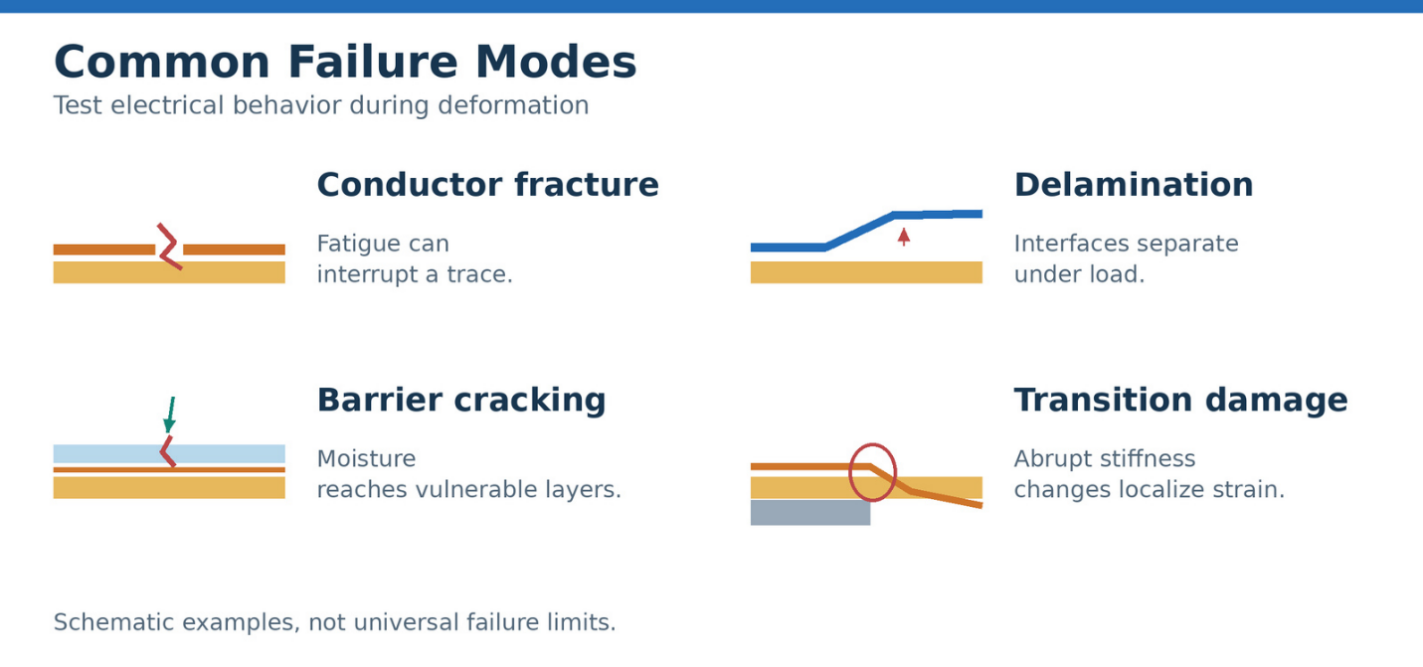
| Reliability | Consolidated interconnections | Fatigue, cracks, delamination |
| Electrical function | Distributed sensing and power | Some inks or devices underperform conventional alternatives |
Sometimes, flexible electronics might not be better than rigid designs. Their mechanical advantage must be able to justify electrical, environmental, lifetime, and cost compromises.
Specify deformation mode, motion frequency, cycle count, stack thickness, and bend radius (the curvature’s radius). Folding, twisting, and stretching impose different loads. Review trace and component placement, sharp corners, neutral-axis location, and stiffener transitions together.
Watch for copper fatigue, cracked films, and separating interfaces. Temperature cycling, humidity, chemicals, abrasion, or washing can accelerate damage. Test continuity or resistance during movement. And then assess flex endurance, adhesion, and relevant environmental exposures. Set acceptance limits for the product. A passing bend demo isn’t lifetime evidence.
Does Your Product Actually Need Flexible Electronics?
What are flexible electronics supposed to solve in your design? You should begin with a mechanical drawing and the required electrical function. Mark where the assembly must move, where it can remain supported, and which surfaces actually need active features. That exercise often helps to narrow down the available options before anyone selects a material.
If the job is routing around a hinge or inside a curved enclosure, an FPC might be enough. It provides established copper interconnections and component mounting and doesn’t require an entirely new device technology. Suppose the surface must measure pressure, temperature, strain, or chemistry. In that case, investigate a flexible or printed sensor platform instead.
For flexible electronics applications that involve substantial extension, stretchable structures or e-textiles should be given consideration. Tight contact with a moving body may demand more than bending. Where a sensor needs conventional processing or wireless communication, FHE can connect those capabilities. When the required function is localized heating, a flexible heater provides the heat-generating circuit itself and can also work alongside sensing elements.
Don’t pay for flexibility that only changes appearance. A rigid board with cables or connectors may offer easier servicing when the housing provides enough room. Compare realistic prototypes under the intended environment and service life, including mounting and replacement access.
Choose among FPCs, printed devices, FHE, thin-film systems, stretchable platforms, flexible heaters, and rigid electronics based on the required function and test evidence. If the requirement is heat on a curved or compact surface, define the heated area, supply voltage, required power, target temperature, and mounting conditions before selecting a polyimide or silicone rubber heater.
Frequently Asked Questions About Flexible Electronics
Are Flexible Electronics the Same as Flex PCBs?
No. A flex PCB is a circuitry and interconnection platform within a broader field. A display’s emitting layers, a printed sensing coating, or a flexible battery performs a different job, even when connected through an FPC. When requesting quotes, you must identify which part you actually need. This includes bare circuitry, a functional device, or a complete hybrid assembly.
Is a Flexible Heater a Type of Flexible Electronics?
Yes. A flexible heater is a flexible circuit designed to produce heat rather than carry signals. It uses a resistive foil trace, such as stainless steel or FeCrAl, laminated between polyimide or silicone rubber insulation. Unlike a flex PCB, it is designed around watt density and temperature uniformity rather than signal routing.
Are All Flexible Electronics Stretchable?
No. Bending tolerance doesn’t set tensile-strain tolerance. Pulling a device lengthwise can rupture conductors that survive curving around a surface. Appropriate elastic materials or geometries that unfold are needed for extension. Ask suppliers for allowable elongation, loading direction, and recovery behavior. A photo of a bent sample answers none of those questions.
How Long Do Flexible Electronics Last?
Essentially, there’s no universal lifetime. Materials, stack-up, packaging, movement, and environment help to control the outcome under particular test conditions. A beneficial supplier report specifies the specimen, fixture, deformation, electrical monitoring, and failure criterion. Compare those conditions with your product’s usage. Apart from that, you should also check if quoted endurance covers the assembled device or only an unpopulated test strip.
Are Flexible Electronics More Expensive Than Rigid Electronics?
Not necessarily. Compare the complete manufactured assembly. Connector removal and fewer assembly steps may offset higher material prices. On the other hand, specialized handling, poor yield, protective packaging, and qualification can increase the bill. Don’t compare just bare substrates. But you should request comparable quotations at the same quantity and performance target. These quotations should include tooling, inspection, rework, and replacement costs.
Conclusion: What to Know About Flexible Electronics
Flexible electronics bring electrical functions into structures that are designed for controlled deformation. Evaluate the functional layers, strain strategy, production route, and qualification as one engineering decision. Printed, organic, hybrid, stretchable, and flex-PCB labels describe overlapping aspects (not interchangeable specifications). The strongest starting point is a measurable requirement for what must move and what must keep working. Flexible heaters belong within this field because their patterned resistive circuits produce heat while conforming to the target surface. For battery preheating, condensation prevention, or sensor temperature stabilization, start with the thermal requirement and match the insulation, watt density, temperature feedback, and mounting adhesive to the application.
Keep Learning
What Is a Thermoelectric Generator and How Does It Work?
Can heat from an engine, industrial process, or other heat source be turned into useful electricity without moving parts? A thermoelectric generator (TEG) does this by converting a temperature difference directly into electrical power through the Seebeck effect. Its power output depends on the temperature difference across the device, the thermoelectric materials, and the overall system design. What Is a Thermoelectric Generator? A thermoelectric generator (TEG) is a solid-state device that converts h......
What Are Flexible Electronics? How They Work & Where They're Used
Flexible electronics are electronic circuits, devices, and systems designed to maintain their intended functions while bending or conforming to a surface. They enable electronic functions to fit curved, moving, lightweight, or space-constrained products. Common examples include flex circuits in cameras and phones, wearable sensors, flexible heaters, flexible displays, RFID and NFC labels, conformal industrial sensors, and medical patches. Flexible electronics is a broad field that encompasses differen......
What Is a Strip Heater? How It Works: A Complete Guide [2026]
Strip heaters are electric resistance heaters commonly used to heat metal surfaces, machinery, and industrial equipment. Their flat, narrow design allows them to be mounted against surfaces or in spaces where other heater shapes may be less suitable. Understanding how strip heaters are constructed and installed helps determine whether they’re the right choice for a particular heating application. What Is a Strip Heater? A strip heater converts electrical energy into heat through a resistance element h......
Cartridge Heater Applications: Where and How They Are Used
Sometimes the difficult part of heating a machine is finding room for the heater. External hardware can obstruct moving parts or leave heat too far from the working zone. Industrial cartridge heater applications address that issue by placing the heat source inside the metal itself. Examples include molds, dies, hot runner manifolds, sealing bars, platens, heating blocks, semiconductor tools, laboratory instruments, and 3D-printer hot ends. But an industry label doesn't specify a heater. Here's how the......
Induction Heat Treatment: Hardening, Tempering & Stress Relief
Induction heat treatment is a heat treatment process that uses an alternating electromagnetic field to generate heat inside an electrically conductive workpiece. It enables manufacturers to selectively heat specific areas of a component for processes such as hardening, tempering, annealing, and stress relieving, rather than heating the entire part in a furnace. This localized heating makes induction particularly useful for applications that require controlled case depth, repeatable results, and integr......
Types of Heating Elements and How They Work [2026]
An electric heating element is any element that transforms electrical energy into heat, typically by electrical resistance. If an electric current flows through a resistance material, the electrical power is dissipated in the form of heat. Two seemingly identical heating elements can deliver very different results depending on how they are designed and used. Some are exposed, while others are enclosed in a sheath or designed for insertion into equipment. Others may be clamped to a surface or bonded to......