What Is a Strip Heater? How It Works: A Complete Guide [2026]
14 min
- What Is a Strip Heater?
- What Is a Strip Heater Made Of?
- How Do Strip Heaters Work?
- What Are the Main Types of Strip Heaters?
- What Are Strip Heaters Used For?
- What Affects Strip-Heater Performance and Selection?
- Strip Heaters vs. Flexible Heaters: What's the Difference?
- FAQs (Frequently Asked Questions) About Strip Heaters
- Conclusion: What to Know About Strip Heaters
Strip heaters are electric resistance heaters commonly used to heat metal surfaces, machinery, and industrial equipment. Their flat, narrow design allows them to be mounted against surfaces or in spaces where other heater shapes may be less suitable. Understanding how strip heaters are constructed and installed helps determine whether they’re the right choice for a particular heating application.
What Is a Strip Heater?
A strip heater converts electrical energy into heat through a resistance element housed inside a flat metal sheath. When installed against a compatible surface or incorporated into suitable equipment, it transfers heat to the target through the intended heating arrangement. Its construction and mounting method affect how efficiently heat is transferred and how the heater performs in service.
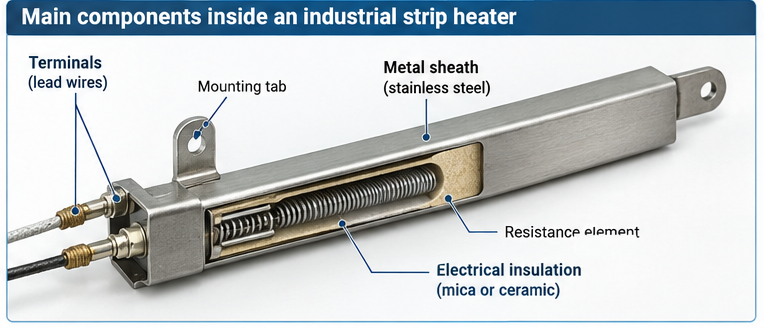
What Is a Strip Heater Made Of?
Strip heaters have a number of essential parts and working mechanisms that contribute to their effectiveness.
Resistance Heating Element
It is the resistance heating element which generates heat. It can be constructed of resistance wire, a coiled element, or resistance ribbon. High resistance alloys which can transform electrical energy to heat within the desired operating range are used quite commonly.
The heating element should not be confused with the complete strip heater — it is only one internal component. The final product of the strip heater is also insulated, sheathed, electrically connected and features mounting elements.
Electrical Insulation and Metal Sheath
The resistance element is enclosed or isolated in an electrical insulator. Its function is to electrically isolate the energized element from the outer sheath, while allowing heat to flow outwards to the sheath. Mica-insulated designs wrap the element in mica sheets, ceramic-insulated designs support it with ceramic insulators, and mineral-insulated designs pack it in compacted magnesium oxide (MgO) powder.
The metal sheath protects the internal assembly and provides a practical path for transferring heat to the equipment or air. Sheath materials are selected according to factors such as operating temperature, oxidation, corrosion, mechanical conditions, and the surrounding environment. Product designs differ, so the manufacturer's technical documentation should be checked for the intended service conditions.
Terminals and Mounting Features
Terminals or lead wires connect the heater to its electrical supply and control circuit. Mounting features can include tabs, slots, holes, clamps, bands, or brackets.
These features are more than mechanical details. Mounting affects contact with the heated surface, heat removal, thermal expansion, and the overall stability of the heater.
A heating element is the internal resistive component that produces heat, while a strip heater is the complete assembly containing the element, insulation, sheath, terminals, and mounting features.
How Do Strip Heaters Work?
The heating process follows a simple path, from electrical input to controlled heat delivered to the target area.
1. Electrical Resistance Generates Heat
This process starts when the proper electrical voltage is applied to the resistance element. The flow of current through the resistive material causes the energy in the current to be transformed into energy in the form of heat. The energy in the current is transformed to energy that is in the form of heat, which is also known as joule heating or resistance heating.
The basic relationships are:
P = VI
P = I²R
P = V²/R
In the equation shown, P is for electrical power in watts, V is for voltage in volts, I is for current in amperes, and R is for resistance in ohms.
These equations also show why resistance cannot be treated as a simple measure of heater power. At a fixed voltage, increasing resistance actually reduces power according to P = V²/R. Heater resistance, supply voltage, and rated wattage therefore have to be considered together.
The heater must be operated at its specified supply voltage. Applying an unsuitable voltage can change the electrical power substantially and can create an unsafe operating condition.
2. Heat Moves Through the Insulation and Sheath
Once the element produces heat, thermal energy moves outward toward the sheath. The insulation ensures electrical isolation and also allows heat to flow through it. The sheath then distributes the heat and transfers it to the target load or the surrounding air.
This part of the energy path is important because the sheath is not simply a cover. It is part of the thermal system. Its material, thickness, contact with the load, and exposure to air all affect how effectively heat leaves the heater.
The maximum sheath temperature should also not be confused with the target or process temperature. A heater may have a sheath operating limit while the actual mold, platen, tank wall, air stream, or process material operates at a different temperature.
3. Heat Reaches the Target and Is Controlled
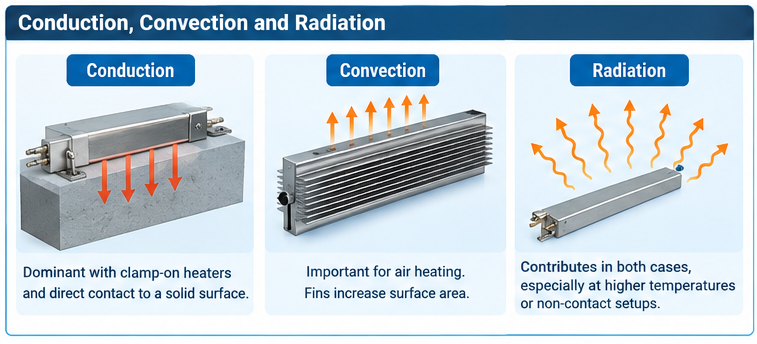
How the heat leaves the sheath depends largely on how the heater is mounted.
When a strip heater is firmly clamped to a mold, die, platen, tank, or other solid surface, conduction is normally the dominant heat-transfer method. Heat passes from the sheath into the contacting material.
Convection is important when the heater is used to heat the air. Finned strip heaters provide additional air-side surface area and are frequently used in natural or forced-convection systems such as enclosures, ovens, drying equipment and ducts.
Another mechanism for energy transfer is through thermal radiation from a hot sheath, especially when it is exposed and not close to the load.
The most important method of heat transfer is related to the mounting of the strip heater and the object it is intended to heat.
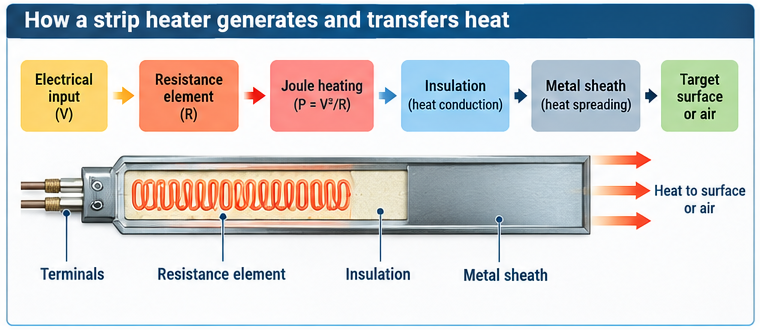
A strip heater is typically only one part of a larger temperature-control system. The operation of a typical control loop is as follows:
- Temperature is measured by means of a thermocouple, RTD, thermistor, or thermostat.
- The controller makes the comparison between measured value and setpoint.
- The power to the heaters is controlled by a relay, contactor, power controller, or solid-state relay (SSR).
- Independent over-temperature protection can provide a separate safety limit.
A thermocouple is a temperature sensor that generates a small electrical signal related to temperature. An RTD, or resistance temperature detector, measures temperature through the predictable change in electrical resistance of its sensing element.
PID (proportional, integral, and derivative) control actions are used to control a process to a desired temperature. Input for industrial controllers are available in thermocouple and RTD form, and output can be either on/off or PID.
Not every strip heater includes a sensor or controller. In many installations, these components are selected and installed separately.
What Are the Main Types of Strip Heaters?
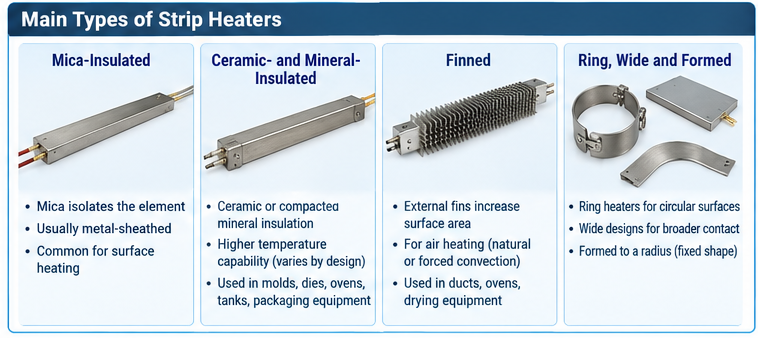
The main types of strip heaters include mica-insulated, ceramic- or mineral-insulated, and finned strip heaters, along with ring, wide, and formed designs.
Mica-Insulated Strip Heaters
Mica-insulated strip heaters have mica as the electrical insulation material of the resistance element and are generally enclosed in a metal sheath. They are widely used for conventional surface and contact heating, including molds, dies, platens, and similar equipment.
There is no universal maximum temperature for all mica strip heaters. Allowable operation depends on the complete heater construction, sheath material, watt density, mounting, and manufacturer's rating.
Ceramic- and Mineral-Insulated Strip Heaters
Ceramic or refractory insulation and compacted mineral insulation are used in designs where the construction and heat-transfer requirements differ from conventional mica heaters. These designs may provide higher temperature capability or different heat-transfer characteristics, depending on the specific construction.
Applications include molds, dies, platens, ovens, tanks, and packaging equipment. Any temperature or watt-density figure must be taken from the specific manufacturer's documentation rather than treated as a universal rating. For example, manufacturers publish different ratings for different sheath and insulation constructions.
Finned Strip Heaters
Finned strip heaters add external fins to increase surface area. Their principal applications are for natural or forced-convection process-air heating in electrical enclosures, in drying equipment and in ovens and ducts.
Selection depends on airflow, air temperature, fin configuration, watt density, and sheath temperature. Manufacturer selection guidance for finned heaters commonly considers air velocity and operating conditions when establishing allowable watt density.
Ring, Wide, and Formed Designs
Ring heaters are suited to circular surfaces, while wider strip designs can cover broader contact areas. Some strip heaters are factory-formed to a specified radius or shape.
These formed products should not be confused with dynamically flexible heaters. They are manufactured for a defined geometry and normally retain that fixed form during operation.
What Are Strip Heaters Used For?
Strip heaters are commonly used for surface heating and process-air heating in applications such as molds, dies, platens, packaging machinery, ovens, ducts, tanks, and control cabinets. Their long, narrow form allows heat to be concentrated along a defined area of equipment or process.
| Application | Heating Function | Main Heat Transfer |
|---|---|---|
| Molds and dies | Maintains processing temperature | Conduction |
| Platens and sealing bars | Provides localized process heat | Conduction |
| Packaging machinery | Supports sealing and forming | Conduction |
| Industrial ovens | Heats air or internal surfaces | Convection/radiation |
| Ducts and drying equipment | Heats process air | Convection |
| Tanks and large pipes | Maintains wall or material temperature | Conduction |
| Control cabinets | Reduces condensation or prevents freezing | Natural convection |
| Laboratory equipment | Maintains component temperature | Mainly conduction |
For direct surface heating, the heater normally needs good physical contact with the heated surface. Flatness, clamping, and the mechanical arrangement all affect the thermal path. For tanks and pipes, the heater must be properly formed and secured using an appropriate mounting arrangement such as bands or clamps.
A conventional strip heater should not be assumed to be suitable for direct immersion in liquid. Liquid heating requires a heater specifically designed and rated for that service.
What Affects Strip-Heater Performance and Selection?
A number of factors influence the performance of a strip heater and determine the type of strip heater that will prove most effective for a given application.
Wattage and Watt Density
Heater wattage is the total electrical power supplied to the heater. Watt density is the power applied over an effective heated area.
The basic relationship is:
Watt Density = Rated Wattage ÷ Effective Heated Area
The total wattage for two heaters may be identical, but the watt density may be different because of differences in effective heated area. Watt density influences sheath temperature and must be considered together with the load's thermal conductivity, airflow, heat loss, and operating conditions.
Higher wattage does not necessarily mean better heating performance. A heater with excessive watt density for its application may operate at an unnecessarily high sheath temperature or experience greater thermal stress. Manufacturer documentation should always be used to determine suitable ratings.
Mounting and Heat Transfer
Mounting has a direct effect on useful heat transfer. A surface heater generally performs better when the mating surfaces are reasonably flat and the heater has suitable, even contact.
Air gaps act as thermal resistance: they reduce heat transfer into the load and raise the local sheath temperature.
Other factors include clamping method, the distance between fasteners, pressure at the contact surfaces, air flow and thermal expansion. Installation instructions are often emphasized by manufacturers for smooth contact surfaces and proper clamping for strip heaters installed on surfaces.
Temperature, Materials, and Heat Loss
The required target temperature should be separated from the heater's sheath temperature. Sheath may run at different temperature as heat is constantly transferred to load and lost to ambient environment.
Sheath and insulation materials can be matched to the anticipated mechanical, contamination, oxidation, and corrosion environment and temperature. Air movement and exposed surfaces can increase heat loss, and a large thermal mass can reduce the rate of temperature change of the heated mass.
In many systems, reducing unwanted heat loss with suitable external insulation can be more effective than simply adding heater wattage.
Temperature Control
Sensor type and position are important because the controller can only respond to the temperature it measures. A sensor located too far from the actual process zone may respond differently from a sensor placed close to the heated surface.
A thermostat can provide simple on/off temperature control. A PID controller can provide tighter process regulation when the application requires it. Relays, contactors, SSRs, and power controllers can be used to switch or regulate heater power, depending on the system design.
Independent over-temperature protection is also valuable where excessive temperature could damage equipment or the process. However, a controller cannot correct an undersized heater, excessive heat loss, poor mounting contact, or an unsuitable watt density.
Strip Heaters vs. Flexible Heaters: What's the Difference?
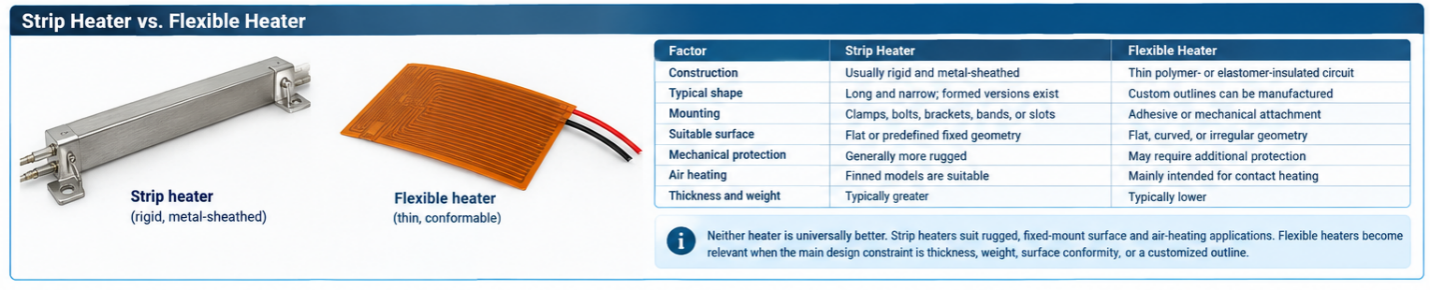
Both strip heaters and flexible heaters use electrical resistance to produce heat. The main difference is how the resistance element is packaged and how the heater is mounted.
| Factor | Strip Heater | Flexible Heater |
|---|---|---|
| Construction | Usually rigid and metal-sheathed | Thin polymer- or elastomer-insulated circuit |
| Typical shape | Long and narrow; formed versions exist | Custom outlines can be manufactured |
| Mounting | Clamps, bolts, brackets, bands, or slots | Adhesive or mechanical attachment |
| Suitable surface | Flat or predefined fixed geometry | Flat, curved, or irregular geometry |
| Mechanical protection | Generally more rugged | May require additional protection |
| Air heating | Finned models are suitable | Mainly intended for contact heating |
| Thickness and weight | Typically greater | Typically lower |
Neither heater is universally better. Strip heaters suit rugged, fixed-mount surface and air-heating applications. Flexible heaters become relevant when the main design constraint is thickness, weight, surface conformity, or a customized outline.
If a rigid heater cannot meet an application's shape, thickness, weight, or installation requirements, consider a flexible heater from JLCPCB, which can be custom-outlined to fit curved or irregular surfaces.
FAQs (Frequently Asked Questions) About Strip Heaters
How Hot Can a Strip Heater Get?
There is no universal maximum temperature for every strip heater. The practical limit depends on the insulation system, sheath material, watt density, mounting arrangement, and how effectively heat is removed from the heater. The sheath temperature can also differ substantially from the target temperature. Always check the specific model's datasheet for its rated operating conditions.
Can a Strip Heater Heat a Surface Directly?
Yes, a strip heater can heat a surface directly when it is designed and mounted for contact heating. Firm and reasonably even contact provides a better conduction path from the sheath into the load. Air gaps caused by poor contact or surface imperfections can reduce heat transfer and create local hot spots.
Can Strip Heaters Be Used to Heat Air?
Yes. Finned strip heaters are commonly used for process-air heating because their fins increase the surface area available for convection. Natural convection can be used in some applications, while forced airflow can provide greater heat transfer. Airflow, air temperature, watt density, and the heater's rated conditions must be considered together.
Does a Strip Heater Need a Thermostat?
A strip heater may need a thermostat or another temperature-control system when the application requires a controlled setpoint or temperature limit. Thermostats provide simple switching, while sensor-and-controller systems can provide more precise regulation. These controls are often external to the heater, although some heater assemblies can be supplied with integrated control components.
What Causes a Strip Heater to Fail?
Common causes include excessive watt density, poor mounting contact, insufficient airflow for air-heating applications, incorrect voltage, moisture or contamination, thermal cycling, and operation above the rated sheath temperature. Poor mechanical contact can be particularly important because it can restrict heat flow from the sheath into the load and create local overheating.
Conclusion: What to Know About Strip Heaters
A strip heater is a long narrow electrical resistance heater used to thermally transfer heat to a solid surface, air or a desired process load. The simple energy pathway is: electrical energy to the resistance element, joule heating to thermal energy, and the thermal energy is conducted through the electrical insulation and metal sheath to the target.
Depending on the mounting arrangement, a portion of the heat transfer will take place by conduction, convection and thermal radiation. When using surface heating, it is important to have good contact and proper clamping. The importance of finned construction and airflow increases for process-air heating applications.
Wattage alone is not indicative of heating performance. Matching to the application is required for the following: Watt density, mounting contact, material selection, heat loss, thermal mass, sheath temperature, and temperature control. Knowing what a strip heater is truly implies not just knowing about the structure of the heater, but also the total thermal path, from the electrical supply to the process.
Keep Learning
Flexible Conductive Coatings: Sheet Resistance, Conductivity, and Durability
Sheet resistance and conductivity describe different aspects of electrical performance. Sheet resistance (Ω/sq) depends on both conductivity and film thickness, while conductivity (S/m) describes charge transport through a material volume. For a uniform thin film, Rₛ = 1/(σ × t), so thickness is essential when converting between them. Neither value alone establishes whether a flexible coating will survive bending, washing, or ageing. This guide explains sheet resistance vs conductivity for flexible co......
How Graphene and MXene Inks Enable Stretchable Circuits
Stretchable circuits must maintain electrical performance while bending, stretching, or twisting. Graphene and MXene inks offer a promising approach by combining electrical conductivity, mechanical flexibility, and printability. But how do these materials actually enable circuits to stretch without losing their electrical function? Graphene and MXene inks enable stretchable circuits by forming interconnected conductive networks that can rearrange as the substrate deforms. Their overlapping 2D platelet......
Graphene vs MXene Inks for Flexible Electronics: Which Is Better?
GNP, GO, rGO, and Ti3C2Tx MXene all share a platelet shape, but they differ dramatically in conductivity, water compatibility, production scale, and shelf life. If you're designing flexible electronics, choosing the right 2D material ink means understanding which trade-offs your device can tolerate. In this guide, we compare the four most common 2D material inks side by side—graphene nanoplatelets (GNP), graphene oxide (GO), reduced graphene oxide (rGO), and Ti3C2Tx MXene—and explain when each one mak......
What Is a Thermoelectric Generator and How Does It Work?
Can heat from an engine, industrial process, or other heat source be turned into useful electricity without moving parts? A thermoelectric generator (TEG) does this by converting a temperature difference directly into electrical power through the Seebeck effect. Its power output depends on the temperature difference across the device, the thermoelectric materials, and the overall system design. What Is a Thermoelectric Generator? A thermoelectric generator (TEG) is a solid-state device that converts h......
What Are Flexible Electronics? How They Work & Where They're Used
Flexible electronics are electronic circuits, devices, and systems designed to maintain their intended functions while bending or conforming to a surface. They enable electronic functions to fit curved, moving, lightweight, or space-constrained products. Common examples include flex circuits in cameras and phones, wearable sensors, flexible heaters, flexible displays, RFID and NFC labels, conformal industrial sensors, and medical patches. Flexible electronics is a broad field that encompasses differen......
What Is a Strip Heater? How It Works: A Complete Guide [2026]
Strip heaters are electric resistance heaters commonly used to heat metal surfaces, machinery, and industrial equipment. Their flat, narrow design allows them to be mounted against surfaces or in spaces where other heater shapes may be less suitable. Understanding how strip heaters are constructed and installed helps determine whether they’re the right choice for a particular heating application. What Is a Strip Heater? A strip heater converts electrical energy into heat through a resistance element h......