ESP8266 vs ESP32: Which One Should You Use?
11 min
- ESP8266 vs ESP32: What's the Difference?
- Can the ESP32 Replace the ESP8266?
- When Should You Still Use the ESP8266?
- What Is the ESP8266 and Where Is It Used?
- What Is the ESP32 and What Does It Add?
- Which ESP32 Should You Use to Replace the ESP8266?
- How to Choose an ESP8266 or ESP32 Module for Your PCB
- Using ESP8266 or ESP32 Modules in JLCPCB PCB Assembly
- Conclusion
- FAQs About ESP8266 vs ESP32
Key Takeaways
- ESP32: Dual-core 240 MHz CPU, Bluetooth Classic and BLE, 520 KB SRAM, and up to 34 GPIOs.
- ESP8266: Single-core CPU, no Bluetooth, and around 50 KB of free RAM for applications.
- Lifecycle status: Espressif marks the ESP8266 Not Recommended for New Designs (NRND) and names the ESP32-C2 (ESP8684) as its upgrade, although the ESP8266 remains in production with a longevity commitment.
- Which ESP32 to use: Choose the ESP32-C2 for simple Wi-Fi or Bluetooth LE firmware, the ESP32-C3 for more memory or GPIO, and the original ESP32 for Bluetooth Classic, many analog inputs, CAN bus, or wired Ethernet.
- Not a drop-in swap: Moving from the ESP8266 changes the pinout, bootstrapping pins, module footprint, and firmware.
“I have an ESP8266 design. Should I keep it, migrate it, and if I migrate it, which ESP32-series device should I choose?”
For most new designs, the ESP32 is the more capable option, while the ESP8266 remains a practical choice for existing products. Both are Espressif system-on-chip (SoC) devices with 2.4 GHz Wi-Fi, but the original ESP32 adds Bluetooth, a dual-core CPU, more memory, and a wider range of peripherals.
Espressif now marks the ESP8266 as Not Recommended for New Designs (NRND) and recommends the ESP32-C2 (ESP8684) as its upgrade. The ESP8266 remains in production, so existing boards can keep using it.
In this guide, you will learn:
- The difference between the ESP8266 and ESP32
- Can ESP32 replace the ESP8266
- When the ESP8266 is still the right part to use
- What each chip offers, and which ESP32 replaces the ESP8266
- How to choose an ESP8266 or ESP32 module for your PCB
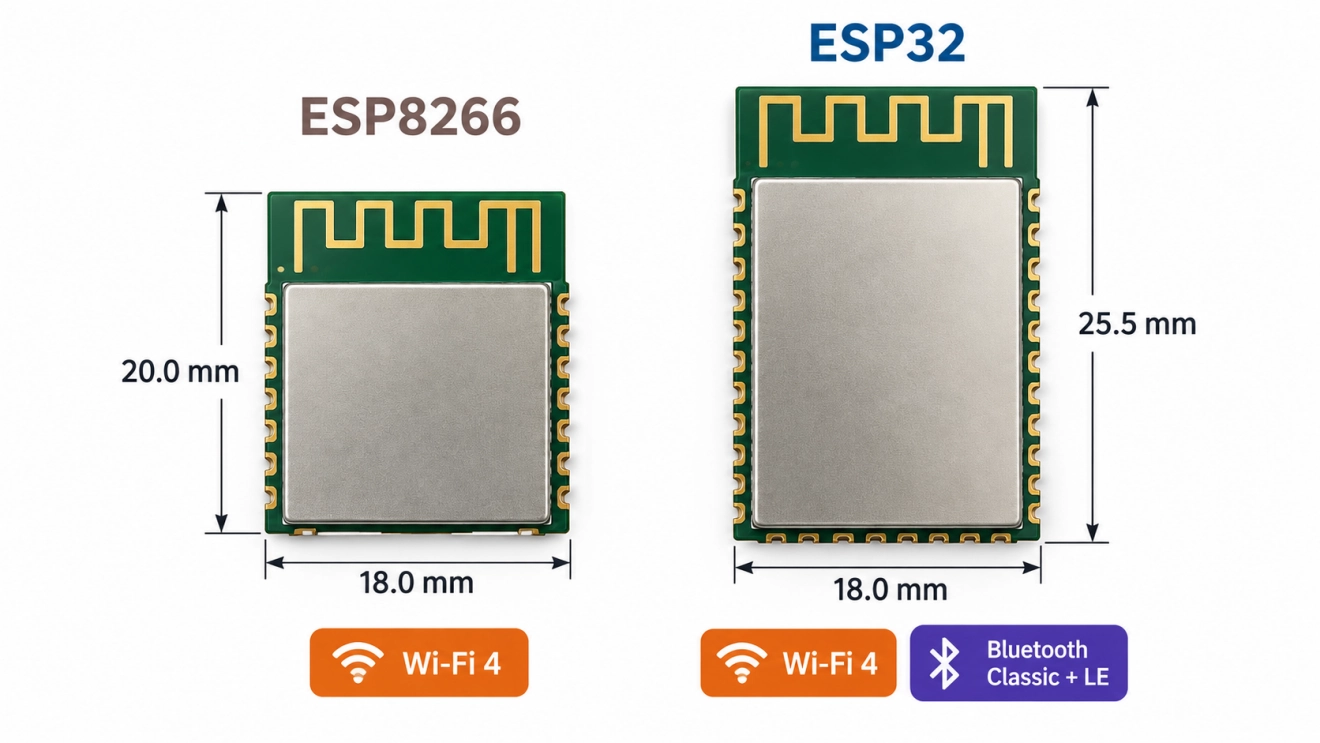
Figure: ESP8266 vs ESP32 modules.
ESP8266 vs ESP32: What's the Difference?
The ESP8266 is a Wi-Fi SoC with a single-core 32-bit processor and no Bluetooth.
The ESP32, by contrast, is a family of SoCs. The original ESP32 adds a dual-core processor, Bluetooth Classic and Bluetooth Low Energy (LE), and far more memory and peripherals.
In short, the ESP8266 provides basic Wi-Fi connectivity, while the ESP32 adds Bluetooth, more processing power, and more peripherals.
| Property | ESP8266 (ESP8266EX) | ESP32 (ESP32-D0WD-V3) | Why It Matters |
|---|---|---|---|
| CPU | Single-core Tensilica L106, up to 160 MHz | Dual-core Xtensa LX6, up to 240 MHz | Two cores provide more processing capacity for concurrent application and system tasks. |
| RAM | Around 50 KB free for the application heap and data when connected to a router | 520 KB, plus 16 KB that stays powered in deep sleep | The ESP8266 figure is free application RAM, not total SRAM. |
| Wi-Fi | 802.11 b/g/n, 2.4 GHz, up to 72.2 Mbps | 802.11 b/g/n, 2.4 GHz, up to 150 Mbps | Neither chip supports 5 GHz Wi-Fi |
| Bluetooth | None | Bluetooth 4.2 Classic and Bluetooth LE | Needed for phone setup over Bluetooth and LE sensors |
| General-purpose I/O (GPIO) | 17 pins | 34 pins, 6 of them input-only | More pins for displays, sensors, and buses |
| Analog-to-digital converter (ADC) | One 10-bit input, 0 to 1.0 V | 12-bit, up to 18 channels | The ESP8266 can read only one analog signal directly |
| Other peripherals | UART, SPI, I2S, pulse-width modulation (PWM) | Adds DACs, touch sensing, MAC, and a CAN 2.0 controller | Covers analog output, touch buttons, wired Ethernet, and CAN bus |
| Hardware security | WPA/WPA2 Wi-Fi security; no secure boot or flash encryption listed | Secure boot and flash encryption | Protects firmware in commercial products |
| Deep-sleep current (chip) | 20 µA | 10 µA | Board-level current is usually higher |
| Lifecycle status | NRND | In production | New designs should start on a part not marked NRND |
Can the ESP32 Replace the ESP8266?
For new designs, Espressif recommends moving from the ESP8266 to an ESP32-series device, but it is not a drop-in replacement.
The latest ESP8266EX datasheet marks the chip as Not Recommended for New Designs (NRND) and recommends the ESP8684, a member of the ESP32-C2 series, as the upgraded model.
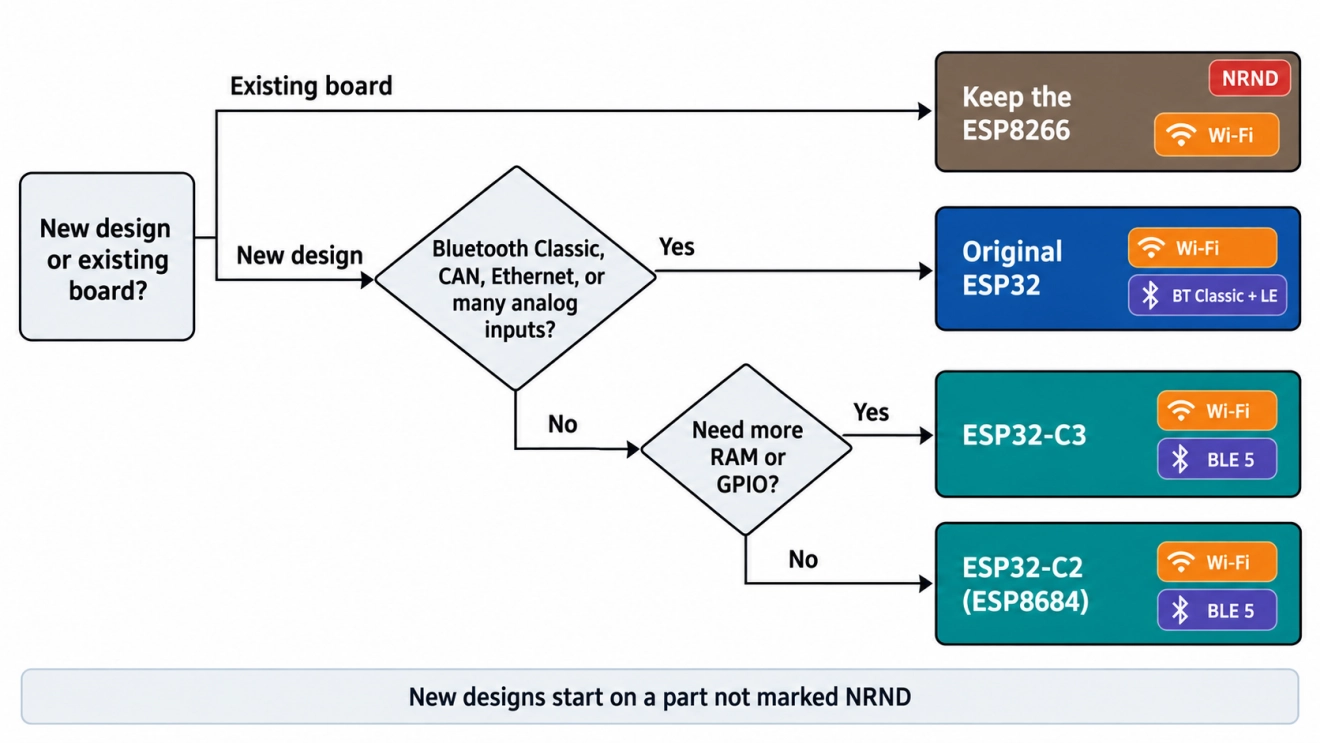
Figure: Decision flow for choosing between the ESP8266 and ESP32 variants.
| Situation | Use |
|---|---|
| New Wi-Fi product with simple firmware | ESP32-C2 (ESP8684) |
| New product that needs Wi-Fi, Bluetooth LE, and more memory or GPIO | ESP32-C3 |
| Bluetooth Classic, such as audio streaming | Original ESP32 |
| Many analog inputs, CAN bus, or wired Ethernet | Original ESP32 |
| Reordering or repairing an existing ESP8266 board | ESP8266 |
The replacement changes both the board and the firmware. The pinout, bootstrapping pins, and module footprint differ. ESP8266 code must also be ported to an ESP32 framework, such as ESP-IDF or the Arduino core for ESP32.
When Should You Still Use the ESP8266?
Use the ESP8266 when a product is already built around it, and a redesign would cost more than keeping it. Moving an existing board to an ESP32 means a new schematic, a new layout, ported firmware, and possibly new radio certification testing for the end product.
Common cases include:
- Maintaining a released product: Reorders, repairs, and small revisions of a board already certified with an ESP8266 module.
- Proven firmware: A mature ESP8266 codebase, where porting and requalifying it would outweigh the hardware gains.
- Products near the end of production: Designs that will stop shipping before the ESP8266 longevity commitment ends.
- Prototypes on existing boards: ESP8266 development boards, such as NodeMCU boards, that are already on hand and cover basic Wi-Fi experiments.
An ESP32-series part is the better choice because the ESP8266 is NRND, lacks Bluetooth, and leaves only around 50 KB of RAM for the application.
What Is the ESP8266 and Where Is It Used?
The ESP8266 is Espressif's Wi-Fi SoC built around a Tensilica L106 32-bit processor. It integrates the antenna switch, power amplifier, low-noise amplifier, and filters, but it lacks a programmable ROM, so the firmware resides in external SPI flash. Typical applications include home automation, smart plugs and lights, and simple Wi-Fi sensor nodes.
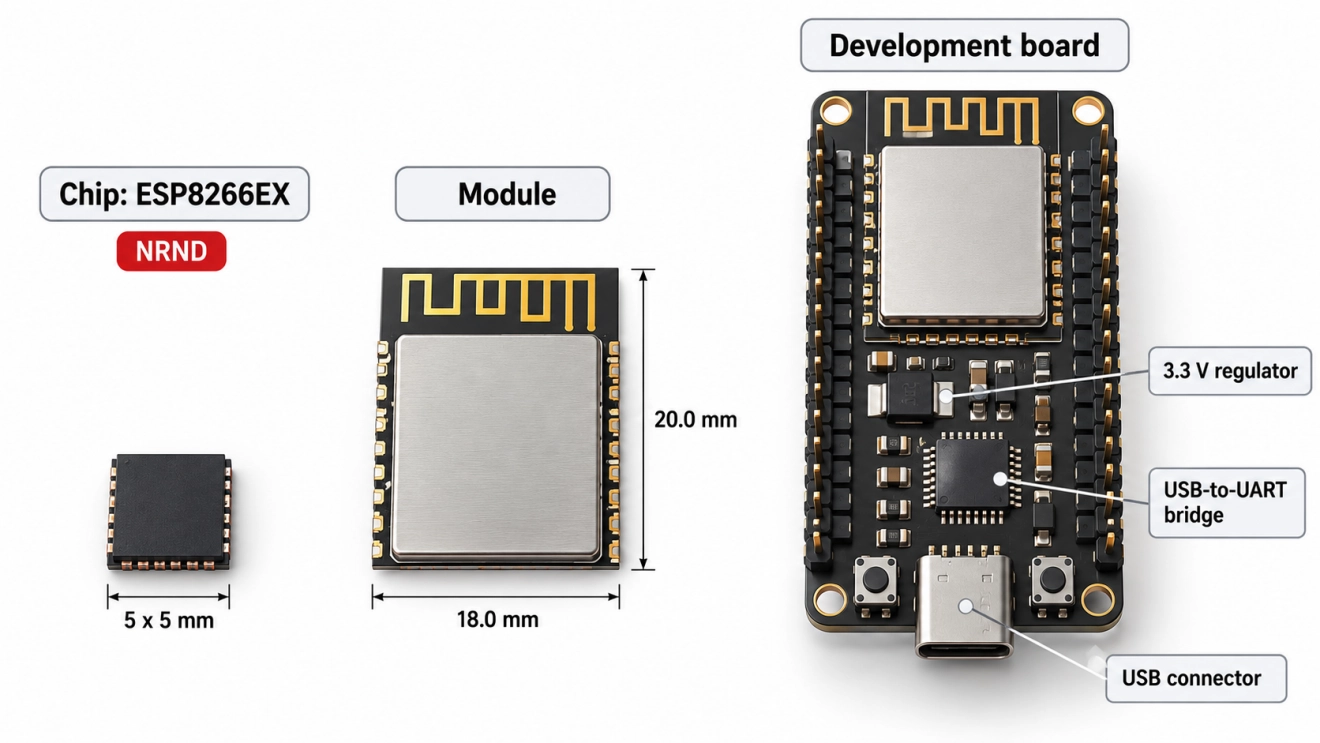
Figure: ESP8266 chip, module, and development board shown at matched scale.
You will find it at three levels:
- Chip: The ESP8266EX in a 5 × 5 mm QFN32 (quad flat no-lead) package. It needs at least 512 KB of external flash, or 1 MB for over-the-air (OTA) firmware updates.
- Module: Espressif's ESP-WROOM-02, now also NRND, or third-party modules such as the ESP-12F. A module adds the flash, the crystal, and a PCB antenna or an external antenna connector.
- Development board: Boards such as NodeMCU add a USB connector, a USB-to-UART bridge, and a 3.3 V regulator for prototyping.
What Is the ESP32 and What Does It Add?
The ESP32 is Espressif's family of Wi-Fi and Bluetooth SoCs. The original ESP32, adds five capabilities to what the ESP8266 offers:
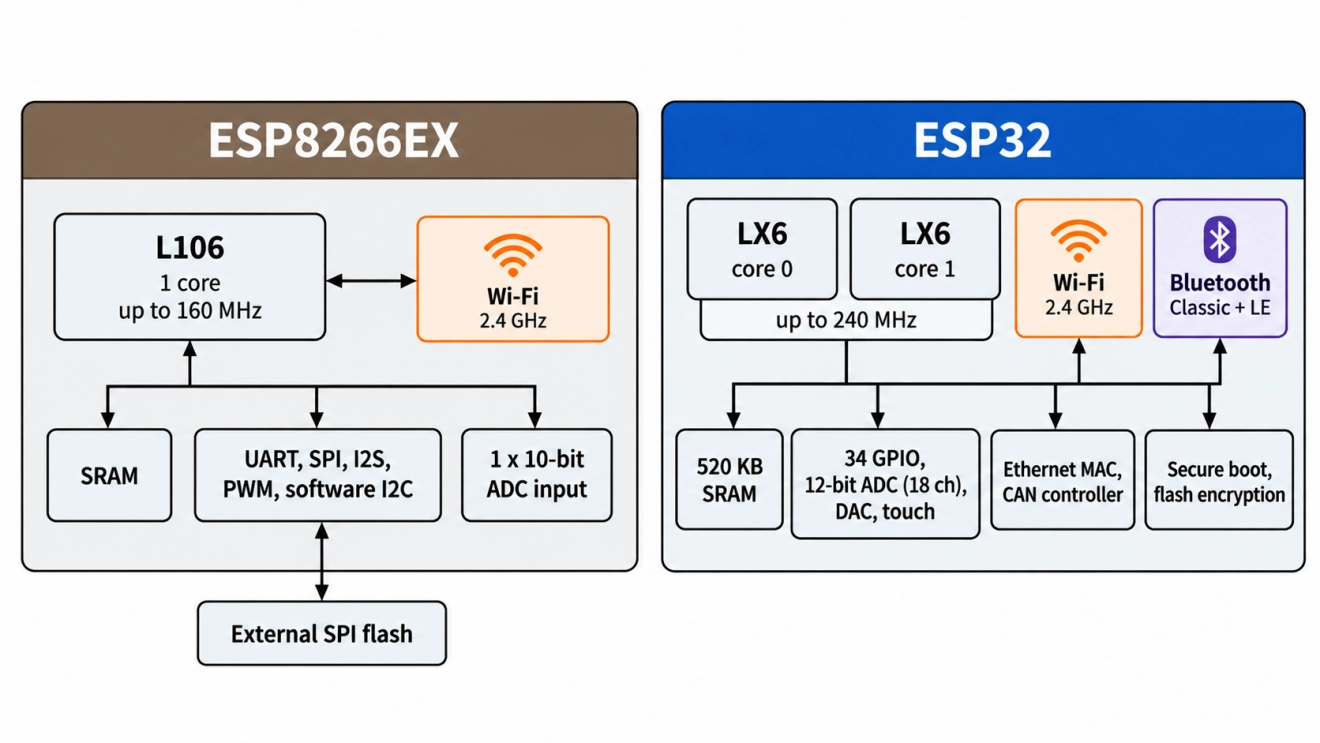
Figure: ESP8266EX and ESP32 compared.
- Dual-core processing: Two Xtensa LX6 cores at up to 240 MHz.
- Bluetooth: Bluetooth 4.2 Classic and Bluetooth LE alongside Wi-Fi.
- Memory: 520 KB of SRAM, which leaves more room for encrypted connections, web servers, and larger buffers.
- Analog and I/O: 34 GPIOs, 12-bit ADCs on up to 18 channels, two 8-bit digital-to-analog converters, and 10 capacitive touch sensors.
- Interfaces and security: An Ethernet MAC that works with an external physical-layer (PHY) chip, a CAN 2.0-compatible controller, secure boot, and flash encryption.
Later family members, such as the ESP32-C3 and ESP32-S3, use newer CPU cores and Bluetooth 5 (LE). The ESP32-C3 vs ESP32-S3 comparison explains how those two chips differ.
Which ESP32 Should You Use to Replace the ESP8266?
The ESP32-C2 (ESP8684) is Espressif's recommended upgrade, and the ESP32-C3 is the step up when a design needs more memory or GPIO. Both use a single-core RISC-V CPU with Wi-Fi 4 (802.11 b/g/n) and Bluetooth 5 (LE).
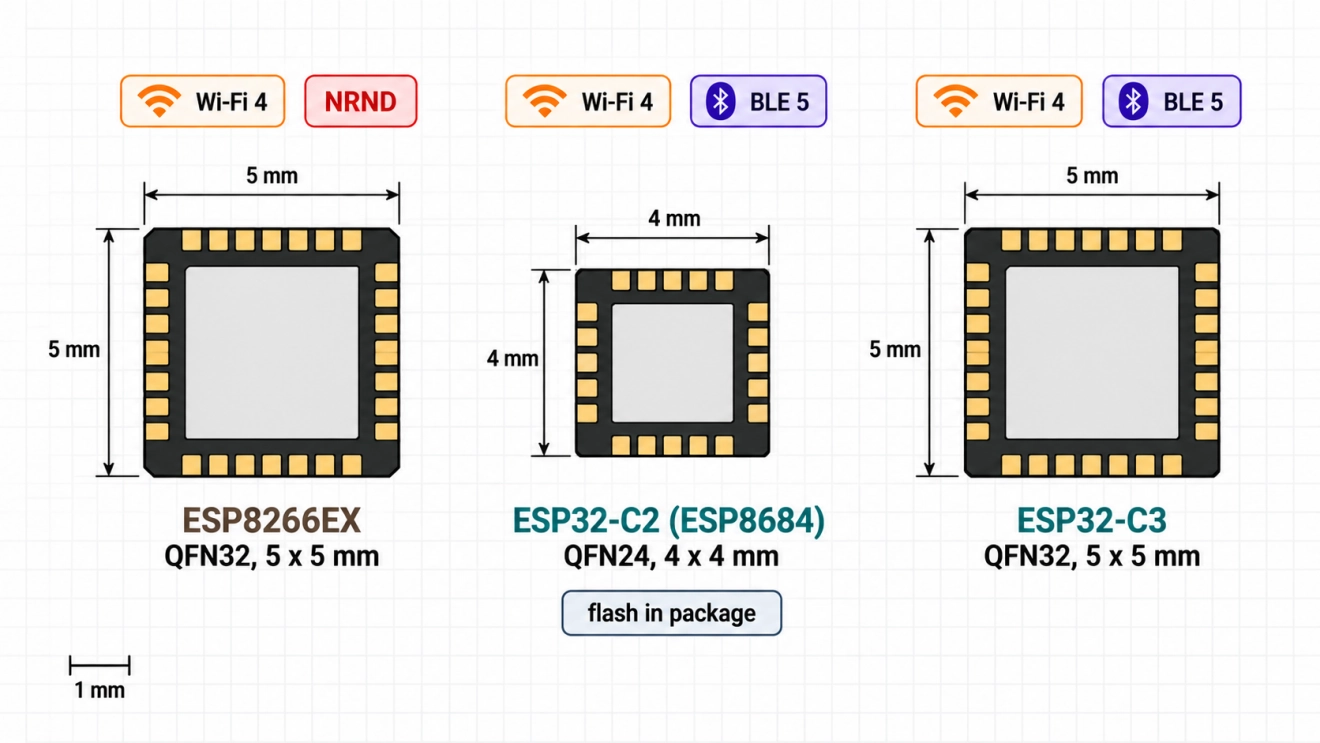
Figure: ESP8266EX, ESP32-C2, and ESP32-C3 packages compared.
| Property | ESP8266EX | ESP32-C2 (ESP8684) | ESP32-C3 |
|---|---|---|---|
| CPU | Tensilica L106, up to 160 MHz | RISC-V, up to 120 MHz | RISC-V, up to 160 MHz |
| RAM | Around 50 KB free for the application | 272 KB, 16 KB of it used as cache | 400 KB, 16 KB of it used as cache |
| Wireless | Wi-Fi 4 | Wi-Fi 4 and Bluetooth 5 (LE) | Wi-Fi 4 and Bluetooth 5 (LE) |
| GPIO | 17 | 14 | 22 (16 on some in-package-flash variants) |
| ADC | One 10-bit input | 12-bit, up to 5 channels | 12-bit, up to 6 channels |
| Flash | External only | 2 MB or 4 MB in the package, by variant | Optional, up to 8 MB in the package |
| Package | QFN32, 5 × 5 mm | QFN24, 4 × 4 mm | QFN32, 5 × 5 mm |
| Deep-sleep current (chip) | 20 µA | 5 µA | 5 µA |
| Longevity commitment | At least to 2029 | At least to 2034 | At least to 2033 |
Note
- Choose ESP32-C2 for: Wi-Fi or Bluetooth LE devices with simple firmware, where the 4 × 4 mm package and in-package flash save board space.
- Choose ESP32-C3 for: designs that need more RAM, more GPIOs, or a USB Serial/JTAG interface for programming and debugging.
- Choose the original ESP32 for: Bluetooth Classic, many analog inputs, touch sensing, CAN bus, or wired Ethernet.
Trade-off: The ESP32-C2 has three fewer GPIOs than the ESP8266 and a lower maximum clock. Confirm the pin count and processing load of the existing design before choosing it as the replacement.
How to Choose an ESP8266 or ESP32 Module for Your PCB
Most boards use a module rather than a bare chip, so the module sets the footprint, supply requirement, and antenna placement. Modules typically carry radio certifications that a chip-down design would need to obtain on its own.
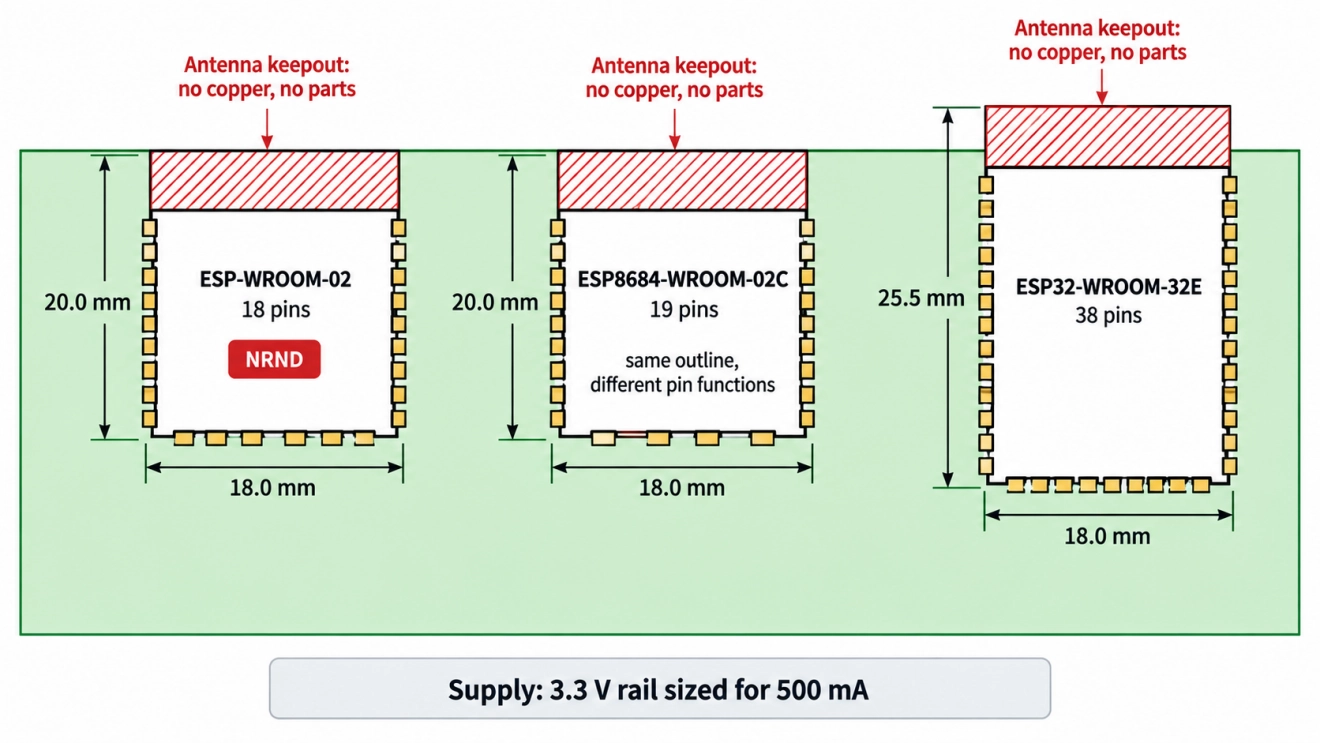
Figure: ESP32 footprints with antenna keepout zones marked.
| Module | Chip | Size | Supply | Status |
|---|---|---|---|---|
| ESP-WROOM-02 | ESP8266EX | 18.0 × 20.0 mm | 2.7 to 3.6 V, 500 mA minimum supply capability | NRND |
| ESP8684-WROOM-02C | ESP32-C2 (ESP8684) | 18.0 × 20.0 mm | 3.0 to 3.6 V, 500 mA minimum supply capability | Espressif's upgrade for the ESP-WROOM-02 |
| ESP32-WROOM-32E | ESP32 | 18.0 × 25.5 mm | 3.0 to 3.6 V, 500 mA minimum supply capability | In production |
Note
Design the 3.3 V supply with sufficient current margin for Wi-Fi transmit peaks. Follow the module datasheet’s recommended supply capability (ESP32-series modules typically specify at least 500 mA) rather than sizing the regulator from average current alone.
Using ESP8266 or ESP32 Modules in JLCPCB PCB Assembly
At JLCPCB, advanced surface-mount technology (SMT) production lines and strict process control help ensure accurate placement and reliable solder joints on Wi-Fi modules and fine-pitch QFN chips.
You can use the JLCPCB Parts Library to check which ESP8266 and ESP32 chips and modules are in stock before finalizing your bill of materials (BOM).
With JLCPCB SMT assembly, your Wi-Fi module, regulator, and passive components can be placed and soldered onto the PCB in the same assembly process.
Conclusion
For new designs, an ESP32-series device is generally the better starting point, while the ESP8266 remains practical for existing products.
The ESP32-C2 (ESP8684) is the closest upgrade path from the ESP8266, adding Bluetooth LE alongside Wi-Fi. Choose the ESP32-C3 when you need more memory, GPIOs, or USB Serial/JTAG, and the original ESP32 when Bluetooth Classic or its additional peripherals are required.
Once your design is ready, upload your files to JLCPCB to review assembly options and get an instant quote.
FAQs About ESP8266 vs ESP32
Is the ESP8266 Obsolete?
No. The ESP8266 is still in production, but Espressif marks it NRND and recommends the ESP32-C2 (ESP8684) for new designs. Its longevity commitment runs to at least 2029.
Is the ESP32 Better Than the ESP8266?
Yes, for most new designs. The original ESP32 adds Bluetooth, a dual-core CPU, 520 KB of SRAM, and more GPIO and ADC channels, while the ESP8266 is now marked NRND.
Can ESP8266 Code Run on the ESP32?
Not without changes. Arduino sketches typically need the fewest changes, but Wi-Fi library names, pins, and ADC resolution differ, so test the ported firmware on the new hardware.
Does the ESP8266 Have Bluetooth?
No. The ESP8266 supports Wi-Fi only. For Bluetooth LE, use the ESP32-C2 or ESP32-C3; for Bluetooth Classic, use the original ESP32.
Which Uses Less Power, the ESP8266 or the ESP32?
It depends on the mode. In deep sleep, the chip datasheets list 20 µA for the ESP8266, 10 µA for the ESP32, and 5 µA for the ESP32-C2. Active current varies with transmit power.
Popular Articles
• SMD Resistor Package Sizes: Complete Size Chart, Footprints & How to Choose
• How to Solder SMD Components Like a Pro [2026 Updated]
• SMD Resistor Codes: How to Read 3-Digit, 4-Digit, and EIA-96 Markings
• SMD Capacitor Codes: Identification, Markings, and Polarity
• SMD Capacitor Sizes: Complete Size Chart and Selection Tips for PCB Design and Assembly
Keep Learning
ESP8266 vs ESP32: Which One Should You Use?
Key Takeaways ESP32: Dual-core 240 MHz CPU, Bluetooth Classic and BLE, 520 KB SRAM, and up to 34 GPIOs. ESP8266: Single-core CPU, no Bluetooth, and around 50 KB of free RAM for applications. Lifecycle status: Espressif marks the ESP8266 Not Recommended for New Designs (NRND) and names the ESP32-C2 (ESP8684) as its upgrade, although the ESP8266 remains in production with a longevity commitment. Which ESP32 to use: Choose the ESP32-C2 for simple Wi-Fi or Bluetooth LE firmware, the ESP32-C3 for more memo......
What Is a Thermistor? A Practical Guide to NTC, PTC, Applications, and Circuit Design
Key Takeaways Definition: A thermistor is a thermally sensitive resistor whose resistance changes markedly and predictably with temperature, typically by about 4.4% per °C for a standard 10 kΩ NTC (B25/50 = 3950 K) near 25 °C. NTC vs. PTC: An NTC thermistor's resistance falls as temperature rises, which suits temperature sensing and inrush current limiting; a switching PTC's resistance rises steeply above its switch temperature, which suits circuit protection. Key Specifications: An NTC thermistor is ......
What Is the ESP32-CAM, and How to Wire, Power, and Program It?
Key Takeaways Board, not chip: The ESP32-CAM is an AI-Thinker development board, not an Espressif product. It carries AI-Thinker's ESP32-S module, an OV2640 camera, PSRAM, a microSD slot, and a flash LED. No USB port: The board has no USB connector or USB-to-UART bridge, so you program it via its serial pins using a 3.3 V USB-to-serial adapter, with GPIO0 held low at reset. Few free pins: The camera, PSRAM, and microSD card occupy most GPIOs. With the microSD card unused, GPIO2, GPIO4, GPIO12, GPIO13,......
ESP32 Versions: Which One Should You Use for Your Project?
Key Takeaways Radios decide first: ESP32 versions differ mainly in their radios, CPU cores, and peripherals. Common defaults: The ESP32-C3 suits low-cost Wi-Fi and Bluetooth LE, the ESP32-S3 suits camera, display, voice, and on-device AI. Original ESP32: The chip is still in production and remains the choice for Bluetooth Classic. Versions without Wi-Fi: The ESP32-H2 targets battery-powered Thread and Zigbee devices. Chip, module, or board: Prototype on a development board, then design a module onto y......
SOIC Package: A Complete Guide to Specifications, Types, Uses, and SMT Assembly
As designs transition from legacy through-hole components to high-density Surface Mount Technology (SMT), the Small Outline Integrated Circuit (SOIC) remains the industry standard for operational amplifiers, flash memory, sensors, and microcontrollers. It reflects a well-balanced engineering design, offering a practical compromise between the miniaturisation demanded by modern consumer electronics and the ruggedness required for industrial applications. In this guide, you will learn: SOIC package dime......
What Is a 100nF Capacitor and How Do You Choose the Right One
Key Takeaways Value: A 100nF capacitor has a nominal capacitance of 0.1 µF, or 100,000 pF, and all three names describe the same part value. Marking: Many through-hole ceramic and film capacitors use the three-digit code 104, while most SMD MLCCs are unmarked. Main use: Its most common function is local decoupling at an IC power pin, where it supplies fast transient current and shunts high-frequency noise to ground. Default choice: For general decoupling, an X7R or X5R MLCC is a common starting point;......