SMD Resistor Codes: How to Read 3-Digit, 4-Digit, and EIA-96 Markings
11 min
- Why SMD Resistor Codes Matter
- How to Read 3-Digit and 4-Digit SMD Resistor Codes (E-Series) System
- Understanding Resistor Tolerance Letter Codes (J, F, G)
- EIA-96: The 1% SMD Resistor Code System
- Unmarked SMD Resistors: When SMD Resistor Codes Are Not Available
- Common Challenges in Reading SMD Resistor Codes
- Conclusion: How to Correctly Identify Any SMD Resistor Code
- FAQs about SMD Resistor Codes
SMD resistor codes are compact markings used to identify the resistance value of surface-mount resistors. Instead of traditional color bands, SMD resistors typically use a combination of numbers and letters printed directly on the component.
Knowing how to read these markings is useful for engineers, technicians, and electronics hobbyists when identifying components, troubleshooting circuits, or replacing resistors during rework.
This guide explains the three most common SMD resistor code systems: 3-digit, 4-digit, and the EIA-96 standard for 1% tolerance components.
Why SMD Resistor Codes Matter
In a densely populated PCB, the surface mount resistor codes provide a quick way to identify a physical component and verify it against the schematic and BOM. They are useful in several engineering activities:
- Assembly Verification: When markings are present, they can help operators and inspection systems verify that the correct resistor has been placed during assembly.
- Debugging & Rework: During troubleshooting and rework, resistor markings can help engineers quickly verify whether the installed component matches the intended value in the schematic and BOM—for example, whether a 10 kΩ resistor in a feedback network was mistakenly replaced with a 1 kΩ resistor.
- Field Repair: For technicians, visible resistor markings can provide a quick reference for identifying a damaged component and selecting a suitable replacement.
For example, confusing a 100 code (10 Ω) with a 101 code (100 Ω) can significantly alter circuit behavior and, in a current-sensing application, may result in incorrect measurements or excessive current.
Understanding these marking systems helps engineers identify resistor values quickly and avoid component selection, assembly, and troubleshooting errors. This guide covers the three common SMD resistor marking systems: 3-digit, 4-digit, and EIA-96 codes.
How to Read 3-Digit and 4-Digit SMD Resistor Codes (E-Series) System
This is the most straightforward system, typically used for 5% (E24) and 2% (E48) tolerance resistors. The logic is simple: all but the last digit are significant figures, and the last digit is the multiplier (the number of zeros to add).
3-Digit Code (E24): Two significant figures and a multiplier.
- 103 = 10 x 103 = 10,000Ω = 10kΩ
- 472 = 47 x 102 = 4,700Ω = 4.7kΩ
- 560 = 56 x 100 = 56Ω
4-Digit Code (E48/E96): Three significant figures and a multiplier. This system is used for 1% or 2% resistors that have more precise values.
- 2201 = 220x 10¹ = 2,200Ω = 2.2kΩ
- 1001 = 100 x 101 = 1,000Ω = 1.00kΩ
- 4992 = 499 x 102 = 49,900Ω = 49.9kΩ
- 7500 = 750 x 100 = 750Ω
The "R" for Decimals: For values under 100Ω (and sometimes 10Ω for 3-digit), the letter R is used to indicate the decimal point's position.
- R102 = 0.102Ω
- 4R7 = 4.7Ω
- 0R22 = 0.22Ω
0-Ohm Resistors (Jumpers): A 0-ohm resistor, or jumper, is used to connect traces and is typically marked with a single 0 or multiple zeros (000, 0000).
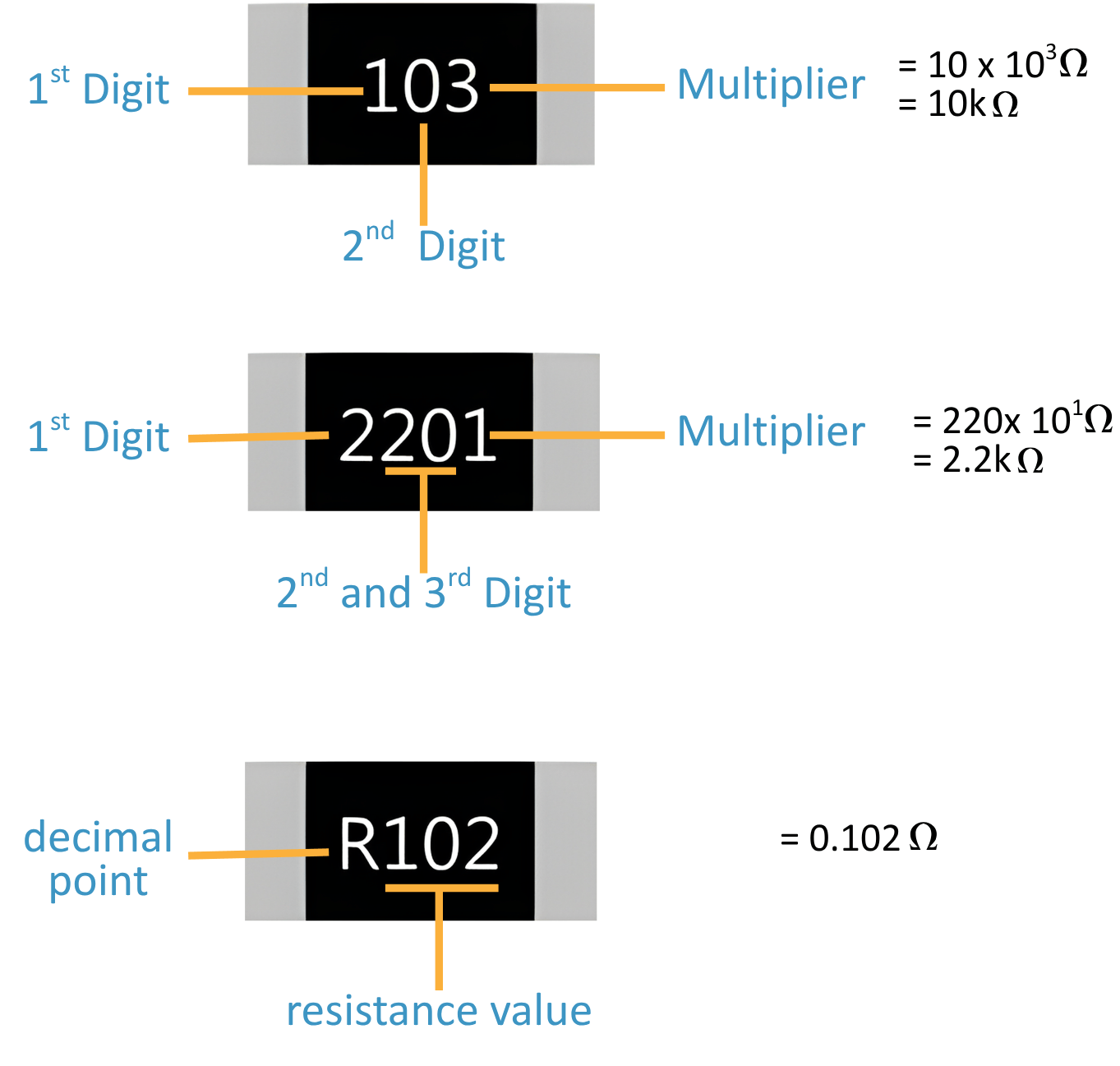
3-Digit and 4-Digit (E-Series) resistor code identification
Understanding Resistor Tolerance Letter Codes (J, F, G)
While the 3-digit and 4-digit systems often imply a 5% or 1% tolerance, you will sometimes see a letter code added, especially on 0603 or larger packages. This letter explicitly states the tolerance.
- 103J = 10kΩ, 5%
- 1001F = 1.00kΩ, 1%
Here is a chart for the most common codes:
| Code | Tolerance |
|---|---|
| F | ±1% |
| G | ±2% |
| J | ±5% |
| K | ±10% |
| M | ±20% |
Resistor Tolerance Letter Codes
Note
Do not confuse the tolerance letter F with the EIA-96 multiplier F. They are used in different systems.
EIA-96: The 1% SMD Resistor Code System
As components shrank, even 3-digit codes became too large. The EIA-96 system was introduced for 1% tolerance (E96 series) resistors, fitting a precise value into a three-character code.
This system consists of two parts:
- Two-Digit Code: A number from 01 to 96 that corresponds to a 3-digit value.
- One-Letter Multiplier: A letter that sets the power of 10.
| Code | Value (Ω) | Code | Value (Ω) | Code | Value (Ω) | Code | Value (Ω) |
|---|---|---|---|---|---|---|---|
| 01 | 100 | 25 | 178 | 49 | 316 | 73 | 562 |
| 02 | 102 | 26 | 182 | 50 | 324 | 74 | 576 |
| 03 | 105 | 27 | 187 | 51 | 332 | 75 | 590 |
| 04 | 107 | 28 | 191 | 52 | 340 | 76 | 604 |
| 05 | 110 | 29 | 196 | 53 | 348 | 77 | 619 |
| 06 | 113 | 30 | 200 | 54 | 357 | 78 | 634 |
| 07 | 115 | 31 | 205 | 55 | 365 | 79 | 649 |
| 08 | 118 | 32 | 210 | 56 | 374 | 80 | 665 |
| 09 | 121 | 33 | 215 | 57 | 383 | 81 | 681 |
| 10 | 124 | 34 | 221 | 58 | 392 | 82 | 698 |
| 11 | 127 | 35 | 226 | 59 | 402 | 83 | 715 |
| 12 | 130 | 36 | 232 | 60 | 412 | 84 | 732 |
| 13 | 133 | 37 | 237 | 61 | 422 | 85 | 750 |
| 14 | 137 | 38 | 243 | 62 | 432 | 86 | 768 |
| 15 | 140 | 39 | 249 | 63 | 442 | 87 | 787 |
| 16 | 143 | 40 | 255 | 64 | 453 | 88 | 806 |
| 17 | 147 | 41 | 261 | 65 | 464 | 89 | 825 |
| 18 | 150 | 42 | 267 | 66 | 475 | 90 | 845 |
| 19 | 154 | 43 | 274 | 67 | 487 | 91 | 866 |
| 20 | 158 | 44 | 280 | 68 | 499 | 92 | 887 |
| 21 | 162 | 45 | 287 | 69 | 511 | 93 | 909 |
| 22 | 165 | 46 | 294 | 70 | 523 | 94 | 931 |
| 23 | 169 | 47 | 301 | 71 | 536 | 95 | 953 |
| 24 | 174 | 48 | 309 | 72 | 549 | 96 | 976 |
EIA-96 Resistor Code and Corresponding Resistance Values
| Letter | Multiplier | Letter | Multiplier |
|---|---|---|---|
| Y | 10⁻² (0.01) | C | 10² (100) |
| X or S | 10⁻¹ (0.1) | D | 10³ (1k) |
| A | 10⁰ (1) | E | 10⁴ (10k) |
| B or H | 10¹ (10) | F | 10⁵ (100k) |
EIA-96 Multiplier Chart
Example: A resistor marked 01C is 100 (from code 01) x 100 (from letter C) = 10,000Ω or 10kΩ.
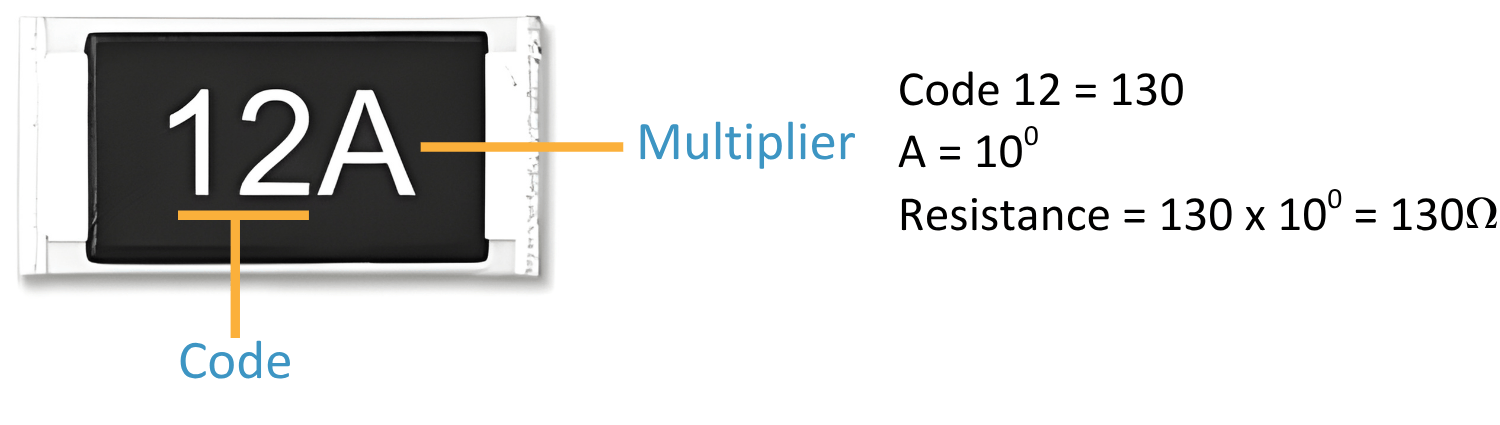
EIA96 resistor code identification

JLCPCB helps turn your BOM into assembled prototypes with automated component placement, access to 730,000+ in-stock parts, and production-level quality controls. From SMD resistors to complex ICs, component selection and placement are checked against your manufacturing data to help reduce assembly errors and rework.
-
Ready to build your prototype? Explore JLCPCB’s PCB Prototype Assembly Service.
-
Click to claim $16 Coupon now!
Unmarked SMD Resistors: When SMD Resistor Codes Are Not Available
Be aware that as package sizes shrink to 0201 (0.6mm x 0.3mm) and 01005, most resistors are unmarked. At this scale, the only way to identify the component is by referencing the assembly documentation (BOM and pick-and-place data).
Common Challenges in Reading SMD Resistor Codes
Even with these standards, you will face challenges in the real world.
Challenge 1: Misreading Similar SMD Resistor Codes
Problem: The risk of misreading 101 (100Ω) as 100 (10Ω) is very high, or 102 (1kΩ) as 120 (12Ω), which can happen as well. A tiny error in the feedback loop might lead to the destruction of a part.
Solution: Use good magnification and lighting all the time. If you are not sure, use a multimeter. A quick in-circuit resistance check (with the board powered off) can often confirm a value. For 100% accuracy, desolder one leg of the resistor to measure it out of the circuit, thereby removing any parallel paths.
Challenge 2: Confusing Different SMD Resistor Marking Systems
Problem: Different marking systems can use similar combinations of numbers and letters, making identification confusing. For example, an EIA-96 marking such as 10F consists of the two-digit code 10 and the multiplier F. In the EIA-96 system, 10 corresponds to 124, while F represents a multiplier of 10⁵, giving a resistance of 12.4 MΩ.
Solution: Always identify the marking system before interpreting the code. EIA-96 markings use two digits followed by a letter multiplier and are primarily used for 1% tolerance resistors. Three-digit markings, such as 103, use the first two digits as the significant value and the third digit as the power-of-ten multiplier, giving 10 kΩ. When a marking includes an additional letter, refer to the manufacturer's datasheet or marking convention rather than assuming its meaning.
Challenge 3: Obscured or Damaged Resistor Markings
Problem: The component is either covered in conformal coating, flux residue, or is partially damaged (burnt).
Solution: Using a cotton swab and 99% isopropyl alcohol (IPA), slowly clean the part. For damaged codes, you have to regard it as an "unmarked" component: find a similar part on the board to measure, or refer to the schematic/BOM, which is the final source of truth.
Conclusion: How to Correctly Identify Any SMD Resistor Code
Correctly reading SMD resistor codes is a fundamental skill for anyone working at the PCB level. These standardized markings provide a direct link between the physical component and the schematic, making them essential for assembly verification, debugging, rework, and field repair. Once you understand the underlying logic, even compact SMD markings become clear, reliable, and actionable.
While decoding SMD resistors is critical when diagnosing existing boards, the most effective way to avoid resistor-related issues is to ensure correctness from the design and assembly stage.
FAQs about SMD Resistor Codes
Q: What's the difference between 3-digit and 4-digit codes?
The number of digits denotes precision. The 3-digit codes are meant for 5% tolerance resistors, commonly known as the E24 series, and have two significant figures along with one multiplier (i.e., two significant figures and one multiplier). The 4-digit codes represent higher precision (1% or 2% E48 or E96 series) resistors with more particular values and have three significant figures and one multiplier (i.e., three significant figures and one multiplier).
Q: I see a resistor marked with just a single '0'. What is that?
That is a "zero-ohm" or "0-ohm" resistor. It is, in fact, a jumper link placed inside a resistor package. Engineers generally use them to link the traces on a PCB, especially as a configurable jumper (to be "stuffed" or "not stuffed") or to connect two traces during layout.
Q: What do the terms E24, E48, and E96 mean?
The terms "E-series" characterize the standard resistor "preferred values" grouped according to tolerance.
- E24 (5%): It offers 24 different values for each decade (e.g., 1.0, 1.1, 1.2, 1.3, 1.5...).
- E48 (2%): It presents 48 different values for each decade.
- E96 (1%): It provides 96 different values for each decade.
The 3/4-digit system is usually employed for E24/E48, while the EIA-96 code system is intended for the E96 values only.
Q: Does the color of an SMD resistor (black vs. blue/green) mean anything?
The vast majority of standard chip resistors are black, with a white/light protective overglaze. You may occasionally see other colors, such as blue or green, which often signify a special type, such as a high-precision thin-film resistor or a specialty resistor. However, this is not standardized, so you should always rely on the code, not the body color.
Q: Does the SMD resistor code (like 103 or 01C) also indicate the power rating?
No, this is a critical point of confusion. The code only indicates the resistance and tolerance. The power rating (e.g., 1/16W, 1/10W, 1/8W) is determined by the physical package size of the component. For example:
- 0402 Package: Typically 1/16W
- 0603 Package: Typically 1/10W
- 0805 Package: Typically 1/8W
An engineer must select the correct package size for the design based on their power dissipation (P = I²R) calculations.
Q: I see a component marked 102, but it has 8 pins. What is it?
That is almost certainly an SMD resistor array or resistor network. The code (102 = 1kΩ) typically applies to all the individual resistors housed inside the single package. These are used to save space (e.g., for pull-up resistors on a data bus). It could be an "isolated" array (four 1kΩ resistors with 8 pins, 2 per resistor) or a "bussed" array (seven 1kΩ resistors, each tied to one common pin). You would need to check the schematic or trace the pins to know which.
Q: My EIA-96 code is ambiguous, like 06. Is it 06 (113Ω) or 90 (845Ω) read upside-down?
This is a real problem, especially with 2-digit codes. To solve this, some high-quality manufacturers will add a small underline or bar to the code to indicate orientation. For example, 06 (underlined) means 06, while a non-underlined 06 might be interpreted as 90 (or vice-versa, depending on the manufacturer). If no orientation mark is present, you must fall back to using your multimeter or consulting the schematic. Never assume the orientation.
Q: Why does the EIA-96 multiplier chart have duplicate letters (like A/Z, X/S, Y/R)?
This is an artifact of merging different standards (EIA and JIS) over time. While the chart lists all of them, in practice, you will most commonly see A (x1), B (x10), C (x100), and X (x0.1). The other letters (Z, S, R) are less common but are still valid. For all practical purposes, you can treat A and Z as the same (x1), X and S as the same (x0.1), and Y and R as the same (x0.01).
Popular Articles
• SMD Resistor Package Sizes: Complete Size Chart, Footprints & How to Choose
• How to Solder SMD Components Like a Pro [2026 Updated]
• SMD Resistor Codes: How to Read 3-Digit, 4-Digit, and EIA-96 Markings
• SMD Capacitor Codes: Identification, Markings, and Polarity
• SMD Capacitor Sizes: Complete Size Chart and Selection Tips for PCB Design and Assembly
Keep Learning
SMD Crystal & Crystal Oscillator Guide: Types, Packages, and How to Choose
Key Takeaways Crystal or oscillator: a passive crystal runs from the MCU’s oscillator and two load capacitors; an XO has its own supply and drives a clock, so use one when a clock feeds several chips. Load capacitors are not CL: with C1 = C2, each capacitor is 2 × (CL − Cstray), so a 20 pF crystal with 3 pF of stray needs about 33 pF, not 20 pF. Check ESR against the MCU: maximum ESR varies with frequency, package and model, so compare it with the MCU’s ESR or Gm_crit limit instead of assuming a typic......
What Are the Main Relay Types and Which One Should You Use?
Key Takeaways Two Main Types: Relays fall into two main categories: electromechanical relays, which use moving metal contacts to switch a circuit, and solid-state relays, which use electronic components with no moving parts. Choose Based on the Load: The load type determines which relay you need. Consider whether the load uses AC or DC, how much current it draws during normal operation and startup, and how frequently it needs to switch. Coil Behavior: A monostable relay returns to rest when its coil i......
SMD MOSFET Code Guide: How to Identify, Test and Replace a MOSFET
Figure: AO3400A (C20917) in the JLCPCB parts library. The listing gives RDS(on) at 2.5 V gate drive, the number that matters in the replacement example later in this guide. An SMD MOSFET code is the two or three characters printed on top of the package, and on its own it rarely tells you which part you're holding. SMD resistors follow standard marking schemes, such as three- and four-digit codes and EIA-96. MOSFETs don't. The same short code can appear on unrelated parts from different manufacturers, ......
ESP8266 vs ESP32: Which One Should You Use?
Key Takeaways ESP32: Dual-core 240 MHz CPU, Bluetooth Classic and BLE, 520 KB SRAM, and up to 34 GPIOs. ESP8266: Single-core CPU, no Bluetooth, and around 50 KB of free RAM for applications. Lifecycle status: Espressif marks the ESP8266 Not Recommended for New Designs (NRND) and names the ESP32-C2 (ESP8684) as its upgrade, although the ESP8266 remains in production with a longevity commitment. Which ESP32 to use: Choose the ESP32-C2 for simple Wi-Fi or Bluetooth LE firmware, the ESP32-C3 for more memo......
What Is a Thermistor? A Practical Guide to NTC, PTC, Applications, and Circuit Design
Key Takeaways Definition: A thermistor is a thermally sensitive resistor whose resistance changes markedly and predictably with temperature, typically by about 4.4% per °C for a standard 10 kΩ NTC (B25/50 = 3950 K) near 25 °C. NTC vs. PTC: An NTC thermistor's resistance falls as temperature rises, which suits temperature sensing and inrush current limiting; a switching PTC's resistance rises steeply above its switch temperature, which suits circuit protection. Key Specifications: An NTC thermistor is ......
What Is the ESP32-CAM, and How to Wire, Power, and Program It?
Key Takeaways Board, not chip: The ESP32-CAM is an AI-Thinker development board, not an Espressif product. It carries AI-Thinker's ESP32-S module, an OV2640 camera, PSRAM, a microSD slot, and a flash LED. No USB port: The board has no USB connector or USB-to-UART bridge, so you program it via its serial pins using a 3.3 V USB-to-serial adapter, with GPIO0 held low at reset. Few free pins: The camera, PSRAM, and microSD card occupy most GPIOs. With the microSD card unused, GPIO2, GPIO4, GPIO12, GPIO13,......