What Are the Difference between Polyimide Flexible Heater and FPC?
6 min
- Introduction
- Features of Polyimide Flexible Heater
- Features of FPC
- Structure of PI Flexible Heater
- Structure of Single-layer FPC
- Applications of PI Flexible Heater
- Applications of FPC
- PI Flexible Heater vs FPC at a Glance
- FAQ about Polyimide Flexible Heater vs FPC
- Conclusion: Polyimide Flexible Heater vs FPC
Introduction
While polyimide (PI) flexible heaters and flexible printed circuit boards (FPCs) may appear similar in structure, their materials, tolerances, and purposes are fundamentally different. PI flexible heaters are designed for heat generation and thermal management, whereas FPCs focus on signal transmission and electrical interconnection. This article explains their differences in features, structures, and functions, helping engineers choose the optimal solution for their applications.
Features of Polyimide Flexible Heater
As part of thermal management solutions, the core function of polyimide flexible heaters is to convert electrical energy into heat, providing a stable and uniform temperature for heating, preheating, or maintaining a specific thermal environment. Considering thermal requirements and safety, these custom flexible heaters require precise resistance control, often with a ±0.05% line width tolerance, to ensure resistance values remain within the standard ±5% range.
Key Advantages
- High heating efficiency and fast thermal response with uniform temperature distribution, allowing rapid heat-up times to meet application demands quickly and ensuring consistent warmth across the entire surface.
- Fully customizable — as a custom product, an electronic heating film can be specifically designed to fit different sizes, shapes, wattages, temperatures, and so on. With good flexibility and customizable shapes, it can bend and conform to curved or irregular surfaces, making it suitable for a wide range of uses.
- Ultra-thin and lightweight — its slim profile and light construction can fit easily into compact or limited spaces without adding bulk and compromising performance.
Features of FPC
FPC is a type of PCB that is primarily designed for signal transmission and component interconnection in electronic devices. They usually have a ±20% line width tolerance, which is sufficient for routing signals.
Key Advantages
- Flexible and lightweight — flex PCBs can be easily bent, folded, and integrated into compact or irregularly shaped electronic products.
- High wiring density — thanks to their dense routing and thin profile, FPCs help reduce the size and weight of devices while maintaining performance.
- Three-dimensional routing — their ability to support 3D routing provides greater design freedom for complex assemblies.
Note
Line width tolerance is the clearest technical divide between the two products: a PI flexible heater is built to a ±0.05% line width tolerance so that its resistance — and therefore its heat output — stays within ±5%, while an FPC only needs ±20% because it carries signals rather than generating heat.
Structure of PI Flexible Heater
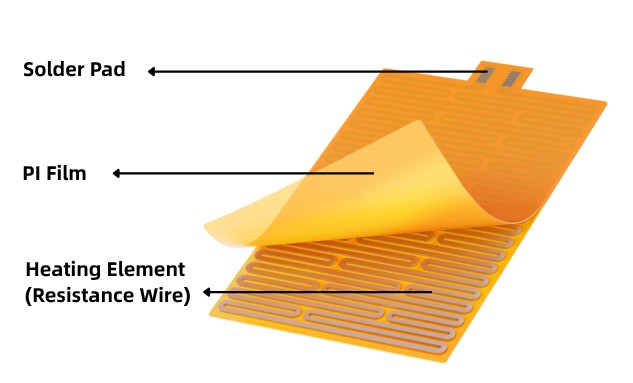
A PI flexible heater typically consists of:
- Insulation Layer: Polyimide film is ideal for electrical insulation and high-temperature resistance.
- Heating Element: Alloy materials such as brass, pure copper, stainless steel (SUS304), or FeCrAl alloy, selected for their high resistivity and stable heat generation.
- Additional Components: Thermostat switches, NTC, adhesive backing, and lead wires (for power connection).
Structure of Single-layer FPC
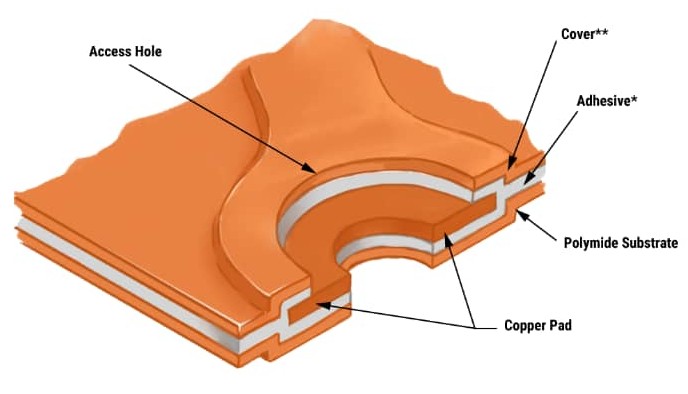
A single-layer FPC is composed of:
- Substrate Layer: Polyimide film providing electrical insulation and high-temperature resistance.
- Electric Conductors: Copper foil with low resistivity, ideal for signal integrity, but unsuitable for generating significant heat.
- Adhesive: The sticky film is made of epoxy resin, for mechanical stability and layer bonding.
Applications of PI Flexible Heater
Typical applications of PI flexible heaters include:
- Consumer electronics: hand warmers, beauty devices, and wearable heating products.
- New energy vehicles: preheating and insulation for EV lithium battery packs.
- Medical and healthcare: physiotherapy devices, incubators, and temperature-controlled instruments.
Applications of FPC
Common applications of flex PCB include:
- Consumer electronics: smartphones, tablets, laptops, digital cameras, and wearable tech.
- Automotive electronics: LED headlights, interior lighting, and driver assistance systems.
- Industrial controllers and medical devices: MRIs, CT scanners, and wearable monitoring devices.
In short, flex PCBs fit anywhere that requires lightweight, space-efficient circuit routing.
PI Flexible Heater vs FPC at a Glance
| PI Flexible Heater | FPC | |
|---|---|---|
| Primary function | Heat generation and thermal management | Signal transmission and component interconnection |
| Line width tolerance | ±0.05% (resistance within ±5%) | ±20% |
| Conductor material | Brass, pure copper, stainless steel (SUS304), or FeCrAl alloy — high resistivity | Copper foil — low resistivity |
| Insulation / substrate | Polyimide film | Polyimide film with epoxy resin adhesive |
| Additional components | Thermostat switches, NTC, adhesive backing, lead wires | Epoxy resin adhesive for layer bonding |
| Typical applications | Hand warmers, beauty devices, wearable heating products, EV lithium battery preheating, physiotherapy devices, incubators | Smartphones, tablets, laptops, digital cameras, LED headlights, driver assistance systems, industrial controllers, MRI and CT scanners |
FAQ about Polyimide Flexible Heater vs FPC
Q: Can an FPC be used as a heater?
It is not suited to that job. An FPC uses copper foil with low resistivity, which is ideal for signal integrity but unsuitable for generating significant heat. A PI flexible heater instead uses higher-resistivity alloys such as brass, stainless steel (SUS304), or FeCrAl to convert electrical energy into heat.
Q: Why does a PI flexible heater need a tighter line width tolerance?
Because heat output depends on resistance. A flexible heater is manufactured to a ±0.05% line width tolerance so that its resistance stays within the standard ±5% range, meeting thermal and safety requirements. An FPC only routes signals, so a ±20% line width tolerance is sufficient.
Q: Do PI flexible heaters and FPCs use the same base material?
Both use polyimide film for electrical insulation and high-temperature resistance. The difference lies in the conductor: the heater uses high-resistivity alloys as the heating element, while the FPC uses low-resistivity copper foil bonded with epoxy resin adhesive.
Q: Can a polyimide flexible heater be customized?
Yes. As a custom product, an electronic heating film can be designed for different sizes, shapes, wattages, and temperatures, and it can bend and conform to curved or irregular surfaces.
Q: What extra components does a flexible heater include?
Beyond the polyimide insulation layer and the heating element, a flexible heater can integrate thermostat switches, NTC, adhesive backing, and lead wires for power connection.
Conclusion: Polyimide Flexible Heater vs FPC
Although PI flexible heaters and FPCs share a similar layered structure, their purposes are entirely different. PI flexible heaters are built for precision thermal management in applications ranging from EV battery heating to medical incubators, while FPCs enable complex electronic signal routing in consumer electronics and industrial systems. Understanding these differences is essential to selecting the right solution for your engineering needs.
Keep Learning
The History and Evolution of Polyimide (PI) Film
Polyimide film has become a critical material in aerospace, electronics, flexible circuits, and other high-performance applications. But its development did not happen overnight. From the early commercialization of polyimide materials to modern applications in flexible electronics, the history of polyimide film reflects the changing demands of engineering over more than half a century. This article traces the major stages in the development of polyimide film, from its origins in the Space Race to its ......
What Is a Flexible Heater? A Complete Guide
Flexible heaters provide customizable heating for applications where space, shape, or installation conditions make conventional rigid heaters difficult to use. But different materials offer different specifications, so selecting the right heater requires more than choosing a size and target temperature. This guide explains what flexible heaters are, how they work, the main types available from JLCPCB, and the differences between polyimide and silicone rubber heaters. It also covers common applications......
The Complete Guide to Silicone Rubber: Properties, Applications, and Benefits
When we think of rubber, we often imagine car tires or elastic bands. However, there is a "super-material" in the elastomer family that operates where ordinary rubbers fail: Silicone Rubber. From the seal in your smartphone to life-saving medical implants and the turbocharger hoses in high-performance cars, silicone rubber is the silent hero of modern engineering. Consider this: the same material that makes your flexible phone case also keeps astronauts safe in space, helps premature babies breathe in......
What Are the Difference between Polyimide Flexible Heater and FPC?
Introduction While polyimide (PI) flexible heaters and flexible printed circuit boards (FPCs) may appear similar in structure, their materials, tolerances, and purposes are fundamentally different. PI flexible heaters are designed for heat generation and thermal management, whereas FPCs focus on signal transmission and electrical interconnection. This article explains their differences in features, structures, and functions, helping engineers choose the optimal solution for their applications. Feature......
The Evolution of Flexible Heaters: From Early Prototypes to Modern Applications
The history of engineering is often narrated through grand monuments that dominate the horizon—soaring cross-sea bridges, colossal skyscrapers, and the rhythmic thunder of steam engines. Yet, there is a narrative just as profound and compelling to be found in the subtle, thin, and often invisible components that form the hidden foundations of modern life. Among these, the trajectory of the Flexible Heating Film stands as a testament not only to breakthroughs in materials science but to the persistent ......
JLCPCB Flexible Heater Manufacturing Process: A Comprehensive Guide
In various industries, resistive heating elements play a critical role in converting electrical energy into heat. As demand grows for more compact and customizable thermal solutions, flexible heater manufacturing has become essential to producing efficient and reliable heating components. Flexible heaters, particularly polyimide (PI) flexible heaters, are known for their thin, lightweight, and adaptable design, which is crucial for effective thermal management across a wide range of applications—from ......