Complete SMD Diode Size Guide: Package Dimensions, Charts, and Selection Tips
14 min
- Understanding SMD Diode Package Naming
- SMD Diode Size Chart
- Common SMD Diode Package Sizes
- Choosing the Right SMD Diode Package
- Common Mistakes When Selecting SMD Diode Sizes
- PCB Design Guidelines for SMD Diode Packages
- Why SMD Diode Package Size Matters
- How SMD Diode Package Size Affects Current and Thermal Performance
- FAQs about SMD Diode Size
- Conclusion

Picking the wrong SMD diode package usually shows up late, either during layout when footprints mismatch, or during testing when junction heating climbs past safe limits. Package size dictates how much current a diode carries, how efficiently it sheds heat, and whether your assembly line can solder it reliably.
This guide details common SMD diode package families (SMA, SMB, SMC, SOD-123, SOD-323, SOD-523, and SOD-923).
You will find our comprehensive SMD diode package size chart, layout recommendations, and a practical selection guide by application.
Understanding SMD Diode Package Naming
Before jumping into the SMD diode dimensions, decoding the standard naming conventions prevents footprint mismatches. Understanding these names is also a helpful foundation when reviewing SMD transistor codes or selecting IC package types for your broader design.
SMA, SMB, and SMC
These are JEDEC-standardized designations for surface-mount power diodes in the DO-214 family. The letters indicate size increments within the series. SMA is the smallest, and SMC is the largest. Their formal JEDEC names are DO-214AC (SMA), DO-214AA (SMB), and DO-214AB (SMC).
SOD-123, SOD-323, SOD-523 and SOD-923
SOD stands for Small Outline Diode. Within the common SOD series discussed here, higher numbers generally correspond to smaller package sizes. SOD-123 is the largest, followed by the highly compact SOD-323, SOD-523, and SOD-923. These flat, two-terminal packages are designed primarily for signal and low-power rectifier applications.
JEDEC Package Standards
JEDEC (Joint Electron Device Engineering Council) is the standards body responsible for semiconductor package specifications. Following JEDEC-compliant footprints in your PCB layout reduces the risk of physical component mismatches. Checking standard diode symbols in your schematic capture tool against the JEDEC footprint is a highly recommended verification step.
SMD Diode Size Chart
If you need immediate dimensional data, use the SMD diode size chart below. It compares the most common packages by footprint, current capacity, and typical use cases.
| Package | Nominal Body Dimensions (mm) | Max Continuous Current | Power Dissipation (PCB) | Approx. Area | Typical Applications |
|---|---|---|---|---|---|
| SMA (DO-214AC) | 4.4 x 2.7 x 2.3 | 1 A | 1 W (up to 2 W w/ copper) | ~24 mm² | General rectifiers, low-power TVS |
| SMB (DO-214AA) | 5.6 x 3.8 x 2.4 | 2 A | 1.5 W (up to 2.5 W) | ~40 mm² | Medium rectifiers, interface TVS |
| SMC (DO-214AB) | 7.7 x 5.9 x 2.6 | 3-5 A | 2-3.5 W (up to 5+ W) | ~75 mm² | High-power rectifiers, surge TVS |
| SOD-123 | 2.8 x 1.8 x 1.2 | 200-500 mA | 350-500 mW | ~9 mm² | ESD data lines, small signal |
| SOD-323 | 1.7 x 1.25 x 0.9 | 200-300 mA | 200-350 mW | ~4 mm² | Mobile ESD, compact rectifiers |
| SOD-523 | 1.2 x 0.8 x 0.6 | 150-250 mA | 150-250 mW | ~1.3 mm2 | Logic boards, compact portables |
| SOD-923 | 1.0 x 0.5 x 0.5 | ≤ 200 mA | 100-150 mW | ~1 mm² | Wearables, IoT devices |
| D2PAK (TO-263) | 10.2 x 8.9 x 4.6 | 10-30+ A | 20-30+ W w/ heatsink | ~180 mm² | SMPS rectifiers, motor drives |
Note
Dimensions listed above and throughout this guide are common nominal package sizes. Exact measurements and tolerances may vary slightly between manufacturers and specific JEDEC variants. Always verify against your specific component's datasheet.
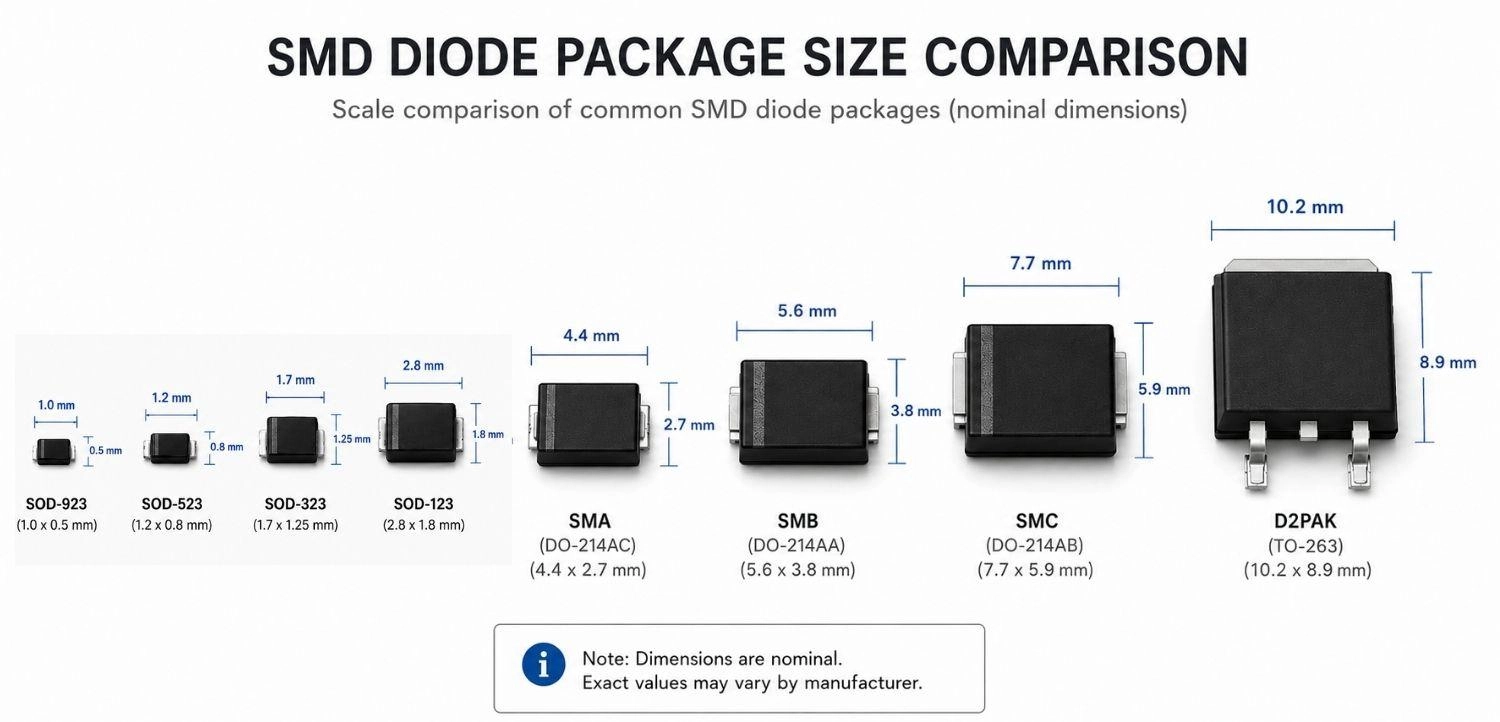
Figure: Common SMD diode packages showing nominal dimensions.
Common SMD Diode Package Sizes
The following sections break down exactly when and why you should choose each specific footprint.
SMA Package (DO-214AC)
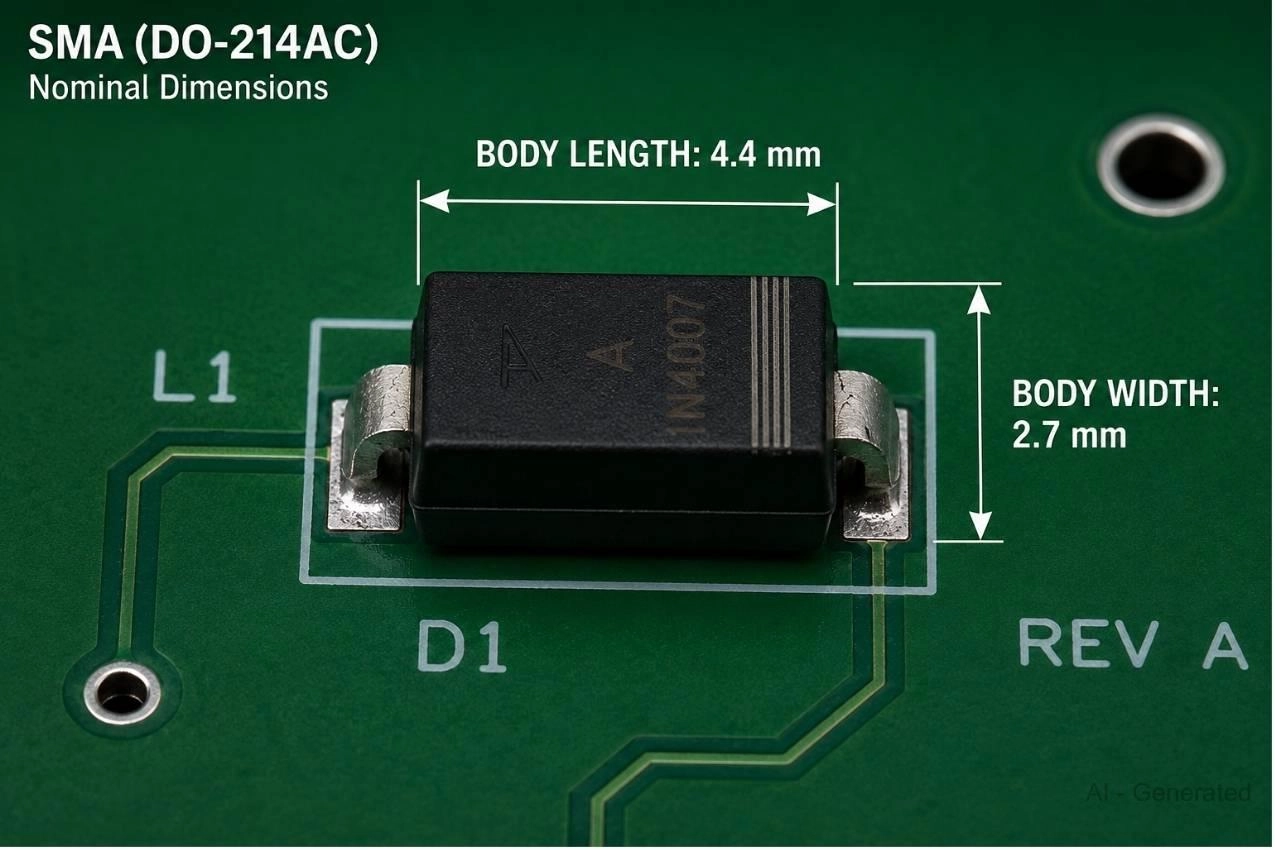
Figure: SMA DO-214AC SMD diode showing nominal 4.4 x 2.7 mm dimensions.
Quick Specs & Recommendations:
- Nominal Dimensions: 4.4 x 2.7 x 2.3 mm
- Max Current: 1 A continuous
- Power Dissipation: 1 W standard footprint
- Best Applications: General-purpose rectifiers, battery protection Schottky diodes, and industrial signal lines.
- Recommendation: The industry standard for basic power handling. Offers an excellent balance of manageable board area and reliable manual solderability.
SMB Package (DO-214AA)
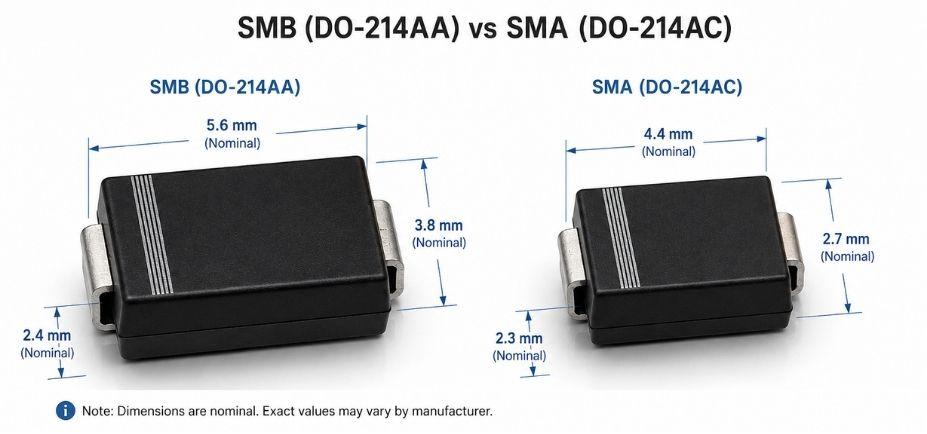
Figure: Size comparison of SMB and SMA diode packages showing nominal dimensions.
Quick Specs & Recommendations:
- Nominal Dimensions: 5.6 x 3.8 x 2.4 mm
- Max Current: 2 A continuous
- Power Dissipation: 1.5 W standard footprint
- Best Applications: Medium-power rectifiers, flyback diodes across relay coils, and moderate TVS ESD protection.
- Recommendation: Choose SMB when an SMA package falls slightly short on current, but an SMC package would waste board space.
SMC Package (DO-214AB)
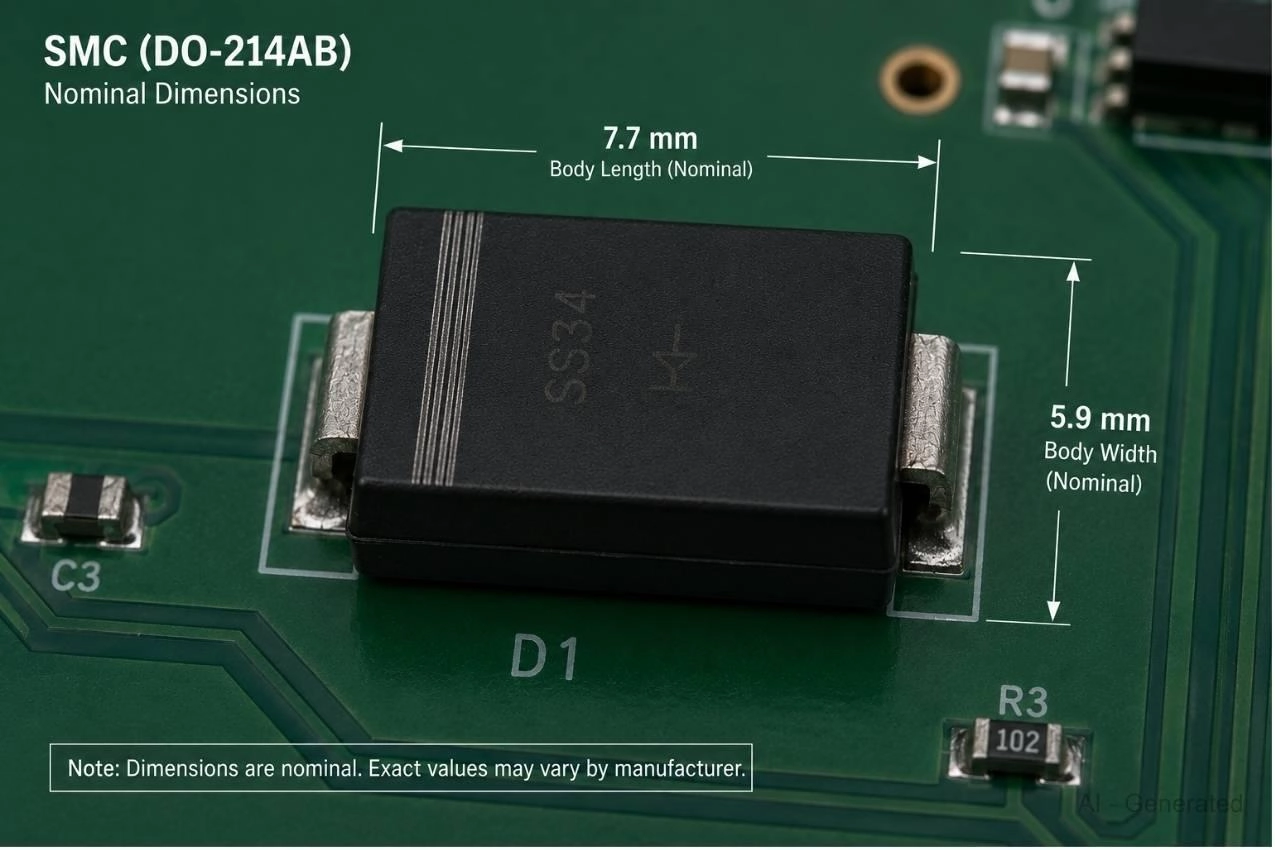
Figure: SMC DO-214AB power diode showing nominal 7.7 x 5.9 mm dimensions on a PCB.
Quick Specs & Recommendations:
- Nominal Dimensions: 7.7 x 5.9 x 2.6 mm
- Max Current: 3-5 A continuous
- Power Dissipation: 2-3.5 W standard footprint
- Best Applications: SMPS output stages, automotive reverse battery protection, and high-energy surge clamping.
- Recommendation: Best for heavy-duty power line clamping and substantial continuous current requirements.
SOD-123 Package
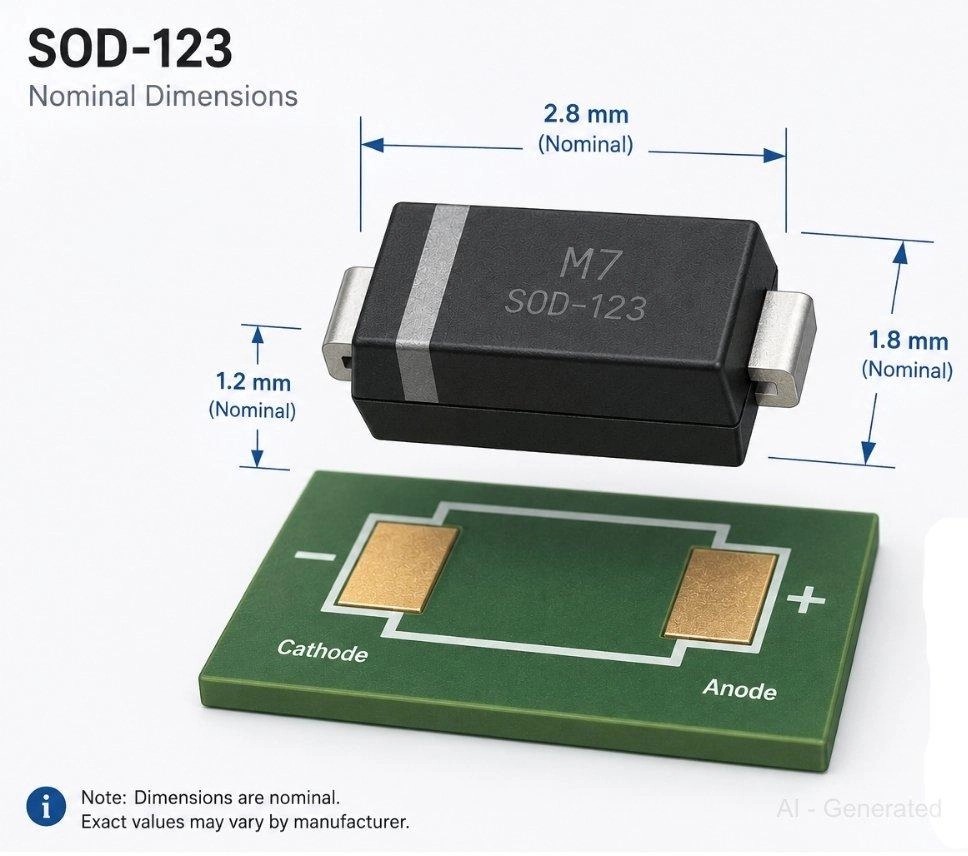
Figure: SOD-123 dimensions 2.8 x 1.8 mm
Quick Specs & Recommendations:
- Nominal Dimensions: 2.8 x 1.8 x 1.2 mm
- Max Current: 200-500 mA continuous
- Power Dissipation: 350-500 mW standard footprint
- Best Applications: Low-power Schottky rectifiers, signal clipping, and USB/HDMI ESD protection.
- Recommendation: The go-to choice for logic-level signals. Small enough for dense layouts but still practical for manual prototyping.
SOD-523 Package
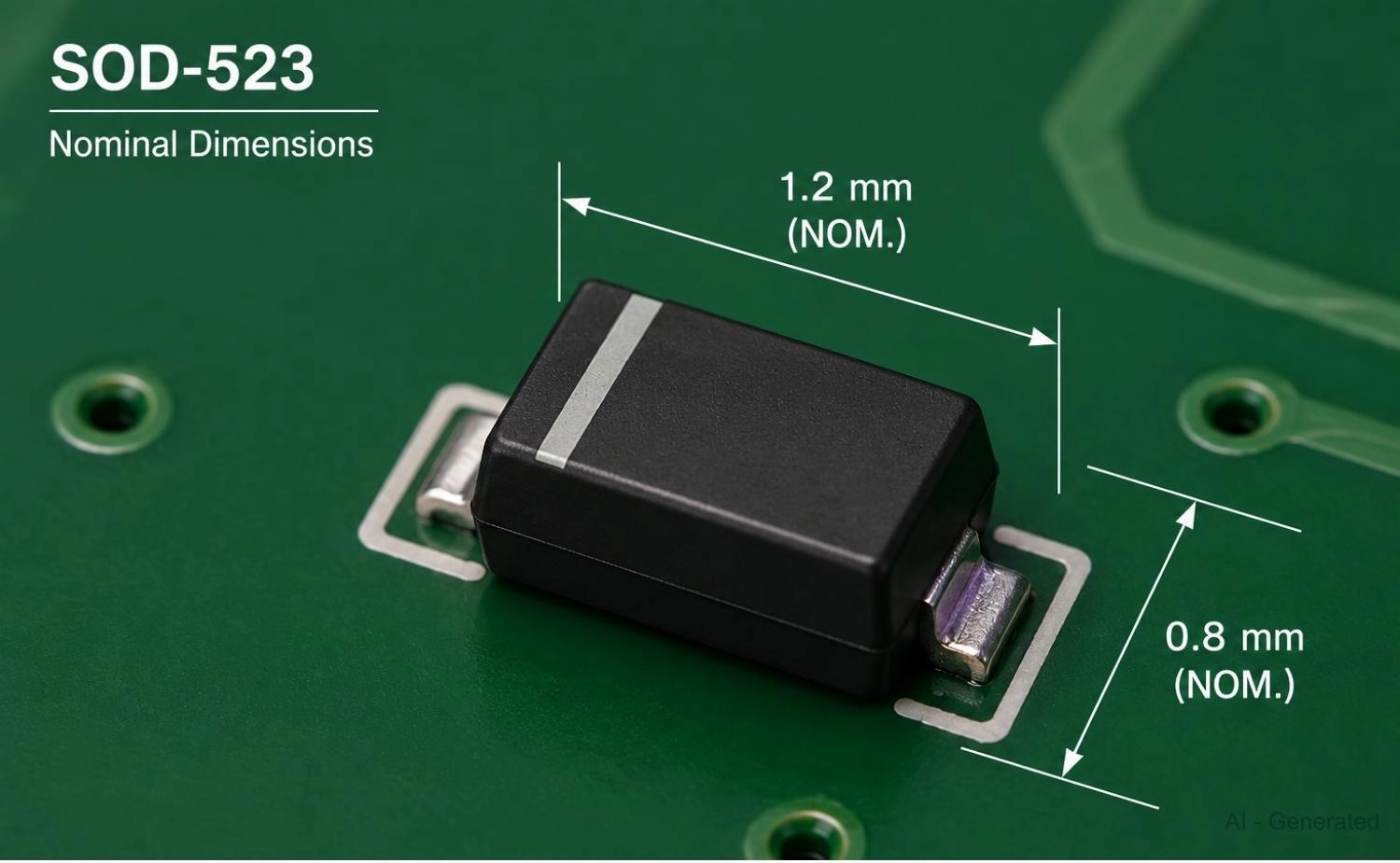
Figure: SOD-523 package dimensions 1.2 x 0.8 mm.
Quick Specs & Recommendations:
- Nominal Dimensions: 1.2 x 0.8 x 0.6 mm
- Max Current: 150-250 mA continuous
- Power Dissipation: 150-250 mW standard footprint
- Best Applications: High-density logic boards, LED drivers, and compact portable electronics.
- Recommendation: Offers an excellent middle ground between the SOD-323 and the ultra-tiny SOD-923. It is roughly equivalent to a 0603 footprint, requiring pick-and-place assembly.
SOD-323 Package Dimensions
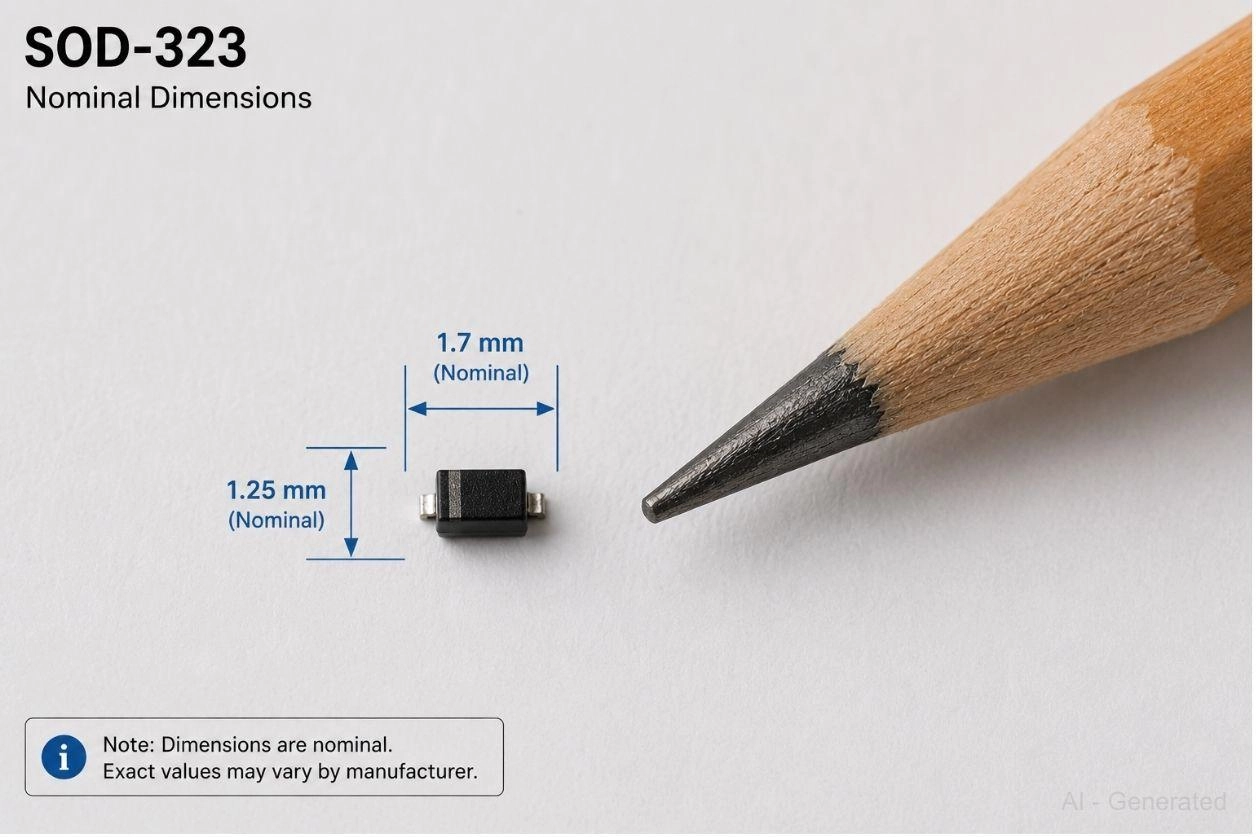
Figure: SOD-323 dimensions 1.7 x 1.25 mm
Quick Specs & Recommendations:
- Nominal Dimensions: 1.7 x 1.25 x 0.9 mm
- Max Current: 200-300 mA continuous
- Power Dissipation: 200-350 mW standard footprint
- Best Applications: Portable device reverse polarity protection, switch-mode rectification, and RF circuits.
- Recommendation: Ideal for lightweight consumer electronics. Reflow assembly is highly recommended due to the miniature pad pitch.
SOD-923 Package
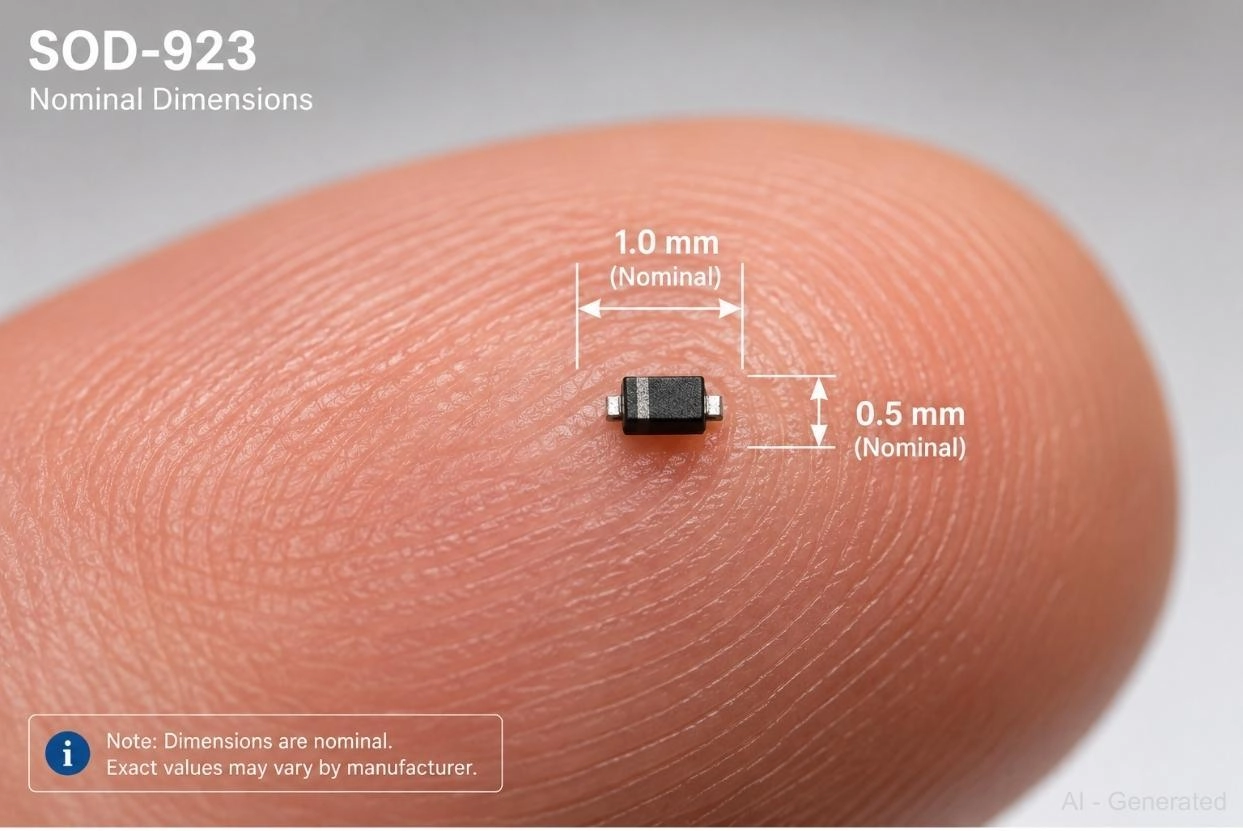
Figure: Ultra-miniature nominal 1.0 x 0.5 mm SOD-923 SMD diode.
Quick Specs & Recommendations:
- Nominal Dimensions: 1.0 x 0.5 x 0.5 mm
- Max Current: ≤ 200 mA continuous
- Power Dissipation: 100-150 mW standard footprint
- Best Applications: Wearable electronics, smartphones, and ultra-compact RF modules.
- Recommendation: Best for high-density applications where board space is critical. Requires automated pick-and-place assembly.
D2PAK Package
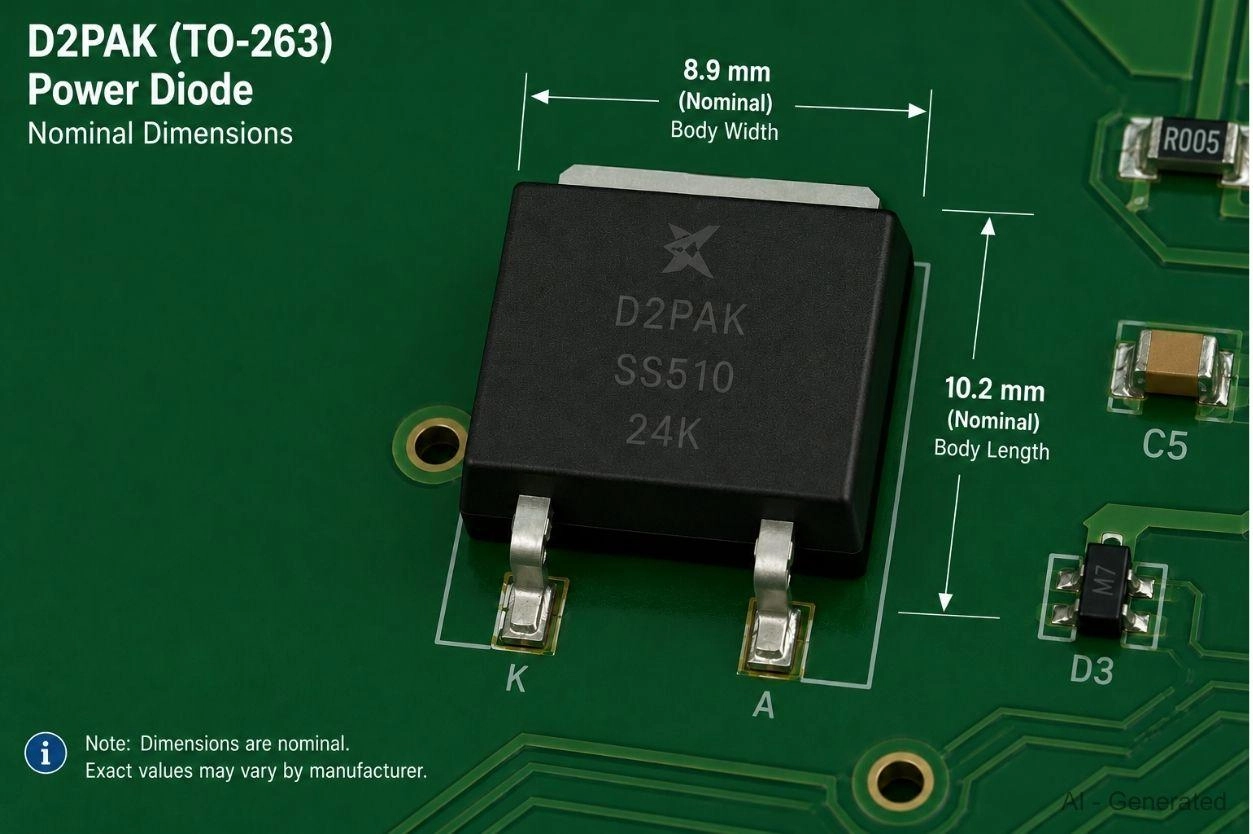
Figure: D2PAK TO-263 power diode showing nominal 10.2 x 8.9 mm dimensions on a PCB.
Quick Specs & Recommendations:
- Nominal Dimensions: 10.2 x 8.9 x 4.6 mm
- Max Current: 10-30+ A continuous
- Power Dissipation: 20-30+ W with heavy copper/heatsinking
- Best Applications: Synchronous rectification, motor drive freewheeling diodes, and high-power SMPS.
- Recommendation: Well-suited for high-current power stages and thermally demanding designs.
Choosing the Right SMD Diode Package
Use these practical guidelines to narrow down your choices based on your application.
For High-Frequency SMPS Designs
Switching power supplies operating above 100 kHz demand fast recovery or Schottky diodes.
- Low power: SOD-323, SOD-123
- Medium power (5-30 W): SMA, SMB
- High power (>50 W): SMC, D2PAK
For TVS and Surge Protection
TVS diode selection hinges on peak pulse power.
- Basic ESD (USB/signal lines): SOD-123, SOD-323
- Heavy Surge (AC mains/Automotive): SMC packages for robust load-dump protection
For Compact IoT and Mobile Devices
IoT designs prioritize size and power consumption over current capacity.
- Recommended Packages: SOD-923, SOD-523, SOD-323
- Design Note: Keep total continuous current under 100 mA to avoid thermal throttling inside enclosed plastic housings.
For Automotive and Industrial Electronics
Automotive designs must survive wide temperature swings (-40°C to +125°C) and heavy vibration.
- Recommended Packages: SMB, SMC
- Design Note: These packages provide the necessary vibration resistance and thermal headroom for harsh environments.
Common Mistakes When Selecting SMD Diode Sizes
Watch out for these frequent errors when reviewing your designs.
Choosing an Undersized SMD Diode Package
When sourcing electronic parts, do not select a diode based purely on average continuous current. A 1A SMA diode can easily be destroyed by a 5A startup inrush spike if the repetitive peak rating is exceeded.
Ignoring Thermal Derating
A diode rated for 1 A at 25°C ambient may only be safe to push 600 mA at 70°C. The ambient temperature inside an enclosure is often much higher than room temperature. Always check the thermal derating chart.
Poor PCB Copper Heatsinking
Adding a package to a board with minimum-width traces limits cooling capacity. For any package dissipating more than a few hundred milliwatts, the pad copper area should be extended.
Using Ultra-Small Packages for Manual Assembly
Trying to hand-build prototype boards with SOD-923 parts leads to ruined components and invisible shorts. Specify SOD-123 as the minimum acceptable package size for manual diode soldering.
PCB Design Guidelines for SMD Diode Packages
Smaller packages such as SOD-323, SOD-523, and SOD-923 require tighter stencil and solder paste control than larger SMA or SMB packages.

- For production builds, professional PCB assembly services such as JLCPCB help maintain consistent placement accuracy across fine-pitch SMD diode footprints.
SMD Diode Footprint Spacing and Reflow Soldering
Following JEDEC-recommended land patterns and proper solder pad design is critical for reliable SMD diode assembly. Incorrect pad sizing can cause tombstoning, poor solder wetting, or diode misalignment during reflow.
Thermal Copper Area for SMD Diode Packages
SMD diode thermal performance depends heavily on PCB copper area. Extending copper pours around SMA, SMB, SMC, and D2PAK packages significantly improves heat spreading and reduces junction temperature.
For higher-power diode packages:
- Use wider copper pours around the anode and cathode.
- Connect thermal pads to internal planes.
- Add thermal vias beneath D2PAK packages.
This becomes especially important in SMPS, automotive, and surge-protection circuits where continuous current and transient power are high.
Manual Soldering vs PCB Assembly for Small SMD Diodes
Ultra-small diode packages like SOD-923 and SOD-523 are extremely difficult to solder manually due to their tiny pad geometry and limited spacing. Even SOD-323 packages can become challenging without magnification and fine-tip tools.
For prototype or production boards using miniature SMD diode packages, automated SMT assembly through services like JLCPCB provides much more reliable solder consistency and placement accuracy.
For hand assembly, the most practical choices remain:
- SMA
- SMB
- SOD-123
PCB Clearance Requirements for High-Voltage SMD Diodes
High-voltage SMD diode layouts require proper creepage and clearance spacing between pads, copper pours, and adjacent traces.
Packages such as SMB and SMC are commonly used in:
- AC mains rectification
- TVS surge suppression
- Industrial flyback protection
When working above 400 V, always follow IPC-2221 spacing recommendations, even if compact package placement appears electrically possible.
Why SMD Diode Package Size Matters
Choosing a package is not purely about fitting a component onto a board. Package size affects far more than physical dimensions, directly determining how the device behaves under load and how straightforward it is to manufacture.
- PCB Space and Compact Circuit Design: Modern electronics, particularly IoT sensors and wearables, operate under tight area constraints. A SOD-923 measures roughly 1.0 x 0.5 mm, making it practical for dense layouts where an SMA package simply will not fit. However, minimizing package size without considering heat dissipation can cause major reliability issues.
- Current Handling and Cooling Performance: Larger packages feature lower junction-to-ambient thermal resistance (θJA). This allows heat to escape more efficiently, so the diode can carry more current before hitting its maximum rated temperature limit. For example, an SMA diode can handle 1A continuous forward current, while a SOD-923 is often limited to 200 mA or less.
- Package Size vs. Power Dissipation: Power dissipation (PD) is calculated simply: PD = VF x IF. Smaller packages force more heat to stay in the junction. As ambient temperature rises, the maximum safe power dissipation drops significantly, which is critical for enclosed or elevated-temperature environments.
- Manufacturing and Soldering Considerations: Package size dictates your assembly method. Ultra-small packages like SOD-923 require pick-and-place machines; hand-soldering them is extremely difficult. Conversely, larger packages like SMA and SMC are easily managed for manual prototyping and low-volume production.
How SMD Diode Package Size Affects Current and Thermal Performance
Understanding how heat dissipation connects to physical size prevents real-world failures.
How SMD Diode Package Size Affects Current Handling
The maximum current a diode can sustain without damage is limited by junction heating. As forward current increases, power dissipation raises the junction temperature. Larger packages offer lower thermal resistance, allowing more power to escape before the junction overheats.
PCB Copper Area and Thermal Dissipation
Datasheets publish values assuming a minimal footprint on a standard board. Adding robust copper pours around your diode improves heat spreading dramatically. Adding one square centimeter of 1 oz copper reduces thermal resistance by roughly 30-50°C/W as a general estimate, though this depends heavily on layer count and copper thickness. Both the anode and cathode pads contribute to cooling.
Surge Power Capability and Package Size
Larger packages tolerate transient energy spikes much better. An SMC-packaged TVS diode might absorb a peak pulse of 1500 W, while a SOD-123 is typically limited to 100-200 W. Always match package size to your expected surge environment.
FAQs about SMD Diode Size
Q: What is the most common SMD diode package?
SOD-123 handles low-power logic and consumer electronics, while SMA is the default for general power handling and industrial rectifiers.
Q: What is the difference between SMA and SMB packages?
SMB is physically larger (5.6 x 3.8 mm vs. 4.4 x 2.7 mm) and supports roughly double the continuous current (2 A vs. 1 A). Use SMB when an SMA package runs too hot for your load.
Q: Can I replace a through-hole diode with an SMD equivalent?
Yes. SMA is the standard SMD replacement for DO-41 diodes (like the 1N4007), while SMB replaces the larger DO-15. Ensure your PCB has adequate copper pours to replace the cooling effect of the original wire leads.
Q: Why do some SMD diodes come in 3-pin packages?
Packages like SOT-23 often contain two separate diodes wired internally (e.g., in series or common cathode). This saves valuable board space when designing logic gates or redundant power inputs.
Q: How do I identify an unknown SMD diode package?
Measure the body length and width with calipers. Compare your measurements against a standard SMD diode package size chart. If a laser marking is visible, check it against an online SMD code database.
Conclusion
Selecting the right SMD diode package comes down to balancing current demands, thermal limits, available board space, and layout constraints.
When in doubt, prioritize thermal margin over a minimum footprint. Always verify package thermal behavior experimentally under real PCB copper conditions, as minimum-pad datasheet values rarely reflect enclosed environments.
Once your design constraints are met, validate your JEDEC footprints before moving to production. Transitioning to prototype PCB assembly with JLCPCB provides a straightforward way to ensure your footprint choices and thermal assumptions perform reliably in the real world.
Popular Articles
• SMD Resistor Package Sizes: Complete Size Chart, Footprints & How to Choose
• How to Solder SMD Components Like a Pro [2026 Updated]
• SMD Resistor Codes: How to Read 3-Digit, 4-Digit, and EIA-96 Markings
• SMD Capacitor Codes: Identification, Markings, and Polarity
• SMD Capacitor Sizes: Complete Size Chart and Selection Tips for PCB Design and Assembly
Keep Learning
ESP8266 vs ESP32: Which One Should You Use?
Key Takeaways ESP32: Dual-core 240 MHz CPU, Bluetooth Classic and BLE, 520 KB SRAM, and up to 34 GPIOs. ESP8266: Single-core CPU, no Bluetooth, and around 50 KB of free RAM for applications. Lifecycle status: Espressif marks the ESP8266 Not Recommended for New Designs (NRND) and names the ESP32-C2 (ESP8684) as its upgrade, although the ESP8266 remains in production with a longevity commitment. Which ESP32 to use: Choose the ESP32-C2 for simple Wi-Fi or Bluetooth LE firmware, the ESP32-C3 for more memo......
What Is a Thermistor? A Practical Guide to NTC, PTC, Applications, and Circuit Design
Key Takeaways Definition: A thermistor is a thermally sensitive resistor whose resistance changes markedly and predictably with temperature, typically by about 4.4% per °C for a standard 10 kΩ NTC (B25/50 = 3950 K) near 25 °C. NTC vs. PTC: An NTC thermistor's resistance falls as temperature rises, which suits temperature sensing and inrush current limiting; a switching PTC's resistance rises steeply above its switch temperature, which suits circuit protection. Key Specifications: An NTC thermistor is ......
What Is the ESP32-CAM, and How to Wire, Power, and Program It?
Key Takeaways Board, not chip: The ESP32-CAM is an AI-Thinker development board, not an Espressif product. It carries AI-Thinker's ESP32-S module, an OV2640 camera, PSRAM, a microSD slot, and a flash LED. No USB port: The board has no USB connector or USB-to-UART bridge, so you program it via its serial pins using a 3.3 V USB-to-serial adapter, with GPIO0 held low at reset. Few free pins: The camera, PSRAM, and microSD card occupy most GPIOs. With the microSD card unused, GPIO2, GPIO4, GPIO12, GPIO13,......
ESP32 Versions: Which One Should You Use for Your Project?
Key Takeaways Radios decide first: ESP32 versions differ mainly in their radios, CPU cores, and peripherals. Common defaults: The ESP32-C3 suits low-cost Wi-Fi and Bluetooth LE, the ESP32-S3 suits camera, display, voice, and on-device AI. Original ESP32: The chip is still in production and remains the choice for Bluetooth Classic. Versions without Wi-Fi: The ESP32-H2 targets battery-powered Thread and Zigbee devices. Chip, module, or board: Prototype on a development board, then design a module onto y......
SOIC Package: A Complete Guide to Specifications, Types, Uses, and SMT Assembly
As designs transition from legacy through-hole components to high-density Surface Mount Technology (SMT), the Small Outline Integrated Circuit (SOIC) remains the industry standard for operational amplifiers, flash memory, sensors, and microcontrollers. It reflects a well-balanced engineering design, offering a practical compromise between the miniaturisation demanded by modern consumer electronics and the ruggedness required for industrial applications. In this guide, you will learn: SOIC package dime......
What Is a 100nF Capacitor and How Do You Choose the Right One
Key Takeaways Value: A 100nF capacitor has a nominal capacitance of 0.1 µF, or 100,000 pF, and all three names describe the same part value. Marking: Many through-hole ceramic and film capacitors use the three-digit code 104, while most SMD MLCCs are unmarked. Main use: Its most common function is local decoupling at an IC power pin, where it supplies fast transient current and shunts high-frequency noise to ground. Default choice: For general decoupling, an X7R or X5R MLCC is a common starting point;......