Supercapacitor vs Battery: Differences, Advantages, and When to Use Each
14 min
- Supercapacitor vs Battery: Key Differences (Quick Comparison)
- Supercapacitor vs Battery: How to Select in Real Applications
- Can Supercapacitors Replace Batteries?
- Supercapacitor vs Battery: Energy Density vs Power Density Explained
- What Is a Supercapacitor and How Does It Work?
- What Is a Battery and How Does It Work?
- Advantages and Disadvantages of Supercapacitors
- Advantages and Disadvantages of Batteries
- Supercapacitor vs Battery in PCB Design and Electronics Manufacturing
- From Design to Production: Bringing Your Power Solutions to Life with JLCPCB
- Supercapacitor Safety and Design Warnings
- FAQ about Supercapacitor and Battery
- Conclusion
Key Takeaways
Supercapacitor vs Battery: Quick Answer
Batteries provide sustained energy for long-duration operation, supercapacitors (ultracapacitors) deliver rapid bursts of high current with exceptional cycle life. Understanding the difference between supercapacitor and battery technologies is essential for designing reliable PCB-based systems.
Decision Rule:
In modern electronics design, selecting the right energy storage component directly impacts system performance, efficiency, and lifespan. The supercapacitor vs battery decision is not simply a component choice-it is a fundamental power architecture trade-off between energy density and power delivery.
In this guide, you will learn how supercapacitors and batteries compare in performance, cost, and real-world applications, how to select the right solution for your design, and how to implement them effectively in electronics manufacturing.
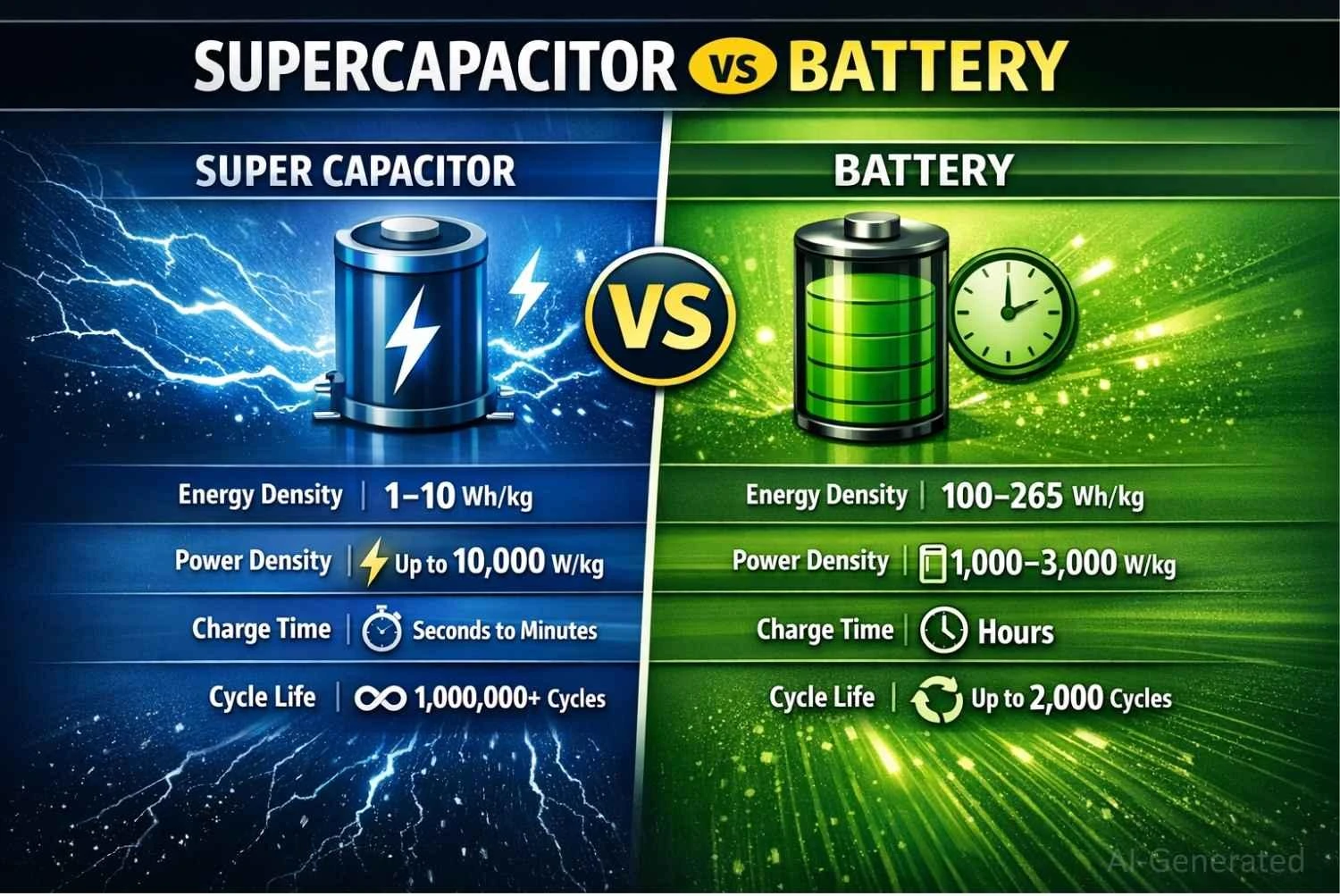
Supercapacitor vs Battery: Key Differences (Quick Comparison)
The difference between supercapacitor and battery performance is defined by energy density vs power density trade-offs.
| Feature | Supercapacitor (EDLC) | Lithium-Ion Battery |
|---|---|---|
| Storage Mechanism | Electrostatic | Chemical |
| Energy Density | Low (1–10 Wh/kg) | High (100–265 Wh/kg) |
| Power Density | Very High (up to 10,000 W/kg) | Moderate (1,000–3,000 W/kg) |
| Charge/Discharge Time | Seconds to minutes | Hours |
| Lifecycle | 100,000 to 1,000,000+ cycles | 500 to 2,000 cycles |
| Temperature Tolerance | Excellent (-40°C to +85°C) | Poor to Moderate (-20°C to +60°C) |
| Weight Factor | Generally heavier per Watt-hour | Lighter per Watt-hour |
| Price / Cost per Wh | High | Low |
A supercapacitor stores energy electrostatically for high power delivery, while a battery stores energy chemically for long-duration supply.
To choose the optimal power source, it is crucial to understand the fundamental performance metrics. Engineers must balance the supercapacitor vs battery weight, physical volume, lifespan, and overall cost to match their product’s exact requirements. In terms of supercapacitor vs battery weight, batteries are significantly lighter per watt-hour, while supercapacitors require more physical volume for equivalent energy storage.
While the supercapacitor vs battery price ratio shows high initial costs per Wh for supercaps, their near-infinite cycle life often makes them significantly cheaper over a 10-year product lifespan.
Supercapacitor vs Battery: How to Select in Real Applications
In real hardware design, selecting between a supercapacitor vs battery depends on the system’s load profile, power requirements, and lifecycle constraints. The decision is driven by how current is drawn, how voltage behaves under transient conditions, and how long the system must operate reliably.
Core Engineering Selection Criteria
- Load profile:
- Continuous load → battery
- Pulsed/high-current spikes → supercapacitor
- Energy vs power:
- High energy (Wh, long runtime) → battery
- High power (W, fast bursts) → supercapacitor
- Voltage behavior:
- Batteries → stable output
- Supercapacitors → linear voltage drop (requires regulation)
- Lifecycle & environment:
- Batteries → limited cycles, temperature sensitive
- Supercapacitors → long lifespan, wide temperature range
In many real systems, this leads to hybrid architectures where batteries supply base load and supercapacitors handle transients.
When to Use a Supercapacitor
Supercapacitor applications are defined by high power demand, rapid cycling, and harsh operating conditions.
- High transient loads: GSM modules, motors, RF transmitters → require burst current without voltage sag
- Extreme environments: Automotive (dash cam supercapacitor vs battery), industrial systems → high temperature stability
- High-cycle systems: Regenerative braking, robotics → frequent charge/discharge cycles
- Energy harvesting systems: IoT devices storing micro-energy and delivering short transmission bursts
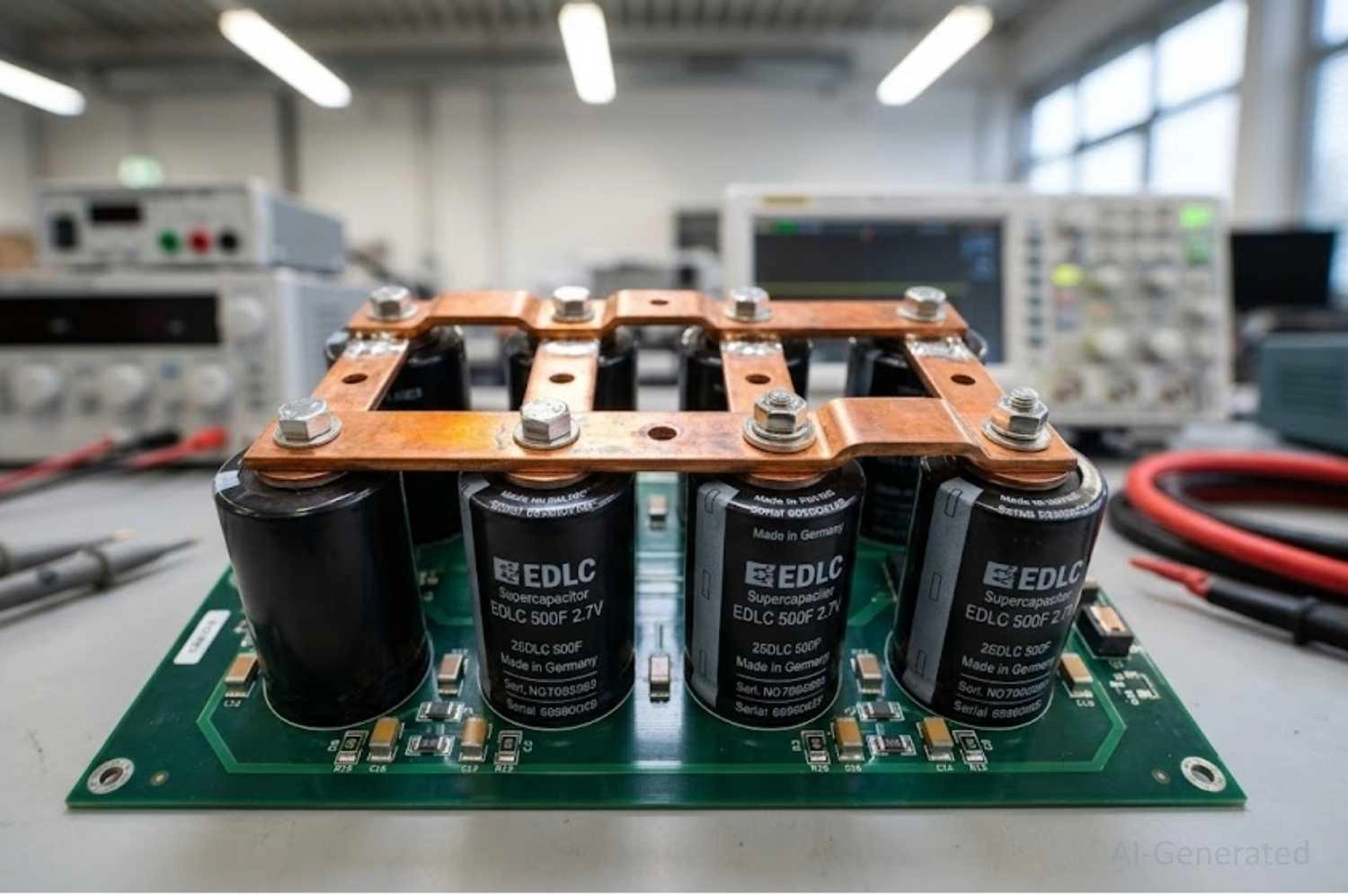
Figure: An array of industrial cylindrical supercapacitor modules mounted on a PCB, featuring heavy-duty copper busbars designed for rapid, high-current energy discharge in harsh physical environments.
When to Use a Battery
Battery applications are centered on long-duration energy supply and stable voltage output.
- Continuous operation systems: Consumer electronics (phones, laptops, wearables)
- High energy storage needs: Electric vehicles, solar energy storage
- Compact, portable designs: Devices where size and weight are critical constraints
- Low self-discharge requirements: Systems that must retain charge over long idle periods
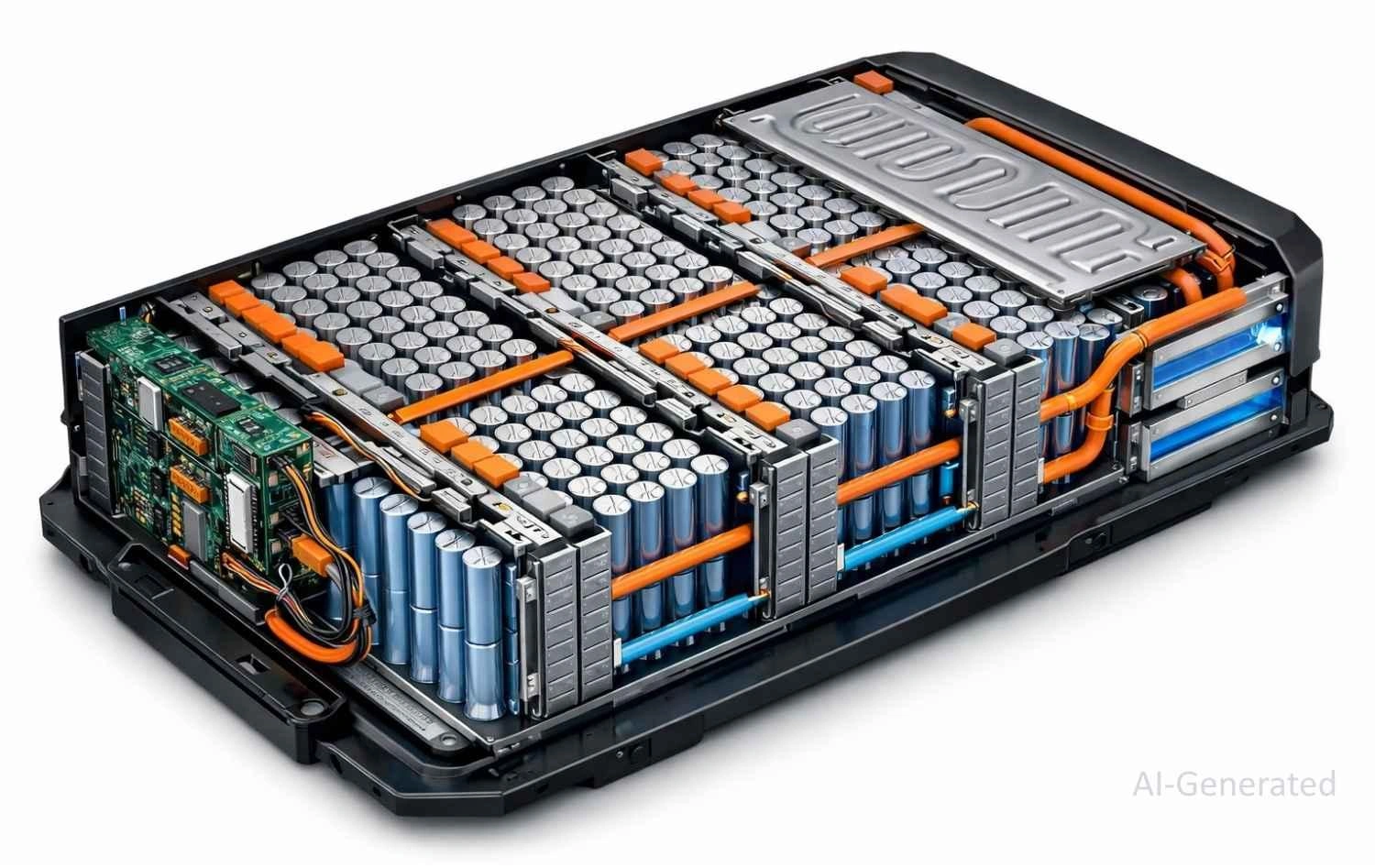
Figure: 3D cutaway render of an electric vehicle lithium-ion battery pack revealing hundreds of tightly grouped cylindrical cells, battery management system wiring, and liquid cooling channels designed for sustained, long-duration high-capacity energy storage.
Quick Decision Table for Supercapacitor vs Battery
| Requirement | Best Choice |
|---|---|
| Long runtime | Battery |
| High peak current | Supercapacitor |
| Fast charging | Supercapacitor |
| Stable voltage | Battery |
| Extreme temperature | Supercapacitor |
| Compact size | Battery |
Note
Key Takeaway: The supercapacitor vs battery decision is governed by system behavior: batteries provide sustained energy, while supercapacitors handle high-power transients and rapid charge/discharge cycles.
Can Supercapacitors Replace Batteries?
A frequent question in hardware engineering is: Can supercapacitors replace batteries entirely?
The short answer is no, not directly.
Supercapacitors cannot fully replace batteries due to low energy density, but they are ideal for high-power and hybrid applications.
While many wonder if supercapacitors are better than batteries, the reality is that neither component is objectively superior. The limitation is fundamentally governed by energy density (Wh/kg), not efficiency or lifespan. Replacing a standard smartphone battery with a supercapacitor would result in a device that charges in 10 seconds but dies in 5 minutes.
However, supercapacitors can replace batteries in specific niche applications where long-term power is unnecessary. For example, they successfully replace coin-cell batteries for RTC (Real-Time Clock) backup during main power loss.
Instead of full replacement, modern engineering leans heavily toward hybrid systems. While conceptually wired in parallel, connecting an empty supercapacitor (0V) directly to a lithium battery would draw a massive, destructive inrush current.
Therefore, engineers implement active power management and load switches to safely govern the current flow, allowing the battery to handle continuous low-draw energy while the supercapacitor safely absorbs extreme load spikes.
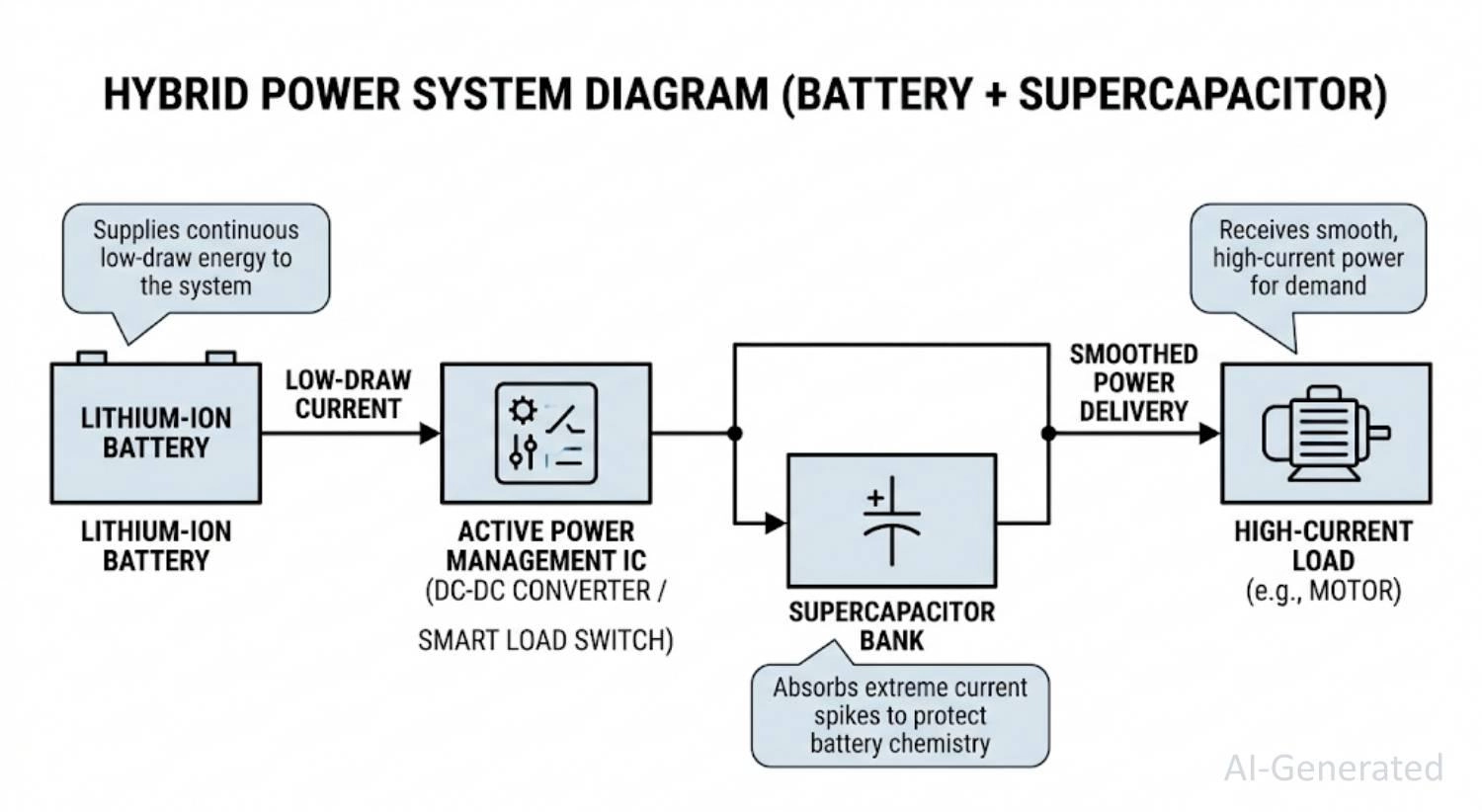
Figure: Electrical schematic of a hybrid power system. It demonstrates a lithium-ion battery supplying continuous low-draw energy to a load, while a parallel supercapacitor bank, managed by an active power controller, absorbs extreme current spikes to protect the battery chemistry.
Supercapacitor vs Battery: Energy Density vs Power Density Explained
The easiest way to understand energy density supercapacitor vs battery differences is through a Ragone Plot. This chart visually graphs energy density (run-time) against power density (instantaneous output).
- Energy Density (Wh/kg): Batteries dominate this metric. Chemical storage allows lithium-ion cells to pack immense amounts of energy into a small volume.
- Power Density (W/kg): Supercapacitors dominate here. Because they store energy electrostatically, they can discharge their entire capacity almost instantly without thermal runaway.
When observing the Ragone plot, capacitors sit at the top left, fuel cells at the bottom right, and batteries in the middle right.
Note
Engineering insight: This trade-off directly determines whether your design behaves as an energy storage system or a power delivery system. This clearly defines the energy density supercapacitor vs battery trade-off that engineers must consider in every power design.
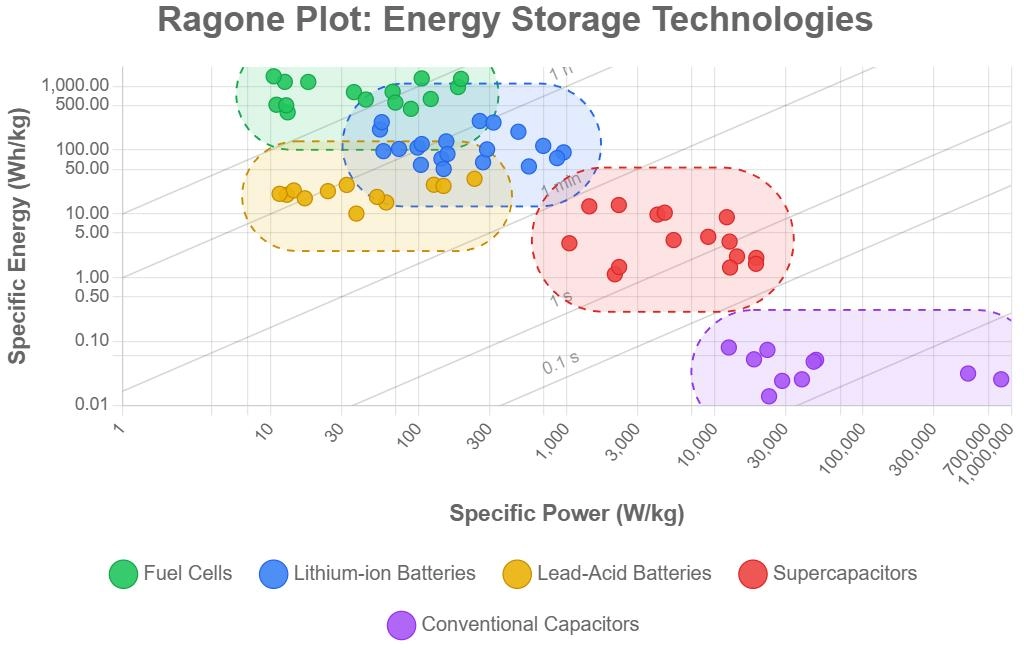
Figure: Ragone plot graph plotting energy density versus power density of batteries and capacitors
What Is a Supercapacitor and How Does It Work?
A supercapacitor (also known as an ultracapacitor) is an electrochemical energy storage device that bridges the gap between conventional capacitors and rechargeable batteries. Unlike batteries, which store energy through chemical reactions, supercapacitors store energy physically by accumulating charge on high-surface-area porous electrodes.
How It Works: The EDLC Principle
Most supercapacitors are Electric Double-Layer Capacitors (EDLCs). Here is the operational breakdown:
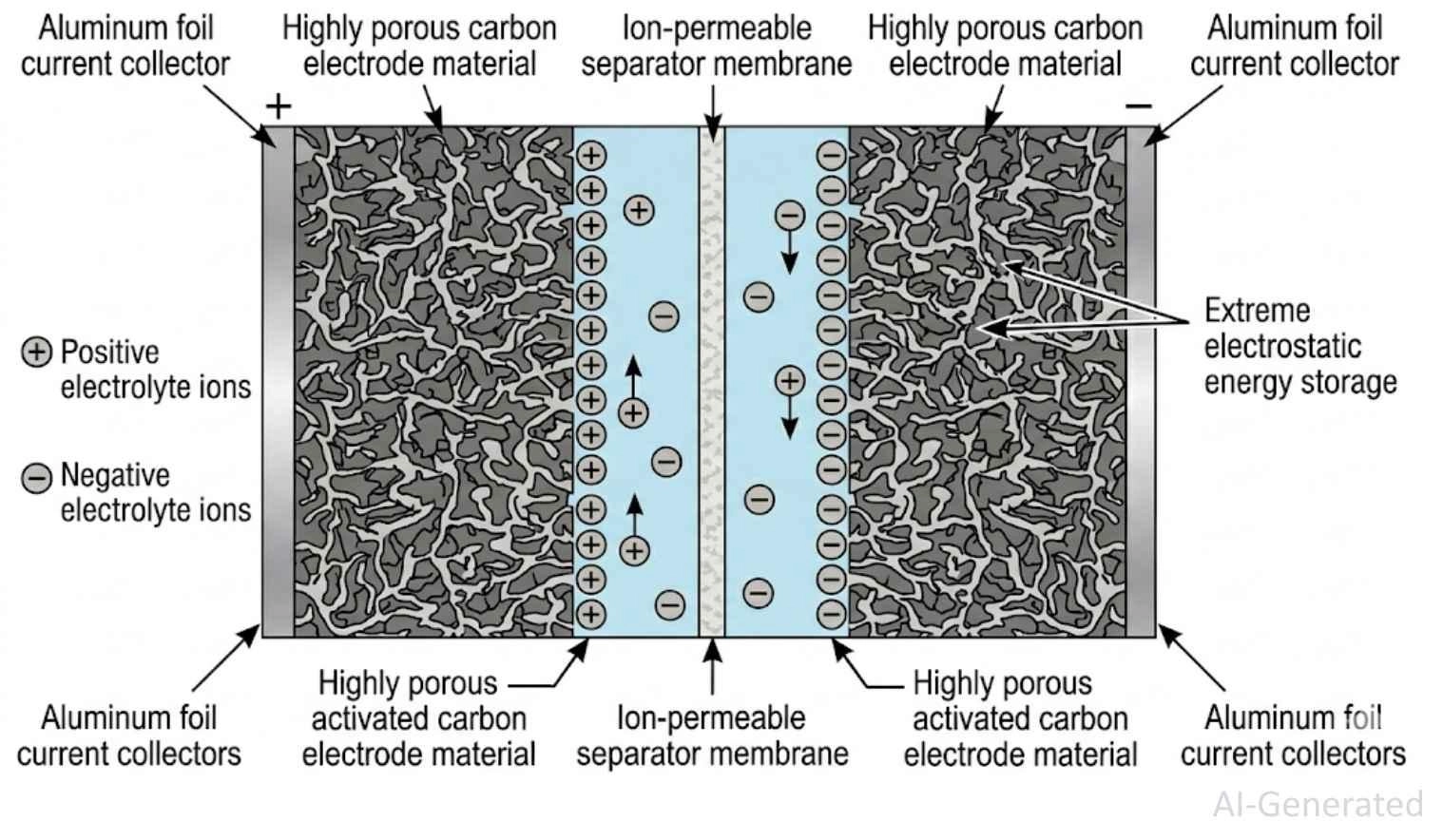
Figure: An Electric Double-Layer Capacitor (EDLC) highlighting its internal physics.
What Is a Battery and How Does It Work?
A battery is an electrochemical energy storage device that converts stored chemical energy into electrical energy. It is optimized for high energy density, meaning it is built to provide sustained, stable power over long durations.
A standard lithium-ion cell contains a positive electrode (cathode), a negative electrode (anode), and a liquid electrolyte. During discharge, lithium ions move from the anode to the cathode, forcing electrons through the external circuit to provide power.
This chemical conversion takes time. Pushing electrons in and out of crystalline structures causes physical expansion and heat, eventually leading to degradation.
Key limitation: Charge/discharge rates are restricted by internal resistance and electrochemical kinetics (C-rate limits).
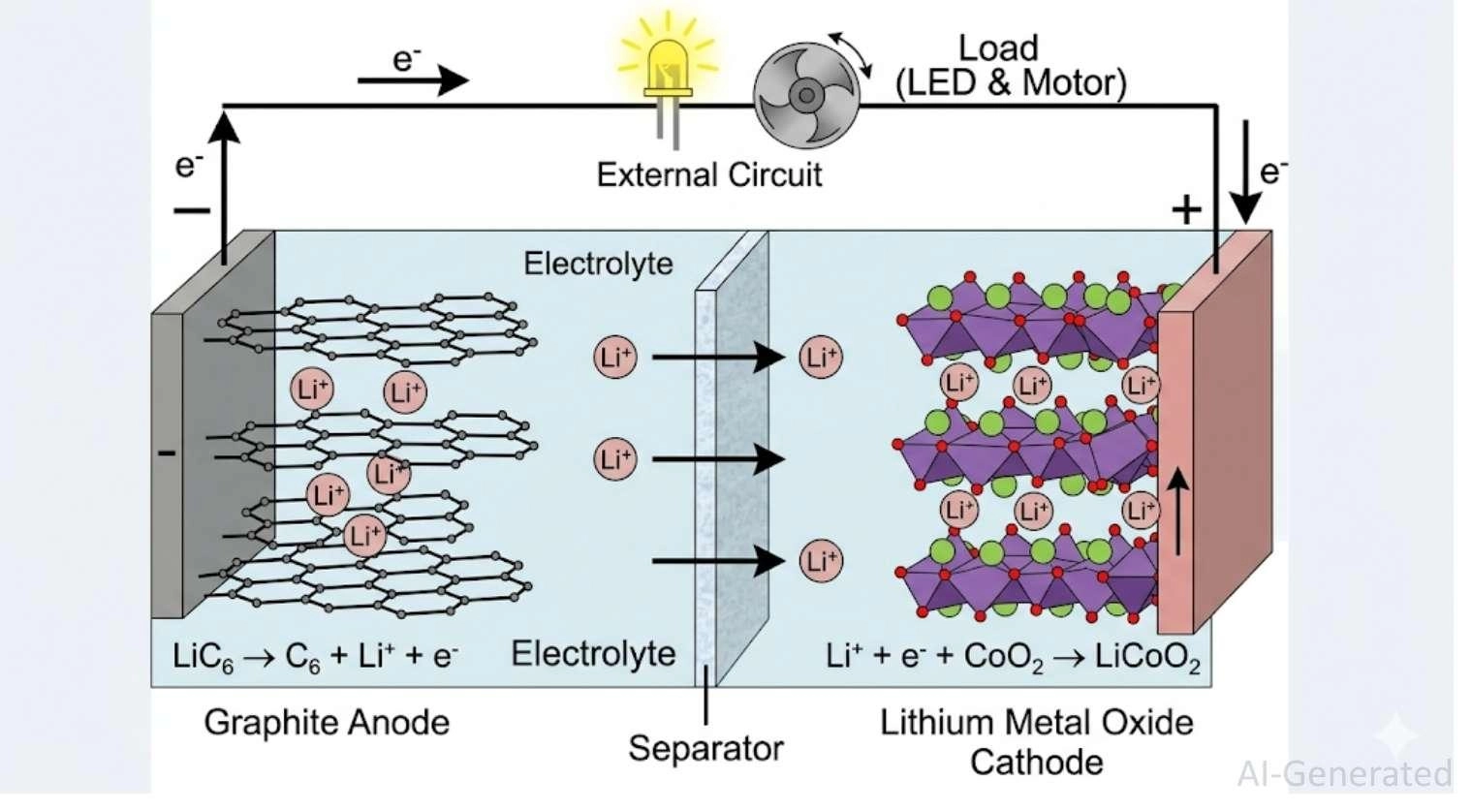
Figure: Chemical mechanism diagram illustrating a lithium-ion battery during discharge.
Advantages and Disadvantages of Supercapacitors
- Virtually Infinite Lifespan: Endures over 1,000,000 charge/discharge cycles with negligible degradation.
- Extreme Thermal Stability: Operates flawlessly in harsh environments ranging from -40°C to +85°C.
- Massive Power Delivery: Ultra-low ESR (Equivalent Series Resistance) enables instantaneous, high-current dumps.
- Lightning-Fast Charging: Achieves full capacity in seconds to minutes without chemical stress.
- Extremely Poor Energy Density: Holds a fraction of the total run-time capacity compared to chemical cells, requiring frequent charging.
- High Self-Discharge: Inherently leaks stored energy rapidly over a matter of days or weeks.
- Linear Voltage Drop: Output voltage decreases linearly as it discharges, demanding complex boost-buck DC-DC regulation to maintain stable IC logic levels.
Advantages and Disadvantages of Batteries
When evaluating the supercapacitor vs battery price ratio over a short product lifecycle, batteries are highly cost-effective, though their chemistry introduces hard limitations.
- Excellent Energy Density: Packs massive amounts of long-duration power (Wh) into a highly compact volume.
- Stable Discharge Curve: Maintains a relatively flat, usable voltage output for the majority of its discharge cycle.
- Low Self-Discharge: Retains stored charge efficiently for months at a time.
- Cost-Effective Capacity: Significantly cheaper initial cost per Watt-hour compared to supercapacitors.
- Limited Lifecycle: Inevitable chemical degradation restricts lifespan to roughly 500–2,000 cycles.
- Thermal Runaway Risks: Highly sensitive to overcharging, physical puncture, and extreme heat, which can lead to fires.
- Slow Charge Times: Electrochemical kinetics (strict C-rates) severely restrict how fast energy can be pushed back into the cell.
- Restricted Power Delivery: Higher internal resistance limits how fast current can be safely drawn without causing destructive thermal stress.
Supercapacitor vs Battery in PCB Design and Electronics Manufacturing
Integrating power sources into a Printed Circuit Board (PCB) requires a mastery of layout, thermal management, and power routing. When evaluating a supercapacitor vs battery design, the rules of SMT layout change dramatically.
1. Power Integrity: Supercapacitors provide excellent transient suppression and bulk decoupling for high-current loads. However, to minimize parasitic inductance, they must be placed as close to the load as possible.
2. Trace Design: Massive current dumps from supercapacitors demand properly calculated current density margins. Engineers must use significantly wider traces and thicker copper layers (e.g., 2oz) to prevent trace melting during a rapid discharge event.
3. Voltage Regulation: Because a supercapacitor's voltage drops linearly as it discharges, complex buck-boost DC-DC converters are mandatory to maintain a stable output for your microcontrollers. Batteries offer a much flatter discharge curve, simplifying the LDO or buck selection.
4. Charging Circuits: Batteries require strict Constant Current/Constant Voltage (CC/CV) charging profiles and thermal monitoring to prevent catastrophic failure. Supercapacitors, conversely, simply need robust current-limiting circuits to prevent power supply brownouts during their massive initial inrush current.
5. Cell Balancing: A single supercapacitor cell typically maxes out between 2.5V and 3.0V. To power standard 5V, 12V, or higher-voltage systems, multiple cells must be placed in series. Because slight manufacturing variances in capacitance can cause one cell to overcharge and fail, engineers must integrate active or passive cell balancing circuits directly into the PCB layout.
Design Tip: Improper trace sizing or placement can lead to voltage drop, EMI issues, or catastrophic failure in high-current supercapacitor discharge paths.
Whether you use SMD supercapacitors or battery management ICs, strict adherence to SMT reflow profiles is vital.
From Design to Production: Bringing Your Power Solutions to Life with JLCPCB
Designing a sophisticated power management system-whether a hybrid supercapacitor array or a strict battery management system (BMS)-requires precision manufacturing.
When moving from a breadboard to a reliable physical product, sourcing high-quality fabrication with controlled impedance, strict SMT tolerances, and multilayer PCB capabilities is essential. JLCPCB provides engineers with industrial-grade manufacturing, ensuring a controlled transition from prototype validation to scalable production.
You can browse an extensive library of verified components on the Parts Library, ensuring you select the exact footprint needed for your schematic. Utilizing PCB Assembly services allows complex power-management ICs to be professionally mounted, saving hours of manual rework.
Supercapacitor Safety and Design Warnings
While supercapacitors are generally safer than lithium-ion batteries regarding thermal runaway, their unique electrical characteristics introduce specific design hazards that hardware engineers must mitigate:
- Catastrophic Short Circuits: Because supercapacitors have ultra-low ESR, an accidental short circuit will dump hundreds of amps almost instantly. This can easily melt PCB traces, vaporize wires, and cause severe burns.
- Strict Voltage Limits: A single cell is typically rated for only 2.5V to 3.0V. Exceeding this limit causes the internal electrolyte to rapidly break down, leading to gas generation, bulging, and eventual rupture.
- Polarity Sensitivity: Unlike non-polarized ceramic capacitors, EDLC supercapacitors are highly sensitive to reverse polarity. Wiring them backward will cause destructive internal outgassing.
- Residual Charge: Supercapacitors hold their charge for extended periods. Always ensure high-power capacitor banks are fully discharged via a bleeding resistor before handling or performing maintenance on the PCB.
FAQ about Supercapacitor and Battery
Q: Supercapacitor vs battery price: which is more cost-effective long-term?
hile batteries have a lower initial cost per Watt-hour, supercapacitors never need replacement. Over a 10-year lifespan in remote or high-cycle applications, a supercapacitor is often far more cost-effective by eliminating maintenance and replacement costs.
Q: How does a supercapacitor vs lithium ion battery compare in EV design?
While lithium-ion batteries provide the energy density needed for vehicle range, supercapacitors excel at regenerative braking. Supercapacitors capture the massive, sudden influx of kinetic energy without overheating, and slowly bleed that energy back into the main lithium-ion battery.
Q: Why do supercapacitors charge faster than batteries?
Supercapacitors store energy electrostatically on the surface of their materials, requiring no chemical changes. Batteries must force lithium ions physically into crystalline structures-a chemical process limited by internal resistance and C-rates, which generates heat if rushed.
Q: Why do supercapacitors have low energy density?
Surface area limits how much total physical charge can be stored electrostatically. This falls far short of the dense chemical slurry inside a battery, resulting in lower Wh/kg.
Q: What is the lifespan difference between batteries and supercapacitors?
A typical battery lasts 500 to 2,000 charge cycles before chemical degradation destroys its capacity. A supercapacitor can easily endure 1,000,000 charge/discharge cycles since it suffers virtually no mechanical wear.
Q: Can supercapacitors work in extreme temperatures?
Yes. Because they do not rely on liquid chemical reactions that can freeze or boil, supercapacitors operate highly efficiently from -40°C to +85°C.
Conclusion
The supercapacitor vs battery decision ultimately comes down to your unique power profile. While batteries offer the marathon-running endurance of chemical storage (Wh), supercapacitors deliver the sprinting power of electrostatic capacitance (W). Often, the most robust engineering solutions use a hybrid of both.
Ready to bring your power architecture to life? Whether you are routing heavy copper for a high-current supercapacitor array or designing a compact battery management system, JLCPCB provides industrial-grade PCB fabrication and PCB assembly. Upload your Gerber files today for an instant Quotation and scale your hardware seamlessly from prototype to mass production.
Popular Articles
• SMD Resistor Package Sizes: Complete Size Chart, Footprints & How to Choose
• How to Solder SMD Components Like a Pro [2026 Updated]
• SMD Resistor Codes: How to Read 3-Digit, 4-Digit, and EIA-96 Markings
• SMD Capacitor Codes: Identification, Markings, and Polarity
• SMD Capacitor Sizes: Complete Size Chart and Selection Tips for PCB Design and Assembly
Keep Learning
SOIC Package: A Complete Guide to Specifications, Types, Uses, and SMT Assembly
As designs transition from legacy through-hole components to high-density Surface Mount Technology (SMT), the Small Outline Integrated Circuit (SOIC) remains the industry standard for operational amplifiers, flash memory, sensors, and microcontrollers. It reflects a well-balanced engineering design, offering a practical compromise between the miniaturisation demanded by modern consumer electronics and the ruggedness required for industrial applications. In this guide, you will learn: SOIC package dime......
What Is a 100nF Capacitor and How Do You Choose the Right One
Key Takeaways Value: A 100nF capacitor has a nominal capacitance of 0.1 µF, or 100,000 pF, and all three names describe the same part value. Marking: Many through-hole ceramic and film capacitors use the three-digit code 104, while most SMD MLCCs are unmarked. Main use: Its most common function is local decoupling at an IC power pin, where it supplies fast transient current and shunts high-frequency noise to ground. Default choice: For general decoupling, an X7R or X5R MLCC is a common starting point;......
SMD Resistor Package Sizes: Complete Size Chart, Footprints & How to Choose
Surface Mount Device (SMD) resistors are fundamental to modern electronics, and selecting the correct package size is a crucial engineering decision that impacts a PCB’s electrical performance, thermal reliability, and manufacturing cost. In this article, you will find practical, authoritative guidance on: The complete SMD resistor size chart (01005 to 2512) with exact dimensions and power ratings. Recommended PCB footprints and guidelines for reflow reliability. Critical trade-offs concerning power d......
PCB Connector Types Explained: Categories, Comparison, Applications and How to Choose the Right One
PCB connectors are essential components for connecting circuit boards with external devices, cables, or other PCBs. Choosing the right connector type affects signal reliability, mechanical stability, and overall product performance. Factors such as current rating, frequency requirements, pitch size, and mounting method should be considered during selection. In this guide, you will learn: The major types of PCB connectors and their applications. How different connector types compare. How to select the ......
What Is a System on a Chip (SoC)? A Complete Guide for PCB Designers
Nearly every electronic device you interact with today, from smartphones and IoT sensors to industrial controllers and AI edge systems, is powered by a System on a Chip (SoC). By integrating processors, memory controllers, communication interfaces, and specialized accelerators onto a single piece of silicon, SoCs deliver the performance, power efficiency, and compact form factors modern electronics demand. Whether you're selecting a processor for an embedded Linux design, evaluating an AI-capable plat......
Capacitors in PCB Design_ A Complete Guide to All Types
Capacitors are indispensable components in PCB (Printed Circuit Board) design, providing functionality from energy storage and noise filtering to voltage regulation. Whether you're designing a simple circuit or a complex multi-layer board, understanding the different types of capacitors and their applications is crucial. The basic structure of a capacitor consists of two metal plates separated by a layer of dielectric. Capacitors can be of fixed or variable type. The ability of the capacitor to hold e......