Supercapacitor vs Capacitor: Differences, Performance, Applications and How to Choose
14 min
- Supercapacitor vs Capacitor: Key Differences
- Supercapacitor vs Capacitor: How to Choose?
- Can Supercapacitors Replace Capacitors?
- Supercapacitor vs Electrolytic Capacitor
- Supercapacitor vs Capacitor in Real Applications and Selection
- Supercapacitor vs Capacitor: Energy Density vs Power Density
- Supercapacitor vs Capacitor in PCB Design and Power Systems
- What Is a Supercapacitor?
- What Is a Capacitor?
- Supercapacitor vs Capacitor: Advantages and Limitations
- Common Mistakes in Choosing Supercapacitors vs Capacitors
- Supercapacitor Charging and Discharging Behavior
- FAQ about Supercapacitor and Capacitor
- Conclusion
Key Takeaways
The main difference between a capacitor and a supercapacitor lies in energy density versus power delivery speed.
While standard capacitors discharge rapid bursts of power in milliseconds, supercapacitors store massive amounts of energy for longer durations to act as short-term battery replacements.
- Choose a supercapacitor if: You need short-term energy backup
- Choose a capacitor if: You need high-frequency noise filtering
When designing modern electronic power systems, engineers frequently face a critical choice: supercapacitor vs capacitor.
This data-driven guide breaks down their key differences, engineering metrics, and exactly how to select the right component for your next PCB project.
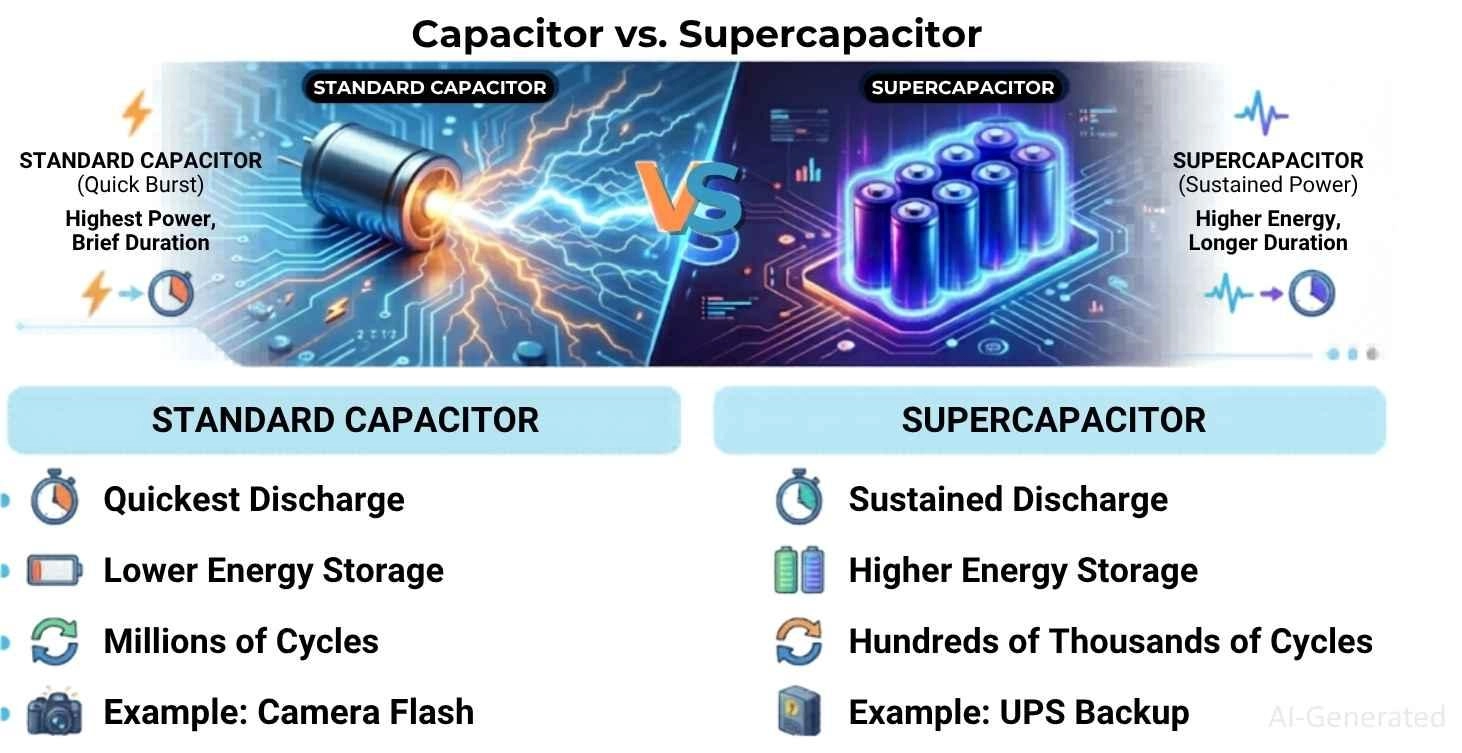
Supercapacitor vs Capacitor: Key Differences
| Feature | Standard Capacitor | Supercapacitor (EDLC) |
|---|---|---|
| Capacitance Range | Pico-farads (pF) to Milli-farads (mF) | Farads (F) to Thousands of Farads (kF) |
| Energy Density | Low (< 0.1 Wh/kg) | High (1 to 10 Wh/kg) |
| Power Density | Extremely High (> 10,000 W/kg) | Moderate (500 to 5,000 W/kg) |
| Charge/Discharge Time | Microseconds to Milliseconds | Seconds to Minutes |
| Voltage Rating | High (Up to 1000V+) | Low (Typically 2.5V - 3.3V per cell) |
| Lifespan (Cycles) | Virtually Unlimited | 500,000 to 1,000,000+ Cycles |
| Primary Function | Filtering, Timing, Decoupling | Energy Storage, Backup Power |
Understanding the difference between capacitor and supercapacitor technologies starts with their fundamental specifications and internal physics.
Standard capacitors rely on a solid dielectric, limiting their overall capacity but enabling blazing-fast response times.
In contrast, supercapacitors utilize a microscopic electric double-layer (EDLC). This allows them to achieve capacitance values thousands of times higher, albeit with lower voltage limits.
Key Insight: Supercapacitors trade voltage capability for massive energy density.
From an engineering standpoint, the differences are drastic:
- ESR (Equivalent Series Resistance): Capacitors have an ESR < 10 mΩ (like in MLCCs), making them ideal for high-frequency decoupling. Supercapacitors range from 10 mΩ to several Ω, resulting in noticeable voltage drops under heavy load.
- ESL (Equivalent Series Inductance): Standard capacitors (especially MLCCs) have extremely low ESL, allowing operation into MHz ranges. Supercapacitors exhibit high ESL, making them unsuitable for high-frequency decoupling.
- Frequency Response: Capacitors operate seamlessly into the MHz range; supercapacitors are heavily limited to low-frequency applications (<1 kHz).
Supercapacitor vs Capacitor: How to Choose?
When to Use Supercapacitors
- RTC & SRAM Backup: Bridging power gaps during main battery swaps by maintaining a 3.3V line at a microampere current draw for weeks.
- Peak Load Shaving: Assisting primary batteries during high-current transmission bursts (e.g., 2A pulses in GSM/LTE-M modules) to prevent severe voltage droop.
- Energy Harvesting Storage: Accumulating trickles of energy from high-impedance sources (like piezo crystals or indoor photovoltaics) until sufficient charge is reached to wake up an MCU.
When to Use Capacitors
- High-Frequency Decoupling: Bypassing high-frequency transient noise (MHz range) directly at IC power pins using ultra-low ESL/ESR ceramic capacitors (MLCCs).
- Bulk Power Filtering: Using large aluminum electrolytic capacitors in Switched-Mode Power Supplies (SMPS) to absorb low-frequency AC ripple and maintain a steady DC output.
- Signal Coupling & Isolation: Blocking DC bias voltages while passing delicate AC signals in RF and audio stages, requiring highly stable dielectrics like C0G/NP0.
Can Supercapacitors Replace Capacitors?
No, supercapacitors cannot entirely replace standard capacitors in most circuit designs. While it might seem tempting to use a massive 1F supercapacitor everywhere, they are fundamentally unsuited for certain tasks:
- Frequency Response: Supercapacitors cannot filter high-frequency AC noise due to their higher ESR and slow response times.
- Voltage Limits: A single supercapacitor maxes out around 2.7V to 3.3V. Handling higher voltages requires complex active balancing circuits.
- Leakage Current: Supercapacitors have significantly higher self-discharge rates, making them poor choices for precision long-term timing circuits.
Supercapacitor vs Electrolytic Capacitor
When bridging the gap between bulk filtering and minor energy storage, the supercapacitor vs electrolytic capacitor debate is common.
Electrolytic capacitors are the absolute kings of bulk power filtering. They can easily handle 400V+ and possess excellent ripple-current ratings. This makes electrolytics mandatory in AC-DC power supplies.
Supercapacitors, however, cannot handle high AC ripple without overheating due to their internal ESR.
If you need to smooth out a 60Hz mains rectification, use an electrolytic. If you need to keep a microcontroller alive for 10 seconds, use a supercapacitor.
Supercapacitor vs Capacitor in Real Applications and Selection
Short-Term Energy Storage and Backup System
Standard capacitors are too small for bulk system backup. Supercapacitors are the industry standard for backing up volatile memory (SRAM) and RTCs during battery replacements.
They also excel in grid applications; if a smart-meter loses grid power, a supercapacitor provides a crucial 10-20 second window to transmit a final wireless alert before shutting down safely.
- Use Case: IoT Sensor Backup
- Requirement: Maintain a 3.3V power supply for 5 seconds during a battery swap.
- Selection Math: If your system draws 100mW, the required energy is E = P ✖ t. So, 100mW ✖ 5 = 0.5J.
- Best Choice: A 1F supercapacitor at 3.3V holds = 5.4J. This is more than sufficient. A standard capacitor would fall drastically short.
High Frequency Power Supply Filtering
While supercapacitors handle bulk energy, standard capacitors are strictly required for high-speed signal integrity.
- Use Case: DC-D Converter Noise
- Requirement: Smooth out 100kHz switching noise in a DC-DC converter.
- Best Choice: Standard Capacitor (Ceramic/Electrolytic).
- Reason: Capacitors possess ultra-low Equivalent Series Resistance (ESR) and ESL, responding in microseconds to suppress high-frequency ripple.
Regenerative Energy Systems
In wind turbines and elevators, massive kinetic energy spikes occur frequently. Supercapacitors capture these sudden bursts instantly, reducing mechanical stress and improving overall efficiency.
- Use Case: EV Regenerative Braking System
- Requirement: Absorb massive spikes of kinetic energy instantly and release it during acceleration.
- Best Choice: Supercapacitor (often paired with batteries).
- Reason: Batteries charge too slowly to capture sudden braking energy. Supercapacitors bridge the gap, absorbing the high-current burst safely.
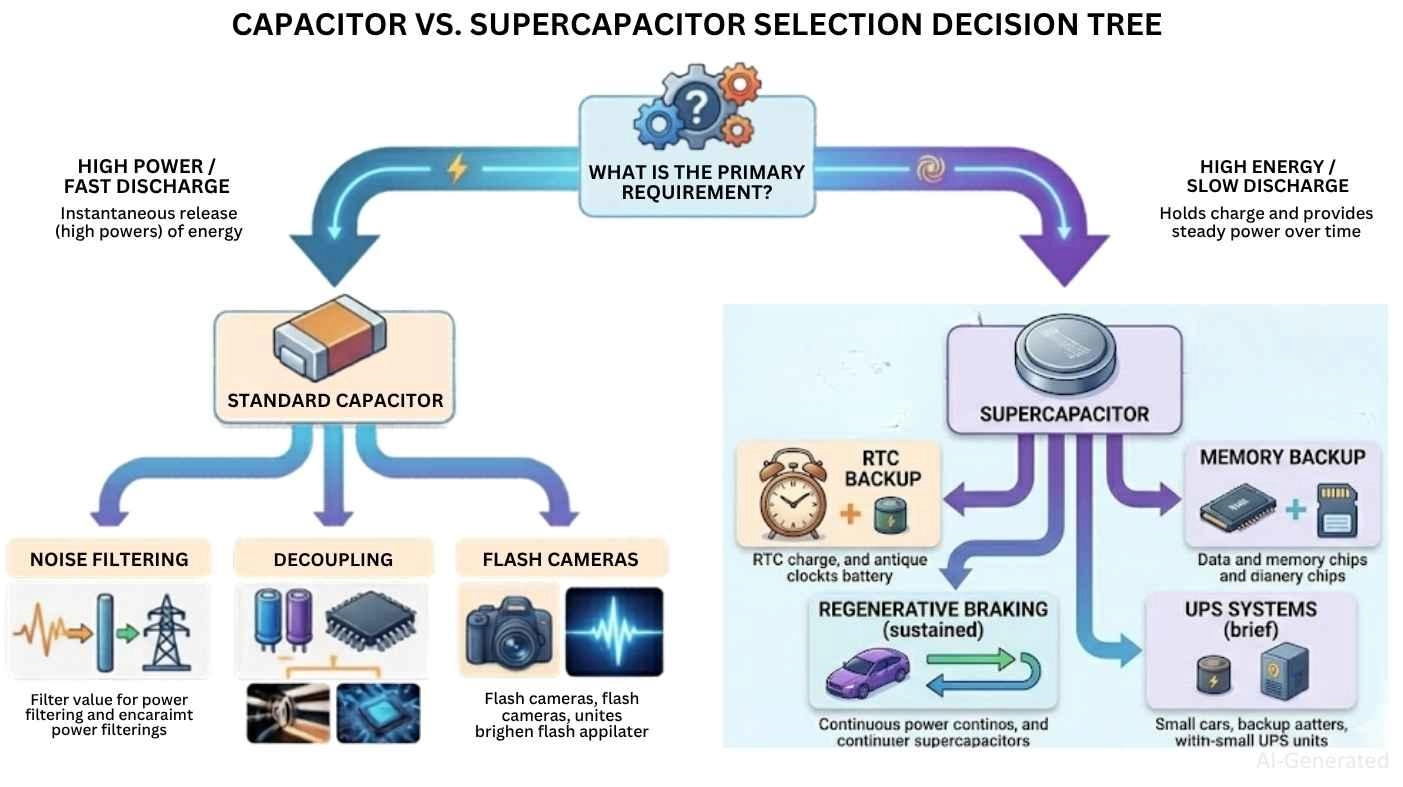
Figure: Decision flowchart for choosing between supercapacitors and normal capacitors in circuit design.
Supercapacitor vs Capacitor: Energy Density vs Power Density
The ultimate difference between capacitor and supercapacitor performance comes down to density metrics.
Why Supercapacitors Store More Energy
Energy density measures how much total energy a component can hold per kilogram.
Because supercapacitors utilize nanoporous materials, their effective surface area is immense, allowing massive energy storage.
Why Capacitors Deliver Faster Power
Power density measures how quickly that energy can be released.
Standard capacitors have very short charge pathways, allowing them to dump their entire payload instantly.
Typical Ragone Context Ranges:
- Capacitors: 10,000–100,000 W/kg (Power), <0.1 Wh/kg (Energy)
- Supercapacitors: 500–5,000 W/kg (Power), 1–10 Wh/kg (Energy)
- Batteries: 100–1,000 W/kg (Power), 100–250 Wh/kg (Energy)
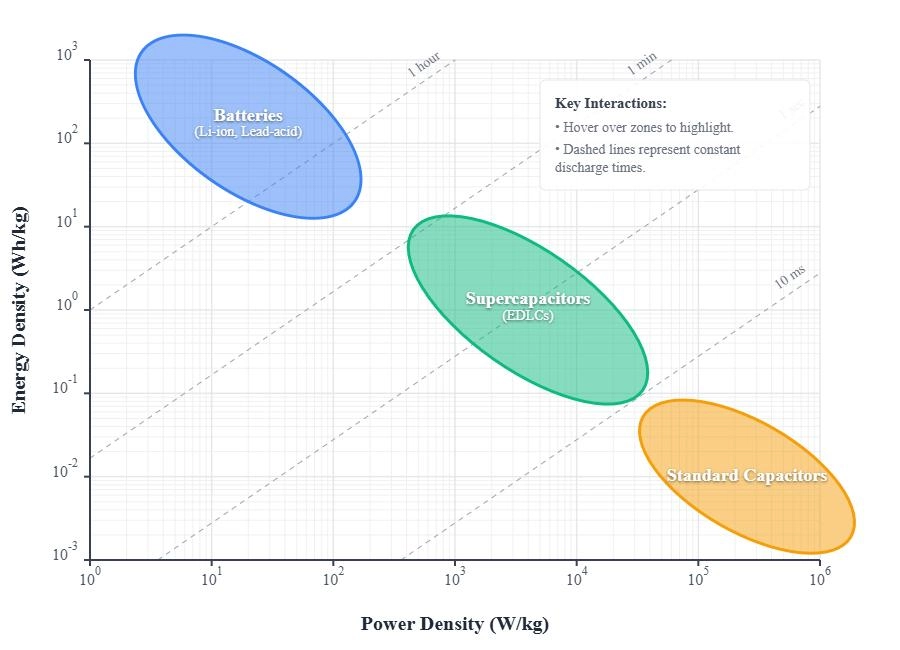
Figure: Ragone chart comparing energy and power density of capacitors, supercapacitors, and batteries.
Supercapacitor vs Capacitor in PCB Design and Power Systems
Transitioning your choice into a physical board requires strict attention to PCBA manufacturing rules and layout constraints.
PCB Layout Impact
Standard capacitors used for decoupling must be placed as close to the IC power pins as possible.
Loop Inductance Minimization: High-current paths between the supercapacitor and load must be minimized to reduce voltage spikes caused by parasitic inductance.
Supercapacitors require careful trace design. Because they pull massive current, engineers should use wide copper pours and consider 2oz copper thickness.
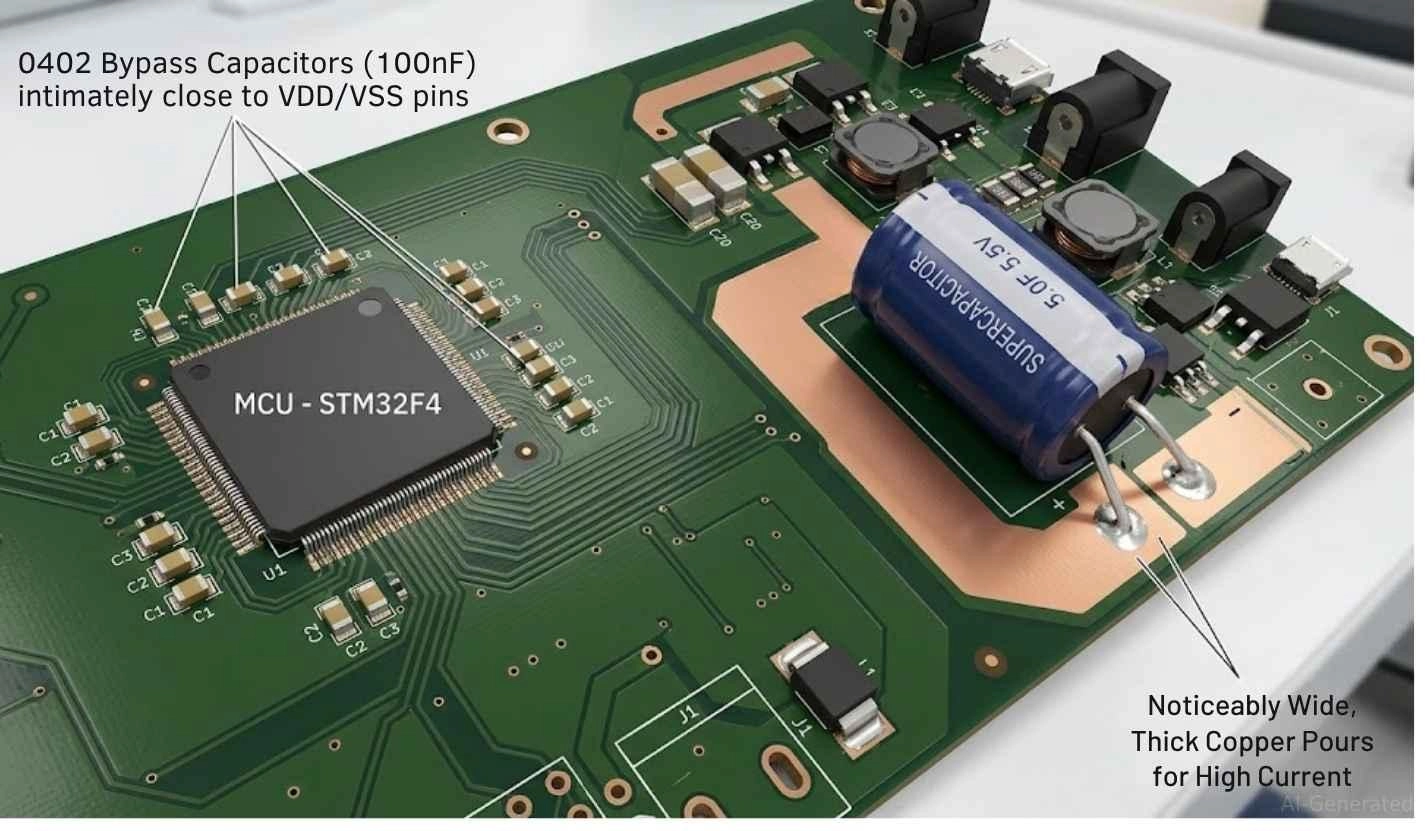
Figure: PCB layout comparison showing trace width differences for bypass capacitors vs supercapacitors.
Inrush and Protection Circuitry
When an empty supercapacitor is powered, the inrush current is extreme.
You must include inrush current limiters or dedicated charging ICs.
Furthermore, if stacking supercapacitors for 5V systems, balancing resistors or overvoltage protection (OVP) ICs are strictly required to prevent cell failure.
BOM Optimization and Production
When optimizing your Bill of Materials (BOM), ensure you source highly reliable SMD components.
You can explore a massive library of verified parts via the JLCPCB Parts Library.
Manual soldering of large supercapacitors is tedious and risks thermal damage.
Utilizing a professional PCB Assembly service guarantees accurate reflow profiles and perfect solder joints for full-scale production.
What Is a Supercapacitor?
A supercapacitor (often termed an ultracapacitor or EDLC) is a high-density, low-voltage electrochemical energy storage component.
It bridges the critical power-energy gap in circuit design by offering power densities exponentially higher than lithium-ion batteries, while possessing an energy storage capacity hundreds of times greater than standard electrolytic capacitors.
How Does A Supercapacitor Work (Supercapacitor Working Principle)
A supercapacitor operates on the principle of electrostatic adsorption rather than bulk dielectric polarization.
When a potential difference is applied, the device does not polarize a solid insulating lattice. Instead, it creates a pure electrostatic energy buffer by physically separating solvated ions within a conductive liquid electrolyte across a vast, highly porous carbon matrix.
Electrochemical Double-Layer Mechanism
EDLCs store charge by forming a Helmholtz double layer at the electrode–electrolyte interface.
This involves a localized accumulation of solvated ions at the mesoporous carbon surface, with a charge separation distance on the order of 0.1–1 nm.
Capacitance is therefore:
- Directly proportional to surface area (up to ~2000 m²/g)
- Inversely proportional to charge separation distance
This purely electrostatic mechanism avoids Faradaic reactions, resulting in superior cycle life and stability.
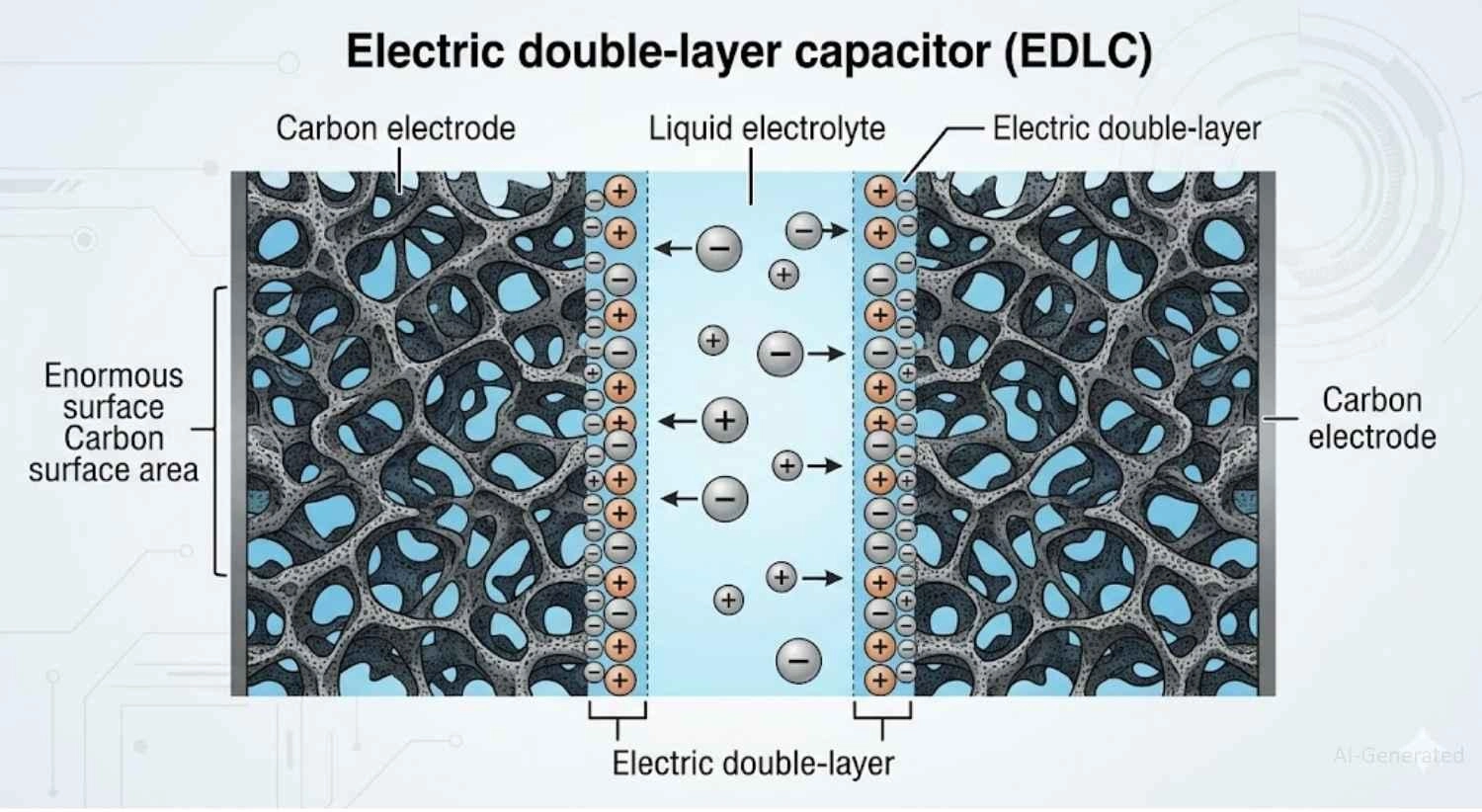
Figure: Internal structure of an Electric double-layer capacitor (EDLC) showing porous carbon electrodes, electrolyte, and ion movement forming a double layer.
Types of Supercapacitors
- EDLC: Pure electrostatic storage, highest cycle life.
- Pseudocapacitors: Use fast, reversible surface chemical reactions.
- Hybrid Capacitors: Combine EDLC and battery technology for higher voltage and density.
What Is a Capacitor?
A capacitor is a two-terminal passive electronic component designed to store and release electrical energy instantaneously through an electrostatic field.
Unlike batteries that rely on slow chemical reactions, a capacitor acts as an immediate electrostatic reservoir, heavily utilized for high-frequency AC filtering, DC voltage smoothing, and rapid transient power delivery.
If you are learning how to read a schematic, familiarizing yourself with the standard capacitor symbol is the first step to understanding its structural role.
How Does A Capacitor Work (Capacitor Working Principle)
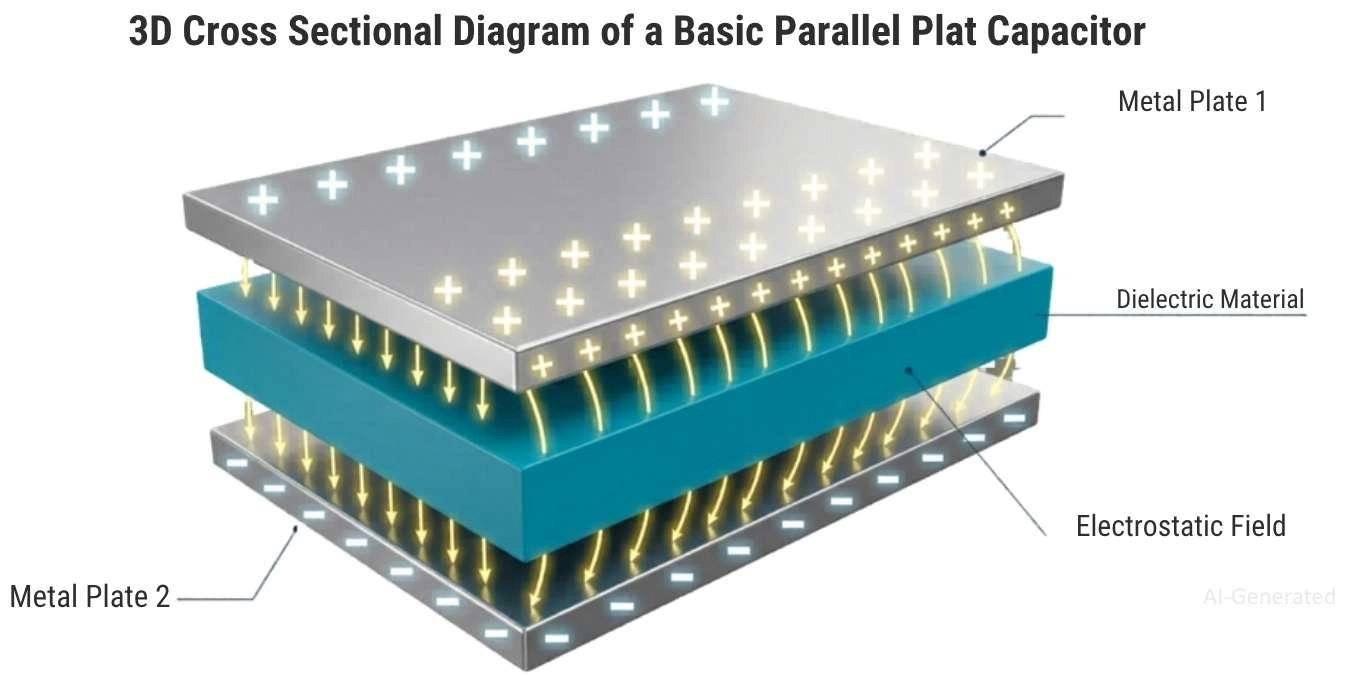
A capacitor consists of two parallel conductive plates separated by an insulating material called a dielectric.
When a voltage is applied, an electric field (E = V/d) develops across the dielectric, polarizing its internal molecular structure. This allows positive charges to gather on one plate and negative charges on the other.
The total capacitance is directly proportional to the plate surface area (A) and the dielectric's permittivity (ϵ), and inversely proportional to the distance (d) between them, governed by the equation
Energy Storage Mechanism
Energy is stored electrostatically via the physical separation of electrical charges, which induces dipole polarization within the dielectric lattice.
Because there is no Faradaic (chemical) electron transfer, the process relies entirely on displacement current, allowing discharge times in the nanosecond to microsecond range.
Common Types of Capacitors
- Ceramic: Tiny, low capacitance, excellent for high-frequency filtering.
- Electrolytic: Larger capacitance, polarized, used for bulk power smoothing.
- Film: High voltage tolerance, used in power electronics and audio.
Supercapacitor vs Capacitor: Advantages and Limitations
Advantages of Supercapacitors
- High-Density Storage: Delivers up to 10 Wh/kg of energy density, successfully bridging the critical gap between passive components and chemical batteries.
- Rapid Power Delivery: Offers a much higher power density (W/kg) than lithium-ion cells, allowing for safe, high-current pulses without the risk of thermal runaway.
- Wide Temperature Range: Operates reliably in extreme environments (often -40°C to +85°C) without the severe capacity loss seen in traditional batteries.
Disadvantages of Supercapacitors
- Strict Voltage Constraints: Individual cells are typically limited to 2.5V-3.3V, requiring stringent thermal and voltage derating to prevent electrolyte breakdown.
- High Leakage Current: Self-discharge rates are significantly higher than both standard capacitors and batteries, making them unsuitable for long-term energy retention.
- Complex Balancing Requirements: Stacking cells for 5V, 12V, or 24V systems strictly requires active or passive balancing networks to prevent catastrophic cell overvoltage.
Advantages of Capacitors
- Infinite Cycle Life: No chemical degradation allows for millions of rapid charge/discharge cycles without capacity fade.
- Superior Voltage Tolerance: Dielectric materials can withstand massive potentials, easily scaling past 1000V for high-power applications.
- Ultra-Fast Transients: Near-zero ESL enables instantaneous current delivery, making them mandatory for high-frequency RF and digital decoupling.
Disadvantages of Capacitors
- Micro-Scale Energy Limits: Volumetric energy density is exceptionally low, meaning they can only sustain loads for microseconds or milliseconds.
- Physical Bulk: Achieving even a single farad of bulk capacitance with standard electrolytics would require a physically massive component footprint.
Common Mistakes in Choosing Supercapacitors vs Capacitors
Supercapacitor Charging and Discharging Behavior
Understanding transient behavior is critical for power engineers designing backup or pulse-power systems.
RC Time Constant Comparison
In a standard capacitor, the RC time constant (𝜏 = R ✖ C) is typically measured in nanoseconds or microseconds due to their low capacitive values.
Because of their massive farad-level capacity, a supercapacitor's time constant stretches into seconds or even minutes, requiring completely different timing and power management calculations.
Charge Curve Differences
Standard capacitors charge almost instantaneously, bounded primarily by trace inductance and their ultra-low internal resistance.
Conversely, an uncharged supercapacitor behaves like a near short-circuit, pulling an extreme inrush current that can instantly trigger power supply overcurrent protections.
Charge Limitation Insight: To prevent system failure, engineers must implement active constant-current (CC) charging circuits or soft-start ICs to safely manage the initial charge phase.
Voltage Droop Characteristics
During high-current discharge pulses, supercapacitors experience an immediate, non-capacitive voltage drop known as "voltage droop."
This is calculated strictly by Ohm's Law (Vdroop = Iload ✖ ESR), highlighting exactly why selecting a low-ESR supercapacitor is vital for maintaining voltage limits under heavy loads.
Energy Efficiency Consideration: High internal resistance not only worsens voltage droop but also dissipates energy as heat (I2R loss), which must be accounted for in thermal design calculations.
FAQ about Supercapacitor and Capacitor
Q: What is the main difference between a capacitor and a supercapacitor?
The primary difference is the storage mechanism. Capacitors use solid dielectrics for fast, low-energy bursts. Supercapacitors use a porous double-layer to store massive amounts of energy.
Q: Can a supercapacitor replace an electrolytic capacitor?
Usually, no. In a supercapacitor vs electrolytic capacitor comparison, electrolytics handle higher voltages and filter AC ripple much better.
Q: What are supercapacitors used for in everyday life?
If you are still wondering exactly what are supercapacitors used for, they are heavily utilized in IoT devices, dashcams, and regenerative braking systems in hybrid vehicles to provide rapid bursts of power without degrading.
Q: Do supercapacitors degrade over time?
Yes, but much slower than chemical batteries. They endure hundreds of thousands of cycles, though high temperatures can cause the internal electrolyte to evaporate.
Conclusion
The decision between a supercapacitor vs capacitor ultimately comes down to your circuit's specific engineering needs.If your system requires high-frequency noise filtering, signal decoupling, or handling high voltages, standard electrolytic and ceramic capacitors remain unmatched.
However, if you need a reliable, fast-charging energy buffer for IoT backups or power-loss protection, supercapacitors are the superior choice.
Popular Articles
• SMD Resistor Package Sizes: Complete Size Chart, Footprints & How to Choose
• How to Solder SMD Components Like a Pro [2026 Updated]
• SMD Resistor Codes: How to Read 3-Digit, 4-Digit, and EIA-96 Markings
• SMD Capacitor Codes: Identification, Markings, and Polarity
• SMD Capacitor Sizes: Complete Size Chart and Selection Tips for PCB Design and Assembly
Keep Learning
SOIC Package: A Complete Guide to Specifications, Types, Uses, and SMT Assembly
As designs transition from legacy through-hole components to high-density Surface Mount Technology (SMT), the Small Outline Integrated Circuit (SOIC) remains the industry standard for operational amplifiers, flash memory, sensors, and microcontrollers. It reflects a well-balanced engineering design, offering a practical compromise between the miniaturisation demanded by modern consumer electronics and the ruggedness required for industrial applications. In this guide, you will learn: SOIC package dime......
What Is a 100nF Capacitor and How Do You Choose the Right One
Key Takeaways Value: A 100nF capacitor has a nominal capacitance of 0.1 µF, or 100,000 pF, and all three names describe the same part value. Marking: Many through-hole ceramic and film capacitors use the three-digit code 104, while most SMD MLCCs are unmarked. Main use: Its most common function is local decoupling at an IC power pin, where it supplies fast transient current and shunts high-frequency noise to ground. Default choice: For general decoupling, an X7R or X5R MLCC is a common starting point;......
SMD Resistor Package Sizes: Complete Size Chart, Footprints & How to Choose
Surface Mount Device (SMD) resistors are fundamental to modern electronics, and selecting the correct package size is a crucial engineering decision that impacts a PCB’s electrical performance, thermal reliability, and manufacturing cost. In this article, you will find practical, authoritative guidance on: The complete SMD resistor size chart (01005 to 2512) with exact dimensions and power ratings. Recommended PCB footprints and guidelines for reflow reliability. Critical trade-offs concerning power d......
PCB Connector Types Explained: Categories, Comparison, Applications and How to Choose the Right One
PCB connectors are essential components for connecting circuit boards with external devices, cables, or other PCBs. Choosing the right connector type affects signal reliability, mechanical stability, and overall product performance. Factors such as current rating, frequency requirements, pitch size, and mounting method should be considered during selection. In this guide, you will learn: The major types of PCB connectors and their applications. How different connector types compare. How to select the ......
What Is a System on a Chip (SoC)? A Complete Guide for PCB Designers
Nearly every electronic device you interact with today, from smartphones and IoT sensors to industrial controllers and AI edge systems, is powered by a System on a Chip (SoC). By integrating processors, memory controllers, communication interfaces, and specialized accelerators onto a single piece of silicon, SoCs deliver the performance, power efficiency, and compact form factors modern electronics demand. Whether you're selecting a processor for an embedded Linux design, evaluating an AI-capable plat......
Capacitors in PCB Design_ A Complete Guide to All Types
Capacitors are indispensable components in PCB (Printed Circuit Board) design, providing functionality from energy storage and noise filtering to voltage regulation. Whether you're designing a simple circuit or a complex multi-layer board, understanding the different types of capacitors and their applications is crucial. The basic structure of a capacitor consists of two metal plates separated by a layer of dielectric. Capacitors can be of fixed or variable type. The ability of the capacitor to hold e......