ANGELO Project with JLCPCB: Building an Open-Source Audio PCB for a Listening Aid
10 min
- The ANGELO Project Overview
- Project Architecture: Understanding the ANGELO Audio System
- Audio PCB Design and Technical Specifications
- Manufacturing Workflow: From EasyEDA to JLCPCB SMT Assembly
- Mechanical Snap-Fit Case and Community Impact
- Open Hardware Ecosystem: EasyEDA, JLCPCB, JLC3DP, LCSC, and OSHWLab
- Final Result: Turning an Open-Source Idea into Real Hardware
- FAQs about ANGELO Project
- Conclusion
Key Takeaways
- Accessible Design: ANGELO is an open-source €10 listening aid created to assist everyday voice amplification.
- Analog Audio Architecture: Uses a TL072 op-amp to boost speech frequencies (1–4 kHz) with low latency and low power.
- EasyEDA & JLCPCB Workflow: Designed in EasyEDA and produced via JLCPCB SMT assembly for fast, reliable hardware execution.
The ANGELO Project Overview
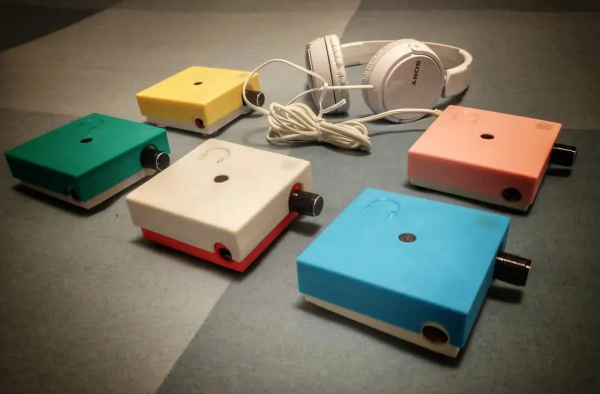
ANGELO is an open-source audio hardware project designed to amplify voices and improve everyday communication experiences for people with hearing difficulties. Based on an analog audio circuit, the device provides a simple and accessible approach to voice amplification while allowing makers, engineers, and communities to explore and reproduce the design.
The idea behind ANGELO came from a real-life communication challenge during the COVID-19 pandemic. Face masks and social distancing made conversations more difficult, especially for elderly people with hearing challenges. Inspired by helping a 104-year-old family member hear conversations more clearly, the project creator developed ANGELO as an exploration of how affordable electronics could support better human interaction.
Although ANGELO is not a medical device and is not intended to replace professional hearing assistance products, the project reflects the growing global interest in accessible technology. In September 2026, the United Nations General Assembly adopted its first resolution on “Access to Assistive Technology,” highlighting the importance of improving the availability and affordability of assistive technologies to support inclusion and participation worldwide.
As an open-source hardware project supported by EasyEDA Spark, ANGELO benefits from the collaboration of the broader hardware ecosystem, including EasyEDA, JLCPCB, LCSC, JLC3DP and OSHWLab. These platforms support different stages of development, from PCB design and component preparation to manufacturing and community sharing, helping transform an electronic concept into a functional product.
Project Architecture: Understanding the ANGELO Audio System
Unlike modern commercial audio products that rely on digital signal processors and software algorithms, ANGELO adopts an all-analog audio circuit architecture. This keeps the hardware straightforward, low latency, easy to understand, and practical for makers, students, and community developers to reproduce or modify within an open-source framework.
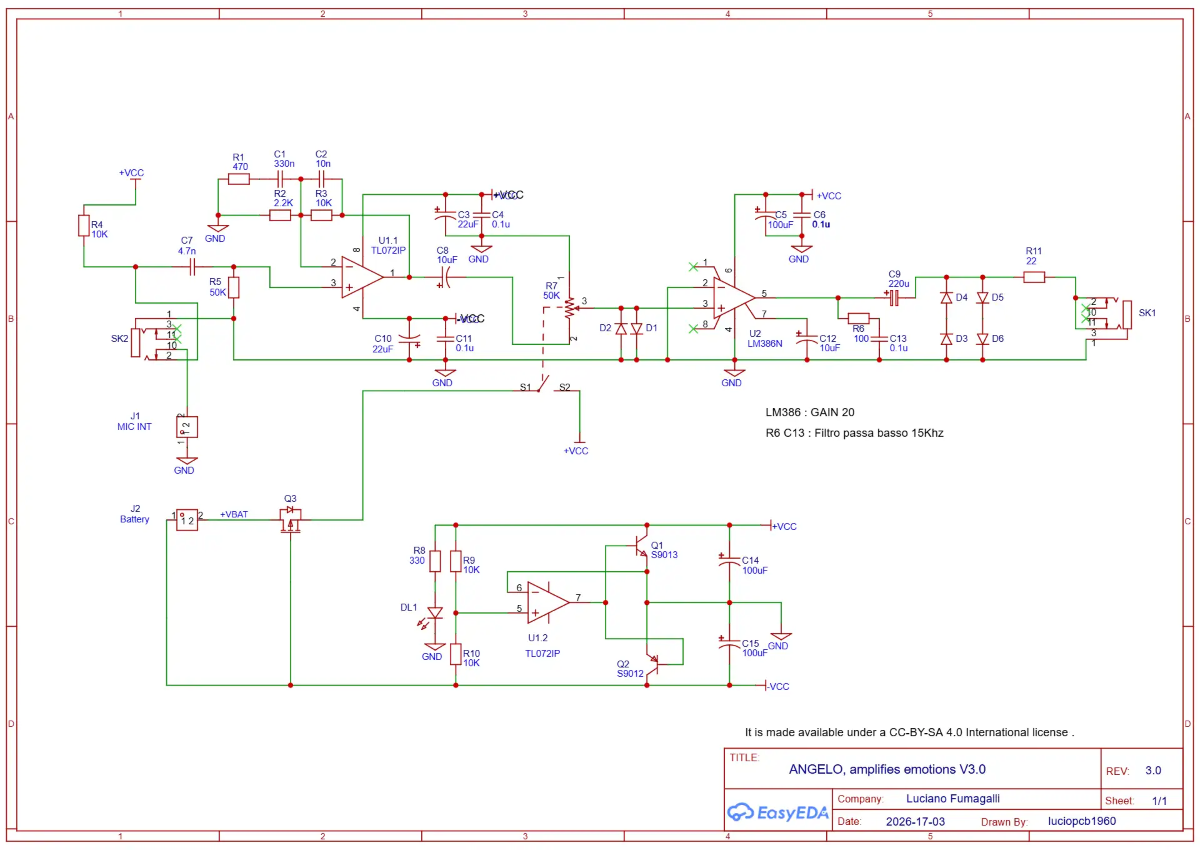
The overall audio system processes sound through four sequential stages:Audio Input → Signal Processing → Amplification → Audio Output
- Audio Input Stage: Receives incoming external acoustic signals using an electret microphone capsule.
- Analog Processing Stage: Filters unwanted ambient noise and conditions voice signals.
- Amplification Stage: Increases signal strength using an operational amplifier.
- Output Stage: Delivers amplified audio directly through a standard 3.5mm headphone jack.
Key Active Component - TL072 Operational Amplifier
The core of the audio circuit uses the TL072 (TL072IP in SOIC-8 package) dual operational amplifier IC. As a widely used analog operational amplifier, the TL072 provides stable audio signal amplification while maintaining low noise performance and low power consumption suitable for portable, battery-powered operation.
Speech Equalization Response
Age-related hearing challenges often reduce sensitivity to higher audio frequencies, making spoken consonants difficult to distinguish. The ANGELO circuit incorporates an analog equalization network tailored for mild to moderate hearing loss, boosting voice frequencies between 1 kHz and 4 kHz while dampening low-frequency background noise.
Power Supply Flexibility
ANGELO is engineered to support multiple power sources to ensure reliable operation in various environments, including off-grid or remote areas:
- 5V Micro-USB / USB-C connection for direct power and battery charging.
- Rechargeable Lithium battery for mobile use.
- Compatibility with small solar panel inputs for sustainable deployment.
Audio PCB Design and Technical Specifications
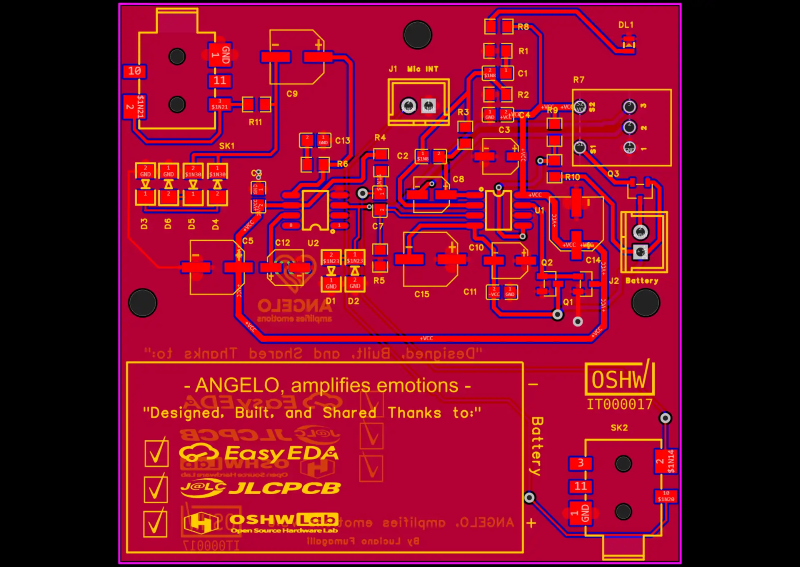
The physical layout of an Audio PCB directly influences signal clarity and operational stability. In analog audio circuits, physical trace routing, component layout, and power filtering dictate final audio performance.
System Hardware Overview
| Specification Item | Technical Detail |
|---|---|
| Primary Active IC | TL072 Dual Operational Amplifier (SOIC-8 Package) |
| Passive Footprints | 0805 SMD Resistors and Capacitors |
| Audio Processing | Analog signal processing with 1 kHz - 4 kHz speech band boost |
| PCB Format | 2-Layer FR-4 Substrate, 1.6mm Thickness |
| Power Options | 5V USB / Li-ion Battery / Solar Panel Input |
| Enclosure Type | 100% Snap-Fit 3D Printed Housing (Screwless & Glueless) |
| Design Software | EasyEDA Pro |
| Manufacturing | JLCPCB (PCB Fabrication and SMT Assembly) |
| Component Supply | LCSC |
Analog Audio Circuit Layout Strategy
Organized Signal Paths: Audio signal traces are routed in short, direct paths to minimize interference and reduce unwanted noise coupling.
Component Grouping: Components belonging to the same functional section are positioned logically near the TL072 pins to simplify routing and improve signal integrity.
Ground Plane Shielding: Large ground copper pours provide electromagnetic shielding across the board.
Key Component Class
| Component Class | Package / Spec | Function on Audio PCB |
|---|---|---|
| TL072IP | SOIC-8 Surface Mount | Dual operational amplifier for primary audio signal amplification |
| Resistors | 0805 SMD | Biasing and circuit gain configuration |
| Capacitors | 0805 SMD | DC blocking and frequency filtering |
| Connectors | 3.5mm & USB Ports | Headphone audio output, power input, and charging ports |
Design for Manufacturing (DFM) Compliance
To ensure high production yields when manufactured through JLCPCB, the Audio PCB uses a standard 2-layer FR-4 substrate (1.6mm thickness). Standard 0805 SMD component packages were selected to balance compact physical size with ease of component sourcing and SMT assembly.
Manufacturing Workflow: From EasyEDA to JLCPCB SMT Assembly
Creating an open-source hardware design is only one step in product development. To transform a PCB design into a working electronic device, reliable manufacturing, component availability, and assembly capability are equally important.
The ANGELO project demonstrates how professional PCB manufacturing services can support this transition.
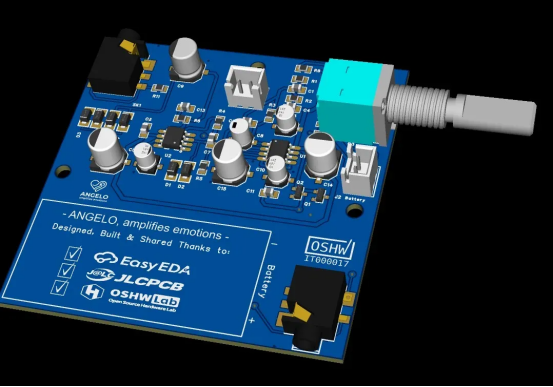
PCB Fabrication: Producing a Reliable Hardware Foundation
The PCB provides the physical structure that connects every electronic component.
For prototype and small-batch hardware development, consistent PCB manufacturing quality helps developers validate their designs more efficiently.
The PCB fabrication process ensures that:
· Circuit structures are accurately produced
· Components can be assembled correctly
· Prototype iterations can be performed reliably
For open-source hardware projects, this capability is especially valuable because it allows creators to move beyond manually produced prototypes and obtain professionally manufactured boards.
SMT Assembly: Improving Prototype Efficiency
The ANGELO PCB integrates SMD components, which require accurate placement and soldering during assembly.
Compared with completely manual assembly, professional SMT manufacturing provides several advantages:
1. More consistent component placement.
2. Reduced manual soldering workload.
3. Faster prototype preparation.
4. Improved repeatability for future builds.
Through JLCPCB PCBA service, surface-mount components can be assembled using automated manufacturing processes, allowing developers to focus more on design improvement and product testing.
Mechanical Snap-Fit Case and Community Impact
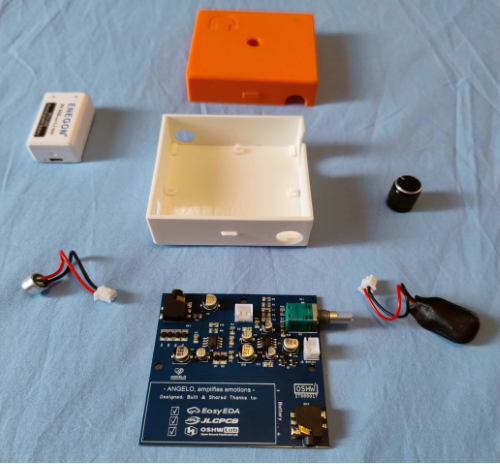
Hardware accessibility extends to enclosure assembly. ANGELO features a 3D-printed enclosure designed for tool-less interlocking assembly.
Tool-Less Snap-Fit Enclosure Design
Zero Tools or Adhesives Needed: The enclosure snaps together cleanly without screws, double-sided tape, glue, or specialized tools.
Internal Slot Guides: Internal channels hold the Audio PCB, rechargeable battery, power switch, and volume dial firmly in position.
Senior-Friendly Ergonomics: Designed with an easy-to-operate volume knob and standard audio connectors for senior users.
Educational Workshops and Care Home Donations
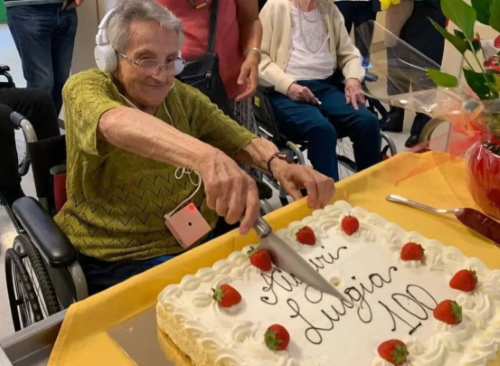
The screwless snap-fit design makes ANGELO an ideal educational tool. In workshops organized by FabLab Bergamo, children as young as six years old and students with disabilities participated in assembling ANGELO units. Assembled devices have been donated to nursing care facilities to support social interaction among elderly residents.
Real-World Story - Franco's Experience
One recipient, Franco, faced severe age-related hearing difficulties that made participating in community entertainment and family conversations challenging. Through the ANGELO project, Franco received a working listening device that restored his ability to engage clearly in daily activities and social gatherings.
Open Hardware Ecosystem: EasyEDA, JLCPCB, JLC3DP, LCSC, and OSHWLab
The development of ANGELO demonstrates the importance of collaboration across different parts of the open-source hardware ecosystem.
EasyEDA: Supporting PCB Design Development
EasyEDA provides the design environment used to create and refine the schematic and PCB layout. It allows developers to move efficiently from circuit concepts to manufacturing-ready design files.
JLCPCB: Connecting Design with Manufacturing
JLCPCB helps bridge the gap between digital PCB designs and physical hardware through PCB fabrication and assembly capabilities.
For open-source projects, this connection is important because it allows creators to access professional manufacturing resources without building their own production workflow.
JLC3DP: Fabricating Custom Enclosures
JLC3DP enables the seamless production of the tool-less, 3D-printed snap-fit enclosure. By manufacturing durable physical housings directly from CAD models, it ensures the hardware is well-protected and easy to assemble without extra hardware or tools.LCSC: Supporting Component Availability
Reliable component sourcing is essential for hardware reproduction. LCSC helps provide access to electronic components required for PCB assembly.
OSHWLab: Sharing and Collaboration
By publishing the project through OSHWLab, ANGELO becomes available to a wider community of developers, makers, and educators, encouraging learning, improvement, and collaboration.
Final Result: Turning an Open-Source Idea into Real Hardware
The ANGELO project demonstrates how an idea focused on communication and inclusion can become a functional electronic product through open collaboration and professional manufacturing support.
From analog audio circuit design to PCB manufacturing and assembly, each stage contributes to making the project more practical, reproducible, and accessible.
More importantly, ANGELO represents how open-source hardware can connect technology with social needs. By combining accessible design principles with modern manufacturing capabilities, projects like ANGELO create new possibilities for educational innovation and community-driven hardware development.
FAQs about ANGELO Project
Q: Is ANGELO a certified medical hearing aid?
No, ANGELO is not a regulated medical device or a hearing aid. It is an open-source, non-medicalized listening aid and voice amplifier designed for social, educational, and everyday communication support. It is intended to complement—not replace—professional medical hearing products.
Q: Why does ANGELO use an analog audio circuit instead of digital signal processing (DSP)?
ANGELO adopts an all-analog circuit architecture based on operational amplifiers (such as the TL072) to eliminate DSP latency, lower total power consumption, and minimize component costs. More importantly, the analog design makes the circuit schematic intuitive and easy to understand, modify, and reproduce for makers, students, and community developers.
Q: How much does it cost to build an ANGELO listening device?
The total Bill of Materials (BOM) cost for the electronic components on the Audio PCB is approximately $10 (€10). Combined with the tool-less, 3D-printed snap-fit enclosure, ANGELO provides an exceptionally low-cost solution for local community initiatives and educational workshops.
Q: How can I order the Audio PCB and SMT assembly service from JLCPCB?
You can export the Gerber design files, Bill of Materials (BOM), and Component Placement List (CPL) directly from EasyEDA Pro with a single click. Uploading these files to JLCPCB allows you to order both PCB fabrication and automated SMT assembly, ensuring accurate placement of SMD components like the TL072 IC and 0805 passives.
Q: Where can I find the open-source files and CAD models for this project?
All project schematics, Audio PCB layouts, Gerber files, and 3D STL models for the snap-fit case are freely published on OSHWLab under a CC-BY-SA 4.0 license. Search for luciopcb1960/project_gnmihamd on OSHWLab to access and download the complete hardware documentation.
Conclusion
The ANGELO project shows how open-source design, accessible technology concepts, and professional PCB manufacturing can work together to create meaningful hardware solutions.
While the project itself is not a medical device, it represents a broader vision: using electronics to reduce barriers, encourage collaboration, and create more inclusive innovation opportunities.
For developers working on audio electronics, educational hardware, and embedded systems, choosing a reliable PCB manufacturing partner can help accelerate the journey from concept to real-world application.
Explore more about EasyEDA Spark now!

Popular Articles
• PiBrick Pocket-CM5: A Compact Raspberry Pi CM5 Handheld PC Built with JLCPCB
• From Membrane Frustration to Custom Mechanical Mastery: Taifur's V3 Full Keyboard Project
• Turn Your Raspberry Pi Pico into a Professional JTAG Programmer with DirtyJTAG & OpenFPGALoader
• Premium Portable Speaker Built with 8-Layer PCBs, DSP & Smart Amps
• ESP32 Smart Control Board for Realistic RC Model Automation
Keep Learning
ANGELO Project with JLCPCB: Building an Open-Source Audio PCB for a Listening Aid
Key Takeaways Accessible Design: ANGELO is an open-source €10 listening aid created to assist everyday voice amplification. Analog Audio Architecture: Uses a TL072 op-amp to boost speech frequencies (1–4 kHz) with low latency and low power. EasyEDA & JLCPCB Workflow: Designed in EasyEDA and produced via JLCPCB SMT assembly for fast, reliable hardware execution. The ANGELO Project Overview ANGELO is an open-source audio hardware project designed to amplify voices and improve everyday communication expe......
Athena: Building a High-Performance 6-Layer PCB for Rocket Avionics
Key Takeaways Athena is an open-source flight computer with a triple-MCU architecture, redundant sensors, and multiple communication interfaces on a compact 6-layer PCB. The 80 × 140 mm board integrates three STM32 MCUs, three IMUs, barometers, GNSS, LoRa, Bluetooth, CAN, USB, flash storage, SD card, and power management. The 6-layer PCB provides routing capacity, organized power distribution, signal organization, and compact functional integration for this complex design. The project demonstrates how......
PiBrick Pocket-CM5: A Compact Raspberry Pi CM5 Handheld PC Built with JLCPCB
Key Takeaways The piBrick Pocket-CM5 is a fully functional, smartphone-sized Raspberry Pi CM5 handheld PC with a physical QWERTY keyboard, AMOLED display, and M.2 NVMe SSD The project utilizes JLCPCB's 4-layer PCB fabrication with controlled impedance (90-ohm for USB, 100-ohm for PCIe/MIPI DSI) to maintain signal integrity Designed using EasyEDA and fabricated by JLCPCB, the project was submitted to the EasyEDA Spark program, successfully securing parts and materials sponsorship for its development. J......
Designing a Precision 72-LED Wearable Watch: Building a 40mm Round PCB with JLCPCB SMT Assembly
Key Takeaways This case study explores the design and fabrication of a 72-LED wearable watch built on a precision 40mm round PCB. Learn how JLCPCB SMT assembly eliminated hand-soldering 70+ 0603 LEDs, how ENIG surface finish ensures reliability in wearable applications, and how a clever panelization strategy with mouse-bite breakaway tabs enabled automated assembly of a circular board. The project demonstrates a complete workflow from EasyEDA schematic capture to firmware optimization and commercial-g......
From Membrane Frustration to Custom Mechanical Mastery: Taifur's V3 Full Keyboard Project
Note Motivation: Replaced a dust-prone membrane keyboard with a durable, custom DIY alternative. Specs: 87-key TKL layout powered by Raspberry Pi Pico (RP2040), featuring hot-swap support, QMK, OLED, and an encoder. Design: A unique 3-layer PCB stack featuring symmetrical routing, an exposed controller, and visible "diode art". Support: Designed using EasyEDA and fabricated by JLCPcB, the project was submitted to the EasyEDA Spark program successfully securing parts and materials sponsorship for its d......
ESP32 Smart Control Board for Realistic RC Model Automation
Key Takeaways This project demonstrates how a well-designed custom PCB, manufactured and assembled through JLCPCB, can democratize advanced electronics for hobbyists. Key lessons include: Prioritizing compact, high-density layouts while respecting DFM rules. Leveraging professional SMT assembly for complex boards. Designing with clear labeling and modularity for user-friendliness. Choosing a manufacturing partner whose capabilities match your project's needs for consistent results. Project Overview: B......