Cartridge Heater Applications: Where and How They Are Used
13 min
- What Is a Cartridge Heater and How Does It Work?
- What Are Cartridge Heaters Used For?
- How to Choose a Cartridge Heater: Mounting, Watt Density, and Control
- Cartridge Heater vs. Flexible Heater: Which Fits the Application?
- Frequently Asked Questions About Cartridge Heater Applications
- Conclusion
Sometimes the difficult part of heating a machine is finding room for the heater. External hardware can obstruct moving parts or leave heat too far from the working zone. Industrial cartridge heater applications address that issue by placing the heat source inside the metal itself.
Examples include molds, dies, hot runner manifolds, sealing bars, platens, heating blocks, semiconductor tools, laboratory instruments, and 3D-printer hot ends. But an industry label doesn't specify a heater. Here's how the thermal job guides the choice.
What Is a Cartridge Heater and How Does It Work?
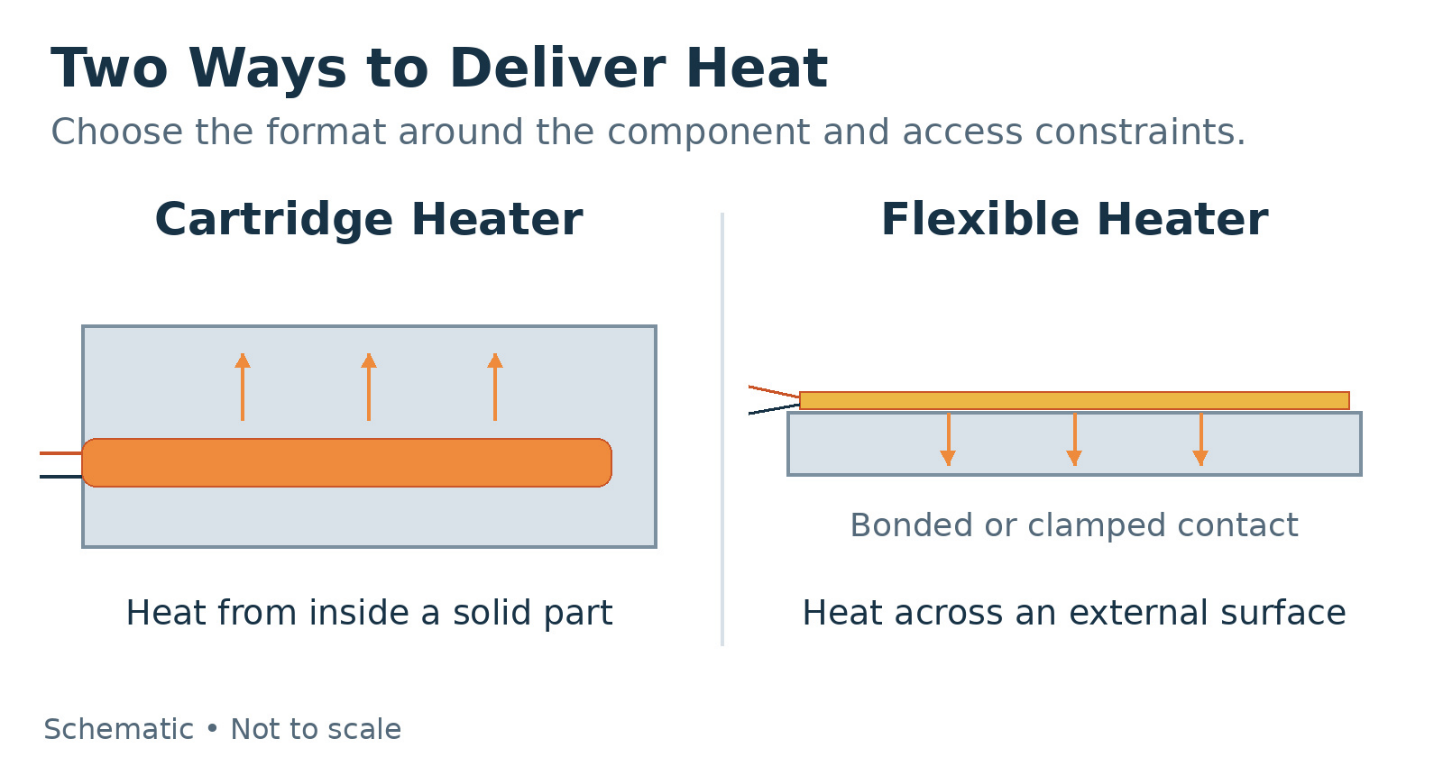
A cartridge heater is a cylindrical electric resistance heater that slides into a sized bore within a metal component. It creates heat internally and transfers it via its outer sheath into the nearby solid. It allows localized heating where external equipment would take up more space.
Inside, a resistance coil produces heat when current flows through it. Compacted electrical insulation separates that coil from the metal sheath. Lead wires supply power. The cartridge heater element is the internal resistance component. Meanwhile, the cartridge is the complete assembly. A “ceramic cartridge heater” designation may refer to its internal construction, so check the specification.
Heated length refers to the active heat-producing section, excluding unheated ends. Sheath temperature refers to the outer metal casing's temperature. It isn't the workpiece temperature. During heat delivery, a temperature difference drives conduction outward.
What Are Cartridge Heaters Used For?
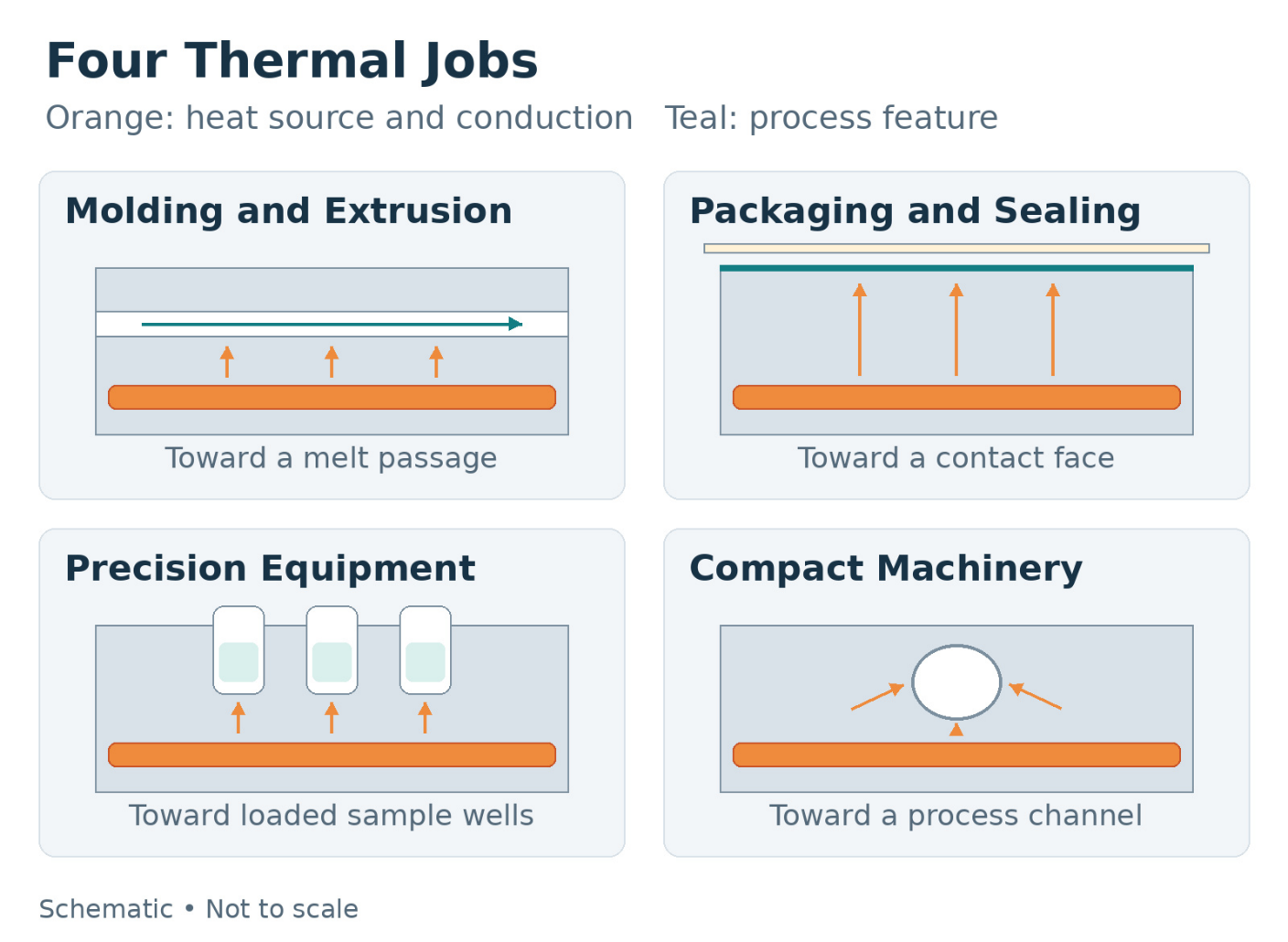
A cartridge heater warms metal components from within. These cartridge heater applications share an insertion geometry, but their heat profiles, cycling, and environments differ. Bore fit (dimensional relationship between heater and hole diameter) also changes the design decision.
| Application Group | Part Being Heated | Thermal Purpose | Design Priority |
|---|---|---|---|
| Molding and extrusion | Mold, nozzle, manifold, die, platen | Material flow or forming | Heat distribution and cycling |
| Packaging and sealing | Jaw, bar, knife, stamp | Repeatable contact heating | Surface recovery and uniformity |
| Precision equipment | Block, chuck, fixture, manifold | Stable process conditions | Measurement and validation |
| Compact machinery | Dispensing block, tool, hot end | Local heating in limited space | Environment and service access |
Molding, Extrusion, and Heated Tooling
Plastic injection molds use inserted heaters wherever the tool needs heating. However, many molding processes also require substantial cooling. Hot runner manifolds and suitably designed nozzles conduct heat from nearby bores toward melt passages. Extrusion dies and screen changers need material to remain workable as it travels through restricted channels.
Rubber and compression molds have different objectives, including delivering the temperature history needed for forming or curing. Hot plates, press platens, and general heated metal blocks spread energy toward a working surface. High-density cartridge heaters might be appropriate for compact dies when space restricts heater count.
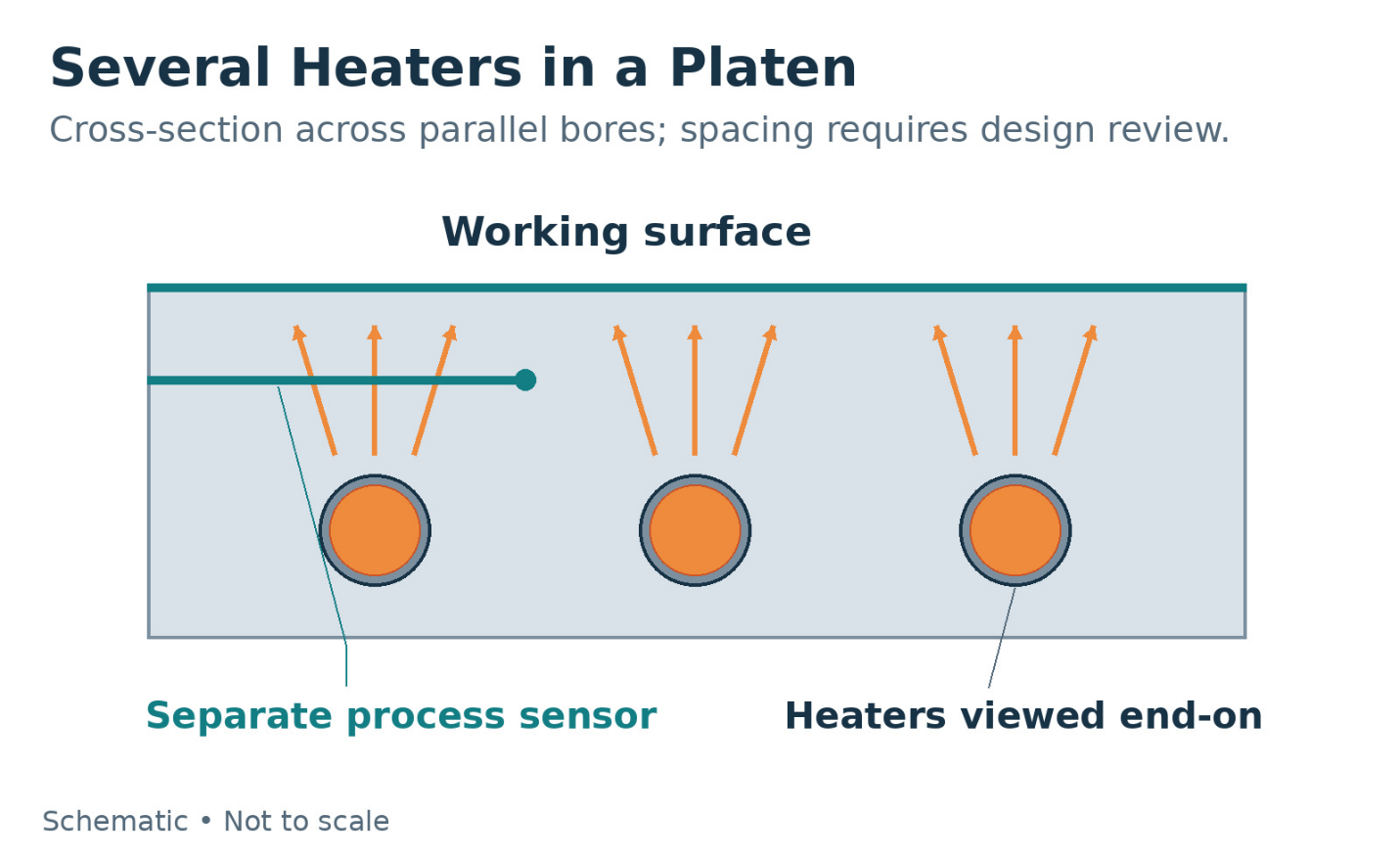
Consideration should be given to distribution. Spacing, heated length, sensor position, edge losses, thermal mass, and metal conductivity affect the pattern. Several units that have been appropriately positioned can outperform one heater that is powerful when it comes to surface uniformity. Uneven heating may leave cold flow paths beside overheated material.
Repeated cycling also challenges the assembly. Access to removal should be reserved, leads should be protected, and contamination should be kept away from terminations. An inaccessible failed heater can make an otherwise serviceable tool expensive to repair.
Packaging, Heat Sealing, and Hot Stamping
Sealing jaws, seal bars, hot knives, labeling tools, laminating equipment, and hot-stamp dies effectively heat the material through a working tool. The cartridge supplies heat to the tool. The tool’s metal face contacts laminate, film, foil, or labels.
For cyclic cartridge heater applications, recovery is as important as the idle temperature. Each contact removes heat. In the event that the face has not recovered prior to the subsequent cycle, the consistency of the seal may worsen as the production speed increases.
Heater layout, a sensor near the working face, and optional distributed wattage can help with uneven losses. Seal quality depends on how evenly the jaw face holds temperature, not just on the setpoint. Moving jaws also require protected and supported leads. A failed cartridge heater element may create a cold region that one remote sensor misses.
Package integrity still depends on pressure, dwell time, materials, and validation. The heater alone determines neither seal quality nor food-safety compliance.
Laboratory, Medical, and Semiconductor Equipment
Laboratory heating blocks, sample preparation tools, analytical instruments, and test fixtures make use of surrounding metal to transfer controlled heat toward samples or devices. In semiconductor equipment, possible locations include process plates, chucks, bonding fixtures, heated manifolds, and chamber components that are designed for inserted heaters.
These cartridge heater applications encourage compact integration and closed-loop operation, in which the measured temperature is sent back to regulate the power. But a stable display doesn't prove that every sample position or wafer region is equally warm.
Specify sensor accuracy, permitted spatial variation, and controlled ramping. Check performance with the actual load. An empty block is a different thermal system. Poor distribution or overshoot can undermine repeatability even when average temperature looks acceptable.
Medical, pharmaceutical, and semiconductor assemblies may additionally need validation, material compatibility, cleanability, electrical safety, and regulatory controls. Clean installation and deliberate lead routing are of significance. Ordinary cartridges carry no automatic approval for patient contact, sterile zones, cleanrooms, or process chemicals.
Food Equipment, Automotive, Aerospace, and 3D Printing
Food equipment uses cartridges inside packaging or dispensing blocks. The metal component separates the heater from the product. That's unlike direct food or liquid contact. Washdown moisture, cleaning chemicals, sanitation, and certification must shape the assembly spec.
Automotive and aerospace production might use heated tooling and test rigs. On the other hand, original equipment manufacturers integrate local heaters into automation. Here, you should qualify vibration, cycling, ambient conditions, and any required redundancy. Use in production tooling does not establish suitability for flight-critical equipment.
Freeze-protection assemblies can warm vulnerable machine blocks through conduction. Evaluate the coldest ambient condition and the consequence of power loss. Note that a heater cannot provide protection during an outage without another provision.
Where the target is a thin enclosure wall, sensor housing, or control cabinet rather than a solid block, a flexible heater bonded to the surface avoids drilling a bore altogether and can provide local warming to help prevent condensation.
In a 3D printer, the cartridge heats the hot-end block. A separate sensor and cartridge heater controller regulate that block in order to maintain the intended nozzle conditions. Match voltage, retention, and wiring. Remember, a loose heater can escape its heat sink.
The heated bed is a different thermal job. It needs even warmth across a large flat plate rather than concentrated heat in a small block, so many beds use a thin silicone rubber or polyimide heater bonded to the underside of the plate instead of cartridges. See how to upgrade a 3D printer heated bed with a silicone heater.
Conditions such as immersion, vacuum, and corrosive service require purpose-designed and explicitly rated construction.
How to Choose a Cartridge Heater: Mounting, Watt Density, and Control
Use this six-step review for cartridge heater applications:
- Set the process temperature and acceptance limits.
- Quantify warm-up and operating demand.
- Lay out bores and service access.
- Confirm fit and surface loading.
- Match construction to exposure.
- Specify sensing, control, and fault protection.
Define the Heat Load and Heater Geometry
You should start cartridge heater calculations with material, mass, initial and target temperatures, warm-up time, process demand, and steady-state losses. Total wattage must cover these demands along with a justified engineering margin.
The warm-up power can be estimated with:
P = (m × c × ΔT) ÷ t
where P is the ideal warm-up power in watts, m is the mass in grams, c is the specific heat in J/g·K, ΔT is the temperature rise in °C, and t is the warm-up time in seconds.
For example, heating a 2 kg aluminium block (assuming a constant c ≈ 0.897 J/g·K) from 25 °C to 200 °C in 10 minutes requires 2,000 × 0.897 × 175 = 313,950 J. Divided by 600 s, that is about 523 W. For an illustrative allowance of about 25–34% for heat losses and a design margin, the starting estimate is roughly 650–700 W; confirm the allowance and required power in loaded trials.
Match supply voltage, diameter, total length, heated length, and heater count to the working zone. Validate cartridge heater calculations against loaded trials. You must never treat a single sizing formula as the complete design.
Check Mounting, Bore Fit, and Watt Density
Cartridge heater mounting determines the path out of the sheath. Excess clearance creates a thermal barrier as well as raises heater temperature and shortens life. Very tight fits complicate insertion and removal. Use the manufacturer's tolerances for cartridge heater installation.
Watt density is power divided by heated sheath surface area. It is expressed in W/cm² or W/in².
For example, a 400 W cartridge with a 12.7 mm (½ in) diameter and a 100 mm heated length has a sheath area of π × 1.27 cm × 10 cm ≈ 39.9 cm², which gives about 10 W/cm² (roughly 65 W/in²). Because 1 W/cm² equals about 6.45 W/in², always check which unit a rating uses before comparing heaters.
Equal-wattage units with different active areas impose different surface loads. Acceptable loading depends on workpiece temperature, fit, conductivity, cycling, heat removal, sheath material, and construction. High-density cartridge heaters therefore need application review (not automatic preference). Published watt-density curves apply only to the heater family and operating conditions they were measured for, so don’t transfer them between products.
Plan Materials, Leads, Sensors, and Controls
Review oxidation, corrosion, moisture, contamination, vibration, terminal temperature, lead movement, space, and access. Straight or right-angle exits, braid, conduit, seals, fittings, and non-heating sections are product-specific options. Support the leads close to the heater exit and keep oil, plastic, and moisture away from the terminations, since lead fatigue and contamination are common causes of early failure.
A thermocouple measures temperature through the voltage that is generated by dissimilar metals. An RTD, the full name of which is resistance temperature detector, uses resistance change. A cartridge heater with a thermocouple measures the temperature at its internal junction, which might not represent the working surface. External sensing should follow the critical process zone.
Cartridge heater temperature control can use a thermostat or PID control. It means proportional, integral, and derivative adjustment of power from temperature error. The cartridge heater controller commands a relay, solid-state relay, or power controller. Provide independent over-temperature protection, grounding, circuit protection, and qualified electrical installation.
A cartridge heater with a controller needs matched sensor inputs and switching capacity. Cartridge heater temperature control cannot rescue insufficient wattage, poor contact, or uneven placement.
Cartridge Heater vs. Flexible Heater: Which Fits the Application?
A cartridge becomes a poor fit when drilling is impossible, its supporting block adds unacceptable mass, or removal demands dismantling the machine. Large and thin surfaces as well as curved or irregular shapes may also favor another heater format.
| Decision Factor | Cartridge Heater | Flexible Heater |
|---|---|---|
| Mounting | Inserted into a bore | Bonded or clamped to a surface |
| Form | Rigid cylinder | Thin sheet or custom outline |
| Strength | Concentrated internal heating | Distributed surface heating |
| Temperature range | Suited to high-temperature tooling; check the heater rating | Suited to low and moderate temperatures; see rated limits |
| Thickness | Needs a bore in a solid block | Adds only a thin layer to the surface |
Band, tubular, strip, coil, immersion, and radiant heaters help with other thermal arrangements. You should choose according to the actual heat-transfer requirement.
JLCPCB offers polyimide and silicone rubber flexible heaters for designs that prioritize low thickness, low mass, custom outlines, or surface conformity. Check flexible heater capabilities against the proposed environment and mounting methodology. Neither format is universally better. Both need appropriate controls and a workable maintenance plan.
Frequently Asked Questions About Cartridge Heater Applications
What Are Cartridge Heaters Most Commonly Used For?
Common cartridge heater applications include metal molds, dies, platens, sealing bars, manifolds, nozzles, and equipment blocks. The job is localized conduction from an inserted cylinder into a surrounding solid. For a replacement, identify the assembly's part number, critical dimensions, and operating duty. Matching the industry name won't establish interchangeability.
Can a Cartridge Heater Be Used to Heat Air?
Remember, only use a cartridge in exposed air when that specific product is designed and rated for it. Conventional insertion heaters might be dependent on a surrounding solid to remove heat. Don't energize an unsupported unit as a bench test. You should also keep in mind that an acceptable block-heating rating doesn't establish safe operation in still or flowing air.
Can a Cartridge Heater Be Used in Liquid?
A standard insertion cartridge must not be assumed suitable for direct immersion. Select a purpose-rated immersion heater or an explicitly approved cartridge assembly. Confirm the liquid, pressure, fitting, seals, operating conditions, and protection against low liquid level. Just a metal sheath does not demonstrate fluid compatibility or a pressure-tight connection.
Why Does Bore Fit Matter?
Bore fit controls thermal contact between the sheath and surrounding part. Cartridge heater mounting must balance heat transfer with practical insertion and removal, as well as use product-specific tolerances. For replacement work, inspect bore condition and nominal diameter. Wear, distortion, or deposits can change how a new heater performs inside an old tool.
Where Should the Temperature Sensor Be Placed?
You have to place it where the reading best represents process quality and safety. This might be between the heater and working surface or near the critical zone. Check the chosen location during startup and loaded operation. A single point may miss the hottest or coldest region. So, commissioning may need temporary measurements at several positions.
Conclusion
Successful cartridge heater applications begin with a thermal requirement and end with an assembly that can be checked, controlled, and serviced. Give the supplier a load estimate, bore drawing, exposure details, and sensing plan. Approve the design through representative testing. Don’t accept a headline wattage or maximum temperature as proof of appropriateness.
Keep Learning
What Is a Strip Heater? How It Works: A Complete Guide [2026]
Strip heaters are electric resistance heaters commonly used to heat metal surfaces, machinery, and industrial equipment. Their flat, narrow design allows them to be mounted against surfaces or in spaces where other heater shapes may be less suitable. Understanding how strip heaters are constructed and installed helps determine whether they’re the right choice for a particular heating application. What Is a Strip Heater? A strip heater converts electrical energy into heat through a resistance element h......
Cartridge Heater Applications: Where and How They Are Used
Sometimes the difficult part of heating a machine is finding room for the heater. External hardware can obstruct moving parts or leave heat too far from the working zone. Industrial cartridge heater applications address that issue by placing the heat source inside the metal itself. Examples include molds, dies, hot runner manifolds, sealing bars, platens, heating blocks, semiconductor tools, laboratory instruments, and 3D-printer hot ends. But an industry label doesn't specify a heater. Here's how the......
Induction Heat Treatment: Hardening, Tempering & Stress Relief
Induction heat treatment is a heat treatment process that uses an alternating electromagnetic field to generate heat inside an electrically conductive workpiece. It enables manufacturers to selectively heat specific areas of a component for processes such as hardening, tempering, annealing, and stress relieving, rather than heating the entire part in a furnace. This localized heating makes induction particularly useful for applications that require controlled case depth, repeatable results, and integr......
Types of Heating Elements and How They Work [2026]
An electric heating element is any element that transforms electrical energy into heat, typically by electrical resistance. If an electric current flows through a resistance material, the electrical power is dissipated in the form of heat. Two seemingly identical heating elements can deliver very different results depending on how they are designed and used. Some are exposed, while others are enclosed in a sheath or designed for insertion into equipment. Others may be clamped to a surface or bonded to......
A Complete Guide to Resistive Heating Elements: How They Work, Types, Materials, and Applications
A resistive heating element converts electrical energy into heat as electric current passes through a material with electrical resistance. This process is known as Joule heating, and its electrical power can be expressed as P = VI = I²R = V²/R. Common forms include resistance wire, heating plates, tubular and cartridge heaters, strip and tape heaters, ceramic heaters, and flexible etched-foil heaters. The right heating element depends on more than its shape. Operating temperature, voltage, required po......