Types of Heating Elements and How They Work [2026]
14 min
- How Do Heating Elements Work?
- Which Material Is Used for Heating Elements?
- What Are the Main Types of Heating Elements?
- Flexible Heaters vs. Conventional Heating Elements
- How Do You Choose the Right Heating Element?
- FAQ (Frequently Asked Questions) About Heating Elements
- Conclusion: Matching the Element to the Heat Path
An electric heating element is any element that transforms electrical energy into heat, typically by electrical resistance. If an electric current flows through a resistance material, the electrical power is dissipated in the form of heat.
Two seemingly identical heating elements can deliver very different results depending on how they are designed and used. Some are exposed, while others are enclosed in a sheath or designed for insertion into equipment. Others may be clamped to a surface or bonded to a flexible substrate.
The difference in how heating elements work lies not only in the resistance material but also in the construction, shape, attachment method, heat-transfer path, and the material or medium being heated.
This guide explains how heating elements work, what they are made of, how the main types differ, and how to narrow the choice for air, liquid, and surface heating.
How Do Heating Elements Work?
Heating elements operate by sending an electric current through an engineered electrical resistance. As a result of the resistance, electrical energy is transformed into thermal energy, which is known as joule heating. This generated heat is then transferred by conduction, convection, and/or radiation through the structure of the element and into the target.
The relationship of the electricity is P = VI, where P is power, V is voltage and I is current. This can be stated as P = I²R or P = V²/R for a resistive load. If it is a current that is held constant, the power will increase as the resistance increases; if it is a voltage that is held constant, the power will decrease as the resistance increases.
For this reason, it is incorrect to say that higher resistance always produces more heat — the outcome depends on whether voltage or current is held constant.
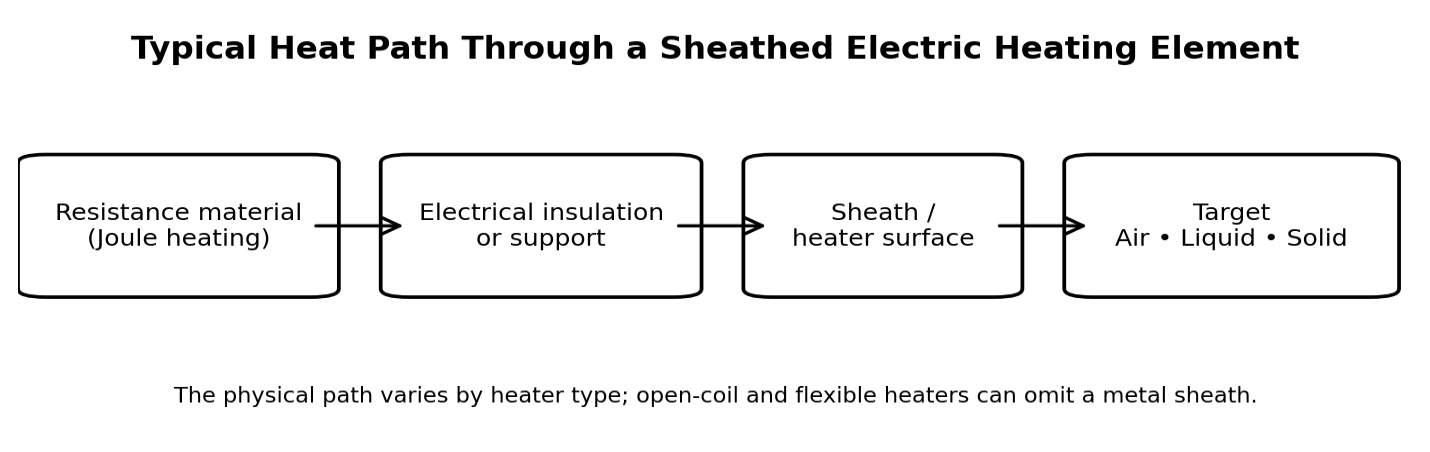
In a common sheathed element, the heat path is from the resistance material to electrical insulation or a supporting structure, then to the sheath or heater surface, and finally to the target. The target may be moving air, a liquid, a metal part, or another solid. Open-coil elements can release heat directly from exposed resistance wire, while flexible etched-foil heaters transfer heat mainly through their broad surface.
Heat transfer by direct contact is called conduction. Convection is the transfer of heat between a surface and a fluid (air or liquid) that is moving or flowing. Radiation is a way of transferring energy from a hot surface through electromagnetic radiation. The dominant path depends on the geometry of the heater; not all elements are suitable for all liquids or open-air flows.
A heating element generates heat, but heat generation alone does not constitute a complete temperature-control system. The temperature sensor reads the temperature, the controller compares the measured value with the desired value and the switching/power-control hardware adjusts the electrical input.
Install the sensor where its reading represents the controlled part or medium, as close to it as practical. The control method should be appropriate for the part or medium being controlled.
Which Material Is Used for Heating Elements?
Most commonly alloys like Nickel-chromium or iron-chromium-aluminum are used to construct electric heating elements. Material selection is based on various parameters. It includes operating temperature, surrounding atmosphere, oxidation resistance, electrical resistivity, and shape of the element required.
The active resistance material is only one part of a complete element. In many sheathed designs, the resistance wire is surrounded by compacted magnesium oxide (MgO), which provides electrical insulation while also providing a path for heat to reach the metal sheath.
The sheath is a separate protective component. It contains the internal construction, provides a durable external surface, and transfers heat to the surrounding air, liquid, or solid.
Other constructions use different supporting and insulating materials. Ceramic can support or electrically isolate a resistance element, while mica is used in some heater assemblies where its electrical and thermal properties fit the design. PTC ceramic heating elements are different again: their ceramic resistance material has a strong positive temperature coefficient, so resistance rises as temperature rises. When supplied by a constant voltage source, it results in self-regulating operation within the product design, due to the variation in current and power as the element gets hot.
Three questions help clarify what a heating element is made of: What provides the resistance? What provides electrical insulation or mechanical support? What protects the assembly and transfers heat? For more information on alloy properties and circuit design, see our guide to resistance heating materials and design.
What Are the Main Types of Heating Elements?
The main types of electric heating elements are tubular (sheathed), open-coil, cartridge, strip and band, flexible etched-foil, and ceramic or PTC heaters. All of them use resistance heating; they differ in how the element is built, mounted, and coupled to the air, liquid, or solid being heated.
| Type | Active material | Construction / form | Mounting | Heat path | Typical target | Key limitation |
|---|---|---|---|---|---|---|
| Tubular / sheathed | Resistance wire | Coil inside MgO and metal sheath; straight, bent, finned or formed | Clamped, supported, immersed or assembled | Conduction → sheath → convection / radiation or solid contact | Air, liquid, solid surface | Sheath, seal, watt density and medium must match the product rating |
| Open-coil / resistance wire | Exposed resistance wire or ribbon | Supported wire / ribbon, often on ceramic supports | Suspended or fixed in an air / radiant zone | Direct convection and radiation | Air or radiant zone | Exposed live / hot wire requires controlled installation and suitable airflow |
| Cartridge | Resistance wire | Compact coil close to metal sheath with insulation | Inserted into a close-fit bore | Conduction | Solid tooling, blocks, molds or other parts | Fit and contact strongly affect heat transfer |
| Strip / band | Resistance wire | Flat or formed sheathed heater; bands wrap cylinders | Clamped to flat or cylindrical surface | Conduction to surface, then convection / radiation | Solid surfaces; some finned forms heat air | Contact, clamping and surface geometry are critical |
| Flexible / etched foil | Etched metal foil or resistive conductor | Thin circuit laminated / bonded between insulating layers | Bonded or otherwise attached to surface | Broad-area surface conduction | Curved, irregular or space-constrained surfaces | Temperature, watt density, insulation, mounting and environment constrain use |
| Ceramic / PTC | Resistance wire on ceramic supports, or PTC ceramic | Ceramic-supported or PTC ceramic body | Pressure contact, holder, exchanger or assembly-specific mounting | Conduction to air / surface; convection in exchanger designs | Air, exchanger or surface heating | PTC behavior does not remove the need for appropriate control and protection |
Tubular (Sheathed) Heating Elements
Tubular heating elements deserve special attention because the same basic construction can be shaped for several heat-transfer conditions. A typical tubular design places a resistance coil inside a metal sheath with compacted insulation between them. Straight and bent forms can be used in different assemblies, while finned versions increase the surface available for air heating. Immersion-oriented forms are designed around contact with a liquid and require product-specific sheath, sealing, watt-density, and installation ratings.
Open-Coil Heating Elements
Open-coil heaters have a resistance wire that is not in a metal sheath. This results in lower thermal mass and direct heat release to air or a radiant zone. However, installation and contact-safety considerations differ from those of a fully sheathed conductor.
Cartridge Heaters
Cartridge heaters are compact insertion heaters. The resistance wire is positioned close to the sheath and separated from it by compacted MgO insulation. The heater is normally installed in a close-fit bore so heat can move by conduction into the surrounding solid.
Strip and Band Heaters
Strip and band heaters are surface-mounted forms. A strip heater may be clamped to a flat surface, while a band heater is formed around a cylindrical part. The quality of contact between heater and surface is part of the thermal design. Finned strip constructions can instead be arranged to transfer heat to air.
Flexible Etched-Foil Heaters
Flexible and etched-foil heaters feature a thin resistive circuit that is laminated or bonded between electrical-insulation layers. They are low-profile and can conform to curved and irregular surfaces and spread the heat over a specified area. JLCPCB builds custom flexible heaters from etched brass, stainless steel, or FeCrAl circuits laminated between polyimide or silicone rubber insulation, with materials chosen to suit the application.
Ceramic and PTC Heaters
PTC ceramic heaters are not to be confused with ceramic-supported resistance heaters. A conventional ceramic-supported heater uses metal resistance wire as the heating material, with ceramic providing support and electrical insulation. In a PTC heater, the ceramic itself is the resistance material.
With PTC products the resistance is higher at higher temperatures, thereby altering the power output at a constant voltage supply. While such behavior may be used to reduce heating at higher temperatures, it is not a substitute for all temperature sensors, controllers, or safety devices.
Flexible Heaters vs. Conventional Heating Elements
The type of heating element selected depends on the geometry and the object to be heated. The method of attachment and desired heat transfer also affect the choice. Some designs may benefit from a flexible heater because it is thin. It can also conform to curved or irregular surfaces.
If insertion, immersion, air movement, clamping or higher mechanical support is necessary, a rigid tubular, cartridge, strip, band, or open-coil element might be more appropriate.
| Heating requirement | Potential fit | Why |
|---|---|---|
| Thin heater on a curved or irregular surface | Flexible / etched foil | Low-profile construction can conform to the surface and distribute heat across an area. |
| Heat into a close-fit metal bore | Cartridge | Rigid cylindrical form is designed for direct conduction into a solid. |
| Heat a liquid with a purpose-rated immersed assembly | Tubular / immersion heater | A sheathed element can place its heated surface directly in the liquid when the product is rated for that service. |
| Heat moving air | Open-coil, finned tubular, ceramic or PTC | The best form depends on airflow, power, temperature, space, safety, and product rating. |
| Heat a cylindrical surface | Band or formed strip / tubular | The heater can be clamped around or closely fitted to the surface. |
| Radiant or open heat zone | Open-coil or radiant tubular design | The exposed or radiating surface can transfer heat without requiring direct contact with the target. |
Flexible heaters become relevant when installation space, surface shape, heating area, low mass, or close surface contact makes a conventional rigid element difficult to package. They are not automatically better. Temperature range, watt density, mounting method, insulation system, environmental exposure, sensor placement, and control strategy still have to fit the actual application.
For a deeper look at flexible construction and material options, see What Is a Flexible Heater? A Complete Guide.
How Do You Choose the Right Heating Element?
Start with the heat target, then work backward through the heat path and installation. The following sequence keeps the selection focused on the complete thermal system rather than the resistance material alone.
- Heat target — Decide whether the main target is air, a liquid, a solid surface, or the inside of a bore.
- Geometry and mounting — Figure out if the element can be placed, dipped, clamped, bonded, suspended or molded around a surface. Simply determine space and heating requirements.
- Thermal load — Estimate the mass to heat, target temperature, warm-up time, heat loss, and thermal mass. From this, determine the required total wattage rather than choosing a heater from temperature alone.
- Watt density — Check how the heater's power is distributed over its heated area. Wattage is total electrical power; watt density describes power relative to an area. Neither number by itself tells you the element temperature or target temperature.
- Electrical requirements — Confirm supply voltage, current, resistance, wiring, switching, grounding, and applicable electrical safety requirements. Remember that P = VI and that the I²R and V²/R forms describe different fixed-variable conditions.
- Temperature and sensing — Separate element temperature, sheath temperature, and target temperature. Place the temperature sensor where it represents the controlled part or medium, and select a controller and switching method suited to the system.
- Environment — Check moisture, liquid chemistry, pressure, chemicals, vibration, contamination, airflow, and installation orientation. The heater's sheath, seal, insulation, and mounting method must be rated for those conditions.
- Validation — Test warm-up, steady-state temperature, temperature uniformity, heat transfer, abnormal conditions, and thermal cycling in the actual assembly. A product rating is not a substitute for validating the complete installation.
The active resistance material matters, but it is only one part of the decision; start with the finished form and heat path.
FAQ (Frequently Asked Questions) About Heating Elements
Why Do Heating Elements Burn Out?
Heating elements can burn out when element temperature becomes excessive or when the heater is operated outside its electrical or thermal design. Possible causes include incorrect voltage, excessive watt density, poor heat transfer, insufficient airflow or liquid coverage, contamination, oxidation, thermal cycling, or failed controls. The actual failure mechanism depends on the element construction and application.
Can a Heating Element Be Repaired?
Repairability depends on the construction and where the failure occurred. Many sealed, sheathed, ceramic, and flexible elements are not intended for field repair and should be replaced when the internal heating circuit fails. External terminals or wiring may sometimes be serviceable, but only when the manufacturer permits it and the repaired assembly can still meet its electrical and thermal safety requirements.
Does a Heating Element Need a Thermostat?
An application that needs a controlled temperature or a safe operating limit normally needs an appropriate temperature sensor and controller, with independent over-temperature protection where the risk assessment calls for it. Some PTC elements have self-regulating behavior, but that does not mean the complete system can ignore sensing, control, or safety requirements.
Which Heating Element Is Best for Air Heating?
Open-coil, finned tubular, ceramic, and PTC elements may all be suitable for air heating, depending on airflow, temperature, space, power, safety, and product ratings. Open coils can provide direct heat release, while finned or sheathed designs provide a protected heat-transfer surface. The final choice should follow the actual airflow and heater rating rather than the element name alone.
Which Heating Element Is Best for Liquid Heating?
Purpose-rated immersion or sheathed tubular heaters are common choices for liquid heating, but the heater must be matched to the liquid and installation. Sheath material, watt density, terminal sealing, liquid chemistry, pressure, mounting orientation, and required control all matter. A heater that works in one liquid service should not be assumed suitable for another without checking its product-specific rating.
Conclusion: Matching the Element to the Heat Path
Most common electric heating elements use resistance heating, but the finished element can look very different because it is built around a particular heat path. Open coils expose resistance wire to air or a radiant zone. Tubular elements put resistance wire inside insulation and a protective sheath. Cartridges focus conduction into a close-fit solid, while strip and band heaters place heat directly against a surface. Flexible and etched-foil heaters spread heat across thin, curved, irregular, or space-constrained surfaces. PTC ceramic elements use a resistance material whose resistance rises with temperature, which limits their power as they heat up at a constant supply voltage.
For practical selection, first establish the heating target, then select the geometry and mounting method. Next, evaluate the thermal load, electrical requirements, sensing and control, and finally, the environmental conditions and product-specific ratings.
If the steps are kept distinct, some common pitfalls are avoided, including the following:
- Wattage should not be confused with temperature;
- Higher resistance should not be automatically equated with more heat;
- The heated medium must be considered when selecting the sheath or mounting method.
Keep Learning
What Is a Strip Heater? How It Works: A Complete Guide [2026]
Strip heaters are electric resistance heaters commonly used to heat metal surfaces, machinery, and industrial equipment. Their flat, narrow design allows them to be mounted against surfaces or in spaces where other heater shapes may be less suitable. Understanding how strip heaters are constructed and installed helps determine whether they’re the right choice for a particular heating application. What Is a Strip Heater? A strip heater converts electrical energy into heat through a resistance element h......
Cartridge Heater Applications: Where and How They Are Used
Sometimes the difficult part of heating a machine is finding room for the heater. External hardware can obstruct moving parts or leave heat too far from the working zone. Industrial cartridge heater applications address that issue by placing the heat source inside the metal itself. Examples include molds, dies, hot runner manifolds, sealing bars, platens, heating blocks, semiconductor tools, laboratory instruments, and 3D-printer hot ends. But an industry label doesn't specify a heater. Here's how the......
Induction Heat Treatment: Hardening, Tempering & Stress Relief
Induction heat treatment is a heat treatment process that uses an alternating electromagnetic field to generate heat inside an electrically conductive workpiece. It enables manufacturers to selectively heat specific areas of a component for processes such as hardening, tempering, annealing, and stress relieving, rather than heating the entire part in a furnace. This localized heating makes induction particularly useful for applications that require controlled case depth, repeatable results, and integr......
Types of Heating Elements and How They Work [2026]
An electric heating element is any element that transforms electrical energy into heat, typically by electrical resistance. If an electric current flows through a resistance material, the electrical power is dissipated in the form of heat. Two seemingly identical heating elements can deliver very different results depending on how they are designed and used. Some are exposed, while others are enclosed in a sheath or designed for insertion into equipment. Others may be clamped to a surface or bonded to......
A Complete Guide to Resistive Heating Elements: How They Work, Types, Materials, and Applications
A resistive heating element converts electrical energy into heat as electric current passes through a material with electrical resistance. This process is known as Joule heating, and its electrical power can be expressed as P = VI = I²R = V²/R. Common forms include resistance wire, heating plates, tubular and cartridge heaters, strip and tape heaters, ceramic heaters, and flexible etched-foil heaters. The right heating element depends on more than its shape. Operating temperature, voltage, required po......