STM32 vs ESP32: A Deep Technical Comparison for Embedded and IoT Design
14 min
- Why Pick STM32 When ESP32 Is Cheaper?
- STM32 vs ESP32: Performance Comparison
- STM32 vs ESP32 Power Consumption
- STM32 vs ESP32: Connectivity Consumption
- STM32 vs ESP32 for Industrial and IoT Applications
- STM32 vs ESP32 Peripherals
- STM32 vs ESP32 Development Experience
- Why Many Commercial Products Use Both STM32 and ESP32
- FAQs
- Conclusion: STM32 vs ESP32 — Which One Should You Choose?
Choosing between STM32 and ESP32 is not just a question of price. Many engineers start with the same doubt: if ESP32 is cheaper and already has Wi-Fi/Bluetooth, why would anyone still choose STM32?
The real answer depends on what your product must do. If you are building a connected smart-home device, ESP32 may be the fastest and most cost-effective path. But if your design needs deterministic control, accurate ADC sampling, low-power operation, industrial interfaces, motor control, or long-term availability, STM32 often justifies its higher cost.
This guide goes beyond a beginner-level comparison. We will compare STM32 vs ESP32 from a practical engineering perspective, including performance, power consumption, peripherals, connectivity, industrial use cases, development workflow, and why many commercial products use both chips together.
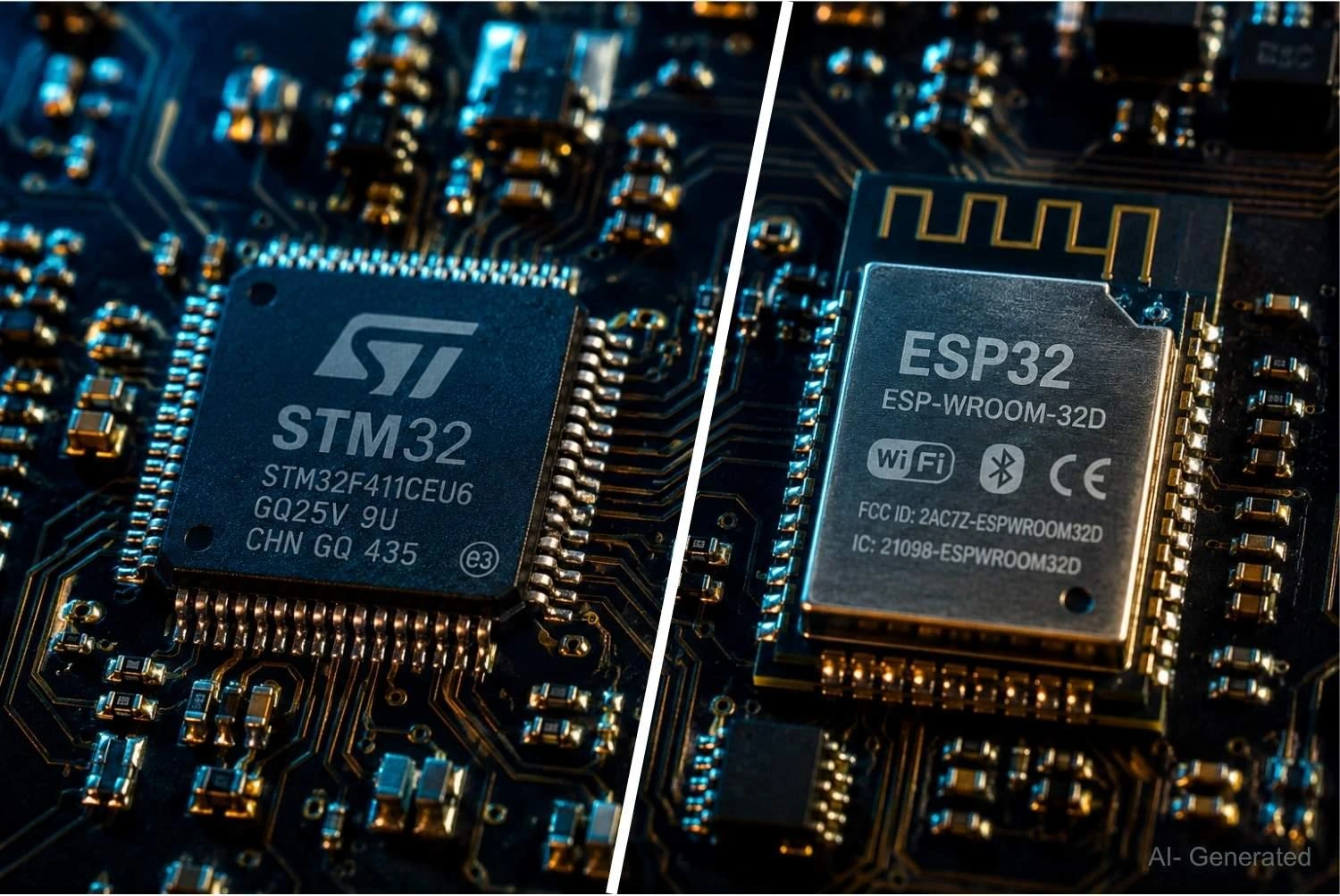
Figure: STM32 microcontroller and an ESP32 wireless module
Why Pick STM32 When ESP32 Is Cheaper?
This question gets asked frequently on Reddit. Here's the answer the spec sheets won't give you.
Where STM32 Justifies the Price
- Deterministic control: Cortex-M interrupt latency is bounded, which is required for motor FOC, SMPS feedback, and safety interlocks.
- Analog performance: STM32 12-bit ADCs are linear edge-to-edge; STM32H7 devices can achieve up to 16-bit effective resolution through hardware oversampling. ESP32 ADCs are non-linear above ~2.5 V.
- Industrial communication: Native CAN/CAN-FD, RS485 hardware support, Ethernet MAC. ESP32 has TWAI (CAN 2.0 only).
- Safety-critical certification: IEC 60730 Class B (appliances), AEC-Q100 (automotive), medical-grade tooling.
- Long-term availability: ST guarantees 7-20 year longevity with formal EOL notice.
Where ESP32 Is the Better Value
- Wi-Fi products: $2 ESP32-C3 replaces $1.50 STM32 + $3 Wi-Fi module + antenna + cert.
- Smart home (Matter/Thread): ESP32-C6/H2 has the radios built in.
- Rapid prototyping: Arduino IDE + Wi-Fi in 20 minutes.
- Consumer electronics: Pre-certified modules, no RF expertise needed.
STM32 vs ESP32: Performance Comparison
CPU Performance
Raw CoreMark scores tell the real story:
| Chip | Clock | CoreMark | Per MHz |
|---|---|---|---|
| STM32H7 (M7F) | 480 MHz | 2010 | 4.19 |
| STM32U5 (M33) | 160 MHz | 651 | 4.07 |
| STM32L4 (M4F) | 80 MHz | ~273 | 3.41 |
| ESP32-S3 (LX7, 1 core) | 240 MHz | 613 | 2.56 |
| ESP32 (LX6, 1 core) | 240 MHz | 504 | 2.10 |
| ESP32-C3 (RISC-V) | 160 MHz | 407 | 2.54 |
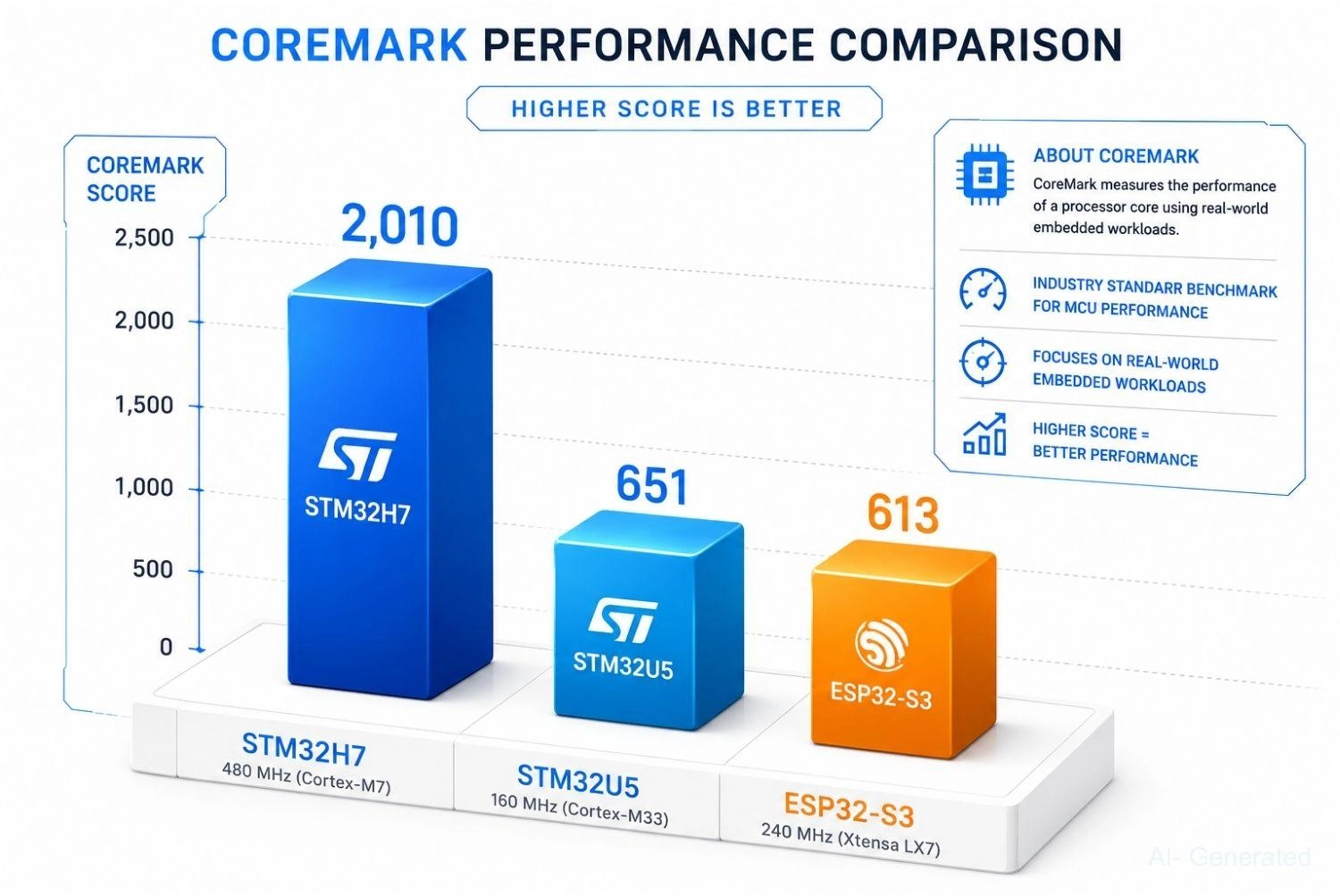
Figure: Showing CoreMark performance comparisons between STM32 and ESP32 chips.
Real-Time Processing
The Cortex-M NVIC handles interrupts in a bounded, predictable number of cycles, which is critical for PID loops, encoder reading, and synchronous ADC sampling. ESP32's dual-core helps throughput, but in many Wi-Fi applications, a significant portion of one core's processing budget is consumed by networking tasks, which reduces available headroom for deterministic control code.
Performance in Real Projects
- Motor control: STM32G4 with HRTIM handles multi-phase FOC at 30 kHz deterministically. ESP32 introduces jitter from radio interrupts.
- Audio DSP / FFT: STM32F4/H7 with FPU + DSP instructions wins.
- MQTT gateway: ESP32 wins, Wi-Fi stack is on-chip.
- 9-DOF sensor fusion: STM32F4 hits 1 kHz cleanly; ESP32-S3 manages it without Wi-Fi.
Final Takeaway: STM32 wins single-thread, deterministic, and DSP-heavy work. ESP32 wins network-bound.
STM32 vs ESP32 Power Consumption
This is where STM32 separates from ESP32 by an order of magnitude.
Unified Power Comparison
| Platform / Mode | Active Current Draw | Deep Sleep Current Draw | Real-World Operational Notes |
|---|---|---|---|
| STM32L4 (Ultra-Low Power) | ~100 uA/MHz (Run mode, 3.3 V) | ~1.86 uA (Stop 2 + RTC) | Optimized for battery-powered sensors waking on interrupts. |
| STM32U5 (High Efficiency) | ~19 uA/MHz (SMPS active) / ~110 uA/MHz (LDO) | ~0.3 uA (Shutdown) / ~1 uA (Standby + RTC) | Features Low Power Background Autonomous Mode (LPBAM). |
| STM32F446 (Mainstream) | ~120 uA/MHz (Standard run mode) | ~20 uA (Typical Stop mode) | Built for DSP and high-speed processing, not long-term sleep. |
| ESP32 Classic (Wireless) | 20-31 mA @ 80 MHz (CPU only) / 180-240 mA (Wi-Fi TX) | ~10 uA (Deep Sleep + RTC) | Active current spikes heavily during RF transmission. |
| ESP32-C3 (RISC-V Wireless) | ~15-25 mA @ 80 MHz (CPU only) / 80-130 mA (BLE TX) | ~5 uA (Deep Sleep) | Highly cost-effective connected node with reduced active footprint. |
Note
A practical note from the ESP32 forums: many users measure 50-300 uA in deep sleep on dev boards because the USB-UART chip, LEDs, and LDO leak current. To hit datasheet numbers, you need a custom PCB with only the module.
Battery Life in Real Applications
- Environmental sensor (CR2032, 10-min LoRa wake): STM32WL ~3 years. ESP32 + LoRa module ~3 months.
- Smart meter (mains + backup battery): STM32L4 watchdog runs years on backup; ESP32 only useful when mains is on.
- GPS logger (2x AA, 5-min interval): STM32L4 + GPS ~12 months. ESP32 + GPS ~2 months.
Final Takeaway: Coin-cell or years on battery? STM32. Mains or large LiPo? ESP32 is fine.
STM32 vs ESP32: Connectivity Consumption
Wi-Fi and Bluetooth
ESP32 wins outright. Every classic ESP32 ships with 802.11 b/g/n + BT Classic + BLE 4.2. ESP32-C6 adds Wi-Fi 6, Thread, and Zigbee on one die. Modules like WROOM-32E and ESP32-S3-WROOM are pre-certified (FCC/CE/IC), saving months of compliance work.
STM32 has no built-in Wi-Fi on mainstream parts. You either add a module, often an ESP32 used as a Wi-Fi co-processor, or pick the wireless STM32 line: STM32WB (BLE 5.2 + Zigbee/Thread) and STM32WL (LoRa, sub-GHz). For pure Wi-Fi, STM32 always needs help.
Wireless Ecosystem and Certification
For commercially shipped IoT products, the wireless ecosystem and certification path are just as critical as raw hardware performance. Pre-packaged ESP32 modules handle the physical RF routing, matching networks, and shielding entirely on-module. More importantly, Espressif covers the substantial upfront costs of FCC, CE, and IC compliance certifications.
Additionally, newer chips like the ESP32-C6 and ESP32-H2 are native platforms for modern smart home standards, building in support for Matter, Zigbee, and Thread protocols.
While the STM32WB and STM32WL lines provide exceptional sub-GHz and BLE communication, STM32 lacks a single-chip, pre-certified Wi-Fi equivalent, meaning developers must manage external RF circuit design and subsequent regulatory certifications independently.
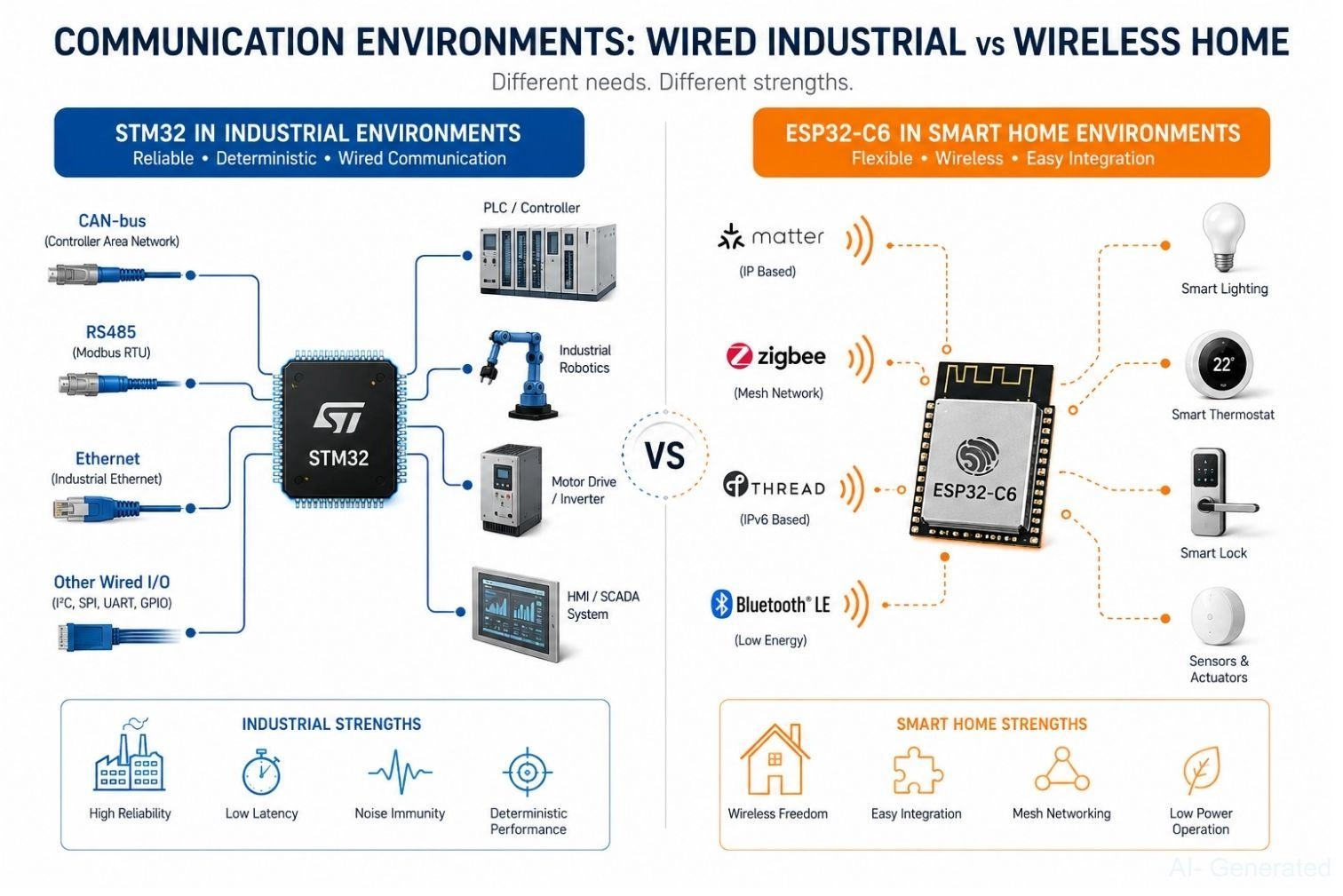
Figure: Comparing STM32 wired industrial networks with ESP32 home automation wireless connectivity.
Industrial Communication
- CAN / CAN-FD: Native on STM32F4/G4/H7. ESP32 has TWAI (CAN 2.0 only).
- RS485: STM32 offers mature hardware support with automatic direction control via UART. ESP32 supports RS485 through dedicated UART RS485 modes in ESP-IDF, but STM32's industrial UART peripheral is generally more feature-complete.
- Modbus RTU/TCP: Stable on both, but timing-strict Modbus RTU prefers STM32.
- Ethernet MAC: STM32F4/F7/H7 integrate Ethernet MAC. The classic ESP32 also includes an EMAC, but still requires an external PHY chip (LAN8720, IP101) and additional board-level design effort, so it's not the same as STM32's tighter integration.
Summary: Wireless = ESP32. Wired industrial = STM32.
STM32 vs ESP32 for Industrial and IoT Applications
The central thesis of this comparison: STM32 is industrial-first; ESP32 is IoT-first. Understanding this shapes every decision.
Why STM32 Dominates Industrial Systems
- PLCs and automation controllers: STM32F4/H7 handle Modbus RTU/TCP, CAN-FD, and Profibus timing that ESP32 cannot guarantee under network load.
- Motor drives and inverters: The STM32G4's HRTIM and advanced timers are the reference platform for BLDC/PMSM FOC. Open-source firmware like SimpleFOC targets STM32 first.
- Energy meters and smart metering: STM32L4/U5 sample ADC continuously at sub-microamp budgets. The metrology core stays alive; the radio, often a separate ESP32, wakes only to transmit.
- Industrial IoT edge nodes: STM32WB handles BLE-based sensor networks while STM32WL handles LoRa, both without pulling in an external radio chip.
Why ESP32 Dominates IoT Products
- Smart home devices: Wi-Fi + BLE + Matter SDK (via ESP32-C6) in a $2 pre-certified module.
- Connected sensors: MQTT, HTTP, HTTPS, WebSocket all work out of the box with ESP-IDF.
- Consumer electronics: ESP32-S3 handles camera, display, and cloud, a near-SoC solution for smart appliances.
- Rapid prototyping: Full Wi-Fi in an Arduino sketch in 20 lines. STM32 with external Wi-Fi takes days to replicate that.
STM32 vs ESP32 Peripherals
ADC and Analog
STM32 ADCs are typically 12-bit, while STM32H7 devices can achieve up to 16-bit effective resolution through hardware oversampling. They feature multiple sample-and-hold units, hardware oversampling, and DMA scan modes. G4 and H7 have dual/triple ADCs for synchronous current sampling, which is essential for motor control.
ESP32 has two 12-bit SAR ADCs but is notoriously non-linear above 2.5 V. Production designs use external ADCs (ADS1115, MCP3424) when accuracy matters.
PWM and Motor Control
STM32's advanced timers (TIM1, TIM8) generate 6 synchronized PWM channels with hardware dead-time, break inputs, and encoder mode. STM32G4's HRTIM has 184 ps resolution, used in SMPS and multi-phase DC-DC converters.
ESP32's LEDC peripheral is fine for LED dimming and servo PWM but has no dead-time, no break input, and no encoder interface.
USB, CAN, Advanced Interfaces
- USB Host/Device/OTG: STM32F4/F7/H7/U5 and ESP32-S2/S3.
- CAN-FD: STM32 only.
- Camera (DCMI): STM32H7 parallel interface; ESP32 uses I2S slave mode.
- 5 V tolerance: Many STM32 pins are 5 V tolerant. ESP32 GPIOs are strictly 3.3 V, meaning a 5 V signal damages the chip. This bites every newcomer.
Summary: STM32 peripherals are a tier above ESP32 for analog and control work.
STM32 vs ESP32 Development Experience
Toolchain and Workflow
STM32 uses STM32CubeIDE + STM32CubeMX for graphical pin/clock config plus HAL/LL libraries. PlatformIO and Arduino-STM32 cover hobby use.
ESP32 uses ESP-IDF (FreeRTOS-based, official) or Arduino-ESP32 for fast prototyping. ESPHome and MicroPython add higher-level options.
Learning curve: ESP32 wins the first two weeks. STM32 wins the next six months; once you outgrow Arduino abstractions, CubeMX gives full peripheral control without leaving the GUI.
FreeRTOS and Zephyr Support
FreeRTOS is baked into ESP-IDF, every ESP32 app already runs on it, tasks pinned to cores. ESP-IDF itself is built around FreeRTOS concepts, while STM32 projects may be developed with or without an RTOS depending on application complexity. On STM32, FreeRTOS is an optional middleware added via CubeMX.
Zephyr RTOS supports both, but STM32 has deeper upstream coverage with full Device Tree support across F, L, G, H, U, WB, WL families. ESP32 (Xtensa) support exists but lags. For long-term industrial projects, Zephyr + STM32 is the cleaner path.
Middleware and Ecosystem
The toolchain is just the start, middleware and SDK ecosystem often determines actual project velocity.
STM32 ecosystem:
- TouchGFX, an embedded GUI framework for displays
- X-CUBE middleware packages (USB, LPWAN, motor control, Azure IoT)
- Azure RTOS (ThreadX, FileX, NetX Duo), a royalty-free, Microsoft-backed
- Zephyr RTOS with deep STM32 Device Tree support
- ST Motor Control Workbench, FOC tuning GUI tied to STM32G4/F4
ESP32 ecosystem:
- ESP-IDF component registry, with hundreds of community-maintained drivers
- Matter SDK (esp-matter), the official chip-level implementation
- ESP RainMaker, a cloud backend for consumer IoT products, zero-server
- ESPHome, a YAML-defined firmware for smart home devices; massive Home Assistant community
- Arduino-ESP32, featuring thousands of libraries, instant onboarding
STM32 middleware tends toward industrial certification paths. ESP32 middleware is built for fast shipping of connected products.
Debugging Tools
- ST-Link Debugging (STM32): Standard SWD (Serial Wire Debug) workflow using affordable ST-Link programmers (often around $3 on official Nucleo evaluation boards) or premium options like Segger J-Link and ULINK. This allows hardware-level real-time breakpoints, variable watching, and memory inspection without halting core execution.
- USB-JTAG Debugging (ESP32): Newer ESP32-S3 and RISC-V C-series chips support native JTAG debugging directly over a USB-C interface. Older models require an external ESP-Prog debugger for hardware breakpoints, leading most developers to default to print statement debugging over serial USB-CDC.
Summary: ESP32 is faster to first blink. STM32 is faster once you need real debugging.
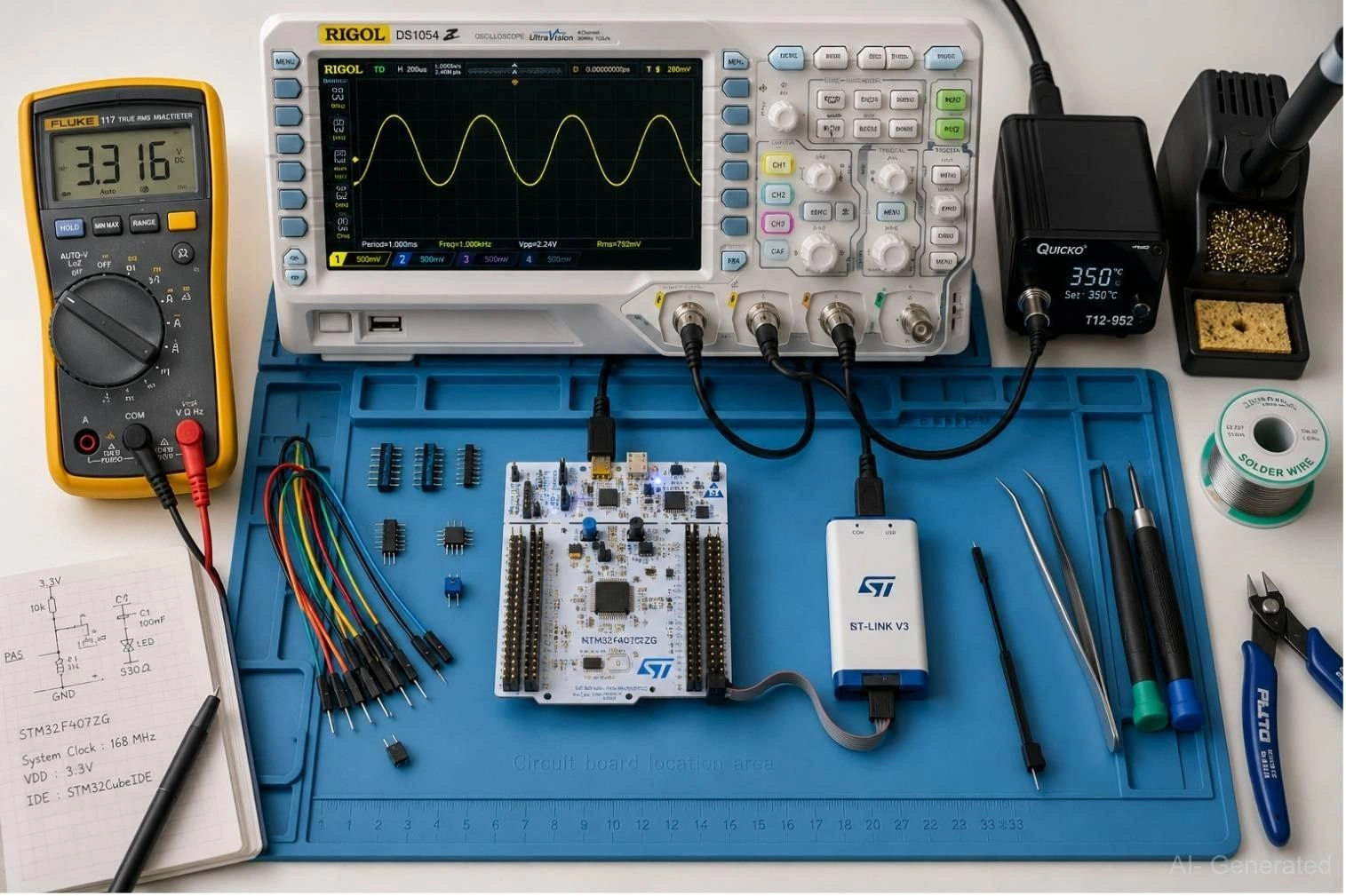
Figure: A professional hardware debugging setup featuring testing instruments and an STM32 evaluation board.
Why Many Commercial Products Use Both STM32 and ESP32
The Hybrid Architecture
To overcome the specific limitations of both chips, engineers often partition the functional workload across a dedicated coprocessor topology:
- STM32 handles: Real-time control loops, high-speed analog sensor acquisition (via ADC/DMA), strict hardware safety interlocks, and precise high-frequency motor or power supply (SMPS) PWM control.
- ESP32 handles: Complex 2.4 GHz Wi-Fi and Bluetooth protocol stacks, secure cloud transaction messaging (MQTT/HTTPS), background Over-The-Air (OTA) firmware delivery, and seamless mobile application BLE pairing.
The two communicate over UART or SPI, with the STM32 typically acting as master and the ESP32 as a "wireless modem."
Real Products Using Both
- Smart appliances: STM32 for motor + safety, ESP32 for app connectivity.
- EV chargers: STM32 for CCS/CHAdeMO + safety, ESP32 for OCPP cloud.
- Smart energy meters: STM32 for metrology, ESP32 for Wi-Fi reporting.
- Industrial gateways: STM32 for Modbus/CAN field side, ESP32 for cloud uplink.
This split lets each chip do what it's best at, and lets the wireless stack be updated without touching control firmware.
FAQs
Q: Can STM32 and ESP32 work together on a custom PCB?
Yes. This is a common commercial design pattern. The STM32 serves as the primary microcontroller for safety-critical and real-time control loops, while the ESP32 acts as a dedicated wireless coprocessor communicating via SPI or UART.
Q: Is ESP32 5V tolerant?
No. ESP32 GPIO pins operate strictly at 3.3 V. To connect ESP32 to 5 V sensors or actuators without damaging the silicon, you must use external level shifters. Many STM32 pins, however, feature native 5 V tolerance.
Q: Do Professional Engineers Use FreeRTOS on STM32 or ESP32?
Yes. FreeRTOS is standard on ESP32 because the official ESP-IDF framework is built around it natively. On STM32, professionals use FreeRTOS or ThreadX to manage complex state machines and networking stacks, but they prefer bare-metal execution for high-frequency control loops.
Q: Is Zephyr Better Than FreeRTOS for STM32 and ESP32?
Zephyr is often preferred for large STM32 projects because its device-tree architecture, standardized drivers, and vendor-independent ecosystem improve long-term maintainability. FreeRTOS remains the most common choice on ESP32 because ESP-IDF is built around it and provides full support for Wi-Fi and Bluetooth features.
Conclusion: STM32 vs ESP32 — Which One Should You Choose?
There is no universal winner in the STM32 vs ESP32 debate. The right choice depends on whether your product is mainly a real-time control system or a connected IoT device.
Choose STM32 if your project needs deterministic timing, accurate analog measurement, motor control, low-power sleep modes, industrial communication, safety-related design, or long-term product availability. STM32 is better suited for applications such as motor drives, PLCs, metering devices, industrial controllers, medical equipment, battery-powered sensors, and automotive-grade systems.
Choose ESP32 if your project is built around wireless connectivity, cloud communication, smart-home integration, fast prototyping, or low-cost consumer IoT. With built-in Wi-Fi, Bluetooth, Matter, Thread, and pre-certified modules, ESP32 is often the better choice for MQTT gateways, smart appliances, connected sensors, Home Assistant devices, and consumer electronics.
For many commercial products, the best answer is not STM32 or ESP32, but STM32 and ESP32. A common architecture is to let STM32 handle real-time control, ADC sampling, safety interlocks, and industrial I/O, while ESP32 handles Wi-Fi, Bluetooth, OTA updates, cloud messaging, and mobile app pairing. This hybrid design allows each chip to do what it does best.
Note
In short: STM32 wins when precision, determinism, power efficiency, and industrial reliability matter. ESP32 wins when wireless connectivity, speed to market, and cost matter most.
Popular Articles
• SMD Resistor Package Sizes: Complete Size Chart, Footprints & How to Choose
• How to Solder SMD Components Like a Pro [2026 Updated]
• SMD Resistor Codes: How to Read 3-Digit, 4-Digit, and EIA-96 Markings
• SMD Capacitor Codes: Identification, Markings, and Polarity
• SMD Capacitor Sizes: Complete Size Chart and Selection Tips for PCB Design and Assembly
Keep Learning
SMD MOSFET Code Guide: How to Identify, Test and Replace a MOSFET
Figure: AO3400A (C20917) in the JLCPCB parts library. The listing gives RDS(on) at 2.5 V gate drive, the number that matters in the replacement example later in this guide. An SMD MOSFET code is the two or three characters printed on top of the package, and on its own it rarely tells you which part you're holding. SMD resistors follow standard marking schemes, such as three- and four-digit codes and EIA-96. MOSFETs don't. The same short code can appear on unrelated parts from different manufacturers, ......
ESP8266 vs ESP32: Which One Should You Use?
Key Takeaways ESP32: Dual-core 240 MHz CPU, Bluetooth Classic and BLE, 520 KB SRAM, and up to 34 GPIOs. ESP8266: Single-core CPU, no Bluetooth, and around 50 KB of free RAM for applications. Lifecycle status: Espressif marks the ESP8266 Not Recommended for New Designs (NRND) and names the ESP32-C2 (ESP8684) as its upgrade, although the ESP8266 remains in production with a longevity commitment. Which ESP32 to use: Choose the ESP32-C2 for simple Wi-Fi or Bluetooth LE firmware, the ESP32-C3 for more memo......
What Is a Thermistor? A Practical Guide to NTC, PTC, Applications, and Circuit Design
Key Takeaways Definition: A thermistor is a thermally sensitive resistor whose resistance changes markedly and predictably with temperature, typically by about 4.4% per °C for a standard 10 kΩ NTC (B25/50 = 3950 K) near 25 °C. NTC vs. PTC: An NTC thermistor's resistance falls as temperature rises, which suits temperature sensing and inrush current limiting; a switching PTC's resistance rises steeply above its switch temperature, which suits circuit protection. Key Specifications: An NTC thermistor is ......
What Is the ESP32-CAM, and How to Wire, Power, and Program It?
Key Takeaways Board, not chip: The ESP32-CAM is an AI-Thinker development board, not an Espressif product. It carries AI-Thinker's ESP32-S module, an OV2640 camera, PSRAM, a microSD slot, and a flash LED. No USB port: The board has no USB connector or USB-to-UART bridge, so you program it via its serial pins using a 3.3 V USB-to-serial adapter, with GPIO0 held low at reset. Few free pins: The camera, PSRAM, and microSD card occupy most GPIOs. With the microSD card unused, GPIO2, GPIO4, GPIO12, GPIO13,......
ESP32 Versions: Which One Should You Use for Your Project?
Key Takeaways Radios decide first: ESP32 versions differ mainly in their radios, CPU cores, and peripherals. Common defaults: The ESP32-C3 suits low-cost Wi-Fi and Bluetooth LE, the ESP32-S3 suits camera, display, voice, and on-device AI. Original ESP32: The chip is still in production and remains the choice for Bluetooth Classic. Versions without Wi-Fi: The ESP32-H2 targets battery-powered Thread and Zigbee devices. Chip, module, or board: Prototype on a development board, then design a module onto y......
SOIC Package: A Complete Guide to Specifications, Types, Uses, and SMT Assembly
As designs transition from legacy through-hole components to high-density Surface Mount Technology (SMT), the Small Outline Integrated Circuit (SOIC) remains the industry standard for operational amplifiers, flash memory, sensors, and microcontrollers. It reflects a well-balanced engineering design, offering a practical compromise between the miniaturisation demanded by modern consumer electronics and the ruggedness required for industrial applications. In this guide, you will learn: SOIC package dime......