Circuit Breaker Types Explained: MCB, MCCB, RCCB, RCBO, ACB, VCB & SF6 Circuit Breakers
15 min
- What Is a Circuit Breaker?
- How Types of Circuit Breakers Are Classified
- Types of Circuit Breakers Overview
- Type 1: Miniature Circuit Breaker (MCB)
- Type 2: Molded Case Circuit Breaker (MCCB)
- Type 3: Residual Current Circuit Breaker (RCCB)
- Type 4: Residual Current Circuit Breaker with Overcurrent Protection (RCBO)
- Type 5: Air Circuit Breaker (ACB)
- Type 6: Vacuum Circuit Breaker (VCB)
- Type 7: SF6 Circuit Breaker
- Other Types of Circuit Breaker
- Circuit Breaker Standards
- MCB vs. MCCB vs. ACB vs. VCB
- How to Choose the Right Circuit Breaker
- FAQs about Circuit Breaker
- Conclusion
A circuit breaker automatically disconnects power when it detects faults such as overloads or short circuits, protecting equipment and reducing fire risk. Different circuit breaker types are designed for different voltage levels, current ratings, and applications, from household distribution boards to high-voltage substations.
This guide explains the most common types - including MCBs, MCCBs, RCCBs, RCBOs, ACBs, VCBs, and SF6 breakers and helps you choose the right one for your application.
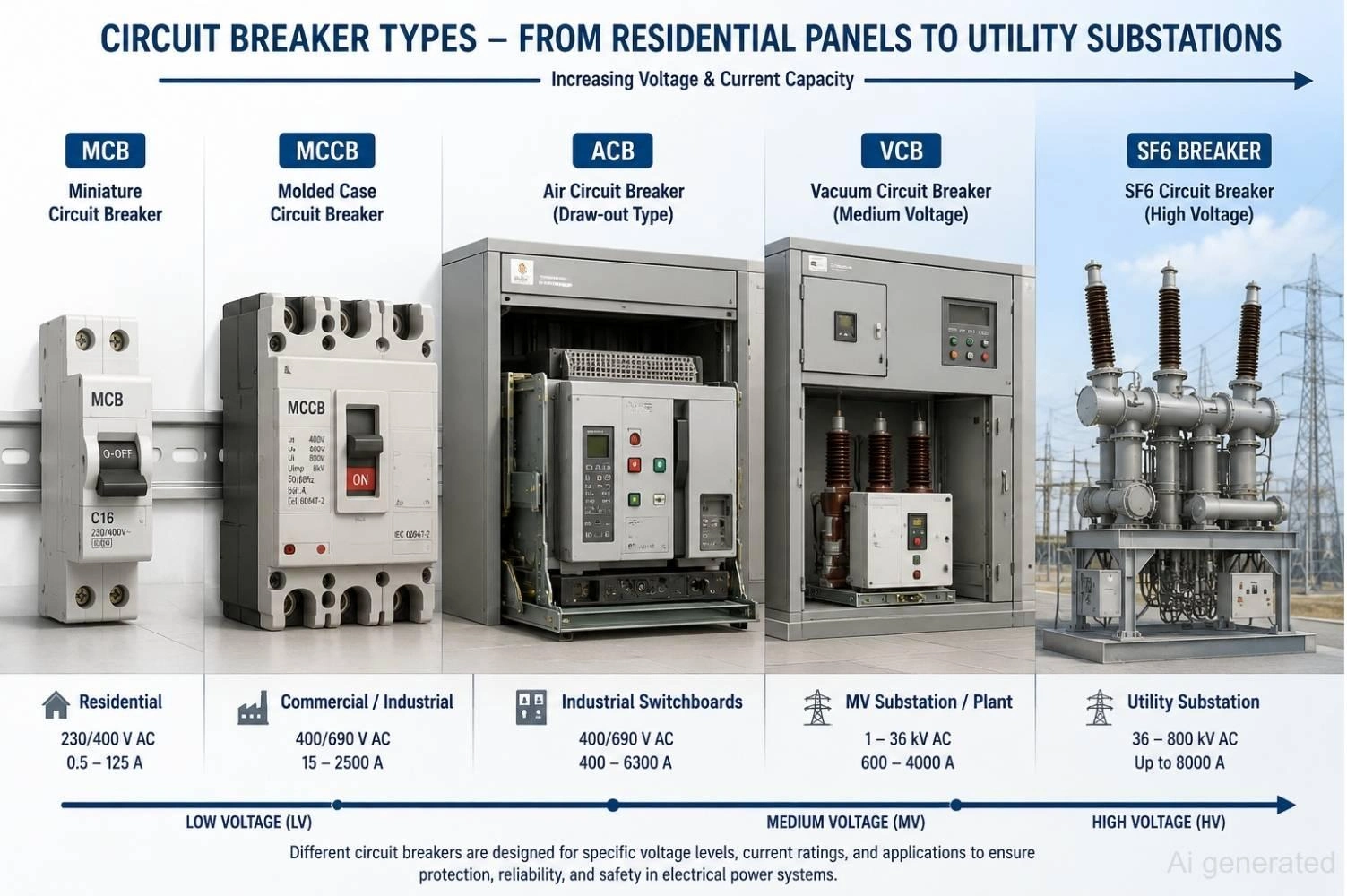
Figure: Circuit breaker types from residential panels to utility substations
What Is a Circuit Breaker?
A circuit breaker is an electromechanical or electronic switching device that automatically interrupts current flow when it detects a fault condition.
Fuse vs. Circuit Breaker
When comparing a fuse vs. a circuit breaker, the core difference lies in reusability and response mechanism:
| Feature | Fuse | Circuit Breaker |
|---|---|---|
| Reusability | Single-use (sacrificial) | Resettable and reusable |
| Response Mechanism | Thermal melting of the internal wire element | Mechanical latch or electronic trip units |
| Post-Fault Action | Must be physically replaced | Can be reset once the underlying fault is cleared |
| Initial Cost | Low cost | Higher initial investment |
How Does a Circuit Breaker Protect a Circuit
A breaker responds to several distinct fault types:
- Overload protection. Excess current above the rated value causes the breaker to trip after a short delay, protecting conductors from overheating.
- Short-circuit protection. An immediate, extremely high-current fault causes the breaker to trip almost instantly (milliseconds) to prevent catastrophic system damage.
- Ground fault protection. Detects current leaking to earth through unintended paths, tripping on an imbalance between line and neutral currents to prevent shock.
- Automatic interruption. Internal mechanisms physically separate live contacts once a fault is sensed, breaking the path without manual intervention.
Components of a Circuit Breaker
| Component | Function |
|---|---|
| Contacts | Carry current in normal operation and physically separate to interrupt it during a fault |
| Trip Unit | Senses overcurrent, short circuit, or leakage and signals the mechanism to open |
| Arc Chute | Cools and extinguishes the arc produced when contacts separate under load |
| Operating Mechanism | Stores and releases the mechanical energy that opens the contacts |
| Enclosure | Insulates live parts and contains arc byproducts |
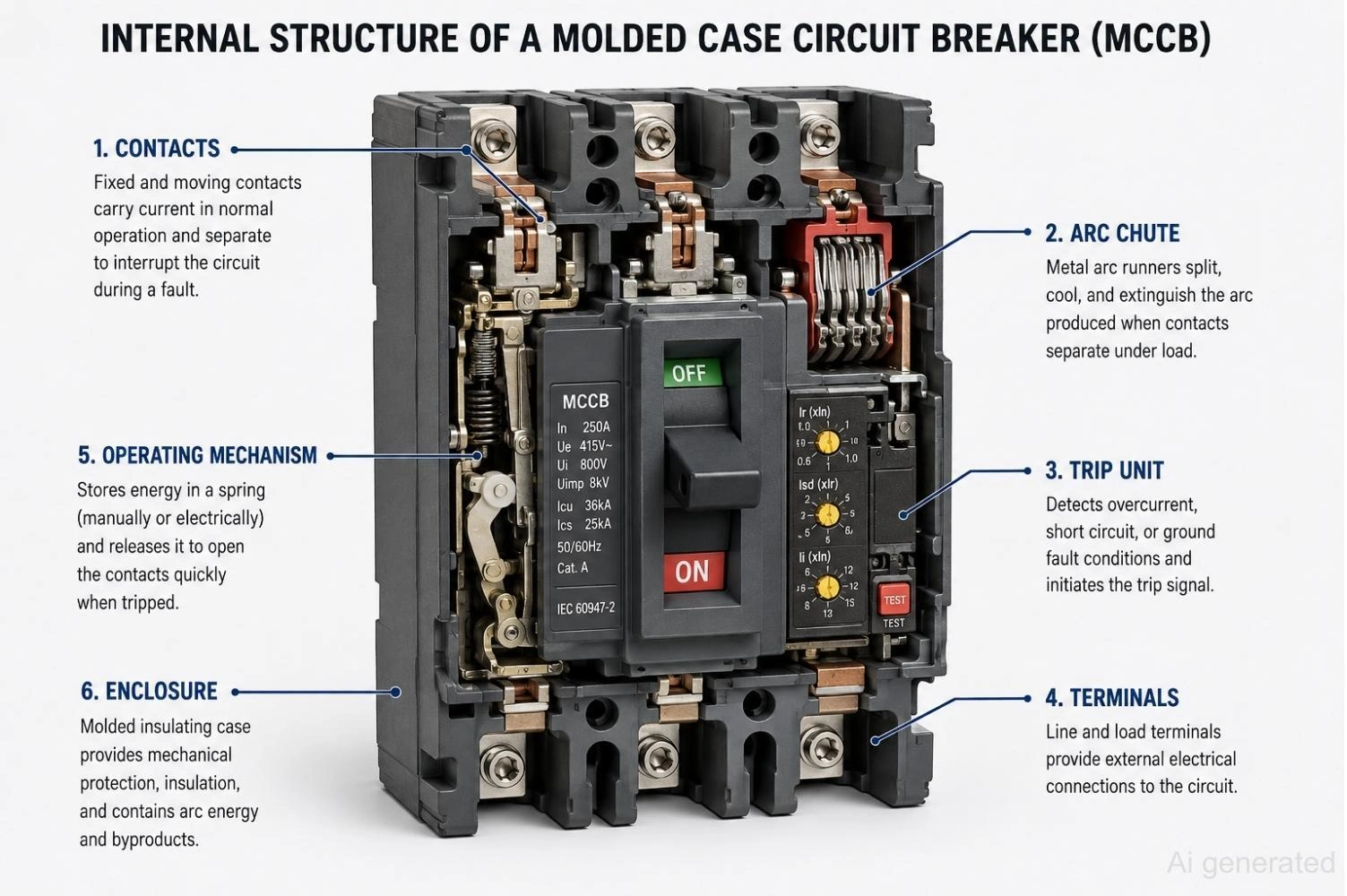
Figure: Internal structure of a circuit breaker with labeled components
How Types of Circuit Breakers Are Classified
Manufacturers and standards bodies group breakers using several frameworks, but two are most useful for selecting a real device: voltage level and arc-extinguishing medium.
Circuit Breakers by Voltage Level
| Voltage Class | Common Breaker Types |
|---|---|
| Low Voltage (under 1 kV) | MCB, MCCB, RCCB, RCBO, ACB |
| Medium Voltage (1 to 36 kV) | VCB, SF6 |
| High Voltage (above 36 kV) | SF6, GIS breakers |
Circuit Breakers by Arc-Extinguishing Medium
| Medium | Breaker Type |
|---|---|
| Air | ACB |
| Vacuum | VCB |
| SF6 Gas | SF6 Breaker |
| Oil | OCB (legacy) |
The arc-quenching medium drives most of a breaker's size, mechanical clearance needs, maintenance cycle, and nominal voltage capability.
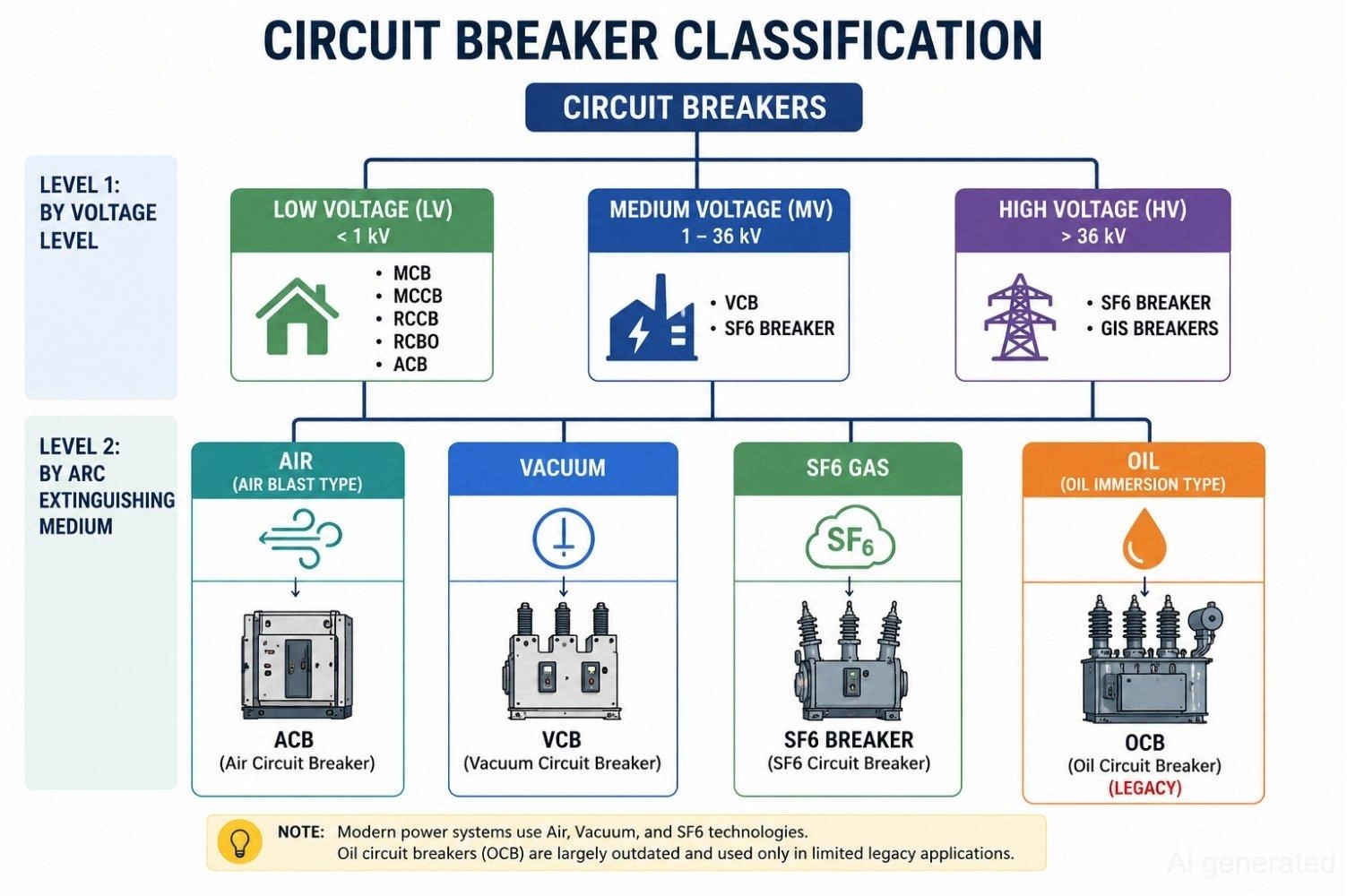
Figure: Circuit breaker classification chart by voltage and arc medium
Types of Circuit Breakers Overview
This quick-reference table summarizes the characteristics, standard protections, and typical placement of the main circuit breaker families.
| Type | Voltage Class | Rated Current | Primary Protections | Typical Application |
|---|---|---|---|---|
| MCB | Low Voltage (LV) | 0.5 A to 125 A | Overload, Short Circuit | Residential branch circuits, lighting boards |
| MCCB | Low Voltage (LV) | 15 A to 2500 A | Overload, Short Circuit (Adjustable) | Industrial distribution feeders, large motors |
| RCCB | Low Voltage (LV) | 16 A to 125 A | Earth Leakage (Ground Fault) Only | Human shock protection, damp environments |
| RCBO | Low Voltage (LV) | 6 A to 45 A | Overload, Short Circuit, Earth Leakage | Individual critical branch circuits (e.g., bathrooms) |
| ACB | Low Voltage (LV) | 400 A to 6300 A | Advanced LSI/LSIG Adjustable Trips | Main LV service incomers, heavy industrial switchboards |
| VCB | Medium Voltage (MV) | 600 A to 4000 A | Managed by external protective relays | Utility distribution substations, large industrial plant mains |
| SF6 | Medium to High Voltage (HV) | Up to 8000 A | Managed by external protective relays | High-voltage transmission substations, GIS environments |

- Once your protection design is finalized, JLCPCB's PCB assembly service can help you build reliable control and monitoring hardware.
- From rapid prototyping to volume production, simply upload your Gerber files to receive an instant online quote.
Type 1: Miniature Circuit Breaker (MCB)
What Is a Miniature Circuit Breaker?
A miniature circuit breaker is a compact, fixed-rating device covering currents from roughly 0.5 A to 125 A. It is the breaker type most engineers and homeowners encounter first, mounted on a DIN rail inside a residential consumer unit or light-industrial distribution board.
How Does an MCB Work?
MCBs combine two trip mechanisms:
- Thermal trip. A bimetallic strip bends as it heats under overload conditions, providing a time-delayed trip.
- Magnetic trip. Provides instantaneous protection against short circuits.
MCB Selection Considerations
- Maximum Continuous Current (In): The nominal load must not exceed the MCB's rating (standard sizes include 6 A, 10 A, 16 A, 20 A, 32 A, etc.).
- Breaking Capacity (Icn): Typically rated at 4.5 kA, 6 kA, or 10 kA. This is the maximum prospective short-circuit current the breaker can safely interrupt without explosive failure.
- DIN Rail Mounting: MCBs are globally standardized for 35 mm DIN rail installation, making them highly modular.
- Trip Curve Selection: Matching the load profile to a B, C, or D curve prevents nuisance tripping from inrush currents.
Typical Miniature Circuit Breaker Applications
- Homes and offices
- Lighting circuits
- Household socket outlets
- Low-power control panels
Advantages and Limitations of MCB
| Advantages | Limitations |
|---|---|
| Low cost | Fixed trip settings |
| Compact | Lower current ratings |
| Easy replacement | Not suitable for high-inrush heavy machinery |
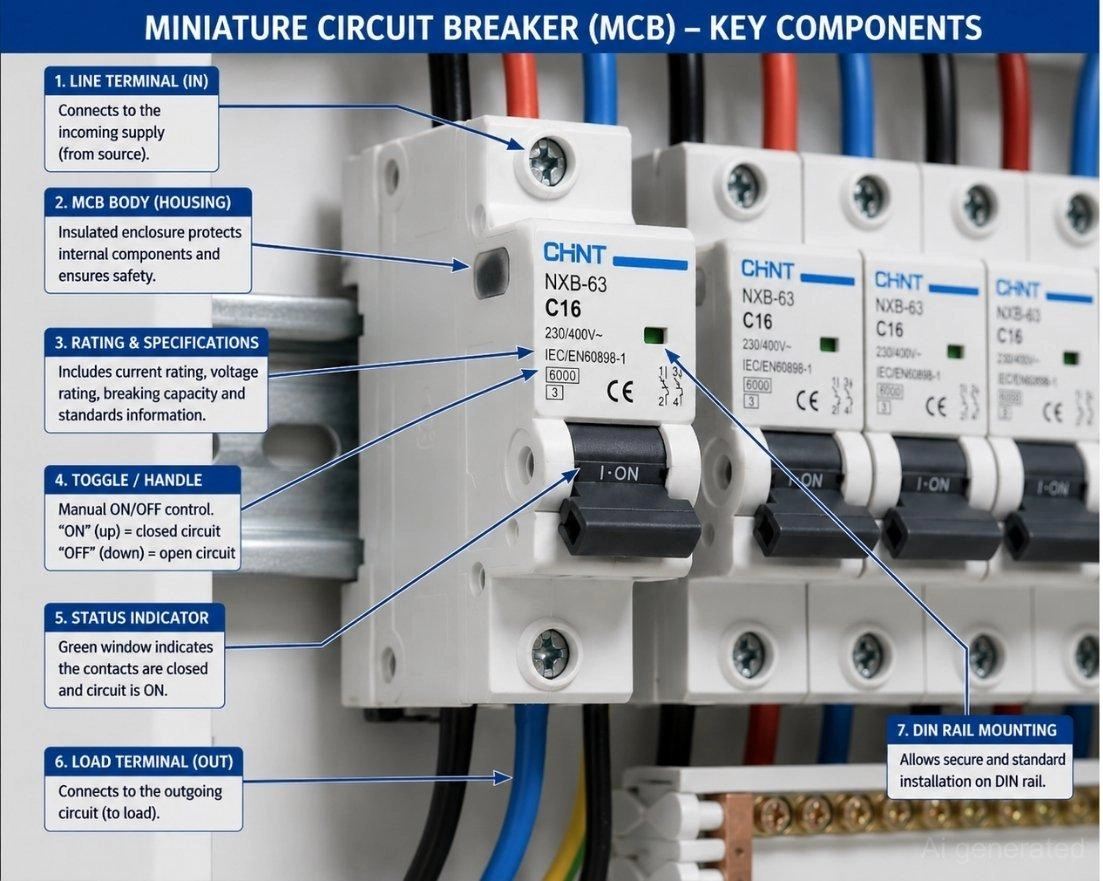
Figure: A DIN-rail mounted miniature circuit breaker installed in a consumer unit panel.
MCB Trip Curves (B, C, and D)
Trip curves determine how quickly the magnetic trip responds to short-circuit current, allowing the breaker to match different load characteristics.
| Curve Type | Instantaneous (Magnetic) Trip Threshold | Typical Application | Load Characteristics |
|---|---|---|---|
| B Curve | 3 to 5 times nominal current (In) | Resistive loads, lighting, and domestic heating | Low inrush, highly sensitive protection |
| C Curve | 5 to 10 times nominal current (In) | Inductive loads, fluorescent lights, and small motors | Moderate inrush, standard commercial loads |
| D Curve | 10 to 20 times nominal current (In) | High-inductive loads, transformers, and large motors | Extremely high inrush, delays magnetic trip |
Choose the trip curve based on the load inrush current. B curves suit resistive loads, C curves suit general-purpose circuits, and D curves suit high-inrush equipment such as motors and transformers.
Type 2: Molded Case Circuit Breaker (MCCB)
What Is a Molded Case Circuit Breaker?
A molded case circuit breaker is a heavier-duty device built into an insulated molded housing, covering current ratings from about 15 A up to 2500 A. Unlike MCBs, many MCCBs offer adjustable thermal and magnetic trip settings to customize protection curves.
MCB vs. MCCB: Core Differences
Compared with MCBs, MCCBs support higher current ratings, adjustable trip settings, and better coordination for industrial distribution.
MCCB Selection Considerations
- Adjustable Trip Parameters: Allow tuning of the thermal overload dial (e.g., 80% to 100% of nominal) and the magnetic short-circuit dial to coordinate with downstream MCBs.
- Ultimate Breaking Capacity (Icu) vs. Service Breaking Capacity (Ics): Icu is the absolute maximum fault current the MCCB can interrupt once, whereas Ics is the current it can interrupt and still remain operational. Look for a high Ics/Icu ratio (preferably 100%).
- Frame Size: Standard physical frame sizes (such as 100 A, 250 A, or 400 A frames) dictate the physical footprint in the panelboard.
Common Industrial Applications of MCCB
- Main motor feeders
- Large industrial machines
- Sub-distribution panelboards
- Commercial building service entries
Advantages and Limitations of Molded Case Circuit Breaker
| Advantages | Limitations |
|---|---|
| Adjustable trips | Significantly higher cost than MCBs |
| Higher current capacity | Larger physical footprint |
| Better selectivity coordination | More complex installation and commissioning |
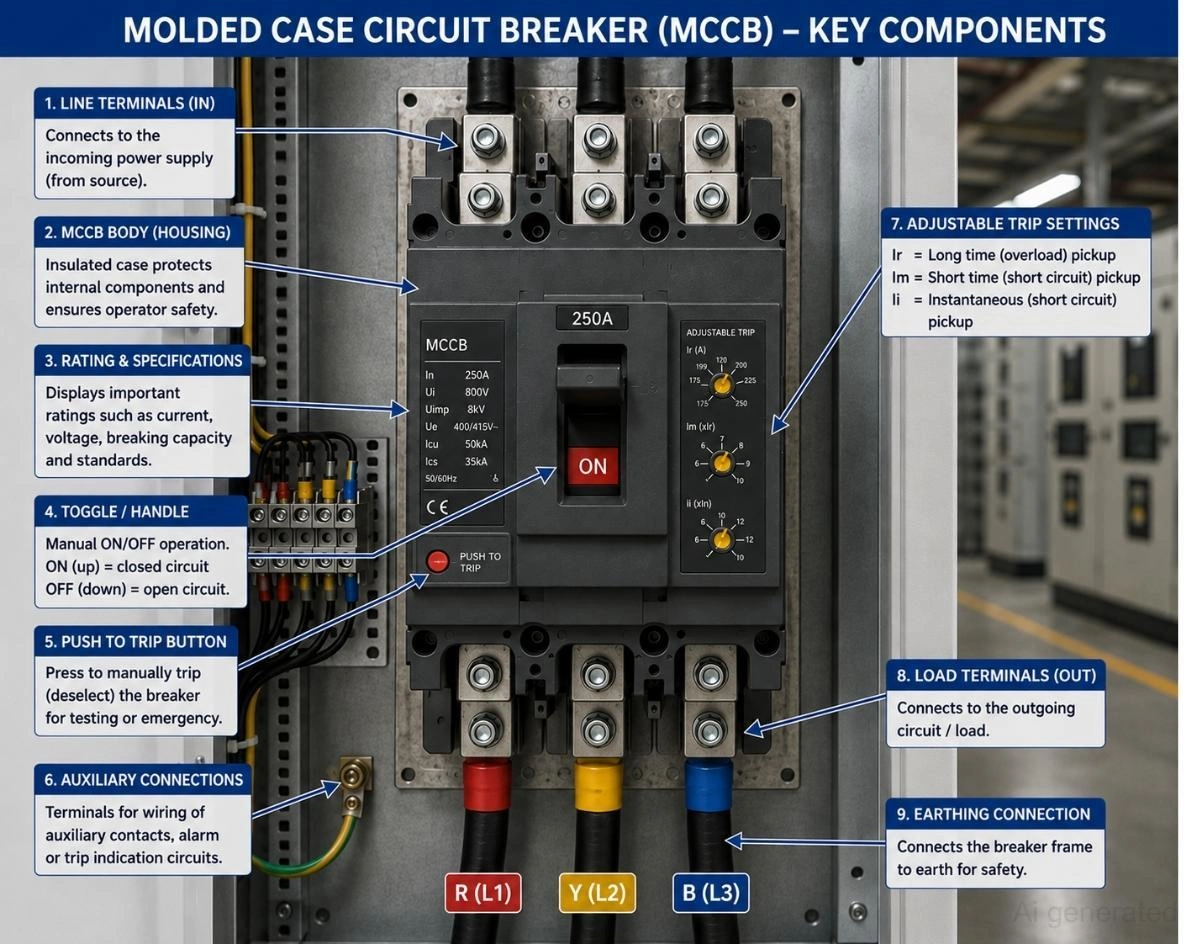
Figure: Industrial molded case circuit breaker in a distribution panel
Type 3: Residual Current Circuit Breaker (RCCB)
What Is an RCCB?
A Residual Current Circuit Breaker (RCCB) detects current leakage to earth by monitoring the imbalance between live and neutral conductors. Because it provides no overload or short-circuit protection, it must be installed together with an MCB inside the electrical panel or distribution board.
Type 4: Residual Current Circuit Breaker with Overcurrent Protection (RCBO)
What Is an RCBO?
A Residual Current Circuit Breaker with Overcurrent Protection (RCBO) combines the ground fault protection of an RCCB with the thermal-magnetic protection of an MCB in a single, compact housing.
RCCB vs. RCBO
| Feature | RCCB | RCBO |
|---|---|---|
| Earth Leakage Protection | Yes | Yes |
| Overload Protection | No | Yes |
| Short-Circuit Protection | No | Yes |
| Space Occupied | Typically 2 poles wide | Often 1 pole wide (slim) |
| Fault Isolation | Trips multiple circuits if shared | Trips only the faulty circuit |
Selection Considerations for Leakage Protection
- Sensitivity (Idn): Use 30 mA devices for personal shock protection. Use 100 mA or 300 mA devices strictly for fire protection on main circuits.
- Type Selection: Class AC (detects sinusoidal AC leakage), Class A (detects AC and pulsating DC), or Class B (detects smooth DC leakage, vital for EV chargers and solar installations).
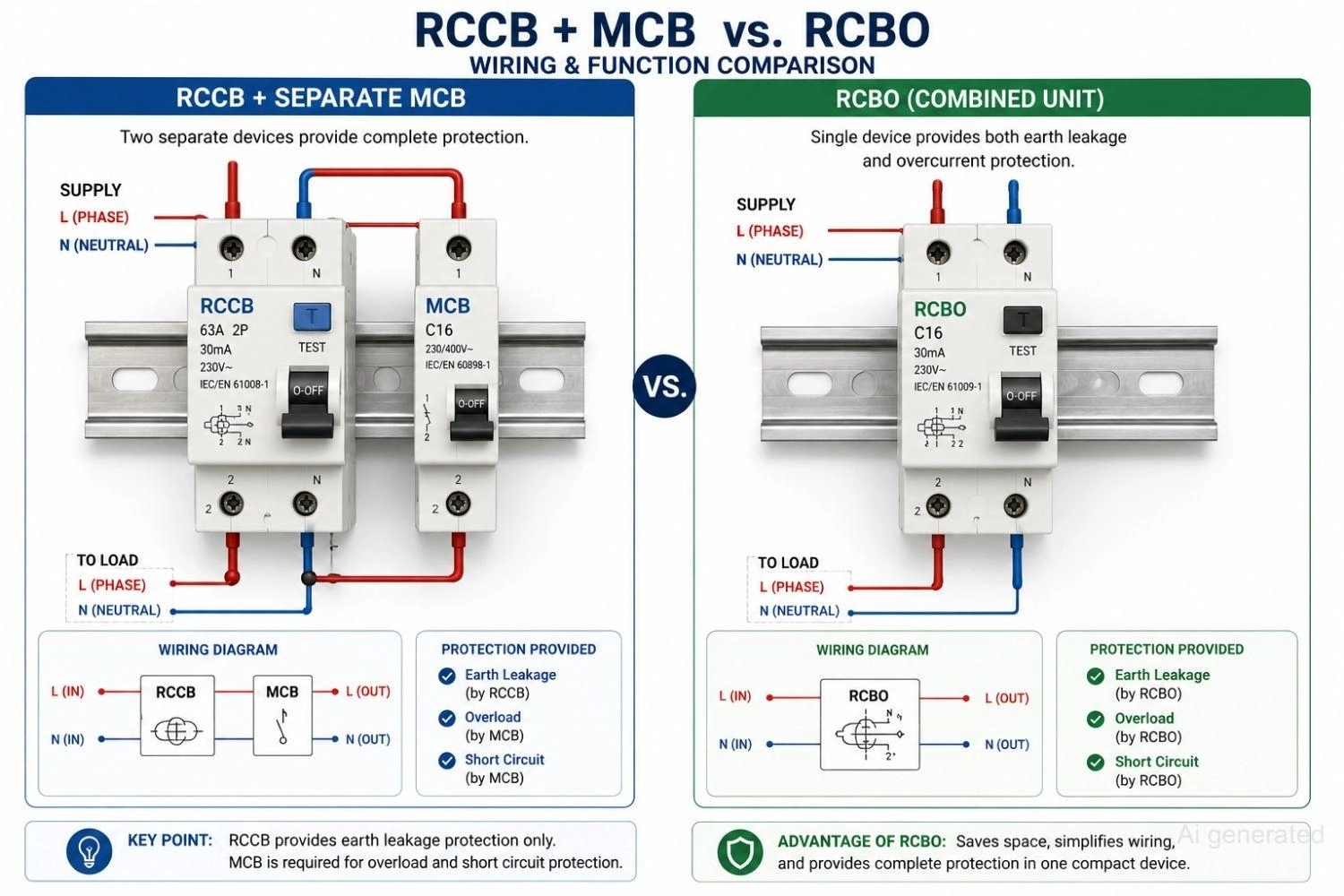
Figure: Comparison of an RCCB paired with a separate MCB, and a single combined RCBO unit, DIN-rail mounting shown.
Type 5: Air Circuit Breaker (ACB)
What Is an Air Circuit Breaker?
An air circuit breaker interrupts current using ambient air at atmospheric pressure as the arc-quenching medium. ACBs are built for the highest current ratings found in low-voltage systems (commonly 400 A to 6300 A up to 690 V) and are typically draw-out mounted inside main switchgear cabinets.
When contacts separate, the resulting high-energy arc is stretched, split, and cooled inside specialized arc chutes lined with metal splitter plates. The plates divide the arc into shorter segments, rapidly increasing its resistance until the voltage drop can no longer sustain the arc.
Selection Considerations for Air Circuit Breaker
- Draw-out vs. Fixed: Draw-out assemblies slide out of a cradle, isolating the breaker from the busbars for safe contact maintenance.
- Arc Flash Mitigation: Remote switching and maintenance bypasses improve operator safety during high-energy faults.
- LSIG Digital Trip Units: Advanced trip controllers provide adjustable settings for Long-time, Short-time, Instantaneous, and Ground fault coordination.
Common Air Circuit Breaker Applications
- Main low-voltage distribution board incomers
- Large industrial plant switchgear
- Generator protection and synchronization panels
| Parameter | Typical Range |
|---|---|
| Voltage | Up to 690 V |
| Current | 400 A to 6300 A |
| Application | Main LV distribution and power generation |
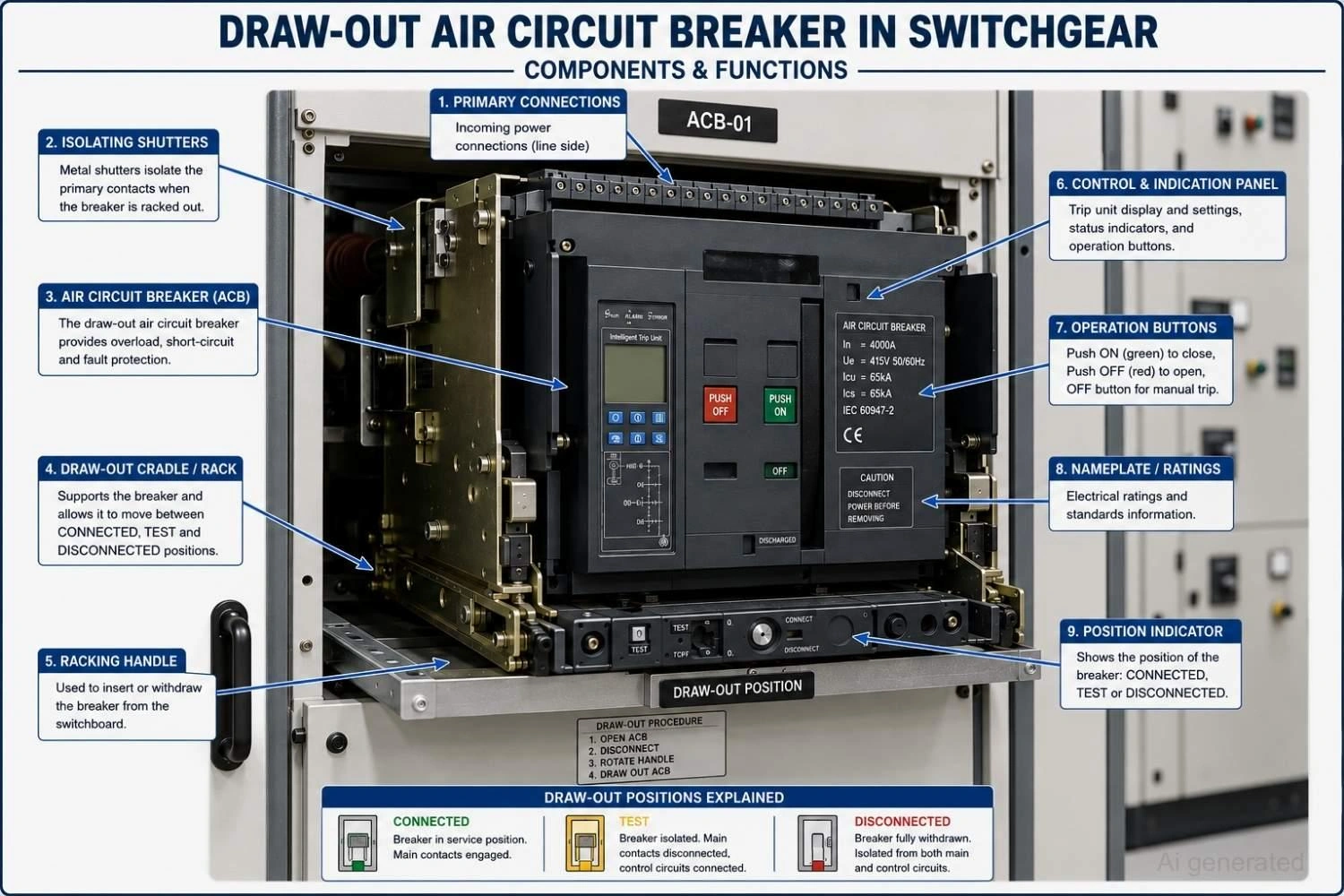
Figure: Draw-out air circuit breaker in switchgear
Type 6: Vacuum Circuit Breaker (VCB)
What Is a Vacuum Circuit Breaker?
A vacuum circuit breaker interrupts current inside a sealed interrupter maintained at extremely low pressure. This ultra-low density leaves virtually no medium to sustain an electrical arc.
How Vacuum Interrupts an Arc
When the contacts separate, a brief metal-vapor arc forms. As the AC reaches zero, the vapor rapidly condenses, allowing the vacuum to regain its insulating strength and extinguish the arc.
Selection Considerations for Vacuum Circuit Breaker
- Rated Voltage: VCBs dominate the medium-voltage band (standard steps include 12 kV, 24 kV, and 36 kV).
- Interrupting Capacity: Typically rated between 25 kA and 40 kA.
- Mechanical Endurance: VCBs are highly rated for mechanical operations (often up to 30,000 operations), making them excellent for environments with frequent switching, such as arc furnaces.
Common Applications of Vacuum Circuit Breaker
- Medium-voltage utility distribution substations
- Industrial motor control centers (MV)
- Railway traction networks
| Feature | VCB |
|---|---|
| Arc Medium | High Vacuum |
| Maintenance Requirement | Extremely Low (Sealed-for-life interrupters) |
| Fire Risk | Non-existent (No oil or gas) |
| Typical Voltage | 3.3 kV to 36 kV |
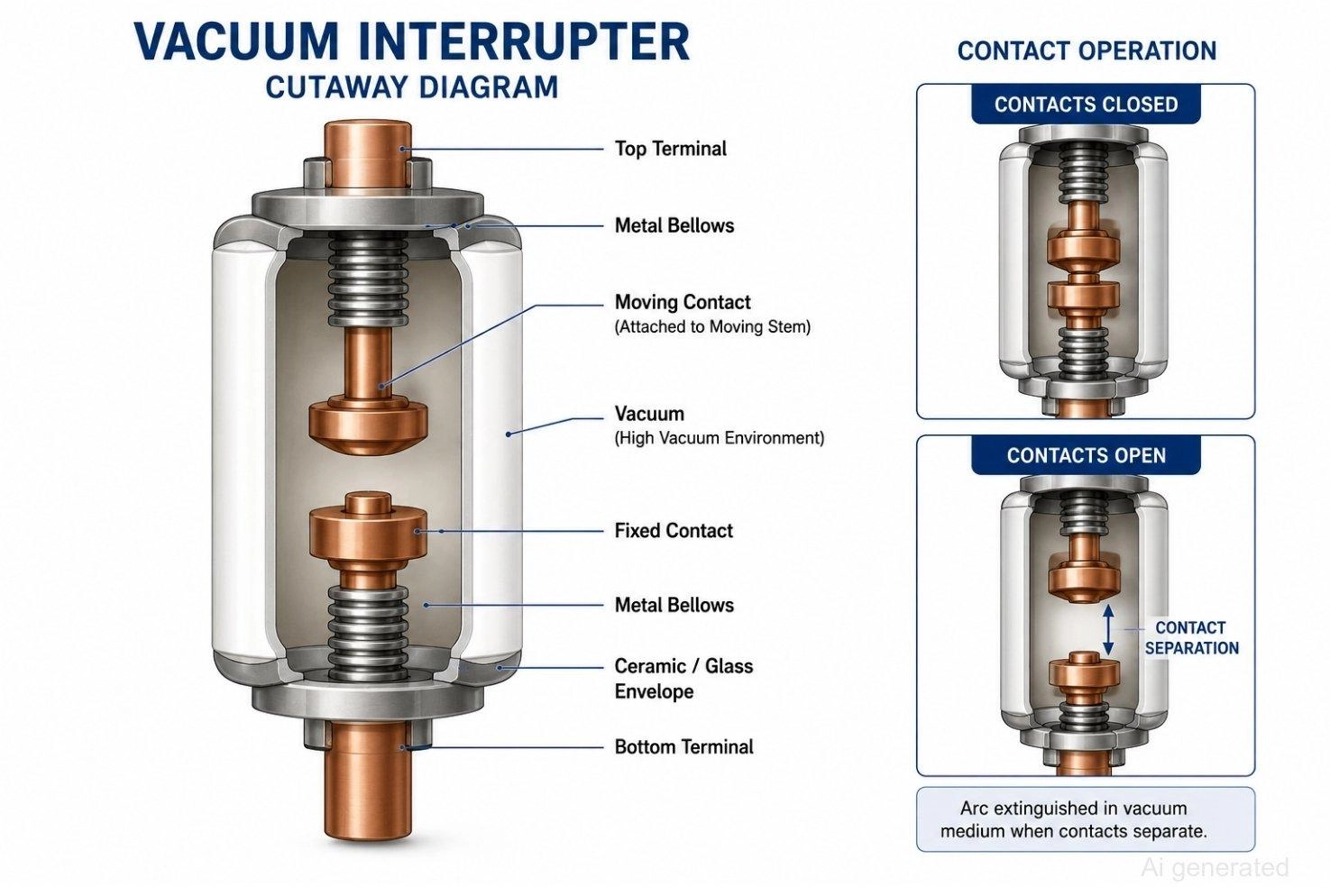
Figure: A vacuum interrupter showing the sealed ceramic or glass envelope, moving and fixed contacts, and the contact separation under vacuum
Type 7: SF6 Circuit Breaker
What Is an SF6 Circuit Breaker?
These breakers use sulfur hexafluoride gas (SF6) as both the insulating and arc-quenching medium. The gas rapidly absorbs free electrons, cooling and extinguishing the arc while providing excellent insulation. This allows for tight contact clearances, enabling compact substation designs.
To maintain performance, these breakers include temperature-compensated density monitors to detect any drops in gas density.
Environmental Considerations of SF6 Circuit Breakers
Because sulfur hexafluoride has an extremely high global warming potential - approximately 23,500 times greater than CO2 - leakage during manufacturing, field servicing, or decommissioning carries high environmental risks. Many utilities are transitioning to alternative green gases or vacuum breakers at higher voltages.
| Feature | SF6 Breaker |
|---|---|
| Arc Medium | SF6 Gas |
| Voltage Level | Medium to Ultra-High Voltage (MV/HV/EHV) |
| Reliability | Exceptionally High |
| Environmental Impact | High (Potent greenhouse gas) |
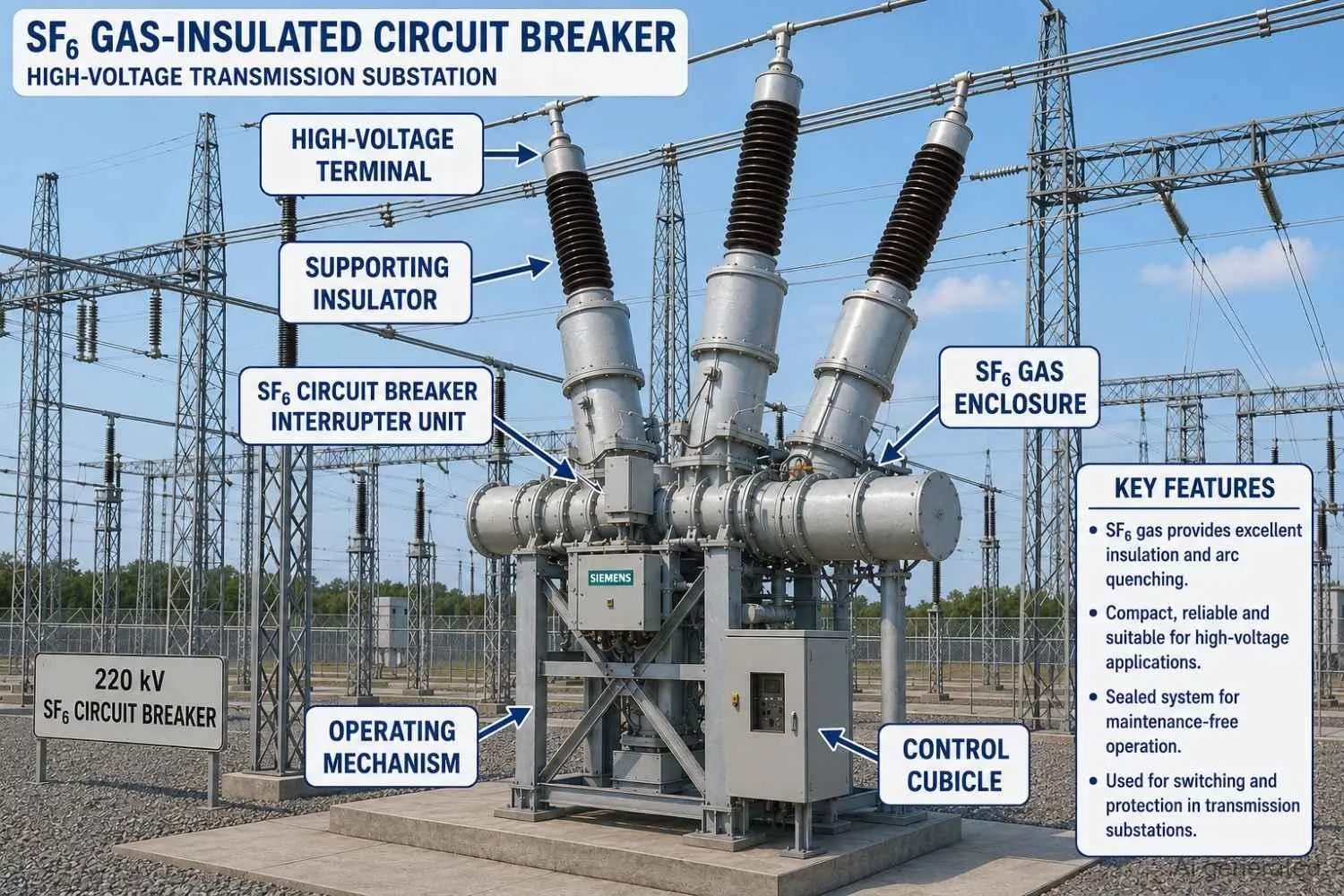
Figure: SF6 gas-insulated circuit breaker installation at a high-voltage transmission substation.
Other Types of Circuit Breaker
Beyond the core categories, several legacy and emerging technologies play specialized roles in modern electrical systems:
- Oil Circuit Breakers (OCB): A legacy technology where contacts part inside mineral oil. It is rarely used today due to high maintenance costs and severe fire or explosion risks.
- Earth Leakage Circuit Breakers (ELCB): An outdated voltage-operated safety device. These are entirely obsolete, replaced by modern current-operated residual current devices (RCCBs/GFCIs).
- Ground Fault Circuit Interrupter (GFCI): The North American equivalent of an RCCB, tripping at a highly sensitive 4 mA to 6 mA threshold for residential personnel safety in wet environments.
- Arc Fault Circuit Interrupter / Detector (AFCI / AFDD): Devices that use digital signal processors to detect high-frequency sputtering arcs from loose connections, preventing electrical fires before overcurrent occurs.
- Solid-State Circuit Breakers (SSCB): An emerging technology using semiconductors (MOSFETs or IGBTs) to isolate faults in microseconds, eliminating moving parts, physical arcs, and mechanical wear.
Circuit Breaker Standards
To ensure safety and global interoperability, circuit breakers are designed and tested according to rigorous international standards:
| Standard | Scope / Application |
|---|---|
| IEC 60898 | Low-voltage circuit breakers for household and domestic installations (operated by untrained users, fixed trip settings) |
| IEC 60947-2 | Low-voltage circuit breakers for industrial and commercial applications (adjustable trips, high breaking capacities) |
| IEC 62271 | High-voltage switchgear operating above 1 kV (including medium-voltage VCBs and high-voltage SF6 switchgear) |
MCB vs. MCCB vs. ACB vs. VCB
| Feature | MCB | MCCB | ACB | VCB |
|---|---|---|---|---|
| Voltage Class | Low Voltage (LV) | Low Voltage (LV) | Low Voltage (LV) | Medium Voltage (MV) |
| Max Rated Current | 125 A | 2500 A | 6300 A | 4000 A |
| Adjustable Trip | No | Yes | Yes | Yes (Via relay) |
| Typical Mount | DIN Rail | Panel Plate | Draw-out Cradle | Draw-out / Chassis |
| Primary Standard | IEC 60898 / 60947 | IEC 60947-2 | IEC 60947-2 | IEC 62271-100 |
How to Choose the Right Circuit Breaker
To select the appropriate protective device, engineers follow a systematic decision process:
- Confirm Operating Voltage: Determine whether the operating voltage is Low (under 1 kV), Medium (1 to 36 kV), or High (above 36 kV) to filter your primary breaker classes immediately.
- Calculate Load Current and Inrush Profile: Determine continuous load current. For capacitive or inductive loads (like large motors), analyze the inrush current magnitude and duration to pick the correct trip curve or delay setting.
- Compute Fault Levels: Calculate the prospective short-circuit current at the installation terminal using the transformer rating and upstream impedance. Ensure the breaker’s breaking capacity (Icu/Icn) exceeds this value with an appropriate safety margin.
- Determine Protection Coordination: Coordinate breakers and protective relays so only the device closest to the fault operates.
| Application | Recommended Breaker | Primary Reason |
|---|---|---|
| Home lighting/sockets | MCB | Compact size, low cost, standardized DIN mounting |
| Household safety (wet areas) | RCBO | Combined shock protection and branch overload isolation |
| Industrial motor feeder | MCCB | Supports high-current adjustments and variable startup currents |
| Main LV switchboard incomer | ACB | Superior continuous current, LSI selectivity, and draw-out safety |
| Medium-voltage feeder (11 kV) | VCB | Maintenance-free arc extinction and high mechanical endurance |
| Transmission substation (132 kV) | SF6 | Superior dielectric performance at extreme voltages |
FAQs about Circuit Breaker
Q: What is the primary difference between a fuse and a circuit breaker?
A fuse melts and must be replaced after a fault. A circuit breaker trips mechanically or electronically and can usually be reset and reused after the fault is cleared.
Q: Why can't an RCCB protect an electrical panel from a short circuit?
An RCCB only monitors current balance between live and neutral to detect leakage to ground. It lacks thermal or magnetic trip elements, meaning it cannot detect overloads or short circuits.
Q: What is the difference between an RCCB and a GFCI?
Both detect leakage currents, but an RCCB is designed to IEC standards (typically with a 30 mA trip threshold for shock protection). A GFCI is built to North American UL standards and operates at a highly sensitive 4 mA to 6 mA threshold.
Q: How do you select the correct MCB trip curve for inductive motor loads?
Use a C curve MCB (tripping at 5 to 10 times nominal current) or a D curve MCB (tripping at 10 to 20 times nominal current) to handle high inductive startup inrush currents without nuisance tripping.
Q: What makes vacuum circuit breakers safer than legacy oil-filled switchgear?
Vacuum interrupters hermetically seal contacts without flammable liquids, eliminating the severe risk of hydrogen gas explosions and fires common in legacy oil breakers.
Q: When is an ACB preferred over an MCCB in industrial power distribution?
ACBs are used for main low-voltage switchboards where currents exceed 1000 A up to 6300 A, offering higher breaking capacity, draw-out designs for safe maintenance, and advanced LSIG selectivity.
Q: Why are high-voltage networks transitioning away from SF6 gas switchgear?
SF6 is a potent greenhouse gas with a global warming potential 23,500 times greater than CO2. Strict emission regulations are driving utilities to adopt pressurized clean air or vacuum alternatives.
Conclusion
Choosing the right circuit breaker depends on voltage level, load current, fault capacity, and protection requirements. MCBs and RCBOs are ideal for residential circuits, MCCBs and ACBs serve industrial power distribution, while VCBs and SF6 breakers protect medium- and high-voltage systems.
Popular Articles
• SMD Resistor Package Sizes: Complete Size Chart, Footprints & How to Choose
• How to Solder SMD Components Like a Pro [2026 Updated]
• SMD Resistor Codes: How to Read 3-Digit, 4-Digit, and EIA-96 Markings
• SMD Capacitor Codes: Identification, Markings, and Polarity
• SMD Capacitor Sizes: Complete Size Chart and Selection Tips for PCB Design and Assembly
Keep Learning
SOIC Package: A Complete Guide to Specifications, Types, Uses, and SMT Assembly
As designs transition from legacy through-hole components to high-density Surface Mount Technology (SMT), the Small Outline Integrated Circuit (SOIC) remains the industry standard for operational amplifiers, flash memory, sensors, and microcontrollers. It reflects a well-balanced engineering design, offering a practical compromise between the miniaturisation demanded by modern consumer electronics and the ruggedness required for industrial applications. In this guide, you will learn: SOIC package dime......
What Is a 100nF Capacitor and How Do You Choose the Right One
Key Takeaways Value: A 100nF capacitor has a nominal capacitance of 0.1 µF, or 100,000 pF, and all three names describe the same part value. Marking: Many through-hole ceramic and film capacitors use the three-digit code 104, while most SMD MLCCs are unmarked. Main use: Its most common function is local decoupling at an IC power pin, where it supplies fast transient current and shunts high-frequency noise to ground. Default choice: For general decoupling, an X7R or X5R MLCC is a common starting point;......
SMD Resistor Package Sizes: Complete Size Chart, Footprints & How to Choose
Surface Mount Device (SMD) resistors are fundamental to modern electronics, and selecting the correct package size is a crucial engineering decision that impacts a PCB’s electrical performance, thermal reliability, and manufacturing cost. In this article, you will find practical, authoritative guidance on: The complete SMD resistor size chart (01005 to 2512) with exact dimensions and power ratings. Recommended PCB footprints and guidelines for reflow reliability. Critical trade-offs concerning power d......
PCB Connector Types Explained: Categories, Comparison, Applications and How to Choose the Right One
PCB connectors are essential components for connecting circuit boards with external devices, cables, or other PCBs. Choosing the right connector type affects signal reliability, mechanical stability, and overall product performance. Factors such as current rating, frequency requirements, pitch size, and mounting method should be considered during selection. In this guide, you will learn: The major types of PCB connectors and their applications. How different connector types compare. How to select the ......
What Is a System on a Chip (SoC)? A Complete Guide for PCB Designers
Nearly every electronic device you interact with today, from smartphones and IoT sensors to industrial controllers and AI edge systems, is powered by a System on a Chip (SoC). By integrating processors, memory controllers, communication interfaces, and specialized accelerators onto a single piece of silicon, SoCs deliver the performance, power efficiency, and compact form factors modern electronics demand. Whether you're selecting a processor for an embedded Linux design, evaluating an AI-capable plat......
Capacitors in PCB Design_ A Complete Guide to All Types
Capacitors are indispensable components in PCB (Printed Circuit Board) design, providing functionality from energy storage and noise filtering to voltage regulation. Whether you're designing a simple circuit or a complex multi-layer board, understanding the different types of capacitors and their applications is crucial. The basic structure of a capacitor consists of two metal plates separated by a layer of dielectric. Capacitors can be of fixed or variable type. The ability of the capacitor to hold e......