Capacitor vs Battery: Key Differences, Energy Storage, and When to Use Each
17 min
- Introduction
- Capacitor vs Battery: Key Differences
- Can a Capacitor Replace a Battery?
- Capacitor vs Battery: Which One Should You Choose?
- What Is a Capacitor?
- What Is a Battery?
- Capacitor vs Battery Performance Comparison
- Capacitor vs Battery in Real Applications
- Supercapacitor vs Battery
- Capacitor vs Battery in PCB Design and Power Architecture
- Common Mistakes in Capacitor vs Battery Selection
- FAQ
- Conclusion
Key Takeaways
- Capacitors deliver high power in microseconds but store very little energy
- Batteries hold large amounts of energy but respond more slowly to load transients
- Capacitors are ideal for filtering, decoupling, and transient suppression
- Batteries are best for sustained, long-duration power
Are capacitors better than batteries?
Neither is universally superior - they are optimized for different roles. Capacitors excel in power delivery and speed; batteries excel in energy storage and runtime. The question is never which is better, but which is right for the load profile you're designing for.
Introduction
"Can a capacitor replace a battery?" - it's one of the most common questions when comparing capacitor vs battery in power design. On the surface, both store electrical energy, but the way they do it - and when to use which - is completely different.
The core distinction comes down to power vs. energy. A capacitor can deliver a huge burst of current almost instantly, but it drains just as fast. A battery holds far more energy and releases it steadily over hours. Getting that trade-off right in your design is what separates a robust circuit from one that fails under real-world load.
This guide explains the key differences, performance trade-offs, and when to use each in real PCB designs.
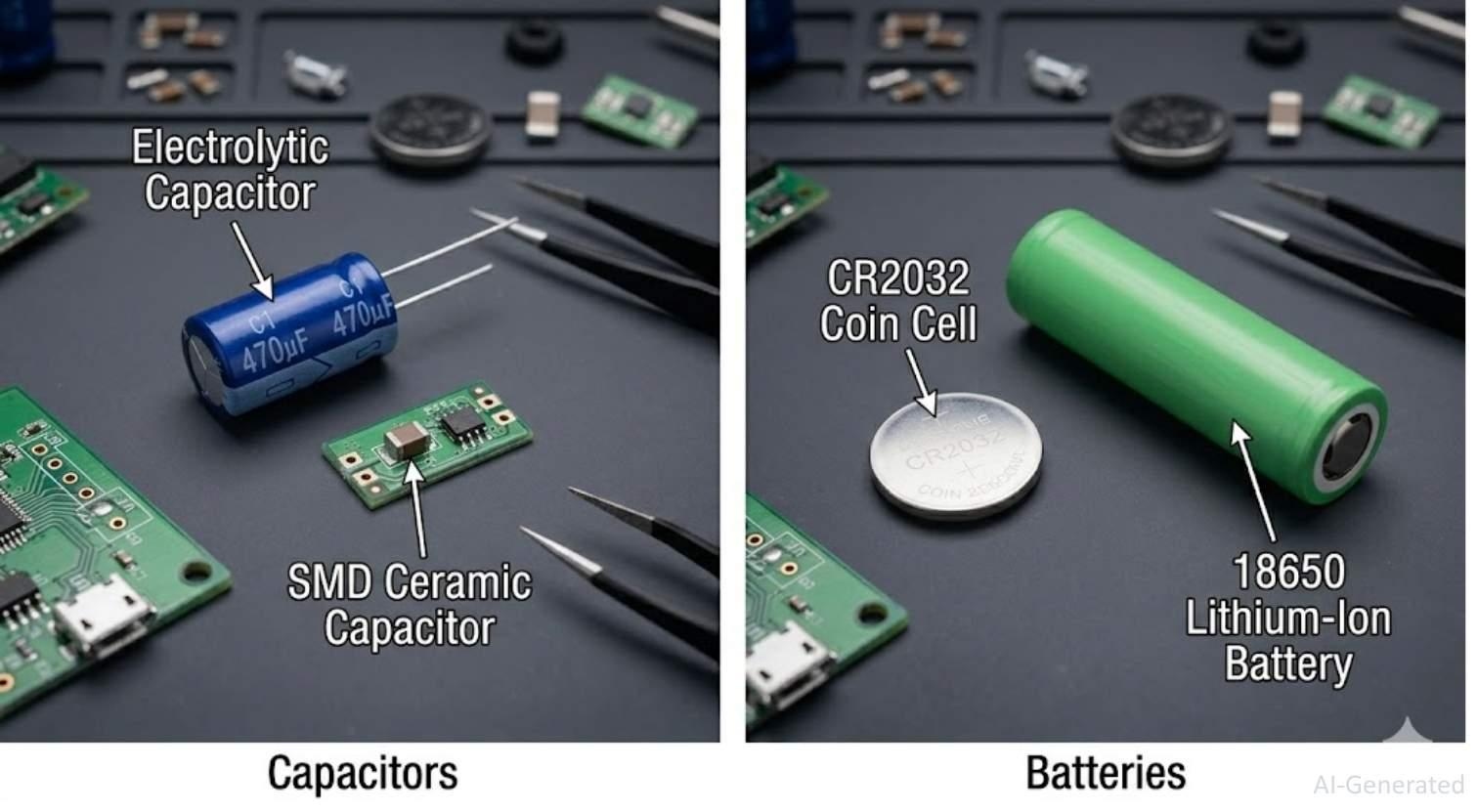
Figure: Showing real physical differences between electrolytic and SMD capacitors versus coin cell and cylindrical lithium-ion batteries
Capacitor vs Battery: Key Differences
Before diving into specifics, this comparison table captures the fundamental contrast between the two:
| Feature | Capacitor | Battery |
|---|---|---|
| Storage mechanism | Electrostatic (electric field) | Electrochemical (chemical reaction) |
| Energy density | Very low (~0.1-10 Wh/kg) | High (~100-250 Wh/kg) |
| Power density | Very high (kW/kg range) | Moderate |
| Charge/discharge speed | Milliseconds to seconds | Minutes to hours |
| Voltage behavior | Drops linearly as it discharges | Relatively flat discharge curve |
| Cycle life | Millions of cycles | Hundreds to a few thousand cycles |
| Temperature tolerance | Wide range | More sensitive |
| Self-discharge rate | High | Lower (varies by chemistry) |
Capacitors and batteries are complementary components used together in most modern electronic systems.
A battery is not a capacitor, even though both devices store charge. A capacitor stores energy in an electric field between two conductive plates separated by a dielectric. A battery stores energy in chemical bonds and converts it electrochemically during discharge. They share the concept of "storing energy," but the physics - and the engineering behavior - are entirely different.
Can a Capacitor Replace a Battery?
The short answer is: sometimes yes, but usually no.
Where Capacitors Can Replace Batteries
- RTC and SRAM backup: A small supercapacitor or large electrolytic can keep a real-time clock or low-power SRAM alive during brief power interruptions. Many microcontroller boards use supercaps in place of coin cells for this exact purpose.
- Camera flash circuits: The flash in a camera charges a large electrolytic capacitor to hundreds of volts and dumps it in microseconds - a discharge speed no battery could match.
- Short-burst actuators: Solenoids, relays, or piezo elements that need a sharp current spike for a few milliseconds are well-served by a capacitor.
Where Capacitors Cannot Replace Batteries
- Smartphones and wearables: A phone battery holds ~12-15 Wh. A same-sized capacitor stores a fraction of a watt-hour - nowhere near enough for hours of use.
- IoT sensor nodes: Even at low average current draw, a battery's flat discharge curve and high energy density are essential for months of field operation.
- Laptops and portable tools: The sustained power demand rules out capacitor-only solutions entirely.
The fundamental barrier is energy density and voltage behavior. The energy stored in a capacitor is: E = ½ × C × V²
This means a capacitor's voltage drops continuously as it discharges. For any system requiring a stable supply voltage, you either need a boost converter to compensate - adding cost and complexity - or a battery, which holds its voltage relatively flat through most of its discharge cycle.
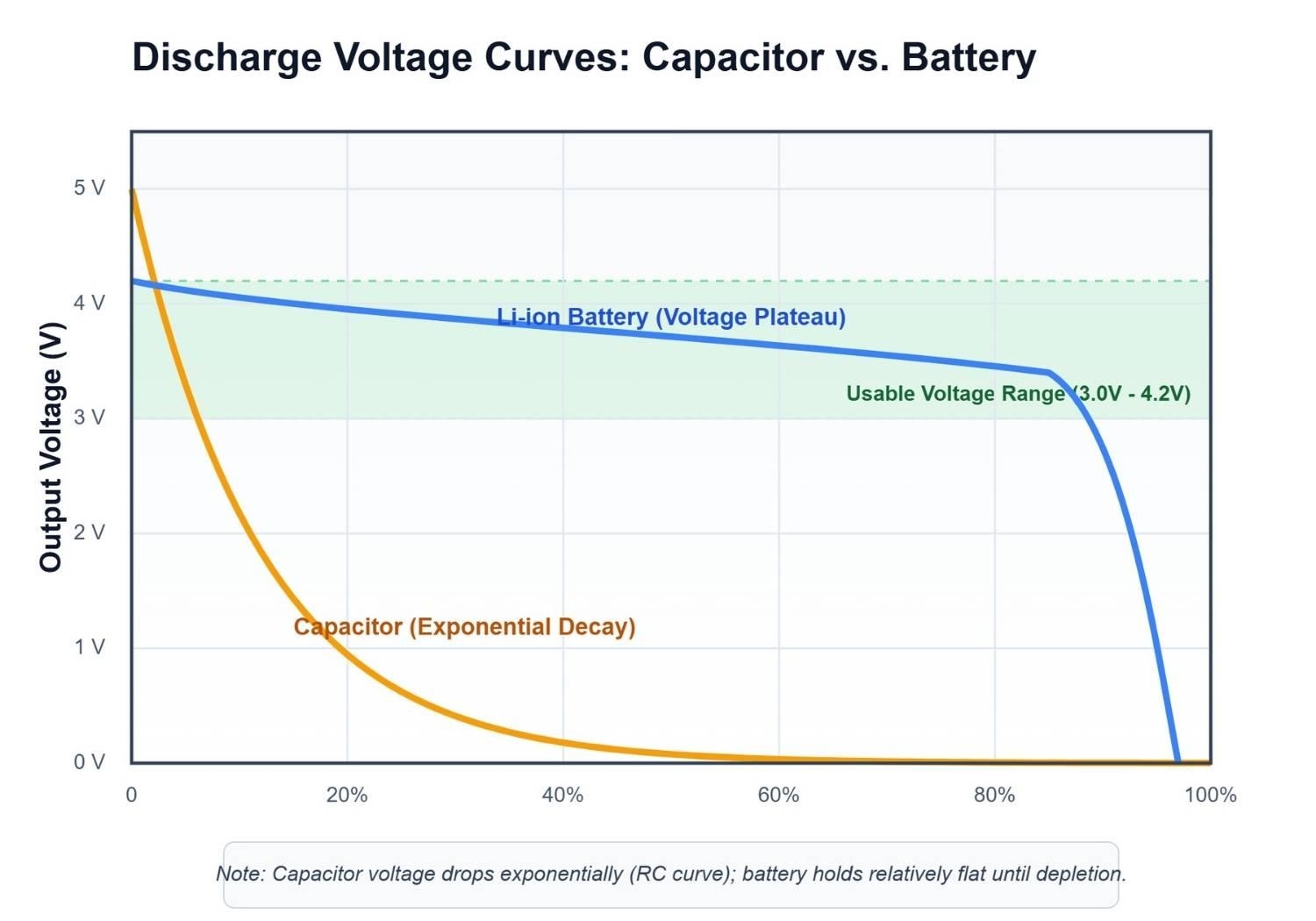
Figure: Graph comparing capacitor vs battery discharge voltage curves over time, showing capacitor voltage drops rapidly while battery voltage remains relatively flat during discharge
Capacitor vs Battery: Which One Should You Choose?
How to choose between a capacitor and a battery?
Use Capacitors When
- Decoupling and bypass: Place ceramic capacitors close to IC power pins to absorb high-frequency switching noise.
- Bulk energy buffering: Large electrolytic capacitors near voltage regulators smooth out load steps that the regulator can't respond to instantly.
- Transient suppression: TVS diodes and capacitors together clamp inductive spikes from motors or solenoids.
- AC coupling and filtering: Capacitors pass AC signals while blocking DC bias in amplifiers and signal chains.
- Power factor correction: In AC power supplies, capacitors reduce reactive power and improve efficiency.
Use Batteries When
- The system needs to operate for minutes, hours, or longer without a wired power source.
- You need a stable supply voltage across a wide range of load conditions.
- The device is portable - phones, drones, field instruments, remote sensors.
- A backup power source is needed during mains outages (combined with a charging circuit).
What Is a Capacitor?
A capacitor is a passive two-terminal component that stores energy in an electric field. It consists of two conductive plates separated by a dielectric (insulating) material. When voltage is applied, opposite charges accumulate on each plate, creating a potential difference.
How Does a Capacitor Work?
When connected to a voltage source, current flows in and charges the plates. Once fully charged, the current stops - a capacitor blocks DC in a steady state. When the source is removed or the load demands current, the stored charge flows out through the circuit.
How Capacitors Store Energy
Energy is stored electrostatically. No chemical reaction occurs. This is why capacitors charge and discharge in microseconds, and why they can sustain millions of charge cycles without degradation.
Types of Capacitors
| Type | Typical Use | Key Property |
|---|---|---|
| Ceramic (MLCC) | Decoupling, filtering | Low ESR, small size, high-frequency performance |
| Electrolytic (aluminum) | Bulk capacitance, power supply smoothing | High capacitance per volume, polarized |
| Tantalum | Compact bulk storage | Stable capacitance, polarized, sensitive to reverse voltage |
| Film | Audio, precision timing | Low loss, non-polarized |
| Supercapacitor (EDLC) | Energy backup, peak power assist | Very high capacitance (1-3000 F), bridges the gap to batteries |
Learn More: Understanding SMD Capacitors: A Comprehensive Guide
Note
Understanding capacitor markings is important for assembly. If you're deciphering component codes for SMT parts, reading SMD capacitor codes and understanding capacitor polarity markings are good references to have on hand.
What Is a Battery?
A battery is an electrochemical device that converts stored chemical energy into electrical energy. It consists of one or more electrochemical cells, each with an anode, cathode, and electrolyte.
How Does a Battery Work?
During discharge, a chemical oxidation-reduction (redox) reaction occurs at the electrodes. Electrons flow through the external circuit (powering your load) while ions move through the electrolyte internally. Recharging reverses the reaction in secondary (rechargeable) batteries.
How Batteries Store Energy
Unlike capacitors, energy is stored in chemical bonds - not in an electric field. This allows far greater energy density, but the electrochemical reaction introduces internal resistance, heat generation, and cycle degradation over time.
Common Battery Types
| Type | Nominal Voltage | Energy Density | Common Applications |
|---|---|---|---|
| Li-ion / Li-Po | 3.6-3.7 V | ~150-250 Wh/kg | Phones, laptops, drones |
| Lead-acid | 2.0 V/cell | ~30-50 Wh/kg | Automotive, UPS |
| NiMH | 1.2 V | ~60-120 Wh/kg | Power tools, AA replacements |
| LiFePO₄ | 3.2 V | ~90-160 Wh/kg | EV, solar storage, long cycle life |
Capacitor vs Battery Performance Comparison
Energy Density of Capacitor and Battery
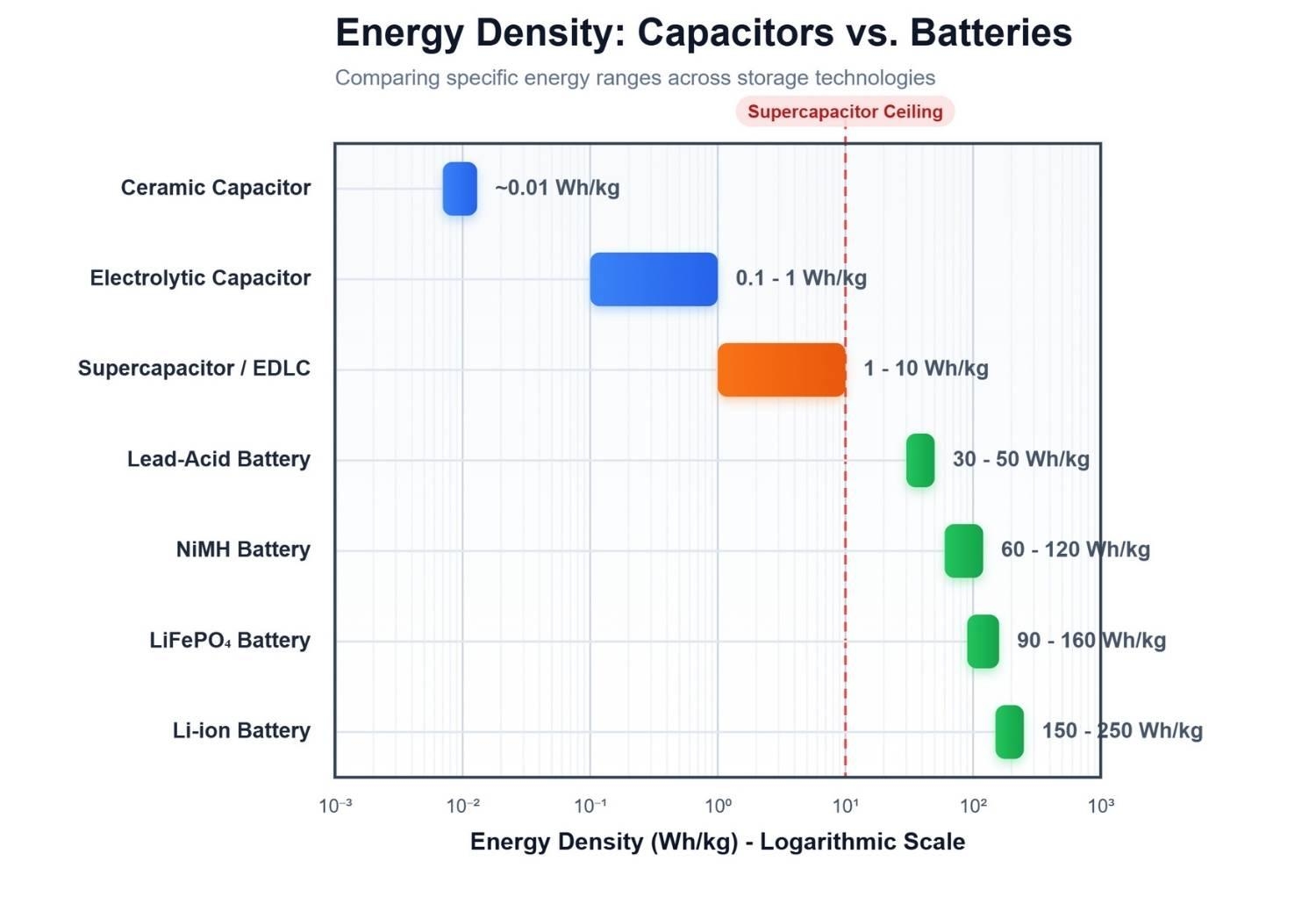
Figure: Comparing energy density in Wh per kg across ceramic capacitors, electrolytic capacitors, supercapacitors, NiMH, lead-acid, LiFePO4, and Li-ion batteries on a logarithmic scale.
This is where batteries win decisively. A typical Li-ion cell stores 150-250 Wh/kg. A high-performance electrolytic capacitor stores roughly 0.1-1 Wh/kg. Supercapacitors close the gap slightly at 1-10 Wh/kg, but still fall far short of batteries for sustained energy needs.
In practical terms: a 100 µF capacitor charged to 5 V holds about 1.25 mJ of energy. A single AA battery holds around 3,000 J - about 2.4 million times more.
In real designs, insufficient bulk capacitance often causes voltage droop during load spikes, even when the average current appears low - a subtle but damaging failure mode that's easy to miss during bench testing at light loads.
Power Density of Capacitor and Battery
Capacitors dominate here. Because there's no chemical reaction limiting the discharge rate, a capacitor can deliver enormous peak currents. Supercapacitors can reach 10,000+ W/kg in power density. Batteries are typically limited to 100-1,000 W/kg before internal resistance and thermal constraints become problematic.
This is why capacitors appear in pulsed laser drivers, defibrillators, railguns, and camera flashes - applications that need kilowatts for microseconds.
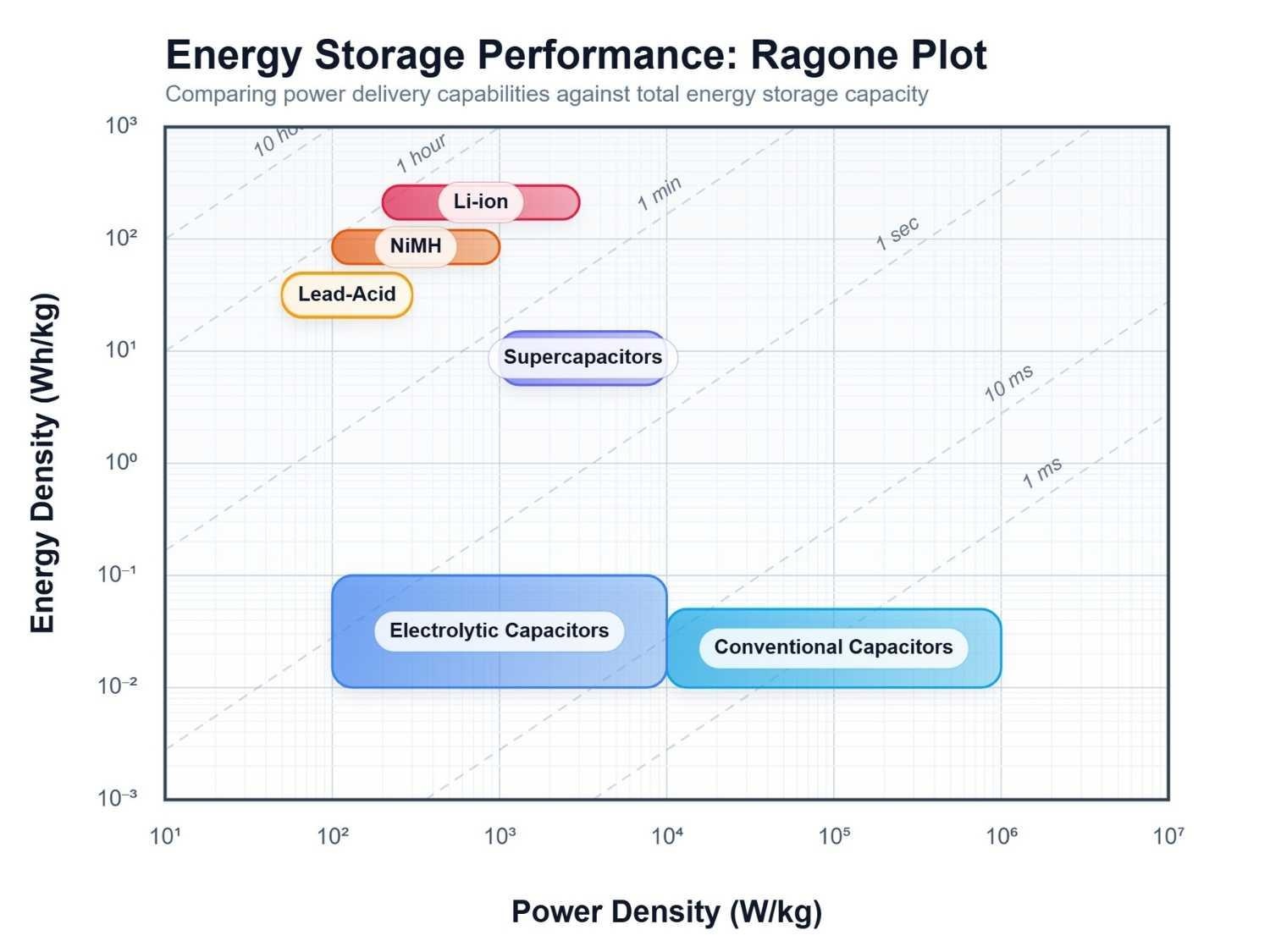
Figure: Comparison chart of energy density vs power density of capacitors, supercapacitors, and batteries - illustrating why capacitors deliver higher power while batteries store more energy.
Charge and Discharge Speed of Capacitor and Battery
A capacitor charges in microseconds to milliseconds - limited only by the RC time constant of the circuit. A lithium battery takes 30 minutes to several hours to fully charge because the chemical reaction must proceed safely without damaging the cell.
For transient loads in switching regulators - where the output voltage dips during a sudden load step - it's the output capacitance (particularly low-ESR ceramics) that responds first. The battery or main supply catches up over milliseconds to seconds.
Capacitor vs Battery in Real Applications
Power Supply Smoothing (Capacitors)
Every linear and switching power supply relies on capacitors to reduce voltage ripple. The output capacitors on a buck converter, for example, must handle the full ripple current while maintaining low ESR to avoid excessive voltage deviation. The choice between ceramics and electrolytics here involves trade-offs in capacitance, ESR, and physical size.
Long-Term Energy Supply (Batteries)
Batteries power everything that needs to run unplugged - from a wireless sensor node transmitting data every 30 seconds to an electric vehicle covering 300 miles. Their flat discharge profile makes them compatible with simple voltage regulators, and their high energy density makes miniaturization possible.
Hybrid Systems (Capacitor + Battery)
The most sophisticated power architectures combine both. Examples include:
- Electric vehicles: The traction battery handles sustained energy delivery, while a supercapacitor bank absorbs and releases energy during rapid acceleration and regenerative braking - protecting the battery from high-current stress.
- UPS systems: Batteries provide the main backup energy; capacitors handle the transfer transient while the inverter switches on.
- IoT edge devices: A rechargeable coin cell or LiPo provides long-term energy; a bulk capacitor on the power rail absorbs the high current spikes from the radio transmitter (a common source of brown-outs in poorly designed boards).
- Car audio systems: A large bank capacitor (1-4 F) supplements the vehicle battery during bass transients, preventing headlight dimming during loud passages.
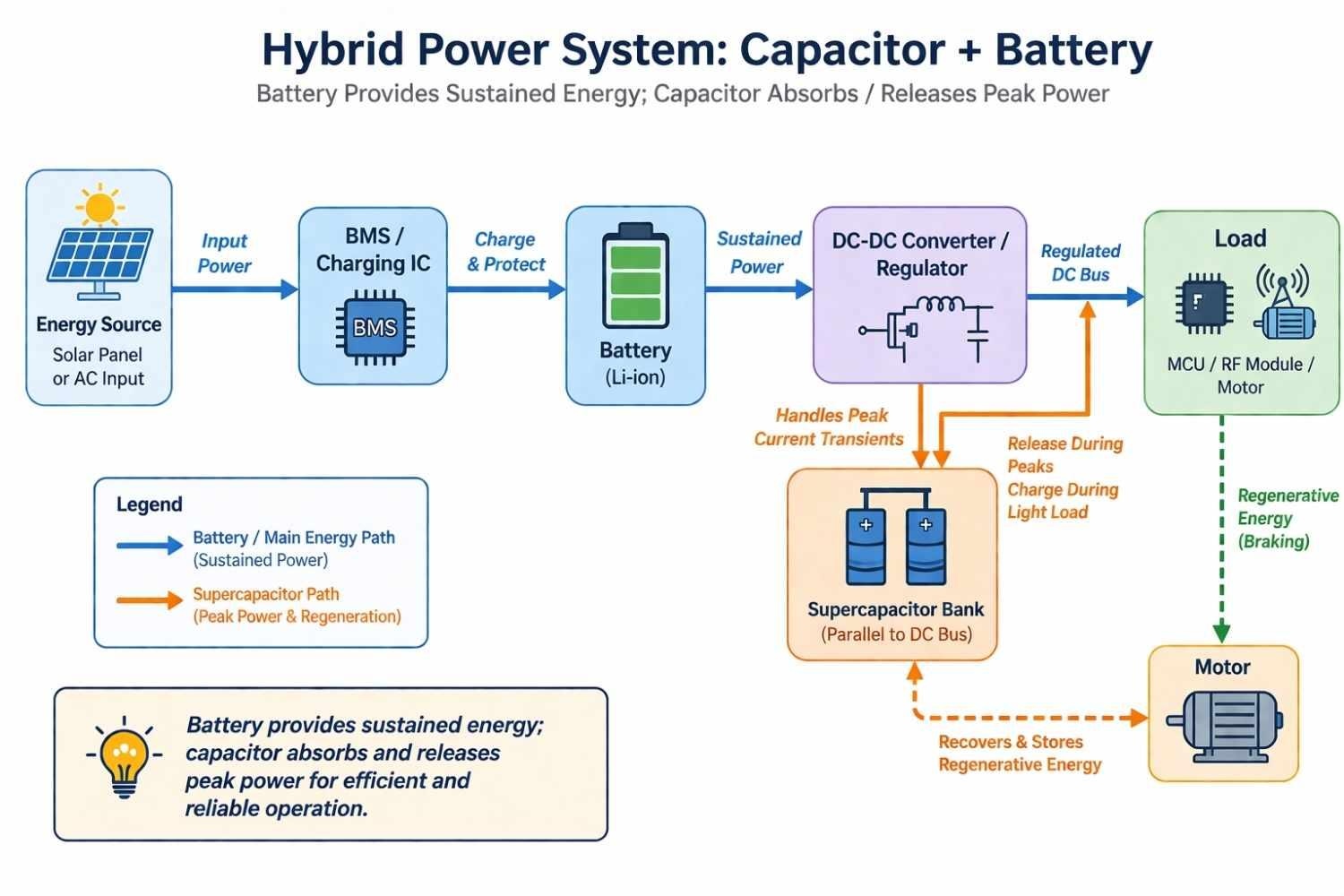
Figure: A hybrid power architecture combining a Li-ion battery and supercapacitor bank, showing how the battery handles sustained energy delivery while the capacitor manages peak current transients in an embedded system.
Supercapacitor vs Battery
Supercapacitors (also called ultracapacitors or EDLCs - electric double-layer capacitors) occupy a middle ground between conventional capacitors and batteries.
They can store significantly more energy than standard capacitors - typical values range from 1 F to 3,000 F - while charging and discharging far faster than batteries. Cycle life exceeds 500,000 cycles in most commercial products, compared to 500-2,000 for Li-ion.
The trade-off: they still can't match battery energy density for long-duration applications, and their self-discharge rate is higher. The sweet spot for supercapacitors is short-term energy buffering - bridging power during a main supply interruption, capturing energy from brief regenerative events, or providing peak power to reduce battery stress.
Capacitor vs Battery in PCB Design and Power Architecture
This is where theory meets layout - and where design decisions directly affect performance, reliability, and cost. This distinction is fundamental in power electronics, embedded systems, and PCB design.
In real PCB designs, a common failure occurs when engineers treat decoupling as an afterthought - placing a single 100 nF capacitor far from the IC and wondering why the board fails EMC testing. In high-speed digital boards, improper decoupling leads to power rail instability that shows up as intermittent resets, logic errors, or radiated emissions that exceed regulatory limits.
Role of Capacitors and Batteries in PCB Power Design
Every PCB power network relies on a hierarchical capacitor strategy:
- High-frequency noise (10 MHz+): Small ceramic MLCCs (0.1 µF, 10 nF) placed within 1-2 mm of IC power pins. These handle fast transients from digital switching.
- Mid-frequency bulk: Larger ceramics or tantalums (1-100 µF) near voltage regulators to stabilize the rail during moderate load steps.
- Low-frequency bulk: Aluminum electrolytics (100 µF-10 mF) at the board power entry point, smoothing ripple from the supply.
The battery interfaces through a protection circuit (PCM/BMS) that handles overcharge, over-discharge, short-circuit protection, and cell balancing in multi-cell packs.
Capacitor Placement and EMI
The effectiveness of a decoupling capacitor depends heavily on placement. A capacitor that's 5 mm from the IC pin it's decoupling may as well not be there at high frequencies - the trace inductance between the capacitor and the pin dominates the impedance.
Key layout rules:
- Minimize the loop area between the capacitor and the IC power/ground pins.
- Use via-in-pad or place vias immediately adjacent to the capacitor pads.
- Route power and ground planes to reduce return-path impedance.
Poor capacitor placement is one of the most common causes of EMI failures in otherwise well-designed boards.
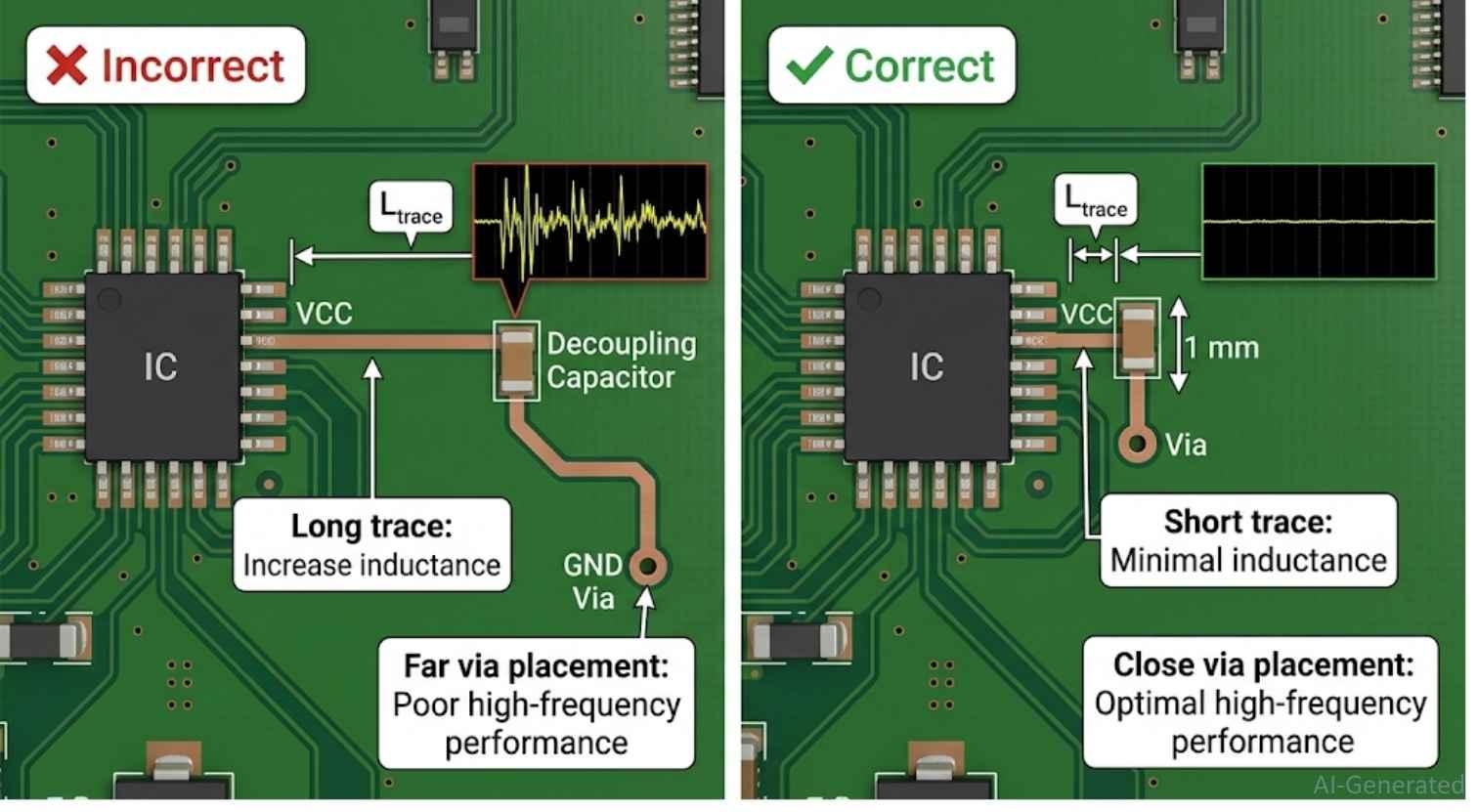
Figure: PCB layout showing incorrect vs correct decoupling capacitor placement near an IC power pin, demonstrating how short traces and close ground vias reduce parasitic inductance and improve power rail stability
Battery Interface and Safety
Integrating a battery into a PCB design requires more than just connecting the terminals. A proper implementation includes:
- Charging IC: Manages CC/CV charging profile, temperature monitoring, and charge termination.
- Protection circuit (PCM): Prevents overcharge (>4.2 V for Li-ion), over-discharge (<2.5-3.0 V), and overcurrent.
- Fuel gauge IC (optional but recommended for consumer products): Provides accurate state-of-charge estimation.
- Thermal management: Avoid placing heat-generating components adjacent to the battery - elevated temperature is the primary driver of Li-ion cycle degradation.
Optimizing BOM Selection
For capacitors, the BOM decision involves:
- Ceramic vs electrolytic: Ceramics are smaller and lower ESR but limited in capacitance; electrolytics offer high capacitance at lower cost but with ESR and aging concerns.
- Voltage derating: Always select capacitors rated at 2× the operating voltage for ceramics (capacitance drops significantly with applied voltage in Class II ceramics like X5R/X7R) and 1.5× for electrolytics.
- Package selection: Smaller packages (0201, 0402) offer better HF performance; larger packages (0805, 1206) give more robust soldering and lower inductance in high-current paths.
Once your schematic and layout are finalized, platforms like JLCPCB enable engineers to move efficiently from schematic to assembled hardware, with integrated PCB fabrication and SMT assembly.
The JLCPCB parts library includes a wide range of MLCCs, electrolytics, and protection ICs for one-stop BOM sourcing, covering placement of both passive components and battery connector footprints. For teams prototyping power-sensitive designs, this kind of integrated service reduces the iteration cycle between layout validation and physical testing.
Common Mistakes in Capacitor vs Battery Selection
Ignoring Power vs Energy Needs
The most frequent mistake: choosing a component based on voltage and footprint alone, without analyzing whether the application is power-limited or energy-limited. A capacitor in a 100 mA continuous load application will collapse in milliseconds. A battery in a 100 A pulse application will fail to respond fast enough - and may be damaged by the current spike. Always profile the load: plot current vs. time across the full use case before selecting energy storage.
Underestimating Transient Loads
Radio transmitters, motor start-up currents, and switched loads create transient current demands that can be 10-100× the average current. If the supply rail isn't stiff enough - meaning there isn't adequate decoupling capacitance near the load - the voltage will droop, potentially resetting microcontrollers or causing logic errors. In many IoT designs, insufficient bulk capacitance causes brown-out resets during RF transmission - even when the battery is fully charged.
Poor PCB Layout
Even the best capacitor spec is undermined by poor placement:
- Decoupling capacitors routed far from the IC they're meant to serve.
- Shared via between power and ground return paths, creating ground bounce.
- Insufficient ground copper under high-current battery traces, adding resistance and inductance.
FAQ
Q: Can you charge a capacitor directly from a battery?
Yes, but it requires caution. An uncharged capacitor acts as a short circuit the moment it connects to power. Without a current-limiting resistor or a dedicated charging circuit, the initial inrush current can be massive—potentially melting thin wires, damaging the battery, or destroying the switch contacts.
Q: Do capacitors expire on the shelf as batteries do?
They age differently. Batteries degrade chemically over time, permanently losing capacity even when unused. Solid-state capacitors (like ceramics) essentially never expire on the shelf. However, aluminum electrolytic capacitors contain a liquid electrolyte that can slowly dry out or degrade over many years in storage, sometimes requiring a "reforming" process before use.
Q: Why do electronics hold a dangerous charge after being unplugged?
If you remove a battery, the power source is gone. But when you unplug a main-powered device (like a TV, amplifier, or motor drive), the large, high-voltage bulk capacitors inside can retain a lethal charge for minutes or even hours unless the PCB was specifically designed with bleeder resistors to safely dissipate the stored energy.
Q: What happens if you wire a battery and a capacitor in series?
A fundamental property of capacitors is that they block direct current (DC) once fully charged. If you place a capacitor in series with a battery, current will flow only for the brief fraction of a second it takes to charge the capacitor. After that, the circuit behaves like an open switch, and no steady DC power will reach your load.
Q: How do you tell a capacitor and a battery apart in circuit diagrams?
A capacitor is drawn as two parallel lines (one curved if it is a polarized electrolytic type) to visually represent the two plates separated by a dielectric. A battery is drawn as alternating long and short parallel lines, representing the electrochemical cell stack.
Conclusion
In every capacitor vs battery decision, the key is understanding whether your design is power-driven or energy-driven.
Capacitors handle fast transients and rail stabilization; batteries provide sustained energy over time.
Capacitors and batteries are complementary components, not competing technologies - most modern systems combine both for optimal performance. This distinction is fundamental in power electronics and embedded system design.
Choosing correctly early in the design process improves reliability, reduces BOM cost, and prevents the kind of real-world failures that only surface after tape-out. If you're ready to move from schematic to assembled board, get a quote and explore JLCPCB's full fabrication and assembly capabilities.
Popular Articles
• SMD Resistor Package Sizes: Complete Size Chart, Footprints & How to Choose
• How to Solder SMD Components Like a Pro [2026 Updated]
• SMD Resistor Codes: How to Read 3-Digit, 4-Digit, and EIA-96 Markings
• SMD Capacitor Codes: Identification, Markings, and Polarity
• SMD Capacitor Sizes: Complete Size Chart and Selection Tips for PCB Design and Assembly
Keep Learning
SOIC Package: A Complete Guide to Specifications, Types, Uses, and SMT Assembly
As designs transition from legacy through-hole components to high-density Surface Mount Technology (SMT), the Small Outline Integrated Circuit (SOIC) remains the industry standard for operational amplifiers, flash memory, sensors, and microcontrollers. It reflects a well-balanced engineering design, offering a practical compromise between the miniaturisation demanded by modern consumer electronics and the ruggedness required for industrial applications. In this guide, you will learn: SOIC package dime......
What Is a 100nF Capacitor and How Do You Choose the Right One
Key Takeaways Value: A 100nF capacitor has a nominal capacitance of 0.1 µF, or 100,000 pF, and all three names describe the same part value. Marking: Many through-hole ceramic and film capacitors use the three-digit code 104, while most SMD MLCCs are unmarked. Main use: Its most common function is local decoupling at an IC power pin, where it supplies fast transient current and shunts high-frequency noise to ground. Default choice: For general decoupling, an X7R or X5R MLCC is a common starting point;......
SMD Resistor Package Sizes: Complete Size Chart, Footprints & How to Choose
Surface Mount Device (SMD) resistors are fundamental to modern electronics, and selecting the correct package size is a crucial engineering decision that impacts a PCB’s electrical performance, thermal reliability, and manufacturing cost. In this article, you will find practical, authoritative guidance on: The complete SMD resistor size chart (01005 to 2512) with exact dimensions and power ratings. Recommended PCB footprints and guidelines for reflow reliability. Critical trade-offs concerning power d......
PCB Connector Types Explained: Categories, Comparison, Applications and How to Choose the Right One
PCB connectors are essential components for connecting circuit boards with external devices, cables, or other PCBs. Choosing the right connector type affects signal reliability, mechanical stability, and overall product performance. Factors such as current rating, frequency requirements, pitch size, and mounting method should be considered during selection. In this guide, you will learn: The major types of PCB connectors and their applications. How different connector types compare. How to select the ......
What Is a System on a Chip (SoC)? A Complete Guide for PCB Designers
Nearly every electronic device you interact with today, from smartphones and IoT sensors to industrial controllers and AI edge systems, is powered by a System on a Chip (SoC). By integrating processors, memory controllers, communication interfaces, and specialized accelerators onto a single piece of silicon, SoCs deliver the performance, power efficiency, and compact form factors modern electronics demand. Whether you're selecting a processor for an embedded Linux design, evaluating an AI-capable plat......
Capacitors in PCB Design_ A Complete Guide to All Types
Capacitors are indispensable components in PCB (Printed Circuit Board) design, providing functionality from energy storage and noise filtering to voltage regulation. Whether you're designing a simple circuit or a complex multi-layer board, understanding the different types of capacitors and their applications is crucial. The basic structure of a capacitor consists of two metal plates separated by a layer of dielectric. Capacitors can be of fixed or variable type. The ability of the capacitor to hold e......