How Transparent Graphene Heaters Clear Fogged Glass
11 min
- Why Graphene Can Heat Without Hiding What Is Behind It
- Building an Atom-Thin Heater
- Fast Response, Small Thermal Mass
- What Does "Efficient" Mean for a Transparent Heater?
- Where an Invisible Heating Film Could Matter
- Three Numbers Worth Remembering
- The Catch: A Perfect Sheet Is Not Yet a Perfect Product
- FAQ about Transparent Graphene Heaters
Key Takeaways
Atom-thin transparency: A single graphene layer transmits about 97.7% of visible light, while five stacked layers still pass roughly 87.3%, making the heater nearly invisible on glass or plastic.
Fast, controllable heating: A monolayer device reaches its target temperature with a thermal time constant of only about 6–7 seconds, and input power can be adjusted to hold temperatures from 38 °C up to around 80 °C.
Efficiency advantage: Graphene heaters achieved higher temperatures at the same power density than comparable metal-film and carbon-nanotube devices in laboratory tests, suggesting lower energy consumption per degree of warming.
Product readiness gap: Resistance drift, humidity sensitivity, and transfer-related defects mean the material works in the lab but still needs durable encapsulation, reliable contacts, and long-term environmental testing before commercial deployment.
Why Graphene Can Heat Without Hiding What Is Behind It
On a cold morning, the fastest route to a clear windshield is usually a blast of warm air or a grid of visible heating wires. Both work, but neither is ideal. Warm air takes time to heat the cabin and glass. Metallic lines can interrupt the view, and continuous transparent coatings often rely on brittle or expensive materials. What if the glass — or a thin film attached to it — could become the heater while remaining almost invisible?
That is the promise of transparent heaters: electrically conductive coatings that turn electrical energy into heat without behaving like an opaque hot plate. They could keep car windows, bathroom mirrors, camera lenses, sensors, outdoor displays, and even wearable devices free of fog or frost. A 2020 study by Yong Zhang and colleagues explored one of the most intriguing candidates for the job: undoped graphene grown by chemical vapor deposition and stacked one to five layers thick on flexible plastic.
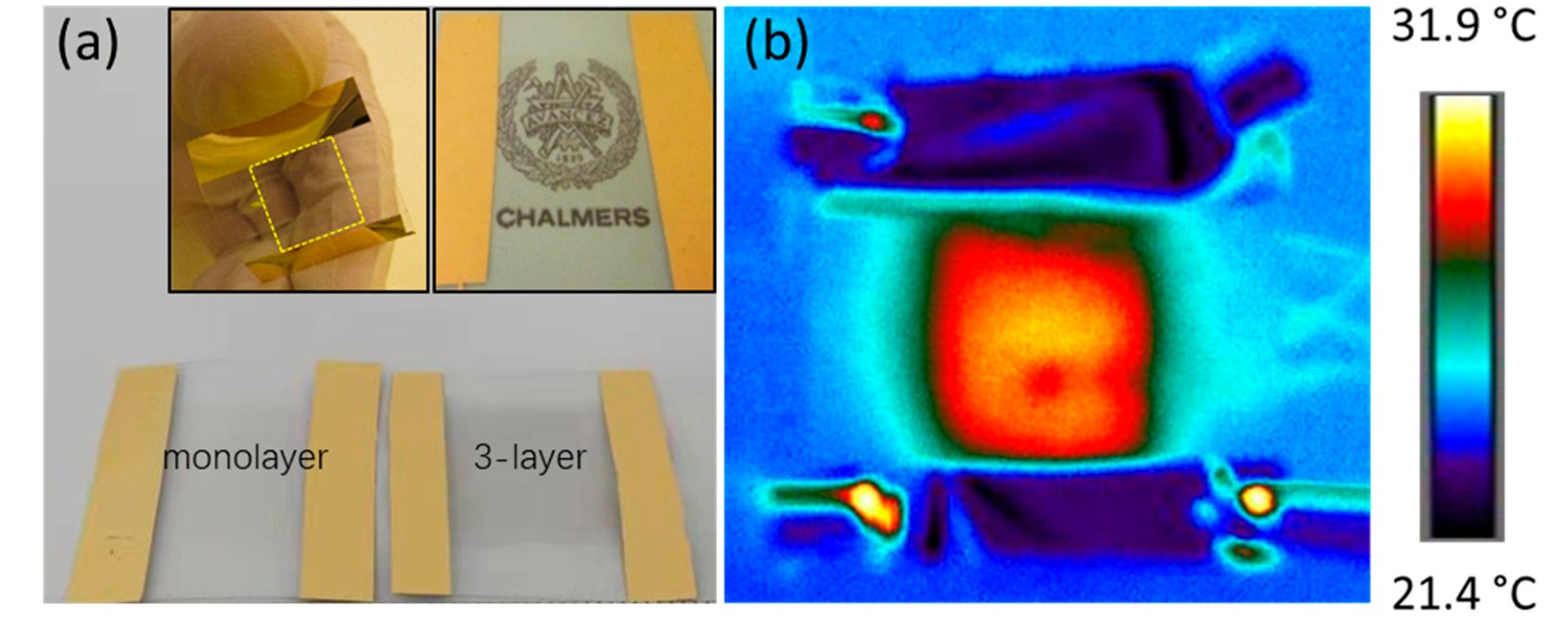
Experimental evidence from the source paper (Figure 2): transparent, flexible graphene heaters and an infrared surface-temperature map. Reproduced from Zhang et al. (2020), CC BY 4.0.
Graphene is a sheet of carbon atoms arranged in a honeycomb lattice. The sheet is only one atom thick, so it absorbs very little visible light. A single layer transmits roughly 97.7 percent of it. At the same time, mobile electrical charges can move through the carbon network. Put electrodes on opposite edges, apply a voltage, and current flows through the film.
The heating principle is familiar even if the material is not. Whenever current moves through a resistance, some electrical energy becomes heat. This is Joule heating — the same broad effect used in a toaster, an electric blanket, or the rear-window defroster in a car. Graphene does not need to glow. Its role is to spread modest electrical heating across a large, transparent area.
That combination matters because transparency and conductivity usually pull in opposite directions. Add more conductive material and resistance tends to fall, but the film also blocks more light. Make the layer thinner and clearer, and it becomes harder to carry current. Graphene gives engineers an unusually fine control knob: they can add atomically thin sheets rather than thickening a conventional metal coating.
A useful way to picture the device is not as a tiny radiator glued to glass, but as the transparent surface becoming part of the electrical circuit. The coating supplies resistance, the substrate supplies shape, and the surrounding air determines how quickly heat escapes. The final behavior belongs to the whole stack, not to graphene alone.
Building an Atom-Thin Heater
The researchers first grew monolayer graphene on copper foil at high temperature using chemical vapor deposition (CVD). In simplified terms, a carbon-containing gas supplied the atoms, and the copper surface helped them assemble into a continuous sheet. The graphene was then supported with a polymer, the copper was removed, and the carbon sheet was transferred onto transparent, flexible polyethylene terephthalate (PET). Repeating the transfer produced samples containing from one to five graphene layers.
Gold and chromium contacts were deposited along two edges, turning a roughly 1.5 by 1.5 centimeter square into a heater. A thermocouple on the back of the PET tracked temperature, while infrared imaging checked whether the surface warmed evenly. Raman spectroscopy and electron microscopy provided evidence that the starting graphene was a high-quality, continuous monolayer rather than a patchwork of small islands.
The stacked films remained impressively transparent, but the trade-off was visible in the numbers. Reported transmission fell from about 97.7 percent for one layer to 95.4 percent for two, 92.7 percent for three, 90 percent for four, and 87.3 percent for five. Five-layer graphene is still see-through, but it is no longer as optically unobtrusive as a monolayer.
| Layers | Optical Transmission |
|---|---|
| 1 | ~97.7% |
| 2 | ~95.4% |
| 3 | ~92.7% |
| 4 | ~90.0% |
| 5 | ~87.3% |
Fast Response, Small Thermal Mass
When voltage was switched on, the temperature did not jump instantly to a final value. It climbed quickly at first and then flattened as heat loss to the surrounding air caught up with electrical heating. When power was removed, the reverse happened: rapid cooling at first, followed by a slow return toward room temperature. This exponential response is summarized by a thermal time constant — the time needed to complete about 63 percent of the rise during heating, or 63 percent of the drop during cooling.
For the monolayer device, the paper reports a response on the order of only several seconds; its detailed measurements and abstract place the time constant just below or around 6–7 seconds. The five-layer heater responded more slowly, with about 10 seconds during heating and 14 seconds during cooling. The general lesson is intuitive: an atomically thin active film has very little thermal mass, but the supporting plastic, contacts, airflow, and extra transferred layers still influence the whole device.
The temperature was also controllable. In one monolayer test, about 170 milliwatts produced a steady temperature of 38 degrees Celsius, while 780 milliwatts produced about 80 degrees Celsius. These values belong to a small laboratory sample, so they should not be read as a ready-made specification for an entire windshield. Scaling the area changes total power, electrical routing, heat loss, and the risk of hot spots.
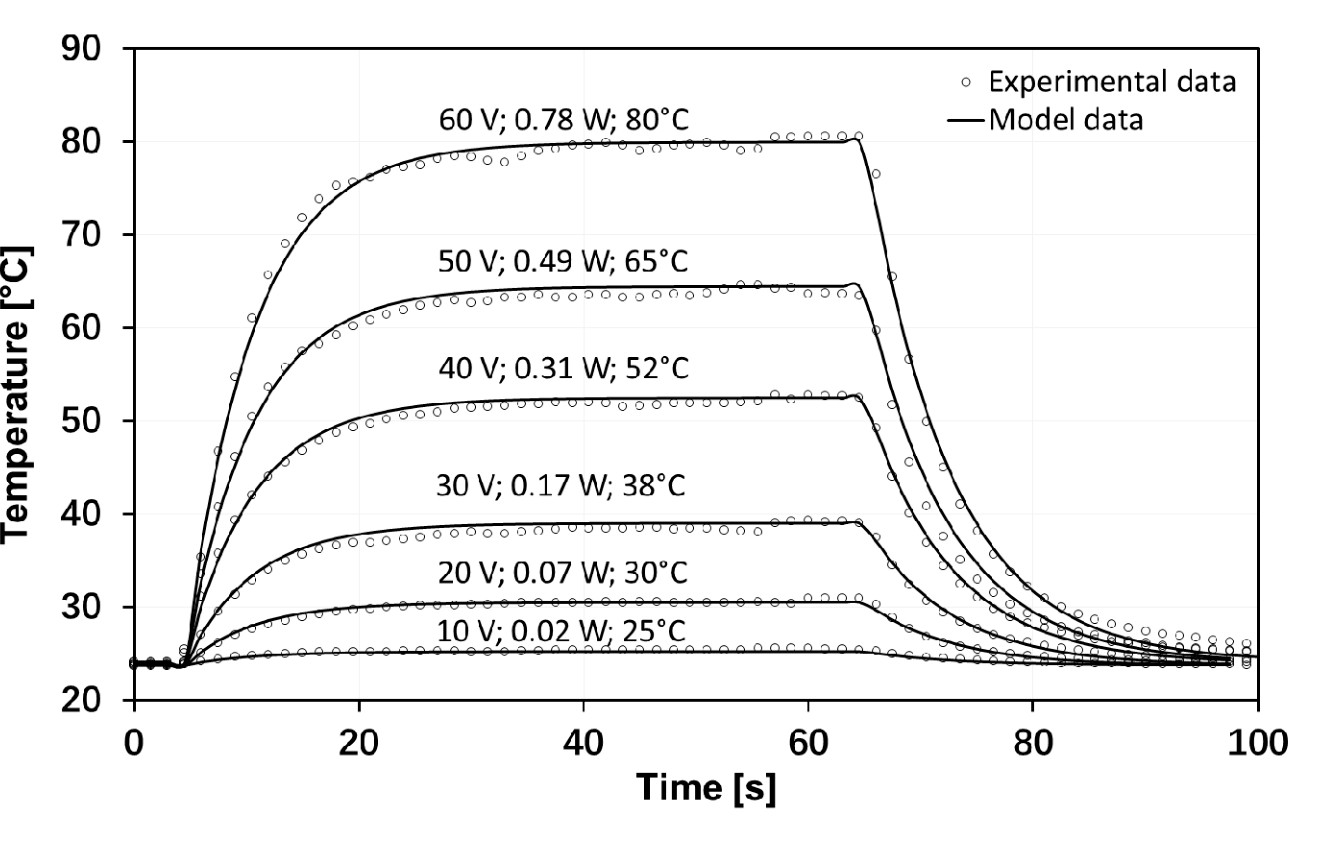
Monolayer heater temperature versus time at six input settings (source paper, Figure 4). Reproduced from Zhang et al. (2020), CC BY 4.0.
What Does "Efficient" Mean for a Transparent Heater?
To compare heaters of different sizes, the researchers plotted temperature against power per unit area. Their graphene devices reached higher temperatures at the same power density than metal-film examples used for comparison, and performed somewhat better than the available carbon-nanotube data. The paper estimated an average convective heat-transfer coefficient of about 60 watts per square meter per degree Celsius for the one- to four-layer graphene devices, compared with roughly 150 for a platinum thin film and 240 for a silver-paste heater in the referenced data.
A lower effective heat-transfer coefficient here means less input power was needed to maintain a given temperature rise under those test conditions. It is useful evidence, but not a universal ranking of materials. The graphene samples were measured in a fume cupboard, where moving air likely increased convection above normal still-air values. Different substrates, geometries, contact designs, temperature sensors, and airflows can shift the result. A product engineer would need side-by-side testing under the same conditions.
The number of layers also changes how a device is driven. The monolayer heater had a resistance close to 5 kilohms, while the two- to five-layer samples were generally around 1 to 1.5 kilohms. In simulations, the five-layer version needed only about half the voltage of the monolayer version to deliver the same power density because its resistance was roughly four times lower. More layers may therefore simplify the voltage requirement, at the cost of transparency and additional transfer steps.
For a product designer, three questions are often more useful than the maximum laboratory temperature:
- How much of the view must remain optically clear?
- How quickly must fog or frost disappear?
- What voltage and energy budget are available?
Those answers can point to different layer counts, electrode layouts, and control strategies. There is no single "best" transparent heater outside a specific use case.
Where an Invisible Heating Film Could Matter
The clearest applications are surfaces whose main job is to transmit light or an image. A transparent heater could clear condensation from a vehicle windshield without a dense wire pattern. It could keep an outdoor information screen readable in cold, damp weather, warm a camera cover without obscuring the sensor, or prevent a bathroom mirror from fogging after a shower. Flexible PET also points toward curved displays, visors, and lightweight optical components.
Graphene is not automatically the winner in every case. Indium tin oxide is established and highly transparent, silver nanowires can be very conductive, carbon nanotubes tolerate bending, and printed metal meshes can cover large areas. Cost, sheet resistance, haze, durability, voltage, manufacturing yield, and connection technology all matter. Graphene's special appeal is not one record number but the unusual package: optical transparency, electrical conduction, low mass, mechanical flexibility, and the possibility of large-area CVD production.
| Graphene (CVD) | ITO | Silver Nanowires | Carbon Nanotubes | |
|---|---|---|---|---|
| Transparency | Very high (97.7% per layer) | Very high | High | Moderate–High |
| Flexibility | Excellent | Brittle | Good | Good |
| Sheet Resistance | Moderate–High | Low | Very Low | Moderate |
| Large-area Scalability | Promising (CVD) | Established | Developing | Developing |
Three Numbers Worth Remembering
The study can be reduced to three useful anchors. First, one graphene layer transmitted about 97.7 percent of visible light, while five layers transmitted about 87.3 percent. Second, a small monolayer device moved from room temperature toward its new steady state on a time scale of roughly 6–7 seconds. Third, that sample reached about 80 degrees Celsius at 780 milliwatts of input. Together, the numbers describe clarity, speed, and heating capability — but they do not specify a finished product.
A consumer device would be judged by a different set of outcomes: how quickly a defined patch of frost disappears, whether the temperature is uniform, how much energy is used per clearing cycle, and how the view changes after years of cleaning and sunlight. Translating laboratory metrics into those outcomes requires a full prototype. The paper supplies strong evidence that the active material can work; it does not claim that a commercial windshield, mirror, or display is already solved.
The Catch: A Perfect Sheet Is Not Yet a Perfect Product
Durability Warning
After a year in air, the resistance of some transferred films rose by three to five times. Placing PET samples on ice temporarily increased resistance by 10 to 20 percent, although it returned toward the original value after drying. The authors linked the instability to cracks, polymer residue, humidity, and weak adhesion introduced during transfer from copper to PET.
That finding changes the engineering question. It is not enough to ask whether pristine graphene heats efficiently on day one. A useful window heater must survive humidity, temperature cycles, bending, cleaning, ultraviolet light, edge damage, and thousands of power cycles. Encapsulation may block water, but it adds optical interfaces and manufacturing steps. Direct growth on a final substrate could avoid transfer damage, but PET cannot tolerate the roughly 1,000 degrees Celsius used in the study's CVD process.
The experiment therefore captures both the excitement and the discipline of materials science. A one-atom-thick conductor can genuinely warm a transparent surface to useful temperatures within seconds. Yet the invisible heater becomes a product only when contacts, substrates, coatings, and manufacturing are as dependable as the graphene itself. The future windshield may look ordinary. The engineering hidden inside it will be anything but.
FAQ about Transparent Graphene Heaters
Q: How does a transparent graphene heater produce heat?
Current passes through the electrically resistive graphene film, converting part of the electrical energy into Joule heat. Because the film is extremely thin, it can warm quickly while remaining highly transparent.
Q: Is a single graphene layer always the best choice?
No. A monolayer offers the highest transparency, but it also has higher resistance. Additional layers lower resistance and can reduce the required voltage, while gradually reducing light transmission.
Q: Are graphene defoggers ready for mass-market windshields?
The study demonstrates the underlying heating capability, not a production-ready windshield. Large-area uniformity, durable contacts, moisture protection, safety controls, and long-term environmental testing still need to be solved.
Conclusion: Transparent Graphene Heaters
Transparent graphene heaters represent a genuinely promising technology for defogging and de-icing applications where optical clarity is paramount. The combination of near-invisible heating, rapid thermal response, and mechanical flexibility sets graphene apart from conventional alternatives. However, translating laboratory performance into reliable, long-lasting commercial products requires solving the remaining challenges of durability, large-area manufacturing, and environmental stability. The science is compelling — the engineering is just getting started.
Keep Learning
Induction Billet Heating: How to Achieve Uniform Heating
Induction billet heating prepares metal for forging, extrusion, or rolling by generating heat inside the workpiece. For steel billets, reaching the required exit temperature is only part of the task: the temperature distribution from surface to core and along the billet must also suit the forming process. Uniformity depends on how frequency, coil geometry, heat transfer, power distribution, and billet movement work together. This guide focuses on through-heating steel billets, particularly in progress......
How to Upgrade a 3D Printer Heated Bed with a Silicone Heater
If your 3D printer heated bed takes too long to reach temperature, develops uneven heating, or struggles to maintain a stable surface temperature, a silicone heater can be a practical upgrade. Faster warm-up and more uniform heat can improve first-layer consistency and reduce temperature-related printing issues. This guide explains how to identify when a heated-bed upgrade is needed, choose a suitable silicone heater, install it safely, and verify the results. Quick Answer A silicone heater can be a s......
How Graphene and MXene Flake Sensors Detect Force
Key Takeaways Flake networks sense force through microstructural change: Graphene and MXene coatings distribute conduction across overlapping platelets whose contacts shift under stretch or pressure, producing measurable resistance changes. Three mechanisms compete: Crack propagation, flake slippage, and quantum tunnelling each dominate at different deformation levels, giving many sensors multiple sensitivity regions rather than one uniform response. The substrate is an active partner: Elastomers, tex......
Conductive 2D Coatings Are a Matching Problem, Not a Miracle Ink
Key Takeaways Ink is a system, not a material: Conductivity depends on the combined effect of flake chemistry, solvent, additives, substrate, coating method, and post-processing—not on the 2D filler alone. Three carbon routes carry different trade-offs: GNPs demand dispersion engineering, GO shifts effort to a reduction step, and MXenes move the bottleneck to synthesis, storage, and oxidation control. Substrate geometry drives method selection: Spray and blade coating suit flat sheets; dip coating nat......
Graphene Heat Spreader Design: Layers and Interfaces
Key Takeaways Conductivity alone is not enough: A record thermal-conductivity value does not guarantee a cooler chip. Effective thickness, interface resistance, hot-spot geometry, and heat-sink connections all belong to the same thermal path. Few-layer graphene can outperform a single layer in practice: A few-layer sheet provides a larger heat-flow cross section and better tolerates transfer, embedding, and defects, even though its intrinsic conductivity is lower. Interface resistance is the bottlenec......
How Graphene Heat Spreaders Cool SOI Chip Hot Spots
Key Takeaways Buried oxide is a thermal bottleneck: SOI's insulating layer improves electrical isolation but traps heat near transistor channels, creating dangerous hot spots that package-level cooling alone cannot fix. Graphene enables lateral heat routing: Placing graphene or few-layer graphene beneath the buried oxide adds a high-conductivity sideways path, redistributing hot-spot energy toward dedicated sinks without removing any heat itself. Multi-source chips benefit most: Finite-element modelin......