Induction Billet Heating: How to Achieve Uniform Heating
11 min
- Working Principle of an Induction Billet Heater
- Set Temperature Requirements Before Selecting Frequency
- Coil Design Strategies for Uniform Heating
- Why Billet Ends and Internal Regions Heat Differently
- Balance Power Distribution, Throughput, and Process Control
- A Practical Checklist for Heating-Uniformity Problems
- FAQ about Induction Billet Heating
- Conclusion: Design for the Required Billet Temperature Profile
Induction billet heating prepares metal for forging, extrusion, or rolling by generating heat inside the workpiece. For steel billets, reaching the required exit temperature is only part of the task: the temperature distribution from surface to core and along the billet must also suit the forming process.
Uniformity depends on how frequency, coil geometry, heat transfer, power distribution, and billet movement work together. This guide focuses on through-heating steel billets, particularly in progressive heating lines, and explains how to evaluate those variables without treating one frequency or coil profile as a universal solution.
Key Takeaways
- Define the required temperature profile first. Specify the steel grade, forming temperature, allowable gradients, and the point in the process where acceptance is checked.
- Select frequency with the complete heating cycle in mind. Billet dimensions matter, but material properties, heating time, and thermal conduction also affect the result.
- Design the coil and power profile together. Graded windings and independently controlled zones can provide useful flexibility, but their benefits depend on the application.
- Check more than the visible surface. A normal pyrometer reading does not establish that the internal temperature distribution is acceptable.
Working Principle of an Induction Billet Heater
An induction billet heater uses alternating current in a coil to create a changing magnetic field. That field induces eddy currents in the electrically conductive billet, producing heat through its electrical resistance. Heat conduction then redistributes that energy within the workpiece. Ambrell's explanation of induction heating principles describes this non-contact heating arrangement.
Industrial induction billet heating systems combine the power supply and matching circuit with a water-cooled induction coil, billet handling equipment, cooling services, and process controls. The coil shapes the electromagnetic field; the feed system determines the billet's position and residence time; monitoring checks whether the run remains within its validated operating conditions.
Two primary heating modes are employed in billet induction heating:
- Progressive heating: Billets move sequentially through one or multiple coils, receiving staged heating.
- Static heating: Billets remain stationary within the coil during the heating cycle.
This article primarily focuses on progressive heating. Static heating may be preferable for some billet sizes and production requirements; the choice should follow the required temperature profile, handling constraints, and throughput. The broader induction mass heating fundamentals and design approaches guide compares heating modes and system layouts.
Set Temperature Requirements Before Selecting Frequency
The forming temperature must be selected for the specific steel grade and subsequent operation. A useful heating specification defines both the target and the permitted temperature differences across the billet, rather than relying on one nominal surface temperature.
- Surface-to-core: The permitted radial temperature difference.
- End-to-end: The permitted axial variation, including the leading and trailing ends.
- Around the circumference: Any permitted side-to-side variation.
- Acceptance point: Whether those limits apply at heater exit, after transfer, or at entry to the forming operation.
These are different checks. A tolerance around a target temperature is not automatically the same as a maximum surface-to-core difference. Where a deliberate axial profile is required, the acceptance criteria should describe that profile instead of demanding a uniform temperature everywhere.
Frequency, penetration depth, and heating time
The frequency of the induction power supply is a key parameter influencing heating depth and uniformity. For otherwise comparable material conditions, higher frequencies concentrate induced current closer to the surface, while lower frequencies allow deeper penetration. Heat conduction and the time available for redistribution still determine how the internal temperature develops.
A larger billet therefore cannot be assigned a frequency from diameter alone. Steel grade, temperature-dependent electrical and magnetic properties, coil coupling, power density, and heating time must also be considered. As ferromagnetic steel passes through its Curie transition, the change in magnetic properties alters the heating conditions.
Review frequency, coil layout, and residence time as a combination. The Inductotherm guide to selecting billet-heating inductors illustrates why heating arrangement and application requirements belong in the same design decision.
Coil Design Strategies for Uniform Heating

The induction coil design profoundly affects the temperature distribution within billets. Geometry determines where energy is coupled into the workpiece, while the billet's thermal response determines how that energy spreads before forming.
Conventional and profiled coils
Traditional coils feature uniform winding pitch and consistent copper tubing dimensions along their length. Profiled or graded coils, by contrast, vary winding geometry to shape the heating distribution. A design may apply more heating earlier in the line and less later, allowing additional time for heat to move toward the core.
That approach is not automatically better for every billet. Excessive initial heating can create damaging gradients, particularly in materials susceptible to thermal cracking. Nor does a change in copper tubing dimensions alone establish how much power will be absorbed by the billet: the complete coil, electrical circuit, coupling, and workpiece conditions must be evaluated.
| Design consideration | Uniform-pitch coil | Profiled or graded coil |
|---|---|---|
| Winding geometry | Consistent along the coil | Varies along the coil to influence the heating profile |
| Fabrication | Generally simpler geometry | Requires control of the specified winding changes |
| Temperature-profile adjustment | Depends on the coil arrangement and available power control | Offers additional geometric means of shaping the profile |
| Selection basis | Can be suitable where the required profile is achieved with the available heating time and controls | Useful where a validated nonuniform heating distribution improves the required final profile |
Coil length should follow the heating and equalization time required at the intended production rate. A profiled coil may help meet those requirements, but a shorter line or better uniformity should be demonstrated rather than assumed.
Coupling, lining, and billet position
Coil design also has to account for the clearance around the billet, the refractory lining, and mechanical support. The gap must permit reliable handling while providing suitable electromagnetic coupling. When billet diameter, position, or the lining condition changes, reassess the resulting heating profile rather than transferring the original recipe unchanged.
Why Billet Ends and Internal Regions Heat Differently
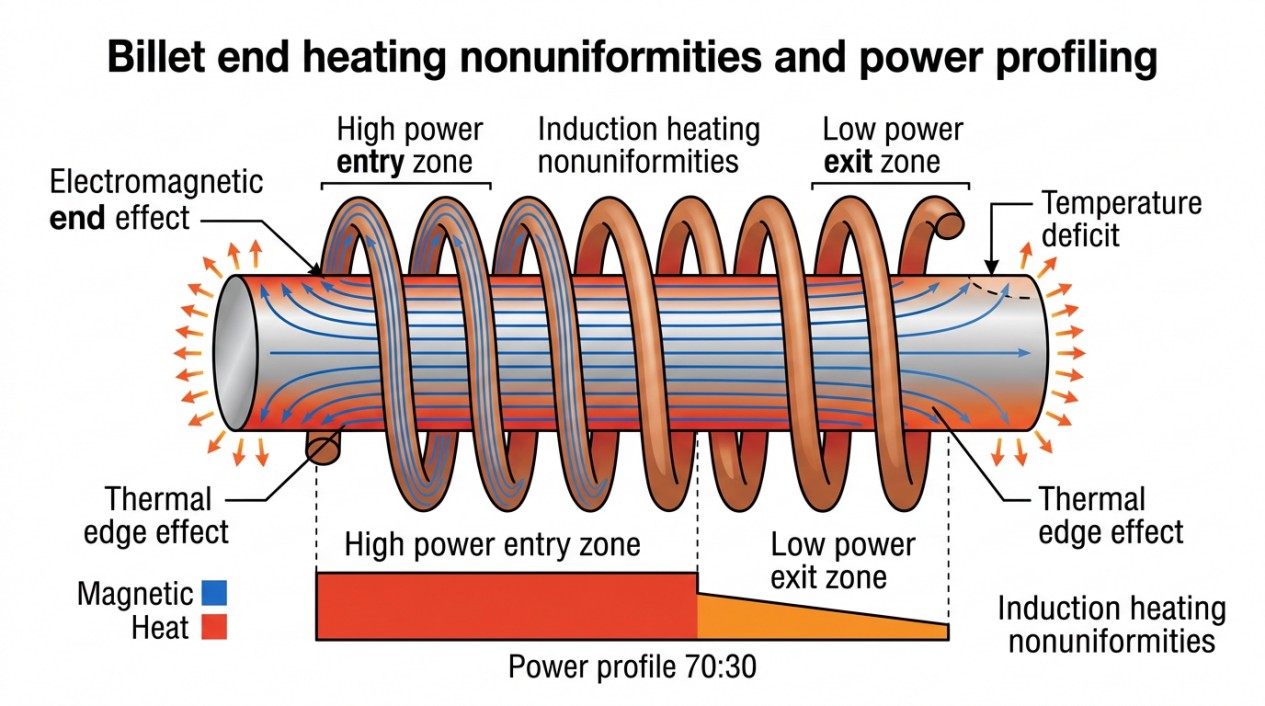
Electromagnetic end effects and thermal losses
The magnetic field near a billet end differs from the field around its central region. The resulting end heating can change with frequency, coil overhang, billet position, and the condition of adjacent billets. An end can therefore be too hot or too cold under different operating conditions; there is no single compensation setting that applies to every line.
Heat loss also affects the axial profile. Exposed end faces exchange heat with their surroundings, and the balance changes with temperature, insulation, geometry, and nearby surfaces. Coil adjustments should address both energy input and thermal losses, not just the electromagnetic field.
Heat transfer along the billet axis occurs through the contact surfaces between adjacent billets. However, surface roughness, oxide scales, and air gaps introduce thermal resistance, limiting conduction. If a model omits this transfer, check that the approximation is appropriate for the contact conditions and heating cycle; do not assume it is negligible in every application.
Subsurface overheating
Surface pyrometers provide limited information, measuring only localized surface temperatures and potentially missing internal temperature anomalies. Under some conditions, surface heat losses can leave a temperature maximum beneath the surface even when the visible surface remains within its operating limit.
This is why surface temperature alone is insufficient evidence of acceptable through-heating. Inductotherm's discussion of billet-heating temperature profiles and modular control identifies material, frequency, refractory conditions, final temperature, and power distribution as interacting factors.
Numerical models can help evaluate internal temperature distributions and compare design changes. Their predictions should be checked against appropriate process-validation evidence; a model is an assessment tool, not a substitute for demonstrating that the production process meets its requirements.
Balance Power Distribution, Throughput, and Process Control
Apply heating where the billet needs it
A progressive line may apply stronger heating early to establish radial heat flow, followed by lower-power heating or a holding stage to support temperature equalization. However, the suitable distribution changes with billet dimensions, material, inlet temperature, production rate, and thermal losses.
Fixed front-to-back power ratios should not be treated as general design rules. Review the temperature history along the line, including the internal peak temperature, before deciding whether additional early power or a longer equalization period is appropriate.
Independently controlled coil zones can make it easier to adjust the heating profile for different production runs. Whether that flexibility is needed depends on the range of products and operating conditions; a stable, validated process does not require the most complex control architecture simply because one is available.
Monitor the run and define the response
A practical monitoring plan connects each billet or batch with its approved recipe and records the variables used to judge the cycle. Relevant checks may include delivered power or energy, frequency, feed rate or heating time, exit temperature, and cooling-system status. The required variables and limits should come from process validation.
For each excursion, define the response: identify affected billets, decide whether to hold or reject them, and establish when the line can restart. The induction heating process control and monitoring guide explains how acceptance windows and reaction plans turn monitoring into quality control.
Heating time, transfer, and coil changes
Optimizing throughput involves balancing heating rate with temperature uniformity and equipment constraints. Excessive heating rates can induce thermal stresses and cracking, while slow heating reduces productivity. Include the time between heater exit and forming when evaluating the temperature actually delivered to the next operation.
Industrial billet heating lines often need to accommodate a range of billet sizes and materials, necessitating coil changes to optimize heating efficiency and temperature uniformity. Minimizing downtime during coil changeover is critical to maintaining throughput.
Coil shuttle or twin-track arrangements can facilitate changeover where the equipment supports them. Their benefit should be evaluated against the required product range and change frequency, without assuming a particular changeover time or eliminating the need for setup verification.
A Practical Checklist for Heating-Uniformity Problems
Use the following checks to narrow the investigation. They identify variables to review, not automatic recipe changes; confirm the cause and validate the revised process before returning affected product to normal production.
| Observed problem | What to review | How to assess a change |
|---|---|---|
| Surface reaches target, but core heating is insufficient | Frequency, power profile, residence time, billet size, and material properties | Evaluate the radial temperature distribution and whether sufficient equalization time is available |
| Leading or trailing end falls outside the required profile | Coil overhang, end position, billet spacing, and exposed-face heat losses | Compare both ends with the specified axial profile at the defined acceptance point |
| Uneven heating appears after a billet-size change | Recipe selection, coil clearance, billet alignment, and handling consistency | Qualify the new size and setup instead of relying on the previous recipe |
| Acceptable surface readings accompany signs of overheating or billet sticking | Internal temperature predictions, power distribution, lining condition, and the measurement method | Investigate internal peaks and product evidence; do not release product on surface readings alone |
| Start-up or a production interruption causes inconsistent results | Initial billet and lining temperatures, holding conditions, restart sequence, and transfer delays | Verify start-up and restart conditions separately from steady production |
Where Flexible Heaters Fit
The induction coils discussed here heat metal billets for hot forming. Flexible heaters use resistive elements for different, lower-temperature heating tasks and do not replace a billet induction heating system. For a separate flexible-heater application, the JLCPCB flexible heater overview provides product types and operating limits to check before selection.
FAQ about Induction Billet Heating
Why is the center of a billet cooler than the surface?
Induced current can be concentrated near the billet surface, so the core depends partly on heat conducting inward. If heating is too rapid or the equalization time is too short, the surface may reach its target while the core remains cooler. Review frequency, power distribution, and heating time together.
Does a lower frequency make billet heating more uniform?
A lower frequency generally allows deeper current penetration, but it does not guarantee a more uniform final temperature. Billet size, material properties, coil coupling, power distribution, and heating time also matter. Choose the frequency as part of a validated heating recipe rather than changing it in isolation.
Can I tell if a billet is heated evenly just by measuring its surface temperature?
No. A surface reading does not directly show the temperature at the core or beneath the surface, where a temperature peak can occur under some conditions. Use surface measurements alongside a validated assessment of the internal temperature profile before concluding that the billet meets its heating requirements.
Conclusion: Design for the Required Billet Temperature Profile
Induction heating of steel billets demands a balance of electromagnetic design, thermal management, and process control. Start with the material and forming requirements, then evaluate frequency, coil geometry, residence time, and power distribution together. Validate both steady production and changing conditions, and use surface temperature measurements as part of the evidence rather than proof of internal uniformity.
Keep Learning
Induction Billet Heating: How to Achieve Uniform Heating
Induction billet heating prepares metal for forging, extrusion, or rolling by generating heat inside the workpiece. For steel billets, reaching the required exit temperature is only part of the task: the temperature distribution from surface to core and along the billet must also suit the forming process. Uniformity depends on how frequency, coil geometry, heat transfer, power distribution, and billet movement work together. This guide focuses on through-heating steel billets, particularly in progress......
How to Upgrade a 3D Printer Heated Bed with a Silicone Heater
If your 3D printer heated bed takes too long to reach temperature, develops uneven heating, or struggles to maintain a stable surface temperature, a silicone heater can be a practical upgrade. Faster warm-up and more uniform heat can improve first-layer consistency and reduce temperature-related printing issues. This guide explains how to identify when a heated-bed upgrade is needed, choose a suitable silicone heater, install it safely, and verify the results. Quick Answer A silicone heater can be a s......
How Graphene and MXene Flake Sensors Detect Force
Key Takeaways Flake networks sense force through microstructural change: Graphene and MXene coatings distribute conduction across overlapping platelets whose contacts shift under stretch or pressure, producing measurable resistance changes. Three mechanisms compete: Crack propagation, flake slippage, and quantum tunnelling each dominate at different deformation levels, giving many sensors multiple sensitivity regions rather than one uniform response. The substrate is an active partner: Elastomers, tex......
Conductive 2D Coatings Are a Matching Problem, Not a Miracle Ink
Key Takeaways Ink is a system, not a material: Conductivity depends on the combined effect of flake chemistry, solvent, additives, substrate, coating method, and post-processing—not on the 2D filler alone. Three carbon routes carry different trade-offs: GNPs demand dispersion engineering, GO shifts effort to a reduction step, and MXenes move the bottleneck to synthesis, storage, and oxidation control. Substrate geometry drives method selection: Spray and blade coating suit flat sheets; dip coating nat......
Graphene Heat Spreader Design: Layers and Interfaces
Key Takeaways Conductivity alone is not enough: A record thermal-conductivity value does not guarantee a cooler chip. Effective thickness, interface resistance, hot-spot geometry, and heat-sink connections all belong to the same thermal path. Few-layer graphene can outperform a single layer in practice: A few-layer sheet provides a larger heat-flow cross section and better tolerates transfer, embedding, and defects, even though its intrinsic conductivity is lower. Interface resistance is the bottlenec......
How Graphene Heat Spreaders Cool SOI Chip Hot Spots
Key Takeaways Buried oxide is a thermal bottleneck: SOI's insulating layer improves electrical isolation but traps heat near transistor channels, creating dangerous hot spots that package-level cooling alone cannot fix. Graphene enables lateral heat routing: Placing graphene or few-layer graphene beneath the buried oxide adds a high-conductivity sideways path, redistributing hot-spot energy toward dedicated sinks without removing any heat itself. Multi-source chips benefit most: Finite-element modelin......