Independent Frequency and Power Control in Induction Inverters: Turning Frequency Back Into a Process Variable
11 min
- The Core Problem: Resonance Couples Everything
- What "Independent Control" Looks Like in Practice
- Comparison Table: Coupled vs. Decoupled Behavior
- Commissioning Tests That Prove the Claim
- Where Independent Control Delivers the Biggest ROI
- Misconceptions That Cause Bad Specifications
- How to Write a Requirement That Vendors Can't Hand-Wave
- How Independent Control Changes Day-to-Day Operation
- Where Independent Control Does Not Help
- Integration Reminder: Control Features Don't Replace Good Sensors
- How Decoupling Improves Model-to-Production Correlation
- Practical Alarm Design Under Independent Control
- Training Outcome: Fewer Hidden Process Changes
- Recommended Monitoring Signals for Independent-Control Systems
- One More Practical Benefit: Better Change Control
- Independent Frequency and Power (IFP): What It Enables in One Cycle
- Non-Resonant Output: The Trade-Off
- A Realistic Expectation: Independence Within a Defined Envelope
- FAQ about Independent Frequency and Power Control in Induction Inverters
Key Takeaways
Frequency as a process variable: Independent frequency and power control decouples resonance supervision from kW regulation, letting engineers set frequency based on process physics rather than control mechanics.
Measurable validation: Prove independent control with three commissioning tests—fixed-frequency power steps, fixed-kW frequency sweeps, and coupling variation stability.
Production consistency: Stable frequency improves recipe portability, reduces hidden process changes, and makes troubleshooting faster by eliminating frequency as an unintended variable.
Not a replacement for good engineering: Independent control amplifies good coil design, fixturing, and matching—it cannot compensate for fundamental mechanical or matching shortcomings.
The Core Problem: Resonance Couples Everything
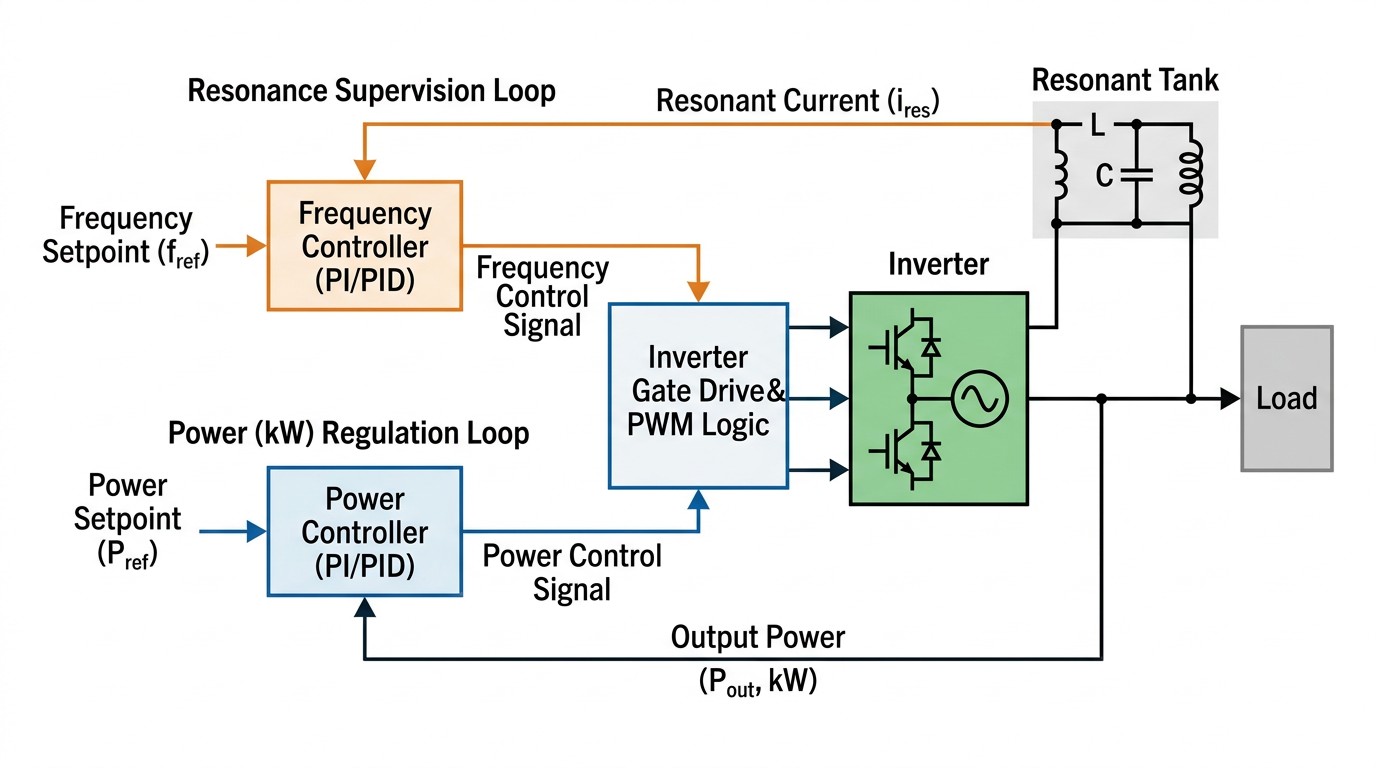
Independent control concept: separate resonance supervision from kW regulation so the recipe behaves predictably.
Resonant tanks are efficient because reactive power circulates locally. But resonance can also tie your hands: if the system regulates power primarily by moving frequency around resonance, then frequency becomes an emergent variable, not a deliberate process choice.
That can produce practical issues: recipe portability suffers, heating patterns shift under load variation, and commissioning becomes sensitive to small layout differences.
What "Independent Control" Looks Like in Practice
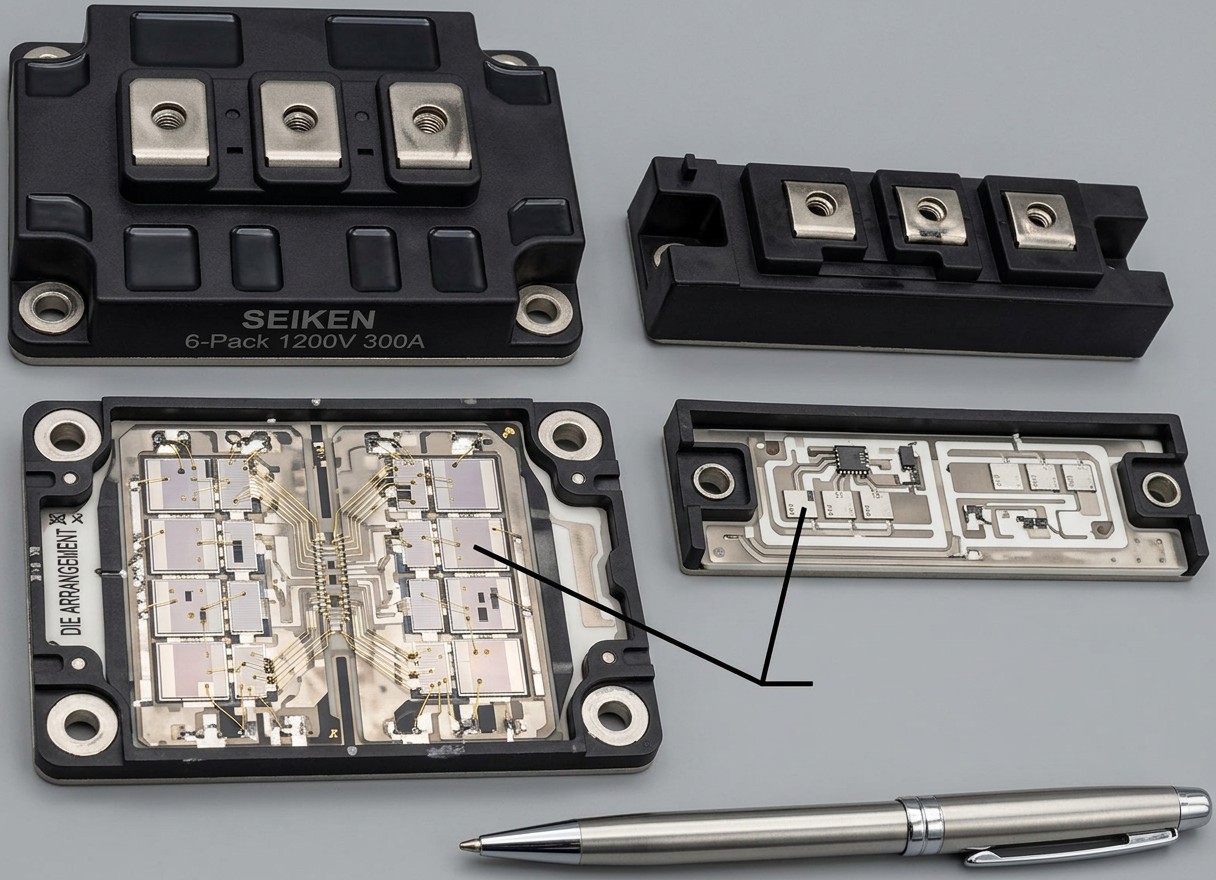
Induction power electronics hardware.
Independent control does not mean frequency never changes. Many systems still make small adjustments to stay within safe resonance margins. The difference is that those adjustments are limited and not the primary mechanism for kW regulation.
Practically, decoupling is achieved by distributing control authority across:
- A resonance supervision loop (often based on voltage–current phase indicators)
- A power regulation loop (kW control via DC bus regulation or modulation)
- A protection/supervision layer (current, voltage, temperature, cooling)
When implemented well, operators experience a calmer machine: less hunting and fewer nuisance trips.
Comparison Table: Coupled vs. Decoupled Behavior
| Behavior | Frequency-as-Control Systems | Independent Control Systems |
|---|---|---|
| Frequency stability | Can drift noticeably under load changes | Typically holds near target |
| Penetration consistency | Can vary with control action | More consistent for a fixed recipe |
| Recipe portability | Lower | Higher |
| Tuning burden | Higher | Lower (when matching is good) |
Commissioning Tests That Prove the Claim
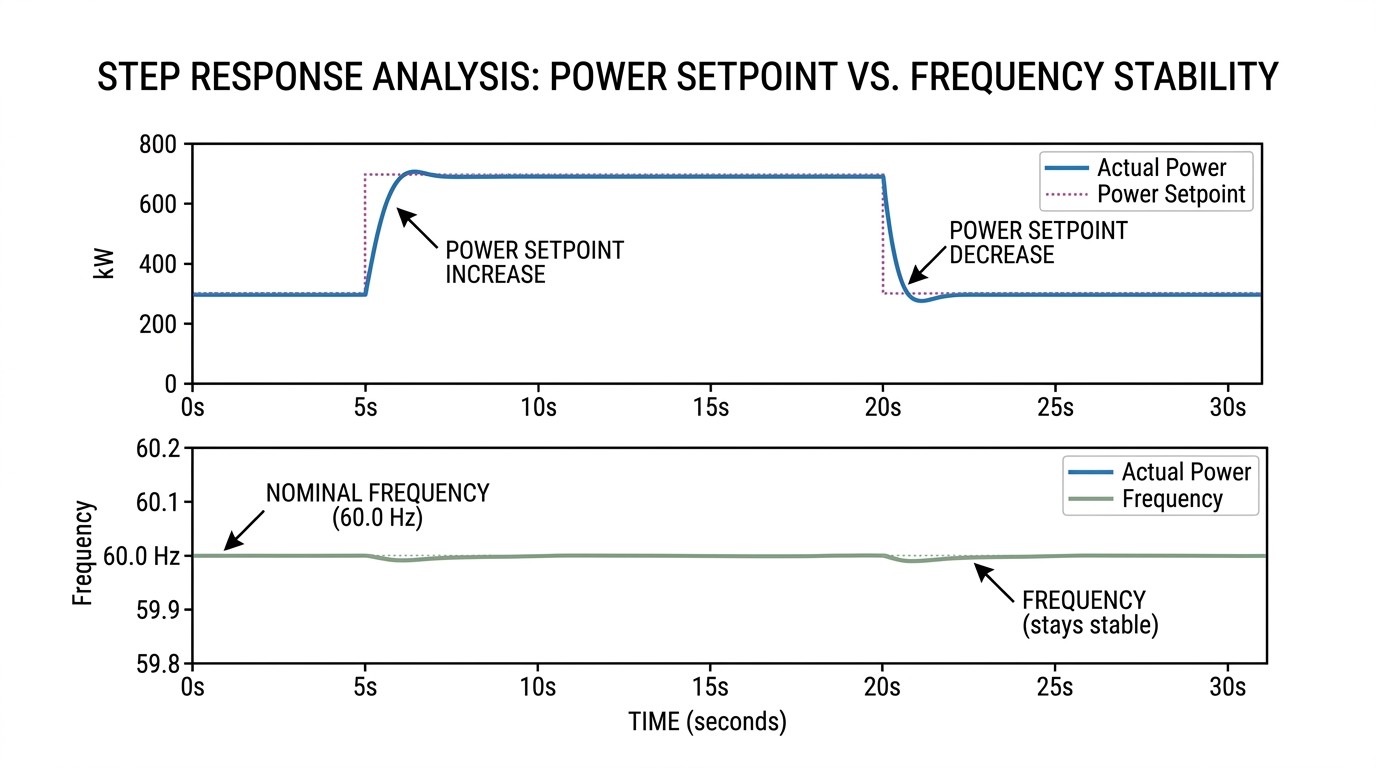
Fixed-frequency power step test.
A simple acceptance sequence reveals whether decoupling is real:
-
Fixed-Frequency Power Step
Hold frequency constant and step power. The machine should follow kW without compensating by large frequency shifts.
-
Fixed-kW Frequency Sweep
Hold kW constant and make small frequency sweeps to confirm stable delivery and safe limits.
-
Coupling Variation Test
Introduce controlled coupling variation and confirm the system stabilizes without hunting.
Design Reminder
Decoupling works best with mechanical discipline. If fixturing allows large part-to-coil variation, the inverter will still spend effort protecting itself. Pair independent control with mechanical repeatability and good matching, and frequency becomes a process variable again—which is exactly the point.
Where Independent Control Delivers the Biggest ROI
Independent control is most valuable when frequency is a critical-to-quality variable. If you are controlling case depth, thin-section heating efficiency, or a sensitive microstructural response, you want frequency to remain stable while you adjust kW for throughput or incoming variation.
It also reduces tuning burden in flexible production. When frequency stays near a validated value, recipe changes become more predictable and troubleshooting becomes more systematic.
Misconceptions That Cause Bad Specifications
Common Misconceptions
- Independent control eliminates the need for good matching. It does not. Matching still defines stress distribution and stability margins.
- Independent control is only for exotic processes. In reality, many ordinary applications benefit when coupling variation is unavoidable.
- "Frequency held constant" is binary. In real systems, small shifts may occur for resonance supervision. What matters is that these shifts are limited and do not dominate power regulation.
How to Write a Requirement That Vendors Can't Hand-Wave
Specify testable behaviors: fixed-frequency kW step response, fixed-kW frequency sweep stability, and coupling variation tests within expected production tolerances. If vendors can show data for these tests, the feature is real.
How Independent Control Changes Day-to-Day Operation
In production, the practical benefit is that operators can adjust power to hit throughput or compensate for incoming temperature variation without unintentionally changing penetration behavior. That reduces the number of hidden process changes and improves recipe repeatability.
Independent control also makes experimentation cleaner. When frequency is stable, you can run structured trials where power is the variable and frequency is held constant. This improves model correlation and reduces the risk of attributing outcomes to the wrong factor.
Where Independent Control Does Not Help
If the fundamental limitation is poor coil design or large mechanical variation, independent control cannot create margin from nothing. In those cases, invest first in coil tooling, fixturing, and matching range. Independent control then becomes an amplifier of good engineering rather than a patch.
A Short Requirements Paragraph You Can Copy Into Specs
Require that the system demonstrate (1) power step response at fixed frequency within defined tolerance, (2) stability during a small frequency sweep at fixed kW, and (3) stable operation under defined coupling variation without nuisance trips. This turns "independent control" into a measurable requirement.
Integration Reminder: Control Features Don't Replace Good Sensors
Independent control depends on reliable measurement of voltage, current, and detuning indicators. If sensors saturate, drift, or are mounted poorly, the controller cannot behave independently in practice. During commissioning, validate sensors under real waveforms and confirm logging is stable over the full duty cycle.
How Decoupling Improves Model-to-Production Correlation
Simulation and modeling are widely used in induction process development. Models typically assume frequency is fixed. If the real machine changes frequency significantly during control action, model correlation degrades and engineers may misattribute discrepancies to material data or heat transfer assumptions.
By holding frequency near a validated value while modulating power, independent control reduces that mismatch. It also enables cleaner designed experiments: frequency is one factor, power is another, and the controller does not inadvertently mix them.
Practical Alarm Design Under Independent Control
Alarm Taxonomy
Independent control does not eliminate detuning; it manages it. Therefore alarms should distinguish "detuning increasing" from "cooling failure" from "overcurrent event." If alarms collapse into generic "fault," operators will revert to random tuning. Good alarm taxonomy is part of making independent control useful.
Training Outcome: Fewer Hidden Process Changes
When frequency is stable, the number of hidden changes decreases. Operators can adjust throughput with power without altering penetration. That reduces the risk of producing parts that look thermally correct but are metallurgically different. Over long periods, this can be the difference between stable quality and unpredictable drift.
Design Reminder: Stable Frequency Enables Cleaner Troubleshooting
When frequency is stable, troubleshooting becomes simpler: changes in current demand often point to coupling or cooling issues rather than hidden frequency shifts. This reduces time to root cause.
Recommended Monitoring Signals for Independent-Control Systems
To get full value from independent control, monitor signals that explain whether the machine is behaving independently in practice. In addition to kW, record frequency, a detuning indicator (often phase-related), and a measure of control effort (for example DC bus command or modulation index, depending on what the platform exposes). These signals help distinguish process-driven variation from control-driven variation.
Also monitor the mechanical variables that drive coupling: position confirmation, motion speed, and any fixture sensors that indicate part seating. Independent control can only compensate within a range; when coupling is out of range, the machine should alarm clearly rather than quietly shifting behavior.
Finally, trend cooling flow and inlet temperature. Control stability depends on thermal stability. If cooling margin is disappearing, control loops may become more aggressive, and the machine may appear "less independent" as it protects itself.
One More Practical Benefit: Better Change Control
When frequency is held stable, it becomes easier to enforce change control. Power adjustments can be treated as throughput changes, while frequency changes can be treated as physics changes. That separation reduces accidental process drift.
A Note on Limits at Frequency Extremes
Even with independent control, most systems have reduced margin at the edges of their frequency range. Specify and validate usable power capability at the specific frequencies you intend to run, not only at a nominal mid-band condition.
Independent Frequency and Power (IFP): What It Enables in One Cycle
The source describes a particularly versatile class of power supplies that can change frequency and power on demand—e.g., varying output power across a wide range while shifting frequency from a few kilohertz up to tens of kilohertz. The motivation is not only convenience; it is the ability to intentionally vary case depth during a continuous cycle.
This capability can also enable process consolidation. For example, if a platform can adjust both frequency and power automatically, it may allow a single coil to perform hardening and then tempering/stress-relieving by switching to a different output condition. Whether that is appropriate depends on your process window, but it illustrates why "independent control" can be more than a stability feature; it can be a process capability feature.
Non-Resonant Output: The Trade-Off
The source notes that some independent-control designs do not rely on a resonant capacitor or power-factor correction. In that case, the inverter must supply the full kVA of the heating coil, which makes the design particularly well suited to low-Q loads. The practical takeaway is that "independent control" can come with architectural trade-offs, and you should validate that the supply is optimized for your expected Q range.
A Realistic Expectation: Independence Within a Defined Envelope
Independent control is most meaningful inside a defined operating envelope. Outside that envelope—very high Q, extreme coupling loss, or frequency extremes—the system will correctly shift behavior to protect hardware. Therefore, document the expected envelope in production terms: part-to-coil gap tolerance, coil family, expected Q range, and required ramp rates. When everyone knows the envelope, alarms become actionable rather than surprising.
Within the envelope, the main benefit is consistency: frequency stays near the validated value while kW changes. That consistency is what improves repeatability and reduces unintended process changes.
Integration Tip: Make Frequency Changes Explicitly Visible
Even in independent-control systems, small frequency moves may occur for resonance supervision. Make those moves visible in the operator and engineer logs. When frequency drift is visible, teams stop making incorrect assumptions about penetration behavior, and troubleshooting becomes faster because it is clear whether a change in outcome came from power, frequency, or coupling.
Independent control is best viewed as a robustness feature. It reduces unintended physics changes when operators adjust output, and it makes induction stations easier to validate and maintain.
Additional note: always validate independent-control behavior at your minimum and maximum coil coupling conditions, not only at nominal coupling. Those edge cases are where production lines spend time after tooling wear.
One more reminder: log frequency, power, and detuning indicators together so you can prove whether the station truly held frequency during production changes.
FAQ about Independent Frequency and Power Control in Induction Inverters
Q: Does independent control mean frequency never changes?
No. Many systems still adjust frequency slightly for safe resonance supervision, but kW regulation is not primarily achieved by large frequency excursions.
Q: What evidence should you request from a supplier?
Plots showing fixed-frequency power steps and fixed-kW frequency sweeps, plus stability data across expected Q/coupling variation.
Q: When should you specify independent control explicitly?
When penetration behavior is critical to quality, when coupling variation is unavoidable, or when you need recipe portability across stations or lines.
Conclusion: Independent Frequency and Power Control
Independent control is best viewed as a robustness feature that reduces unintended physics changes when operators adjust output, making induction stations easier to validate and maintain. The key to realizing its benefits is pairing it with good mechanical discipline, proper matching, and measurable commissioning tests. Always validate behavior at your minimum and maximum coil coupling conditions, and log frequency, power, and detuning indicators together to prove whether the station truly held frequency during production changes.
Keep Learning
Induction Billet Heating: How to Achieve Uniform Heating
Induction billet heating prepares metal for forging, extrusion, or rolling by generating heat inside the workpiece. For steel billets, reaching the required exit temperature is only part of the task: the temperature distribution from surface to core and along the billet must also suit the forming process. Uniformity depends on how frequency, coil geometry, heat transfer, power distribution, and billet movement work together. This guide focuses on through-heating steel billets, particularly in progress......
How to Upgrade a 3D Printer Heated Bed with a Silicone Heater
If your 3D printer heated bed takes too long to reach temperature, develops uneven heating, or struggles to maintain a stable surface temperature, a silicone heater can be a practical upgrade. Faster warm-up and more uniform heat can improve first-layer consistency and reduce temperature-related printing issues. This guide explains how to identify when a heated-bed upgrade is needed, choose a suitable silicone heater, install it safely, and verify the results. Quick Answer A silicone heater can be a s......
How Graphene and MXene Flake Sensors Detect Force
Key Takeaways Flake networks sense force through microstructural change: Graphene and MXene coatings distribute conduction across overlapping platelets whose contacts shift under stretch or pressure, producing measurable resistance changes. Three mechanisms compete: Crack propagation, flake slippage, and quantum tunnelling each dominate at different deformation levels, giving many sensors multiple sensitivity regions rather than one uniform response. The substrate is an active partner: Elastomers, tex......
Conductive 2D Coatings Are a Matching Problem, Not a Miracle Ink
Key Takeaways Ink is a system, not a material: Conductivity depends on the combined effect of flake chemistry, solvent, additives, substrate, coating method, and post-processing—not on the 2D filler alone. Three carbon routes carry different trade-offs: GNPs demand dispersion engineering, GO shifts effort to a reduction step, and MXenes move the bottleneck to synthesis, storage, and oxidation control. Substrate geometry drives method selection: Spray and blade coating suit flat sheets; dip coating nat......
Graphene Heat Spreader Design: Layers and Interfaces
Key Takeaways Conductivity alone is not enough: A record thermal-conductivity value does not guarantee a cooler chip. Effective thickness, interface resistance, hot-spot geometry, and heat-sink connections all belong to the same thermal path. Few-layer graphene can outperform a single layer in practice: A few-layer sheet provides a larger heat-flow cross section and better tolerates transfer, embedding, and defects, even though its intrinsic conductivity is lower. Interface resistance is the bottlenec......
How Graphene Heat Spreaders Cool SOI Chip Hot Spots
Key Takeaways Buried oxide is a thermal bottleneck: SOI's insulating layer improves electrical isolation but traps heat near transistor channels, creating dangerous hot spots that package-level cooling alone cannot fix. Graphene enables lateral heat routing: Placing graphene or few-layer graphene beneath the buried oxide adds a high-conductivity sideways path, redistributing hot-spot energy toward dedicated sinks without removing any heat itself. Multi-source chips benefit most: Finite-element modelin......