Turnkey PCB Assembly Explained: Full vs Partial Process And Benefits
8 min
- What Is Turnkey PCB Assembly?
- Turnkey PCB Assembly Quote with JLCPCB
- Benefits of Turnkey PCB Assembly
- Full Turnkey vs Partial Turnkey PCB Assembly
- Full Turnkey PCB Assembly Process
- Conclusion
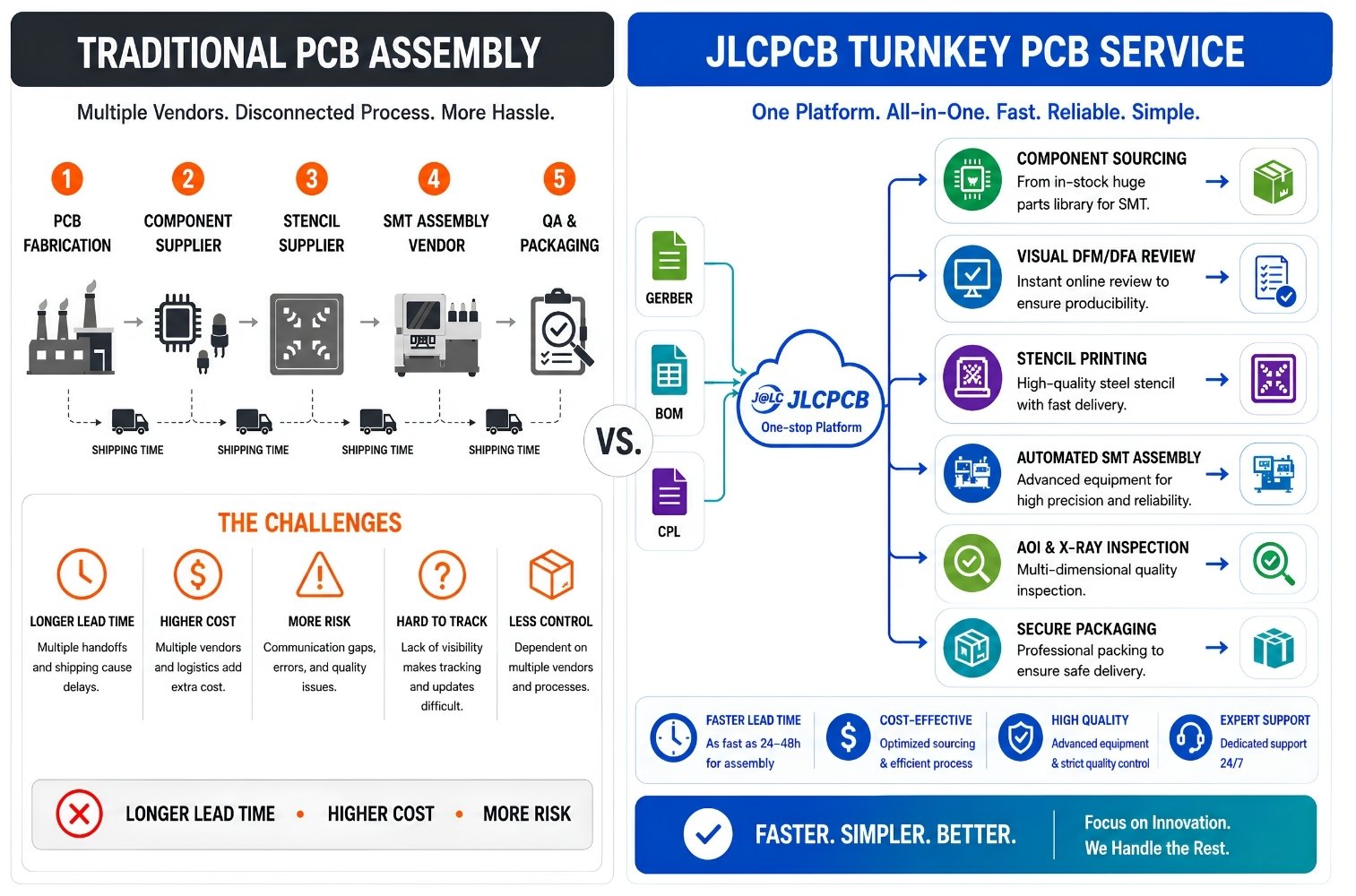
Turnkey PCB Assembly offers a streamlined way to bring electronic products from design to production by handling component sourcing, PCB fabrication, assembly, and quality control under one service provider. For teams facing long lead times, complex BOM management, or repeated communication across multiple vendors, a turnkey solution eliminates these bottlenecks and significantly reduces the risk of production delays.
By consolidating procurement and assembly into a single workflow, turnkey PCB assembly enables faster prototypes, more reliable mass production, and lower overall manufacturing costs.
In this guide, we explain how turnkey PCB assembly works, when to choose full or partial turnkey, and how it can help you deliver high-quality boards with shorter time-to-market.
What Is Turnkey PCB Assembly?
Turnkey PCB assembly is a complete electronics manufacturing service in which a single supplier manages the entire PCB production process, including parts sourcing, PCB fabrication, SMT assembly, through-hole assembly, testing, and final delivery.
For startups, hardware teams, and OEM companies, managing multiple suppliers for PCB fabrication, component procurement, and assembly can create long lead times, sourcing risks, and communication challenges. A turnkey PCB assembly service simplifies this workflow by consolidating all manufacturing stages under one experienced EMS provider.
In a full turnkey PCB assembly project, the manufacturer handles:
- PCB fabrication
- Electronic component sourcing
- BOM management
- SMT and THT assembly
- AOI, X-ray, and functional testing
- Quality inspection
- Final packaging and shipment
This integrated manufacturing approach helps reduce supply chain complexity, improve production efficiency, and accelerate time-to-market for both PCB prototypes and mass production.
Compared with traditional consigned assembly, turnkey PCB manufacturing reduces the burden on engineering and procurement teams by allowing a single supplier to coordinate sourcing, assembly, inspection, and logistics.
Services Offered in Turnkey PCB Assembly
A professional turnkey PCB assembly manufacturer typically provides the following services:
- Quick-turn PCB prototype assembly
- Full turnkey PCB assembly
- Partial turnkey PCB assembly
- Consigned PCB assembly
- SMT (Surface Mount Technology) assembly
- Through-hole (THT) assembly
- Mixed-technology PCB assembly
- RoHS-compliant lead-free assembly
- Functional testing and inspection
- Conformal coating services
- Final product packaging and shipment
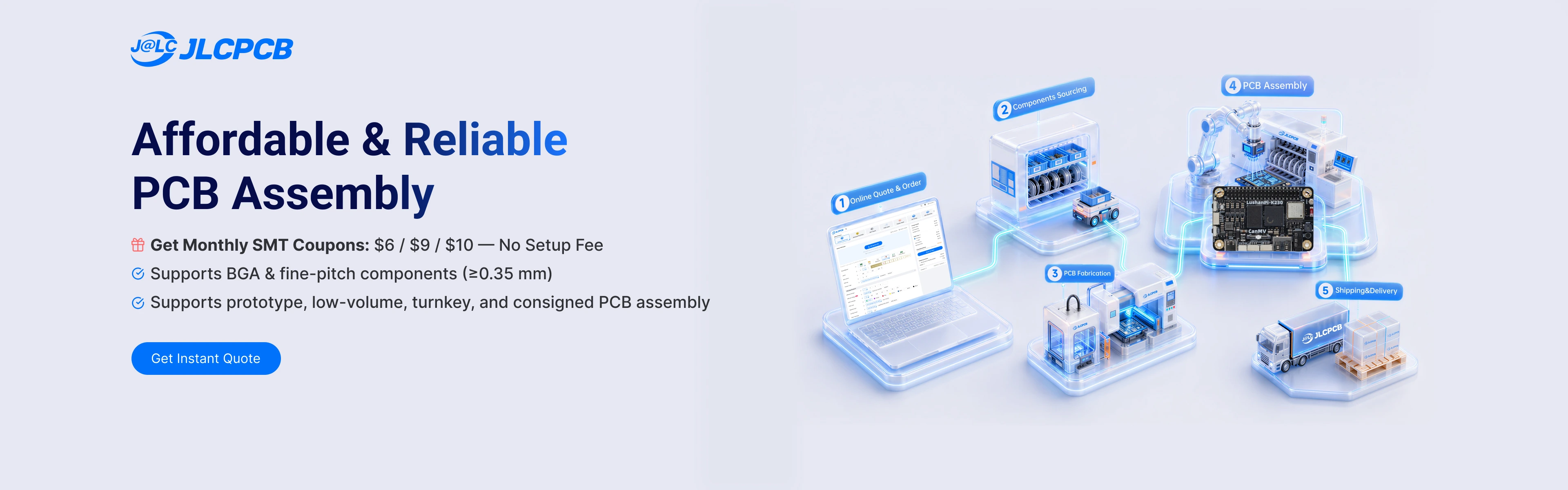
- Turn Your PCB Design Into Production-Ready Hardware
- Simplify component sourcing, PCB fabrication, and assembly with JLCPCB's turnkey PCB assembly services.
- Reduce lead times, improve manufacturing efficiency, and accelerate product development with integrated DFM support and reliable PCB assembly capabilities.
Turnkey PCB Assembly Quote with JLCPCB
After preparation of all required files, check the following quoting process
Step 1: Upload Gerber Files
You drag and drop your exported Gerber zip archive (or ODB++ file) into the main upload area. The system immediately starts extracting and unpacking your design files to map out basic dimensional data.
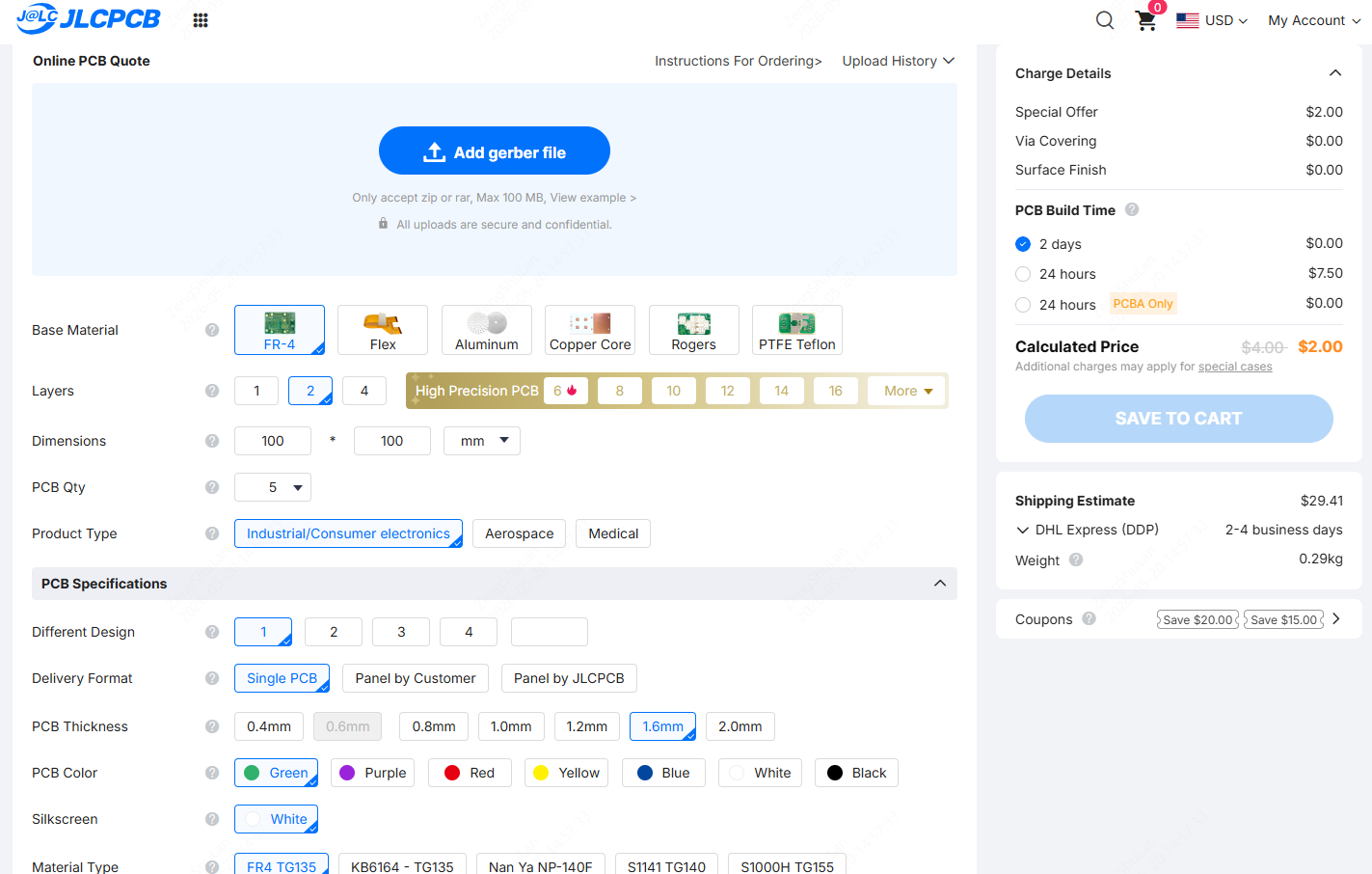
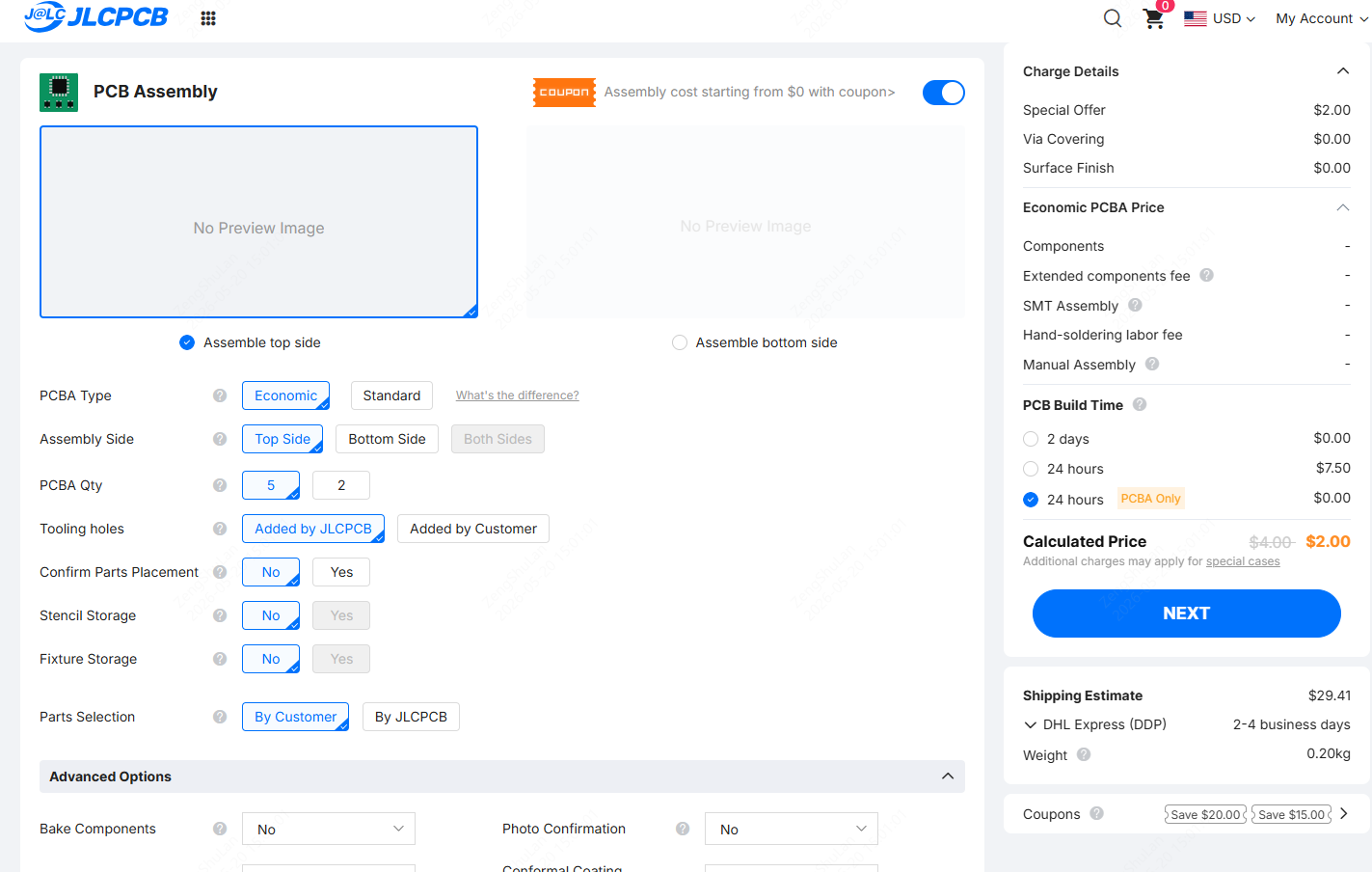
Step 2: Enable PCB Assembly Service
While still on the initial setup interface, you scroll down past the standard bare-board parameters to find the specialized PCB Assembly section. You toggle this switch to "On" to unlock the turnkey assembly configuration settings. After configuring the required options for your PCBA, click "Next."
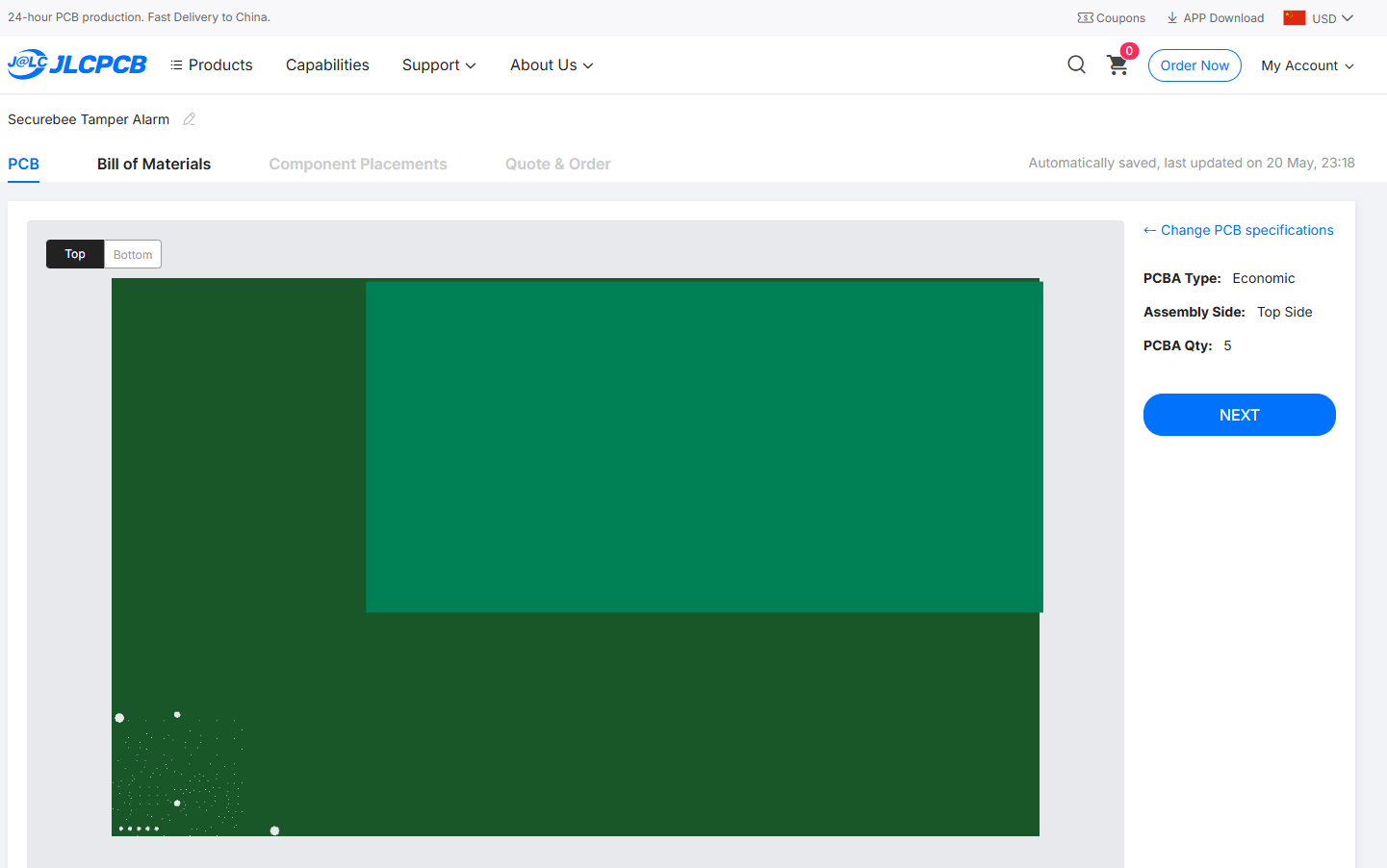
Step 3: Verify PCB Layers in the Gerber Viewer
On the next page, you check the automatic Gerber layer viewer to ensure your board contours are rendered accurately.
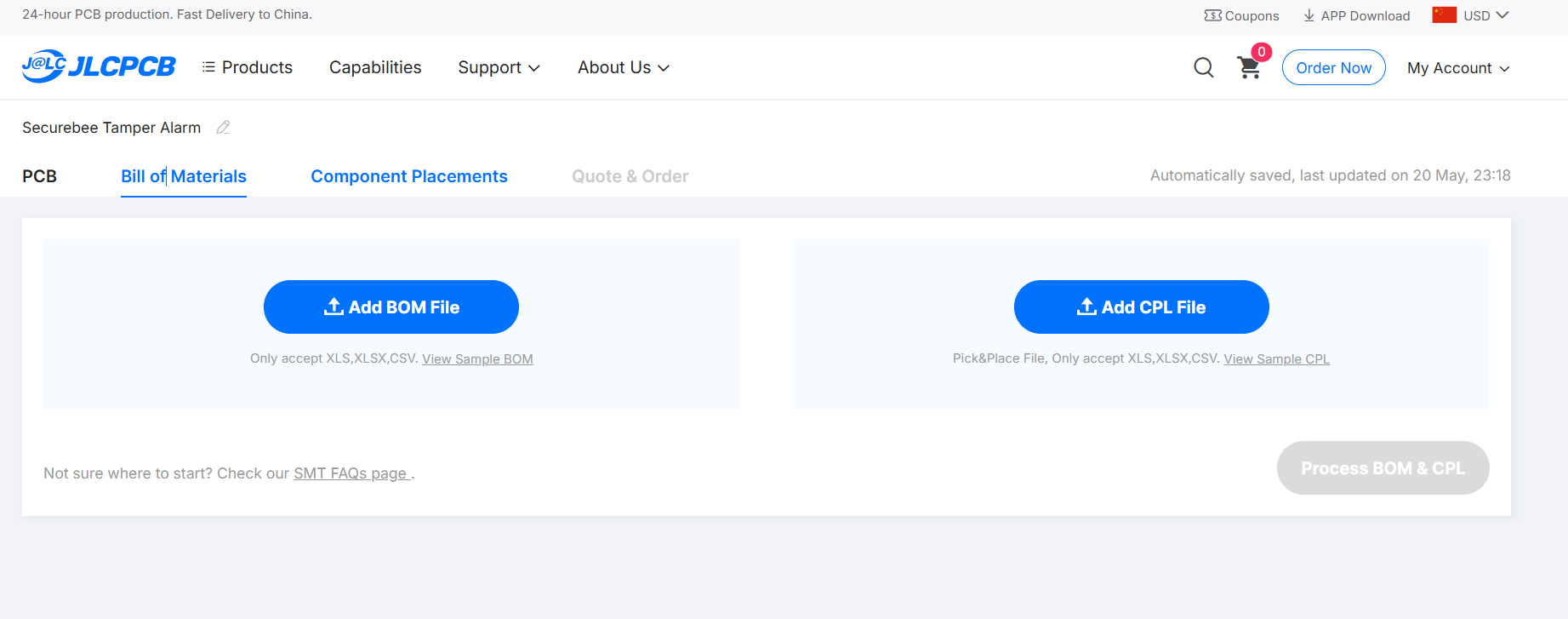
Step 4: Upload BOM and CPL Files
You land on the dedicated file upload screen, where you provide your formatted Bill of Materials (.xls/.xlsx/.csv) and your Component Placement List (.csv / Centroid file). The system processes these files simultaneously to bridge your design footprint data with spatial data.
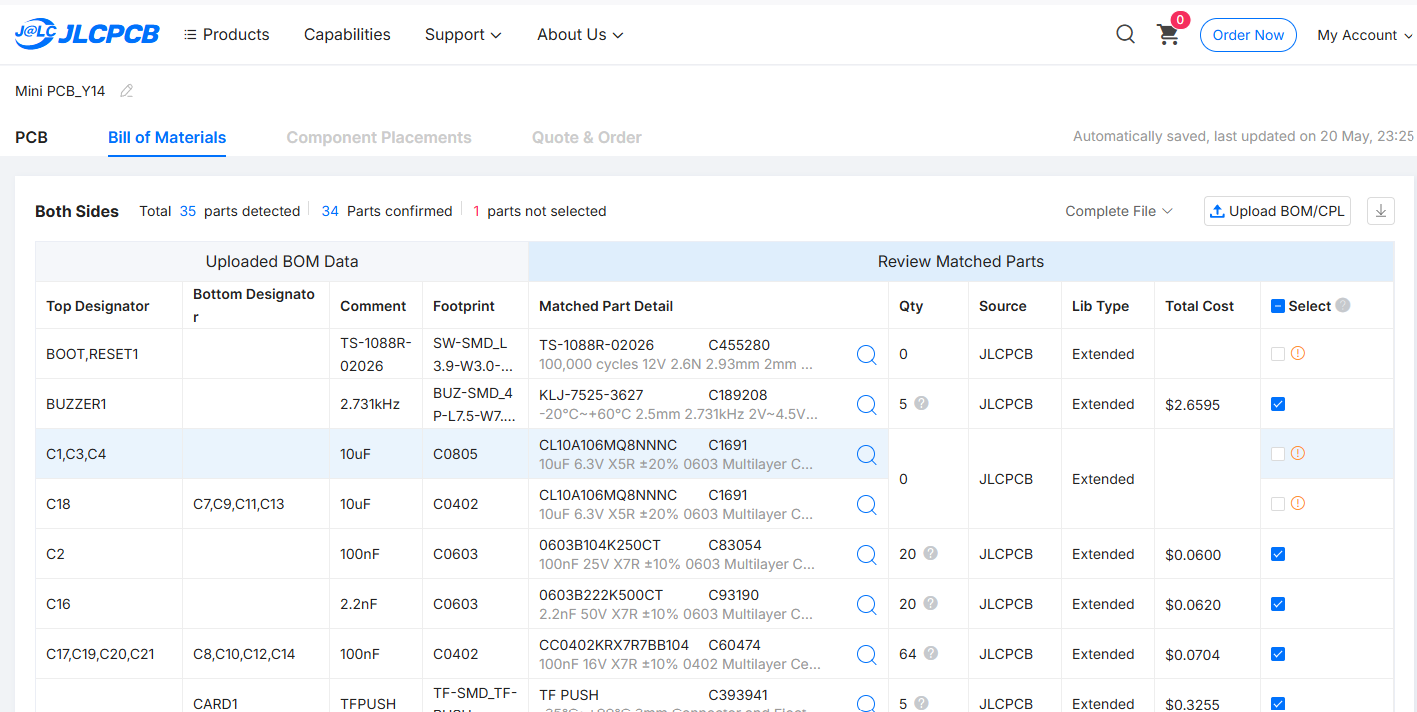
Step 5: Check Component Availability and Pricing
The engine parses your BOM line items (Manufacturer Part Numbers or LCSC part codes) against live factory warehouse inventory. It displays a matching table showing unit costs for every available component.
If a part is out of stock or missing, it highlights the line item in red, allowing you to instantly search the global library for a drop-in alternative or flag it as DNP (Do Not Place).
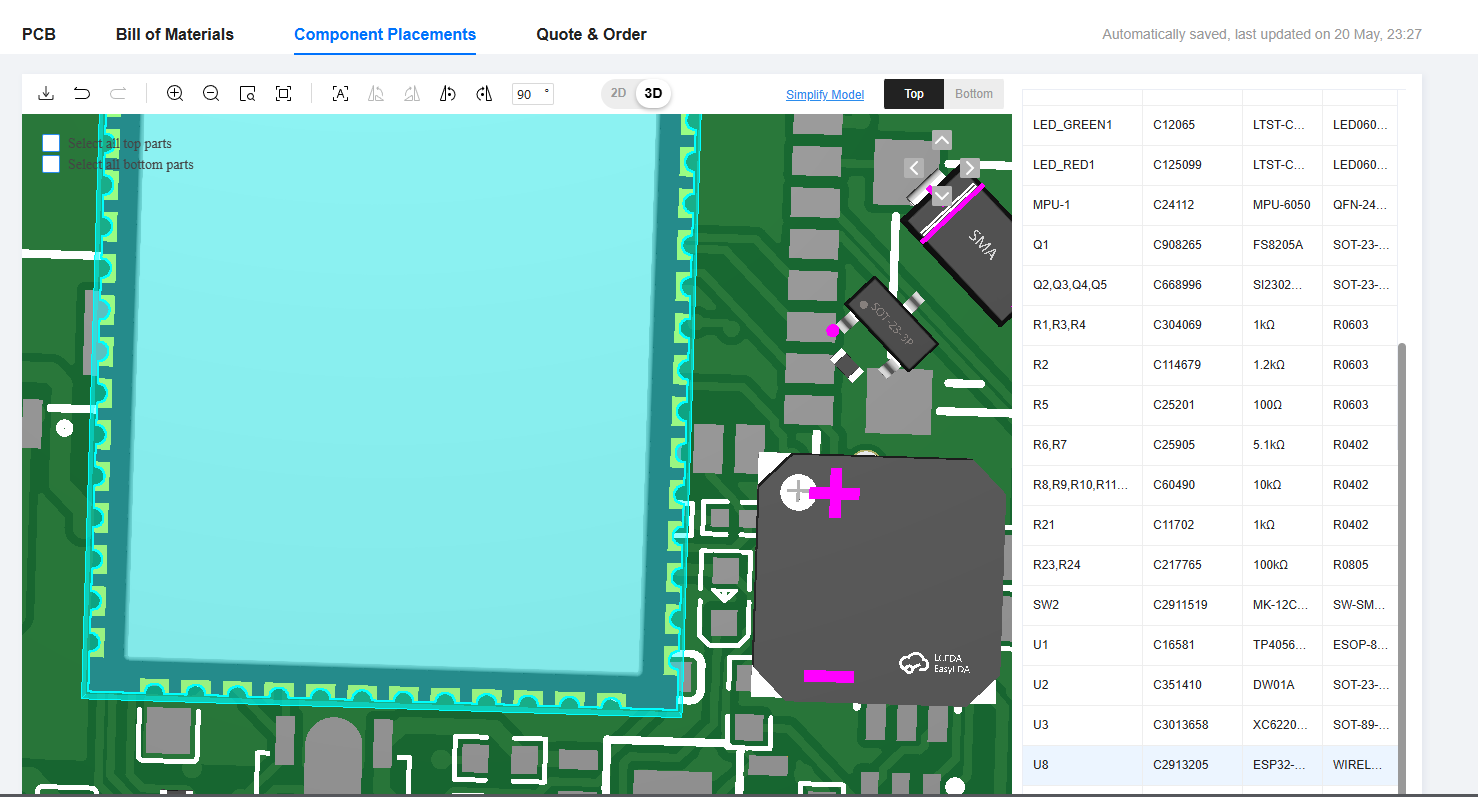
Step 6: Review Component Placement and Orientation
The platform generates an interactive visual preview, mapping your selected components onto your actual Gerber pad layouts.
Because ECAD software suites export zero-orientation rotations differently, you use this step to check for parts rotated by 90° or 180° or misaligned pin geometries. You can use the web interface tools to manually rotate or offset components until everything lines up perfectly, catching costly placement errors before production starts.
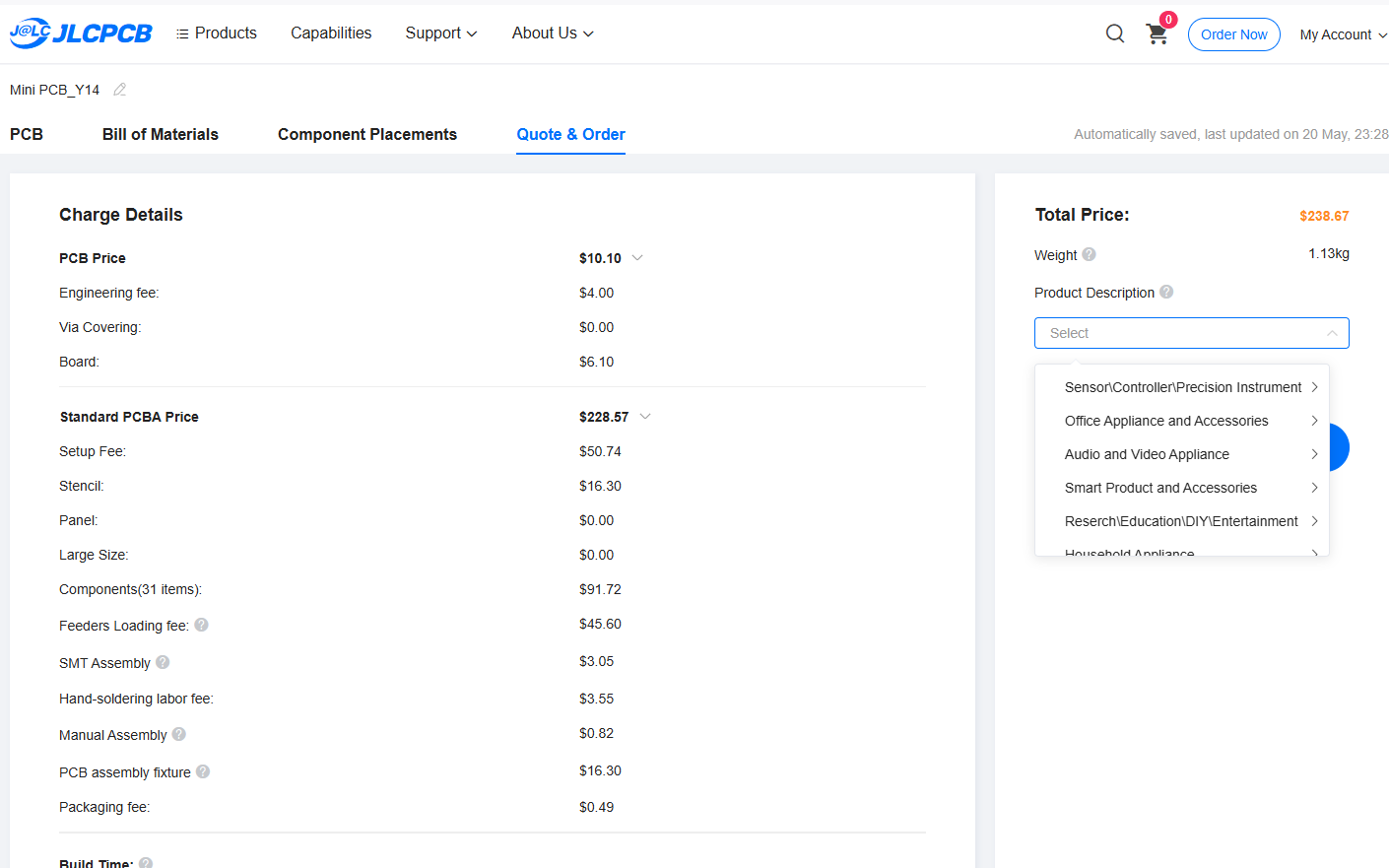
Step 7: Review Final PCB Assembly Quote and Place Order
Once you click through the visual validation, the system outputs your final, itemized cost breakdown, separating PCB fabrication, SMT labor/engineering fees, stencil tooling, and raw component costs.
From here, you select your product classification description, click "Save to Cart", and proceed to secure checkout for shipping and payment.
Benefits of Turnkey PCB Assembly
For companies developing new electronic products, turnkey PCB assembly services offer several advantages:
1. Lower Manufacturing and Procurement Costs
EMS manufacturers often maintain long-term relationships with authorized distributors and component vendors, allowing them to obtain competitive pricing and improve sourcing efficiency.
In addition, centralized procurement and manufacturing reduce shipping coordination, inventory handling, and administrative overhead.
2. Early Detection of Design and Manufacturing Issues
Before production begins, turnkey PCB assembly providers typically perform DFM (Design for Manufacturability) and DFA (Design for Assembly) reviews to identify potential design or assembly risks.
These checks may detect issues such as:
- Footprint mismatches
- Incorrect polarity markings
- Insufficient component spacing
- BOM inconsistencies
- Sourcing or lifecycle risks
Early issue identification helps reduce assembly defects, improve production yield, and minimize costly redesigns during mass production.
3. Simplified Supply Chain and Project Management
Managing separate PCB fabricators, component suppliers, and assembly vendors can increase communication complexity and delay production schedules.
A turnkey PCB assembly manufacturer centralizes these processes under a single point of contact, simplifying coordination throughout sourcing, assembly, testing, and delivery.
This streamlined workflow improves project visibility, reduces miscommunication, and helps engineering teams focus more on product development and time-to-market objectives.
Further read: Top Benefits of Turnkey PCB Assembly for Faster Production
Full Turnkey vs Partial Turnkey PCB Assembly
Turnkey PCB assembly services are generally divided into two models: full turnkey PCB assembly and partial turnkey PCB assembly. The key difference lies in how component sourcing and supply chain responsibilities are shared between the customer and the manufacturer.
| Feature | Full Turnkey PCB Assembly | Partial Turnkey PCB Assembly |
|---|---|---|
| Component Sourcing | The manufacturer handles all component procurement and sourcing. | The customer supplies part of the components, while the manufacturer sources the remaining parts. |
| PCB Fabrication | Fully managed by the EMS provider. | Usually managed by the EMS provider. |
| Assembly Services | Complete SMT, THT, and mixed-technology assembly are included. | Complete assembly services are still provided by the manufacturer. |
| Supply Chain Responsibility | Fully outsourced to the turnkey PCB assembly provider. | Shared between the customer and the manufacturer. |
| BOM Management | Managed entirely by the manufacturer. | Shared BOM responsibility depending on supplied components. |
| Inventory Requirements | Minimal customer inventory management required. | Customers may need to manage inventory for consigned components. |
| Flexibility | Lower flexibility in component sourcing decisions. | Greater flexibility for sourcing critical or customer-preferred components. |
| Lead Time Control | Manufacturer manages procurement and production scheduling. | Lead times may depend partly on customer-supplied components. |
| Best Suited For | Startups, OEMs, and teams seeking a fully outsourced PCB manufacturing solution. | Customers with existing component inventory or preferred suppliers. |
| Typical Advantages | Simplified management, faster production workflow, reduced coordination effort. | Better control over specific components, supplier selection, and sourcing costs. |
Full Turnkey PCB Assembly Process
| Process Stage | Description |
|---|---|
| Design File Review | The manufacturer reviews Gerber files, BOM, CPL files, and assembly drawings to verify manufacturing readiness. |
| DFM & DFA Analysis | Design for Manufacturability (DFM) and Design for Assembly (DFA) checks are performed to identify potential production or assembly issues before manufacturing begins. |
| PCB Fabrication | Bare PCBs are manufactured according to the required layer count, materials, copper weight, and surface finish specifications. |
| Component Procurement | Electronic components are sourced through authorized distributors and supply chain partners based on the BOM requirements. |
| SMT & THT Assembly | Surface-mount (SMT) and through-hole (THT) components are assembled using automated pick-and-place machines, reflow soldering, and wave soldering processes. |
| Inspection & Testing | AOI, X-ray inspection, ICT, and functional testing are performed to ensure assembly quality and electrical performance. |
| Final Packaging & Shipment | Finished products are packaged and shipped according to customer logistics and delivery requirements. |
Note
JLCPCB currently supports turnkey PCB fabrication and PCB assembly services, while enclosure integration and box-build assembly are not yet included in the manufacturing workflow.
Conclusion
Turnkey PCB assembly provides a streamlined and efficient manufacturing approach by integrating PCB fabrication, component sourcing, assembly, and testing under a single EMS provider. This consolidated workflow helps reduce supply chain complexity, shorten production lead times, and improve overall manufacturing consistency for both prototypes and mass production.
By choosing between full turnkey and partial turnkey PCB assembly, companies can balance supply chain control with outsourcing flexibility based on their project requirements and component availability.
Popular Articles
Keep Learning
PCB Assembly Manufacturing Process - JLCPCB Factory Tour
Printed circuit board assembly (PCB assembly manufacturing) is where a circuit design becomes a functional electronic product. Even with a perfectly fabricated PCB, poor assembly processes can lead to defects, reliability issues, and costly rework. In this factory tour, we walk through the complete PCB assembly manufacturing process at JLCPCB—from solder paste printing and automated component placement to reflow soldering, inspection, and final quality control. You'll see how a modern PCB assembly lin......
Turnkey PCB Assembly Explained: Full vs Partial Process And Benefits
Turnkey PCB Assembly offers a streamlined way to bring electronic products from design to production by handling component sourcing, PCB fabrication, assembly, and quality control under one service provider. For teams facing long lead times, complex BOM management, or repeated communication across multiple vendors, a turnkey solution eliminates these bottlenecks and significantly reduces the risk of production delays. By consolidating procurement and assembly into a single workflow, turnkey PCB assemb......
Low-Volume PCB Assembly for Startups and Prototyping
Introduction: Beyond the First Prototype The rapid advancement of the electronics industry has enabled the journey from a digital design to a physical product to be sped up. For startups, R&D labs, and individual makers, the ability to physically prototype and iterate time-sensitive solutions is not just a nice option; it is a necessity. Low-volume PCB assembly is a specialty manufacturing service catering to the manufacturing of low quantities of populated circuit boards, in most cases ranging from a......
Printed Circuit Board Assembly (PCBA): A Step-by-Step Guide
Printed Circuit Board Assembly (PCBA) is the process of mounting electronic components onto a fabricated PCB through solder paste deposition, SMT placement, reflow soldering, inspection, and final testing. A well-controlled PCB assembly workflow is essential for electrical performance, reliability, and overall manufacturing yield. This guide provides a clear, step-by-step overview of the full Printed Circuit Board Assembly process. At JLCPCB, PCB manufacturing and assembly are integrated in one ecosys......
Low-Cost and Rapid PCB Prototype Assembly Service
For hardware developers, electrical engineers, and entrepreneurs, the most critical stage of product development is the transition from digital design to a physical prototype. Bringing a great schematic to life as a fully functional board is the ultimate goal—though historically, this has been the most costly and time-consuming phase of the process. This is where PCB prototype assembly becomes the key manufacturing stage, where electronic designs are physically realized for the first time. This articl......
Selecting a PCB Assembly Manufacturer: Expert Engineer Tips
In the field of electronics, the final product's dependability rests on its Printed Circuit Board Assembly (PCBA). PCB assembly is the process of soldering electronic components onto the bare PCB itself. This complicated act of assembly is very important to the function of the product. Choosing a PCB assembly manufacturer should be viewed as a partnership decision. A competent manufacturer will serve as an extension of your engineering staff, providing important feedback on Design for Manufacturabilit......