Low-Cost and Rapid PCB Prototype Assembly Service
12 min
- What Is PCB Prototype Assembly and Why Does It Matter
- Key Challenges in Traditional PCB Prototype Assembly
- How to Choose a Low-Cost and Fast PCB Prototype Assembly Service
- Top Advantages of JLCPCB's PCB Prototype Assembly Service
- Ways to Reduce PCB Prototype Assembly Cost and Lead Time
- Conclusion
- FAQs about Prototype PCB Assembly
For hardware developers, electrical engineers, and entrepreneurs, the most critical stage of product development is the transition from digital design to a physical prototype. Bringing a great schematic to life as a fully functional board is the ultimate goal—though historically, this has been the most costly and time-consuming phase of the process.
This is where PCB prototype assembly becomes the key manufacturing stage, where electronic designs are physically realized for the first time.
This article serves as a technical guide to help engineers and product teams choose an efficient and cost-effective PCB assembly manufacturer, moving away from the slow and expensive methods of the past.
Today, coordinated online manufacturing platforms have enabled rapid prototyping, PCB assembly, and fast turnaround times. This shift is catalyzing large-scale innovation at a level never seen before.
What Is PCB Prototype Assembly and Why Does It Matter
Essentially, Prototype Printed Circuit Board Assembly refers to the process of populating a bare circuit board (PCB) with its relevant electronic components in smaller quantities, usually for test and validation purposes. It is not just a step in manufacturing; rather, it is an essential aspect of the design and engineering process.
Its notable importance in product development cannot be emphasized enough, and it may be described in three categories:
● Design Validation: A successful prototype is the proof that, to some extent, your theoretical circuit schematic and complex simulation translate into real-world behavior. This is the first moment of ever powering up a device, running a series of tests on the electrical characteristics, and making sure that the entire design works in unison.
● Iterative Engineering: The sooner you can put a prototype in the engineer's hand, the sooner the engineer will find and fix the problems it has.
Additionally, speed in the prototype PCB assembly will allow for rapid, iterative testing cycles. Engineers will be able to identify design problems in real-time applications and quickly optimize component layout for performance or thermal management before committing to a larger, more expensive production run.
● Firmware and Software Integration: For all embedded or semi-embedded systems, hardware is only half of the equation. The physical prototype provides the platform for the firmware and software engineers to develop, test, and debug code on the actual hardware it will be used on.
A fast prototype PCB assembly process has a direct and large impact on business. It significantly reduces time-to-market, reduces the financial exposure of unproven designs, and eliminates the crippling expense of discovering an error in the product after mass production has started.
Key Challenges in Traditional PCB Prototype Assembly
For years, engineers have faced the same recurring frustrations when building prototypes. These challenges have historically made prototype PCB assembly a slow and costly bottleneck to innovation.
● Exorbitant Costs for Low Volumes: Most PCB assembly manufacturers in the market are typically organized for high-volume production. This made prototypes prohibitively expensive for low-volume orders, in part because of high Non-Recurring Engineering (NRE) fees for setup, expensive stencil costs, and the often-imposed Minimum Order Quantities (MOQ) that may require a startup to order fifty boards when they only want five. These factors add up to substantially higher initial costs to produce PCB assemblies.
● Extended Lead Times: Procuring prototype printed circuit boards and their components is often inefficient and time-consuming, with limited flexibility in sourcing and lead times.
First, one vendor must fabricate the PCB, while components are sourced from multiple distributors, each with its own shipping schedules. These variables can easily shift, causing the entire process to take weeks and delaying the crucial iterative development cycle.
● Component Sourcing and Management: The first step is to get a good Bill of Materials (BOM) in order. But wait till you start sourcing every single resistor, capacitor, and integrated circuit. Inventory management and getting all the correct components delivered on time are often an overwhelming experience. This whole aspect is a risky business too, as you may receive counterfeit components from untrustworthy suppliers or be out of stock of critical items that could completely stop your prototype in its tracks.
● Quality and Communication Gaps: If there are a number of different vendors, add quality to the mix, and communication becomes a nightmare. Providing assembly instructions for certain assemblies, requiring last-minute changes to the BOM, or just working through some discrepancies can create chaos.
And let’s not forget that there is always the chance of making mistakes in the assembly process (poor solder joints, tombstoning of components, incorrect placement would make a prototype worthless, pushing the entire team back to step one).
How to Choose a Low-Cost and Fast PCB Prototype Assembly Service
Selecting the appropriate prototype PCB assembly manufacturer is an important technical choice. Engineers should assess potential prototype PCB assembly manufacturers based on the following factors:
● Integrated Component Sourcing: This may be the most significant factor for speed and cost of prototype PCB assembly. A manufacturer that has a large, in-house, readily available library of electronic components will eliminate the entire headache of relying on third-party sourcing.
This integration significantly reduces lead times and ultimately lowers the overall cost of prototype PCB assembly, as the prototype PCB assembly manufacturer can leverage its bulk purchasing power.
● Transparent, Instantaneous Quoting: In today's world, waiting 1-2-3 days for a quote is unacceptable. The gold standard is to have an advanced online platform that allows you to immediately have an easy-to-read, transparent, and accurate cost for PCB assembly the moment you upload your Gerber files and BOM. This function allows for instant budget figures and comparisons.
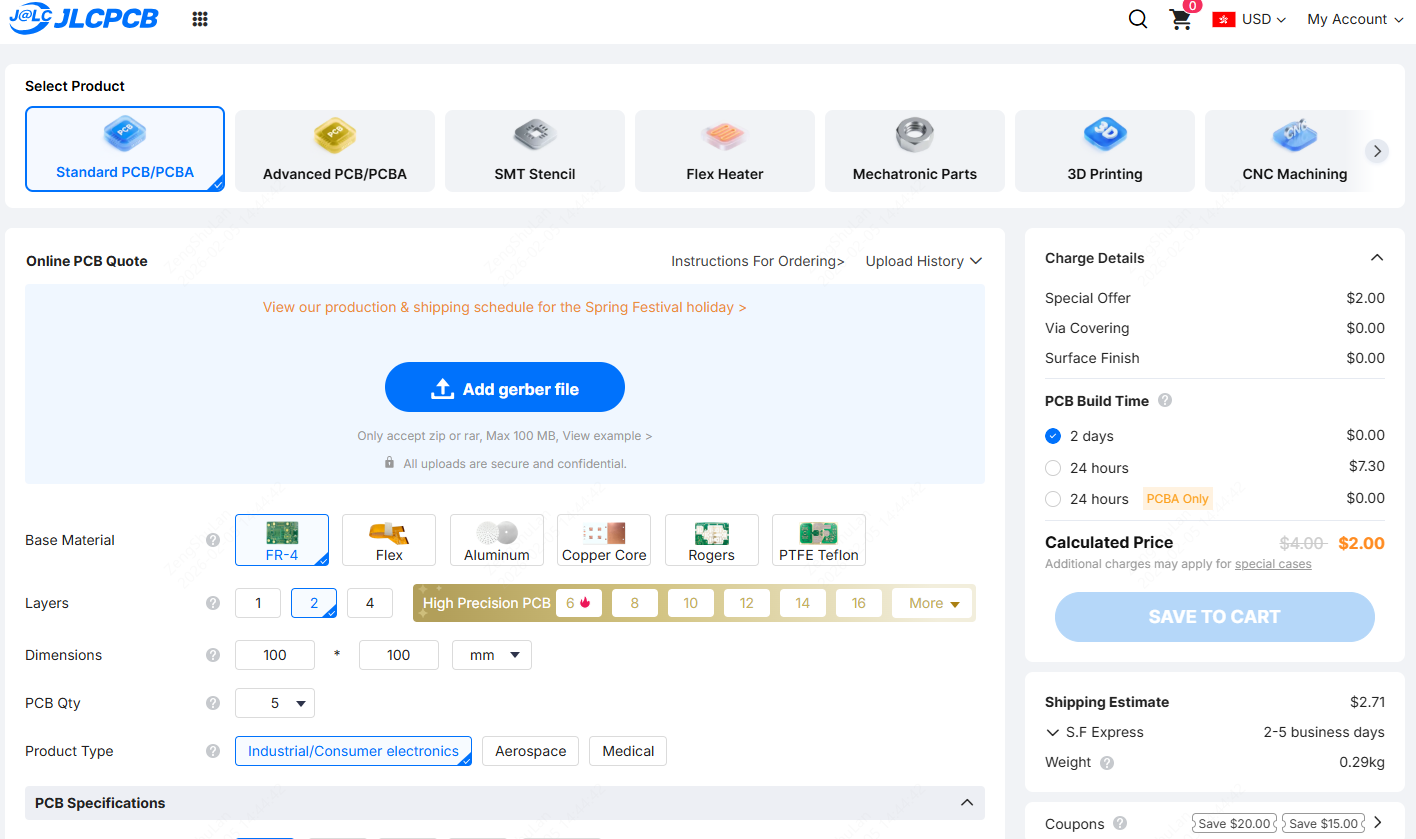
● Low MOQ (Minimum Order Quantity) and Scalability: An actual prototype PCB assembly service should support orders as low as two to five units. Beyond this, it must offer a seamless pathway that leads to scaling low-volume production (e.g., 100-1000 units), without the need to switch manufacturers, re-qualify processes, and substantially redesign the board.
● Automated DFM and DFA Checks: Choosing a prototype PCB assembly manufacturer offers access to free, automated Design for Manufacturability (DFM) and Design for Assembly (DFA) checks directly via an online platform. These powerful software tools analyze your design files to detect potential issues—such as incorrect component footprints, insufficient clearances, or missing solder mask between pads—before production begins, saving significant time, cost, and frustration.
JLCDFM analysis tool highlighting potential manufacturing defects on a PCB layout.
● Guaranteed Quality and Inspection: A low cost should not equal low quality. You should seek out prototype PCB assembly services that have professional inspection methods, such as Automated Optical Inspection (AOI) to inspect placement errors or solder joint quality, and even X-ray inspection for complex packages, like Ball Grid Arrays (BGAs), even on small prototype runs.
JLCPCB's Integrated PCB Manufacturing and Assembly Services
Top Advantages of JLCPCB's PCB Prototype Assembly Service
● Unmatched Cost-Efficiency: JLCPCB offers significant cost savings through economies of scale. With 430,000+ in-stock components, JLCPCB minimizes sourcing delays and material costs. Its automated quoting and production pipeline further reduces manual labor and overhead, allowing these savings to be passed directly on to customers. Learn more at JLCPCB's fast PCB Assembly Service.
● The Power of an Integrated Ecosystem: PCB manufacturing, a large parts library, and assembly combined under one roof achieve productive synergy and speed. This provides large efficiencies and helps speed up the time to turn around in modern rapid prototyping PCB assembly. JLCPCB offers a fast turnaround time, completing PCB assembly within 2–3 days.
● Effortless Online Platform: The user experience has been developed for busy engineers. The workflow is easy: upload Gerbers and a BOM, receive an immediate and interactive quote, select components from JLCPCB Parts Library, and order in a matter of minutes. This ease and efficiency translate into a real competitive advantage.
● Assured Quality for Prototypes: JLCPCB has no compromise on quality. We spend on the same advanced inspection equipment used for mass production, such as AOI and X-ray, to ensure that even a two-piece prototype will undergo rigorous quality control.
● Technical Flexibility: JLCPCB’s PCB assembly services are designed to be flexible, supporting Surface-Mount Technology (SMT) and older Through-Hole Technology (THT) components. This ensures our ability to meet design needs for both maker projects and complex, multi-layer boards using fine-pitch components.
| Prototyping Challenge | JLCPCB Solution | Technical Benefit |
|---|---|---|
| High Upfront Cost | $8 Assembly Setup Fee (Economic PCBA) & Low MOQ (2 pcs) | Drastically lowers the financial barrier for testing |
| Long Lead Times | 24-hour Turnaround and Integrated Platform | Enables multiple design iterations in a single week |
| Component Sourcing | 430,000+ in-stock Components | Eliminates sourcing delays & reduces component cost |
| Risk of Design Errors | Free Automated DFM/DFA Analysis and 3d Viewer | Catches manufacturing issues pre-production |
| Uncertain Quality | Standard AOI and X-ray Inspection | Ensures reliable assembly for accurate testing |
Ways to Reduce PCB Prototype Assembly Cost and Lead Time
● BOM and Centroid File Perfection: The principle of "garbage in, garbage out" applies perfectly here. Provide a meticulously prepared Bill of Materials with exact, unambiguous Manufacturer Part Numbers (MPNs) for every component. Equally important is a correctly formatted Centroid file (also known as a Pick-and-Place file) that specifies the exact X-Y coordinates and rotation for every component on the board.
● Prioritize In-stock Parts: Most integrated PCB manufacturing and assembly services maintain a category of "basic" or "in-stock" parts—common components like resistors, capacitors, and connectors that are stocked in massive quantities. Designing with these parts whenever possible guarantees the best price and availability, eliminating potential sourcing delays.
● Designate Alternate Parts: To build design resiliency, specify 1-2 pre-approved alternate parts for key parts of the BOM. This will give the assembler a readily available backup, preventing an unwanted project delay situation if your first choice is suddenly out of stock.
● Smart Panelization: Engineers producing a very small board may need to consider panelization of the design. This process takes multiple copies of the PCB board and places them onto a single larger PCB panel. This can speed up the assembly process as the pick-and-place machine can populate many boards in one pass, which will lower the cost per board.
A panelized PCB showing several identical small circuit boards connected by tabs for efficient manufacturing.
● Clear Assembly Instructions: Use the silkscreen layer of your board smartly. Clearly indicate polarity for components like diodes and electrolytic capacitors, always have a pin-1 indicator for any IC or chip, and put any other necessary direction indicators. The explicit direction markings help prevent very easy, yet expensive, assembly errors.
Conclusion
The landscape of hardware development has fundamentally changed. The traditional challenges of prototype PCB assembly— costs, frustratingly long delays, and complex supply chain logistics—are no longer unavoidable barriers to innovation.
Modern online platforms have successfully democratized the prototype PCB assembly process, providing global access to professional-grade, low-cost prototype PCB assembly services that operate with unprecedented speed. This shift empowers individual engineers, startups, and established companies alike to test, iterate, and bring new technologies to market faster than ever before.
Ready to turn your PCB design into a functional prototype? Get an instant quote for your PCB assembly now and accelerate your innovation cycle!
FAQs about Prototype PCB Assembly
Q1: Can I use my own components for Prototype PCB assembly?
JLCPCB does allow "consigned" assembly, where you can provide some or all of the parts. However, this usually requires thorough coordination, particular packaging and labeling, and may have different pricing structures compared to a fully turnkey PCB assembly service.
Click to know more about how to consign parts to JLCPCB.
Q2: What happens if a part in my BOM is out of stock and I don't have an alternate?
If a component in your BOM is out of stock, JLCPCB will typically place your order on hold and contact you immediately. You can then choose to approve a recommended substitute, select a replacement from the JLCPCB Parts Library. To avoid delays, it’s strongly recommended to pre-select alternate components in advance.
Q3: Are there any size limitations for components to be included in an automated SMT assembly?
Yes, and this capability is a key differentiator for an advanced assembly service. Basic assembly services may struggle with modern high-quality designs. Top-tier manufacturers invest heavily in high-precision automated equipment.
This is a key advantage of JLCPCB’s advanced SMT service. The automated lines are equipped to handle high-density and miniaturized designs, giving engineers great flexibility. This includes the capability to reliably place components as small as 0201 passives and handle complex, fine-pitch packages like BGAs, allowing you to create more compact and powerful prototypes. You can find the full list of specifications in JLCPCB's PCB assembly capabilities document.
Q4: What is the key difference between a DFM and a DFA check?
A Design for Manufacturability (DFM) check evaluates the PCB layout and identifies the potential manufacturing issues (like trace widths, clearances, and via hole sizes). A Design for Assembly (DFA) check does the opposite and evaluates the board, looking for problems connected with the component placement (like component spacing, footprint accuracy, and rotation).
Q5: How does panelizing my design actually reduce the assembly cost?
Automated assembly machines are at their peak performance when dealing with larger standardized panels. The process of placing multiple small boards on one panel (panelization) not only cuts the machine's setup time per board but also enhances the pick-and-place head's movement efficiency.
Popular Articles
Keep Learning
PCB Assembly Manufacturing Process - JLCPCB Factory Tour
Printed circuit board assembly (PCB assembly manufacturing) is where a circuit design becomes a functional electronic product. Even with a perfectly fabricated PCB, poor assembly processes can lead to defects, reliability issues, and costly rework. In this factory tour, we walk through the complete PCB assembly manufacturing process at JLCPCB—from solder paste printing and automated component placement to reflow soldering, inspection, and final quality control. You'll see how a modern PCB assembly lin......
Turnkey PCB Assembly Explained: Full vs Partial Process And Benefits
Turnkey PCB Assembly offers a streamlined way to bring electronic products from design to production by handling component sourcing, PCB fabrication, assembly, and quality control under one service provider. For teams facing long lead times, complex BOM management, or repeated communication across multiple vendors, a turnkey solution eliminates these bottlenecks and significantly reduces the risk of production delays. By consolidating procurement and assembly into a single workflow, turnkey PCB assemb......
Low-Volume PCB Assembly for Startups and Prototyping
Introduction: Beyond the First Prototype The rapid advancement of the electronics industry has enabled the journey from a digital design to a physical product to be sped up. For startups, R&D labs, and individual makers, the ability to physically prototype and iterate time-sensitive solutions is not just a nice option; it is a necessity. Low-volume PCB assembly is a specialty manufacturing service catering to the manufacturing of low quantities of populated circuit boards, in most cases ranging from a......
Printed Circuit Board Assembly (PCBA): A Step-by-Step Guide
Printed Circuit Board Assembly (PCBA) is the process of mounting electronic components onto a fabricated PCB through solder paste deposition, SMT placement, reflow soldering, inspection, and final testing. A well-controlled PCB assembly workflow is essential for electrical performance, reliability, and overall manufacturing yield. This guide provides a clear, step-by-step overview of the full Printed Circuit Board Assembly process. At JLCPCB, PCB manufacturing and assembly are integrated in one ecosys......
Low-Cost and Rapid PCB Prototype Assembly Service
For hardware developers, electrical engineers, and entrepreneurs, the most critical stage of product development is the transition from digital design to a physical prototype. Bringing a great schematic to life as a fully functional board is the ultimate goal—though historically, this has been the most costly and time-consuming phase of the process. This is where PCB prototype assembly becomes the key manufacturing stage, where electronic designs are physically realized for the first time. This articl......
Selecting a PCB Assembly Manufacturer: Expert Engineer Tips
In the field of electronics, the final product's dependability rests on its Printed Circuit Board Assembly (PCBA). PCB assembly is the process of soldering electronic components onto the bare PCB itself. This complicated act of assembly is very important to the function of the product. Choosing a PCB assembly manufacturer should be viewed as a partnership decision. A competent manufacturer will serve as an extension of your engineering staff, providing important feedback on Design for Manufacturabilit......