Mastering Split Planes for Cleaner Power Delivery and Better Signal Integrity
11 min
- The Role of Split Planes in Modern PCB Design
- Benefits and Potential Risks of Split Planes
- Best Practices for Effective Split Plane Design
- Manufacturing Considerations for Split Plane PCBs
- JLCPCB's Expertise in Split Plane Implementation
- FAQ about PCB Split Plane
- Conclusion
Key Takeaways
- Split power planes when needed for multiple voltage domains or analog/digital isolation, but never split ground planes — always keep ground continuous for clean return paths.
- Avoid routing high-speed signals across splits; if unavoidable, use stitching capacitors (0.1 µF) and ensure differential pairs cross together.
- Place split power planes next to a solid ground layer, maintain ~10 mil moat width, and use proper decoupling near IC pins.
- Good split plane design significantly reduces noise and EMI, but poor implementation can worsen signal integrity.
Ever had a new board up and running where analog sensor values kept vibrating, or sound output ends up sounding like it has a hum in it when it shouldn't? In 9 out of 10 cases, it is your power distribution that's at fault. Plus, one of the most misunderstood tools to fix it is the Split Plane. As the name suggests, a Split Plane is a copper plane on your PCB that is subdivided into separate areas. When properly implemented, it separates the noisy digital circuits from analog circuits that are sensitive to noise and tidies up multiple voltage rails.
If misapplied, it ruins your return paths and turns your board into an EMI antenna. Balancing the act of splitting planes is a power integrity and signal integrity game. This guide will explain what split planes are, when they are genuinely an asset, and the precautions you must take and must not take to differentiate a clean layout from a noisy mess.
The Role of Split Planes in Modern PCB Design
What Split Planes Are and When They Are Needed
A PCB Split Plane is a one-layer copper board that is etched into one or more electrically isolated areas, referred to as a moat. Different voltages may be applied to each zone, and/or each zone may provide a different functional block. The most valid excuse for splitting a plane is to route two or more separate power rails on a single layer. A split plane is usually required when:
- There are several supply voltages (such as 1.8 V, 3.3 V, and 5 V) on a single power layer.
- The sensitive analog domain needs to be isolated from noisy digital switching currents.
- For a mixed-signal device (ADC or DAC), there are separate analog and digital power pins specified on its datasheet.
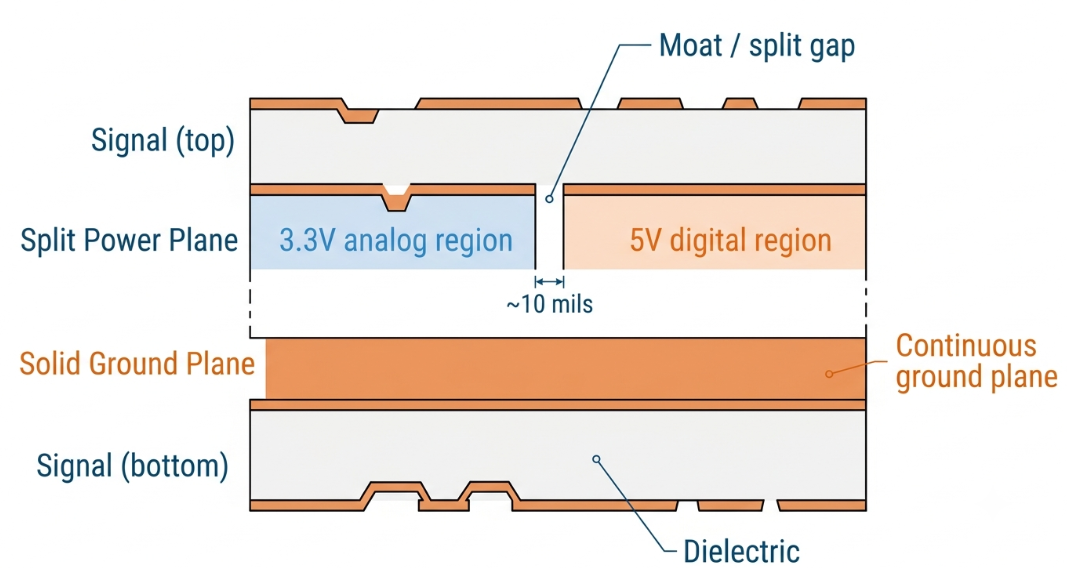
It is a common occurrence that Power Plane Splits are needed. Ground Plane Splits, however, are hazardous, typically not a good idea since a continuous ground provides a clean return path for signals.
Common Use Cases in Power and Ground Distribution
The traditional application is the mixed-signal board. When the analog supply is in its own quiet zone, it is advantageous for an audio codec, a precision data acquisition system, or a medical sensor front-end. You can split the power plane and power that section of the power plane through a ferrite bead or a separate regulator. Other common scenarios are:
Multi-rail power layers: powering an FPGA core at 1.2 V, an I/O layer at 3.3 V, and a peripheral layer at 5 V.
Noise-sensitive instrumentation: where a few millivolts of ripple on a power source will ruin a measurement.
High-frequency designs, which run at frequencies of several hundred megahertz or higher, are where the supply noise directly affects the timing margins.
Benefits and Potential Risks of Split Planes
Improved Noise Isolation and Voltage Domain Management
Domain isolation is the greatest benefit. Switching noise is prevented from leaking from one voltage domain to another via a shared plane impedance by providing each rail with its own copper area. If an analog supply is properly isolated from a digital supply, some mixed-signal designs claim to have a 20 dB noise-coupling reduction. The advantages are pretty nice:
- Less cross-contamination between voltage domains: less voltage contamination seen by each rail from other circuits.
- Lower ground bounce in the areas critical for precision analog.
- Confined EMI: interference remains localized and isn't radiated everywhere.
- Dedicated regions: routing & decoupling are much easier to reason about.
Risks to Return Paths and Signal Integrity
Each high-speed signal creates a return current that would prefer to travel on the plane immediately below the trace. A gap through which the return current cannot flow directly is encountered when a signal crosses a split. The moat then causes the return current to take a longer detour around the moat, thus making the current loop larger. In that loop, you're doing 3 bad things at once.
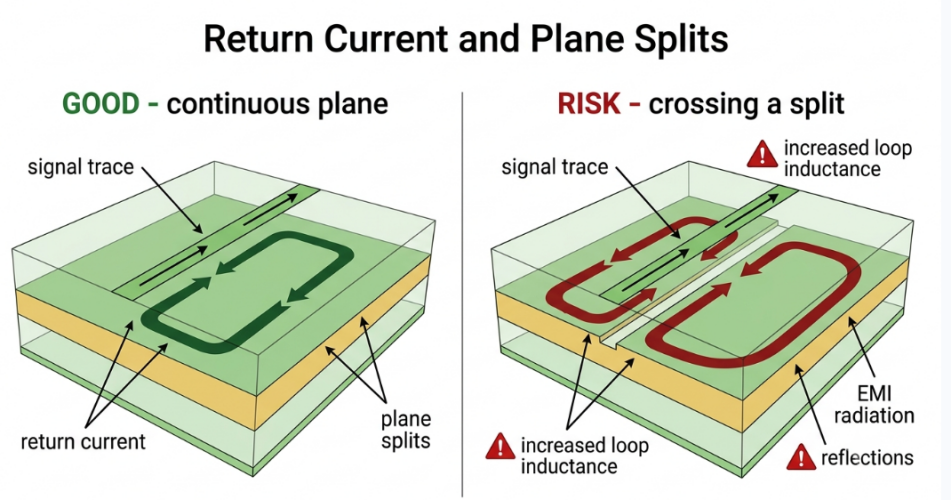
It increases the loop inductance, hence signal integrity is compromised, and there will be reflections at the impedance discontinuity. It turns into a very effective radiator, increasing your EMI figure and endangering your compliance with EN 55032 or FCC part 15. This allows for crosstalk between the signals that share that detour path.
Best Practices for Effective Split Plane Design
Proper Placement, Moating, and Stitching Via Strategies
First, perform the split at the physical split between blocks of function – analog on one side of the moat, digital on the other. The moat itself does not have to be wide; a gap of about 10 mils (0.254 mm) is usually enough to isolate the domains. If the two domains need to be joined, do so with a single controlled bridge, not a leaky boundary. Some techniques that have been proven:
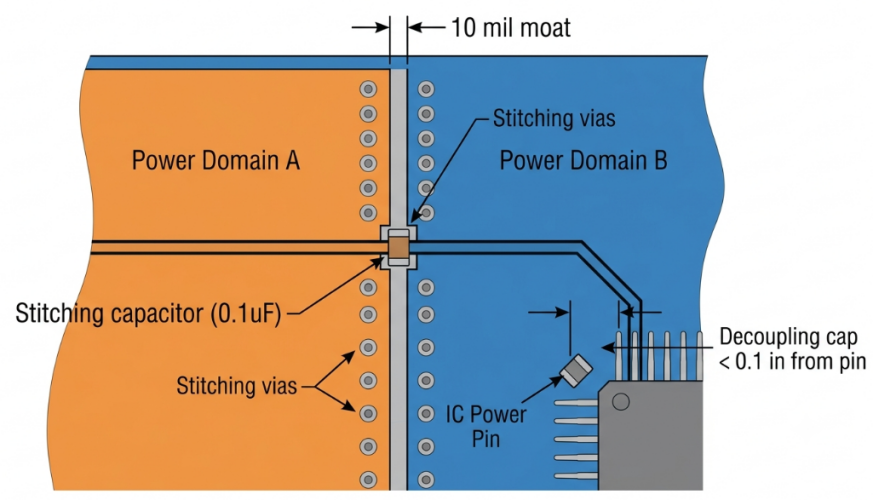
- Stitching vias: connect split power regions to a continuous ground plane on an adjacent layer to keep return currents tightly coupled.
- Stitching capacitors: make sure there is a high-frequency AC return path across which a signal is required to cross by installing a small capacitor, usually 0.1 µF or 1 nF, across the moat.
- Decoupling discipline: Use decoupling capacitors within 0.05 to 0.1 inches (1.3 mm to 2.5 mm) of each IC power pin to keep the local plane impedance in the milliohm range.
Handling Plane Splits with Differential Pairs and High-Speed Signals
High speed and singles/plane, a bad mix. The most basic is to never cross a plane split with your fast signals. If a crossing is unavoidable, follow these guardrails:
- On differential pairs (USB 3.0 at 90 Ω and PCIe and LVDS), both traces of the pair cross the split at the same point, so skew remains matched.
- Add a stitching capacitor next to the crossing to provide a return path for the crossing current.
- Use a pair of continuous ground planes instead of a split power plane as much as possible.
- Layer stack up considerations for optimal performance.
Layer Stackup Considerations for Optimal Performance
How forgiving a split plane will be depends upon your stackup. The basic rule is that whatever layer you split for power should be placed over a solid, continuous ground plane. This will provide a clean return path for each signal, even if the overlying power plane is broken up. Here are a few stackup guidelines to follow:
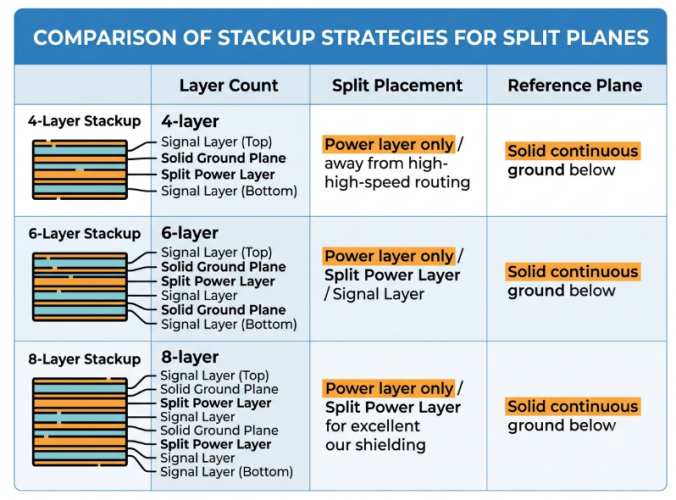
In a 4-layer board, use splits only for the power layer and use one internal layer as a solid ground. For 6-layer and above: Make sure that the high-speed routing layers are sandwiched between solid reference planes, and that any splits are clear away from the high-speed routing layers. Minimize the thickness of the dielectric between the signal layer and the reference plane to make the return current coupling tight and to control the impedance.
Manufacturing Considerations for Split Plane PCBs
Etching Precision and Plane Integrity Control
The moat between domains is totally determined by the etching process. With etching irregularity, it is possible to get a 10 mil gap under-etched (copper bridging two domains) or over-etched (eroding clearances elsewhere). Both of these result in the violation of the isolation you set up. Factors that contribute to the integrity of planes during manufacture are:
- Tight etch tolerance to ensure that the moat width is as per design intent.
- Balancing of copper to avoid warpage at a large plane area split unevenly across the panel.
- Copper edges around the moat should be kept clean, as the copper slivers or debris can cause a short circuit.
Ensuring Reliable Performance During Fabrication
In addition to the etch, the entire fabrication chain has an impact on how a split plane behaves in the field. Lamination registration is the measurement that will tell you if your split power layer is correctly positioned on the ground plane that it relies on. Misregistration is a relationship change between trace, gap, and reference. This is based on some checks to ensure reliable production:
- Layer-to-layer registration has been checked during lamination and drilling.
- Uniformity of plating in stitching vias to maintain a low impedance via-to-plane connection.
- Electrical Testing to verify each isolated Domain is actually isolated, and each connection conducts.
JLCPCB's Expertise in Split Plane Implementation
Advanced DFM Review for Complex Split Plane Layouts
JLCPCB's instant quoting system automatically conducts a Design for Manufacturing (DFM) review on every upload and alerts any problems, such as insufficient clearances or copper slivers around a moa,t before getting into production. For intermediate designers, this early feedback is a safety net that captures plane-integrity issues at an early stage when they can be easily resolved. EasyEDA is directly integrated with JLCPCB, so you can make changes to a split power layer and re-check the manufacturability in the same workflow. Because of the small circle, it is easy to adjust the width of moats and stitching strategies without guesswork.
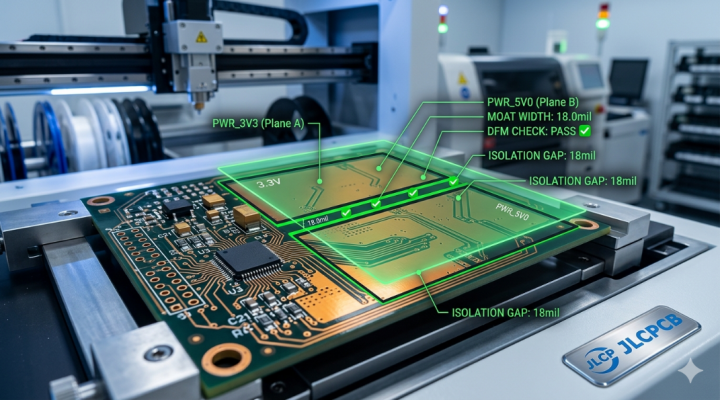
Precision Manufacturing Ensuring Clean Power Delivery
Accurate copper is the first step in clean power delivery. When you design an isolation, JLCPCB's controlled etching process brings it into reality. The platform spans a variety of different surface finishes (HASL to ENIG), multiple layer counts, and controlled-impedance capabilities, which are essential for split planes. With PCBs starting at $2 and fast turnaround times of 1 to 2 days, you can prototype a split-plane board, measure it, and refine it without having to wait long periods of time. This quick feedback is extremely useful when tuning power and ground distribution.
FAQ about PCB Split Plane
Q: What is a Split Plane in PCB design?
A split plane is a single copper layer divided into two or more electrically isolated regions by an etched gap called a moat. Each region can carry a different voltage rail or serve a different functional block, such as separating analog and digital power domains.
Q:Should I split the ground plane the same way I split a power plane?
Generally, No. Power plane splits are common and often necessary for multiple voltage rails, but ground plane splits break return paths and usually hurt signal integrity. Keep your ground continuous so every signal has a clean path home.
Q: What happens when a high-speed signal crosses a plane split?
The return current is forced to detour around the gap, increasing loop inductance, adding reflections, and raising EMI. If a crossing is unavoidable, place a stitching capacitor right at the crossing and reference the signal to a continuous ground plane.
Q: How wide should the moat between split planes be?
A gap of around 10 mils (0.254 mm) is typically enough to isolate two power domains. The gap behaves as an AC path through plane capacitance and nearby decoupling capacitors, so excessively wide moats provide little extra benefit.
Conclusion
Mastering split planes is one of the most effective ways to achieve cleaner power delivery and superior signal integrity in modern mixed-signal PCB designs. When used correctly, split power planes allow you to isolate sensitive analog circuits from noisy digital domains, minimize crosstalk, reduce ground bounce, and maintain stable voltage rails across multiple supplies.
However, success depends on disciplined implementation. Always keep your ground plane continuous, strategically place stitching capacitors and vias for return current paths, avoid routing high-speed signals across splits whenever possible, and follow proven layer stackup practices. A poorly executed split can easily create more problems than it solves — turning your board into an EMI radiator instead of a precision instrument.
By understanding both the power of domain isolation and the critical importance of return paths, you can confidently design PCBs that perform reliably even in demanding applications such as audio systems, precision sensors, medical devices, and high-speed digital circuits.
Ready to put these principles into practice? Upload your next split-plane design to JLCPCB, take advantage of their instant DFM feedback, and turn your clean power delivery vision into a high-quality, professionally manufactured board.
Popular Articles
Keep Learning
Navigating the Impedance Landscape: Selecting the Right Impedance for USB, Ethernet, HDMI, and SD Card Interfaces
Introduction In the realm of high-speed digital communication, choosing the right impedance is a critical aspect of successful PCB design. Impedance matching ensures optimal signal integrity, minimizes reflections, and enhances the overall performance of interfaces such as USB, Ethernet, HDMI, and SD Card. In this blog post, we'll explore the importance of impedance, the factors influencing impedance selection, and best practices for ensuring reliable data transmission in these widely used interfaces.......
A Beginners Guide to Impedance Control in PCBs
When a digital signal is transmitted from one point to another, it causes a change in the state of the signal line. This change can be understood as an electromagnetic wave moving through the circuit. Reflection occurs when this wave encounters a boundary between different mediums. At this boundary, some of the wave's energy continues as a signal, while the rest is reflected. This process repeats until the energy is either absorbed by the circuit or dissipated into the environment. For electrical engi......
What is PCB Signal Attenuation: How Signals Weaken Over Distance and How to Mitigate It
Key Takeaways Primary Causes: Signal attenuation is mainly caused by skin effect (conductor loss) and substrate energy absorption (dielectric loss). How to Mitigate: Reduce loss by using wider traces, low-loss materials, controlled impedance, and removing via stubs. JLCPCB Solutions: JLCPCB offers Rogers high-frequency laminates, High-TG FR4, precision impedance control, and backdrilling to protect signal integrity. As a signal travels from the source to the load through PCB conductors, the signal is ......
Understanding Analog and Digital Ground in PCB Design
When working on printed circuit board (PCB) design, proper grounding is crucial for ensuring signal integrity, minimizing noise, and maintaining reliable performance. Two common types of ground planes used in PCB layouts are Analog and Digital ground. In this article, we will explore the differences between analog and digital ground, their significance in PCB design, and best practices for their implementation. Analog Ground vs. Digital Ground Analog ground and digital ground have separate purposes in......
Design Guide for USB-3.0 Differential Signaling
In the world of data transfer, USB 3.0 is the Usain Bolt to USB 2.0’s friendly jogger. USB 2.0 is called “High Speed” and limped along at 480 Mb/s, whereas USB 3.0 SuperSpeed rockets up to 5 Gb/s (over ten times faster). But this speed jump brings full‑duplex operation and new differential transmit (SSTX) and receive (SSRX) pairs on dedicated pins. USB 2.0 D+/D– lines handle enumeration and legacy data, while two new 5 Gb/s high‑speed differential pairs carry SuperSpeed data in each direction. While m......
Understanding Impedance Matching for High-Speed PCB Designs
With the advancement of technology and the ever wider application of integrated circuits, the frequency and speed of electronic signal transmission have been increasing, making it essential for PCB conductors to provide high-performance transmission lines. These transmission lines are responsible for delivering signals from a source to the input of a receiver accurately and completely. This requirement emphasizes the need for impedance matching. Electrical impedance, commonly represented as Z and meas......