ESP32 BLE Guide: Choosing the Right Chip and Designing Your PCB
12 min
- Which ESP32 Chips Support BLE?
- How to Choose an ESP32 for Your BLE Product
- ESP32 BLE Module or Chip-Down: What Goes on Your PCB?
- How Does ESP32 BLE Work? Roles, GATT, and Host Stacks
- Can ESP32 Use Wi-Fi and BLE at the Same Time?
- How Much Power Does ESP32 BLE Use?
- ESP32 BLE Range and Antenna Placement
- ESP32 BLE PCB Assembly with JLCPCB
- Conclusion
- FAQs About ESP32 BLE
Key Takeaways
- ESP32 BLE support: Most ESP32 chips support Bluetooth Low Energy (BLE), except the ESP32-S2, which supports only Wi-Fi, and the ESP32-P4, which has no built-in wireless radio. The original ESP32 also supports Bluetooth Classic, while newer models offer Bluetooth 5 features.
- Wi-Fi and BLE coexistence: Wi-Fi and BLE share the same 2.4 GHz radio and take turns using it. Heavy Wi-Fi activity can reduce BLE throughput or interrupt scanning, so both functions need to be tested together.
- Power consumption: A 32.768 kHz external crystal can significantly reduce power consumption during BLE light sleep while maintaining a connection.
- Antenna placement: Position the ESP32 module's PCB antenna near a board edge, preferably with the antenna extending beyond it. Keep copper, traces, and components out of the specified antenna clearance area to avoid reducing wireless range.
Most ESP32 chips support Bluetooth Low Energy (BLE), with the ESP32-S2 and ESP32-P4 being the exceptions.
Choosing the right chip depends on your project's Bluetooth requirements. The original ESP32 supports Bluetooth Classic, while newer options such as the ESP32-S3, ESP32-C series, and ESP32-H2 offer Bluetooth 5 features. If you need a longer range through Coded PHY, make sure your chosen chip supports it.
Beyond chip selection, there are four important considerations when designing your PCB: whether to use a module or a bare chip, antenna placement, sleep clock requirements, and Bluetooth qualification.
In this guide, you will learn:
- Which ESP32 chips support BLE, and which one fits your product
- How ESP32 BLE works, and how Wi-Fi and BLE share one radio
- How to keep ESP32 BLE power low and range high on your PCB
- What Bluetooth qualification is required before you sell the product
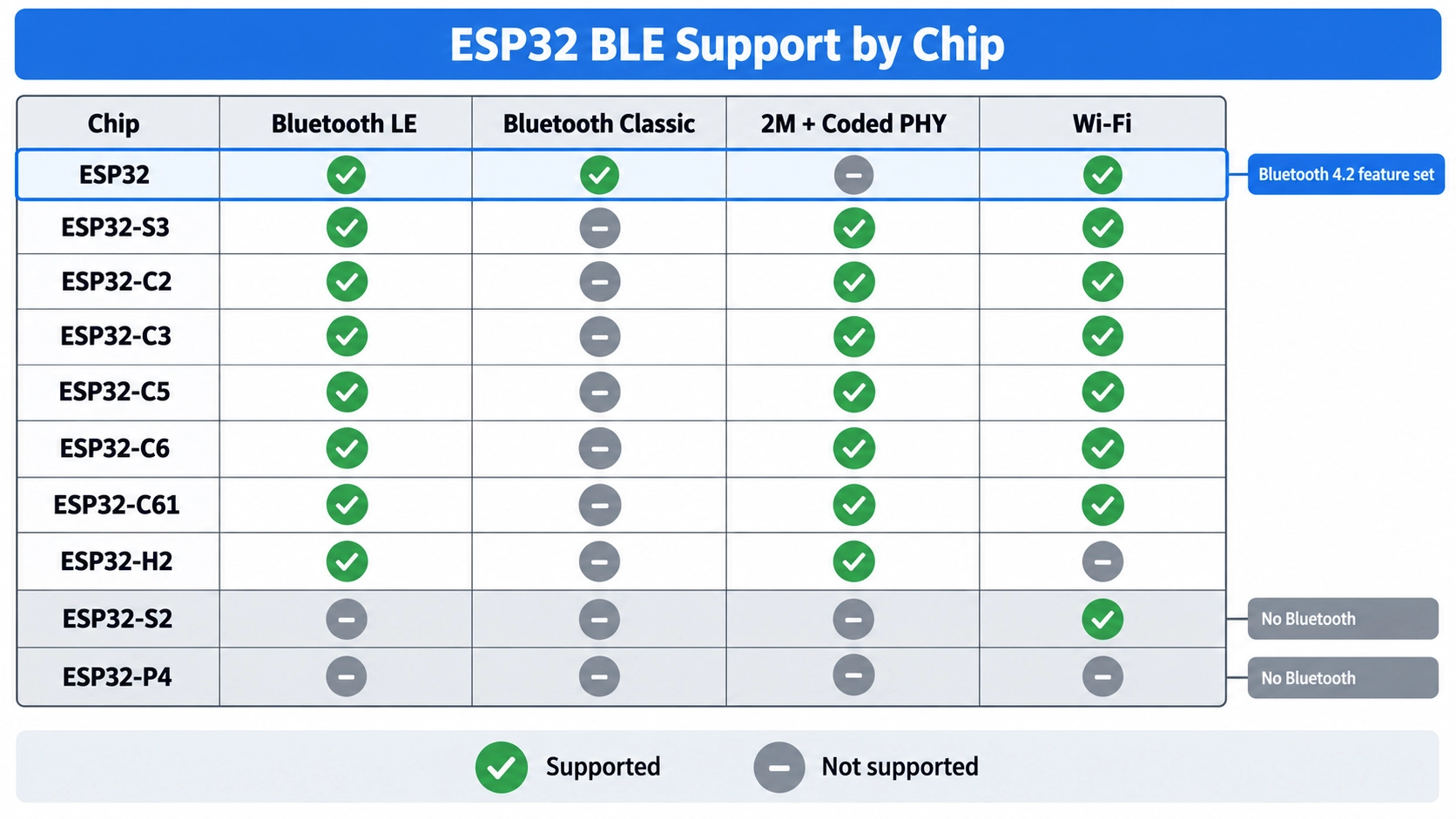
Figure: ESP32 BLE family with features chart.
Which ESP32 Chips Support BLE?
The original ESP32, ESP32-S3, ESP32-C2, ESP32-C3, ESP32-C5, ESP32-C6, ESP32-C61, and ESP32-H2 support BLE. The ESP32-S2 is a Wi-Fi-only chip, and the ESP32-P4 has no wireless radio.
Compiled from Espressif's official ESP-IDF documentation, the table below compares key radio features: the 2M PHY doubles standard 1M throughput, while the Coded PHY trades data rate for extended range.
| Chip | Bluetooth LE | Bluetooth Classic (BR/EDR) | 2M PHY and Coded PHY | Other Radios |
|---|---|---|---|---|
| ESP32 | Yes, Bluetooth 4.2 feature set | Yes | No | Wi-Fi 4 |
| ESP32-S3 | Yes, Bluetooth 5 (LE) | No | Yes | Wi-Fi 4 |
| ESP32-C2 | Yes, Bluetooth 5 (LE) | No | Yes | Wi-Fi 4 |
| ESP32-C3 | Yes, Bluetooth 5 (LE) | No | Yes | Wi-Fi 4 |
| ESP32-C5 | Yes, Bluetooth 5 (LE) | No | Yes | Dual-band Wi-Fi 6, IEEE 802.15.4 |
| ESP32-C6 | Yes, Bluetooth 5 (LE) | No | Yes | Wi-Fi 6, IEEE 802.15.4 |
| ESP32-C61 | Yes, Bluetooth 5 (LE) | No | Yes | Wi-Fi 6 |
| ESP32-H2 | Yes, Bluetooth 5 (LE) | No | Yes | IEEE 802.15.4, no Wi-Fi |
| ESP32-S2 | No | No | No | Wi-Fi 4 |
| ESP32-P4 | No | No | No | None |
Note
The original ESP32 passed Bluetooth LE 5.0 certification, but Espressif states that its hardware supports only Bluetooth LE 4.2, not the new features of Bluetooth LE 5.0.
How to Choose an ESP32 for Your BLE Product
Select your ESP32 variant based on your project's non-negotiable requirement: Bluetooth Classic, long-range support, Wi-Fi integration, IEEE 802.15.4 (Thread/Zigbee), or high connection capacity.
The table maps each need to the chips that meet it:
| Situation | Use |
|---|---|
| BLE plus Bluetooth Classic, such as an audio or serial-port device | Original ESP32 |
| Wi-Fi plus BLE at low cost | ESP32-C3 or ESP32-C2 |
| Long-range BLE with Coded PHY | Any Bluetooth 5 chip, such as the ESP32-C3, ESP32-S3, or ESP32-C6 |
| BLE plus Thread or Zigbee, such as a Matter-over-Thread device | ESP32-C6, ESP32-C5, or ESP32-H2 |
| BLE only, with no Wi-Fi | ESP32-H2 |
| More simultaneous BLE connections | ESP32-C6, ESP32-C5, or ESP32-H2 |
- ESP32: Up to nine client connections when acting as a BLE server, with three recommended for a stable link.
- ESP32-C3: No more than eight, shared between its central and peripheral roles.
For a side-by-side comparison of two popular choices, see ESP32-C3 vs ESP32-S3.
Selection rule: If the product needs Bluetooth Classic, use the original ESP32. If it needs any Bluetooth 5 feature, use a newer chip.
ESP32 BLE Module or Chip-Down: What Goes on Your PCB?
Opt for a pre-certified module unless your engineering team possesses dedicated RF design expertise and high-volume production warrants a custom chip-down layout.
A module already contains the RF matching network, the antenna or antenna connector, the flash, and the main crystal.
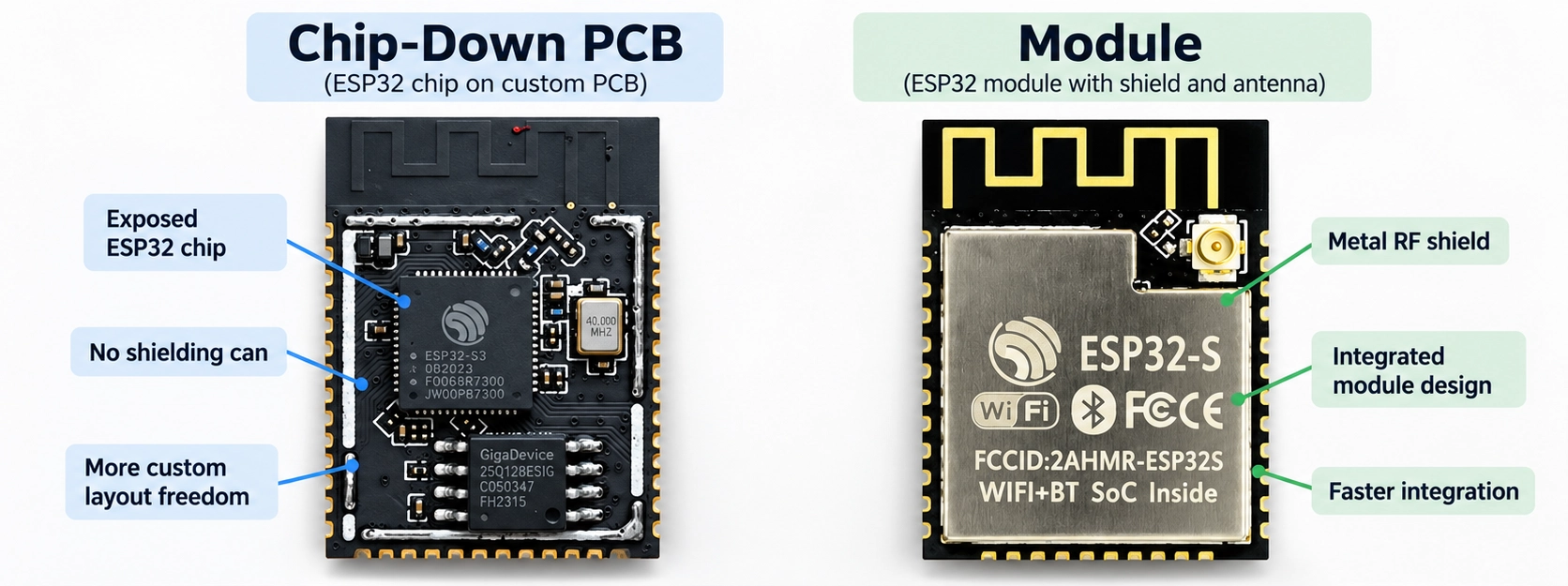
Figure: ESP32 BLE module beside a chip-down ESP32 design.
Espressif tunes the RF circuit and obtains the module's RF certifications. A chip-down design places the bare ESP32 chip on your own board, so you build that radio frequency (RF) circuit yourself.
| Property | ESP32 Module | Chip-Down ESP32 |
|---|---|---|
| Example | ESP32-WROOM-32E, ESP32-C3-MINI-1 | Bare ESP32 or ESP32-C3 chip |
| RF matching and antenna | Included and tuned by Espressif | You design and tune them |
| Flash and main crystal | Included | You add them, unless the chip has in-package flash |
| RF certification | Module certificates are listed in their datasheet; the end product still needs its own regulatory assessment | Your product needs its own RF testing |
| Bluetooth qualification | Still required for your product | Still required for your product |
How Does ESP32 BLE Work? Roles, GATT, and Host Stacks
A connectable ESP32 BLE device broadcasts advertisements, accepts incoming connection requests, and subsequently exchanges structured data via the Generic Attribute Profile (GATT). The Generic Access Profile (GAP) defines the roles each device plays in discovery and connection.
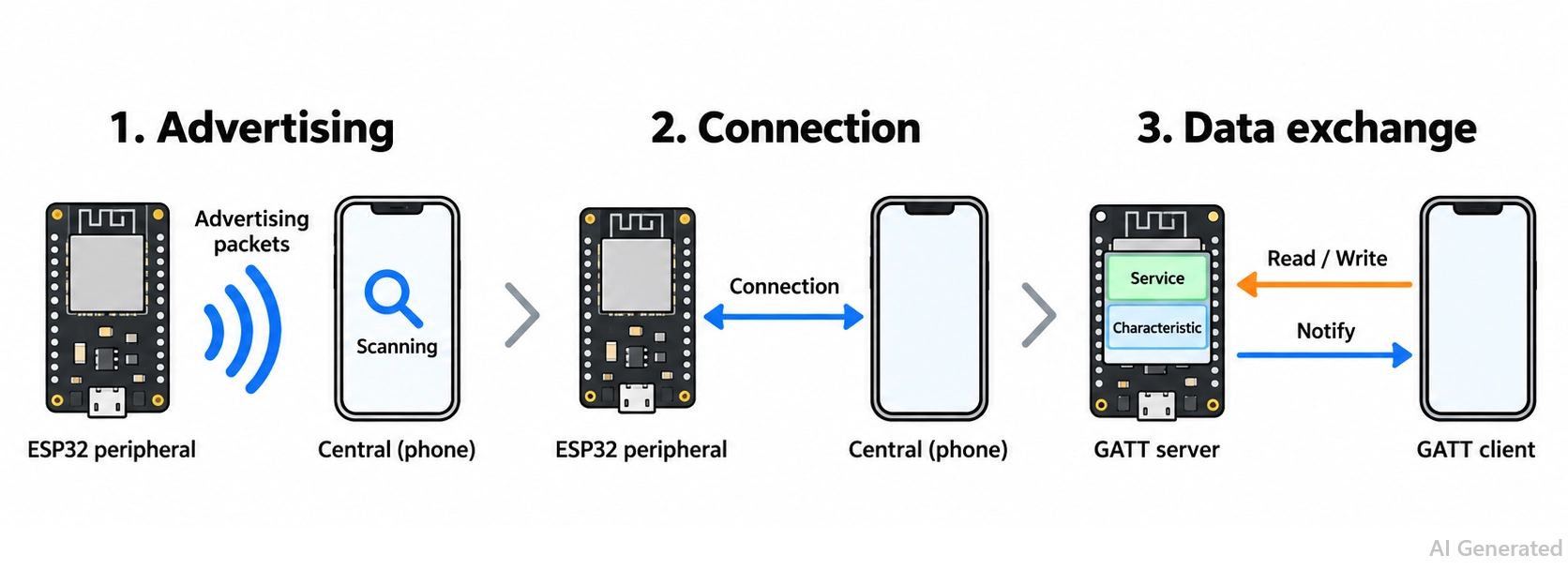
Figure: ESP32 BLE roles showing a peripheral
ESP32 BLE Roles: Peripheral, Central, Broadcaster, and Observer
| Role | What It Does | Typical Device |
|---|---|---|
| Peripheral | Advertises, then accepts a connection | Sensor, wearable, smart switch |
| Central | Scans, then starts the connection | Phone, gateway |
| Broadcaster | Sends advertising data only, never connects | Beacon |
| Observer | Receives advertising data only, never connects | Data logger |
An ESP32 can hold several roles at once. A gateway, for example, can act as a central to sensors while it acts as a peripheral to a phone.
ESP-NimBLE vs ESP-Bluedroid: Which Host Stack to Use
ESP-IDF, Espressif's IoT Development Framework, offers two Bluetooth host stacks that run on top of the chip's Bluetooth controller.
| Property | ESP-NimBLE | ESP-Bluedroid |
|---|---|---|
| Bluetooth LE | Yes | Yes |
| Bluetooth Classic | No | Yes, on the original ESP32 only |
| Heap and flash use | Lower | Higher |
| Typical use | BLE-only products | Dual-mode ESP32 products |
- Choose ESP-NimBLE for: BLE-only products, where Espressif states it requires less heap and flash than ESP-Bluedroid.
- Choose ESP-Bluedroid for: products on the original ESP32 that also need Bluetooth Classic.
Can ESP32 Use Wi-Fi and BLE at the Same Time?
Yes, through time-division multiplexing. Because the ESP32 hardware features a single shared 2.4 GHz radio, Wi-Fi, and BLE alternate access cycles. One cannot transmit or receive while the other is using it.
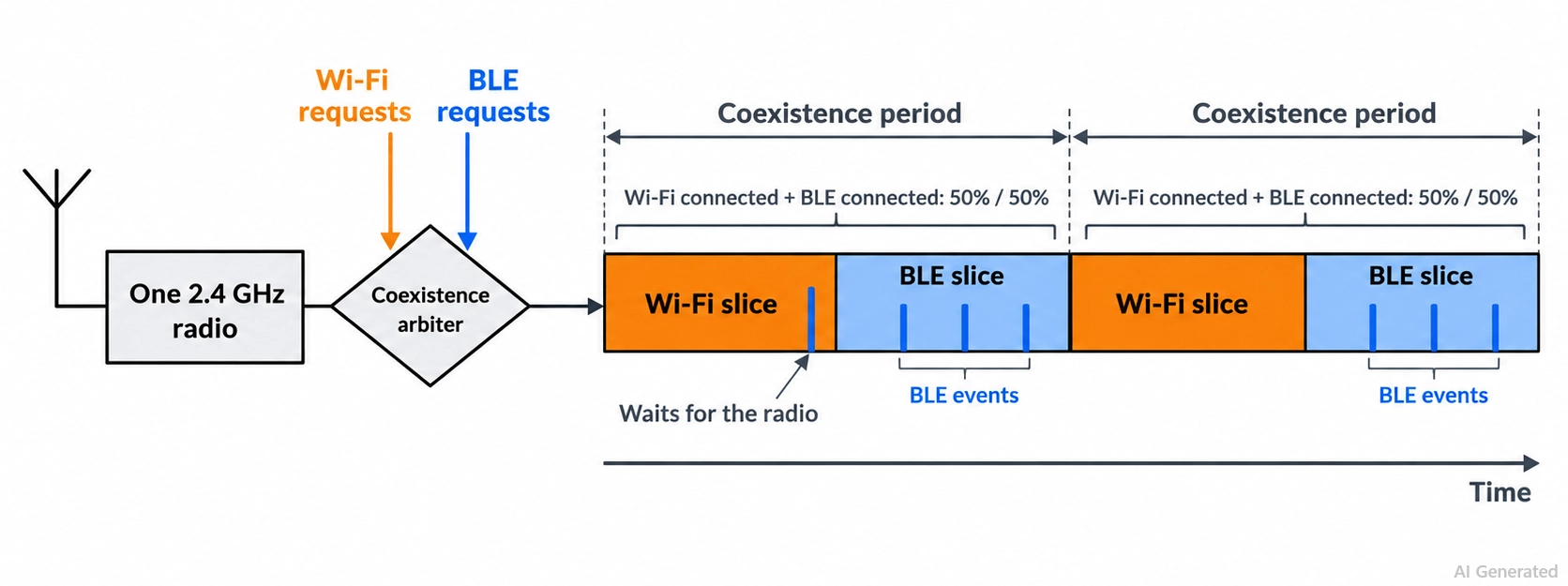
Figure: ESP32 Wi-Fi and BLE coexistence timeline showing one radio time-sliced.
The coexistence module grants the radio priority and time slice. With Wi-Fi connected and BLE connected, each gets 50% of a coexistence period that starts at the access point's beacon time and lasts more than 100 ms.
ESP32 Wi-Fi and BLE Coexistence by Wi-Fi Mode
Espressif rates each combination for the ESP32 and ESP32-C3 as follows:
| Wi-Fi State | With BLE Scanning, Advertising, or Connected |
|---|---|
| Station scanning, connecting, or connected | Supported and stable |
| SoftAP sending beacons | Supported and stable |
| SoftAP is connecting to or connected to clients | Supported, performance unstable |
| Sniffer mode | Supported, performance unstable |
Trade-off: BLE traffic waits while Wi-Fi holds the radio, so BLE throughput and scan results can drop when both radios are busy.
How Much Power Does ESP32 BLE Use?
ESP32 BLE power consumption depends primarily on radio duty cycles determined by advertising and connection intervals, and the use of low-power sleep states between events.
- Advertising interval: 20 ms to 10.24 s, in 0.625 ms steps. A longer interval saves power but makes the device slower to discover.
- Connection interval: 7.5 ms to 4.0 s, in 1.25 ms steps. Between connection events, the device can sleep.
- Peripheral latency: Allows a peripheral skip-connection event when it has no data to send.
Espressif's FAQ lists the original ESP32 at an average of 42.67 mA while advertising every 40 ms. In a connection at an 80 ms interval, the average is 35.33 mA, and the peak is 142.1 mA. The minimum of those measurements is 32 mA, indicating the chip stayed awake between radio events. Light sleep between events is what brings the average down.
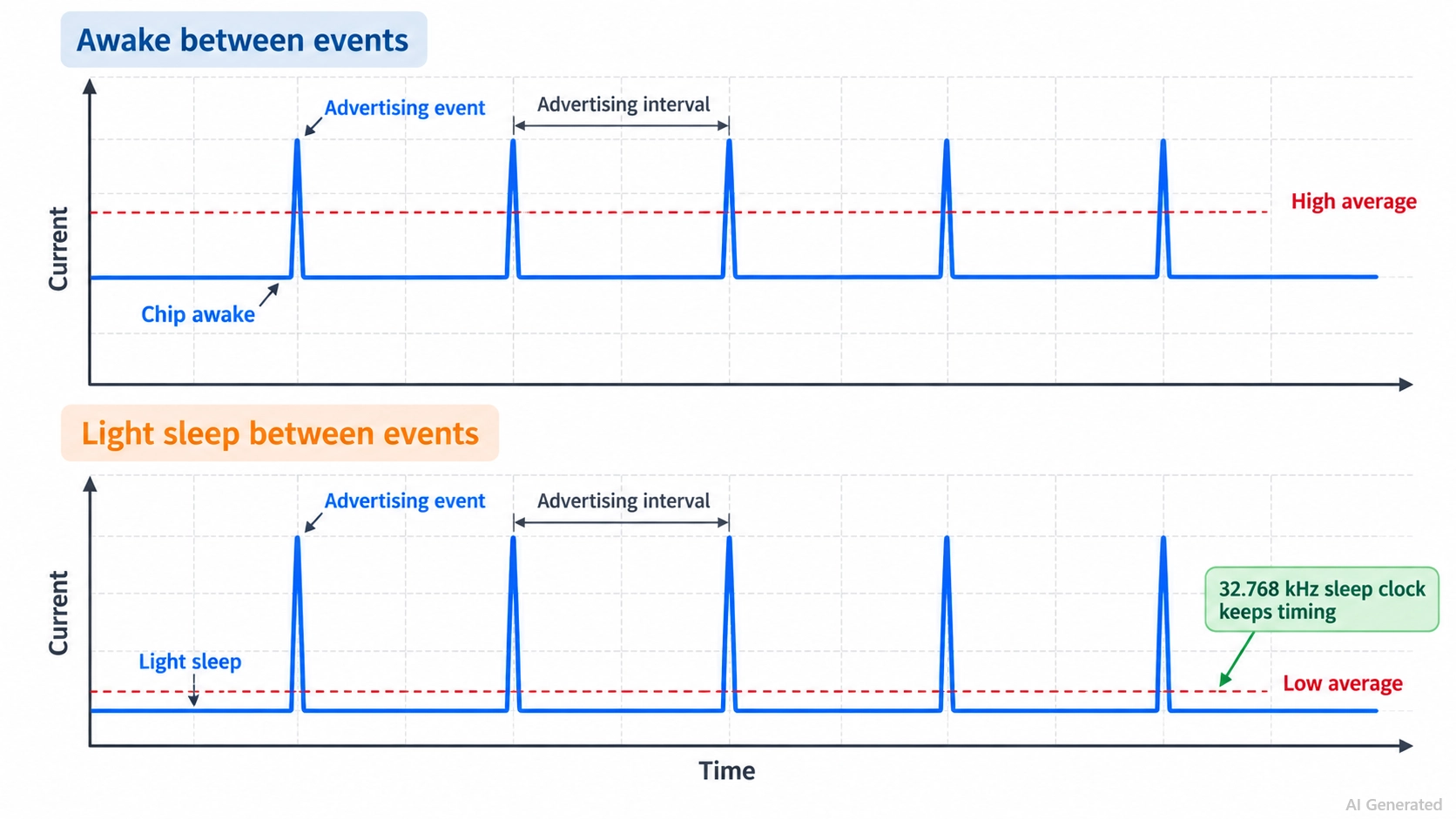
Figure: ESP32 BLE current over time showing radio events at each interval.
How a 32.768 kHz Crystal Lowers ESP32 BLE Sleep Current
To keep a BLE connection alive in light sleep at the lowest current, add an external 32.768 kHz crystal. The Bluetooth specification requires a sleep clock accurate to within 500 ppm (parts per million).
| Chip | Light Sleep, Main Crystal | Light Sleep, 32.768 kHz Crystal |
|---|---|---|
| ESP32 | Not supported | 1.9 mA |
| ESP32-C3 | 2.3 mA | 140 µA |
| ESP32-S3 | 3.3 mA | 230 µA |
| ESP32-C6 | 3.3 mA | 34 µA |
| ESP32-H2 | 4.0 mA | 24 µA |
These are typical figures from Espressif's ESP-IDF BLE power-save example, with power management enabled.
Four details affect the sleep-clock choice:
- Original ESP32: The main crystal supports BLE modem sleep, but cannot keep BLE running once light sleep is enabled, so the external crystal is required.
- Internal RC oscillator: On the ESP32-C3, the 136 kHz RC oscillator is generally not accurate enough for BLE. Espressif rates it suitable only for legacy advertising or scanning, and it does not support connections.
- Detection: If the crystal is fitted but not detected during Bluetooth LE initialization, ESP-IDF falls back to the main crystal, and the light-sleep current rises.
- Footprint: Espressif's ESP32-C3-MINI-1 peripheral schematic reserves a 32.768 kHz crystal footprint, marked as not populated, so the crystal can be added when needed.
ESP32 BLE Range and Antenna Placement
Actual ESP32 BLE range is determined by PHY selection, transmit power configuration, antenna layout, and operating environment, rather than by the chip designation alone.
| PHY | Raw Data Rate | Effect on Range | Chips |
|---|---|---|---|
| 1M PHY | 1 Mbps | Baseline | All BLE chips |
| 2M PHY | 2 Mbps | Typically shorter than 1M | Bluetooth 5 chips |
| Coded PHY, S=2 | 500 kbps | Typically longer than 1M | Bluetooth 5 chips |
| Coded PHY, S=8 | 125 kbps | Typically the longest | Bluetooth 5 chips |
On the original ESP32, BLE transmit power has eight levels from −12 dBm to +9 dBm in 3 dBm steps. Other chips have their own ranges.
ESP32 BLE Antenna Placement on Your PCB
Wi-Fi and BLE share one antenna on ESP32 modules that have both radios, so the antenna layout sets the range for both:
- Board edge: Place the module's PCB antenna at a corner of the board, extending beyond the edge where possible.
- Keep-out: Keep copper, traces, and components out of the area under the antenna on every layer, or cut the board away there.
- Enclosure: Keep metal away from the antenna, or use a module with an external antenna connector.
ESP32 BLE PCB Assembly with JLCPCB
JLCPCB supports SMT assembly with minimum IC pin pitches of 0.35 mm for Standard PCBA and 0.40 mm for Economic PCBA. For packages with hidden solder joints, such as QFN (quad flat no-lead) and LGA (land grid array), JLCPCB performs X-ray inspection as a required quality control step.
This applies to a bare ESP32 chip in its QFN package and to LGA-style modules. Before finalizing the bill of materials, use the JLCPCB Parts Library to check availability and package information for the ESP32 module and the 32.768 kHz crystal.
Conclusion
Most ESP32 chips support Bluetooth Low Energy (BLE), except the ESP32-S2 and ESP32-P4. The original ESP32 also supports Bluetooth Classic, while newer chips like the ESP32-S3, ESP32-C series, and ESP32-H2 offer Bluetooth 5 features. However, features such as Coded PHY vary by chip.
The key is to choose an ESP32 that fits your project's needs. Plan your module selection, antenna placement, and sleep clock before starting the PCB layout, and complete the required Bluetooth qualification before selling your product. These early decisions can help you avoid design issues and achieve better range and battery life.
Once your design is ready, upload your files to JLCPCB and get an instant quote.
FAQs About ESP32 BLE
Does the ESP32-S2 Support Bluetooth?
No. The ESP32-S2 supports Wi-Fi only, and the ESP32-P4 has no wireless radio. The original ESP32, ESP32-S3, ESP32-C series, and ESP32-H2 support Bluetooth LE.
Is the Original ESP32 a Bluetooth 5 Device?
No. It passed Bluetooth LE 5.0 certification, but Espressif says the hardware supports only Bluetooth LE 4.2. For 2M PHY or Coded PHY, choose a newer ESP32 chip.
Do I Need Bluetooth Qualification If I Use an ESP32 Module?
Yes. Referencing the module's existing Bluetooth design can remove the testing step, but your company must still qualify the product under its own Bluetooth SIG membership.
Does ESP32 BLE Need a 32.768 kHz Crystal?
Only for low-current light sleep. The original ESP32 requires BLE to stay running in light sleep. Newer chips can use the main crystal instead, at a higher sleep current.
Keep Learning
Understanding Multilayer PCB Stackup
Key Takeaways Layer Arrangement: Optimize signal, ground, and power layer placement for better performance. Material Selection: Choose suitable core, prepreg, and copper materials. Signal Integrity: Control impedance and minimize crosstalk and EMI. Stackup Design: Use symmetrical structures to reduce warpage risks. Manufacturability: Consider layer count, via structures, and manufacturing limits early in design. Performance & Cost: Balance electrical requirements, reliability, and production costs. In......
Designing Antennas on PCB: A Beginner to Advance Guide
In today’s world of widespread wireless connectivity, the demand for small, affordable, and reliable antennas is higher than ever. Antennas act as real-world implementations of electromagnetic wave principles. They enable the sending and receiving of signals for a variety of wireless uses. While there is a lot of theoretical and experimental research in this area, only a few designs become widely used in actual products. Among the different options, Printed Circuit Board (PCB) antennas have become a p......
PCB Antenna Design: Types, Principles, and Best Practices
In the world surrounded with wireless communication, the demand for compact, inexpensive and reliable antennas has never been higher. Antennas are the application of electromagnetic waves. There are many theories and practicals available on antennas, but only few of them get recognised. For wireless data transfer the one solution can be usage of Printed Circuit Board (PCB) antennas. Using PCB antennas represents a convenient solution for integrating them directly into electronic devices, eliminating t......
Effective Escape Routing Strategies for High-Density BGA Success
Key Takeaways Escape routing is essential for successfully fanning out high-density BGAs, especially at 0.5 mm pitch and below. Use dogbone fanout for ≥0.5 mm; switch to via-in-pad (filled & capped) for finer pitches. HDI microvias and stacked vias significantly improve routing density and reduce layer count. Maintain symmetry and short stubs for differential pairs to preserve signal integrity. Combine smart stackup, DFM checks, and capable fabrication for reliable, high-yield results. Ever put a 484-......
ESP32 BLE Guide: Choosing the Right Chip and Designing Your PCB
Key Takeaways ESP32 BLE support: Most ESP32 chips support Bluetooth Low Energy (BLE), except the ESP32-S2, which supports only Wi-Fi, and the ESP32-P4, which has no built-in wireless radio. The original ESP32 also supports Bluetooth Classic, while newer models offer Bluetooth 5 features. Wi-Fi and BLE coexistence: Wi-Fi and BLE share the same 2.4 GHz radio and take turns using it. Heavy Wi-Fi activity can reduce BLE throughput or interrupt scanning, so both functions need to be tested together. Power ......
How SMA Connectors Work in RF PCB Design
Key Takeaways Focus on the Launch: Signal loss happens where coax turns into a flat trace, not inside the SMA body. Clear Ground Under Pads: Cut ground planes under launch pads to control capacitance and keep 50 ohms. Place Ground Vias Close: Put ground vias next to connector legs to shorten return paths. Account for Tolerances: Trace etching and board thickness directly alter launch impedance. Handle with Care: Use a torque wrench on joints and switch to high-frequency boards above 6 GHz. An SMA conn......