SMD Soldering Tools You Need: Complete Guide from Beginner to Pro
8 min
- Essential SMD Soldering Tools for PCB Assembly
- Optional Pro-Level Surface Mount Soldering Tools
- Choosing the Right SMD Soldering Tools
- Conclusion
- FAQs

Surface Mount Devices (SMDs) are essential components in modern electronic devices, including smartphones, tablets, and IoT systems. Unlike older through-hole methods, where components were inserted through drilled PCB holes, soldering SMD components manually can be challenging, especially for beginners.
The extremely small sizes and tight spacing on modern PCBs require high precision, and achieving reliable solder joints often depends on using the best SMD soldering tools. Common issues arising from insufficient or improper tools include cold solder joints, component bridging, heat damage, and even component loss, which can frustrate novice assemblers.
Whether you are building your first electronic device or assembling a single SMD component, having the right SMD soldering tools is crucial for accuracy, reliability, and safety. In this guide, we will cover the essential tools required for successful SMD soldering.
Essential SMD Soldering Tools for PCB Assembly
Working with Surface Mount Devices requires precision, especially when handling fine-pitch components on modern PCBs. The following SMD soldering tools are essential for both beginners and experienced makers to ensure accurate placement, reliable solder joints, and efficient workflow.
1. Temperature-Controlled Soldering Station
A temperature-controlled, ESD-safe soldering station is the foundation for PCB SMD assembly. Unlike basic pencil irons, it provides stable, adjustable heat for precise soldering of tiny pads and components.
Key Features:
- Adjustable temperature range: 200–450°C
- Interchangeable tips for different SMD packages
- ESD-safe design to protect sensitive ICs
A Temperature-Controlled Soldering Station
2. Hot Air Rework Station
A hot air rework station allows selective reflow or removal of SMD components without direct contact. It is indispensable for ICs, fine-pitch devices, and repair tasks. While a PCB preheater can reflow an entire board, a hot air station provides localized control, minimizing risk to surrounding components.
A basic hot air rework station with temperature control and air flow control features
3. Precision Tweezers
Miniature SMD components cannot be placed accurately by hand. Non-magnetic, ESD-safe fine-point tweezers are required for safe and precise placement of resistors, capacitors, and ICs.
Tips for selecting tweezers:
- Choose straight, curved, or angled tips based on your workflow
- Ensure firm grip without excessive bending
- ESD-safe tools protect components from electrostatic damage
ESD-safe tweezers for SMD components placement
4. Solder Flux and Solder Flux Pen
Solder flux lowers the surface tension of molten solder and prevents oxidation, allowing solder to flow smoothly across pads and leads. Flux pens provide a convenient, targeted application for SMD components, improving joint quality and reducing rework.
5. Solder Wire
Solder wire is the core material for forming secure electrical and mechanical connections. For SMD assembly, the recommended diameter is 0.3–0.5 mm, suitable for fine-pitch pads.
Considerations:
- Lead-based solder: lower melting point, easier to handle
- Lead-free solder: environmentally friendly, requires higher temperatures
- Store in dry, clean conditions to preserve quality
A basic 63/37 solder wire
6. Magnification Tools
Due to the small size of SMD components, magnification is critical for detecting cold solder joints, solder bridges, and under-pad defects.
Essential magnification tools include:
- Head-mounted magnifiers – hands-free operation for precise placement and inspection.
- Desk-mounted magnifying glass – ideal for detailed work on small sections.
- Digital microscope – best for inspecting fine-pitch components, documenting defects, and capturing high-resolution images of solder joints.
Digital microscope for SMD soldering
7. PCB Holder
Accurate soldering requires the PCB to remain stable. Any movement can result in misaligned or poor-quality solder joints. Recommended solutions include:
- Silicone work mats – prevent slippage and provide heat resistance.
- Clamp-style PCB holders, vises, or adjustable “third-hand” tools – stabilize the board and free both hands for precise soldering or rework.
PCB holder with adjustable hinge for SMD soldering
8. Cleaning Tools
Post-soldering cleaning ensures reliable electrical performance and long-term board reliability.
Key cleaning tools include:
- Isopropyl alcohol (IPA) with lint-free wipes – remove flux residues without damaging components.
- Solder wick / desoldering braid – remove excess solder and correct solder bridges.
- Solder sucker (manual vacuum tool) – remove solder from pads for rework.
- Small brushes (ESD-safe) – gently clean residual flux and debris from delicate surfaces.
Isopropyl alcohol flux remover for SMD soldering
9. Solder Paste and Stencil
For fine-pitch SMD assembly, uniform solder paste application is critical.
- Solder paste ensures consistent solder volume on all pads.
- Stencils provide precise, repeatable deposition across dense boards, improving reflow consistency and reducing the risk of solder bridges or tombstoning.
Solder paste dispenser with interchangeable nozzles for SMD assembly
Optional Pro-Level Surface Mount Soldering Tools
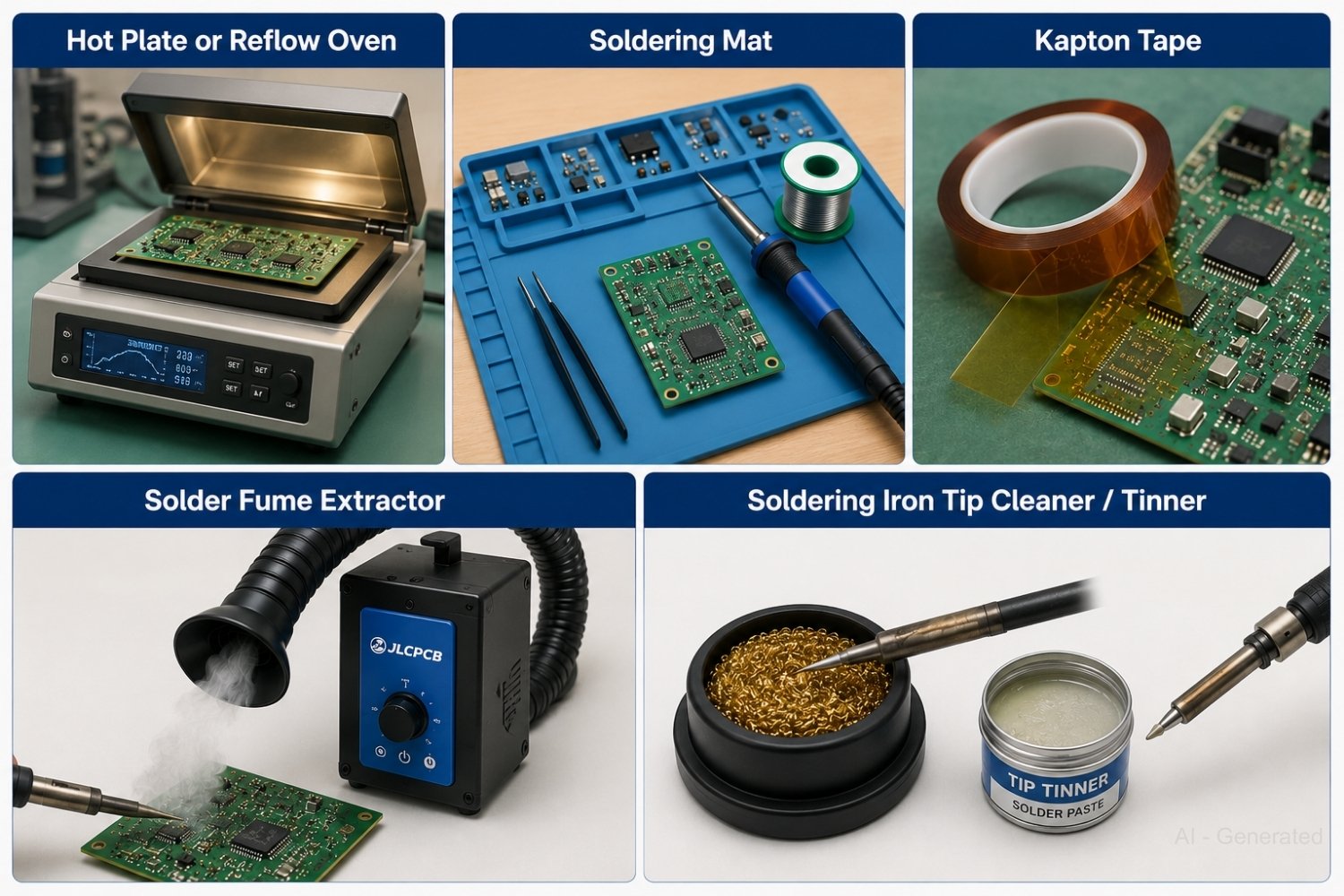
10. Hot Plate or Reflow Oven
A hot plate or reflow oven allows uniform heating of PCBs during soldering or rework. They are essential for:
- Reflowing multiple SMD components simultaneously
- Ensuring consistent solder joints across densely populated boards
- Reducing thermal stress by controlled, even heating
11. Soldering Mat
A heat-resistant, anti-static silicone mat protects both the workspace and sensitive electronic components. It also helps organize small parts during assembly or repair, improving workflow efficiency.
12. Kapton Tape
Kapton tape is a high-temperature, heat-resistant tape used to:
- Shield neighboring components during reflow or hot-air soldering
- Temporarily hold components in place
- Prevent thermal damage during rework or selective soldering After rework, it can be removed without leaving residue.
13. Solder Fume Extractor
A solder fume extractor removes harmful fumes generated during soldering, improving air quality and operator safety. It is essential for long-term health in workshops or labs.
14. Soldering Iron Tip Cleaner/Tinner
Maintaining a clean soldering iron tip is critical for reliable solder joints. Tools include:
- Brass wire sponge – removes oxidation and debris without damaging the tip
- Tip tinner / solder paste – re-tins the tip, improves solder flow, and extends the life of frequently used tips
Choosing the Right SMD Soldering Tools
Beginner-Level: Focus on mastering the basics. Essential tools include a temperature-controlled soldering station, ESD-safe flux pen, solder wire (0.3–0.5 mm), precision fine-point tweezers, and basic magnification tools. These allow beginners to practice soldering small SMD components safely and efficiently, improving their learning experience and building confidence in electronics assembly.
Intermediate-Level: Targeted at hobbyists, electronics students, and DIY enthusiasts. In addition to beginner tools, users should invest in a hot air rework station, cleaning kit (solder wick, isopropyl alcohol, brushes), and improved task lighting. These enable safe rework, selective soldering, and maintenance of high-quality solder joints on moderately complex PCBs.
Advanced-Level: Designed for industrial, university research, and high-precision applications where defects are unacceptable. Along with all beginner and intermediate tools, additional requirements include a reflow oven or hot plate, microscope or digital inspection tools, ESD-safe workbench, and solder fume extraction/PPE. These tools ensure precise handling of fine-pitch components, high-volume production, and compliance with professional safety standards.
For ultra-fine SMT soldering or PCB assembly, using professional SMT assembly service ensures reliable results.
Conclusion
Effective SMD soldering depends on precise thermal control, accurate solder deposition, and careful handling of miniature components. Essential SMD soldering tools—including temperature-controlled soldering stations, ESD-safe tweezers, solder wire, and flux pens—help prevent common soldering defects such as bridging, tombstoning, and cold joints, ensuring reliable, high-quality solder connections.
Services like JLCPCB SMT Assembly further simplify this process by providing professional stencil, pick-and-place, and reflow soldering solutions, making high-quality SMD assembly accessible for both prototypes and small-to-medium production runs.
FAQs
Q: What tools do I need for surface mount soldering as a beginner?
You will need a temperature-controlled soldering station, ESD-safe tweezers, flux pen, fine solder wire, and magnification tools. As you gain experience, you may add a hot air rework station and stencils for more precise and complex assemblies.
Q: How can I secure SMD components during the soldering process?
After positioning the component with fine tweezers and applying a small amount of flux, tack-solder one pin or pad first to fix the part in place. Then solder the remaining pins to ensure stable and accurate placement.
Q: Is a hot air rework station necessary for soldering SMD components?
For simple boards and larger SMD components, a fine-tip soldering iron is sufficient. For fine-pitch ICs, dense layouts, or complex PCBs, a hot air rework station is highly recommended for safe and reliable soldering.
Q: In SMD soldering, what distinguishes solder wire from solder paste?
Solder paste, applied using a stencil, is designed for reflow soldering with hot plates or ovens, while solder wire is intended for manual soldering with a soldering iron. Each serves a different purpose depending on the assembly method.
Popular Articles
• SMT Assembly Process Explained and Equipment Used: A Step-by-Step Guide to PCBA Manufacturing
• Common PCB Assembly Methods and Soldering Techniques Explained
• SMD Soldering Tools You Need: Complete Guide from Beginner to Pro
• What Is BGA Void? Causes, IPC Limits, and Solutions
• Reflow Soldering: Everything You Need to Know
Keep Learning
01005 Assembly Guide: PCB Design, Stencil, Feeder Static and Reflow
Key Takeaways 01005 (imperial) parts measure 0.4 × 0.2 mm and are called 0402 in metric. Reliable assembly rests on a flat surface finish such as ENIG, symmetrical NSMD pads, a stencil about 3 mil thick with fine paste, static control at the feeder, and 3D SPI before placement. Because 01005 parts are slow and risky to rework, first-pass yield is the number that matters most. Six SMD capacitors on a fingertip, from left: 01005, 0201, 0402, 0603, 0805 and 1206. Photo: Filip Wahlberg, CC BY-SA 4.0, via ......
How to Repair a PCB: Traces, Pads, Solder Joints and Corrosion
figure: reworking an SMD joint with a soldering iron and tweezers A cut trace, a lifted pad or a joint that cracked after two years of thermal cycling doesn't mean the board is scrap. Most surface-level circuit board damage can be fixed with an iron, a multimeter and an hour at the bench. This guide covers finding the fault, the five most common repairs, and testing the board before it goes back into service. Each repair is broken into the steps you perform, in order, with the mistakes that most often......
How to Solder Wires to a Circuit Board Properly: Step-by-Step Guide
Learning how to solder wires to a circuit board is a fundamental skill for electronics repair, prototyping, and PCB assembly. Whether you are attaching power leads, signal wires, or test connections, a weak solder joint can cause intermittent failures, lifted pads, or long-term reliability issues. In this step-by-step guide, you'll learn the correct tools, preparation methods, and soldering techniques needed to create strong, clean, and reliable wire-to-PCB connections. From preparing the wire and PCB......
PCB Soldering Basic Techniques and Overview
Soldering means joining metal components with a melted metal called solder, which has a low melting point compared to other metals. Soldering is crucial in the electronics industry and is the primary method of joining electrical components. There are different types of soldering materials based on quality and their melting points. The most common combination is a tin or lead metal alloy mixed with silver or brass. The soldering iron melts the metal so it can be used like glue to connect two pieces. On......
SMT Assembly Process Explained and Equipment Used: A Step-by-Step Guide to PCBA Manufacturing
Today's high-performance electronics, from pocket-sized smartphones and IoT sensors to sophisticated industrial control systems, are made possible by a manufacturing miracle: Surface Mount Technology (SMT). SMT is the backbone of electronics manufacturing, allowing us to have the incredible component density and miniaturization. A bare circuit board is simply a substrate. The process of transforming it into a functional electronic circuit is known as Printed Circuit Board Assembly. This article outlin......
Common PCB Assembly Methods and Soldering Techniques Explained
Whether you're designing your first prototype or scaling up to production, understanding PCB assembly methods and soldering techniques is crucial to achieving reliable, high-performance circuit boards. Modern PCBA primarily relies on Surface Mount Technology (SMT) and Through-Hole Technology (THT)—each offering unique advantages for component density, durability, and manufacturability. In this guide, we'll break down the major PCB assembly methods, key soldering techniques such as reflow and wave sold......