Best BGA Rework Station: Complete Buying Guide and Comparison
14 min
- What is a BGA Rework Station?
- BGA Rework Station Comparison Table
- Best BGA Rework Stations (2026 Edition)
- Types of BGA Rework Stations
- Hot Air vs. Infrared (IR): Choosing the Right Heating Technology
- Key Features to Consider When Buying a BGA Rework Station
- How Much Does a BGA Rework Station Cost?
- Cost vs. ROI: Is a BGA Rework Station Worth It?
- Maintenance and Calibration of BGA Rework Stations
- Alternatives to BGA Rework Stations
- When to Use Professional PCB Assembly or Repair Services
- FAQs
- Conclusion

If you work with BGA (Ball Grid Array) components, you know how difficult they can be to repair or replace. Because the solder joints are hidden beneath the chip, BGA rework requires specialized tools and precise temperature control—this is where a BGA rework station becomes essential.
But with so many options available, choosing the right BGA rework station can be confusing. Should you choose hot air or infrared heating? Do you need optical alignment? What’s the difference between manual, semi-automatic, and fully automatic systems?
In this guide, we’ll explain how BGA rework stations work, compare different types, highlight key features to consider, and review the best options in 2026 to help you choose the right solution for your needs.
What is a BGA Rework Station?
A BGA rework station is a specialized, integrated workspace system designed to apply strictly controlled thermal profiles to remove and replace surface-mounted devices (SMDs). Unlike standard soldering irons or basic hot air wands, these stations are engineered to execute localized heating without subjecting the surrounding PCB or adjacent micro-components to damaging thermal stress.
At its core, a professional BGA rework station consists of a top heater to melt the chip's solder balls, a bottom preheater to warm the entire PCB and prevent warping, a rigid PCB fixture to hold the board perfectly flat, and a precision alignment system for placing the new component.
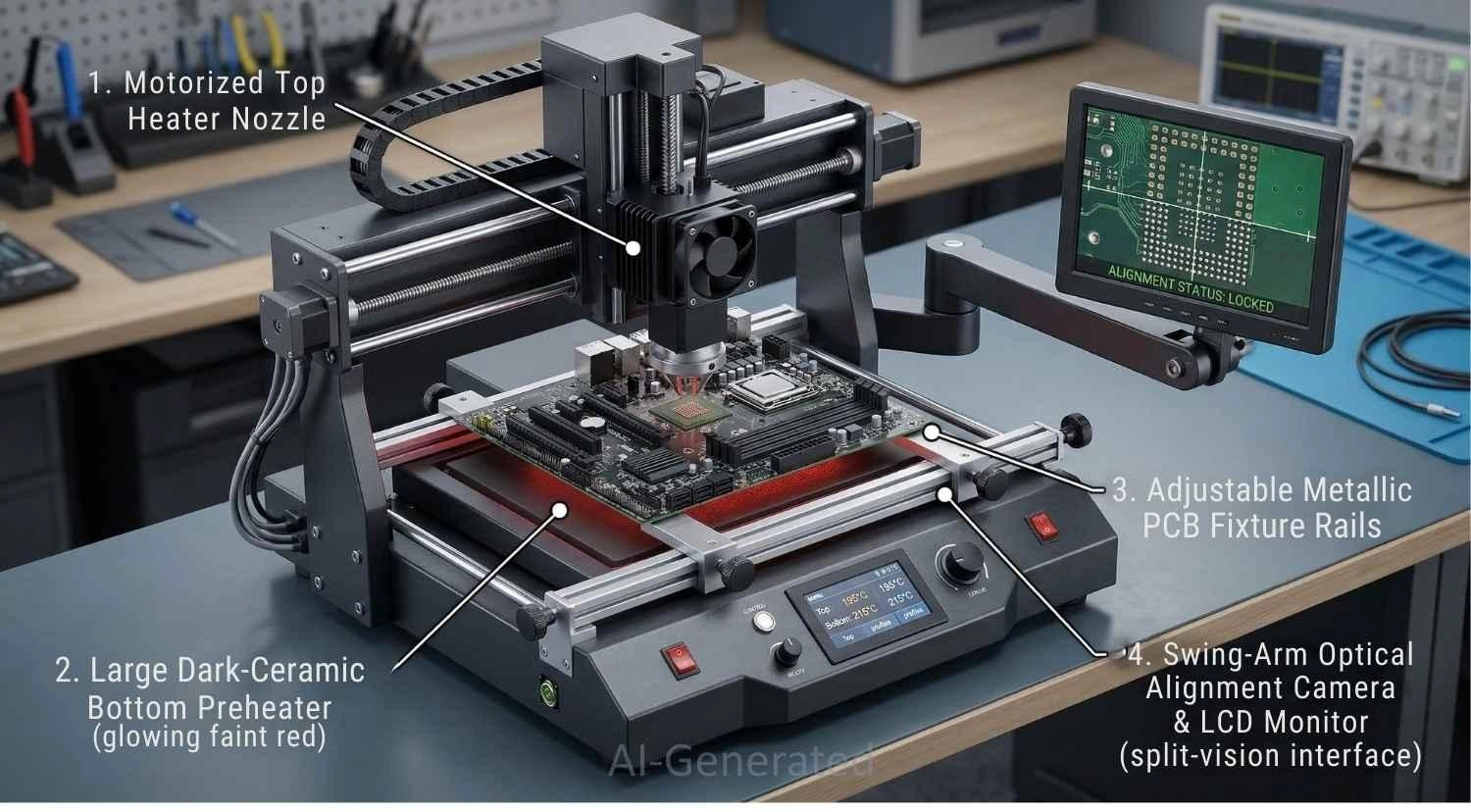
Figure: Key components of a professional BGA rework station, including top heater, bottom preheater, and optical alignment.
BGA Rework Station Comparison Table
To quickly understand the landscape of BGA rework equipment, it helps to view the options side-by-side based on their automation level and target application.
System Type | Alignment Method | Heating Technology | Target Application | Estimated Cost |
|---|---|---|---|---|
Manual | Visual / Silkscreen | Hot Air or Basic IR | Hobbyists, Mobile Phone Repair | $200 - $800 |
Semi-Automatic | Split-Vision Optics | Hybrid (IR Bottom / Air Top) | IT Repair Shops, Console Techs | $1,500 - $4,000 |
Fully Automatic | Automated Prisms & Lasers | Advanced Multi-Zone Hybrid | EMS Providers, Aerospace, Medical | $5,000 - $25,000+ |
Best BGA Rework Stations (2026 Edition)
Categorizing the market helps determine what level of equipment matches your specific operational volume and board complexity.
Entry-Level BGA Rework Station
- Top Picks: Quick 861DW, Yihua 853AAA
- Overview: Technically advanced hot air stations rather than full BGA machines, these units are best for hobbyists, simple reballing of small memory chips, and mobile phone repair, where budgets are tight and optical alignment isn't strictly necessary.
Professional BGA Rework Station
- Top Picks: ACHI IR6500, Seamark ZM-R5830
- Overview: The sweet spot for laptop repair shops and console technicians. They feature robust IR/Air hybrid heating, basic programmable profiling, and decent board support structures. These offer a massive step up in reliability without entering industrial pricing.
Industrial BGA Rework System
- Top Picks: PDR IR-E3, Seamark ZM-R7850A
- Overview: Built for continuous, high-yield operation. These units feature automated optical alignment, micrometer precision placement, and advanced software for perfect thermal profile tracking. They are the standard for aerospace, medical, and large-scale EMS providers.
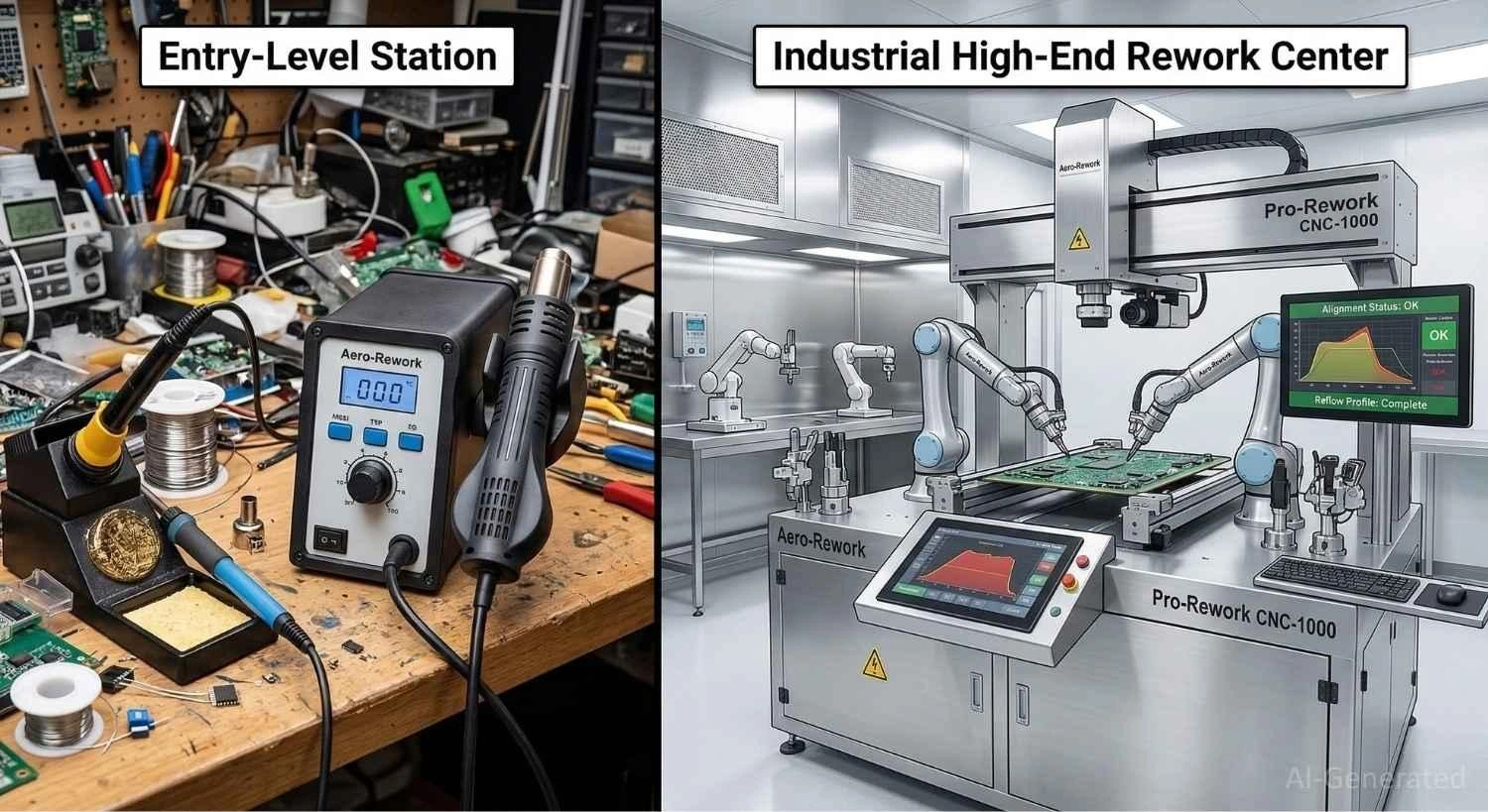
Figure: Comparison of entry-level vs industrial BGA rework stations.
BGA Rework Station Category
Category | Typical Heating Type | Key Features | Target User |
|---|---|---|---|
Entry-Level | Hot Air | Manual alignment, basic temp control | Hobbyists, mobile phone repair |
Mid-Range | Hybrid (IR/Air) | Programmable profiles, robust preheaters | IT repair shops, console tech |
High-End | Advanced IR / Air | Split-vision optics, automated placement | EMS providers, aerospace/medical |
Types of BGA Rework Stations
The rework market is segmented primarily by the level of operator intervention required.
Manual BGA Rework Stations
Manual stations are the most affordable but require the highest level of operator skill. The user must manually position the PCB, lower the heating element, and align the new BGA chip using the PCB's silkscreen markings as a guide. They often lack sophisticated thermal profiling software, relying on basic digital temperature inputs. They are best suited for smaller chips and less complex boards.
Semi-Automatic BGA Rework Machines
This is the standard for professional repair depots. Semi-automatic machines feature programmable thermal profiles and, crucially, split-vision optical alignment. The machine handles the precise heating and cooling cycles, while the operator uses micrometer knobs to align the component perfectly via a digital overlay screen before manually lowering the placement head.
Fully Automatic BGA Rework Systems
Used in high-yield PCBA manufacturing environments, these systems remove almost all human error. They feature motorized X-Y axis tables, automated component pick-up, laser auto-focusing, and automatic profile generation based on the board's thermal mass. The machine precisely aligns, lowers, and reflows the BGA with zero physical intervention during the heating cycle.
Hot Air vs. Infrared (IR): Choosing the Right Heating Technology
The most heavily debated topic when buying a BGA rework station is the method of heat delivery. The choice between hot air and infrared (IR) dictates how the machine interacts with different component surfaces and adjacent parts.
Hot Air Rework Stations
Hot air systems use a targeted pump and specialized nozzles to direct heated ambient air down onto the BGA component.
- Pros: Hot air provides exceptionally fast heating and excellent localized control. It is highly versatile because nozzles can be swapped to match virtually any SMD component's dimensions perfectly.
- Cons: High airflow creates turbulence. If the air pressure is too high, it can easily blow away or shift tiny, adjacent passive components (like 0201 resistors).
Infrared (IR) Rework Stations
IR stations utilize dark IR emitters or focused infrared beams to heat the component and the board directly through electromagnetic radiation.
- Pros: IR provides incredibly uniform heat distribution with absolutely no air turbulence, meaning there is zero risk of blowing away small neighboring parts. It is virtually silent and doesn't require swapping nozzles for different chip sizes.
- Cons: IR systems can struggle with highly reflective or silver-capped components, which bounce the radiation away (requiring the application of matte thermal tape). They also typically have slower ramp-up times compared to hot air.
Hybrid Systems
The industry standard for mid-to-high-end rework is a hybrid approach. These machines combine an expansive IR bottom preheater with a precision hot air top heater, offering the thermal stability of infrared with the speed and localized precision of hot air.
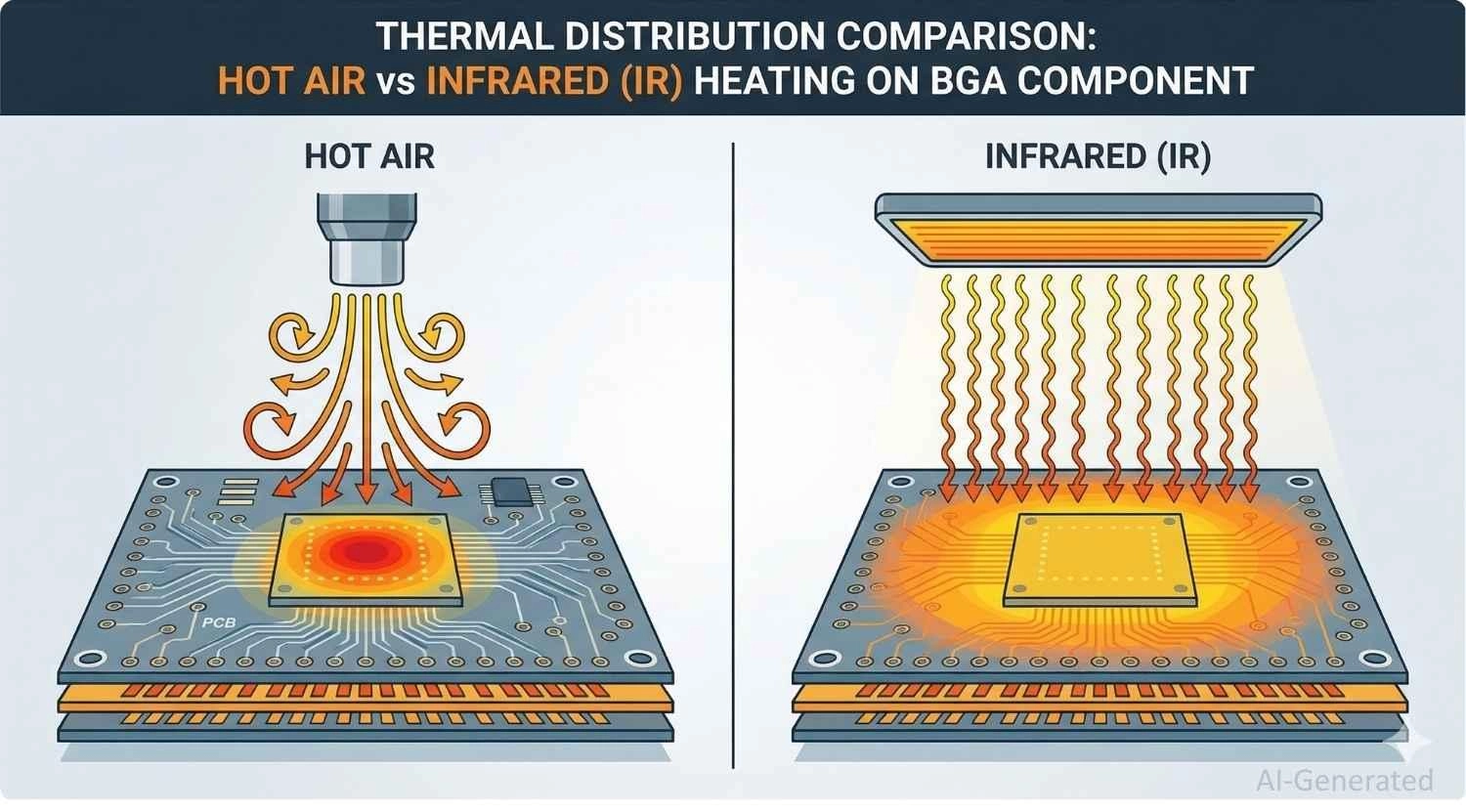
Figure: Thermal distribution comparison: Hot Air vs Infrared (IR) heating on a BGA component.
Key Features to Consider When Buying a BGA Rework Station
When evaluating a station, raw wattage is not the only metric that matters. The ability to control that power precisely is what separates a tool from a liability.
Multi-Zone Temperature Profiling for Precision Reflow
A quality rework station must be programmable. It needs to accurately mimic standard reflow soldering profiles—moving precisely through the preheat, thermal soak, reflow (liquidus), and cooling phases. The best stations offer 2 to 3 independent heating zones (top, bottom localized, and bottom global) that can be programmed and monitored via closed-loop thermocouples.
Split-Vision Optical Alignment for Perfect Placement
Manually aligning a BGA chip via silkscreen outlines is highly prone to error. Professional stations utilize split-vision prisms. These camera systems look upward at the BGA solder balls and downward at the PCB pads simultaneously, overlaying both images on a monitor. The operator adjusts X, Y, and Theta (rotation) micrometer knobs until the balls and pads perfectly overlap.
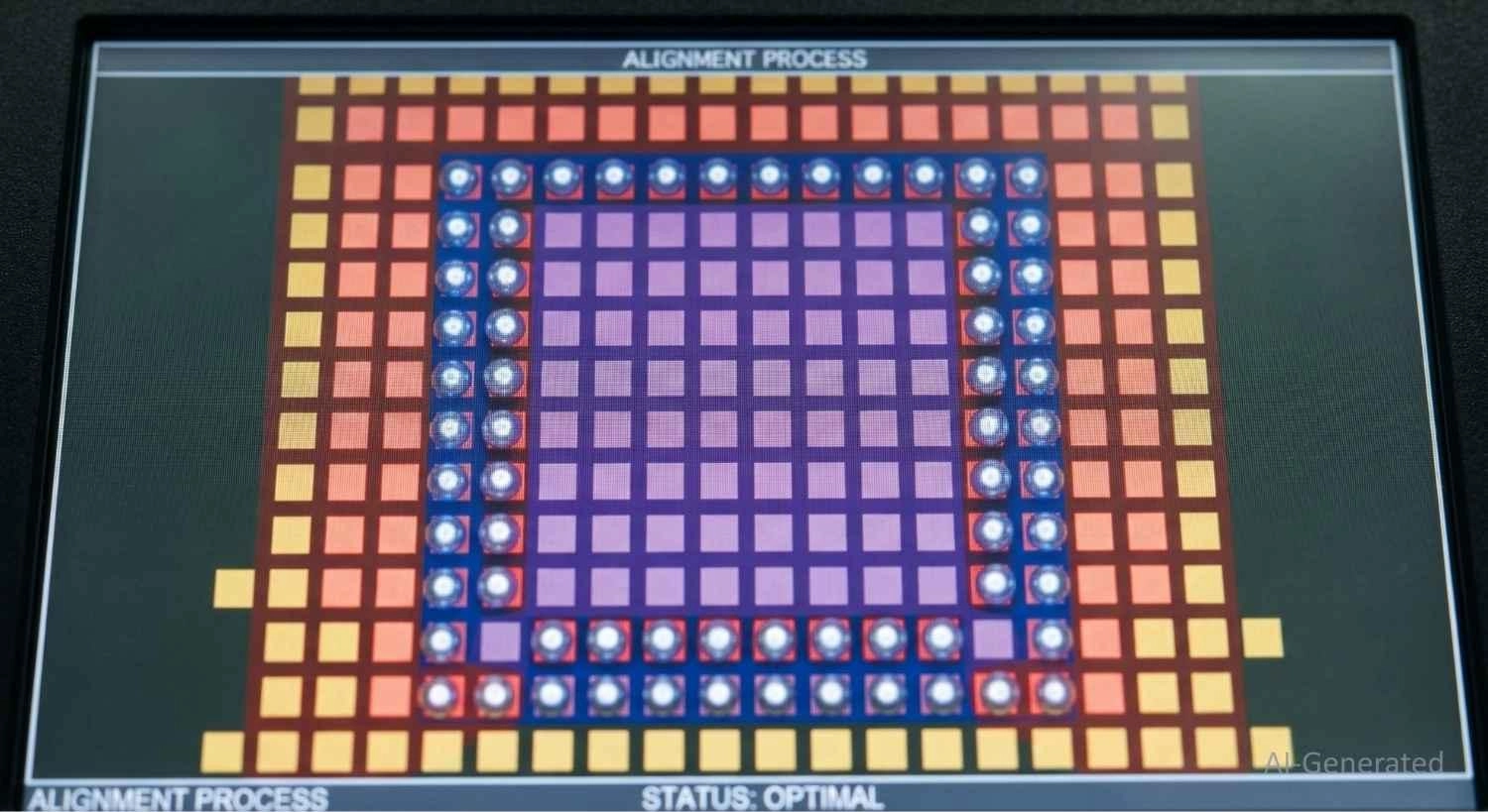
Figure: Split-vision optical alignment screen showing precise BGA pad overlay.
Large-Area Bottom Preheaters to Prevent PCB Warpage
FR4 fiberglass (the standard PCB material) expands when heated. If you only heat a small central area, the board will bow or warp, causing trace fractures. A large, uniform bottom preheater is critical, especially for thick, multi-layer motherboards or server boards, as it ensures the entire PCB expands evenly.
Programmable Cooling Mechanisms for Thermal Shock Prevention
Once the reflow profile completes, the solder must solidify properly to form strong intermetallic bonds. Stations should include programmable cross-flow cooling fans to bring the board temperature down safely, preventing both thermal shock to the joints and prolonged heat degradation to the silicon.
PCB Size Compatibility
FR4 fiberglass expands when heated. If you only heat a small central area, the board will warp, causing trace fractures. A large-area bottom preheater is critical for thick, multi-layer motherboards or server boards to ensure uniform thermal expansion across the entire PCB. Make sure the station's fixture rails can accommodate the physical dimensions of your largest standard boards.
Automation Level
Beyond heating, consider the cooling cycle. Once the reflow profile completes, the solder must solidify properly to form a strong intermetallic bond. Stations with higher automation feature programmable cross-flow cooling fans that activate automatically to bring the board temperature down safely, preventing thermal joint fracturing.
How Much Does a BGA Rework Station Cost?
Pricing varies wildly based on automation and thermal precision.
- Basic setups can be cobbled together for under $500, but they carry a high risk of destroying complex boards.
- Capable semi-automatic systems typically run between $1,500 and $4,000.
- High-end industrial systems start at $5,000 and can easily exceed $25,000.
When calculating the cost, you must factor in ROI. If you only occasionally repair $50 PCBs, a $5,000 machine makes no financial sense. Conversely, if you are reworking dense server boards worth $2,000 each, an industrial machine pays for itself in just a few successful repairs.
Cost vs. ROI: Is a BGA Rework Station Worth It?
Investing $5,000 in a high-end rework machine - plus the cost of operator training and facility upgrades - is not a trivial decision. You must contrast this capital expenditure against the actual frequency and value of the repairs needed.
If your team is primarily creating initial test runs, investing heavily in rework gear might be the wrong approach. Often, relying on fast and easy prototype PCB assembly for DIY projects or rapid prototyping services ensures the board is assembled the first time correctly, bypassing the need for an expensive, in-house rework setup altogether.
Maintenance and Calibration of BGA Rework Stations
A BGA machine is a precision instrument. Over thousands of thermal cycles, heating elements degrade, and thermal sensors drift.
Ensuring Accuracy: Regular calibration of the top and bottom thermocouples is strictly necessary. Using a secondary, calibrated digital thermometer to verify the actual output temperature at the board level prevents accidental burns or incomplete reflows.
Routine Cleaning: The vacuum nozzles and optical alignment prisms attract vaporized flux residue. Routine cleaning with isopropyl alcohol is required to maintain optical clarity and ensure the vacuum pen doesn't drop components mid-air.
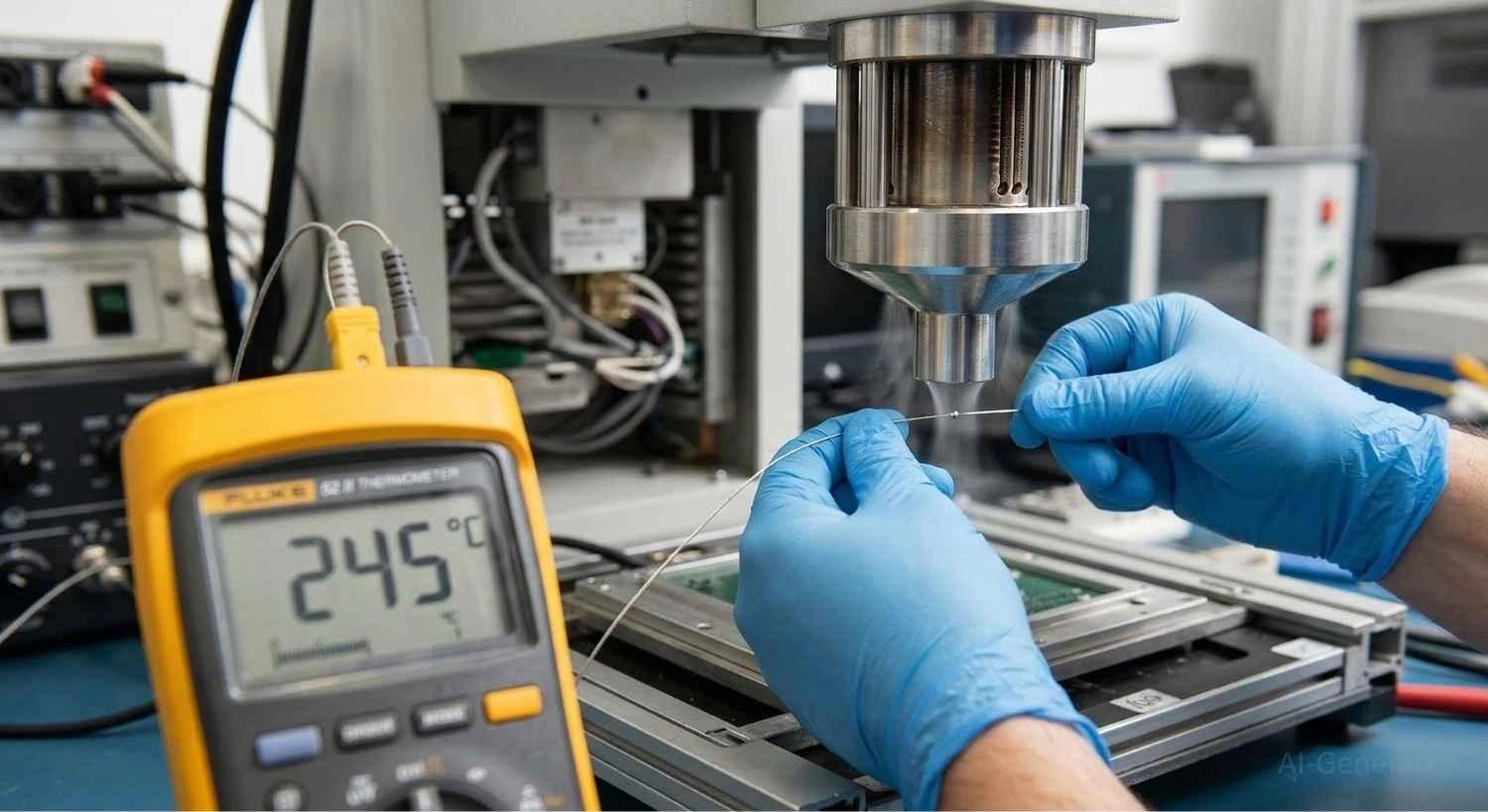
Figure: Calibrating the temperature output of a BGA rework station using external thermocouples.
Alternatives to BGA Rework Stations
If a dedicated BGA machine is out of your budget, there are alternative methods, though they come with higher risks or differing workflows.
Hot Air Rework Stations
High-end handheld hot air stations paired with a separate, standalone infrared bottom preheating plate can mimic the thermal dynamics of a full rework station. However, this relies entirely on the operator's physical steadiness and visual accuracy.
Manual BGA Repair Tools
Successful manual rework relies heavily on chemistry. You will need high-quality, tacky "no-clean" flux (read our guide on the best flux for soldering electronics), precision titanium tweezers, and conductive desoldering braid.
For reballing, you must stock precision-machined BGA reballing stencils and understand exactly how to use solder paste to create uniform solder spheres.
Furthermore, when a chip is dead, sourcing high-quality replacement parts is critical to avoid repeating the rework cycle.
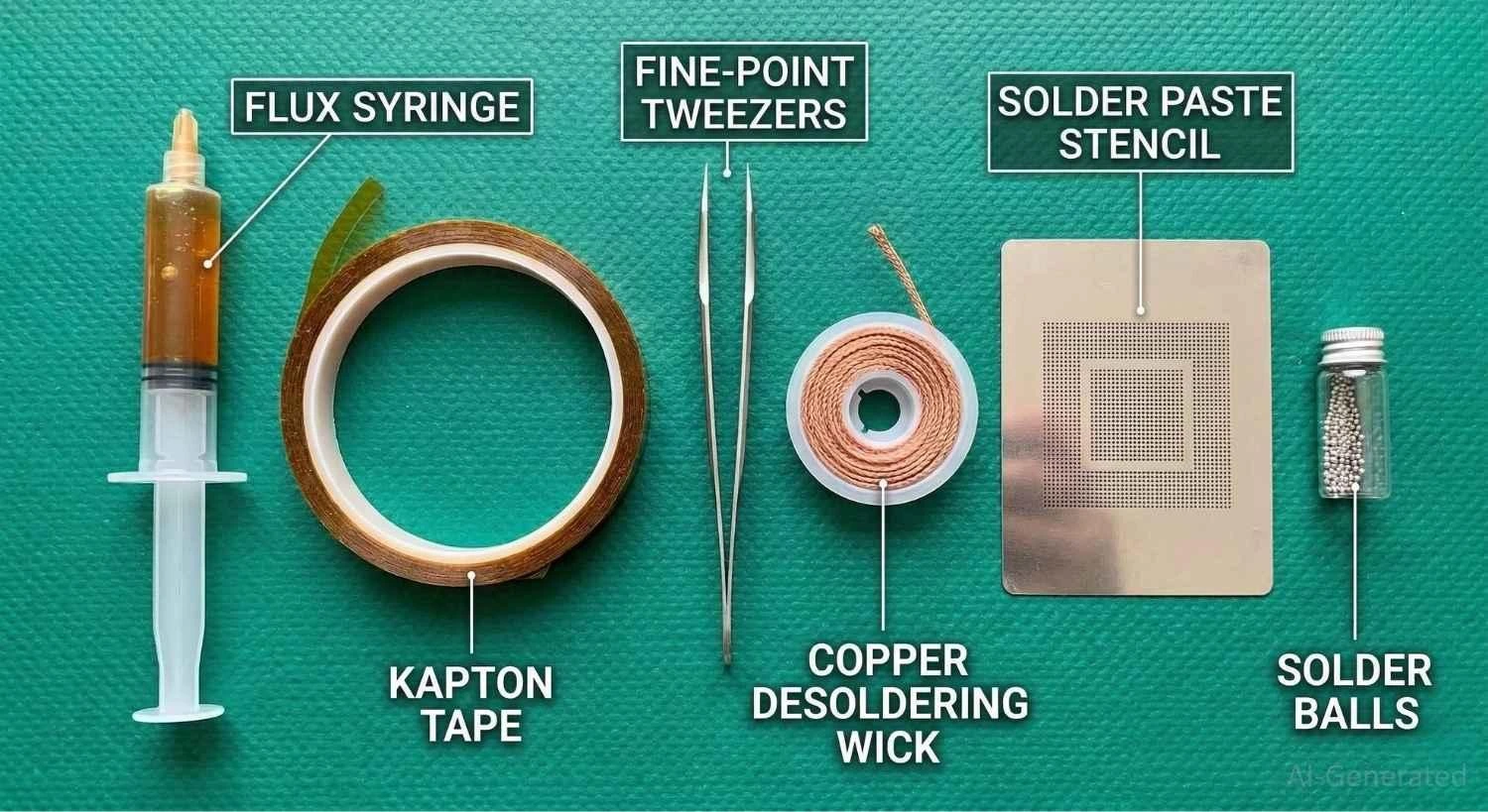
Figure: Essential manual tools and accessories required for BGA rework and reballing.
Professional PCB Rework Services
For teams creating prototypes or small batches, it’s often more economical to outsource assembly or repair rather than maintaining an expensive machine and trained operator in-house.
When to Use Professional PCB Assembly or Repair Services
Manual rework is a costly symptom of assembly failure. It is incredibly time-consuming and inherently introduces secondary thermal stress to the PCB, which can weaken the original solder pad design and reduce its overall lifespan in the field.
The most effective way to handle BGA rework is to actively avoid it through superior initial manufacturing. Transitioning your projects from hand-soldered prototypes to low-volume PCB assembly with an industry-leading partner like JLCPCB guarantees that BGAs are placed by precise automated machines.
Utilizing a fast and easy prototype PCB assembly service ensures the board is assembled correctly the first time. By opting for JLCPCB's rigorous turnkey PCB assembly services, your boards are validated by advanced 3D X-ray and Automated Optical Inspection (AOI) systems straight out of the factory, drastically driving down your failure rates and bypassing the need for manual rework entirely.
FAQs
Q: Can X-ray inspection be substituted with boundary scan testing after BGA rework?
While boundary scan (JTAG) testing can electrically verify that the pins of a BGA are making contact and passing data, it cannot verify the structural integrity of the joint. It will not detect excessive voiding, poor wetting, or malformed ball shapes that could fail under mechanical stress later. X-ray remains the only non-destructive way to physically inspect BGA joint structure.
Q: Do lead-free BGA spheres have a different shelf life than leaded ones?
The core metal alloy (whether SAC305 lead-free or Sn63Pb37 leaded) does not degrade quickly. However, the surface of the solder spheres will oxidize over time, especially in humid environments. While neither has a strict "expiration date" like paste, heavily oxidized spheres of any alloy will fail to wet properly to the pad during reballing. They should always be stored in tightly sealed, dry environments.
Q: What is the maximum number of times a single BGA pad on a PCB can be reworked?
There is no hard industry number, but IPC standards generally suggest that after 2 to 3 rework cycles on the same site, the integrity of the copper pad and the intermetallic bonding layer severely degrades. The repeated extreme thermal cycling breaks down the adhesive holding the copper pad to the FR4 substrate, exponentially increasing the risk of lifted pads.
Q: How does atmospheric pressure or high altitude affect BGA rework profiles?
High altitudes lower the boiling point of liquids. While this doesn't strictly affect the melting point of the solder alloy, it dramatically changes how fluxes behave. At higher altitudes, the solvents in the flux can boil off prematurely before reaching the actual reflow temperature, leaving dry, inactive flux that results in cold solder joints. Adjustments to the pre-heat soak time are often required.
Q: Can I use a standard ultrasonic cleaner to remove flux trapped completely under a reworked BGA?
It is highly discouraged. Ultrasonic cleaning operates via cavitation - microscopic bubbles imploding to scrub surfaces. When these high-frequency vibrations are applied to a PCB, they can cause sympathetic resonance within the microscopic wire bonds inside the BGA silicon package itself, potentially severing the internal connections and destroying the chip.
Conclusion
Choosing between an entry-level hot air station and a high-end optical IR system comes down to your repair volume and board complexity. Armed with the right thermal profiles, high-quality accessories, and patience, successful BGA rework is highly achievable. However, the ultimate goal should always be flawless design and initial manufacturing.
Ready to bring your next complex BGA design to life without the headache of manual rework? Get an instant quote with JLCPCB today for industrial-grade assembly, micrometer-precise component placement, and strict X-ray inspection.
Popular Articles
• SMT Assembly Process Explained and Equipment Used: A Step-by-Step Guide to PCBA Manufacturing
• Common PCB Assembly Methods and Soldering Techniques Explained
• SMD Soldering Tools You Need: Complete Guide from Beginner to Pro
• What Is BGA Void? Causes, IPC Limits, and Solutions
• Reflow Soldering: Everything You Need to Know
Keep Learning
How to Repair a PCB: Traces, Pads, Solder Joints and Corrosion
figure: reworking an SMD joint with a soldering iron and tweezers A cut trace, a lifted pad or a joint that cracked after two years of thermal cycling doesn't mean the board is scrap. Most surface-level circuit board damage can be fixed with an iron, a multimeter and an hour at the bench. This guide covers finding the fault, the five most common repairs, and testing the board before it goes back into service. Each repair is broken into the steps you perform, in order, with the mistakes that most often......
How to Solder Wires to a Circuit Board Properly: Step-by-Step Guide
Learning how to solder wires to a circuit board is a fundamental skill for electronics repair, prototyping, and PCB assembly. Whether you are attaching power leads, signal wires, or test connections, a weak solder joint can cause intermittent failures, lifted pads, or long-term reliability issues. In this step-by-step guide, you'll learn the correct tools, preparation methods, and soldering techniques needed to create strong, clean, and reliable wire-to-PCB connections. From preparing the wire and PCB......
PCB Soldering Basic Techniques and Overview
Soldering means joining metal components with a melted metal called solder, which has a low melting point compared to other metals. Soldering is crucial in the electronics industry and is the primary method of joining electrical components. There are different types of soldering materials based on quality and their melting points. The most common combination is a tin or lead metal alloy mixed with silver or brass. The soldering iron melts the metal so it can be used like glue to connect two pieces. On......
SMT Assembly Process Explained and Equipment Used: A Step-by-Step Guide to PCBA Manufacturing
Today's high-performance electronics, from pocket-sized smartphones and IoT sensors to sophisticated industrial control systems, are made possible by a manufacturing miracle: Surface Mount Technology (SMT). SMT is the backbone of electronics manufacturing, allowing us to have the incredible component density and miniaturization. A bare circuit board is simply a substrate. The process of transforming it into a functional electronic circuit is known as Printed Circuit Board Assembly. This article outlin......
Common PCB Assembly Methods and Soldering Techniques Explained
Whether you're designing your first prototype or scaling up to production, understanding PCB assembly methods and soldering techniques is crucial to achieving reliable, high-performance circuit boards. Modern PCBA primarily relies on Surface Mount Technology (SMT) and Through-Hole Technology (THT)—each offering unique advantages for component density, durability, and manufacturability. In this guide, we'll break down the major PCB assembly methods, key soldering techniques such as reflow and wave sold......
What Is Tombstoning? A Practical Guide to Causes, Reflow Risks, Prevention, and Rework
Key Takeaways Definition: Tombstoning occurs when a small two-terminal component lifts off one pad during reflow and stands upright, leaving one end without a proper solder connection. Root Cause: Unequal solder wetting forces act on the two terminals, often due to differences in pad temperature, solder-paste volume, pad geometry, or thermal mass. Highest Risk: Small passive components, such as 0201 and 0402 resistors and capacitors, are especially susceptible because their low mass and small terminat......