How to Use Solder Flux When Soldering Through-Hole Components: Best Practices
5 min
- Step-by-Step: How to Use Solder Flux for Through-Hole Soldering
- Solder Flux Tips for Through-Hole Soldering
- Conclusion
Through-hole soldering is often done with flux-core solder, but relying on the core alone is rarely enough for consistent, high-quality joints. Oxidized leads, thick copper barrels, and large ground planes all demand better flux control to ensure proper wetting and full barrel fill.
This guide explains how to use solder flux for through-hole soldering in real-world conditions—from choosing liquid flux pens to handling difficult ground connections.
Before walking through the step-by-step process, we’ll first answer the most common practical questions technicians ask when soldering THT components.
Q1: Do I Need Extra Flux If Using Flux-Core Solder?
Technically, no - but practically, yes. While the flux inside the solder wire core is sufficient for clean, new components, it often isn't enough for oxidized vintage parts or thick power planes. Adding external flux ensures wetting starts before the solder melts, guaranteeing a better bond.
Q2: Liquid Pen or Gel Flux: Which is Best for Through-Hole?
Liquid Flux Pens are superior for THT. The low viscosity allows the flux to wick rapidly down the plated hole (capillary action), coating the entire barrel walls. Gel flux tends to sit on top and may not penetrate deep enough before activation.
Q3: How Does Flux Help with "Barrel Fill"?
IPC standards require vertical fill (solder visible on the top side of the board). Flux reduces surface tension inside the barrel, allowing the solder to climb up against gravity. Without extra flux, the solder may stop halfway up, leading to a weak mechanical connection.
Q4: Can Flux Help When Desoldering Through-Hole Parts?
Yes. Old solder joints are often heavily oxidized and do not transfer heat efficiently, making desoldering difficult. Applying fresh liquid flux to an old joint acts as a heat-transfer medium, helping the iron melt the solder faster and protecting the pad from lifting due to excessive thermal stress.
Q5: What If My Through-Hole Components Are Old and Oxidized?
If you are working with "New Old Stock" (NOS) or salvaged parts, standard flux-core solder may fail to wet the leads. In this case, use a more active flux like Rosin Activated (RA) or gently abrade the leads with a fiberglass eraser before soldering to expose fresh metal.
Q6: Does Flux Help with Ground Planes?
Absolutely. Soldering a leg connected to a large ground plane requires significant heat. Flux prevents the joint from oxidizing during the extended heating time required to bring the copper plane up to temperature, ensuring a solid connection rather than a cold, dry joint.
Step-by-Step: How to Use Solder Flux for Through-Hole Soldering
1. Targeted Application: Use a flux pen or fine brush to apply a localized amount of flux to the annular ring (the copper pad surrounding the hole) and the component lead. You do not need to flood the area; a simple coat ensures that as the lead heats up, the flux activates immediately to clean the barrel walls.
2. Create a Heat Bridge: Use a flux pen or fine brush to apply a localized amount of flux to the annular ring (the copper pad surrounding the hole) and the component lead. You do not need to flood the area; a simple coat ensures that as the lead heats up, the flux activates immediately to clean the barrel walls.
3. Feeding for Capillary Action: Feed the solder wire into the joint, ideally on the side opposite to the soldering iron tip. Do not melt the solder on the tip itself. By feeding into the joint, you force the molten alloy to follow the activated flux down into the plated barrel (vertical fill), creating a robust mechanical rivet.
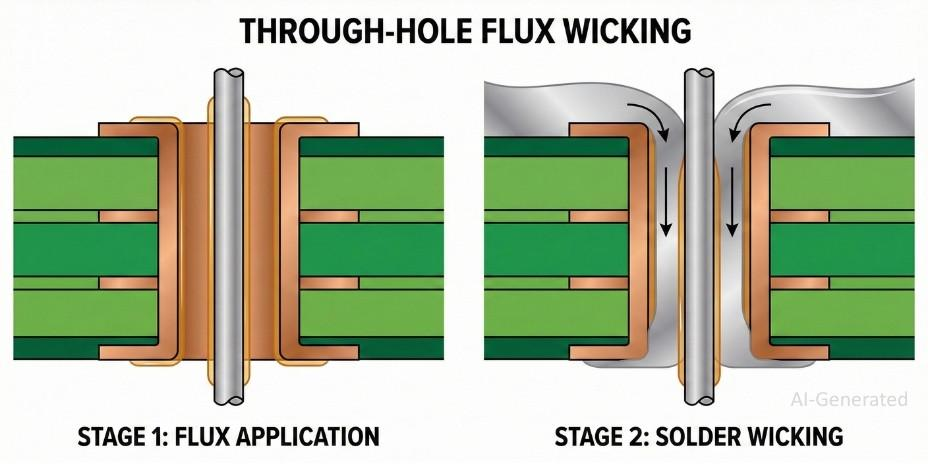
Figure: Showing how flux helps solder wick down the barrel of a through-hole component.
Solder Flux Tips for Through-Hole Soldering
1. Avoid Socket Contamination: When soldering sockets (DIP, ZIF), be extremely careful with liquid flux. Capillary action can wick the flux inside the spring contacts, insulating them and ruining the socket. Apply flux sparingly to the solder side only.
2. Fixing "Icicles" (Solder Flags): If you pull the iron away and leave a spike of solder (an icicle), it indicates the flux has burned off. Add a drop of fresh flux to the icicle and touch it with a clean iron. The flux will break the surface tension, causing the solder to snap back into a smooth cone.
3. Managing Ground Planes: Flux is essential for ground pins. Because ground planes act as massive heatsinks, you must hold the iron on the joint longer. Without extra flux, this extended heating time would oxidize the pad before the solder melts. A generous coat of flux protects the copper during this "pre-heat" phase.
Conclusion
Using solder flux correctly is one of the most effective ways to improve through-hole soldering quality. While flux-core solder works for clean, simple joints, additional external flux becomes essential when dealing with oxidized components, thick barrels, or heat-sinking ground planes. Proper flux application improves wetting, enables full vertical barrel fill, and reduces the risk of cold joints and lifted pads.
By applying flux precisely, feeding solder into the joint rather than the tip, and refreshing flux during extended heating, you can achieve mechanically strong, IPC-compliant through-hole joints with far greater consistency and reliability.
Popular Articles
• SMT Assembly Process Explained and Equipment Used: A Step-by-Step Guide to PCBA Manufacturing
• Common PCB Assembly Methods and Soldering Techniques Explained
• SMD Soldering Tools You Need: Complete Guide from Beginner to Pro
• What Is BGA Void? Causes, IPC Limits, and Solutions
• Reflow Soldering: Everything You Need to Know
Keep Learning
01005 Assembly Guide: PCB Design, Stencil, Feeder Static and Reflow
Key Takeaways 01005 (imperial) parts measure 0.4 × 0.2 mm and are called 0402 in metric. Reliable assembly rests on a flat surface finish such as ENIG, symmetrical NSMD pads, a stencil about 3 mil thick with fine paste, static control at the feeder, and 3D SPI before placement. Because 01005 parts are slow and risky to rework, first-pass yield is the number that matters most. Figure: Six SMD capacitors on a fingertip, from left: 01005, 0201, 0402, 0603, 0805 and 1206. Photo: Filip Wahlberg, CC BY-SA 4......
How to Repair a PCB: Traces, Pads, Solder Joints and Corrosion
figure: reworking an SMD joint with a soldering iron and tweezers A cut trace, a lifted pad or a joint that cracked after two years of thermal cycling doesn't mean the board is scrap. Most surface-level circuit board damage can be fixed with an iron, a multimeter and an hour at the bench. This guide covers finding the fault, the five most common repairs, and testing the board before it goes back into service. Each repair is broken into the steps you perform, in order, with the mistakes that most often......
How to Solder Wires to a Circuit Board Properly: Step-by-Step Guide
Learning how to solder wires to a circuit board is a fundamental skill for electronics repair, prototyping, and PCB assembly. Whether you are attaching power leads, signal wires, or test connections, a weak solder joint can cause intermittent failures, lifted pads, or long-term reliability issues. In this step-by-step guide, you'll learn the correct tools, preparation methods, and soldering techniques needed to create strong, clean, and reliable wire-to-PCB connections. From preparing the wire and PCB......
PCB Soldering Basic Techniques and Overview
Soldering means joining metal components with a melted metal called solder, which has a low melting point compared to other metals. Soldering is crucial in the electronics industry and is the primary method of joining electrical components. There are different types of soldering materials based on quality and their melting points. The most common combination is a tin or lead metal alloy mixed with silver or brass. The soldering iron melts the metal so it can be used like glue to connect two pieces. On......
SMT Assembly Process Explained and Equipment Used: A Step-by-Step Guide to PCBA Manufacturing
Today's high-performance electronics, from pocket-sized smartphones and IoT sensors to sophisticated industrial control systems, are made possible by a manufacturing miracle: Surface Mount Technology (SMT). SMT is the backbone of electronics manufacturing, allowing us to have the incredible component density and miniaturization. A bare circuit board is simply a substrate. The process of transforming it into a functional electronic circuit is known as Printed Circuit Board Assembly. This article outlin......
Common PCB Assembly Methods and Soldering Techniques Explained
Whether you're designing your first prototype or scaling up to production, understanding PCB assembly methods and soldering techniques is crucial to achieving reliable, high-performance circuit boards. Modern PCBA primarily relies on Surface Mount Technology (SMT) and Through-Hole Technology (THT)—each offering unique advantages for component density, durability, and manufacturability. In this guide, we'll break down the major PCB assembly methods, key soldering techniques such as reflow and wave sold......