A Complete Guide to Copper Clad Laminate (CCL) in PCB Manufacturing
19 min
- What Is Copper Clad Laminate (CCL)?
- Copper Clad Laminate Structure and Materials
- Copper Clad Laminate vs. Prepreg, Core, and Finished PCB
- How Copper Clad Laminate Is Manufactured
- Types of Copper Clad Laminate
- Copper Clad Laminate Classifications and Standards
- Key Copper Clad Laminate Properties for PCB Design
- How to Select a Copper Clad Laminate for Your PCB
- Copper Clad Laminate Options at JLCPCB
- FAQs About Copper Clad Laminate
- Conclusion

Key Takeaways
- CCL is the base material: a cured resin-reinforcement sheet with copper foil bonded to one or both sides.
- Three parts control performance: Resin affects heat and loss, reinforcement controls stability, and copper foil affects conductor behavior.
- Choose by the main design stress: Heat, frequency, and cost usually determine the best laminate family.
- Slash sheets define the material: IPC-4101 uses numbered slash sheets to specify rigid PCB base materials.
- Tg alone is not enough: Td and time to delamination are also critical for predicting lead-free reflow reliability.
Copper-clad laminate (CCL) is the foundation of every PCB, yet it is often specified simply as “standard FR-4” and left there. That works until a board delaminates during lead-free reflow or an RF trace loses more signal than expected. In both cases, the laminate had already influenced the outcome long before layout began.
FR-4 is a flammability grade, not a formulation. Two laminates carrying the same label can behave very differently at 260 °C, because the resin system, glass fabric, and copper foil underneath are not the same. The properties that actually separate them — Tg, Td, Dk, Df, and CTE — are the ones this guide works through.
In this guide, you will learn:
- What a copper-clad laminate is made of.
- How CCL differs from prepreg, core, and the finished board.
- The main laminate types and their best applications.
- Which properties actually predict board performance?
- How to choose the right laminate grade for your design.
What Is Copper Clad Laminate (CCL)?
A copper-clad laminate is a fully cured, resin-impregnated reinforcement sheet with copper foil bonded to one or both sides. Fabricators buy it in large panels and etch the copper to create the circuit pattern. The laminate is the raw material; the PCB is the finished product.
Copper-clad laminate (CCL) is the core substrate material used to build most rigid PCBs.
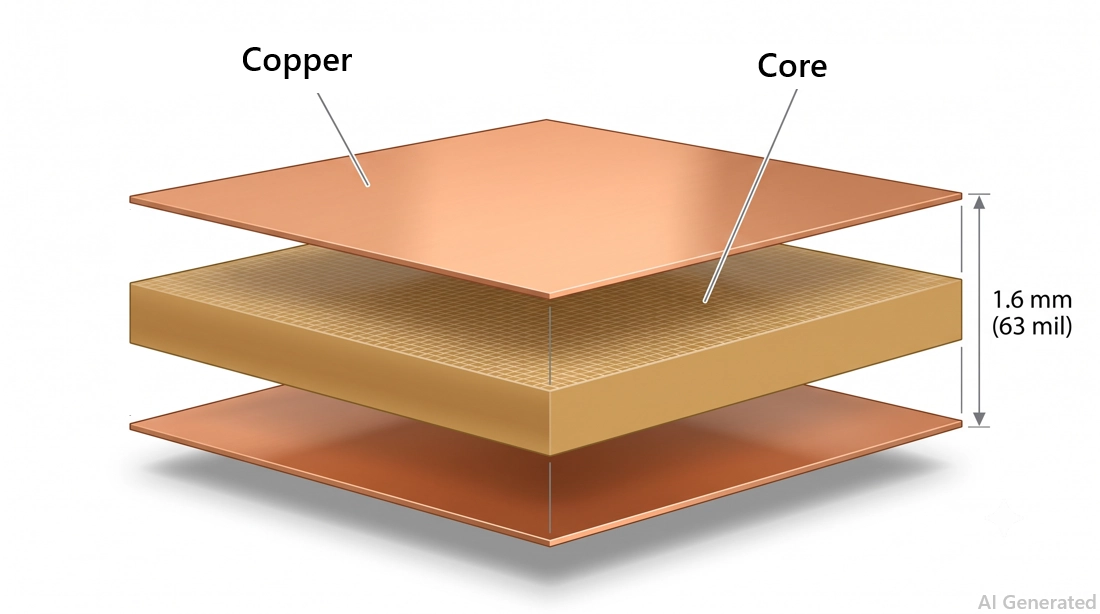
Figure: Cross-section of a double-sided copper-clad laminate
The word “clad” matters because the copper arrives already bonded to the laminate rather than being plated on later. During lamination, the foil is pressed into the resin, creating a mechanical bond measured as peel strength.
For example, Shengyi supplies S1000-2M in 40 × 48 inch (1020 × 1220 mm) sheets, from which individual boards are cut.
Copper Clad Laminate Structure and Materials
A copper-clad laminate can be understood through three key material components: the resin system, the reinforcement, and the copper foil.
The resin system largely determines thermal and dielectric behavior, the reinforcement contributes to dimensional stability, and the copper foil provides the conductive layer.
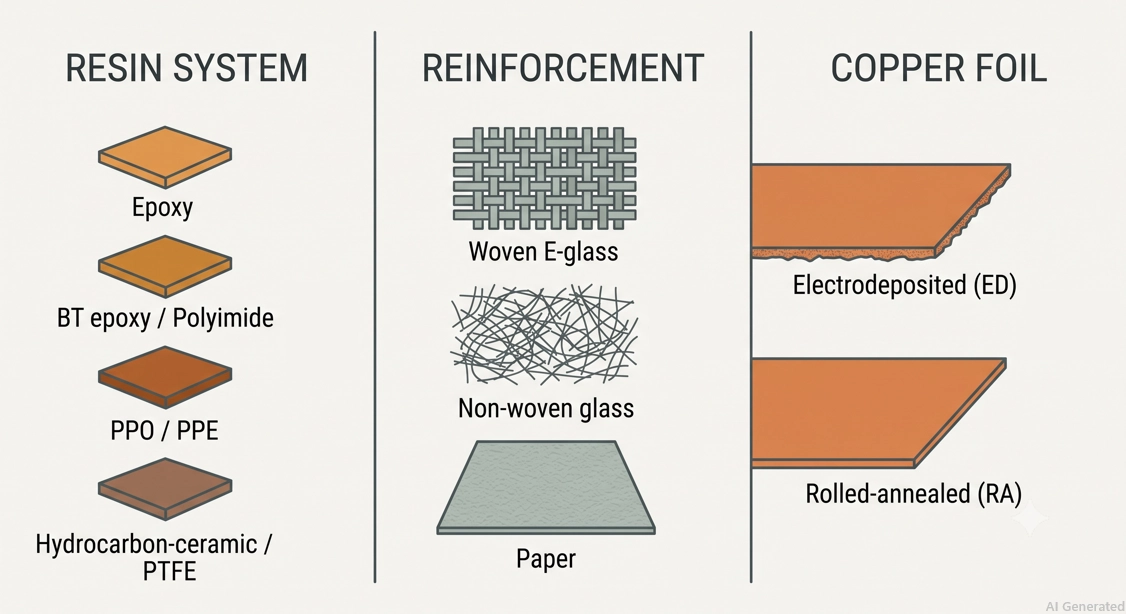
Figure: Copper-clad laminate material components: resin, reinforcement, and copper foil types.
This also makes datasheets easier to read: Tg is primarily a resin property, whereas peel strength describes the bond between the copper foil and the resin.
1. Resin Systems in Copper Clad Laminates
The resin determines how much heat the board can withstand before it begins to soften. Standard epoxy softens around 130 °C to 140 °C, which suited tin-lead solder at 183 °C.
Lead-free soldering changed the thermal requirements. SAC305 melts around 217–220 °C and typically uses reflow peaks of 245–260 °C, so laminate resin systems had to withstand much higher temperatures.
Multifunctional and phenolic-cured epoxies raise crosslink density and lift Tg into the 150 °C to 180 °C range. Beyond epoxy, each resin family offers a specific performance advantage:
- Epoxy: The cost baseline, and the reason FR-4 dominates general-purpose work.
- BT epoxy and polyimide: Thermal headroom, for boards that stay hot in service.
- PPO and PPE: Lower dissipation factor, for multi-gigabit links on a normal process line.
- Hydrocarbon-ceramic and PTFE: Very low dielectric loss for high-frequency applications, with greater processing complexity than conventional FR-4.
2. Reinforcement Materials and Glass Fabric Styles
The reinforcement keeps the board dimensionally stable and also influences its dielectric constant. Woven E-glass is standard in rigid PCBs, while non-woven glass and paper are used in lower-cost CEM materials. Common glass weave styles include 106, 1080, 2116, and 7628.
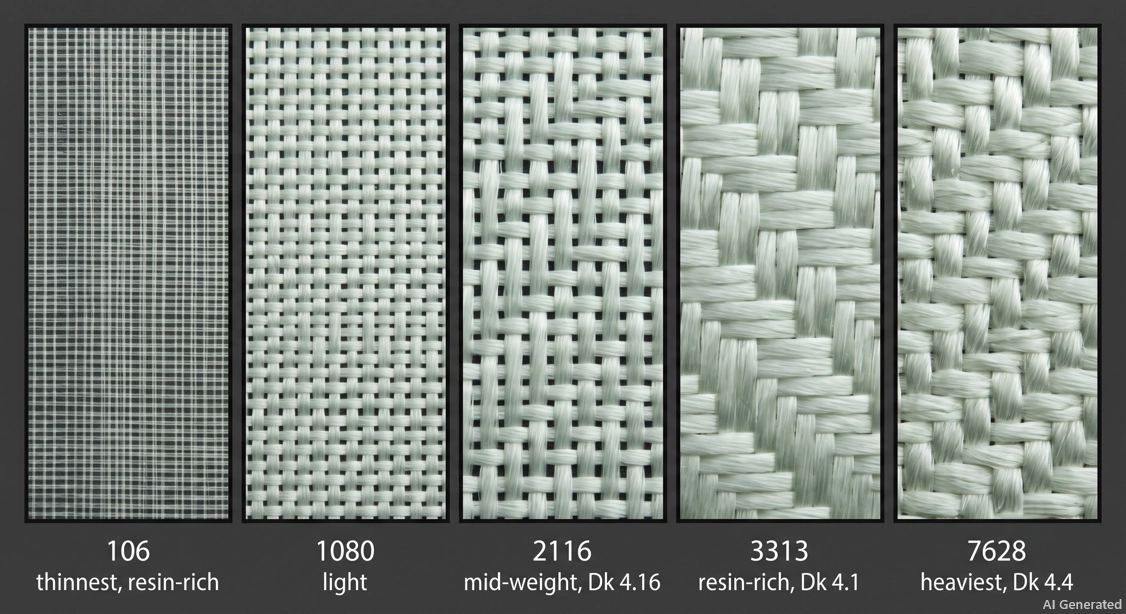
Figure: Glass fabric style drawn at matched scale with weave density
A heavier style carries more glass and less resin; glass has a higher dielectric constant than epoxy, so a heavier weave means a higher Dk. JLCPCB's published prepreg values show the effect directly:
- 7628: The heaviest common style, Dk 4.4, is used to build thickness cheaply.
- 2116: Mid-weight, Dk 4.16, the usual compromise in four-layer stackups.
- 3313: Light and resin-rich, Dk 4.1, chosen when impedance matters more than cost.
A 50-ohm microstrip designed for Dk 4.1 can miss its target if the fabricator uses a different glass style, such as 7628. For controlled impedance, specify the exact prepreg and glass styles in the stackup.
3. Copper Foil Types and Weights in Copper Clad Laminates
Copper foil comes in two forms, and the difference lies in how it was made.
Electrodeposited (ED) foil is formed on a rotating drum, resulting in one shiny side and one rougher, matte side.
Rolled-annealed (RA) foil is produced by rolling copper into thin sheets. It is smoother and more flexible, which makes it better suited to flex circuits.
Copper roughness is intentional because the matte surface improves adhesion to the resin. However, rough copper can increase conductor loss at high frequencies because skin effect pushes current toward the surface.
Copper thickness is commonly specified in ounces per square foot, with 1 oz = 35 µm (1.4 mil). Heavier copper can carry more current, but it also increases the etching undercut and affects the final stackup thickness.
Copper Clad Laminate vs. Prepreg, Core, and Finished PCB
What is the difference between CCL, prepreg, core and PCB?
The main differences are the cure state and the presence of copper.
Prepreg is a glass fabric with partially cured resin and no copper. Copper-clad laminate is fully cured, with copper foil bonded to one or both sides.
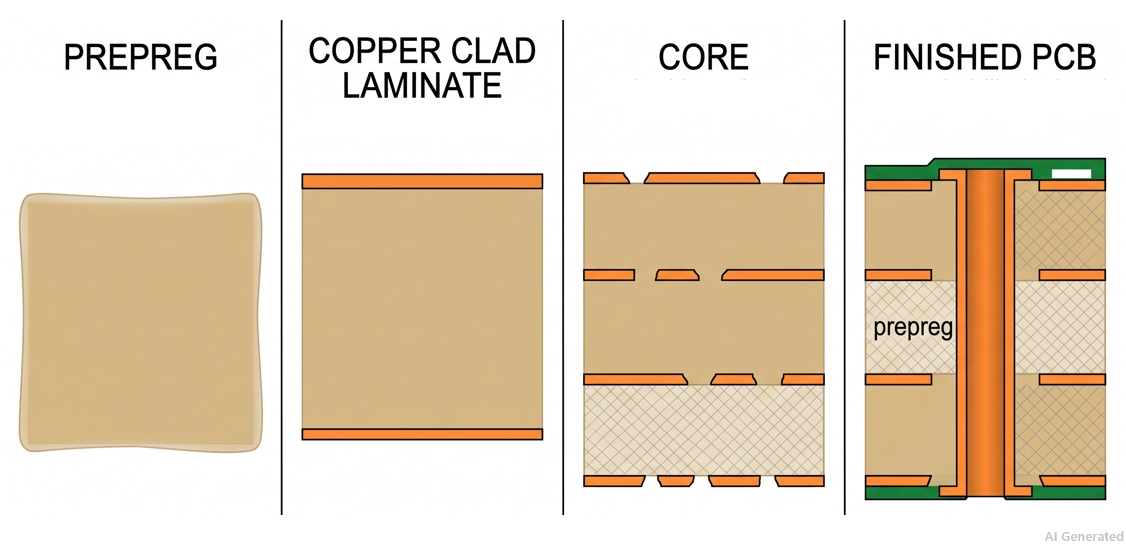
Figure: Comparison of prepreg, copper-clad laminate (CCL), PCB core, and a finished four-layer PCB.
Resin passes through three cure stages: A-stage is liquid, B-stage softens and flows when heated, and C-stage is fully cured and no longer flows. Prepreg is B-stage, so it acts as the bonding layer during lamination. CCL is C-stage, so it keeps its shape and thickness under heat and pressure.
| Material | Cure State | Copper Present | Role in the Stackup |
|---|---|---|---|
| Prepreg | B-stage, partially cured | No copper | Flows and bonds adjacent layers during lamination |
| Copper-clad laminate | C-stage, fully cured | Copper foil on one or both sides | Base laminate material used to form PCB layers |
| Core | C-stage, fully cured | Usually copper on both sides | Rigid dielectric layer that forms part of the multilayer stackup |
| Finished PCB | Fully pressed assembly | Plated and finished | Completed board after lamination, drilling, plating, solder mask, and other processes |
How Copper Clad Laminate Is Manufactured
Laminate production is a continuous impregnation line followed by a batch press. Every property on the datasheet is set in one of those two stages, and the six steps below are the standard sequence:
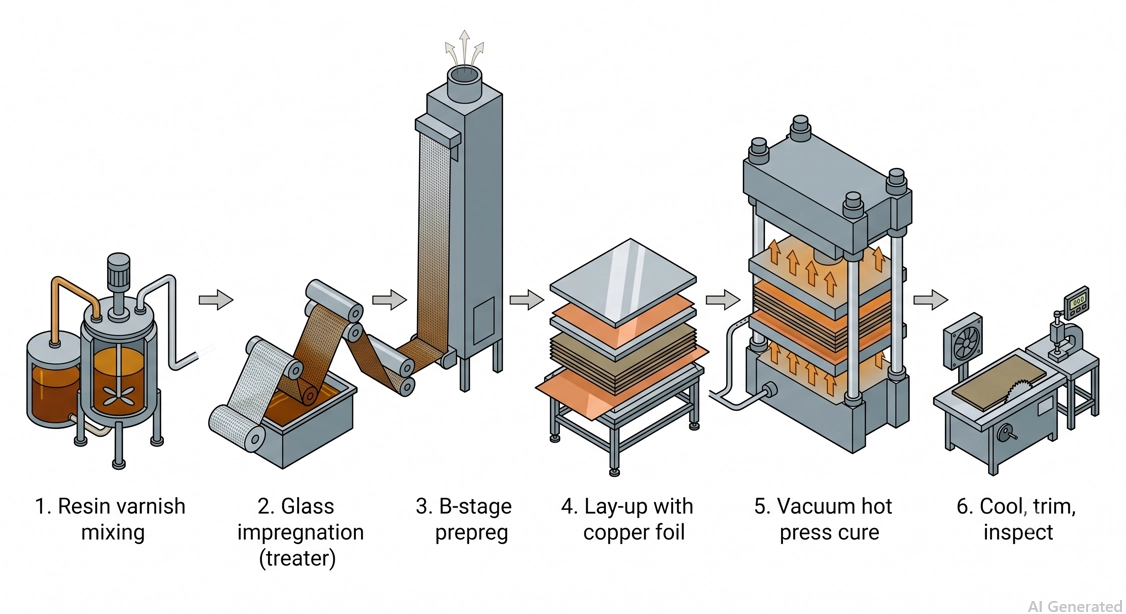
Figure: Copper-clad laminate manufacturing process
- Mix the resin varnish: Resin, curing agent, flame retardant, and solvent are blended to a set viscosity, since viscosity decides how much resin the glass picks up.
- Impregnate the glass on the treater: The fabric runs through a varnish bath and metering rollers that set the resin content.
- B-stage the resin: Solvent evaporates in a heated tower, and the resin partially cures, giving prepreg that is dry but will flow again.
- Lay up the book: Stack prepreg plies to the required thickness, apply copper foil to the outer faces, and place the stack between polished press plates.
- Cure in the vacuum hot press: Heat melts the resin, allowing it to wet the foil; pressure completes crosslinking; and the vacuum removes volatiles that would otherwise form voids.
- Cool, trim, and inspect: Controlled cooling avoids locking in stress that later causes warp, and panels are tested for thickness and peel strength.
Peel strength is largely determined during lamination. If the press heats too quickly, the resin can gel before it properly wets the copper foil, reducing bond strength. After lamination, the finished panels move into PCB fabrication, where imaging, etching, and drilling begin. See our guide on the full PCB manufacturing process.
Types of Copper Clad Laminate
Copper-clad laminates can be classified by resin system, reinforcement, thermal performance, electrical properties, construction, and compliance requirements. Each material family involves different trade-offs in cost, processing, thermal performance, and signal integrity.
Higher thermal performance usually means more demanding processing, while lower dielectric loss often comes at the cost of easier fabrication.
| Laminate Family | Resin / Reinforcement | Key Thermal Property | Typical Applications |
|---|---|---|---|
| Standard FR-4 | Difunctional epoxy, woven E-glass | TG135 to TG140 | General-purpose 2- to 4-layer PCBs and common assembly applications |
| High-Tg FR-4 | Multifunctional or phenolic-cured epoxy, woven E-glass | TG155 and TG170, up to 180 °C on grades such as S1000-2M | Lead-free assembly, high layer count, thick boards |
| Halogen-free FR-4 | Phosphorus-modified epoxy, woven E-glass | Comparable to the equivalent FR-4 grade | Products with a halogen-free compliance requirement |
| CEM-1 | Epoxy, paper core with woven glass surfaces | Below standard FR-4 | Single-sided consumer boards where cost dominates |
| CEM-3 | Epoxy, non-woven glass core with woven glass surfaces | Below standard FR-4 | Low-cost boards that still need plated holes |
| Hydrocarbon-ceramic | Hydrocarbon and ceramic, woven glass | Tg above 280 °C on RO4350B | RF and microwave boards that still need normal FR-4 processing |
| PTFE | PTFE, woven glass, or ceramic filler | Not epoxy-like; limited by processing | Millimeter-wave and the lowest-loss microwave work |
| Metal-core | Epoxy dielectric on an aluminum or copper base | Set by the dielectric, not the metal | High-power LED and power modules that dump heat sideways |
| Polyimide | Polyimide, woven glass | The highest thermal class of the organic laminates | Downhole, aerospace, and high-temperature assemblies |
1. Standard FR-4 Copper Clad Laminate
FR-4 is a flame-retardant material classification, not a single formula. Different FR-4 laminates can therefore have different Tg, dielectric loss, and thermal performance. Standard grades are typically around Tg 135–140 °C and suit most two-layer and four-layer PCBs.
Also read: FR4 PCB Deep Guide: Material Truth, Real Specs & When to Use (or Avoid) It
2. High-Tg FR-4 Copper Clad Laminate
High-Tg laminates use similar glass reinforcement with a more heat-resistant epoxy system, so they process much like standard FR-4 but tolerate higher temperatures. JLCPCB lists Tg 155 °C and Tg 170 °C options, while Shengyi S1000-2M reaches about 180 °C by DSC. They are a better choice for thicker boards, repeated reflow cycles, and other thermally demanding assemblies.
3. Halogen-Free Copper Clad Laminate
Halogen-free laminates replace brominated flame retardants with alternatives such as phosphorus-based systems. Their main purpose is compliance, not higher electrical or thermal performance. In most cases, they perform similarly to the equivalent standard grade.
4. CEM-1 and CEM-3 Composite Copper Clad Laminate
CEM materials use lower-cost core structures with glass-reinforced outer layers.
CEM-1 uses a paper-based core and is mainly suited to single-sided boards.
CEM-3 uses a non-woven glass core and can support plated through-holes. Both generally offer lower thermal performance than FR-4, making them less suitable for demanding lead-free multilayer assemblies.
5. PTFE and Hydrocarbon-Ceramic Copper Clad Laminate
Rogers RO4000 laminates are not PTFE. They use glass-reinforced hydrocarbon-ceramic materials and fall under IPC-4103 rather than IPC-4101. RO4350B offers about Dk 3.48 and Df 0.0037 at 10 GHz, making it suitable for many RF and microwave designs without the processing challenges of PTFE. True PTFE can achieve even lower loss, but it requires more specialized fabrication.
6. Metal-Core Laminates
Metal-core laminates use an aluminum or copper base beneath a thin dielectric layer. Heat passes through the dielectric and spreads through the metal core, making these materials ideal for LEDs and power electronics. Their main advantage is thermal management, especially where standard FR-4 cannot remove heat fast enough.
7. Polyimide Copper Clad Laminate
Polyimide laminates maintain their properties at temperatures where standard epoxy materials begin to soften. This makes them useful in aerospace, downhole, and other high-temperature applications. They cost significantly more than FR-4, so they are best specified when temperature performance is a real design requirement.
Copper Clad Laminate Classifications and Standards
Note
The exact slash-sheet designation should be verified against the applicable revision of IPC-4101 and the laminate supplier's datasheet.
IPC-4101 is the main specification for base materials used in rigid and multilayer PCBs. Instead of relying on trade names such as “FR-4,” it classifies materials through numbered slash sheets. Each slash sheet defines the resin system, reinforcement, flammability class, and key material limits. That makes a slash-sheet reference more precise than simply writing “FR-4” on a fabrication note.
Examples include:
- /29: Epoxy/cyanate-ester system for high-performance laminates
- /30: BT epoxy
- /40 to /42: Toughened polyimide
- /71: Cyanate ester for low loss and thermal stability
- /98: High-Tg multifunctional epoxy
- /99: Lead-free-compatible high-Tg epoxy
Other standards cover different material families. IPC-4103 applies to high-speed and high-frequency laminates, including Rogers RO4000 materials, while IPC-4204 covers flexible metal-clad dielectrics. Older NEMA grades include FR-1 and FR-2.
Key Copper Clad Laminate Properties for PCB Design
Copper-clad laminate datasheets contain many specifications, but a few key properties have the greatest impact on PCB fabrication, signal integrity, thermal reliability, and assembly performance.
| Property | Reference Value | Test Method | What the Number Predicts |
|---|---|---|---|
| Glass transition temperature, Tg | 180 °C by DSC, 185 °C by DMA | IPC-TM-650 2.4.25, 2.4.24.2 | The temperature at which the resin softens, and expansion accelerates |
| Decomposition temperature, Td | 355 °C | IPC-TM-650 2.4.24.6 | The point at which the resin chemically breaks down and outgasses |
| Z-axis CTE | 41 ppm/°C below Tg, 208 ppm/°C above Tg | IPC-TM-650 2.4.41 | Potential thermal stress on plated through-hole barrels |
| Time to delamination | T260 60 min, T288 30 min, T300 15 min | IPC-TM-650 2.4.24 | How many reflow and rework cycles does the bond survive |
| Dielectric constant, Dk | 4.49 at 1 GHz, 4.9 at 1 MHz | IPC-TM-650 2.5.5.9, SPDR at 56% resin content | Signal propagation delay and the impedance of controlled-impedance traces |
| Dissipation factor, Df | 0.016 at 1 GHz, 0.015 at 1 MHz | IPC-TM-650 2.5.5.9 | Insertion loss on long or high-frequency traces |
| Copper peel strength | 1.3 N/mm (7.4 lb/in), 1 oz ED foil after solder float | IPC-TM-650 2.4.8 | Resistance to pad lifting during assembly and rework |
| Water absorption | 0.08% | IPC-TM-650 2.6.2.1 | Risk of moisture-driven blistering in reflow |
| Thermal conductivity | 0.7 W/m·K at 100 °C | ASTM D5470 | How poorly the board spreads heat away from a hot part |
| Contrast: Rogers RO4350B | Dk 3.48, Df 0.0037 at 10 GHz, Tg above 280 °C | Rogers RO4000 series datasheet | The loss and thermal headroom a hydrocarbon-ceramic buys |
Thermal Properties: Tg, Td, CTE, and Time to Delamination
Tg is the temperature where the resin changes from a rigid, glass-like state to a softer state. It does not melt, but Z-axis expansion rises sharply above Tg. For S1000-2M, the increase ranges from about 41 ppm/°C below Tg to 208 ppm/°C above Tg. Our guide on selecting the Tg of a PCB explains this in more detail.
Td measures thermal decomposition rather than softening. S1000-2M has a Td of about 355 °C, well above its Tg.
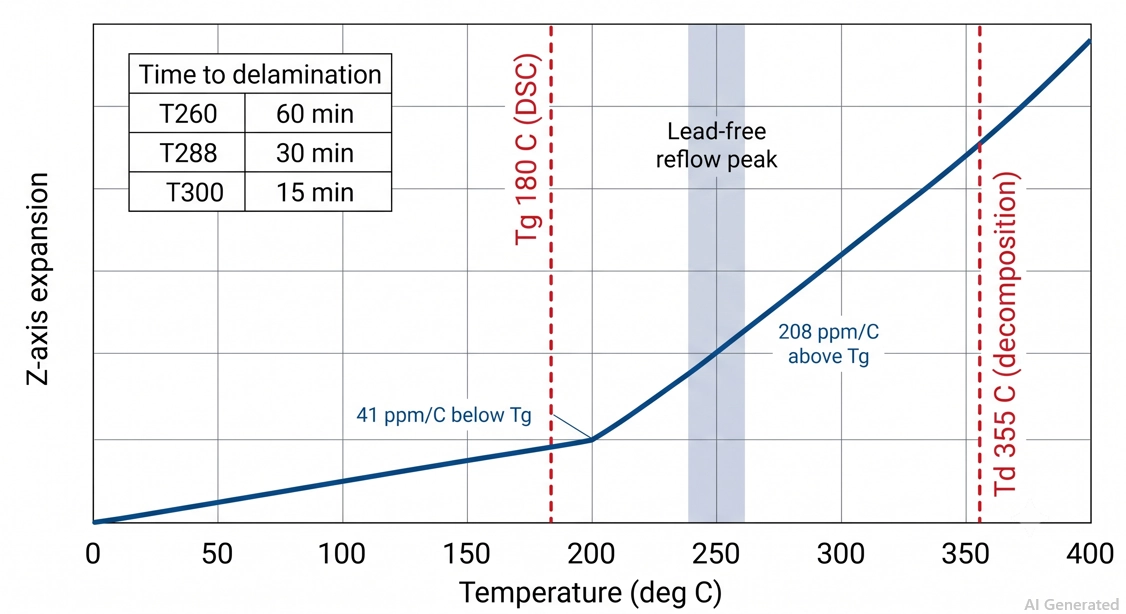
Figure: Thermal analysis plot of a copper clad laminate with Tg, Td, and Time to delamination
Time to delamination measures how long the laminate can withstand high temperatures. A T288 of 30 minutes means it withstands 288 °C for about 30 minutes before delamination. See the PCB Td value guide for more.
Electrical Properties: Dielectric Constant and Dissipation Factor
Dk controls signal velocity and impedance. A higher Dk slows the signal and lowers impedance for the same trace geometry, so controlled-impedance calculations must use the actual laminate value.
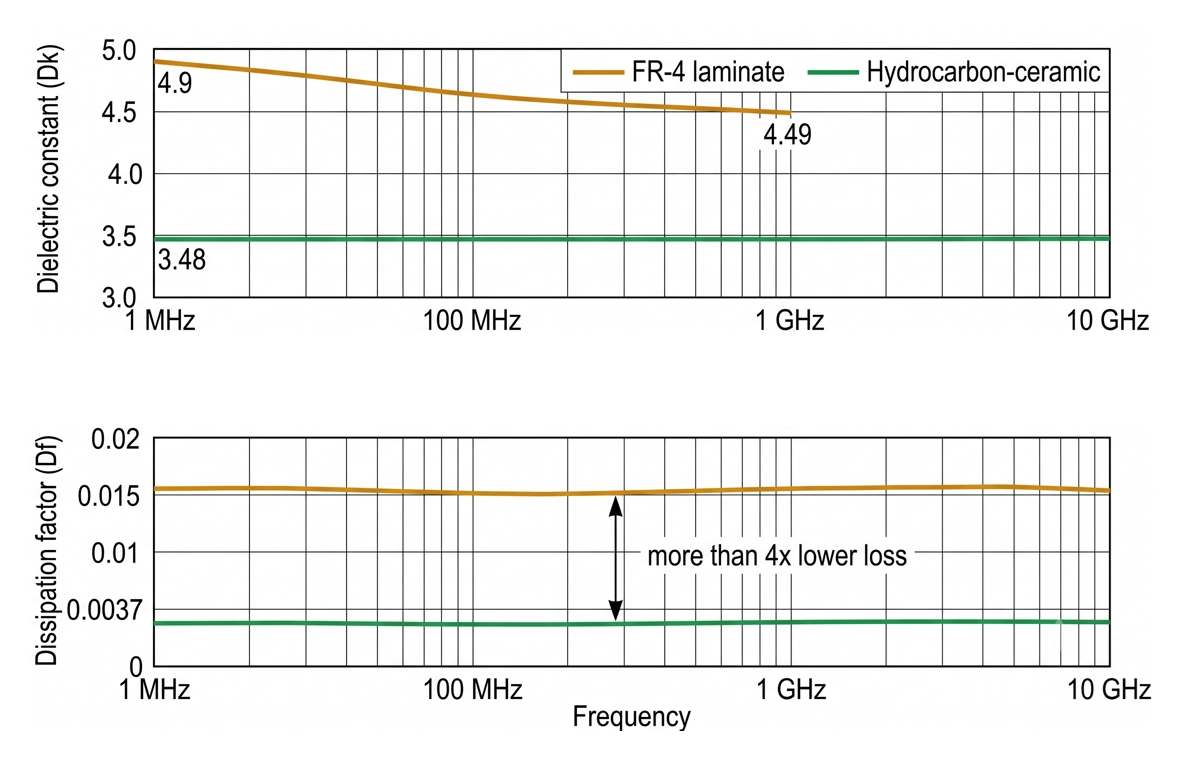
Figure: Dielectric constant and dissipation factor plotted against frequency for standard FR-4.
Df describes dielectric loss. Lower Df matters more as frequency and trace length increase. For example, S1000-2M is around 0.016 at 1 GHz, while RO4350B is about 0.0037 at 10 GHz, making low-loss laminates a better fit for demanding high-speed and RF designs.
Physical and Reliability Properties: Peel Strength, Water Absorption, and Flammability
These additional properties help assess laminate reliability during fabrication and assembly:
- Peel strength: 1.3 N/mm (7.4 lb/in) with 1 oz ED copper indicates how well pads resist lifting during rework.
- Water absorption: 0.08% helps predict the risk of moisture-related blistering during reflow.
- Flammability: A UL 94V-0 rating supports safety compliance for the finished product.
The solder float in the peel test matters because it reflects the bond after the board has seen heat, rather than as delivered. Trapped moisture behaves the same way.
That is why stored panels are baked before assembly, and our guide on how PCB moisture absorption affects assembly covers the handling side.
How to Select a Copper Clad Laminate for Your PCB
Start with the board’s main design constraint, then confirm the material against the correct slash sheet. Most designs are driven by heat, frequency, or cost, so identifying the dominant requirement quickly narrows the laminate choices.
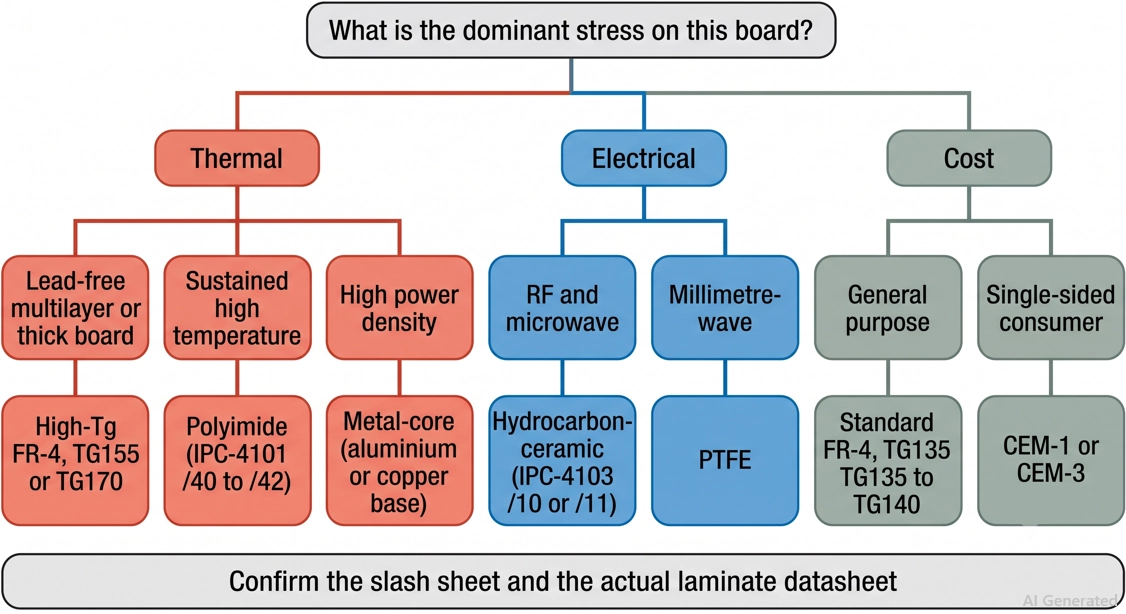
Figure: Copper-clad laminate selection decision tree
- Name the dominant stress: Decide whether the board is thermally, electrically, or cost limited, because optimizing all three buys nothing.
- Set the thermal floor from the assembly process: Lead-free reflow peaks near 245-260 °C, so check Td and T288 rather than Tg alone.
- Set the electrical requirement from the fastest edge: If the design has controlled-impedance nets, fix Dk and the glass style together, since the weave changes the effective Dk.
- Check the mechanical constraints: Confirm that the required finished thickness and copper weight are stocked in that grade.
- Confirm against a slash sheet: Ask the fabricator which laminate they will actually press, then verify the values you assumed.
For many general-purpose PCB designs, standard FR-4 grades around Tg 135–140 °C are sufficient. Designs exposed to repeated lead-free reflow, higher operating temperatures, or demanding reliability requirements may use higher-Tg grades such as 155 °C or 170 °C.
Copper Clad Laminate Options at JLCPCB
JLCPCB works with established CCL suppliers — including Nan Ya, KB, and Shengyi, so the material used in your design is a named product.
FR-4 is stocked in TG135 to TG140, TG155, and TG170, which covers standard, lead-free, and high-layer-count work without a custom request.
The published stackup provides enough detail to begin impedance calculations using real design values rather than rough assumptions.
- Dielectric constant: Core material is 4.5, while prepreg values are 4.4 for 7628, 4.16 for 2116, and 4.1 for 3313.
- Copper weight: Inner layers support 0.5-2 oz of copper, while the two-layer outer layers can reach 4.5 oz.
- Finished thickness: Available board thickness ranges from 0.4 mm to 4.5 mm (16 mil to 177 mil).
- Beyond FR-4: Aluminum-core and copper-core boards are available for thermal designs, while Rogers and PTFE options support high-frequency RF applications.
These fabrication details are listed on the PCB capabilities page, while the JLCPCB parts library covers the assembly side.
FAQs About Copper Clad Laminate
Q: What Is the Difference Between Copper Clad Laminate and Prepreg?
Prepreg is a partially cured resin-coated glass fabric used to bond PCB layers. Copper-clad laminate is fully cured, with copper foil bonded to one or both sides.
Q: Is FR-4 the Same as copper-clad laminate?
No. FR-4 is one type of copper-clad laminate. CCL also includes materials such as CEM, polyimide, hydrocarbon-ceramic, and metal-core laminates.
Q: What Is the Difference Between CCL and a PCB?
CCL is the raw material; a PCB is the finished circuit board. The laminate becomes a PCB after processes such as imaging, etching, drilling, and plating.
Q: How Thick Is Copper Clad Laminate?
CCL is available in many thicknesses depending on the material and supplier. The finished PCB thickness varies depending on the complete stack of cores, prepregs, and copper layers.
Q: What Does the Tg of a Copper Clad Laminate Mean?
Tg is the temperature where the resin changes from a rigid to a softer state. Above Tg, Z-axis expansion increases and can place more stress on plated through-holes.
Conclusion
Choosing a copper-clad laminate is a design decision, not just a material selection.
Tg matters, but Td, T288, dielectric loss, thermal behavior, and processing requirements can be just as important.
For high-frequency designs, low-loss materials such as hydrocarbon-ceramic or PTFE may be worth the added cost, while standard or high-Tg FR-4 remains practical for many conventional boards.
The key is to match the laminate to the application's electrical, thermal, and reliability requirements rather than simply choosing the highest specification available.
Keep Learning
Choosing the Right PCB Solder Mask Material for Reliable PCBs
Key Takeaways Dual-Curing: UV defines openings; heat cures epoxy for durability. LPI vs. Coverlay: LPI for rigid boards; coverlay for flexible circuits. Color & Pitch: Green allows tighter dams (0.10 mm) than black/white (0.13 mm). Protection: Prevents solder bridges and seals copper from moisture. Cure Quality: Proper baking prevents mask peeling during plating and reflow. PCB solder mask material is a cured polymer film usually 10 to 30 µm (0.4 to 1.2 mil) thick. During reflow, it is the only barrie......
Safeguarding Circuit Boards Against Breakdown Voltage Failure
Key Takeaways Construction Matters: Breakdown voltage depends on stackup and defects, not raw material ratings. Stress Causes Failures: Heat and moisture degrade insulation over time, leading to field defects. Four Main Failure Modes: Insulation fails via internal voids, treeing, CAF growth, or surface tracking. Layout Design Fixes: Use dual prepregs, wider hole spacing, rounded trace corners, and isolation slots. Testing Split: Bare-board testing checks low-voltage net continuity, while hi-pot tests ......
Is FR4 the Best Board Material for Your Design
Key Takeaways Best All-Rounder: Ideal balance of strength, insulation, and low cost for standard PCBs. Clear Limits: Poor heat dissipation (~0.3 W/m·K) and high loss for RF (>3 GHz). Alternatives: Use Rogers for RF, Aluminum for high heat, and FPC for flexibility. Selection Essentials: Pick High-Tg (170°C+) for lead-free reflow and custom stackups for impedance. JLCPCB Advantage: 1–32 layer FR4 boards with ±10% impedance control and 24h fast dispatch. In the world of electronics and printed circuit bo......
Optimizing High-Voltage Circuit Safety with PCB Dielectric Strength
Key Takeaways Non-linear Scaling: Dielectric strength drops as thickness increases. Safety vs Signals: Dielectric strength ensures safety, while Dk controls signal speed. Material Selection: High-voltage safety depends on Tg, CTI, and moisture resistance. Spacing Rules: Clearance prevents air arcs, while creepage prevents surface tracking. Assembly Testing: Hi-pot testing requires finished assemblies, not bare boards. Dielectric strength is the number engineers quote to prove a board is safe at mains ......
How Copper Foil Shapes PCB Performance and Manufacturing Quality
Key Takeaways Weight: 1 oz copper ≈ 35 µm thickness; higher weight increases current capacity. Types: ED for standard rigid boards, RA for dynamic flex circuits. DFM & Loss: Smoother foil lowers RF loss; thicker foil requires wider trace spacing. The part of a PCB that actually carries the electrical signal is the copper foil. The strength comes from the glass weave, the resin is used to keep the layers together, and the solder mask is used to provide protection and separation of exposed copper. But w......
Why PCB Substrate Choice Matters More Than You Think
Key Takeaways Prevents Via Failures: Z-axis CTE expansion strains via barrels; right substrates prevent field failure. Specify Beyond FR-4: Name IPC-4101 sheets to guarantee proper Tg and lower thermal growth. Match Material to Need: Choose FR-4 for standard, Polyimide for flex, Aluminum for heat, and Rogers for >3 GHz. Use Real Fab Stackups: Prepreg weave alters Dk; compute impedance using real factory stackups. The PCB substrate is the one part of your board you never actually draw. You choose a thi......