Precision Beyond Hardening: Specialized Applications of Induction Heating in Modern Engineering
13 min
- Advanced Joining and Bonding Techniques
- Precision Assembly: Shrink Fitting and Disassembling
- Seam Annealing and Structural Integrity
- Miscellaneous and Emerging Frontiers
- FAQ
While induction heating (IH) is most commonly recognized for its dominant role in surface hardening and heat treatment, its underlying physical principles—electromagnetic induction and Joule heating—lend themselves to a vast array of specialized engineering applications. These applications extend far beyond simple metallurgical transformation, reaching into the realms of precision assembly, advanced materials processing, and even large-scale food production. The ability to generate heat internally within a workpiece, without physical contact and with surgical precision, provides a unique competitive advantage in industries where speed, repeatability, and energy efficiency are paramount.
In the following technical analysis, we explore the diverse landscape of specialized IH applications, ranging from high-speed joining to induction-assisted laser processing. Unlike traditional furnace heating, which relies on ambient thermal transfer, induction provides a direct energy transfer into the material. This distinction allows engineers to rethink manufacturing sequences, integrating heating steps directly into production lines with minimal footprint. The following sections detail how this localized energy source is leveraged to solve complex assembly challenges, enhance product durability, and ensure consumer safety across diverse industrial sectors.
Advanced Joining and Bonding Techniques
Joining metallic components often requires a concentrated heat source that can be precisely localized to the joint interface. Electromagnetic induction serves as an ideal thermal source for a variety of joining processes, including friction welding preheating, brazing, soldering, and adhesive bonding. By targeting specific regions, engineers can minimize the thermal impact on surrounding material, preserving the structural integrity and mechanical properties of the overall assembly. This selectivity is a hallmark of induction, allowing for the fusion of materials that might otherwise be damaged by the broad-spectrum heat of an oven.
Induction Joining and Friction Welding
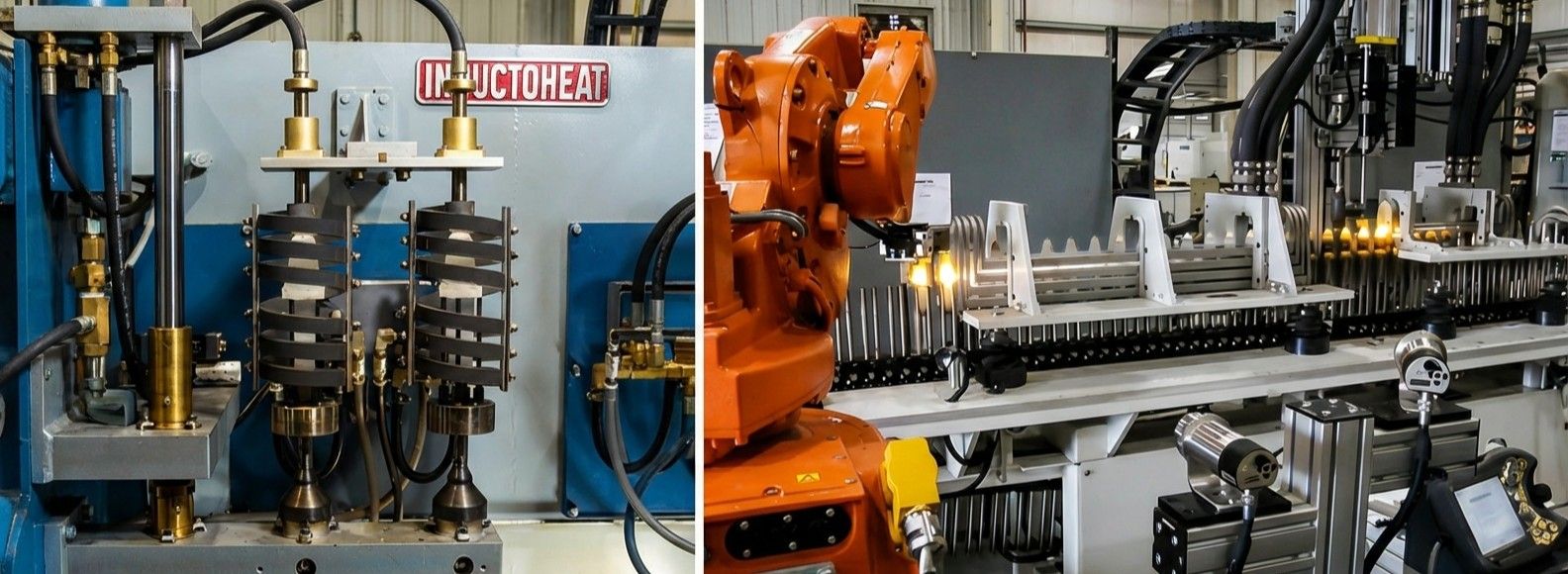
In high-speed manufacturing, IH is frequently used to prepare components for mechanical joining. A primary example of induction joining is the heating of the end of an axle hub before it is friction welded. In this application, the hub is spun at high speed and pressed against the axle housing or housing assembly. The initial induction preheat is vital as it reduces the mechanical force required for the weld and ensures a more consistent, high-quality weld bead. Without this controlled preheat, the sudden mechanical friction might lead to irregular bonding or excessive wear on the welding machinery.
Another specialized application is the induction bonding of automotive vibration damper assemblies. These assemblies typically comprise multiple different materials that must be bonded together reliably to withstand the continuous mechanical stresses of the engine environment. Induction allows for the precise application of heat to the specific interface where the bond is required, ensuring that sensitive damping materials are not degraded by excess heat. This process highlights induction's capability to handle complex assemblies where material compatibility is a primary engineering concern.
Brazing and Soldering
Brazing and soldering are among the most classic industrial uses for induction, where two metallic pieces are held sufficiently close together with a precise gap. In these applications, the joint area is heated until a filler material (braze or solder) flows into the joint via capillary action. Precise temperature control and the critical gap between the two pieces are essential for achieving a successful, leak-free joint. Industrial systems often combine hardening and brazing in a single operation to maximize throughput. A prominent example is the production of tool bits for the mining industry, where tungsten carbide working tips are brazed onto steel shanks. This combined cycle ensures the shank has the required toughness while the tip is securely bonded for extreme service conditions.
To ensure successful wetting and flow of the filler material, a flux is applied to the joint to prepare the surface and enhance material flow. The localized nature of induction heating prevents the "filler" material from melting before the base metals have reached the appropriate temperature, while also avoiding the overheating of areas adjacent to the joint. This level of control is particularly beneficial when working with complex geometries or assemblies where overheating could lead to distortion or unwanted changes in the material's microstructure.
Adhesive Bonding and Curing
Induction-assisted bonding offers a versatile alternative to traditional mechanical fastening. A significant advantage of this approach is that the components being joined do not both need to be metallic; it is sufficient if only one component is electrically conductive and capable of being heated by induction. The heat generated in the metallic part is then transferred to a non-conductive adhesive, such as an epoxy or thermal setting glue, triggering a rapid and controlled cure. This technique is widely applied in automotive body assembly to bond different sections of sheet metal panels.
The process can be configured as a continuous bond, creating a complete seal around the periphery of a component using a single power supply. Alternatively, "spot bonding" can be utilized, where the panel is fastened at discrete locations to replace traditional spot welds. For spot bonding, a series of small, individual power supplies are often used. This configuration provides individual control of the temperature at each bonding point, which is more effective than attempting to control multiple points by contouring a single large inductor or relying solely on flux concentrators. This flexibility allows engineers to precisely tailor the bonding strength and thermal profile to the specific requirements of the assembly.
Precision Assembly: Shrink Fitting and Disassembling
Induction heating is a staple in precision assembly through shrink fitting, a process used for the heating of various types of housings and base assemblies to allow the insertion of another component, such as a shaft, pin, or bearing. This process relies on the predictable thermal expansion of metal. The base assembly with a mating hole is typically heated to approximately 200°C. Once the area around the hole has expanded sufficiently, the inner component can be inserted freely or with minimal pressure. Upon cooling, the outer part shrinks around the inner part, creating a powerful mechanical interference fit. A classic example is the automotive steering knuckle, which has a wheel spindle inserted into a hole in the knuckle using this method.
Shrink Fitting Best Practices
- Uniform Heating: It is critical to use low frequencies for these applications to ensure deep thermal penetration and uniformity of expansion throughout the desired area of the base assembly.
- Mass Considerations: Sufficient mass around the hole must be heated for the hole size to increase. If local heating is restricted to the inside of the hole (e.g., using I.D. inductors for a short duration), the metal may expand inward, reducing the hole diameter and preventing insertion.
- Disassembly and Salvage: Induction can be applied to the reverse process. For example, motor frame heating is used to soften epoxies, allowing the frame to break apart so high-value components can be salvaged from open frame motor posts.
Motor Rotor Manufacturing and Efficiency
The production of electric motor rotors has seen a significant shift from traditional ovens to induction heating. This transition is driven by several factors: traditional furnaces (fossil fuel, resistance, or infrared) consume valuable floor space, negatively impact the working environment, and involve large quantities of product in the workflow. Induction, by contrast, allows for rapid start-up, shutdown, and faster product changeovers, which are essential for modern just-in-time manufacturing environments.
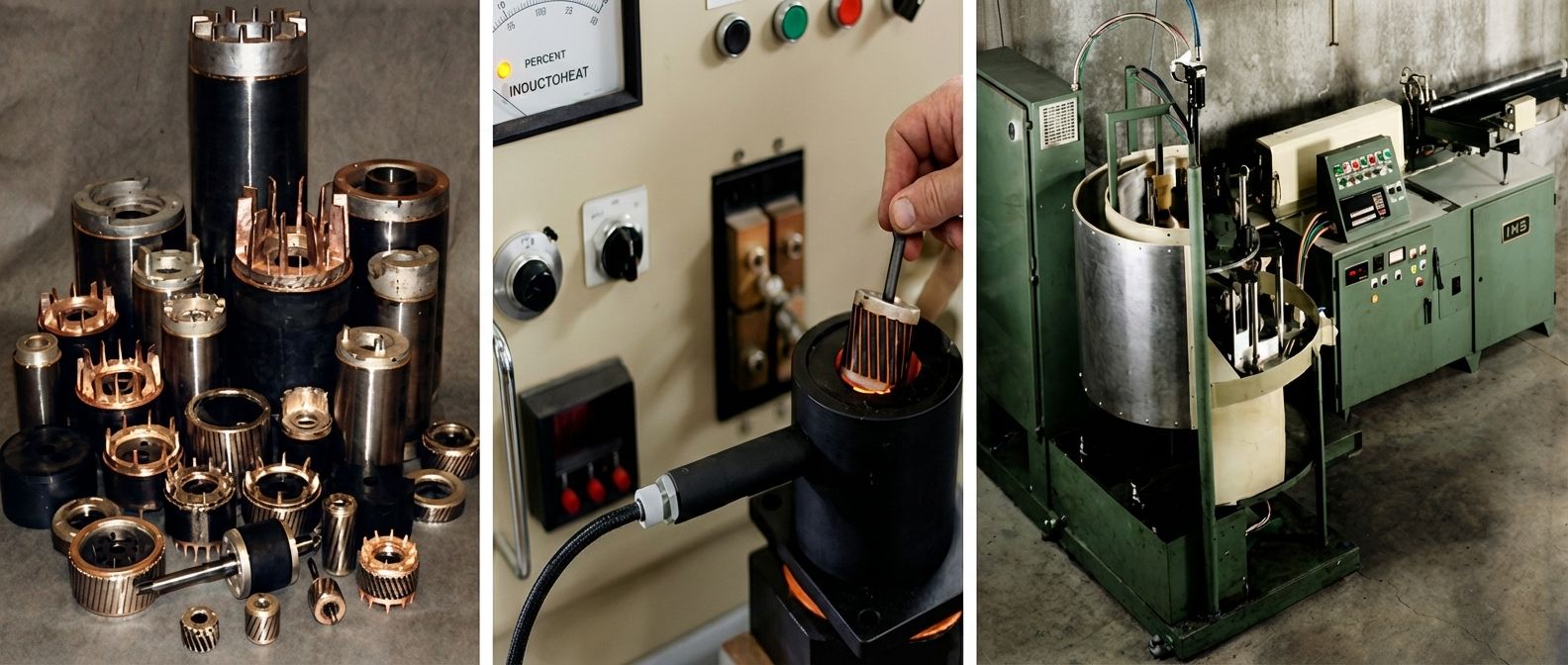
In the production of small- and moderate-size motors, induction is integrated into several critical stages:
- Die-Cast Preparation: Induction is used for preheating before die-casting to ensure proper metal flow and bond quality.
- Thermal Shocking: This process breaks the bond in die-cast aluminum rotors to improve electrical efficiency by reducing parasitic losses.
- Lamination Bluing: Controlled induction heating creates an oxide layer (bluing) that prevents rust and increases electrical resistivity between laminations, further boosting motor efficiency.
- Curing Processes: Induction is used for curing varnish and epoxies used in component assembly, such as stator-in-housing assembly and field ring magnet bonding.
- Shaft Assembly: Shrink fitting for motor shaft insertion is a primary application, often automated for high throughput.
High-capacity systems, such as 100-kW/1-kHz in-line induction rotor heaters, demonstrate the potential for automation. These systems can process hundreds of rotors per hour (e.g., 240 units/hr) and include magazine loading, automated shaft positioners, and spray quench systems. They are designed to handle a wide range of rotor diameters and stack heights, providing precise heating up to 510°C (950°F) while maintaining a compact footprint on the factory floor.
Seam Annealing and Structural Integrity
In the manufacture of tubular products, such as pipes formed from flat metallic strips or plates, a straight longitudinal or spiral seam is created and welded. These welded seams typically exhibit a heterogeneous microstructure, which is associated with high brittleness, poor toughness, and a high susceptibility to cracking under stress. While full-body annealing of the entire tube is an option, it is energy-intensive and time-consuming. Selective heat treatment of the welded area—induction seam annealing—provides a more efficient solution.
To focus the heat precisely on the seam, specialized inductors like split-return and butterfly-type coils are employed. These coil arrangements are designed to provide high field strength specifically in the joint area. The efficiency of the process is further enhanced by using flux concentrators (laminations) that focus the magnetic field into a narrow band along the weld line. By restoring ductility and toughness only where it was lost during welding, manufacturers can produce high-quality tubular products with a significantly lower energy footprint compared to traditional full-body heat treatment methods.
Induction-Assisted Laser Processing
Combining induction with laser technology represents a powerful hybrid approach to materials processing. Because of the nature of lasers as high-intensity heat sources, they can produce extreme temperatures and significant thermal gradients. This often results in transient and residual stresses, as well as unwanted microstructures or an undesirable increase in hardness due to intense mass cooling rates. These factors can worsen the ductility and toughness of the processed material.
Induction pre-heating and post-heating can assist in a noticeable reduction or elimination of these drawbacks. By reducing thermal gradients and improving the distribution of stresses, induction helps prevent cracking and produces more desirable microstructures. Common hybrid applications include induction-assisted laser welding, weld-based additive manufacturing, surface remelting, cladding, and hardening. In these scenarios, the induction coil provides a broader, more gentle thermal foundation that allows the high-precision laser to perform its work without the risk of thermal shock or brittleness in the heat-affected zone.
Induction in Food, Chemical, and Consumer Industries
The versatility of induction heating extends into industries that do not primarily focus on heavy metalworking. In these cases, induction often heats a metallic intermediary (a susceptor) or a small metallic component within a larger non-metallic assembly, providing safety and control benefits that traditional methods cannot match.
|
Industry |
Key Application |
Primary Benefit |
|---|---|---|
|
Food |
Cooking stoves, extruders, large cauldrons for caramel |
Direct heating of vessels results in faster and more efficient energy use. |
|
Papermaking |
Calendar roll temperature control with multiple spaced coils |
Allows for precise monitoring and adjustment of paper thickness and quality. |
|
Chemical |
Reactor and distillation equipment heating (e.g., pharmaceuticals) |
Eliminates open flames, providing superior safety, ease of control, and efficiency. |
|
Pharmaceutical |
Tamper-evident cap sealing using aluminum foil liners |
Guarantees product purity and provides consumer confidence in safety. |
Beyond these categories, induction is used in industries like wool and wood processing for drying materials as they pass along production lines, often by heating a metal plate that contacts the material. In the chemical industry, even the "losses" in the inductor copper—which usually just heat cooling water—can be maximized by using high-resistivity materials like stainless steel to intentionally create steam or heat fluids. These examples demonstrate that induction is not just for melting and hardening; it is a precision thermal tool used for drying, distilling, and regulating industrial processes.
Cap Sealing: Protecting the Consumer
Induction cap sealing is a vital application in both the food and pharmaceutical sectors, developed to address concerns regarding illegal tampering. In this process, a small layer of aluminum foil is placed on top of a container that has been filled and inspected. As the container passes under an induction coil, the foil is heated sufficiently to bond it to the rim of the container. This creates a hermetic seal that virtually guarantees the product reaches the consumer in the same state and purity as it was packaged at the factory. This high-speed, reliable technology has become a global benchmark for consumer protection.
Miscellaneous and Emerging Frontiers
The reach of induction heating continues to expand into specialized niches. For example, "lost core" melt-out systems use induction to remove plastic or wax molds from complex castings. In the maritime and oil industries, induction is used for de-bonding coatings from massive oil tanks and ship hulls. Automotive applications include preheating rubber bushings for air suspension systems. At the cutting edge of technology, induction is used for crystal growing for electronics, induction pumping of liquid metals, and levitation heating.
Emerging research even extends induction into medical and environmental fields, such as nanoparticle heating for hyperthermia treatments, processing of hazardous wastes, and optical fiber draw processing. Advanced systems are even being tested for solar-powered Stirling engines and induction thermal plasmas. As engineering challenges become more complex and the demand for energy-efficient, localized heating grows, the precise and controllable nature of electromagnetic induction ensures it will remain a critical component of the industrial toolkit for decades to come.
FAQ
Q: Why is induction heating preferred over traditional ovens in motor rotor manufacturing?
Induction heating offers rapid start-up and shutdown, faster product changeovers, and a smaller floor footprint compared to traditional furnaces. It eliminates the need for large quantities of product in the workflow and doesn't negatively impact the working environment, making it ideal for modern just-in-time manufacturing. Additionally, it can be integrated directly into automated production lines for processes like shaft insertion, lamination bluing, and epoxy curing.
Q: How does induction-assisted laser processing improve material quality?
Lasers alone can create extreme thermal gradients that lead to cracking, brittleness, and undesirable microstructures. By adding induction pre-heating and post-heating, manufacturers can reduce these thermal gradients and distribute stresses more evenly. This hybrid approach prevents thermal shock, improves ductility and toughness, and produces better microstructures in applications like laser welding, additive manufacturing, and surface hardening.
Q: What is induction cap sealing and why is it important?
Induction cap sealing is a tamper-evident packaging method used in food and pharmaceutical industries. A layer of aluminum foil is placed on a container, then heated by an induction coil as it passes through production. The foil bonds to the container rim, creating a hermetic seal that guarantees product purity and prevents illegal tampering. This high-speed, reliable technology has become a global standard for consumer protection.
Keep Learning
How to Upgrade a 3D Printer Heated Bed with a Silicone Heater
If your 3D printer heated bed takes too long to reach temperature, develops uneven heating, or struggles to maintain a stable surface temperature, a silicone heater can be a practical upgrade. Faster warm-up and more uniform heat can improve first-layer consistency and reduce temperature-related printing issues. This guide explains how to identify when a heated-bed upgrade is needed, choose a suitable silicone heater, install it safely, and verify the results. Quick Answer A silicone heater can be a s......
How Graphene and MXene Flake Sensors Detect Force
Key Takeaways Flake networks sense force through microstructural change: Graphene and MXene coatings distribute conduction across overlapping platelets whose contacts shift under stretch or pressure, producing measurable resistance changes. Three mechanisms compete: Crack propagation, flake slippage, and quantum tunnelling each dominate at different deformation levels, giving many sensors multiple sensitivity regions rather than one uniform response. The substrate is an active partner: Elastomers, tex......
Conductive 2D Coatings Are a Matching Problem, Not a Miracle Ink
Key Takeaways Ink is a system, not a material: Conductivity depends on the combined effect of flake chemistry, solvent, additives, substrate, coating method, and post-processing—not on the 2D filler alone. Three carbon routes carry different trade-offs: GNPs demand dispersion engineering, GO shifts effort to a reduction step, and MXenes move the bottleneck to synthesis, storage, and oxidation control. Substrate geometry drives method selection: Spray and blade coating suit flat sheets; dip coating nat......
Graphene Heat Spreader Design: Layers and Interfaces
Key Takeaways Conductivity alone is not enough: A record thermal-conductivity value does not guarantee a cooler chip. Effective thickness, interface resistance, hot-spot geometry, and heat-sink connections all belong to the same thermal path. Few-layer graphene can outperform a single layer in practice: A few-layer sheet provides a larger heat-flow cross section and better tolerates transfer, embedding, and defects, even though its intrinsic conductivity is lower. Interface resistance is the bottlenec......
How Graphene Heat Spreaders Cool SOI Chip Hot Spots
Key Takeaways Buried oxide is a thermal bottleneck: SOI's insulating layer improves electrical isolation but traps heat near transistor channels, creating dangerous hot spots that package-level cooling alone cannot fix. Graphene enables lateral heat routing: Placing graphene or few-layer graphene beneath the buried oxide adds a high-conductivity sideways path, redistributing hot-spot energy toward dedicated sinks without removing any heat itself. Multi-source chips benefit most: Finite-element modelin......
Graphene Heaters Look Brilliant in the Lab. Can They Survive the Real World?
Key Takeaways Undoped graphene simplifies reliability: By avoiding chemical dopants that can migrate or degrade, undoped CVD graphene removes one failure route — though it starts with higher sheet resistance than doped alternatives. Layer stacking is a design trade-off: Each added graphene layer lowers resistance and voltage requirements but also reduces optical transmission and introduces potential transfer defects such as wrinkles and polymer residue. Durability is the real barrier: After one year i......