Avoid PCB Assembly Failures: Mastering Solder Mask Expansion Rules and Best Practices
6 min
- Introduction: Why Solder Mask Expansion is Critical for PCB Reliability
- Standard Values and Core Concepts of Solder Mask Expansion
- Design Rules and Best Practices for Optimal Solder Mask Expansion
- Manufacturing Challenges and Professional Solutions for Solder Mask Expansion
- Impact of Expansion on Soldering Yield and Long-Term Reliability
- Conclusion: Achieve Perfect Solder Mask Results with Professional Expertise
- FAQ: Common Questions About Solder Mask Expansion

Solder mask protects copper traces and pads from oxidation, bridges, and contamination during assembly. Incorrect solder mask expansion—the clearance around features where mask is pulled back—leads to defects like shorts or exposed copper. Engineers must set expansion values precisely to ensure reliable soldering and long-term performance.
Introduction: Why Solder Mask Expansion is Critical for PCB Reliability
Understanding Solder Mask and Expansion Basics
Solder mask is a polymer layer applied over the PCB to insulate copper except at solderable areas. Expansion defines how much the mask opening extends beyond the pad or trace edge, typically 0.05–0.1 mm per side. This accounts for registration tolerances during mask alignment and prevents mask from encroaching on pads. In liquid photoimageable (LPI) masks, common in professional fabrication, expansion ensures clean openings after exposure and development.
How Poor Expansion Leads to Assembly Issues
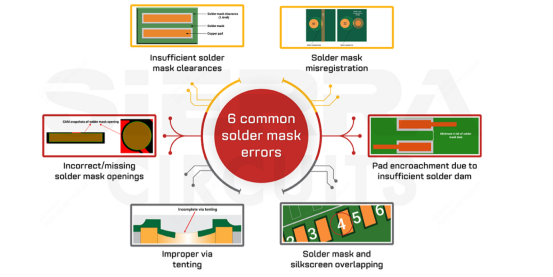
Insufficient expansion causes mask to overlap pads, leading to poor solder wetting or dry joints. Excessive expansion exposes traces to oxidation or shorts from solder bridges. In high-density designs, these issues increase rework costs and failure rates by 20–30%. Proper expansion also aids in wave soldering by controlling solder flow and reduces tombstoning in reflow.
Standard Values and Core Concepts of Solder Mask Expansion
Clearance, Overlap, and Expansion Definitions
Clearance is the distance from pad edge to mask edge, positive for expansion (mask pulled back) or negative for overlap (mask covers edge). Overlap protects fine traces from etchant but risks assembly if too large. Expansion values balance manufacturing tolerance (alignment accuracy ±0.05 mm) and assembly needs, with clearance ensuring at least 0.025 mm exposed copper ring for solder fillet formation.
Industry Standards and Recommended Values
IPC-7351 recommends 0.05–0.075 mm expansion for SMD pads and 0.1 mm for through-hole. For vias, tenting (full coverage) or plugging uses zero or negative expansion. In high-reliability boards, adjust for mask type—LPI allows tighter 0.05 mm vs. dry film at 0.075 mm.
| Feature Type | Recommended Expansion (mm) | Tolerance Consideration | Notes |
| SMD Pads | 0.05–0.075 | ±0.025 | Ensures wetting without bridges |
| Through-Hole Pads | 0.1–0.15 | ±0.05 | Accommodates annular ring |
| Traces | 0.025–0.05 | ±0.025 | Prevents exposure in fine lines |
| Vias (Untented) | 0.05–0.1 | ±0.05 | Allows plugging if needed |
| BGA Pads | 0.025–0.05 | ±0.025 | Tight for fine pitch |
Table 1: Standard solder mask expansion values by feature type.
These values derive from IPC standards and fabrication capabilities, where tighter tolerances require advanced alignment.
Design Rules and Best Practices for Optimal Solder Mask Expansion
Rules for Pads, Vias, Traces, and High-Density Areas
For SMD pads, set expansion to 0.05 mm to expose enough copper for solder fillet while avoiding bridges in 0.5 mm pitch. Vias need 0.1 mm if untented to prevent solder wick, or zero for tenting to block ingress. Traces require minimal 0.025 mm to protect from etchant without narrowing effective width. In high-density areas, scale expansion down to 0.025 mm for 0.4 mm pitch, but verify with DFM to match fabrication limits.
Common Pitfalls and How to Avoid Them (Slivers, Bridging)
Slivers occur when expansion creates thin mask strips (<0.1 mm) that peel during curing—avoid by increasing clearance or merging openings. Bridging happens with negative expansion on close pads—use dams (0.1 mm wide mask strips) between pads. Check Gerber files for mask misalignment risks, and use teardrops on vias to enhance adhesion.
Special Cases: SMD Pads, BGA, and High-Density Designs
BGA pads demand NSMD (non-solder mask defined) with 0.05 mm expansion for better alignment tolerance. SMD pads favor SMD (solder mask defined) with slight overlap for protection. High-density designs integrate dams to prevent solder flow between fine-pitch pads, ensuring 0.075 mm min dam width for reliable curing.
Manufacturing Challenges and Professional Solutions for Solder Mask Expansion
Impact of Expansion on Soldering Yield and Long-Term Reliability
Tight expansion improves yield by ensuring clean pad exposure for HASL or ENIG finishes, but too small risks incomplete development, leaving residue that causes poor wetting. Over time, insufficient expansion exposes copper to humidity, accelerating corrosion. Optimal values support reflow profiles with peak 260°C, reducing voids by 15–25%.
Advanced Process Controls in Professional Fabrication
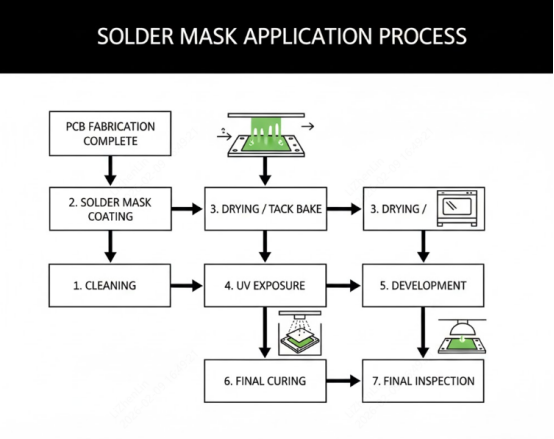
Professional processes use LPI mask with 0.01–0.03 mm thickness for high resolution. Exposure aligns to ±0.025 mm using laser imaging, and development removes unexposed areas precisely. Curing at 150°C hardens the mask without shrinkage. Multi-color options (green, black, blue) affect thermal properties, with matte finishes reducing glare in inspection.
How Expert Manufacturers Handle Expansion Tolerances and Variations
Fabricators control tolerances through automated coating and double-sided application for uniformity. Test coupons verify expansion on each panel. Variations from board thickness or copper density are mitigated with adaptive exposure. DFM reviews adjust for 4-layer vs. multilayer, ensuring 0.05 mm min for high-density.

Conclusion: Achieve Perfect Solder Mask Results with Professional Expertise
Solder mask expansion is key to avoiding shorts, poor joints, and corrosion. Use 0.05–0.1 mm for most pads, scale for density, and follow IPC for reliability in consumer or industrial boards.
JLCPCB excels in precise solder mask application with LPI technology, achieving ±0.025 mm alignment and 0.01–0.03 mm thickness. Their multi-color options (green, black, white, blue, red) suit various needs, with matte finishes available. Quick-turn prototyping lets you test expansion settings, and free DFM checks catch issues early. Upload designs at jlcpcb.com for instant quotes and fabrication that ensures assembly success.

FAQ: Common Questions About Solder Mask Expansion
Q1: What is the ideal solder mask expansion for SMD pads?
A: 0.05–0.075 mm per side to ensure good solder wetting without risking bridges; adjust based on pitch and IPC guidelines.
Q2: How does negative expansion affect PCB reliability?
A: It provides overlap for trace protection but can cause poor wetting if too large (>0.05 mm); use sparingly on fine pads to avoid assembly defects.
Q3: Why use dams in high-density designs?
A: Dams (0.1 mm wide mask strips) prevent solder bridging between close pads; minimum width ensures curing stability.
Q4: Can solder mask expansion vary by mask color?
A: No, but multi-color options affect visibility and thermal properties; green is standard, black suits high-contrast inspection.
Keep Learning
Choosing the Right Surface Finish for Your PCB: An Overview of HASL, ENIG, OSP, Immersion Tin and Immersion Silver
Key Takeaways Lead-Free HASL: Best low-cost, RoHS-compliant finish for general PCB builds. ENIG: Superior flatness and 12+ month shelf life for fine-pitch BGAs. OSP: Ultra-flat, lowest-cost option for high-volume SMT (3–6 month shelf life). Immersion Silver: Ideal for high-frequency RF by eliminating nickel signal loss. Immersion Tin: Best for press-fit connectors and fine-pitch assembly. Printed Circuit Boards (PCBs) are essential components in the manufacturing of electronic devices ranging from sma......
Conformal Coating in PCB Technology: Benefits, Challenges, and Future Developments
If you're searching for conformal coating, you're likely looking for a reliable way to protect your PCB from moisture, dust, chemicals, or harsh environments. Choosing the right coating directly affects product reliability, performance, and lifespan. In this guide, you'll learn what conformal coating is, the main types available, and how to select the best option for your application. We'll also cover key benefits, application methods (manual, automated, and selective), as well as inspection, rework, ......
PCB Gold Fingers: Why They Matter and How to Design Them
Key Takeaways PCB gold fingers provide reliable electrical and mechanical contact for PCBs that connect to external connectors or card slots. ENIG is suitable for general contact applications, while electroplated hard gold offers higher wear resistance for repeated insertion and removal. Gold fingers should remain fully exposed, with solder mask and silkscreen kept away from the contact area. Proper chamfering and gold finger orientation are essential to ensure smooth insertion and prevent damage duri......
Comparing HASL and ENIG Surface Finishes for PCBs
Selecting the right surface finish for a printed circuit board (PCB) is crucial to ensuring its performance, reliability, and longevity. Two of the most commonly used finishes are Hot Air Solder Leveling (HASL) and Electroless Nickel Immersion Gold (ENIG). Each of these surface finishes offers distinct advantages and disadvantages, making them suitable for different applications. In this article, we will compare HASL and ENIG to help you determine which finish is best suited for your PCB project. What......
Avoid PCB Assembly Failures: Mastering Solder Mask Expansion Rules and Best Practices
Solder mask protects copper traces and pads from oxidation, bridges, and contamination during assembly. Incorrect solder mask expansion—the clearance around features where mask is pulled back—leads to defects like shorts or exposed copper. Engineers must set expansion values precisely to ensure reliable soldering and long-term performance. Introduction: Why Solder Mask Expansion is Critical for PCB Reliability Understanding Solder Mask and Expansion Basics Solder mask is a polymer layer applied over t......
The Ultimate Guide to OSP Surface Finish in PCB Manufacturing: Advantages, Process, and Selection
Key Takeaways OSP (Organic Solderability Preservative) is a water-based, cost-effective PCB surface finish that deposits a 0.2-0.5μm organic film directly onto copper pads. Unlike metallic finishes such as ENIG or HASL, OSP provides superior surface flatness for fine-pitch SMT components at no extra process charge, making it ideal for high-density consumer electronics. However, OSP requires controlled handling and a limited assembly window (24-48 hours after opening vacuum packaging). It is best suite......