Hard Gold PCB Finish: Achieving Exceptional Wear Resistance and Contact Performance
13 min
- Hard Gold vs. ENIG and Soft Gold: Key Distinctions
- Design Considerations for Optimal Hard Gold Implementation
- Precision Manufacturing of Hard Gold Finishes
- JLCPCB's Expertise in High-Quality Surface Finishes for Diverse PCB Needs
- Frequently Asked Questions (FAQ)
Surface finishes are not all the same thing, and this is obvious beyond mention when you are dealing with parts that are beaten against one another over and over. Hard gold. The most common finish used when PCBs must complete hundreds or even thousands of insert-and-remove operations before going out of service is essentially a hard alloy of gold electroplated over a nickel barrier coating. The prototypical piece of evidence that demonstrates why this is important is the edge connector, otherwise known as a gold finger. These miniature card edge contacts are inserted into similar connectors on motherboards, backplanes, and test boards, and each time they collide with something, they receive a bit of abrasion.
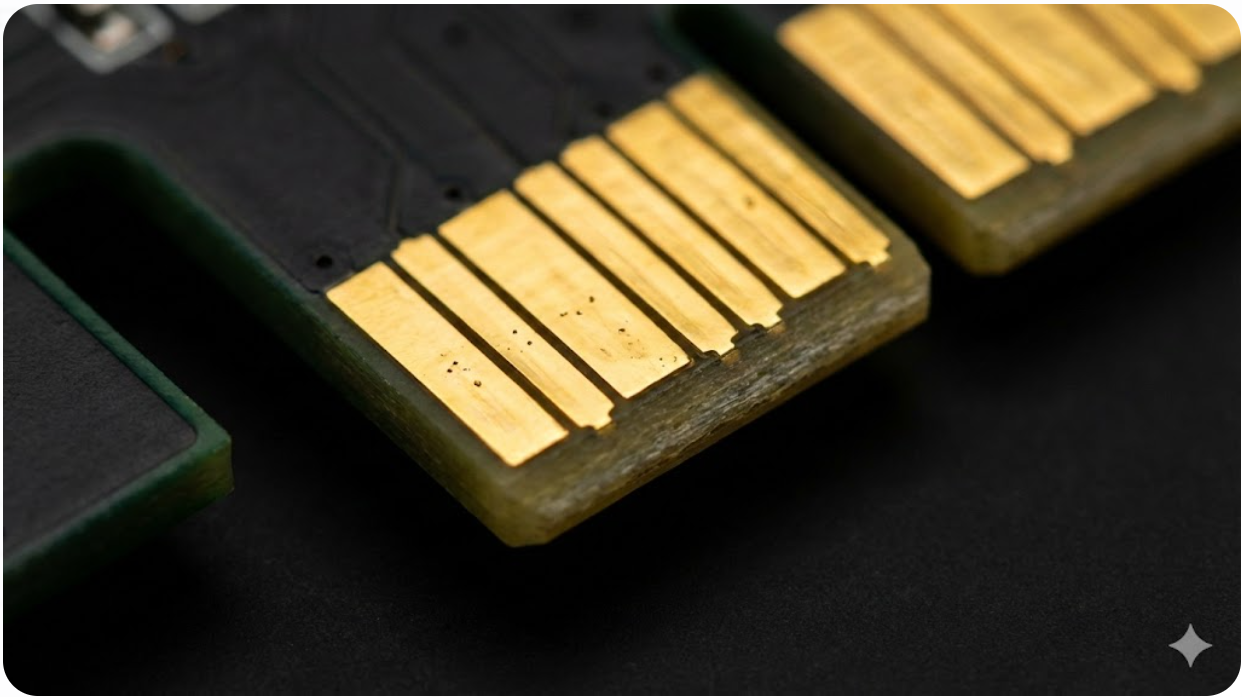
With a typical ENIG finish (that thin 0.05 - 0.1 micrometer gold plating), you would get the gold to wear away in only a couple of dozen insertion cycles, revealing the nickel metal underneath it, then copper. The result of that is increased contact resistance, oxidation, and bizarre connection failures. Hard gold fixes, which are made hard by a much thicker gold layer (typically 0.5-1.5µm, sometimes up to 2.5µm) mixed with a small amount of cobalt or nickel. This thickness and hardness combination enables hard gold contacts to pass through 500-1000+ insertion cycles and maintain the contact resistance low and constant throughout the entire life of the part. Other typical applications are membrane keypad contacts, test-point pads on bed-of-nails fixtures, slider contacts in potentiometers and switches, and anywhere there is a contact surface that rubs or abrades back and forth.
Applications Requiring Superior Durability Over Standard Finishes
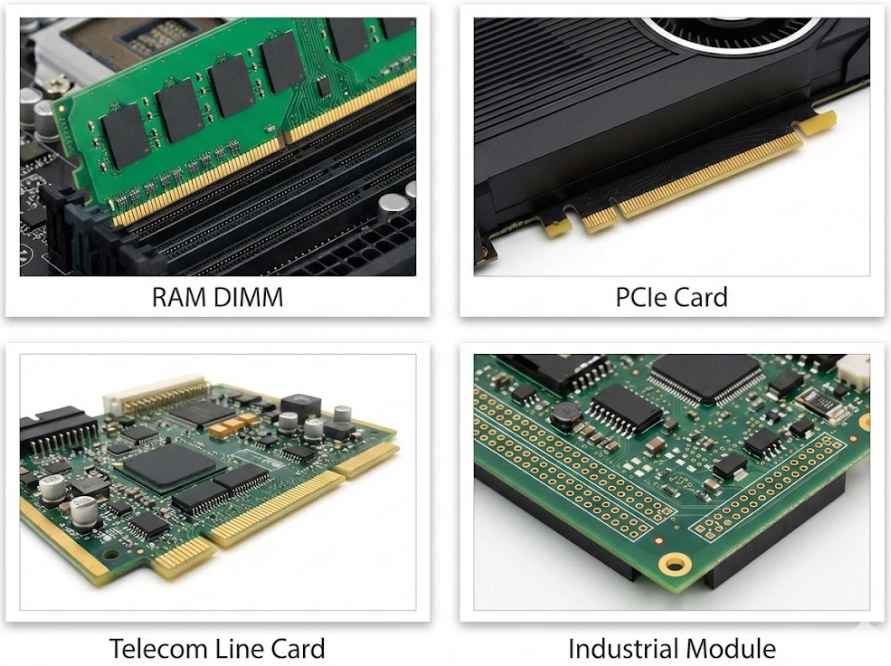
In addition to the insertion connectors, hard gold is required in cases where the reliability of contacts during mechanical stress is required over a long period. The card cage architecture of industrial control systems utilises gold finger edge connectors that are required to be serviceable over a 15-20 year period of periodic maintenance and reconfiguration. Test and measurement equipment is based on gold-plated test points and probe pads, which are required to sustain a constant level of contact resistance over millions of test cycles.
Field-replaceable modules, such as line cards, switching modules, optical transceivers, etc., are provided with edge connectors. The life of the contact surface finish in any of these applications is directly related to system reliability and the cost of maintenance. Hard gold is also being used in high-reliability connector contacts in safety-related systems in the automotive industry. The electronic control units (ECUs) of the braking, steering, and powertrain cannot withstand the contact degradation throughout the lifetime of the vehicle, and hard gold is a reasonable investment in spite of its high price.
Hard Gold vs. ENIG and Soft Gold: Key Distinctions
Thickness, Hardness, and Brittleness Trade-Offs
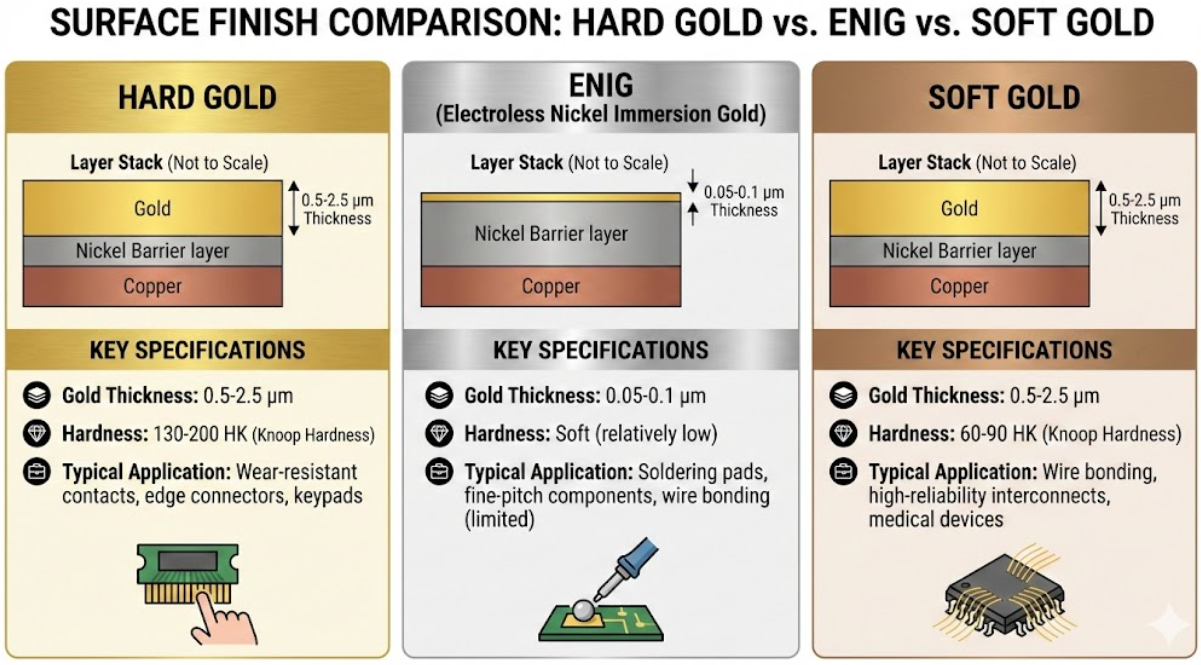
When choosing a finish on your board, you must be conversant with hard gold, ENIG, and soft gold. ENIG, which is an abbreviation of Electroless Nickel Immersion Gold, deposits a small gold layer (0.05-0.1µm) over a 3-6µm nickel layer. That gold is soft and pure, and it has the primary purpose of covering the nickel prior to you soldering. ENIG is a good choice in case you are soldering flat parts, but you cannot expect it to be the least wear-resistant; that thin layer of gold will be all but worn away after even a few blows.
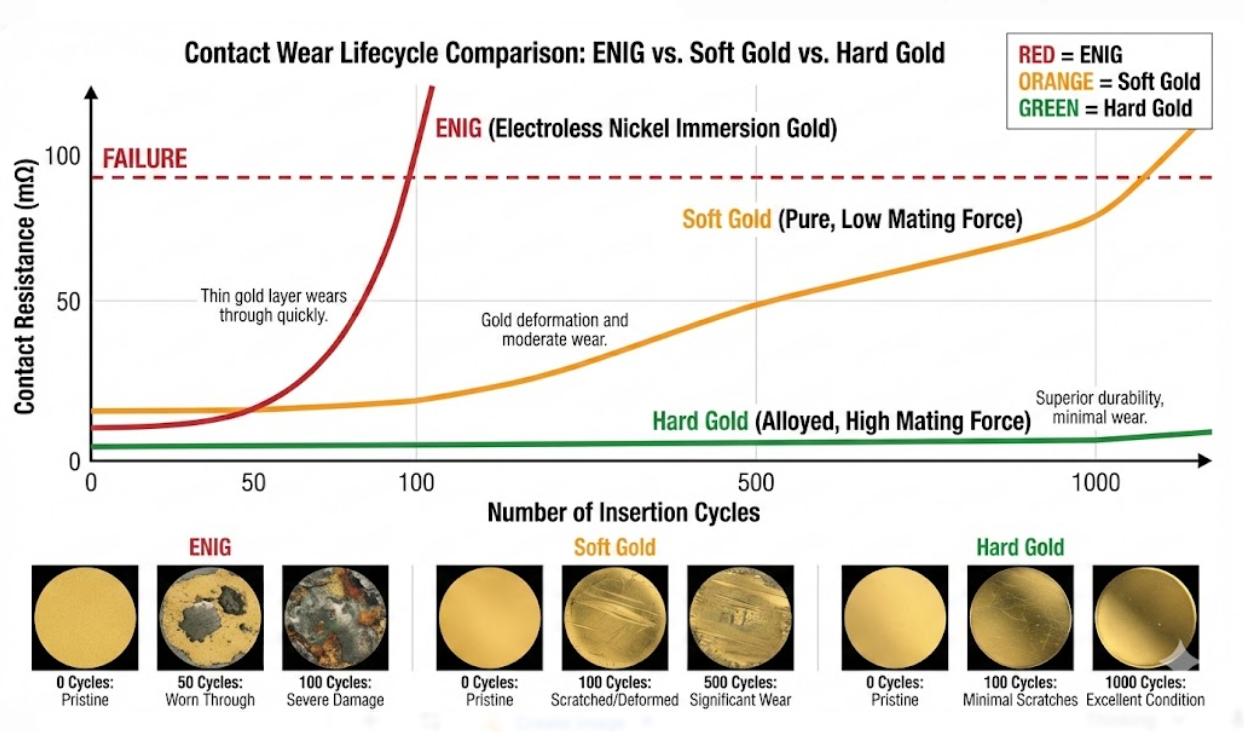
Soft gold (also known as bondable gold or Type III gold) is actually gold electroplated; it is nearly 100 percent pure (99.7 percent+). It is normally 0.5-2.5µm, and it is super ductile, which is why it is ideal to use in wire-bonding, whereby the tool is required to dent the gold to establish a connection. The flip side? It is not good in sliding contacts since it is easy to wear out due to low hardness (60-90 HK).
A different beast is hard gold - Type I or Type II. It is electroplated gold with a trace of cobalt or nickel (0.1 -0.3%), which results in a final hardness of 130-200 HK Knoop. The wear resistance is terrific with that hardness increase, and yet conductive. The thing about it is that once you exceed 2.5µm in thickness, the layers may become brittle and fracture when they are stressed.
Electroplated Process Advantages for Wear Resistance
The electroplated nickel-gold method (or electrolytic nickel-gold), which produces hard gold, is in fact superior to the chemical (electroless) one. When you need it, you can have uniform coatings down to 0.25 - 2.5 µm thick with electroplating by simply varying the plating time and current density to get the desired thickness. The nickel underlayer (typically 2.5-5.0µm) serves as a diffusion barrier to prevent copper from entering the gold, and also provides a hard substrate, such that the gold layer will not deform due to contact pressure.
It is also selective, gold only forms where there is a linkage to the plating bus (the current-carrying traces that are between the plating pads and the panel edge as you make the board). That allows hard gold on edge connectors and another finish, such as ENIG or some other finish, on the soldering pads in the same board, so each area is optimized to its purpose.
Pro-Tip: When specifying hard gold, always indicate the gold thickness, nickel thickness, and plating area clearly in your fabrication notes and drawing. Ambiguous specifications lead to incorrect plating thickness or plating on the wrong areas, both expensive mistakes to correct.
Cost and Performance Comparisons in Real Projects
The ENIG vs hard gold cost comparison is stark. ENIG typically adds 5-15% to the bare board cost, while hard gold on edge connectors can add 20-50% or more, depending on the plating area and gold thickness. The gold material cost alone is high, as gold pricing fluctuates with commodity markets, and thicker plating means proportionally more gold consumed. However, the cost comparison must account for the application’s lifetime requirements. A server backplane with 50 line card slots, each requiring 500+ insertion cycles over a 10-year service life, has no economically viable alternative to hard gold.
The cost of field failures from worn contact surfaces (technician dispatch, downtime, replacement parts) vastly exceeds the premium for hard gold plating. For designs with minimal insertion requirements (fewer than 20 cycles), ENIG or even OSP may suffice. The decision should be driven by a realistic assessment of the contact’s lifecycle mechanical demands, not by default specification.
Design Considerations for Optimal Hard Gold Implementation
Finger Spacing, Beveling, and Plating Area Definition
Gold finger design follows specific rules to ensure reliable mating and long-term performance. Finger width and spacing must match the mating connector specification precisely. Standard edge connector pitches include 1.27mm (50 mil), 1.0mm, and 0.8mm for high-density applications.
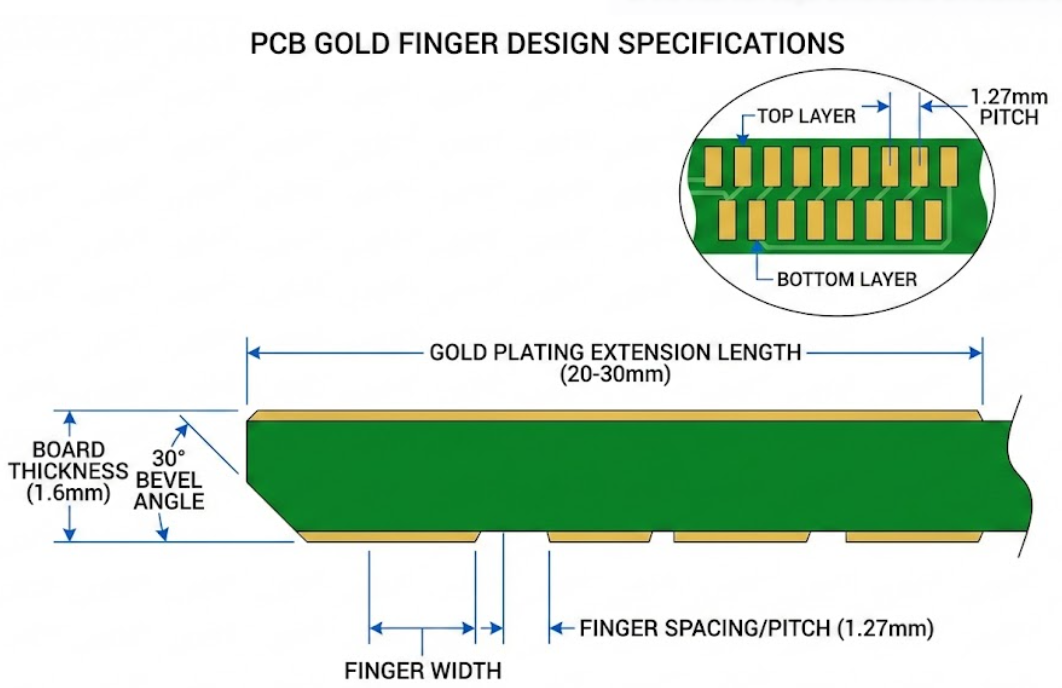
Beveling is chamfering the board edge at a 30-45 degree angle that facilitates smooth insertion into the mating connector and reduces the initial contact force that can damage the gold surface. Most gold finger designs specify a 30-degree bevel on the insertion edge.
Plating area definition requires careful attention. The gold must extend far enough from the board edge to maintain contact with the connector throughout the full insertion depth, but should not extend unnecessarily because every additional square millimeter of gold plating adds cost. A typical gold finger extends 20-30mm from the board edge, depending on the connector specification.
Avoiding Brittleness Issues Through Proper Thickness Control
The largest thing we need to look out for in hard gold projects is gold brittleness. When we make it too thick, say more than 2.5 μm thick, it may develop internal stresses and crack, especially along sharp corners or edges. The hardening cobalt or nickel that provides the hardness also decreases the ductility; therefore, we have a sweet spot of thickness that is optimal between wear resistance and mechanical integrity.
Most edge connector material takes 0.75-1.5µm of hard gold over 2.5-5.0µm of nickel to strike that sweet spot. The combination of that can be repeated thousands of times and remain soft enough to prevent cracking during flex-folding or heating of the board. Should we require the stuff to be extreme-duty, such as exceeding 1,000 cycles, we may increase the gold to 2.0 - 2.5 µm, but we certainly must not allow it to go around sharp geometry transitions, which would accumulate stress.
Integration with Overall PCB Layout and DFM Rules
Hard gold areas require special consideration in the overall PCB layout. Plating bus traces must connect all gold finger pads to a common plating rail during fabrication. These traces are typically routed on the same layer as the gold fingers and are removed (by routing or scoring) after plating is complete. The designer must plan for these temporary connections in the layout. Solder mask must be carefully defined to expose only the intended gold plating areas while protecting adjacent features.
Soldermask-to-gold registration tolerance is critical mask overlap onto gold fingers creates insertion interference, while excessive gap exposes copper that can oxidize. DFM review should verify that gold finger dimensions match the target connector specification, bevel dimensions are correctly defined, plating bus routes are feasible, and the transition zone between gold-plated and non-gold-plated areas is properly managed.
Precision Manufacturing of Hard Gold Finishes
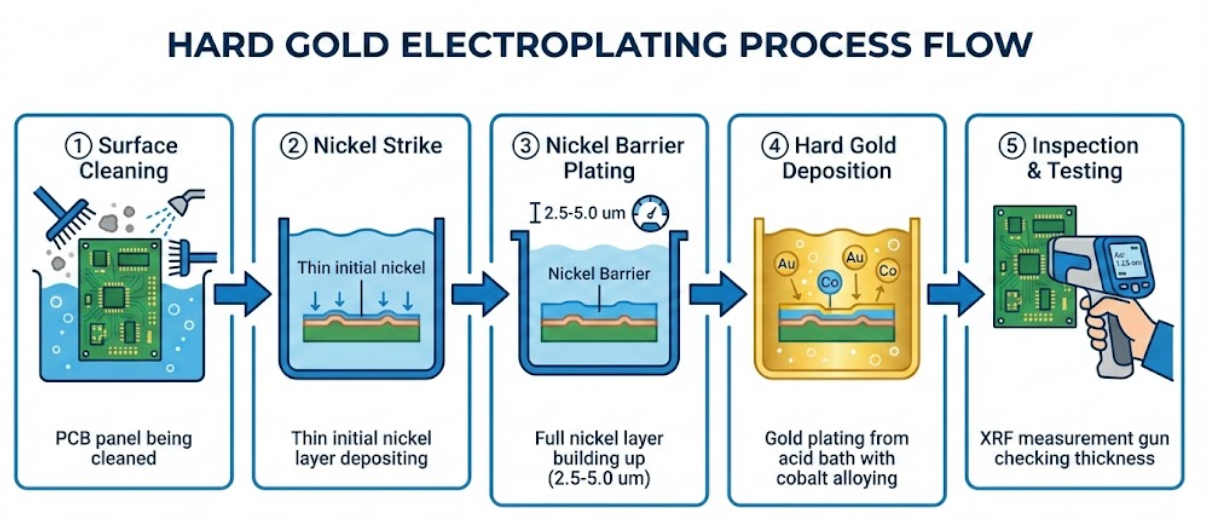
Electroplating Nickel Barrier and Gold Layer Deposition
Basically, therefore, the entire hard gold thing begins when all the rest on the board is finished. We need to clean up the copper first, and then we have to plate it. Laying down a nickel strike layer, then immediately followed by the main nickel barrier (approximately 2.5-5.0mm of sulfamate nickel). That provides the board with a hard base and prevents diffusion.
When the nickel is in, we shift out to the gold. It is produced out of an acid gold bath containing cobalt or nickel. We monitor the present density, bath temperature, and agitation extent of the stuff, so the gold is hard enough and the grains. We check it using coulometric measures of thickness to ensure that the gold finishes the correct thickness in all locations.
Uniformity Control and Post-Process Cleaning Techniques
It is hard to make the gold smooth on all the fingers of a panel. The edges and angles are more likely to be struck by the current (that is, the dog-boning thing), and in those places, the thickness is much greater than the thickness in the middle. To correct that, the plating shops are equipped with additional anodes, current thieves, and intelligent rack constructions to distribute the current and ensure that the thickness difference is minimal.
We then plate, and we clean the board to remove any remaining chemicals, flux, and contamination that may interfere with the contacts. An ultrasonic clean followed by a deionized water rinse. We then examine the gold with a magnifier, looking at it to see whether it has pitting, nodules, staining, and general dirt.
Rigorous Testing for Adhesion, Hardness, and Contact Resistance
We test hard gold in a number of tests when we check it. The X-ray fluorescence (XRF) tests the validity that the gold and nickel layers have reached the minimum and maximum thicknesses at various points. The tests of microhardness of the knoop ensure that the alloy of gold is flattened into 130-200 HK.
An adhesion test (tape test according to IPCTM650) is also done to ensure that the gold and nickel actually adhere to each other and to the copper. It is also measured by the contact resistance, and it must be low and uniform- this is essential in a sound electrical contact. These tests are performed on actual production samples and coupons in order to ensure that each batch is spec-matched.
JLCPCB's Expertise in High-Quality Surface Finishes for Diverse PCB Needs
When designing edge connectors or high-density boards, balancing wear resistance, solderability, and overall unit cost is key. While JLCPCB currently focuses on highly automated, streamlined manufacturing and does not offer electroplated hard gold finish, we provide fully optimized, industry-standard surface finishes that effectively serve the vast majority of electronic designs—including golden finger connectors for moderate-insertion-cycle applications.
For boards requiring edge connectors, JLCPCB applies our precision Electroless Nickel Immersion Gold (ENIG) finish to the gold fingers. Our controlled ENIG process delivers a super-flat contact surface, exceptional tarnish resistance, and robust contact reliability for moderate mating cycles, all while keeping production costs significantly lower than hard gold plating.
Beyond ENIG for edge contacts, JLCPCB offers a robust spectrum of surface finishes tailored to various design priorities:
- ENIG (Electroless Nickel Immersion Gold): Our primary choice for multi-layer (6+ layers), high-frequency, and fine-pitch designs such as BGA and QFN components. It provides an ultra-flat planar surface, outstanding shelf life, and superior solder joint reliability.
- Lead-Free HASL and Leaded HASL (Hot Air Solder Leveling): The classic, cost-effective finish for general-purpose electronics, offering strong thermal resistance and excellent solderability for standard SMT and through-hole soldering.
- OSP (Organic Solderability Preservative): An eco-friendly, ultra-flat protective coating that shields bare copper from oxidation without adding metallic surcharges. It is ideal for high-volume, fine-pitch surface-mount assemblies.
Supported by fully automated processing lines, rigorous AOI and X-ray quality inspections, and fast turnarounds, JLCPCB delivers high-precision surface finishes with tight tolerances, ensuring your designs achieve peak reliability without over-engineering your budget.
Frequently Asked Questions (FAQ)
Q. What is the difference between hard gold and ENIG?
ENIG deposits a thin (0.05-0.1µm) soft gold layer over nickel using a chemical process. Hard gold electroplates a much thicker (0.5-2.5µm) cobalt-alloyed gold over nickel using electrical current.
Q. How many insertion cycles can hard gold withstand?
Properly specified hard gold (0.75-1.5µm over 2.5-5.0µm nickel) typically survives 500-1,000+ insertion cycles. Thicker gold (up to 2.5µm) can extend this further.
Q. Can hard gold and ENIG coexist on the same board?
Yes, this is common practice. Hard gold is applied to edge connectors and contact areas, while ENIG covers the soldering pads. The selective plating process deposits gold only on areas connected to the plating bus, allowing different surface finishes on the same board.
Q. Is thicker gold always better for hard gold applications?
No. Excessively thick hard gold (above 2.5µm) can become brittle and prone to cracking. The optimal thickness depends on the expected number of insertion cycles and the mechanical stress environment.
Q. Why is hard gold more expensive than other surface finishes?
Hard gold cost is driven by the gold material itself (commodity-priced precious metal), the thicker deposition (10- 50x more gold than ENIG), and the electroplating process requiring dedicated equipment and precise control.

Keep Learning
Choosing the Right Surface Finish for Your PCB: An Overview of HASL, ENIG, OSP, Immersion Tin and Immersion Silver
Key Takeaways Lead-Free HASL: Best low-cost, RoHS-compliant finish for general PCB builds. ENIG: Superior flatness and 12+ month shelf life for fine-pitch BGAs. OSP: Ultra-flat, lowest-cost option for high-volume SMT (3–6 month shelf life). Immersion Silver: Ideal for high-frequency RF by eliminating nickel signal loss. Immersion Tin: Best for press-fit connectors and fine-pitch assembly. Printed Circuit Boards (PCBs) are essential components in the manufacturing of electronic devices ranging from sma......
Conformal Coating in PCB Technology: Benefits, Challenges, and Future Developments
If you're searching for conformal coating, you're likely looking for a reliable way to protect your PCB from moisture, dust, chemicals, or harsh environments. Choosing the right coating directly affects product reliability, performance, and lifespan. In this guide, you'll learn what conformal coating is, the main types available, and how to select the best option for your application. We'll also cover key benefits, application methods (manual, automated, and selective), as well as inspection, rework, ......
PCB Gold Fingers: Why They Matter and How to Design Them
Key Takeaways PCB gold fingers provide reliable electrical and mechanical contact for PCBs that connect to external connectors or card slots. ENIG is suitable for general contact applications, while electroplated hard gold offers higher wear resistance for repeated insertion and removal. Gold fingers should remain fully exposed, with solder mask and silkscreen kept away from the contact area. Proper chamfering and gold finger orientation are essential to ensure smooth insertion and prevent damage duri......
Comparing HASL and ENIG Surface Finishes for PCBs
Selecting the right surface finish for a printed circuit board (PCB) is crucial to ensuring its performance, reliability, and longevity. Two of the most commonly used finishes are Hot Air Solder Leveling (HASL) and Electroless Nickel Immersion Gold (ENIG). Each of these surface finishes offers distinct advantages and disadvantages, making them suitable for different applications. In this article, we will compare HASL and ENIG to help you determine which finish is best suited for your PCB project. What......
Avoid PCB Assembly Failures: Mastering Solder Mask Expansion Rules and Best Practices
Solder mask protects copper traces and pads from oxidation, bridges, and contamination during assembly. Incorrect solder mask expansion—the clearance around features where mask is pulled back—leads to defects like shorts or exposed copper. Engineers must set expansion values precisely to ensure reliable soldering and long-term performance. Introduction: Why Solder Mask Expansion is Critical for PCB Reliability Understanding Solder Mask and Expansion Basics Solder mask is a polymer layer applied over t......
The Ultimate Guide to OSP Surface Finish in PCB Manufacturing: Advantages, Process, and Selection
Key Takeaways OSP (Organic Solderability Preservative) is a water-based, cost-effective PCB surface finish that deposits a 0.2-0.5μm organic film directly onto copper pads. Unlike metallic finishes such as ENIG or HASL, OSP provides superior surface flatness for fine-pitch SMT components at no extra process charge, making it ideal for high-density consumer electronics. However, OSP requires controlled handling and a limited assembly window (24-48 hours after opening vacuum packaging). It is best suite......