Precision in Power: The Engineer's Guide to Induction Mass Heating Applications
13 min
- Core Objectives of Induction Mass Heating
- Foundations of Mass Heating Engineering
- Bar, Rod, and Billet Reheating
- Selective Heating for Massive Components
- Specialized Heating: Thixoforming and Semi-Solid Casting
- Induction in Coating and Surface Treatment
- Conclusion: The Future of Mass Heating
- FAQ
In the modern metallurgical landscape, the ability to rapidly and precisely elevate the temperature of metallic stock is a cornerstone of efficient production. Induction mass heating (IH) has emerged as the premier technology for preparing materials for warm and hot forming—including forging, upsetting, rolling, and extrusion—as well as for critical preheating and post-heating in coating operations. Unlike traditional furnace methods that rely on ambient heat transfer, induction generates thermal energy directly within the workpiece, offering unparalleled control over temperature uniformity and process flexibility.
Core Objectives of Induction Mass Heating
- Temperature Uniformity: Achieving precise "surface-to-core," "end-to-end," and "side-to-side" profiles to prevent equipment wear and ensure forming quality.
- Throughput Maximization: Delivering high power (hundreds to thousands of kilowatts) for rapid production rates.
- Resource Efficiency: Minimizing metal loss due to scale, oxidation, and decarburization while maintaining a compact floor footprint.
System Flexibility: Adapting to varying geometries, sizes, and alloys through modular design and intelligent power distribution.
Foundations of Mass Heating Engineering
The fundamental goal of induction mass heating is to raise the workpiece temperature to a specified level while adhering to strict uniformity standards. Nonuniform heating is more than a quality concern; it is a mechanical risk. A piece of stock with cold spots can cause premature wear on hammers and presses or require excessive force during the forming stage. This "surface-to-core" temperature differential is a critical metric; if the core remains too cold, the material may not flow correctly, leading to internal stress or structural defects. Conversely, "end-to-end" and "side-to-side" uniformity ensures that the entire volume of the metal reaches the plastic deformation range simultaneously, preventing uneven strain on the forming tooling.
However, there are specialized scenarios where profiled or gradient heating is intentionally sought. In aluminum billet heating before extrusion, a controlled longitudinal thermal gradient—often 40°C to 80°C higher at the leading end—facilitates isothermal extrusion. As the billet is forced through the die at a constant ram speed, the trailing end (which starts cooler) heats up due to the friction and work of extrusion, resulting in a consistent temperature at the die exit. This precision is only achievable through the rapid, localized control offered by induction.
Engineering an effective induction system requires a delicate balance between frequency and power. Most mass heating applications utilize relatively low frequencies (50 Hz to 30 kHz) to achieve the deep heat penetration necessary for large-diameter billets. The skin effect—the tendency of alternating current to flow primarily on the surface of a conductor—dictates the depth of heat generation. For massive products, lower frequencies are essential to allow the core to be heated primarily by thermal conduction from the surface layers without causing subsurface overheating or grain boundary liquation in the outer layers.
When processing thinner materials like wire, thin-walled tubing, or narrow strips, frequencies can escalate to 200–600 kHz. In these cases, high frequencies are required to maintain electrical efficiency and prevent "eddy current cancellation," which occurs when the penetration depth is comparable to the material thickness. Furthermore, design must account for longitudinal end effects and transverse edge effects, which describe how electromagnetic energy concentrates or dissipates at the boundaries of the workpiece. Without proper compensation, these effects can lead to "over-heating" or "under-heating" at the edges and ends, compromising the structural integrity of the final part.
Bar, Rod, and Billet Reheating
The reheating of bars, rods, and billets represents the most ubiquitous application of induction heating in the forging industry. The engineering objective is to deliver a workpiece to the press or hammer with a temperature profile as uniform as possible across its entire volume. This is inherently challenging because electromagnetic energy is deposited in the surface layers, and the core must rely on thermal conduction to reach the target temperature. In high-speed production lines, this can lead to a significant lag, where the surface may approach the melting point while the core remains below the plastic range.
To manage this, modern systems employ multiple in-line induction coils. For large-diameter steel bars, a line may consist of over 30 coils, each precisely controlled to manage the heating rate. This modular design concept, exemplified by technologies like Inductoforge, allows for individual control of power and frequency at different stages of the heating process. By distributing the energy input, engineers can prevent the "burning" of the surface while ensuring the core reaches the required temperature. This modularity also provides unparalleled system flexibility, allowing the same line to process different alloys and diameters by adjusting the power distribution in real-time.
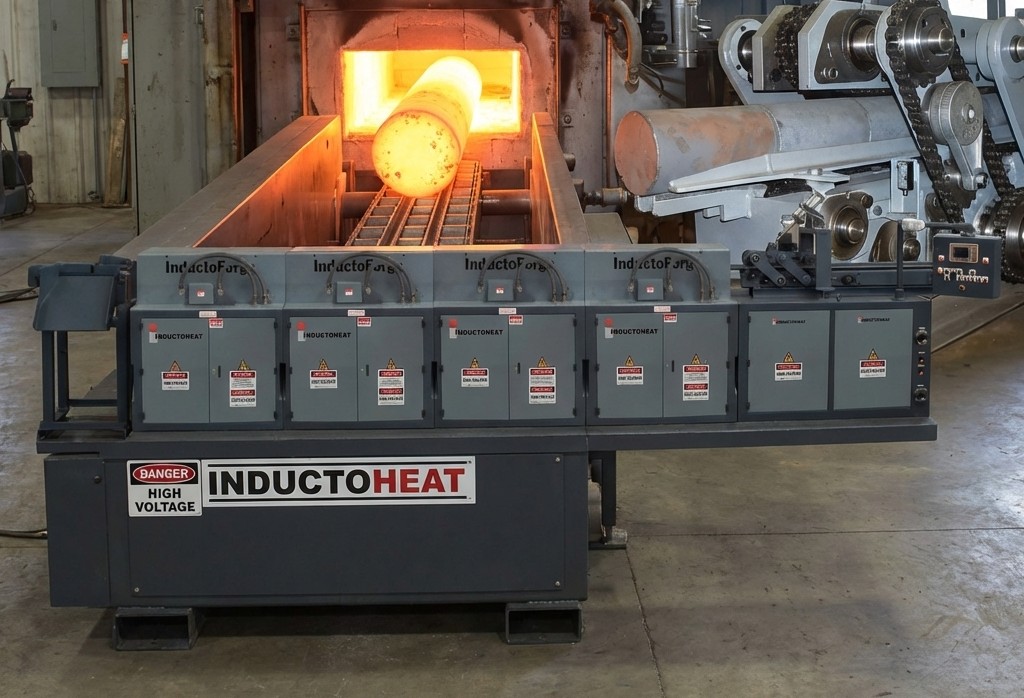
Transitioning from traditional gas-fired furnaces to induction offers more than just energy efficiency; it fundamentally improves product quality. Gas furnaces require massive tunnels to allow enough time for heat to soak from the surface to the core, which results in long exposure to high temperatures and oxygen. This leads to excessive scale formation and decarburization—the loss of carbon from the surface of the steel—which can weaken the final part and require additional machining. In contrast, induction heating's rapid cycle times minimize these surface reactions. Furthermore, induction allows for selective heating, enabling forgers to heat only the specific portions of a bar (such as the ends or the middle) required for localized forming, thereby saving energy and preserving the mechanical properties of the rest of the workpiece.
A critical operational challenge in billet heating is billet sticking or fusing. When billets are pushed through the coil line end-to-end, high contact pressures and temperatures can cause the ends to weld together. This is often mitigated by using automated "flying loaders" or sophisticated pushing systems that maintain the required separation and speed. Additionally, true temperature control is achieved through the use of non-contact infrared pyrometers and closed-loop feedback systems, ensuring that every billet leaves the line at the exact forging temperature required by the process recipe.
Selective Heating for Massive Components
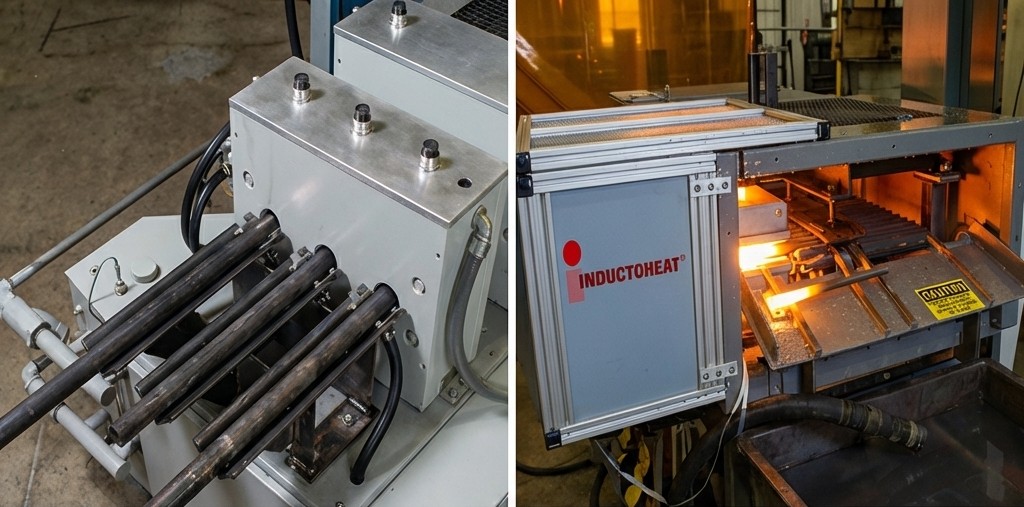
The precision of induction is most dramatically demonstrated in the production of massive marine crankshafts, which can exceed 20 meters in length and weigh over 300 tons. Forging such a part in its entirety is physically unfeasible. Instead, induction coils are used to selectively heat individual sections—such as journals or pins—to the forging range of 1100°C to 1300°C. Historically, this process was extremely inefficient; the entire blank had to be cooled between stages to "reset" the thermal profile and ensure that the next section started with a uniform ambient temperature.
Today, advanced control of electromagnetic end effects allows for successive heating and forging without intermediate cooling. By sensing the actual residual temperature distribution along the shaft using advanced sensors, the induction system can adaptively adjust the power distribution for the next section. This compensates for the heat conducted from previously forged sections, achieving a uniform longitudinal temperature profile before the next forging strike. This adaptive approach not only saves massive amounts of energy—as the residual heat is utilized rather than wasted—but also significantly reduces the overall cycle time for these critical components.
Specialized Heating: Thixoforming and Semi-Solid Casting
For specialized aluminum and magnesium alloys, thixoforming (or semi-solid casting) leverages induction's ability to maintain a workpiece in a partially liquid state—typically 50% solid and 50% liquid. The target temperatures are incredibly close to the melting point, necessitating automated systems that can control the temperature within a narrow window of ±3°C. If the temperature exceeds this limit, the semi-solid slug may sag or collapse into a "puddle." Induction is uniquely suited for this task because it provides the internal heat generation required to ensure high flow viscosity and low product porosity during forming, resulting in complex parts with superior structural integrity.
Heating of Tubular Products, Wires, and Cables
Hollow workpieces present a distinct set of electromagnetic challenges compared to solid billets. In a solid body, heat is conducted from the surface toward a cold core. However, in a tube or pipe, heat can be generated on both the outside (OD) and inside diameters (ID) depending on the wall thickness relative to the penetration depth. This "transparency" to the magnetic field means that if the wall is thin, eddy currents on the ID and OD may oppose each other, reducing efficiency. This necessitates specific coil designs and frequency selections for applications like annealing, stress relieving, and coating of pipes, ensuring that the entire wall reaches the target temperature without local cracking due to thermal stress.
Wire, rope, and cable heating often utilize continuous-feed systems with oval-bore coils and individual guides. Because wire has a high surface-to-volume ratio, it loses heat rapidly through radiation and convection. To combat this, induction lines often use dual-frequency designs. For example, a lower frequency (e.g., 10 kHz) might be used to heat the material below its Curie temperature where it is magnetic and absorbs energy easily, while a second, much higher frequency (e.g., 200 kHz) continues the heating efficiently once the material becomes non-magnetic. This approach ensures high throughput while maintaining the tight temperature control needed to prevent wire breakage or degradation.
Slab, Plate, and Bloom Reheating
Heating rectangular bodies like slabs and blooms involves managing complex electromagnetic phenomena, including the skin effect, longitudinal end effects, and transverse edge effects. Slabs, which can be over 3 meters wide, often arrive from the casting stage with highly nonuniform temperature profiles. The edges and corners cool much faster than the central core, creating a "bone-shaped" thermal profile. If such a slab were rolled without reheating, the cold edges would resist deformation, leading to "edge cracking" and severe rolling mill wear.
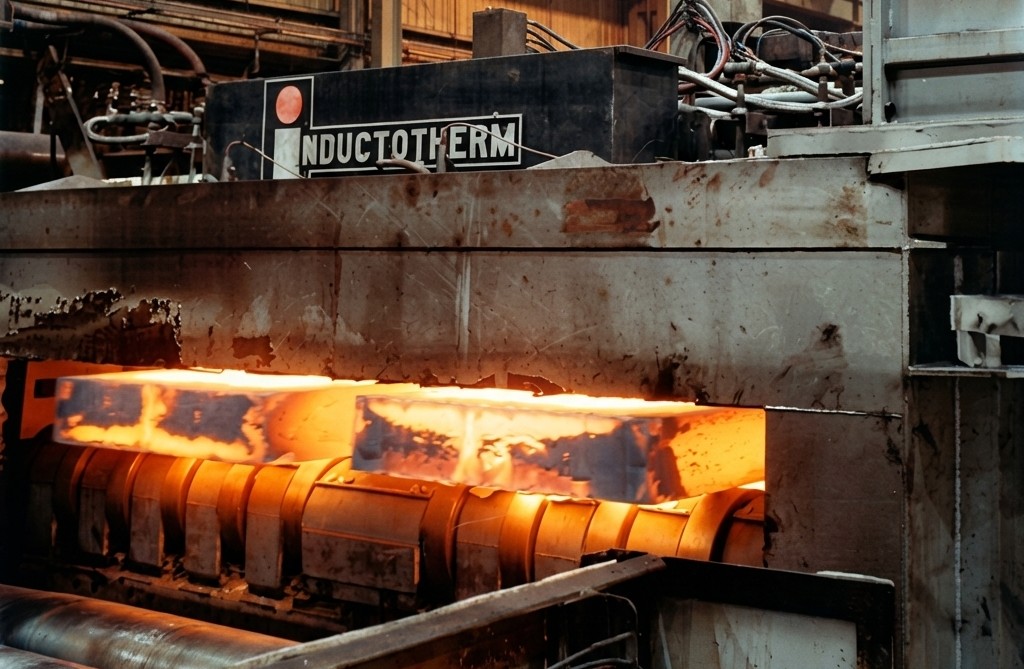
Efficient slab reheating requires predictive temperature control. The induction system must sense the incoming thermal profile and intentionally distribute heat sources nonuniformly—putting more energy into the cold edges and corners—to compensate for the initial temperature dips. This adaptive approach not only ensures a uniform output temperature for rolling but also maximizes energy savings by utilizing the residual heat from the casting process. The ability to "profile" the heat across the width of a 3-meter wide slab is a testament to the sophistication of modern induction inductor designs, such as transverse flux inductors, which can direct flux specifically where it is needed.
Induction in Coating and Surface Treatment
The final major application family for induction mass heating is the coating industry. This includes preheating before thermal spraying, the curing of paints and varnishes, and hot-dip coating processes like galvanizing, galvannealing, and galvaluming. The operational reasoning for choosing induction in these environments is often driven by speed, footprint, and the unique physics of internal heat generation.
Curing and Preheating
In curing applications for strips, wires, and sheets, induction offers a "substrate-first" heating advantage. Because heat is generated within the metal itself, it flows from the inside out. This allows gases and solvents to escape from the coating (outgassing) without creating pinholes or surface defects that are common in conventional convection ovens where the "skin" of the coating dries first. Induction curing is also significantly more compact; a system that replaces a 50-meter gas oven might only occupy 5 meters of floor space. Furthermore, the absence of lengthy "warm-up" and "cool-down" cycles allows the line to stop and start instantaneously, minimizing waste during downtime.
Galvanizing, Galvannealing, and Galvaluming
In continuous galvanizing lines, induction is used to heat the steel strip and maintain the temperature of the molten zinc bath. Galvannealing is a particularly critical process where the strip is reheated immediately after it emerges from the zinc bath. The goal is to remelt the coating and hold it at a specific temperature to facilitate the diffusion of iron from the steel into the zinc. This forms a series of zinc-iron alloys that significantly improve the paint adhesion and weldability of the strip—essential requirements for the automotive industry.
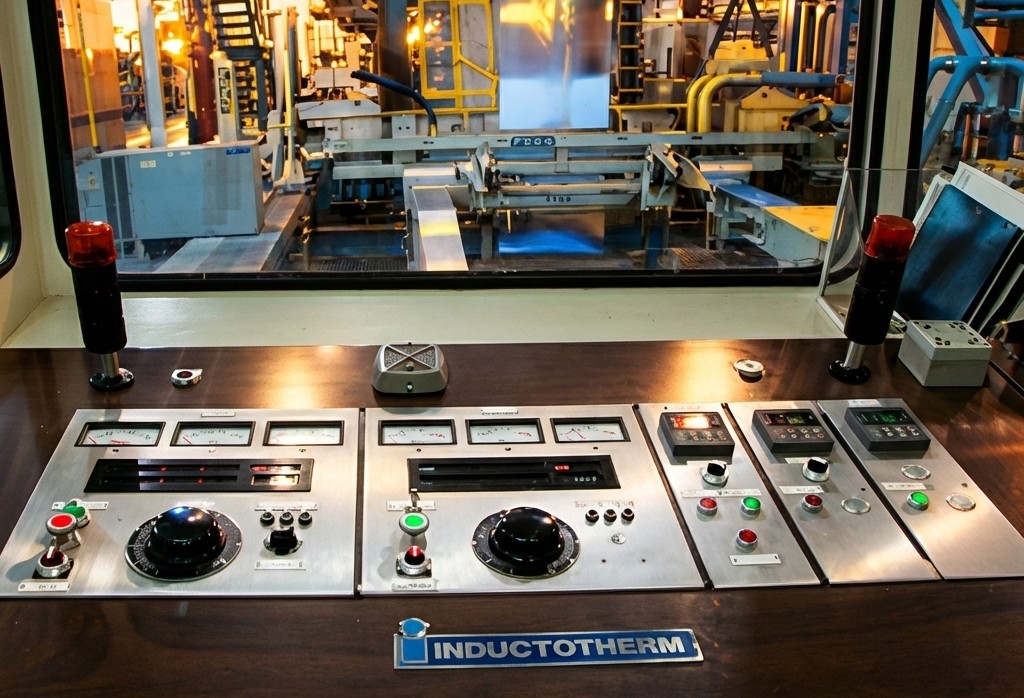
The operational reasoning for induction in these lines centers on instantaneous response. Since the line speed and material gauge can change rapidly, the induction system can adjust its power output in milliseconds to maintain the precise temperature required for the zinc-iron alloy formation. Advanced inductor designs, such as "doorless" inductors, are critical in these environments. By eliminating the mechanical contact doors that are prone to fouling by zinc dust, these systems reduce maintenance costs and improve line availability. Whether it is pure galvanizing or galvaluming (using a zinc-aluminum alloy), induction provides the "true temperature control" necessary to ensure a high-quality, malleable coating with minimal yield loss.
Conclusion: The Future of Mass Heating
Induction mass heating is far more than a simple heating method; it is a sophisticated engineering solution for high-volume, high-precision metal processing. Its success depends on the deep integration of electromagnetic theory and practical process control to manage complex effects like skin depth, edge concentrate, and thermal lag. From the controlled gradients needed for aluminum extrusion to the adaptive power distribution required for massive crankshafts and steel slabs, the technology's ability to provide rapid, uniform, and controllable heat is unmatched. As industries continue to prioritize energy efficiency, automation, and reduced carbon footprints, the role of induction in the metal-working shop floor will only continue to expand, providing the flexibility and reliability demanded by modern manufacturing.
FAQ
Q: Why is induction heating preferred over traditional gas furnaces for metal forming?
Induction heating generates heat directly within the workpiece, offering faster cycle times and better temperature control. This minimizes scale formation, oxidation, and decarburization—common issues with gas furnaces that expose metal to prolonged high temperatures and oxygen. Induction also enables selective heating of specific sections, saving energy while preserving the mechanical properties of unheated areas.
Q: What is the significance of "surface-to-core" temperature uniformity in mass heating?
Surface-to-core uniformity is critical because cold spots in the workpiece can cause premature wear on forming equipment and require excessive force during operations like forging or pressing. If the core remains too cold, the material won't flow properly, leading to internal stress, structural defects, or uneven strain on tooling. Achieving uniform heating ensures the entire volume reaches the plastic deformation range simultaneously.
Q: How does induction heating benefit galvannealing processes?
In galvannealing, induction provides instantaneous temperature control to remelt the zinc coating and hold it at a precise temperature for iron-zinc diffusion. This forms zinc-iron alloys that improve paint adhesion and weldability—essential for automotive applications. The system can adjust power output in milliseconds as line speed or material gauge changes, ensuring consistent coating quality with minimal yield loss.
Keep Learning
How to Upgrade a 3D Printer Heated Bed with a Silicone Heater
If your 3D printer heated bed takes too long to reach temperature, develops uneven heating, or struggles to maintain a stable surface temperature, a silicone heater can be a practical upgrade. Faster warm-up and more uniform heat can improve first-layer consistency and reduce temperature-related printing issues. This guide explains how to identify when a heated-bed upgrade is needed, choose a suitable silicone heater, install it safely, and verify the results. Quick Answer A silicone heater can be a s......
How Graphene and MXene Flake Sensors Detect Force
Key Takeaways Flake networks sense force through microstructural change: Graphene and MXene coatings distribute conduction across overlapping platelets whose contacts shift under stretch or pressure, producing measurable resistance changes. Three mechanisms compete: Crack propagation, flake slippage, and quantum tunnelling each dominate at different deformation levels, giving many sensors multiple sensitivity regions rather than one uniform response. The substrate is an active partner: Elastomers, tex......
Conductive 2D Coatings Are a Matching Problem, Not a Miracle Ink
Key Takeaways Ink is a system, not a material: Conductivity depends on the combined effect of flake chemistry, solvent, additives, substrate, coating method, and post-processing—not on the 2D filler alone. Three carbon routes carry different trade-offs: GNPs demand dispersion engineering, GO shifts effort to a reduction step, and MXenes move the bottleneck to synthesis, storage, and oxidation control. Substrate geometry drives method selection: Spray and blade coating suit flat sheets; dip coating nat......
Graphene Heat Spreader Design: Layers and Interfaces
Key Takeaways Conductivity alone is not enough: A record thermal-conductivity value does not guarantee a cooler chip. Effective thickness, interface resistance, hot-spot geometry, and heat-sink connections all belong to the same thermal path. Few-layer graphene can outperform a single layer in practice: A few-layer sheet provides a larger heat-flow cross section and better tolerates transfer, embedding, and defects, even though its intrinsic conductivity is lower. Interface resistance is the bottlenec......
How Graphene Heat Spreaders Cool SOI Chip Hot Spots
Key Takeaways Buried oxide is a thermal bottleneck: SOI's insulating layer improves electrical isolation but traps heat near transistor channels, creating dangerous hot spots that package-level cooling alone cannot fix. Graphene enables lateral heat routing: Placing graphene or few-layer graphene beneath the buried oxide adds a high-conductivity sideways path, redistributing hot-spot energy toward dedicated sinks without removing any heat itself. Multi-source chips benefit most: Finite-element modelin......
Graphene Heaters Look Brilliant in the Lab. Can They Survive the Real World?
Key Takeaways Undoped graphene simplifies reliability: By avoiding chemical dopants that can migrate or degrade, undoped CVD graphene removes one failure route — though it starts with higher sheet resistance than doped alternatives. Layer stacking is a design trade-off: Each added graphene layer lowers resistance and voltage requirements but also reduces optical transmission and introduces potential transfer defects such as wrinkles and polymer residue. Durability is the real barrier: After one year i......