Precision and Power: Navigating the Evolution and Design of Modern Induction Heating Systems
8 min
- The Physics of Selective Heating
- Visualizing Current Distribution
- The Technological Shift: From Mechanical to Solid-State Power
- The Complexity of Modern Design
- Audience and Use Cases
- Summary and Future Directions
- FAQ
Induction heating (IH) stands as one of the most transformative technologies in modern metallurgy and manufacturing. At its core, it is a method of heating electrically conductive materials—typically metals—by utilizing the power of electromagnetic induction. Unlike traditional heating methods such as furnace heating or flame hardening, which rely on convection or radiation to transfer heat from an external source to the workpiece, induction heating generates heat directly within the material itself. This fundamental difference enables a level of precision, speed, and control that is virtually unmatched in the industrial world.
The Physics of Selective Heating
The defining characteristic of induction heating is its ability to be selective. Engineers can precisely target specific regions of a part—such as the teeth of a gear or the journal of a crankshaft—for heat treatment while leaving the rest of the component relatively unaffected. This selectivity is not merely a convenience; it is a critical metallurgical requirement for many high-performance components. To achieve this, designers must master the relationship between three primary physical variables: electrical resistivity, magnetic permeability, and frequency.
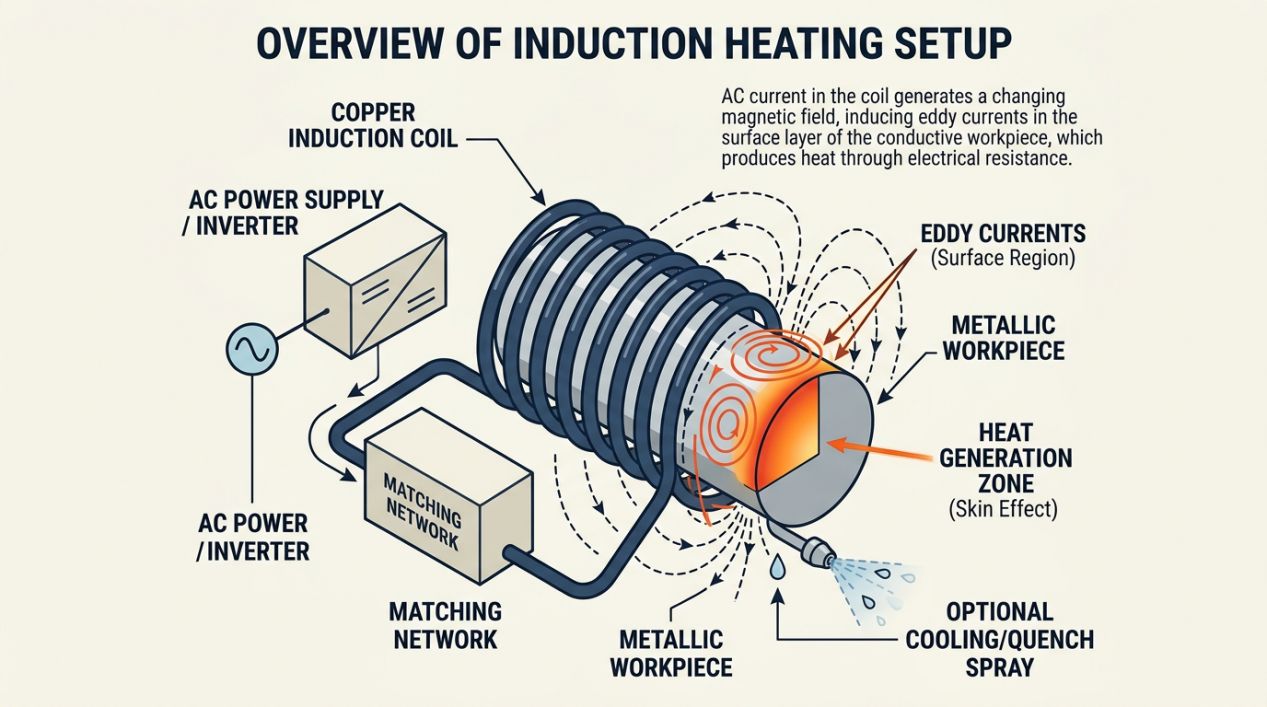
The selective nature of the process is governed by the skin effect, a phenomenon where alternating current (AC) tends to flow primarily on the outer surface of a conductor. The depth at which this current flows is known as the penetration depth. By adjusting the frequency of the AC power supply, engineers can control exactly how deep the induced currents—and therefore the heat—penetrate into the metal.
- Electrical Resistivity: This property determines the material's inherent resistance to the flow of eddy currents. As a material heats up, its resistivity typically increases (often by 4 to 6 times for steel), which in turn increases the penetration depth.
- Magnetic Permeability: This indicates how easily a material can conduct magnetic flux. Magnetic materials like steel have high permeability at room temperature, which keeps the current concentrated in a very thin surface layer. However, once the material reaches its Curie temperature, it becomes non-magnetic, and the penetration depth increases dramatically.
- Frequency: This is the primary tool for the designer. High frequencies result in shallow penetration (ideal for surface hardening), while lower frequencies allow for deeper heating (necessary for through-hardening or mass heating of large billets).
Visualizing Current Distribution
Understanding the distribution of current is essential for optimizing any induction process. As frequencies increase, the current density becomes more concentrated at the surface, a concept illustrated in the following diagram.
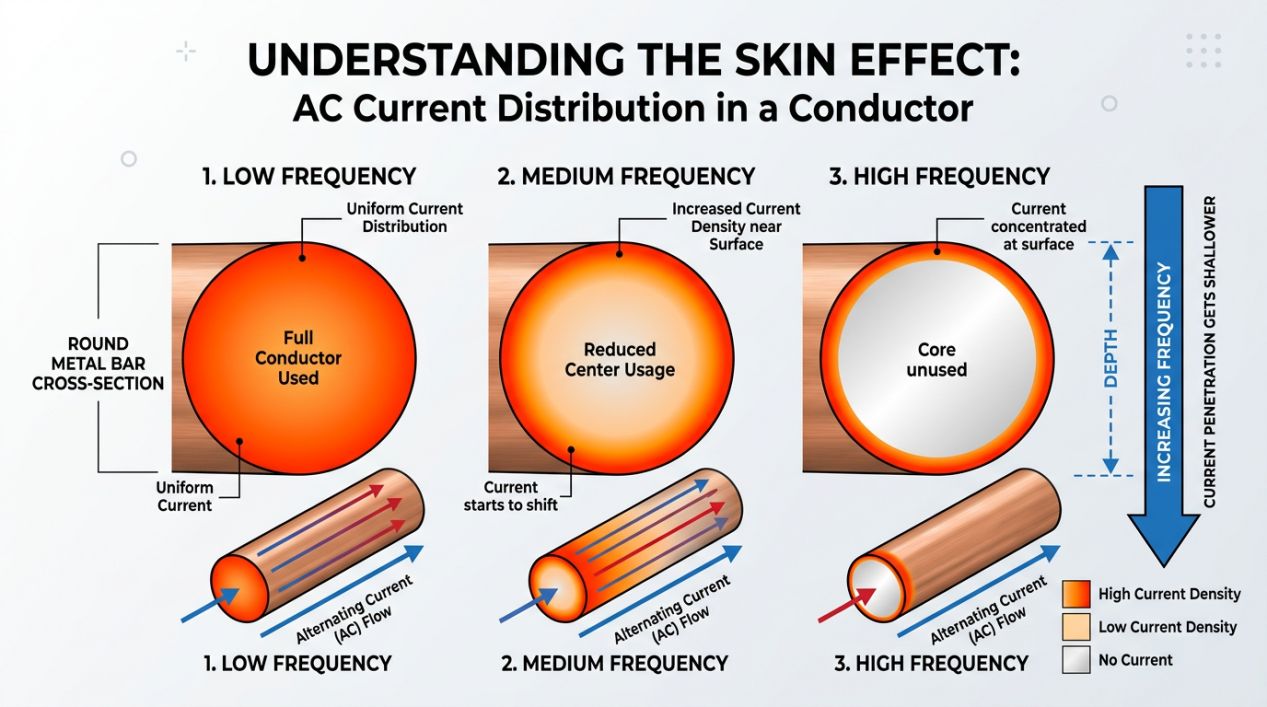
This extreme concentration of energy—where approximately 86% of the total power is dissipated within a single skin depth—is what allows induction to perform metallurgical feats that are impossible with other methods. For instance, surface hardening a crankshaft journal to improve wear resistance while maintaining a ductile, fracture-resistant core requires this precise control over penetration depth.
The Technological Shift: From Mechanical to Solid-State Power
The history of induction heating equipment is marked by a major technological pivot that occurred in the late 1960s. For decades prior, the primary source of high-frequency power was the motor generator. These were large, rotating mechanical devices that converted standard utility power into the frequencies needed for induction. While reliable for their time, they were inherently limited by their mechanical nature.
The development of high-current, high-voltage semiconductors revolutionized the field, leading to the rapid adoption of solid-state power supplies. This shift was driven by three critical industrial requirements:
-
Improved Process Efficiency: Solid-state systems eliminated the mechanical friction and significant electrical losses associated with large rotating machinery. This transition drastically reduced energy consumption and operational costs.
-
Lower Total Cost: While the initial investment in semiconductors was significant, the long-term costs of maintenance and manufacturing became much lower than those of complex mechanical generators that required constant lubrication and mechanical oversight.
-
Noise Reduction: Motor generators were notoriously loud, often requiring separate soundproofed rooms. The relatively quiet operation of solid-state cabinets vastly improved the safety and comfort of the factory floor environment.
The Complexity of Modern Design
In previous eras, induction system design often relied on "engineering intuition," basic electromagnetic formulas, and a trial-and-error approach. Today, that is no longer sufficient. Modern industry demands stringent levels of process precision, metallurgical quality, and energy efficiency that were unimaginable even 15 years ago.
Designing a successful induction system is now a multi-domain challenge. A change in one variable—such as the shape of a coil or the quenching rate—can have cascading effects on the final metallurgy, the electrical circuit stability, or the efficiency of the power supply. Modern designers must account for:
- Interrelated Physical Phenomena: The tight coupling between electromagnetic fields, thermal dynamics, and metallurgical transformations.
- Geometrical Intricacies: Managing the "Ring Effect" in curved coils, "Proximity Effects" between the coil and part, and the impact of holes, splines, or fillets on the workpiece.
- Advanced Simulation Needs: The necessity for sophisticated software to model the entire heating and cooling cycle, including phase transformations and residual stress formation.
Audience and Use Cases
The knowledge required to master induction heating is valuable to a wide range of professionals. Understanding the "nuts and bolts" of the technology is essential for those who make decisions at every level of the manufacturing process:
|
Professional Role |
Primary Value of Induction Knowledge |
|---|---|
|
Engineers & Designers |
To integrate induction systems effectively and leverage simulation tools while avoiding common modeling pitfalls. |
|
Metallurgists |
To predict microstructure changes during rapid heating and design cooling strategies that prevent cracking or distortion. |
|
Practitioners |
To troubleshoot floor equipment, optimize coil performance, and maintain process consistency. |
|
Managers & Purchasing |
To understand the complexity of the equipment and justify investments in high-quality, energy-efficient systems. |
|
Students & Scientists |
To bridge the gap between abstract electromagnetic theory and the practical realities of industrial heat treatment. |
Summary and Future Directions
The evolution of induction heating has transformed it from a manual craft into a high-precision science. At its core, the ability to selectively heat materials remains the technology's greatest lever. By mastering the interplay between frequency, electrical resistivity, and magnetic permeability, engineers can precisely control the heat distribution within a workpiece. This selective nature, governed by the skin effect, allows for localized metallurgical transformations that provide superior performance while maintaining the structural integrity of the component's core.
The historic shift from mechanical motor generators to solid-state power supplies revolutionized the industrial landscape. This transition was not merely a change in hardware but a move toward significantly higher process efficiency, lower long-term operational costs, and a substantial reduction in noise on the factory floor. Modern power electronics now provide the stability and control required to meet the stringent quality demands of contemporary manufacturing, enabling consistent results across millions of parts.
As we look forward, the design of induction systems continues to evolve into a multi-physics challenge. Successful implementation now requires deep multi-domain thinking that accounts for the tight coupling between electromagnetic fields, thermal dynamics, and metallurgy. The adoption of sophisticated simulation tools has become essential, allowing designers to model complex scenarios and avoid costly trial-and-error. By bridging the gap between theoretical physics and practical industrial application, modern induction heating stands as a cornerstone of efficient, data-driven manufacturing.
FAQ
Q: What makes induction heating different from traditional heating methods?
Induction heating generates heat directly within the material itself through electromagnetic induction, rather than transferring heat from an external source. This allows for precise targeting of specific regions—like gear teeth or crankshaft journals—while leaving other areas unaffected. The process is controlled by adjusting frequency, which determines how deeply the heat penetrates into the metal.
Q: Why did the industry shift from motor generators to solid-state power supplies?
The transition in the late 1960s was driven by three key advantages: improved energy efficiency by eliminating mechanical friction and electrical losses, significantly lower long-term maintenance and operational costs, and much quieter operation that improved factory floor conditions. Solid-state systems provide the stability and control needed for modern manufacturing quality standards.
Q: What factors do engineers need to control for selective heating?
Engineers manipulate three primary variables: electrical resistivity (the material's resistance to current flow), magnetic permeability (how easily the material conducts magnetic flux), and frequency (the main control tool). High frequencies create shallow penetration ideal for surface hardening, while lower frequencies enable deeper heating for through-hardening or heating large components. This interplay, governed by the skin effect, allows precise control over where heat is generated.
Keep Learning
How to Upgrade a 3D Printer Heated Bed with a Silicone Heater
If your 3D printer heated bed takes too long to reach temperature, develops uneven heating, or struggles to maintain a stable surface temperature, a silicone heater can be a practical upgrade. Faster warm-up and more uniform heat can improve first-layer consistency and reduce temperature-related printing issues. This guide explains how to identify when a heated-bed upgrade is needed, choose a suitable silicone heater, install it safely, and verify the results. Quick Answer A silicone heater can be a s......
How Graphene and MXene Flake Sensors Detect Force
Key Takeaways Flake networks sense force through microstructural change: Graphene and MXene coatings distribute conduction across overlapping platelets whose contacts shift under stretch or pressure, producing measurable resistance changes. Three mechanisms compete: Crack propagation, flake slippage, and quantum tunnelling each dominate at different deformation levels, giving many sensors multiple sensitivity regions rather than one uniform response. The substrate is an active partner: Elastomers, tex......
Conductive 2D Coatings Are a Matching Problem, Not a Miracle Ink
Key Takeaways Ink is a system, not a material: Conductivity depends on the combined effect of flake chemistry, solvent, additives, substrate, coating method, and post-processing—not on the 2D filler alone. Three carbon routes carry different trade-offs: GNPs demand dispersion engineering, GO shifts effort to a reduction step, and MXenes move the bottleneck to synthesis, storage, and oxidation control. Substrate geometry drives method selection: Spray and blade coating suit flat sheets; dip coating nat......
Graphene Heat Spreader Design: Layers and Interfaces
Key Takeaways Conductivity alone is not enough: A record thermal-conductivity value does not guarantee a cooler chip. Effective thickness, interface resistance, hot-spot geometry, and heat-sink connections all belong to the same thermal path. Few-layer graphene can outperform a single layer in practice: A few-layer sheet provides a larger heat-flow cross section and better tolerates transfer, embedding, and defects, even though its intrinsic conductivity is lower. Interface resistance is the bottlenec......
How Graphene Heat Spreaders Cool SOI Chip Hot Spots
Key Takeaways Buried oxide is a thermal bottleneck: SOI's insulating layer improves electrical isolation but traps heat near transistor channels, creating dangerous hot spots that package-level cooling alone cannot fix. Graphene enables lateral heat routing: Placing graphene or few-layer graphene beneath the buried oxide adds a high-conductivity sideways path, redistributing hot-spot energy toward dedicated sinks without removing any heat itself. Multi-source chips benefit most: Finite-element modelin......
Graphene Heaters Look Brilliant in the Lab. Can They Survive the Real World?
Key Takeaways Undoped graphene simplifies reliability: By avoiding chemical dopants that can migrate or degrade, undoped CVD graphene removes one failure route — though it starts with higher sheet resistance than doped alternatives. Layer stacking is a design trade-off: Each added graphene layer lowers resistance and voltage requirements but also reduces optical transmission and introduces potential transfer defects such as wrinkles and polymer residue. Durability is the real barrier: After one year i......