Using Solder Flux for Lead-Free Soldering: Best Practices
5 min
- Using Solder Flux for Lead-Free Soldering: Best Practices
- Practical Tips for Using Flux in Lead-Free Soldering
- Conclusion
Lead-free soldering is far less forgiving than traditional tin-lead processes. Higher melting temperatures, faster oxidation, and narrower activation windows make flux selection and application absolutely critical. Many cold joints, poor wetting issues, and grainy solder connections are not caused by bad solder—but by improper flux usage.
This guide focuses specifically on how to use solder flux for lead-free soldering, addressing the real-world challenges engineers and technicians face when working with SAC alloys.
Before diving into a step-by-step process, we’ll first answer the most common practical questions.
Q1: Why Does Lead-Free Soldering Require More Active Flux?
Lead-free alloys (like SAC305) have higher melting points (~217°C) and do not wet as easily as leaded solder. The flux must be more active to overcome the increased oxidation rates at these higher temperatures.
Q2: How Should You Adjust Flux Amount for Higher Temperatures?
You may need slightly more flux, but more importantly, you need a flux rated for high-temperature stability. Standard rosin might char before the lead-free solder melts.
Q3: Should You Apply Flux More Frequently When Using Lead-Free Solder?
Yes. Because the process temperatures are higher, the "activation window" is shorter. The flux burns off faster, so you must work quickly or reapply if the joint doesn't wet immediately.
Q4: Where Should You Apply Flux for Lead-Free Soldering?
Apply to both the pad and the lead. With lead-free's poor wetting properties, you need every advantage to get the solder to flow.
Q5: Can the Wrong Flux Cause Poor Wetting in Lead-Free Soldering?
Yes. If the flux isn't designed for lead-free temps, it will decompose before the solder flows, resulting in a cold, gray, non-conductive joint.
Q6: How Do You Tell If Flux Is No Longer Effective at Lead-Free Temperatures?
If the flux turns dark brown or black and the solder looks grainy or won't stick, the flux is exhausted (carbonized).
Using Solder Flux for Lead-Free Soldering: Best Practices
1. Chemical Compatibility Verification: Ensure the flux is specifically formulated for High-Temperature / Lead-Free excursions. Standard rosin fluxes designed for Sn63/Pb37 may decompose (carbonize) before the SAC305 alloy reaches its liquidus (~217°C), leaving behind a charred residue that inhibits wetting. Look for fluxes classified as ROL0/REL0 with high solids content.
2. Pre-Cleaning for Low Wettability: Lead-free alloys have naturally higher surface tension (poorer wetting) than leaded solder. Surface preparation is non-negotiable. Clean the pad with IPA to ensure the flux has direct access to the intermetallic interface without fighting through oil or grime.
3. Generous Flux Application: Apply a slightly more generous amount of flux compared to leaded soldering. Since the process temperature is higher (typically 350°C–380°C at the iron tip), the flux's solvent vehicle evaporates much faster. A thicker layer ensures active ingredients remain present throughout the heating cycle.
4. Thermal Transfer & Activation Window: Set your soldering iron to 350°C - 370°C. Place the tip on the joint. Crucial: The "activation window" is significantly shorter. You have roughly 2-3 seconds before the flux is exhausted. Do not dwell.
5. Rapid Solder Feeding: Feed the lead-free solder wire immediately after tip contact. The flux must be active while the solder is melting to lower the surface tension of the SAC alloy. If you wait too long, the flux will burn, and the solder will ball up (de-wetting).
6. Visual Inspection (The "Grainy" Reality): Unlike the shiny mirror finish of leaded solder, lead-free joints often appear dull or slightly grainy due to the dendritic structure of the cooling alloy. Do not mistake this for a cold joint unless there is visible non-wetting or cracking.
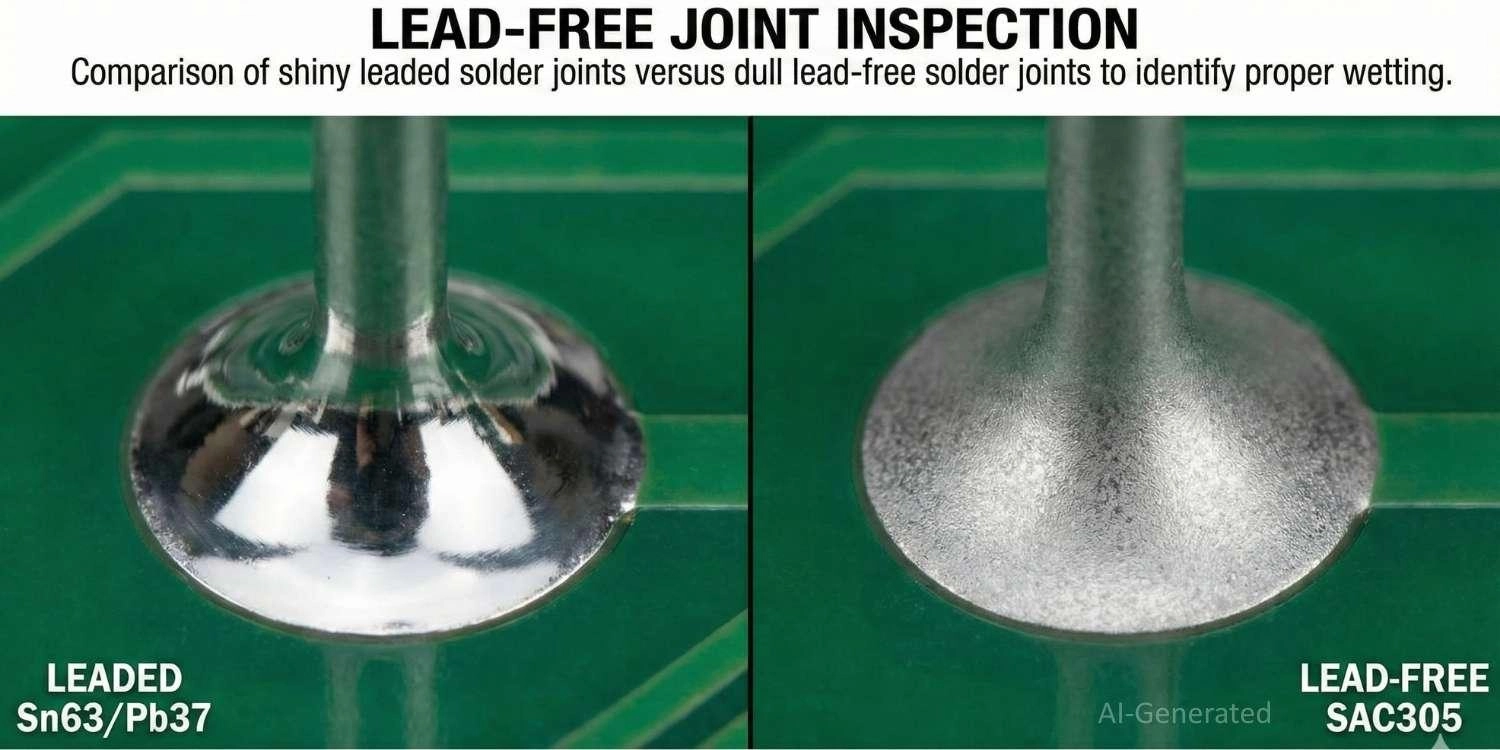
Figure: Comparison of shiny leaded solder joints versus dull lead-free solder joints to identify proper wetting.
Practical Tips for Using Flux in Lead-Free Soldering
● Tip Activator: Keep your iron tip tinned and use tip activator paste frequently, as lead-free solder oxidizes tips aggressively.
● Don't Crank the Heat: It is tempting to raise the iron temperature (>400°C) to make lead-free solder flow faster, but this burns off flux instantly and damages the tip. Keep the iron between 350°C and 370°C and use a larger tip geometry (chisel/hoof) to transfer heat efficiently.
● Fume Management: Lead-free flux requires higher activation temperatures, generating more acrid smoke. Ensure your fume extractor is positioned close to the work area to protect your respiratory health.
Conclusion
Successful lead-free soldering depends far more on flux behavior than many technicians realize. Because SAC alloys operate at higher temperatures and oxidize rapidly, using a flux designed for lead-free conditions—and applying it correctly—is non-negotiable. From selecting thermally stable flux chemistry to working within a short activation window, every step influences wetting quality and long-term joint reliability.
By understanding how flux reacts under lead-free temperatures, applying it generously but precisely, and avoiding excessive dwell or overheating, you can achieve consistent, reliable joints without resorting to extreme temperatures. Mastering flux usage not only improves solder flow—it reduces rework, protects components, and significantly lowers the risk of cold solder joints in modern lead-free assemblies.
Popular Articles
• SMT Assembly Process Explained and Equipment Used: A Step-by-Step Guide to PCBA Manufacturing
• Common PCB Assembly Methods and Soldering Techniques Explained
• SMD Soldering Tools You Need: Complete Guide from Beginner to Pro
• What Is BGA Void? Causes, IPC Limits, and Solutions
• Reflow Soldering: Everything You Need to Know
Keep Learning
SMT Assembly Process Explained and Equipment Used: A Step-by-Step Guide to PCBA Manufacturing
Today's high-performance electronics, from pocket-sized smartphones and IoT sensors to sophisticated industrial control systems, are made possible by a manufacturing miracle: Surface Mount Technology (SMT). SMT is the backbone of electronics manufacturing, allowing us to have the incredible component density and miniaturization. A bare circuit board is simply a substrate. The process of transforming it into a functional electronic circuit is known as Printed Circuit Board Assembly. This article outlin......
Common PCB Assembly Methods and Soldering Techniques Explained
Whether you're designing your first prototype or scaling up to production, understanding PCB assembly methods and soldering techniques is crucial to achieving reliable, high-performance circuit boards. Modern PCBA primarily relies on Surface Mount Technology (SMT) and Through-Hole Technology (THT)—each offering unique advantages for component density, durability, and manufacturability. In this guide, we'll break down the major PCB assembly methods, key soldering techniques such as reflow and wave sold......
What Is Tombstoning? A Practical Guide to Causes, Reflow Risks, Prevention, and Rework
Key Takeaways Definition: Tombstoning occurs when a small two-terminal component lifts off one pad during reflow and stands upright, leaving one end without a proper solder connection. Root Cause: Unequal solder wetting forces act on the two terminals, often due to differences in pad temperature, solder-paste volume, pad geometry, or thermal mass. Highest Risk: Small passive components, such as 0201 and 0402 resistors and capacitors, are especially susceptible because their low mass and small terminat......
Rigid-Flex PCB Assembly: Design, Process, Quality & Cost
Miniaturization, higher functionality, and mechanical adaptability are three main trends in modern electronics. Circuit boards that can tolerate bending, vibration, and compact or small installation spaces are becoming more and more necessary for modern devices like smartphones, medical implants, and aerospace systems. Combining flexibility and stability, rigid-flex PCBs provide both mechanical strength and design freedom, while flexible PCBs allow for bending and folding in confined spaces. This hybr......
SMD Soldering Tools You Need: Complete Guide from Beginner to Pro
Surface Mount Devices (SMDs) are essential components in modern electronic devices, including smartphones, tablets, and IoT systems. Unlike older through-hole methods, where components were inserted through drilled PCB holes, soldering SMD components manually can be challenging, especially for beginners. The extremely small sizes and tight spacing on modern PCBs require high precision, and achieving reliable solder joints often depends on using the best SMD soldering tools. Common issues arising from ......
BGA Reballing Explained: Complete Process, Tools, Risks, and Best Practices
In modern electronics design, the Ball Grid Array (BGA) is the standard for high-performance silicon, enabling thousands of I/O connections in a tiny footprint. However, this density creates a "black box" scenario: connections are hidden, and defects like cold joints or thermal fatigue cracks are invisible to the naked eye. Unlike a QFP that can be fixed with a soldering iron, a failed BGA threatens the viability of the entire board. BGA reballing is the critical solution to this problem. It is the pr......